Showing posts with label Gerda Lundequist. Show all posts

Sunday, 26 January 2025

A thank you… Gösta Berlings saga (1924), BFI with John Sweeney


“ONCE there was a story that wanted to be told and sent out in the world.... As yet it was only a confused jumble of stories – a big, formless cloud of adventures rushing hither and thither like a swarm of stray bees on a summer's day, not knowing where they will find someone who can gather them into a hive.”

Selma Lagerlöf, The Story of a Story 


Gerda Lundequist’s family were there, my family were there and the silent film community turned out in numbers too for the screening of the Swedish Film Institute’s exhaustive restoration of one of the most important films from the golden age of Swedish silent film. It’s a long film and I tried to keep my introduction as broad and brief as possible before we launched ourselves back to the 1820s and Mauritz Stiller’s interpretation of Selma Lagerlöf’s classic novel featuring some of the finest actors of the period all accompanied by John Sweeney’s tirelessly epic improvisations on piano.


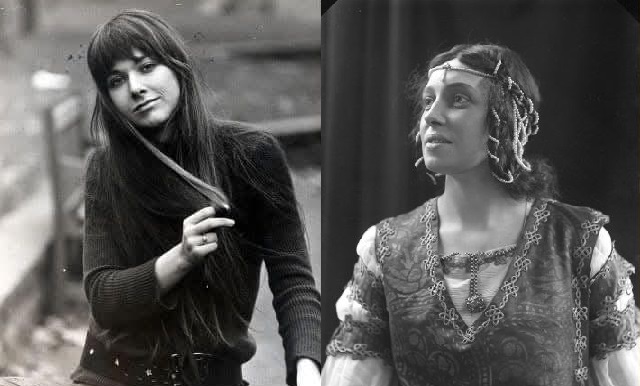
Gerda Lundequist plays Margaretha Samzelius, the matriarch of Ekeby, a grand estate in rural Värmland, and it was a genuine privilege to be joined by her granddaughter, singer and actress Sonja Kristina as her children and their children watched this rare example of their forebear on screen. Sonja knew Gerda as a child, meeting her in Sweden and England and the reconnecting with her grandmother in this sparkling restoration must have been special indeed.  Seeing Sonja’s young grandchildren cheer and wave in their animal masks as their Great, Great Granny was announced was also reminder of the familial joy of belonging.


Gerda Lundequist

For the rest of us there were other connections to be made not least the warmth of being a part of an audience of like-minded people who share the same love of cinema and specifically silent film, gathered again in this secular temple of committed, collaborative – endlessly generous – cineastes. People who programme who preserve and promote this era of film, “classic” but also timelessly true regardless of age or form. The emotions displayed by Gerda Lundequist and her peers are still part of human language and we connect with them in old familiar ways: yes this is true even after so long the family that stays together plays together.


Stiller did not have Victor Sjöström’s way with picking out the deeper humanity and magical reality from Selma Lagerlöf’s works and she was initially dismissive of this film only to have changed her mind by the mid-1930s when she met with Greta Garbo and thanked her and Stiller for the film. Garbo was just 18 when she started filming and still Gustafson before Stiller renamed this hottest of properties “Garbo” and she too was grateful to the man she later deemed her favourite director (sorry Clarence Brown!). He may have told her to lose weight and to stop moving like a farmer’s gatepost but he brought out her star power enough for Louis B Mayer to snap her up as soon as he could after seeing Gösta Berling in Berlin. Stiller came to America with her but he was never able to find the freedom and control he needed.


This was Stiller’s last Swedish film and with his departure was gone one of the fathers of the Golden Age. Soon his lead actor, Lars Hanson, was also to follow to play another cleric, The Reverend Arthur Dimmesdale in The Scarlet Letter (1926) alongside Lillian Gish who had insisted that Louis B Mayer make the film. Gish and LB were impressed with the cut of Hanson’s cassock and whilst The Internet has her requesting him post Gösta, this film came first. His performance is as assured and dynamic as Gerda’s and the scene in which she confronts him over his failings by sharing her own is one of the most moving in the entire film.


Jenny Hasselqvist posing for Henry Goodwin (1921)


You have to admire Stiller’s choices for the film, the stakes were high in terms of the pressure to succeed and off the largest budget assigned to that point by AB Svensk Filmindustri, and, whilst he took a big chance on his youngest lead, he was able to persuade not only the country’s leading stage actress and film actor but also its leading prima ballerina. Jenny Hasselqvist had worked with the director before on the little seen but very worthwhile Johan (1921), Guarded Lips (1921) as well as her first film, The Prima Ballerina (1916) just after she had started in that role at the Royal Swedish Ballet. As Marianne Sinclaire she represents a more forceful and knowing partner for our de-0frocked priest after the two are caught kissing during a play. Her control and physicality is brought to good use by Stiller as she is left in the cold, literally, by her cruel father and later gets caught in the burning inferno of Ekeby.


Garbo’s Elizabeth Dohna has deep eyes and longing looks and needed a good deal of coaching, lighting and editing from Stiller to hold her place among these consummate professionals.


All this we could see on the restoration and I am convinced that this screening led many to re-evaluate the film. The previous restoration is black and white, not so well paced and looks murky in parts whilst here the SFI have been able to sharpen the story as well as the image. The re-editing of some parts and introduction of tints and new sequences gives a richer story, as close as possible to the one first seen a century ago over two parts in March 1924.


I’d previously seen the restored film in Il Cinema Ritrovato 2023 in Bologna with a small ensemble accompanying but John Sweeney was a one-man orchestra, exploring his way expertly across the new running time and evoking the deeper humanity and grandeur of the film, connecting with the deeper meanings smuggled in from the original book which in many ways is so different from the film. It’s 400 pages long in the recent translation from Paul Norlen and whilst Sjöström would have turned that into three or four films, Stiller’s edit is remarkable for capturing the essence of these characters even if some of them changed…


Selma Lagerlöf calls the tune

At the end of the screening, I was thanked by complete strangers in the aisles as well as those I know but in truth I am the one who is grateful for the SFI, especially Jörgen Viman, Film Archivist, for restoring the film, the BFI for screening it, Bryony Dixon in particular and who kindly invited me to introduce it. I also must thank John Sweeney for playing so wonderfully and Sonja Kristina and her amazing family old and new, and all of you who attended and communed in the dark with these century-old ghosts. Thank you for reading too!


Thank you too to Selma Lagerlöf, who at the end of her Gösta Berlings saga leaves us with the cryptic clue to life:


Dear Reader… Here the giant bees of imagination have swarmed around us during years and days, but to get into the beehive of reality, they will truly have to keep their eyes open.


* The Saga of Gösta Berling (Penguin Classics), by Selma Lagerlöf, translated by Paul Norlen (2009) is available from all good bookshops and Amazon.


Cover of my 1924 Danish programme 


Thursday, 16 January 2025

Gerda Lundequist and Sonja Kristina – the Gösta Berling connection

Sonja and Gerda - generational talents


It’s strange the connections you make in your life as well as in silent film which, after all is history itself and not just a representation of past events. Without knowing it at the time, I spent a number of pleasant afternoons in the company of Cecil Hepworth’s daughter Elizabeth Barbara – the young star of Rescued by Rover (1901) and her sister Margaret as my friends were renting their basement in the 1990s.


It was also a surprise a few years ago, to see Sonja Kristina, the pioneering singer, actress and leading lady of progressive rock, folk and beyond, posting on Facebook some year’s back about her Swedish grandmother Gerda Lundequist, a Swedish stage legend and the star of Gösta Berling's Saga which, as I think I mentioned is screening this Sunday 19th at the BFI! Knowing the connection, I asked Sonja for a few memories about her grandmother and it seems the “performance gene” runs strongly in their family!


Born in 1871, Gerda was the daughter of a hairdresser but was fostered by her mother’s sister a manufacturer’s widow. She had theatrical ambitions from an early age and she was enrolled in theatre school in Stockholm at just 15. At this stage in her own career, Sonja had already started singing in folk clubs and, also in her teens, enrolled at the New College of Speech and Drama before staring in the theatrical version of Hair along with the likes of Paul Nicholas, Elaine Page and the late Diane Langton.


Gerda Lundequist in costume in 1906


Gerda’s professional debut was at Svenska teatern in Stockholm 1889, and her breakthrough soon came her portrayal of Kristina in August Strindberg’s Mäster Olof at the old Royal Dramatic Theatre in Stockholm. She was soon starring in almost every conceivable major role in plays from Ibsen, Schiller, Moliere, Shakespeare and others establishing herself as Sweden’s finest actress and it must have been a huge coup for Mauritz Stiller to get her for the role of as Margaretha Samzelius, the matron at Ekeby in Gösta Berling.


Gerda’s daughter Cecelia married an English criminologist called Shaw and moved to the UK. Sonja remembers meeting her on a number of occasions:

I was 10 years old when Gerda died in 1959… she had come to stay with us in England when I was 6 and we visited with her in Stockholm and at her summer home.


Gerda’s professional reputation was one of strict principles and, not enjoying interviews, she soon refused all offers and was a very private person, protecting herself and her family from intrusion. Yet she was also described as a very warm and humorous person by those who did know her and this is confirmed by Sonja’s recollections:

I remember her sitting at my mother’s dressing table brushing her beautiful long auburn tinted hair before braiding it and putting it up. Her perfume was lovely and I will always remember the aroma of her favourite digestive biscuits with honey that she enjoyed as a night-time snack.


Sonja Kristina


Gerda was an ardent supporter of female emancipation in Sonja’s words and she was able to support talent through her work as artistic director at Helsingborg City Theatre and then later as a teacher at drama schools. She contributed to the independent women’s education centre Kvinnliga medborgarskolan vid Fogelstad, for which she was also a member of the board of trustees.


Sonja describes the school as a feminist and that her mother, recovering from TB, shared several stimulating and entertaining months with Gerda and her students at Foglestad.


She also relates the tutoring and encouragement she had from Gerda and her hugely experienced eye for talent: She liked to listen to me sing and encouraged me with gentle instruction on breathing technique and interpretation.


She remained such an important figure in Sweden hosting celebrity soirees at her apartment and performing on radio and television right up until the late fifties. Sonja’s mother was frequently asked for autographs by school friends and no doubt, had she grown up in Stockholm, the same would have been true then.


Gerda with Greta Garbo in Gösta.

But to Sonja and her family, the private side of her grandmother was no less precious and, especially the playful bond they developed.

Gerda was so mischievous, making grand entrances at public gatherings. Stopping traffic in the street to talk to horses - and policemen.


She was perfectly cast in Gösta Berling's Saga and, also, it seems as a mother and grandmother.


I am delighted that Sonja and her own grandchildren will be attending the screening on Sunday 19th and I hope you will too and witness one of the finest actors of the last 150 years pouring decades of experience into one of her precious few cinematic appearances!


You can book your place here!


The cast of Hair in 1968, Sonja spent over two years in the show, here on the lower right!


Tuesday, 14 January 2025

Ten reasons not to miss Gösta Berlings saga (1924) UK restoration premier!


This Sunday, 19th January at 2.30pm the BFI will be screening the UK premier of the restored Gösta Berling's saga and, as there are still a few tickets remaining and I want you to get the best possible vantage point!


This will be an event to rival the finest gala screenings of many a film festival with the film as close to its original length and condition as it has been in a century! If you are in any doubt, here’s ten good reasons not to miss this unique event!


1. It's the culmination of the Golden Period of Swedish film?


This film is one of the last of the major films from the golden period of Swedish Silent film and features some of the major talents. This is not just from within film but also without: bringing together the very best of contemporary theatrical and cinematic talent along with literature and ballet.


Selma in the office


2. Selma Lagerlöf was a phenomenon


The film is based on the book from Selma Lagerlöf for which she had won the Nobel Prize for literature in 1909, the first woman to do so. Lagerlöf’s works were also the source material for a number of films across this period in much the same way as Dickens for the British.


The Lass from the Stormy Croft (1917) Directed by Victor Sjoström

Sir Arne’s Treasure (1919) Directed by Mauritz Stiller

The Sons of Ingmar (1919)/ Karin, Daughter of Ingmar (1920) Directed by Victor Sjoström

The Phantom Carriage (1922) Directed by Victor Sjoström

Ingmar’s Inheritance (1925)/ To the Orient (1926) Directed by Gustaf Molander


Lagerlöf led a fascinating life a distinctive voice who made her own choices even if that led her to buying back the family farm and manor house Mårbacka, managing it to profitability with a range of healthy oatmeal “Mårbacka Oats-Power”. Any resemblance to the estate of Ekeby is intentional.


An example of the dynamic new tints

3. Mauritz Stiller was no slouch…


For Gösta Berling, Stiller made merry with the sequence of the story, cutting away all but the main half dozen characters and dispensing with the author’s magical realism and forensic humanity. How could such a book be filmed though, 400 pages long and written in Lagerlöf’s intensely lyrical style. Luckily Stiller’s instincts were correct in terms of his film and he was blessed with key performers who, familiar with the book could bring some of these elements back.


Selma was not impressed, calling the result “cheap and sensational”, but there’s no reason we can’t be just as the audiences of the time were with the film enjoying success across Europe and even America. Stiller got offers to make films in Germany and then Hollywood and within a year set sail with one of his young co-stars for the USA.


Greta Gustafsson before Stiller suggested Garbo...

4. Yes, Greta Garbo started right here!


She was only 19 and rather outgunned by those around her but Greta Gustafsson does very well in her first major film. Legend has it that a certain Louis B Mayer saw her in this film and after Pabst’s Joyless Street, she was on her way to becoming a legend.


In 1935 Garbo tried to visit Selma in Mårbacka but the writer was ill, they did meet the following year in Stockholm where Lagerlöf’s stage adaptation of her great novel was playing. Oh, to be a fly on the wall, next to a fly that could translate Swedish, for their discussions.


 Gerda Lundequist

5. Gerda Lundequist… the great tragedian in her only silent film!


Gerda Lundequist was “the Swedish Sarah Bernhardt” and an enormously powerful performer who enjoyed a career lasting well over half a century starting aged 18 in 1889 and carrying on to the late 1940s. She played pretty much every major role in Scandinavian as well as European classic theatre but sadly only made a handful of screen appearances with Gösta Berling her debut aged 53!


She is quite incredible in the film and clearly knows how to act on film without blowing the camera away as, naming no names, some theatre specialists had been known to do. This is her only silent film and so this is the equivalent of seeing Anna Pavlova dance in Lois Weber’s The Dumb Girl of Portici (1916) and a performance to match Bea Lillie’s in Exit Smiling (1928), her only silent feature.


On Sunday, Gerda Lundequist’s granddaughter and family shall join us to celebrate this screening and that makes me particularly happy!


Jenny at the day job

6. Jenny Hasselqvist: the Acting and Dancing Queen!


Dancing?? Happiness?!? Yes, this film features one of the most talented people to have ever reflected the glare from a Klieg Lights onto celluloid or to have bounced with perfect precision on point from the stage of the Royal Swedish Ballet and elsewhere!


Jenny Matilda Elisabet Hasselqvist was one of the finest prima ballerinas of her age and, whilst she made 20-odd films in Sweden and Germany, she remained a dancer first and foremost. In an alternate universe Mauritz Stiller could have been her Boris Lermontov, coaxing her to star in his 1916 film Balettprimadonnan when she had just begun as the Royal Swedish Ballet’s prima ballerina. But this “Vicky Page” returned to the stage and didn’t make another film until Lubitsch’s Sumurun (1920) and whilst she worked with Stiller again on Johan (1921), The Exiles (1921 and mostly lost) as well as this film, she maintained her dancing career reverting completely after her final, talking, picture Den farliga liken (1931).


She is fabulous in Gösta Berling and brings a more physical aspect to expression than even Gerda Lundequist, her emotional extremes always expressed viscerally by her body in ways that only the most controlled of beings can muster – ways that silent film magnifies in the absence of other signals.


Lars and the lads.

7. Lars Hanson is here!


Now then, it’s possible that Mr Hanson is too charming to play Gösta Berling, but there’s a mean streak to Lars that we rarely see and his ability to mask self-pity with leading qualities is unrivalled. He also breaks hearts as the defrocked and perpetually failing priest who can’t help breaking heart including his own.


Hanson was the pre-eminent film star of the Swedish Golden Period and he went on – with Lillian Gish’s insistence - to repeat the trick in Hollywood in The Wind and The Scarlet Letter (1926) and, of course twice with Garbo in The Divine Woman (1928) and Flesh and the Devil (1926). My favourite of his American films is Captain Salvation (1926) with Marceline Day. His star power is undimmed to this day!


8.  The Restoration will be colourised!


The Swedish Film Institute have been working on restoring the film for many years and they upgraded the previous black and white restoration using tinted nitrate materials in French, German and Portuguese archives to create a digitized template for re-tinting the film.


In our lifetimes the film has not looked this good and the vision of Stiller and his legendary lensman Julius Jaenzon is as close to perfect as possible.


Lars and Jenny

9. New footage… even more wolves!


The restoration team was able to add new footage throughout the film and key sequences in which first the Major’s wife, and then Marianne are disgraced at Ekeby parties are given more impact. The thrilling section on the ice with Gösta and Elizabeth try to flee from a wolf pack has been re-edited and you will be on the edge of your seat!


10.a John Sweeney is accompanying!!


Having seen and heard John accompany the three-hour Michel Strogoff (1926) in one sitting late one British Silent Film Festival, I can think of no one better to accompany such an epic! he blends dynamic imprivistations so well with lines that switch so seemlessly with emotional tione I'm really looking forward to hearing him play.


10.b. There will be an interval during which refreshments can be purchased for both the audience and the pianist!


You may have seen the film before, but never like this! We are going to party like it’s 1924!!


And, remember, as Gösta Berling knows all too well, it's better to regret something you have done than something you missed! 


Get your tickets here!


Sunday, 5 January 2025

Preview. The remaking of Gösta Berlings saga (1924). BFI screening on 19th January!


The BFI are screening Gösta Berling's saga on 19th January and if you haven’t already booked I suggest you click on this link right away to make sure of the best seats for what will be a spectacular Sunday with the best musical accompaniment!


The Swedish Film Institute have been working on restoring one of the major works of their golden silent era for years and first presented a restored version a few years back at the San Francisco Silent Film Festival but, this wasn’t enough and they were motivated to further enhance what had been done by the desire to present something as close as possible to Mauritz Stiller’s original vision and… here we are!


I’ve been speaking to the person responsible for the project, the SFI’s Jörgen Viman, Film Archivist and man on a mission. He says that the initial motivation to make a new print was that the existing ones were only in black and white. They discovered that there were tinted nitrate materials in French, German and Portuguese archives and borrowed from all three to create a digitized template for re-tinting the film.


I found images that we were missing completely, and these are euphoric moments. I also discovered images that were similar, but still not exactly the same. The camera angle was slightly different.


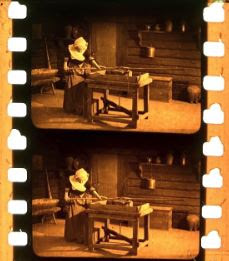
An example of one of the tinted source nitrates, many sprockets were fixed...


Source materials


Examining the images in detail he discovered that that there were differences in content and approach, these being all further highlighted by a black and white print from Moscow. The project was now not just about restoring the tints but also missing parts of the narrative and I can well understand the satisfactions of an archivist on this trail especially when he discovered after painstaking work sifting through the SFI’s filming reports, text lists, text signs and other documentation, that there were originally two slightly differing negatives.


Running to the same length these featured different angles with Stiller and his legendary lensman Julius Jaenzon using two cameras as was standard practice for at least parts of the filming. Trying to make sense of Stiller’s intended narrative was always going to be difficult as films often varied from the script which still survives in this instance. Luckily Swedish censorship was diligent and so there was a record of all of the intertitles – praise be to those who have the viewers’ delicate sensibilities at heart.


None of these records showed how the images were edited around the text and so a long and laborious process was begun reviewing the materials side-by-side to identify the best quality takes from scenes of varying length and angles from those two cameras.


One of only six surviving images of Ava Lundin's original intertitles


405 Intertitles…


In terms of the intertitles only three of Ava Lundin’s lovely painted inserts survive but Jörgen found three more reproduced in a magazine from 1924 that helped the team create a font that was a close as possible to the originals. Anyone who has worked with typography knows what a challenge this is but luckily all but the letter z were present in lower case on the six intertitles although the capitals were more elusive especially as they varied by context in the sentences.


Jörgen then used Photo Shop to recreate everyone of the 405 intertitles, originally painted by hand now by digital programming with no less attention to detail and layout. I remember a world of graphic design before digital artwork and it is such an underappreciated art with text placement needing to balance, avoid line breaks and to be readable as easily as possible. Jörgen centred the text and also aligned left and right creating a consistent read area throughout the film. I noticed in Bologna that some of the English text had changed as well, perhaps moving them closer to the original Swedish?


The reconstructed intertitle, only 404 to go...

Tinting and colour ways


Obviously it was not possible to recreate Alva Lundin’s painted images on the title cards but the magazine article revealed that they were all toned in dark brown which no other document mentioned. This may not always look the case though as the eye gets used to the colour that is in the image before the text. As Jörgen says: If the image is blue, the eye perceives the text as more strongly toned than if the image before is yellow, for example.


Now for the colour of the images the restoration team mostly used the Portuguese nitrate print, but there were variations with that print showing all the night images in light green, while the same sequence were tinted blue in the French material. Swedish convention was – as with Hollywood films – to use blue for night and this they did with exception of one scene only found in the Portuguese copy – which they left in dark green. You’ll see it when Gösta finds the little bird on the road.


Re-creation is an interpretation that is based on facts, but also experience and collaboration.


New footage…


This is what gets most of us excited about any restoration and watching the restoration in Bologna last June there were many occasions when I wanted to stop the film and compare with my old Kino DVD but this would have been rude of course!


There are a number of images from slightly different places throughout the film and it felt like the key sequences in which first the Major’s wife, Margaretha Samzelius (the Swedish theatre legend Gerda Lundequist) and then Marianne (my favourite prima ballerina/actress Jenny Hasseqlvist) are disgraced at Ekeby parties, were separated, giving both more impact for me.


There are new images in the latter scene where Gösta (Lars Hanson) and Marianne dance – I always love seeing Jenny dance! – which fills out the depth of feeling between the two as their attraction is revealed on stage leading to Marianne’s father refuses to have anything more to do with her.


Jörgen says that the section that perhaps took the longest to put together was the sequence that took place on the ice with many options from the footage and different camera angles. He says that the sequence where one of the wolves is attacked by his own pack was filmed from two completely different directions, leaving him with the task of re-editing one of the most exciting and important sections of the film.


Thank you for your time and for your diligence Jörgen, what I saw at Il Cinema Ritrovato you have done a splendid job and I can’t wait to see it all over again on Sunday 19th January at the BFI and to introduce the results of your work as succinctly as possible!


Book your tickets now at the BFI website!


Sunday, 7 July 2024

Day by Day in Bologna… Il Cinema Ritrovato XXXVIII

Catherine Deneuve is the cover girl from The Umbrellas of Cherbourg


OK, after catching up on work and sleep, what was my pick from eight days of relentless cinema, meeting some of the finest cinephiles in the world and an unquantifiable amount of coffee, brioche, ragu and, dear reader I must be honest, Aperol Spritz. In no particular order, these are my personal highlights, from a festival you start off with the best of intentions, 6-7 sessions a day for eight days, what could go wrong? Answer: nothing, the Ritrovato experience you get is the one that you deserve and the one that suits you best!


 10.   Kohlhiesel’s Töchter/Kohlhiesel’s Daughters (1920), with John Sweeney, Il Cinema Modernissimo


The funniest thing of the week and a major Lubitsch I had yet to see featuring Emil Jannings acting his age and being charming as part of a couple of chaps trying to woo sisters played by Henny Porter who proves what a superb talent she was, not only with her highly persuasive physicality but also timing. She plays the kind-natured Gretel who wants to marry but, following her father’s instructions, can’t until her elder sister, Liesel (also Henny), weds first. The problem is that Liesel is as bitter as her sibling is sweet and more of a match for either Jannings’ Peter or Gustav von Wangenheim’s Paul by any measure.


It's fast-paced and utterly charming and very much cut from the same cloth as the Ossi Oswalda comedies and those with Pola Negri which the director made before and after. Shot against an alpine background by Theodor Sparkuhl, it was the feel-good hit of the week which I thought I’d missed only to find it re-played on the last day.


John Sweeney’s playing was on another level, i.e., the same at the film’s, and his emphatic flourishes continued to fill the gorgeously restored Modernissimo right till the end of the credits. I trust it won’t be long before we see Lubitsch’s 34th film (including shorts) screening in London with John playing as a pre-requisite!


Emil Jannings und Henny Porten


9. It’s a family affair… Judex (1915-16), accompanied by many hands, Cinema Mastroianni


On the final Saturday as all the mystery and loose ends were tied up I emerged triumphant from the Mastroianni having watched the whole series and thoroughly enjoyed Louis Feuillade’s sense of drama, his eye for dynamic framing, his direction and team building and his ability to keep the narrative ball rolling even when you think he’s backed himself into a dramatic dead end. That’s 12 episodes and one big Prologue with not a second missed for lack of sleep, breakfast or headache… probably!


It's not quite up there with Les Vampires but it does have the essentiality of Musidora playing Diana Monti aka Marie Verdier, a scheming opportunist who becomes more and more dominant the longer the story unwinds. Judex himself as played by René Cresté, is a goodie version of Fantômas, part Sherlock Holmes, maybe part Eugène-François Vidocq – an actual French criminal turned criminalist - certainly an outlier for The Shadow, Doc Savage and even The Batman. Feuillade had been criticised for glorifying his evil masterminds and so here was one of good intent even if he does kidnap and fake the death of the businessman responsible for his father’s death and many others, Favraux (Louis Leubas) before imprisoning him for life in a remote castle.


Judex has worked a long game, disguised as Favraux’s secretary, to infiltrate his business dealings. His plan is soon complicated when he falls in love with the banker’s daughter, Jacqueline (Yvette Andréyor) who is soon targeted by the evil Monti! There’s great support from Vampires’ alumni Édouard Mathé as brother Roger and Marcel Lévesque as the comedic Cocantin whose swimming-costume clad fiancée Miss Daisy Torp (Lily Deligny) helps save the day. The kids are alright too and Le petit Jean (Olinda Mano) and The Liquorice Kid (Rene Poyen) deserved their own series!


Musidora, aka Jeanne Roques


8. Quo Vadis? (1924) with Neil Brand, Eduardo Raon and Frank Bockius, Cinema Mastroianni


This was an attempt to repeat the pre-war success of the Italian epic’s including Enrico Guazzoni’s massive 1912 adaptation of Henryk Sienkiewicz’s 1895 novel, Quo Vadis: A Narrative of the Time of Nero. It was an Italian German co-production followed on with a cast of thousands, gigantic sets (real and constructed) and the combined star power of Lillian Hall-Davis’ nuanced emoting and Emil Jannings’ protean excess. Larger than life and twice as tiring, his Nero offers Lillian’s frail Licia the world and we cower behind her in the darkness as her faith rises up as the only defence against the monstrous ego of the man who is Empire.


It's saucy in a Cecil B DeMille way with snatches of nudity and a-typical sexuality along with elaborate displays of Roman cruelty which peaks in the Colosseum and in a genuinely gripping chariot race that hasn’t been seen in the length or detail for many years until this superb restoration. It’s a thoroughly enjoyable effort that was surprisingly not a success at the time, perhaps too opulent for German audiences and too close to the bone for the newly fascist Italians… I’d love to know more about how it was received in those early days of Il Duce…


Neil  Brand accompanied across the two parts on piano assisted by Eduardo Raon on harp for part one and Frank Bockius on drums for the epic finale on drums… the players were perfectly aligned with the momentum of the film with Rome’s dangerous beauty giving way to death and destruction and ultimate martial revenge by the end of a story that had already been told many times.


Emil harasses our Lil'!


7. He Who Gets Slapped (1924), with Laura Agnusdei, Simone Cavina, Stefano Pilia and Antonio Raia, Il Cinema Modernissimo


Of films I had already seen multiple times, this, The Wind, The Last Laugh et al, I was most interested in seeing this one having missed it recently at the Kennington Bioscope. In the plush Modernissimo it was accompanied by an ensemble featuring Laura Agnusdei (tenor sax and electronica), Simone Cavina (percussion and electronica), Stefano Pilia (guitar and electronica), Antonio Raia (sax, chalumeau/clarinet and “oggetti” … objects?), whose modern stylings overlayed and enhanced the action on screen in new ways.


That said, this is one of the hardest-hitting Hollywood films of the twenties as you’d expect from the mighty Victor Sjöström, certainly the most successful Swedish director in the US who was able to maintain his approach across this and work with Garbo and Gish. Here he brings out the full flavour of Lon Chaney in a film that breaks your heart which as Ehsan Khoshbakht describes in the catalogue as about the act of “de-clowning… only the vile and ignorant laugh at the clown”. As my friend, the poet Ged Griffith, used to say after a few Jamesons, “Life’s a walking shadow, nah-nah, na-nah-nah…”


Lon Chaney: if you don't have a fear of clowns, perhaps you should re-consider?


6. The Searchers (1956), Piazza Maggiore


I only managed two screenings at the big Piazza this year as a result of rain and other distractions but Coppola’s Conversation was not as engaging on the grand screen as John Ford’s masterwork. Rarely has John Wayne been this monumentally frightening, dark eyes staring out across the vastness of the west in search of revenge and the restoration of his culture. There’s some jokey sequences but nothing really dents the full force of this film which continues to evolve in its meaning as the West in general seeks answers to the same issues of invasion, cohabitation and peaceful evolution. This is a film made at a time closer to the tail-end of the Wild West in the 1880s than to now, struggles still just about in living memory for a United States still ill at ease with its diversity.


Screened from 70mm on the biggest screen the film was introduced by Wim Wenders who has made the pilgrimage to Monument Valley, Arizona and wondered at the audacity of filming entirely at this location. It was something to view in a fresh light, immersive and impactful making us feel the filmmakers’ anew with even the plastic seats not distracting from the two hours on mental horseback.


The big country

 5. Chemi bebia/My Grandmother (1929), with Cleaning Women, Il Cinema Modernissimo


Due to unseasonal rain, this screening of Chemi bebia (My Grandmother) was moved from the Piazza Maggiore to the Cinema Modernissimo which only served to amplify the intensity of Kote Mikaberidze‘s film and the extraordinary accompaniment of Finland’s Cleaning Women. Now then modern scores for silent films can be controversial but this film is so out of time with its Dadaist energy that an avant-alt-post-rock-post-jazz-experimental-industrial set played by a group consisting of three cleaning robots (CW01, CW03 and CW04) ended up being perfect.


Chemi bebia defies easy summation and that’s from one of the only two people in the stalls who had seen it before but, essentially, it’s a film highlighting the damaging impact of bureaucracy on the revolutionary project with so many self-serving idiots only responding to the appearance of the Universal Worker (or similar). It’s one of the oddest and funniest propaganda films ever made and even more so with the “cleaners” quirky propulsion. Mop and Bowl on home-made instruments!


4. Scuola D'Eroi (1914) Daniele Furlati and Silvia Mandolini, Cinema Mastroianni


Meanwhile, back in the Golden Age of Italian Cinema, we watched an early film from one of the three great Dive, without which no CR is complete for some. This was not yet the imperious Pina Menichelli of her most successful period but she draws the eye in one of her first major roles dominates the screen whenever her character, Rina Larive is in shot even alongside Amleto Novelli and certainly the more established Gianna Terribili Gonzales.


Directed by Enrico Guazzoni – who made the 1912 Quo Vadis as well as other classical classics … Scuola d’eroi is an Napoleonic epic and I mean epic, straggling decades, family lost and found and with the fortunes of war and love all tangled together. Pina plays Rina, sister of Carlo, Amleto, who during a Napoleonic campaign, having been separated from their father as children and raised by a kindly farmer, get caught up years later in another with the emperor playing his part in recognising the courage of the family and saving them from the machinations of bad-faith nobility.


Daniele Furlati provided suitably spirited accompaniment on piano with Silvia Mandolini on violin, flavouring and enhancing during battles scenes and the moments of highest tension. Italian silent film of this era carried its heart on its sleeve and this was a very affecting screening of a fresh restoration from a nitrate positive held by the Cineteca Milano. It is the only tinted copy currently in existence and close to the original running time.


Pina Menichelli


3. 1904: Un Anno Magnifico, Stephen Horne and Frank Bockius, Piazetta Pier Paolo Pasolini


There are moments in every festival when you settle down and suddenly feel at the heart of the event, watching the perfect film and listening to just the right accompaniment and this happened on this rain-delayed outdoor event on the Thursday with a selection of shorts from 1904, A Magnificent Year indeed! I decided on the Pasolini’s carbon arc projector rather than watching the restoration of The Wind in the Piazza Maggiore – with orchestra! – and was rewarded with such rare delights!


We started with the breakneck gymnastics of Les Cambrioleurs modernes – often wrongly attributed as from a later year – which featured a stunningly synchronised troupe playing cops and robbers by throwing themselves in and out of a set full of trap doors. Clearly a stage act rehearsed tot the finest degree this was still a marvel to observe in real-time with no trickery. There was plenty of time for that with Georges Méliès' Détresse et Charité - The Christmas Angel and Match de prestidigitation but most of these films just used the new media to show actuality, whether it was the British Fleet being inspected at Spithead or A Miner’s Daily Life from RW Paul.


There was plenty of magic though with Gaston Velle’s silhouetted Burglars at Work showing what the camera can do as well as his deliciously hand coloured Métamorphoses du papillon with unknown dancer changing in front of our very eyes. And then, then we had a song as Frank Bockius performed the missing vocals from Henry Bender in a hand-coloured take of over-fed babies he would have performed at Berlin’s Metropol-Theatre. It was a job well done as indeed was the entire accompaniment from both payers with the memory of Stephen’s flute reverberating high into the clear skies as likely to linger as his partner’s percussion and vocalisation!


2. Re-building Jerusalem… Ingmarsarvet (1925), Andre Desponds and Frank Bockius / Till Österland (1926), Neil Brand, Cinema Mastroianni


This list isn’t really in order but the top two are such has been my pre-occupation with Selma Lagerlof and the tsars of these three films, notably the extraordinary ballerina Jenny Hasselqvist. I’ve gone on at length elsewhere but it was such a joy to see Gustaf Molander’s two films based on the author’s Jerusalem and I am so grateful to the Swedish Film Institute for the work they have done in restoring and reconstructing them.


More raving here...


1. Ekeby at last! Gösta Berling’s Saga (1924), Matti Bye, Eduardo Raon and Silvia Mandolini, Cinema Mastroianni

Having waited years to see this film on the big screen, I was also more than eager to see the results of the last five years’ worth of restoration and was in no way disappointed by the clarity and the majesty of this re-ordered and extended version of Mauritz Stiller’s work; perhaps not his best but my favourite anyway. Jenny, Greta Garbo, Lars and, especially Gerda Lundequist all shine as never before and the restoration and broader appreciation of filmmakers and the author Selma Lagerlöf will rightfully benefit.


More detailed appreciation here...


I saw much more though easily missing my 50-film target and apart from the silents enjoyed talkies as diverse as Morocco (1930), En Natt (1931) – Gerda again! - The Lavender Hill Mob (1951), Coeur de Lilas (1932) and Tirez sur le pianiste (1960). There was also a beautiful film of Anna Pavlova (USA-GB/1924-1954) which brought me close to tears with John Sweeney’s accompaniment.


As with life it’s best to celebrate what you saw rather than mourn what you missed and so, with hope in my heart, I look forward to revisiting many of the above and catching up, if the programmers so will it, with the rest.

Grazie mille Bologna and Il Cineteca Ritrovato! Ci vediamo nel 2025!


My copy of a 1924 Danish Gosta booklet


Tuesday, 25 June 2024

Ekeby at last! Gösta Berling’s Saga (1924), with Matti Bye, Eduardo Raon and Silvia Mandolini, Il Cinema Ritrovato XXXVII


"Finally, the vicar was in the pulpit..."


Sometimes at these festivals your day is done after you’ve just seen something that resonates with such force you don’t want to spoil the mood or otherwise break the spell that was so brilliantly cast by the film and musical accompaniment. So it was that I retired to just stay as long as possible in the moment of having just seen and been seen, by Mauritz Stiller’s magnificent adaptation of Selma Lagerlöf’s epic novel. Now, I’m not saying the film is perfect in fact there’s a reason he was no higher than her second or third favourite film director of the Nobel Prize winning author, but like Heaven’s Gate, Greed and several works by Monsieur Gance – one of which was frustratingly counter-programmed against this one… - the ambition wins you over along with incredible performances.


Lagerlöf’s name is on the film after, against her better judgement, she signed off on Stiller and Ragnar Hyltén-Cavallius original script which changed during production; she called the result “cheap and sensational”. The film takes considerable liberties in its mash-up of the novel’s narrative with some events happening at different parts of the arc and to different characters and, indeed buildings… Characters are changed with Gösta himself much more charming – how can he fail, he’s played by Lars Handsome? - whilst Countess Elisabeth is not quite the strong character she becomes as she leads the fallen priest towards a better, humbler life. She’s played by Greta Garbo of course in her first film, yet to master her craft and here just 19 and about to learn very quickly in Hollywood.


Needless to say, the Majoress and Marianne are women of agency in both, with the latter pushing Gösta away, refusing his offer to stay with the woman who has lost her beauty after smallpox although Jenny Hasselqvist still looks wonderful to my eyes. More than ever though this screening showed the Swedish Sarah Bernhardt, the great Gerda Lundequist, in full force as Margaretha Samzelius, the Major’s wife and mistress of the estate of Ekeby in Varmland. She has the most expressive face and know exactly how to play for the camera with delicate hand movements and shifts in expression that bely the fact she only made four films. One of these, One Night/En Natt (1931) was shown as part of the Gustaf Molander strand and she is fabulous too in a smaller role; along with Bea Lilley in Exit Smiling, her display in Gösta is one of the greatest of those who only made a single silent film.


Gerda Lundequist


Selma’s women are so strong – as you’d expect from her own life story – and this is one of the most fascinating aspects of this epic, so many female characters are creating their own direction, making their own mistakes and standing up for what they believe in… which raises the question, was Selma Lagerlöf “woke”? She was certainly a force to be reckoned with and a pioneer with a big prize to prove it!!


The magic realism of the novel is dropped almost completely in favour of the pure drama and the poetic world created by Lagerlöf is given less room for melding myths and legends with the characters such as Sintram, the cavaliers… dozens of finely wrought episodes punctuate the main story with meanings only emerging from within the text as you search for the link. Lagerlöf was so adept at subtext but also so disciplined in building the “spirit” of the book; the place and the people of Varmland are vibrantly interconnected in ways that are frankly still inspiring. *


Now then, back to the digital wonders on screen, this latest version from the Swedish Film Institute is not just a restoration of Gösta but a remix and extended cut being not only some 20 minutes longer than the 1975 restoration which most of us have only seen up till now via the Kino release, but also in a different narrative order with the party sequences and their two exiles are re-sequenced and there are variations elsewhere, with a more dynamic mix for the burning of Ekeby and Gösta’s rescue of Marianne, a longer intro and new intertitles that carry more of the original author’s poetic wonder.


Lars/Gösta and Jenny/Marianne (after the ravages of smallpox)


Never has the camera work of the great Julius Jaenzon looked so fine from the gorgeous sweeps of the lakes and forests to the shots on set and the performer’s expressions. It’s the quality this film deserves and to be able to focus on individuals’ emoting is a delight with Jenny Hasselqvist and Lars Hanson being, in their own ways, two of the most talented of all silent actors, the former all force and subtlety and the latter bringing her world-class balletic movement and grace to the fore along with a remarkable ability to radiate changing emotions through very controlled raising of the angle of her face, a flash of the eyes or hands raised in grief.


As with the original release, the film was split into two parts with Matti Bye’s specially written score forming the basis for extemporisation with Eduardo Raon on harp for the first part and Silvia Mandolini, on violin, for the second. Eduardo has been a feature of this edition of Il Cinema Ritrovato and his use of effects peddles brings a whole range of tonality and atmospherics which served the statelier pace of the first half. Silvia’s violin could have been played by the demonic Sintram himself for the fiery climax and the iconic chase across the ice as wolves pursue Gösta and Elisabeth was breathless before the piano and strings played out an inspiration and elegiac conclusion.


For a film I’ve waited a decade or more to see online and a restoration I first heard mentioned in 2018 in Pordenone… there was a lot at stake; I set bad personal expectation when I had a Lars and Gerda t-shirt made for the occasion. The SFI delivered though as did Stiller, the film and all his cast with the aid of these three musicians. Selma might not have completely approved but this film is part of her living legacy and I hope it, along with other famous works from Stiller and Sjostrom especially, along with the two Molander films screening later in the festival, will see interest in her work increase.


As the authorial voice at the end of the book ponders… “the giant bees of Fancy have thronged about us… but how they are to enter the beehives of Reality is surely their own affair.”


Make of that what you will dear reader.


Hang on lads, I've got an idea...


*Translating in words and film

I am basing this on a reading of the most recent translation, the first in a century, from Paul Norlen – previously awarded the American-Scandinavian Foundation Translation Prize in 2004 – who is closer to the spirit and intent of the original work than contemporary translators such as the well-intentioned but over fussy and interventionist, Velma Swanston Howard.


In terms of filmmakers “getting” her work, according to Paolo Cherchi Usai in The Oxford History of World Cinema, it was the author’s admiration for Sjöström’s films that led her to sign over the film rights for all her books to Svenska Bio and he adds that the director “found in her work the ideal expression of the active role played by nature in the destiny of characters torn between good and evil.”


Greta in glorious tints!!
Lars in even more clarity

Even more snow for Jenny

Sadly that inter-title has been changed...