Showing posts with label Werner Krauss. Show all posts

Sunday, 21 August 2022

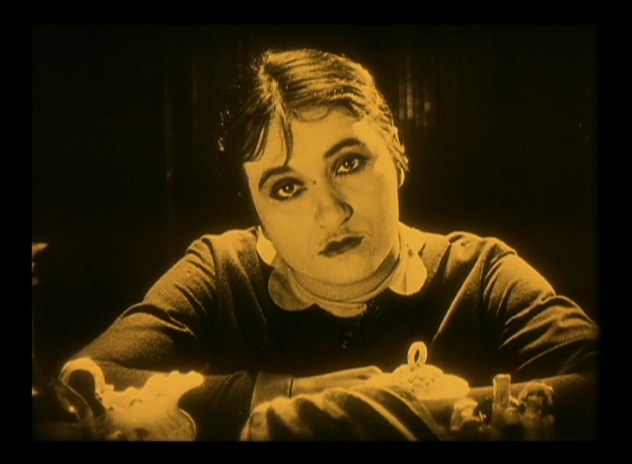
Asta addicted… Laster der Menschheit (The Vice of Humanity) (1927), with Filmsirup, Bonn Silent Film Festival


Weimar films never cease to amaze and there was clearly a different tolerance for subject matter in Germany at this time. This film deals overtly with drug addiction and features graphic scenes of both cocaine use and its euphoric impact as well as the longer-term devastation. All this is done in a dramatically convincing way and without the moralising outrage of, say, Reefer Madness and more puerile efforts of American films to get audiences to just say no.


No, here we have one of the finest actors of her generation, Asta Nielsen, acting out the message as part of her character’s general tragedy; her failure to face down the weakness that led to her requiring the “prop” to support her acting career as well as her decision to abandon family for theatrical success. It’s an old, old story but in the hands of Die Asta we believe it all over again.


Part of the success is in the extended sequence showing her performing Salome on stage as, unbeknownst to her (and us) her daughter sits watching, astonished at her stage craft, as are we all. Asta could be a great stage actor as we see but, as the story progresses, we watch her character, Tamara, break down with the kind of visceral psycho-physical implosion, very few could match then or now. Those who saw the BFI’s wonderful season earlier this year will recognise the style of this closing sequence and also the fact that whilst it’s different every time, it’s also never less than moving. In dramatic terms, Asta was her own special affect.


Die Asta abides...


The film has been unseen for many years and this new digital restoration by Cinematek, Belgian Film Archive, is the most complete version since the censors first set eyes on the debauchery, based on their 1993 restoration, this has new title cards and is as crisp as human-digitally possible, with live accompaniment from Bonn-based Filmsirup, who mix electronics with a range of instruments to cinematic effect, this digital stream of the live screening the day before engaged this watcher, 415 miles away.


The film begins on All Souls Day as Baron Beythen (Charles Willy Kayser) and his family gather in gloom to remember his late wife. His daughter Marleine (Elizza La Porta) asks to hear one of her recordings and mournfully places the 78 on the record player, imagining again the woman she never met and yet who had such a special talent. But all is not as it seems as the Baron’s sister (Sybille Lerchenfeld) reveals her discomfort at the fact that the Baron’s wife is not dead at all, just erased form existence at his will, to “protect” his daughter.


“… to let her say prayers for the dead for a living person is a sin!”


Elizza La Porta's Marleine listens to her mother's voice


Their friends arrive in the form of Mrs. von Führing (Trude Hesterberg) and her children, Hannah (Carla Meissner) and Victor (Ekkehard Arendt) who want to take Marleine to the theatre to see the sensational opera star, Tamara (Asta Nielsen) in that stunning performance of Salome… can you see where this is going? The whole sequence is an interesting one with director Rudolf Meinert making the most of the chance to direct the opera and also the audience with Marleine and Hannah watching the action with binoculars that just as easily could be pointed at the audience. It’s a brief meditation on the relationship between the film’s main purpose and any baser interpretation – you, watch this, we mean it…


Sure enough, in a break between scenes Tamara, wearying, begs the newly-arrived Mangol (Alfred Abel) for a pick me-up before the finale. He duly hands her a sachet of white power, she sniffs it and the opera swings to it’s conclusion. Meanwhile Marleine, not used to being let free, drinks the whole story in, especially when Salome kisses the detached head of John the Baptist; she’s mesmerised by the power of the performance and can’t wait to get the star’s autograph.


Alfred Abel is having a ball

We move on to an after-show party at Mangol and Tamara’s mansion where a number of revellers receive the former’s discrete packages in exchange for money and potentially a lot more. It’s not just the young but also an elderly man in tuxedo, no doubt a pillar of society – perhaps a conservative politician? - who needs some extra energy. Irises are fully dilated and Mangol passes through his society with a knowing smirk, master of most he surveys, controlling supply, creating demand. All this passes the youngsters by but Mangol stops dead when he sees Marleine, here’s someone new to pull into his orbit.


Tamara meanwhile is exhausted and strung out as Mangol’s maid Li (Maria Forescu in yellow face, the film being introduced with a trigger warning covering this and other "attitudes of the time") struggles to prepare her for her audience downstairs. She duly arrives like a pro and signs autographs including one for Marleine who, pestered by Mangol – Alfred Abel absolutely killing it as the embodiment of capitalist evil, he even twists his hair to give a demonic impression – is already vulnerable to his powers of persuasion.


But, almost immediately, there is a bond between Tamara and the young woman, especially after she sings… then, as Mangol makes his mischievous moves, a recording of Tamara sounds just like her late mother’s voice…


Mangol helps Marleine sniff his new oportunity...


I won’t spoil any further, but the action is well paced and Asta provides that operatic emotionality which lifts the story and the message over the closing parts of the film. Also present is Werner Krauss as a “cocainist” customer of Mangol’s who brings a strange physicality to the role of a man clearly hollowed out through addiction as he arrives in search of more drugs from the man who clearly has no further use for him.


Ludwig Lippert’s cinematography greatly adds to the mostly studio-based atmosphere and there are late period camera tricks aplenty including a lovely montage of night life and plenty of perfectly lit interiors that almost, but not quite, present as “expressionist” (Lotte Eisner would probably disagree).


I enjoyed Filmsirup’s score and it ranged occasionally towards post-rock whilst also including some Barrett/Gilmour type psychedelic slide guitar from Michael Hendricks. When the composition and players are this attentive, left-field accompaniments can work and the whole group contributed to a range of orchestration that properly matched the subject matter and the message. Hendricks also plays piano and provides tape loops whilst there’s Christian Carazo-Ziegler (xylophone, electro beats), Matthias André (bass, synth) and Matthias Kaufmann (cello, bass). I look froward to hearing more of their work!


Werner Krauss is haunted


Another quality presentation from Bonn in a week that has already seen the mighty Stephen Horne and Elizabeth Jane Baldry accompanying deMille’s Male and Female (1919) and Ellen Richter in Moral (1928) – recently screened at Pordenone - as well as solo Stephen on Francesca Bertini’s restored classic Assunta Spina (1915).


We’ve also seen Blind Husbands (1919) – an excellent restoration shown in Bologna as well as Fritz Lang’s Die Vier um die Frau/Four Around the Woman (1921) on which, more later.


You can still stream some of the performances and films up until the 24th but you be quick as the films are only available for two days after screenings.


Full details are here on the festival site.


Screenings are broadcast via wireless waves that cross the entire globe!!


Tuesday, 2 July 2019

Misery loves objectivity... The Joyless Street (1925) with John Sweeney, BFI Weimar Cinema Season


This was the first time I’d seen Die freudlose Gasse on the big screen and, after my last viewing of the EditionFilmMuseum DVD, I’d connected it very strongly with the austerity programmes of the former Tory-led coalition under the joyless headline “plus ca change”. Well, French was never my strong suit but over the last five years, things have just got so much better haven’t they?

Anyway, back to 1925 and post-war depression in greater “Germany”, specifically Austria and a film that having once been ten reels long is now in an ongoing state of restoration. Even now it feels like a Diagon Alley version of the Melchior Street it’s supposed to be with understandable narrative disruption caused by using five different sources and retrospective sequencing. That said, it’s never made more sense to me than tonight, sat in the front row after a week in Bologna and yet with John Sweeney holding the story with the thematic continuity of his 151 minutes of improvisation. There’s such variety in Mr Sweeney’s playing and none of tonight sounded like what he played for Sir Arne’s Treasure or Les Vampires just a few days ago in Bologna.

Where the sun never shines... the locals queue in Melchior Street
Pabst’s film is based on Hugo Bettauer's novel and takes what is essentially a crime story and develops its socio-political aspects. Screenwriter Willy Haas described the source book as "a miserable crime novel" and said that what appealed to his director was "... the harsh social portrayal of inflation, the bankruptcy of the old-established patrician circles...the corruption, the moral decay..." The Joyless Street therefore focused on the "social" and a realistic portrayal of poverty and the consequences of mean-spirited capitalism and the greed that drove western-European economies.

Pabst cast a combination of one of the creators of cinematic acting and a relative newcomer who’d only made one feature film. Asta Nielsen was cast as Maria Lechner the daughter of a disabled father who lives in near poverty and then becomes entangled in the lives of the financiers running and ruining the economy for profit. Then into her forties, even Asta was a stretch for the part of an innocent younger woman but her skill carries her through some memorable and powerful scenes even when the lighting and unforgiving close-ups can't.

Asta Neilsen, Hertha von Walther and Greta Gustafsson soon to be Garbo
Standing next to her in the forlorn queue for the butchers is Grete Rumfort, played, of course, by one Greta Gustafsson, fresh from Gosta Berling and not quite 20 years of age. This was the film that clinched her ticket to Hollywood and it's not hard to see why Mr Goldwyn was so impressed. She's superbly photographed by Pabst and you can see the beginnings of the force of nature that would captivate millions, she’s sublimely eye-catching if markedly less centred than she will become, jumpy even.

Legend has it that Pabst used slow motion to help counteract the impression created by the young actress's nerves and this combination served to create an impression of graceful edginess. Even if Stiller was on hand to help manage his protege, can it be a coincidence that Herr Pabst managed to enable defining performances of such power and beauty from both Garbo and Louise Brooks?

Greta.
The film features many strands and an ensemble of rich characters. Werner Krauss is monstrously greasy as Geiringer the Butcher who rules Melchior Street by restricting the supply of meat to only those he favours: the wealthy or those women prepared to pay in kind. He meets his match in the local brothel when offered Grete; he can’t cope with her at all and it’s a telling moment when the bully is flawed by beauty. 
  
Running that house of ill-repute is the other ruler of the Street, Mrs. Greifer who is played by the extraordinary Valeska Gert, a dancer and cabaret artist who brings a great knowing energy to the screen – even breaking the fourth wall on occasion, yelping in silence at the audience: more Poly Styrene or Ari Up than Gloria Swanson! Mrs. Greifer runs a fashion boutique which acts as the front for a relatively high-class brothel. Women of the street are drawn into Mrs. Greifer's, seemingly labyrinthine premises driven by hunger and desperate poverty to subvert dignity in the service of selfish and, as it turns out, hypocritical males.

Valeska Gert meant it!
Amidst so much economic disruption, greedy speculators act to make things worse by manipulating the stock market and the people of the street suffer whilst the bankers waltz around in opulent hotels and drink champagne in Greifer's salon.

Further up the social scale, the Rosenow family are untouchable, with Max (Karl Etlinger) leading the stock market scams. His daughter Regina (Agnes Esterhazy) loves his assistant Egon Stirner (Henry Stuart) and this is where it gets complicated. Whilst Egon’s love appears to be true… this doesn’t stop him from having designs on the Rosenow’s lawyer’s rather striking daughter Lia Leid (Tamara Geva) AND… he’s also in a somewhat serious relationship with Maria who writes him love letters and is convinced that they have a future together.

All of this makes Egon The Eager, pivotal to the entire story and makes him a disappointing man for a happy ending with Regina or anyone else. Regina tells him that he’s too poor for her – presumably Maria is too poor for him? – and that the only way he can have her is to "... become as rich as I am, or I as poor as you."

Maria's boyfriend Egon with other lovers, Lia and Regina... what's a boy to do?
This leads Egon into willing complicity with her father’s idea to make half a million by spreading the rumour of a strike at the Petrowitzer mine which will push the value of the stocks down and then, at their lowest, reassurances will be made that send the value skyrocketing; guaranteeing a killing for those in the know. This will include Don Alfonso Canez (Robert Garrison) who is in town to make just such a profit but not, of course, Grete’s father, Councillor Rumfort (Jaro Fürth). He decides to take voluntary redundancy and to bet it all on the stock market.

When the fix comes in, Rumfort loses everything having bet on Coal stocks remaining low and the family is forced into taking a lodger as Grete struggles to keep the money worries away from her broken father. A lodger is soon found in Lt. Davy (Einar Hanson) an American serviceman in Vienna to help with reconstruction, he hands Grete $60 and she has to use it to pay her father’s stock market loses…

Asta
The plot has all the hallmarks of a novel as source but the main thing for Pabst is to foreground the social injustice with the complexities of personal and social betrayal rather less important than the fact they happen. The direction of the women’s’ lives is driven by the need to provide and both Maria and Grete move nearer and nearer to the club Frau Greifer runs with the former becoming Don Carlos’ “girl” for rent which is how she ends up in the cheap hotel next door the night Lia Leid has gone there for an illicit rendezvous with Ergon…

There are some excellent sequences in the club as Grete comes closer to following the same path; she can’t quite bring herself especially after one of the club’s waiters, Kellner (Gregori Chmara) has a rush of blood and tries to force himself on her. This is when you can see Pabst’s use of slow-motion; whether it was used to make Garbo look “smoother” or to heighten the moment of fear, it is certainly effective.

Gregori Chmara chases Greta slowly...
Even this reconstructed version is missing some content but it makes sense overall and the emotional force of the story is clear as day. As the men go wild for Grete the people in the street outside decide that enough is enough and the film ends with a call to action and for solidarity in the crisis. Nearly a century later we are still grappling with the gap between rich and poor and struggling to recover from a banking crash that has led directly to Trump and to Brexit. Who knows what will happen next?

Stylistically Joyless Street is post-expressionist and part of the “New Objectivity” movement with its resigned cynicism balanced by a desire to seize the moment. Pabst was, according to biographer Lee Aywell, the first to take up this stance with his expressive style focused on the everyday and not fantasy. Melchior Street is accentuated reality of a very stylized kind; entirely studio-based and yet gritty as any exterior; the gutters may have been papier-mâché, but the grief was all too real.


Sunday, 19 May 2019

The Veidt Stuff… The Student of Prague (1926), BFI with Stephen Horne, Weimar Cinema


“In many respects, the second film is much superior to the first… a powerful work (that) … proves for the second time that in film, pure art can have great success.” Hans Heinz Ewer, 1930

In her insightful and entertaining introduction, Weimar expert, Miranda Gower-Qian, described this film as essentially a “doppelgänger” of itself, it being a broad “remake” of the 1913 version with Paul Wegener. The film re-doubles the force of Hans Heinz Ewer’s 1913 story with this re-telling and uses that as a launching point for a dramatic enhancement of the ideas drawn principally from Edgar Allen Poe’s William Wilson with a smattering of Faust; as Miranda said, pulling in German Romanticism along with contemporary ideas of individuality and ambition.

For Conrad Veidt’s Balduin to succeed, it’s not just that his friends must fail but that he also must be sacrificed. Balduin’s doppelgänger represents the darker side of his ambition and desires… he ends up ignoring the pure love of a flower-girl, Lyduschka (Elizza La Porta), casting away her pauper’s posy, in his frustrated pursuit of rich girl, Margit von Schwarzenberg (Agnes Esterhazy) and he’ll cheat at all costs to get what he wants.

Veidt, Krauss and Veidt
In this way the film tapped into the Weimar zeitgeist and what Siegfried Kracauer later called “a deep and fearful concern with the foundations of the self. So, forget expressionist cinema this could rightly be termed existential cinema which incorporated elements of the former and added much else besides.

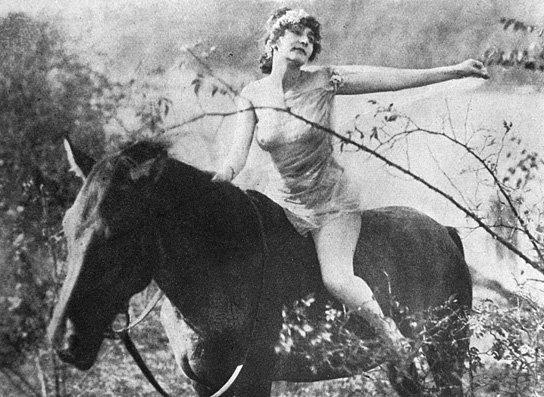
Henrik Galeen directed and co-scripted with Ewer and he was, as Miranda said, chiefly known as one of Weimar’s best scripters, with work on both Golems, Nosferatu and Waxworks amongst others. The result is a sumptuous mix of stunning framing, lighting and fluid camerawork from Günther Krampf and an uncredited Erich Nitzschmann, that capture magnificent rural settings as characters ponder by lakes, dramatic action as Balduin tries to save Margit on her horse and add haunting atmospherics to the tale. Selling your soul to the Devil is one thing but selling it to yourself is altogether more unsettling.

Conrad and Krauss
There’s a far more bucolic set up for Balduin’s fateful deal than in 1913, not surprisingly perhaps, although that version does have some excellent exterior shots. Veidt gives Balduin far more mystery and depth than Wegener and manages to unsettle the audience through changes in physicality and expression. Make no mistake, Der Student is “concentrated Connie” and it established him at a higher level internationally with what Pat Wilks Battle described as his greatest starring role of the silent era.

His student maybe the finest swordsman in Prague but he is also one of the most impoverished. He broods while the others mess about, drunkenly pawing at Lyduschka in the tavern and challenging each other to duals. Many of the students carry duelling scars and whether this was down to casting or make-up, there’s no denying that duelling and the scars that went with it were very popular among the military schools of this period. Balduin carries no scars and shows just why as he runs rings around an objectionable colleague he challenges to protect Lyduschka’s honour.


But Balduin is broke and susceptible to the enticements of soul-loan-shark Scapinelli (Werner Krauss, without whom, no supernatural Weimar film is complete) who offers him 600,000 gold coins in exchange for just one thing from Balduin’s bare lodgings. Laughing, the student signs off on the deal only for Scapinelli to take his reflection from the mirror… who needs a reflection, you ask yourself? Well, it’s more than a shadow…

Scapinelli also helps set up Balduin with Margit as he rescues her from her bolting horse following a stampede engineered by the old man with a wave of his arms and an evil grin: our hero is playing with fire and doesn’t know it yet; ambition and material success come first.

Agnes Esterhazy
Naturally there’ll be a reckoning but the film is so well paced and engaging we almost forget its coming. I wasn’t disappointed with Der Student and it is indeed one of Weimar’s finest.

Accompaniment was provided by Stephen Horne who made light of the two-hour running time and maintained atmospherics and tension throughout with emotionally literate improvisations that lent so much weight to the uncanny drama on screen. Perhaps the soul of Balduin/Connie was on hand to guide him… he sees and he hears dead people and is our musical medium connecting the modern day to the mood and mystique on 1926 film.

We saw a projection of the excellent reconstruction by Filmuseum München and it was a fine copy with clarity and excellent tinted detail... enough to see right into the Veidt!


Wednesday, 8 May 2019

Weimar mania… Opium (1919), with Jonny Best, BFI


In her sparkling run through of this major BFI retrospective of Weimar Cinema, Margaret Deriaz said that in the years between 1919 and 1933, Germany produced over 3,500 films, second only to Hollywood in scale and productivity. Of all those films it would be hard to find one more purely quirky than Opium and yet, for all its strangeness the film has plenty of charms especially when accompanied by Yorkshire's finest, Jonny Best, whose patient minor chords and plaintive discords did much to liberate Robert Reinert’s original dramatic flavours.

The film has a distinctive visual style, almost a series of tableaux in the manner of pre-war Italian film but very vibrant and filled with ambitious double exposures as well as some superbly-captured performances. Reinert’s cameraman was Helmar Lerski, a former portrait photographer who used deep focus and careful lighting to capture every performer in the frame with absolute clarity. Over and again one actor is joined by another and then another moving into frame and adding layers of meaning as they react to events. Another startling shot sees the main character, Professor Gesellius (Eduard von Winterstein), on a boat moving relentlessly in focus towards a distant shore filled with opium-induced faeries and sprites (of which more later…).

When the Professor gives a lecture a glass remains in close-up on his lectern as do his students as he approaches to speak, it’s very skilled and apt for a film about perception: The Doors of Perspective perhaps? It’s a very powerful style and whilst it wasn’t the way movies were to go it is still a compelling example of the experimentation of the time.

Conrad fades away and Eduard marvels at the depth of field as Sybill stays calm
This was also that brief period, post-war, when all censorship was dropped and so the film’s frequent Faerie nudity adds some extra surprise as does the take of mixed-race relationships and, yes, drug addiction. The effects of opium are revealed through double exposures and static montage of dancing sprites and pools of water, sometimes inverted over the character’s head. It’s clear that Psychedelia nearly happened here and yet the summer of love was far from the thoughts of film-makers still trying to make sense of the Great War.

As film historian Tobias Nagl, quoted in tonight’s hand-out said: “under the surface, Opium captures the experience and shock of the War… (using) … a brilliant, hallucinatory cinematic language.” So it is that the sanatorium the Professor sets up for recovering addicts is so very like those for the shell-shocked and the physically-destroyed, men who were all but dead already trying to piece themselves together away from the adrenal rush of fear and mortal dread.

Now some of the audience and I’m naming no names couple in the second row with horsey laughs… found all this a bit too melodramatic but maybe they’d been caught up in BFI Weimar Mania (it’s a thing!) and hadn’t quite – literally – got with the programme.

"Smokers, get high..."
This being 1919 some stereotypical characters are deployed but the relationships between the “Indians” in brown face, the “Chinese” and the white men are more even-handed than you might credit. Granted there is a completely bonkers bad guy, Nung Chiang (Werner Krauss, yes the good Dr Caligari) who literally pops up onto screen to the surprise his enemies across the World with a manic grin and acid jazz hands but I think, like so much of the film, his character is representative and not meant to be a genuine description of a contemporary drug dealer.

Lotte Eisner shoot me down in flames but, whilst this is most definitely not an expressionist film, there are elements of the style not so much in the mis en scene but the performances all of which are designed as emblems rather than characters. No one plays it straight but then this is a drug-den of a movie and we’re all out of minds with grief and as the first tentative buzz of the new democracy kick in. No censorship mein Herr: we’re so out of it, we see lions in India!

The story is about addictions to love and revenge with Nung Chiang swearing revenge on Richard Armstrong (Friedrich Kühne) an Englishman who smoked his opium and then stole his wife in China. There’s a further grievance for Chiang when Professor Gesellius rescues a young woman, Sin (Sybill Morel) from his den of multiple iniquities – you name it he’s selling it – and takes her back to his sanatorium in the West. Sin is mixed race and you can guess who her father is… but, none of this is known to Gesellius’ wife Maria (Hanna Ralph) who just happens to be having an affair with Dr. Richard Armstrong Jr. (Conrad Veidt).

Eduard von Winterstein, Werner Krauss and Sybill Morel
Connie’s younger and better fed than I’m used to and is convulsed with shame after his boss comes back… so much so that he’s not long for this World, dying on a bed surrounded by almost all of the main characters in another remarkable tableau with centimetre-perfect depth of field.

His death is considered suspicious and with the Professor in the frame, Sin takes the blame only to be whisked away from execution by Gesellius. Which is how we find ourselves in India with all those lions and so many scores to settle.

Opium is opulent and over-wrought and I’d love to see it again. The restoration from Filmmuseum München, as premiered at last year’s Berlinale, is crisp and clear, is as close as we’ve been to the original which is one of Reinhert’s few surviving films.

Jonny Best took the film in his stride and maintained a watchful poignance that fitted the sparkling visuals perfectly; this film is an elegy as much as a beginning and despite appearances there was more unknown than known emotion on screen.

An excellent start to the BFI Weimar season!

Just say no.
Jungle Book, not The Lion King

Monday, 16 May 2016

A light in the museum… Waxworks (1924), with Stephen Horne, Barbican


This was the last screening in the Barbican’s season of Weimar expressionist films (as opposed to films that are just very expressive…) with Stephen Horne, introducing as well as playing, quoting Lotte Eisner’s later-life conviction  that there were only two fully-fledged expressionist films - Von morgens bis mitternachts, and Caligari – along with the third segment of this film which, as Stephen promised, was well worth the wait!

As the Sun cracked the flags in the Barbican’s concrete courtyards, a substantial audience clearly preferred silence to shining as we gathered at the Centre’s lowest point: The Pit cinema.

Olga charmed by Emil
Waxworks was directed by Paul Leni who subsequently made The Cat and Canary, The Man Who Laughs and others in Hollywood. It is one of the first portmanteau horror/fantasy films with three stories all contained in a framing sequence set in a house of wax.

Leni recruited three of the Weimar’s leading men: Jannings, Veidt and Krauss who were respectively, corpulent, terrible and cutting!

Luna Park
A fairground – Luna Park – a whirl of double-exposed rides and lights, a young poet (William Dieterle) paper in hand, looking to respond for an advert for “an imaginative writer for publicity work in a waxworks exhibition”. He arrives at The Panopticum, a booth run by an elderly showman (John Gottowt) and his young daughter Olga Belajeff.

Haroun
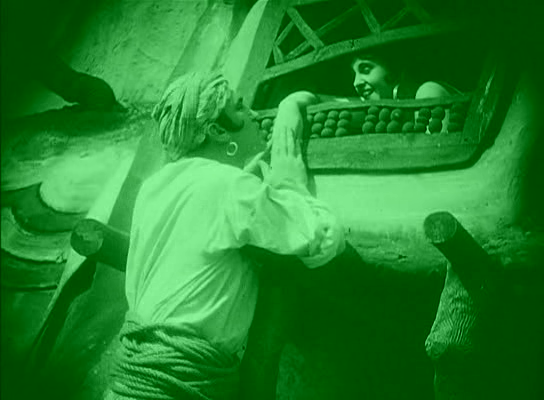
“Can you write startling tales about these wax figures?” asks the Showman before introducing his milky-faced cast of characters: Spring Heeled Jack (Werner Krauss), Ivan the Terrible (Conrad Veidt) and Haroun-al-Raschid, Caliph of Bagdad (Emil Jannings). Seeing the Caliph’s detached arm, the poet decides to write a story of how he came to lose his limb… the camera flicks out of focus and we’re in a wonderful, cartoonish Arabia looking on a paper-mache palace and plastic palm trees.

Assad canoodles with Zarah
The poet casts himself as Assad the Baker with the showman’s daughter as his wife – Zarah – one of the most beautiful women in the city not already married to the Caliph (he has a wife for every day…). The baker bakes and makes eyes at Zarah whilst the Caliph is pampered on the roof of his palace losing, badly, at chess. Distracted by the smoke from the baker’s oven the Caliph, perfectly reasonably, sends his Grand Vizier and his men to kill the baker but when they arrive they are distracted by Zarah’s beauty…
The Caliph's Palace is almost like a living thing...
The Caliph decides to investigate this woman for himself whilst Assad, forced to prove his manhood after Zarah realises that if she can catch the Grand Vizier’s eye she could do better, heads off to the palace to steal the Caliph’s magical Wishing Ring…

Cue a masterclass in kingly carousing from the protean Jannings, fleshy-grotesque in heavy padding, over-weighted turban and wicked moustache… he smiles, he gurns he licks his lips but he has charm enough to stop Zarah – and the audience – from running. Can Assad complete his task and keep his head and his wife? Have you read the Arabian Nights?

Ivan
Next up the Poet turns his gaze towards Ivan the Terrible and a far more sinister tale ensues as Conrad Viedt’s Czar exhibits a sinuous delight in watching the grains of sand count down his tortured victims’ last seconds of life as they pass from chamber to chamber in his hourglass. It’s a horrible concept that perfectly encapsulates his silicon psychopathy.

Time waits for no man
But Ivan trusts no one, not even his poisoner-in-chief, who he has hunted down and killed but not before the man can write his master’s name on the terrible timer. Ivan is unaware as he continues his abuse of his subjects – terrible and not at all awesome in this context. When he does find out his solution reflects the tortured hyper-paranoia you hope haunts every psychotic despot – those to come and those passed.

Jack
The long day closes with that Eisner-authenticated expressionist sequence in which Spring-Heeled Jack comes to life and pursues the young couple in shadows and light as Leni let’s rip with every trick from the expressionist cookbook! Conrad Veidt’s sunken-cheeked ferocity aside, it is the film’s most genuinely haunting moment and right till the close you eye the Jack waxwork a little nervously.

Waxworks is a sight for sore eyes (hayfever and long drives…). Leni’s sets are superb throughout and Helmar Lerski’s cinematography brings them to life from the oppressive low-beamed ceilings of the Kremlin to the nightmarish exposures for jumping Jack flash.

Jack's menacing montage
Stephen played with his customary lyricism and control – playing the electronic keyboard always anchored with the Barbican’s splendid Steinway. Flute and accordion were also played all in sympathy with the film and as part of a remarkably well-structured improvisation. Waxwork’s range of moods presents a challenge to any musician, especially the curious mix of comedy, drama and horror (not to mention Emil!) but, once again, Mr Horne made it look like he’d spent weeks planning this all out with the ghost of Paul Leni or, possibly his animated wax figure…

Waxworks is available in its fully-restored length complete with tints, from Kino and you can order direct as well as from the long river that winds past localised tax-returns…