
Watching Jeanne Moreau’s detachment as twisted fire starter, malicious flooder and silent poisoner you get the feeling that, had she not been a child at the time, this is a role Isabelle Huppert would have, probably, killed for. As it was Ms Moreau was dating director Tony Richardson at the time and this is the first of two collaborations they made after he left first wife Vanessa Redgrave. Original script writer, Jean Genet, could not see why Moreau's skills were needed and would have prefered a non-actor and yet it's hard to imagine this film without Jeanne's micro-managed emotions.
Famously a member of the “booed at Cannes” club, Mademoiselle
had a very mixed response on initial release with The Observer’s Penelope
Gilliatt calling it ‘dense and audacious’ and Alexander Walker of the Evening
Standard finding it ‘memorable’, whilst The Sunday Telegraph’s Robert Robinson called it ‘frightful’ and Felix Barker of the Evening News, simply, ‘Quite
terrible’. Over the years poet Patti Smith is far from alone in defending the
film and this new release presents a stylishly flawed film that is ripe for
re-appraisal.
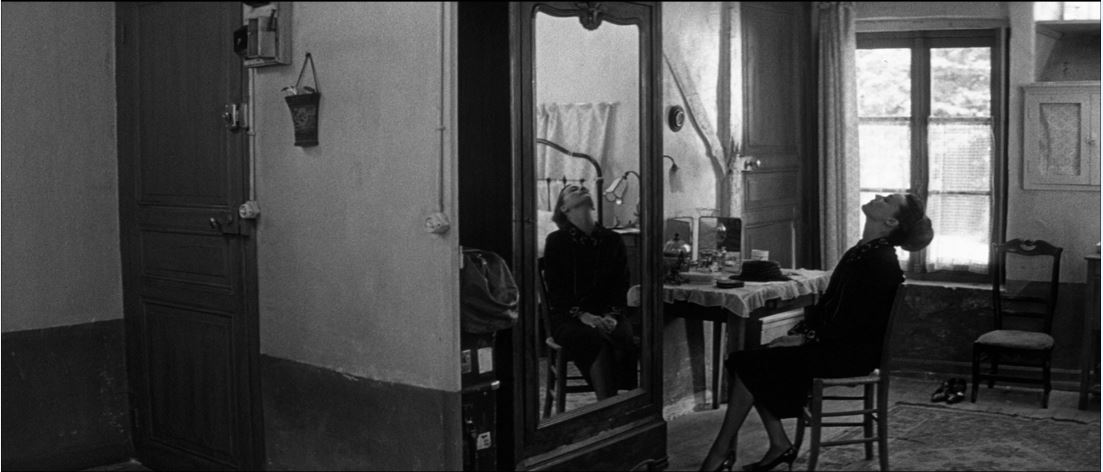 |
| Jeanne Moreau alone in a room on a chair |
Filmed in the stark black and white more usually associated with Woodfall Film’s British kitchen sinks, Richardson’s French foray, could almost be a silent film. Many who hear the dubbing of French performers into English may actually prefer that but at least Moreau’s voice is her own, not that she needs audible language to make her feelings shown. She is remarkable as the titular Mademoiselle with a performance of oblique intensity that conceals as much as it reveals.
In Jon Dear’s essay in the accompanying booklet, he
describes Moreau as empowered by her solitude, committing destructive acts with
impunity protected by her status and loneliness from consequence and discovery.
We know from the very start, as her fishnet gloved hands casually open a sluice
gate that floods a farm, that she has no guilt only fascination with the
wreckage she creates. She stands excitedly watching the rescue attempt, attracted
to the heroic masculinity of Italian woodsman Manou (Ettore Manni) who we begin
to suspect is her motivation for causing the havoc.
 |
| Jeanne and Keith Skinner |
The script was completed by Marguerite Duras based on Jean
Genet’s original idea and the latter’s focus on isolated characters was drawn
from his own experience as an outsider in a small rural community. No matter
how much the Italian men step in to help put out fires and rescue farm stock
from floods, they are constantly under suspicion from the locals, driven by xenophobic
distaste as well as sexual jealousy. Manou is a big hit with the local ladies
and, no doubt from Genet, there is the sexualisation of his manliness as well
as physique with the camera following Mademoiselle’s interest.
Genet’s complex relation ship with the progression of his
work to screen is examined in an essay from Jane Giles who provides much
fascinating detail, as does Jon Dear who reveals that David Bowie’s Jean
Genie was written about the author – new information certainly for me. Genet
had long rolled off this particular project but his themes remain, especially
those of control and identity; the disconnect between the schoolteacher’s
actions and her wish to be respected. Her obsession with French war hero-turned-child
killer Gilles de Rais and child warrior-turned-Saint, Joan of Arc, speak for themselves.
 |
| Jeanne and Ettore Manni in the wild |
The film’s narrative is sometimes out of joint, adding to
a general dislocation and a dreamlike quality a full-channel width away from Richardson’s
A Taste of Honey (1961) or Look Back in Anger (1959). Mademoiselle
dreams in the forest and then she meets Manou on a bridge and he shows her a
snake he has wrapped around his midriff; it’s the most obvious phallic symbol
and one the rightly belongs in a dream and yet, some time later the two resume
their meeting and appreciation of the reptile.
This approach to narrative combines with Moreau’s masterful
control to confound our expectations and to reinforce that feeling of reverie as
the schoolmistress blows very hot and then very cold with Manou’s son, Bruno (Keith
Skinner) chiding him for being dressed like a gypsy before going out of her way
trying to help him. Whilst there is something building with his father, the boy
is not yet tainted by the sex and sin of men and which she is drawn to and
repulsed.
 |
| Hats off to David Watkin - stunning depth of field all achieved in camera and under water |
At times the film feels like a folk horror of a slightly later vintage as David Watkin’s camerawork gives us a disorientating mix of largely static close ups and people dominated by the force of their country landscapes. The woodlands carry a visceral sense of freedom and ancient mystery whilst the village interiors are clinical and confining. Antoine Duhamel’s music amplifies these conflicting spaces perfectly and when events do happen, they are jumbled and disorientating.
Richardson's shots are oddly pointed with the village processing to church intercut with Mademoiselle's first evil deeds and fish being taken out of a river as they walk above. There's also a conversation between local women conducted almost entirely over a shot of their washing clothes; the enclosed atmosphere of the village focusing in on itself. The woods act as a catalyst for the school teacher, she reaches out to the boy when she sees him there and, of course, that is where the barriers are removed between her social self and her true nature.
Once Mademoiselle and the Woodsman do connect there is the
most extraordinary sequence of physical interactions that, spoilers aside,
provides a jaw-dropping crescendo amongst this deafened world of petty jealousy
and indifference to truth versus preconceptions. It always comes down to the
now…
In addition to the essay-packed 38-page booklet, there’s
an interview with Keith Skinner with the BFI’s Vic Pratt as he looks back on
the film as well as a new audio commentary from film scholar Adrian Martin
recorded especially for this release.

There’s also a second feature, the British Doll’s Eye
(1982) directed by Jan Worth who, writing about it in the booklet, describes it
as an attempt to blur the lines between documentary and fiction in relation to
sex workers and their male customers. The idea had been sparked by inviting men
to write in with their responses to adverts for prostitutes and these led to
Worth writing a script and directing the film.
Doll’s Eye features Jane (Bernice Stegers), a
researcher working on a research project about men’s views on female sex work;
Maggie (Sandy Ratcliff) a sex worker; and Jackie (Lynne Worth), a young woman
who has moved south from the industrial north of England, as part of the early
eighties migration as Thatcher’s “managed decline” saw prospects disappear. Jackie
babysits for both and works part-time as a switchboard operator. Worth’s film pays
tribute to the social realism of early Woodfall films but without attempting
the same naturalism and the result is a mix of verbatim quotations from the
source research and a restrained drama examining social situations and power
relationships; ‘who looks at whom and for what purpose?’
Mademoiselle is out now and is available from the
BFI shop and online.


+canal.jpg)





