Showing posts with label Aphrodite Raickopoulou. Show all posts

Friday, 26 February 2016

It’s in the air… Love (1927) Aphrodite Raickopoulou, Vadim Repin and Philharmonia Orchestra, Royal Festival Hall

Well it was certainly love for Mordaunt Hall, with the New York Times critic almost lost for words in describing Greta Garbo as "a blonde Mona Lisa" who "outshines any other performance she has given to the screen".

I doubt he could have contained himself had he been here to hear Aphrodite Raickopoulou's stonking new score written for and played by Vadim Repin ably accompanied by the might of the Philharmonia Orchestra… “Paramedic for Mr Hall!”

Is often been said that the camera loved Garbo – watching Sky Arts Movie documentaries it seems that the camera also loved Ava Gardner, Lana Turner et al and so on: that Camera was pretty fickle. I think that the director, cinematographer and, subsequently the audience loved Greta and Mordaunt Hall of course…

Mordaunt loves Greta
She must have brought something powerfully new to the screens and perhaps her European ethereality topped off an earthy sexuality that the West had rarely seen. Theda and Pola were too deliberate whilst Lillian, Mary and even Clara were girls in comparison with this woman who operated on unknowable levels. She has more in common with Asta Nielsen and the great Italian Divas, especially Bertini: realism with just a silent touch of a short-fuse.

A Lyda Borelli reveal borrowed from Malombra?
Her only vulnerability was love itself and even she could be charmed by the wholesome wit of John Gilbert. Gilbert was the proof of accessibility and possibility and, pause for sigh, proved that ultimately neither of things actually applied in Greta Gustafsson’s case.

But all that was to come and tonight, as in 1927, the audience believed in their love and, in the love of a mother and son as well as the love of a soldier for his comrades in arms: there was a lot of love going round.


But first to feel it was off-screen, as Vadim Repin – described as the leading soloist of his generation – took to the stage to rapturous applause alongside conductor Frank Strobel wading through the eighty-strong Philharmonia. Aphrodite Raickopoulou has spent much of the intervening period between her splendid score for Faust – performed in the same venue in 2012 – on this new piece and it was worth every note.

Repin took flight almost from the first few bars of the overture before the film began and Raickopoulou’s themes began to reveal themselves against the well-travelled narrative of Tolstoy’s Anna Karenina. It is an interesting choice to follow up the more tonally extreme Murnau film but the score succeeded in adding flavour especially to Garbo’s almost mystical expressiveness. I probably said it before but she over-matches Mr Gilbert whose natural charm and earnestness simply washes over the swede’s hidden depths.

John Gilbert: at first sight
Don’t get me wrong, I do love John Gilbert and I would also agree with the rather leftfield suggestion from Hugo Vickers who in his introduction suggested that were he alive today, Gilbert would easily beat Donald Trump to the Whitehouse: well yes, him, Felix the Cat and Ben Turpin too!

Meanwhile, back in Tsarist Russia… as adaptations go, this one is remarkably economical with Director Edmund Goulding moving Frances Marion’s precis swiftly along and focusing on the aspects of love that bind the characters to their diverging paths: there is no easy way for any of them to follow their hearts. Such clever work Miss Marion!

John Gilbert also part directed, perhaps been given his head with his almost soul-mate – not for nothing did the publicists promote the film as “Garbo and Gilbert in… Love” although the original title was simple Heat which I’m less convinced about.

OK... it is a little warm in here...
Their first encounter is tantalizing as horse-drawn carriages career through frozen countryside. We only see Garbo’s face through a veil which delays the moment of her rescuer, Alexis Vronsky (Gilbert) seeing her face. After her carriage loses a horse he takes her to an n inn and after installing her in a double room wrongly assumed to be theirs, is transfixed when the big reveal happens: love at first sight!

But… it’s complicated: Anna is already married to the influential, rich and late middle-aged Senator Alexei Karenin (Brandon Hurst) and, worse still, they have a son, Serezha Karenin (Philippe De Lacy) who Anna adores more than life itself. The bond between the 10-year old boy and the 22-year old actress is a strong one but I’m pretty sure it’s meant to show the immensity of the maternal bond. True Vronsky is jealous in the selfish days of his passion but he comes to accept the boy’s position in her life.

George Fawcett does his Windsor Davies
But Vronsky is similarly compromised by his family connection to his regiment, led by the Grand Duke Michel (George Fawcett who is about as Cossack as Windsor Davies!). He faces being drummed out after generations of Vronsky family service if he doesn’t save face by giving up Anna.

Eventually the Senator intervenes, telling the lovers that they will destroy themselves. He is playing a long game and counting on the pressures of societal norms to keep them apart.

Ultimately Anna cannot leave her boy any more than Vronsky can walk away from his comrades and his familial history. Regretfully they give up their love and prepare for the misery of separation.

Anna gives her emotions away as she watches Vronsky's race
Famously two endings were filmed one based on Tolstoy’s and another crafted for local taste… you’ll have to watch it yourself to find out which one won.

Love is a very good film above and beyond G&G. There is some lovely cinematography from William H. Daniels who employs a good range of “European” camera mobility, following the characters through immense rooms and tracking John Gilbert during the soldier’s horse race – Anna’s heart is in her mouth and we respond in kind to the under-cranked danger of the equine dual.


It’s available from Warner Archives in a decent print but it would be good to see it released with this enormous, radiantly good-natured new score.

The concert launched the 2016 UK-Russia Year of Language and Literature and featured my pal Sarah’s live debut at a silent film – thanks for taking the chance SEG!

Tuesday, 28 February 2012

Royal Festival Hall - Faust (1926)

The latest stage in my Murnau education took place at London’s Royal Festival Hall where I watched his 1926 classic, Faust, accompanied by a splendid new score composed by Aphrodite Raickopoulou . This was superbly performed by the Philharmonia Orchestra conducted by Benjamin Wallfisch and ably supported with some jaw-dropping piano improvisations from Gabriela Montero.

It was an evening that lifted the spirits and sent the audience away on a high…we didn’t trash the seats but we smiled our way home into the night, chattering and tweeting our satisfaction. Just what is it about silent films and live performance?

Having watched a good few silent films with live music this was my first full-blown orchestra and in the voluminous setting of the South Bank’s biggest venue, the big band worked exceptionally well. The audience was, how shall I put this, my friends … rather more… sartorially focused than your usual silent gig; more of a concert crowd perhaps?

But, even though the wife and I felt slightly under-dressed, it was a warm, friendly and highly-appreciative gathering.

The screening was introduced by Hugh Grant, a surprising choice perhaps (and one that helped lure my Catherine out on a Monday night) but one quickly explained by the fact that he’s a mate of Aphrodite’s as well as a fan of her music. He gave a typically bumbling yet humorous introduction, revealing a few fun wiki-facts on Murnau, Jannings’ unfortunate later choices of Nazi propaganda work and embarrassing the allegedly “flakey Julia on the cor anglais….”

There was also a round of applause, which I think I started, when Mr Grant made a reference to the “faustian pact” of Prime Minister David Cameron with former News of the World Editor Andy Coulson…

Apparently delighted that Aphrodite had at last been able to put out this music having “gone on about it for years”, he was gracious enough to reveal his own admiration after repeat viewings of the film.

I hadn’t seen the film before and, having viewed an excellent production of Marlowe’s play at The Globe Theatre last year, it was interesting to compare Murnau’s 1926 version of the legend. Mr Grant’s wiki-research had revealed that the story was based on a medieval alchemist who had tried to find a cure for the plague only to be accused of selling his soul…

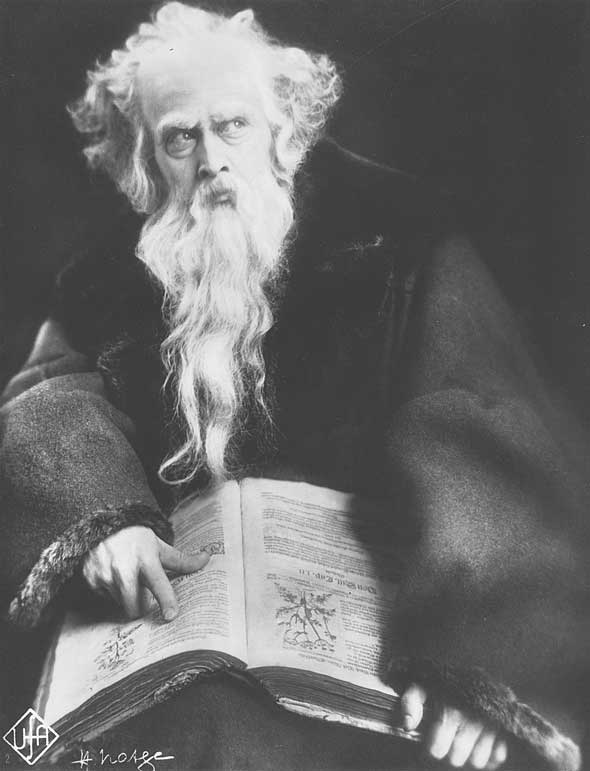
Gösta Ekman played this Faust and gives an impressive performance as the man who surrenders all to ambition even if his road to Hell is initially paved with the good intention of curing the plague.

At the start, Faust is an old man but he reverts to his pretty youth for much of the film – an androgynous figure who’s layers of make-up reflect his misguided attempt to conceal his real self. It’s hard to feel sympathy for what looks like a refuge from Bolan or Bowie’s glam backing band but we do…there but for the grace of God…

Emil Jannings, who I last saw as the doorman in The Last Laugh – puffed out with pride one minute, literally diminished by failure the next - gives another extraordinary turn as Mephisto.

What a range he had, physically imposing and powerful yet capable of these quicksilver changes in stature and poise…all matched by his hugely expressive face: an operatic performance in all but name, complete with knowing laughs and grand gestures.

Mephisto sets the story in motion by betting the guardian angel that he can lure Faust’s soul away from God.

This he does with much alacrity sending a pestilence to Faust’s town and forcing the old man to risk his soul for a day’s “trial” of demonic power. He hopes to use this for good but he cannot cure those protected by crosses and his rejected by the god-fearing villagers.

Mephisto turns this to his advantage by offering Faust his youth and the old man buys it, setting off on a series of selfish adventures with his cunning “servant”.

But then Faust is thrown off course as he comes across the beauteous Gretchen and falls for the most innocent soul in the village.

Camilla Horn got the part of Gretchen that had been intended for Lillian Gish, the latter couldn’t make it and so Horn undertook not only her first film but also first full acting role (although her legs had been in a previous Murnau film, according to Hugh…).

She acts very well, in spite of what looks like a longer version of the hairpiece worn by Janet Gaynor in Murnau’s masterpiece Sunrise. It matters not, she’s great “very beautiful with a natural open smile” said Catherine and is particularly moving during the later scenes as Mephisto’s plan to ruin it all begins to come to fruition.

She makes the horror and the tragedy believable and her acting is a naturalistic counter weight to the pantomime villainy of Jannings and the foolishness of Faust. She’s the hero and not him.

The outline of the Faust story is familiar to most and quite clearly it isn’t going to end that well but Murnau moves the narrative in characteristically forceful manner towards the tragic denouement.

Yet, this is not quite the Faust that I saw in The Globe and there is a twist in the tale.

As you’d expect Faust is beautifully photographed by Murnau’s cinematographer Carl Hoffman, a major figure in expressionist cinema who also worked on Fritz Lang’s Metropolis. The set design from Robert Herlth and Walter Rohrig, is also amazing, another Murnau film shot entirely in studio?

The music was simply superb - very moving - and the Philharmonia Orchestra filled the huge space of the hall to the brim. This was maybe even louder than the Utley/Gregory Joan of Arc I saw last year and really suited what is an operatic and mightily expressive story.

It was another powerful example of the importance of music to silent film and the ways in which it can revitalise the creative existence of the latter bringing out new flavours, emphasising existing impressions and helping to re-connect audiences with the creative spirit of the film makers.

Music and Murnau worked in perfect tandem and to loud, sustained acclaim.

The Kino and Masters of Cinema Faust are available from Amazons all over, but I think I’ll wait until a version is available featuring this soundtrack. There's a sample here on YouTube.

Don't miss it if you get the chance to experience it live, clear and loud!