Metropolis is
probably one of the two or three silent films most people can name and for such
an intensely
evaluated film I feel a
bit like Cordelia being challenged by her father to elevate
her level of praise above that of her siblings:
“…what can you say to draw a third more opulent than your sisters/fellow bloggers…” Maybe not much but I should have a go and I know King Lang isn’t
fussed either way.
  |
| Robo women through the ages: Sophie May Williams gets silent on The Voice... |
My teenage daughter asked to see the film, we’d just watched
an episode of the BBC’s talent show, The
Voice (Saturday night compromise TV...), which featured a staging drawn directly from Metropolis – proving the film’s enduring mainstream credentials almost
90 years on… Our Beth also wanted to understand more of the references to the
film in Janelle Monae’s music. Both Monae’s two albums have looked back to Metropolis along with her early EP,
called, erm, Metropolis: Suite 1 (The
Chase)… The energetically eclectic, multi-talented Monae is obviously a
woman of taste and discernment as, indeed, is my daughter.

How much she found connecting the concept albums with Fritz
Lang and Thea Harbou’s story I’m not sure but The Electric Lady was certainly there for all to see with teenage
Brigitte Helm’s amazing performance: she is mesmerising and gives a quite
stunning physical performance as she switches from the graceful spiritualism of
Maria to the body-popping kinetic madness of robo-Maria. Her energetic
commitment is still genuinely shocking: she is
the robot and she is infused with the nihilism of her creator laughing in the
face of her own destruction.
  |
| Brigitte Helm |
But the immediate dazzle of Metropolis is the city itself: a
vision so powerful that you can trace its influence not just through to modern
soul-punk but also through cinematic science fiction – Blade Runner even looks a little like it. Lonng before Philip K Dick
Lang was telling us how badly the future can go wrong Lang was in there even if Aldous Huxley
and HG Wells would already have agreed with him – although I'm not sure the latter was that
impressed with the film: he called it silly… thank goodness he never saw the Giorgio Moroder version.
Lang presents a future world with amazing cohesion and style
– and art deco heaven propped up by a Dadaist hell in which machines are oiled
by the sweat of subterranean slaves who march in de-humanised desolation all
unified in their defeat by a society that values only their number, not their
individuality. Weimar Germany still lay crushed by the defeat/”betrayal” of
1918 and communist alternatives still found wide favour as did other developing
ideologies that looked to redress the imbalances in German society.
  |
| Art deco heaven... |
The Weimar was the first democratic government in Germany a
country with no culture of democracy but of benevolent autocracy and political
culture cannot be changed through process alone… if you are used to the Leader
you may still look for a Leader (political scientist SE Finer is not alone in pointing out the ways in which changed systems must evolve and not just be imposed).
It’s not too much of a stretch to see Metropolis attempting
to find answers to the question of how to rule and how to manage capitalist
diversity… Then again it may just be a simple fable.
  |
| Greasing the wheels... |
But the film also clearly portrays Modernism and by
implication Americanisation, as a threat… albeit a good-looking one! Lang
claimed later that his first trip to New York had inspired the film’s look and
feel even though its stunning designs had already been completed by this time.
Then again he could hardly have been unfamiliar with high-rise…. There are
glimpses of San Francisco in The Spiders
(1919-20) apart from anything else.
But again, is Metropolis
any less of a fable than Die Neibelung
– one looking forward the other looking back? Above all else Lang dealt in
adventure and human drama and both films deliver mightily on both scores. What
gives Metropolis the edge though is
the scale of its forward-thinking fantasy: it was a step change in how the
future was going to look and move from the airborne vehicles flying between the
mile-high towers to the slow-moving traffic on crowded fly-overs.
The opening segment has the audience looking up at the sheer
scale of the future city and then marvelling at how those at the top tier live,
gymnastics in roof-top stadia and arboreal pleasure gardens: they appear to be
free from the everyday, Earth-bound concerns.
That is until one of the playboys, Freder (Gustav Fröhlich)
notices a young woman with a group of children clearly out of place in their
rags. She is Maria (Brigitte Helm), a teacher who has bought her class of
children to see the gardens above the ground.
Captivated, Freder, follows Maria as she returns below, he
has no inkling that anyone lived under the city – having only ever seen the
pristine environs of the elevated. He is the son of The Master of Metropolis,
Joh Fredersen (Alfred Abel) and has no inkling that his father maintains the
city in ruthless fashion…
  |
| Gustav Fröhlich and Brigitte Helm |
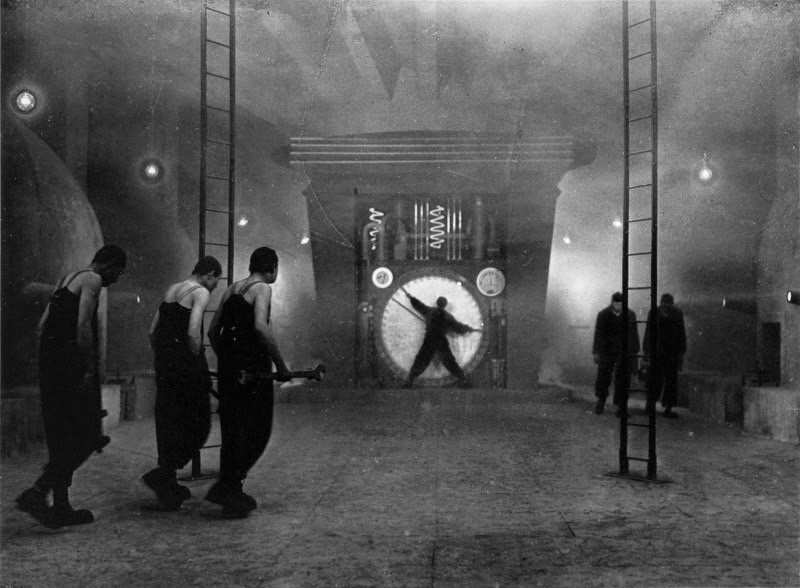
As Freder explores the world below he finds a dispirited
mass of workers regimented to the level of machines used to feed the immense
foundries that bring light to the gleaming spires above.
Maria is one of those who bring hope, imploring her fellow
workers to pray for their saviour: someone who will provide the heart to link
the head in the clouds to the hands in the dirt. They meet in darkened caves as
she preaches in front of a collection of crosses: has religion been outlawed in
the future… driven underground.
 |
| Herr Rasp and Alfred Abel |
But Joh Fredersen has no intention of sharing power or
loosening his grip on the populace – he rules with authoritarian efficiency
using a network of spies and secret policemen such as the sinister Thin Man
(Fritz Rasp… has ever an actor been so perfectly type-cast by their name?).
They rely on surveillance and betrayal to keep order… sadly this was to be the
real future.
But order starts to break down as Freder becomes radicalised
by what he sees underground and driven by his growing love for Maria returns to
the underworld. Realising this, a desperate Joh Fredersen enlists the aid of
Rotwang (Rudolf Klein-Rogge) – the maddest of mad scientists who still mourns
the love of his life Hel, the woman who died giving birth to Joh’s son Freder.
 |
| Jon and Rotwang hatch a plan |
Rotwang has built a robot – Maschinenmensch - intended to
give some kind of life to his beloved but which he now turns to another
purpose: the corruption and destruction of the City. He will turn the worker’s
hope into a catalyst for their hate whilst at the same time using her facsimile
to push those over ground into a frenzy of lust and greed.
It’s going to be a long night.
I watched the BFI Blu-ray which features the Argentine
footage found in 2008 which makes the story almost complete and much more
understandable. The original score from Gottfried Huppertz is revived in
stirring form and it’s wonderful to hear the original soundtrack for a silent
film of this magnitude.
The most expensive film ever made by UFA and one to rival
Hollywood’s excesses, Metropolis
turned out to be a flop at the time – even 7500 extras couldn’t guarantee
success… but this wasn’t entirely the fault of Lang’s vision. The American’s
cut it down for being too long whilst certain, more communistic sections were
excised in Germany. The Argentine film was a complete copy but two scenes
featuring a monk preaching in the cathedral and the fight between Rotwang and
Joh Fredersen were too badly damaged to resurrect.
What remains is now almost whole and one of the genuinely
great silent films: a fable about the future from the past that says so much
about the present in which it was made. By 1933 Thea von Harbou had joined a
party intent on mediating from the head through the heart to the hands… She and
Lang divorced and he headed off the America: the land of the free and the home
of the high-rise.
The BFI Blu-ray/DVD is readily available direct or from
Movie Mail and those
Amazons… but you’ve probably already got it.