Showing posts with label The Saga of Gosta Berling (1924). Show all posts

Tuesday, 30 December 2025

Yet another Top Ten, 2025 in live silent cinema...


Have you noticed that there are more and more best-of lists this year? Most are aimed at generating engagement either with heated debates on the socials or via ecommerce, but some are just the outpourings of unquiet minds, butterflies who just need to bring some order at this disturbing time of the year between normal service and Christmas’ mourning. This is one of those, it punctuates the space between regular rants about live screenings and hot digital media – or lukewarm in the case of the last post. So, here we go after the year in which I published the THOUSANDTH post on this blog and crossed the one MILLION words mark… I’ll try be brief.


Gösta Berlings saga (1924), BFI with John Sweeney


January was the hottest month as a cool breeze blew in from Sweden as the BFI screened the SFI’s restoration of Mauritz Stiller’s adaptation of Nobel laureate Selma Lagerloff’s novel. I was honoured to introduce the film and to interview Sonja Kristina, the granddaughter of Gerda Lundequist (who played the matriarch of Ekeby), who then attended the event with her children and grandchildren.


The film is long and may have its faults but it is a major work and features Lars Hanson, the young Greta Gustafson and my favourite Silent Film Principal Dancer/Actor, Jenny Hasselqvist. The restoration looked stunning bringing new vibrancy and order to the film and, cometh the three hours cometh the accompanist - John Sweeney topped things off with energy and invention, as ever the perfect player for the long dance!


Dans l’Hellade / In Ancient Greece (1909) from Christopher Bird's collection

Museums of Dreamworlds… Kennington Bioscope Programme of Antiquities


This was a collaboration between the Bioscope, the BFI and the Department of Greek and Latin, at my daughter’s alma mater, University College London as part of Museums of Dreamworlds: Silent Antiquity in the BFI National Archive. Introduced by the BFI’s Bryony Dixon, and presented by Professor Maria Wyke from UCL it was a selection of films from 1901 to 1927 all of which drew their inspiration from the classical world of Greece and Rome – very loosely in some cases!


Most of the films were from the BFI’s archive with one - Dans l’Hellade / In Ancient Greece (1909) from Christopher Bird’s collection on 28mm digitally scanned by the Cinema Museum. The project asks “…how did silent cinema design its Greek and Roman dreamworlds? What did cinema gain from recreating the distant past? What did the past gain from being recreated in moving images?” On the night, we found some answers and some more questions and we also discovered how Helen’s fabulous face and fancy for the tailors of Troy led to the war between Sparta and Troy: even now we know these stories so well we can understand these jokes.


A 1919 Erdmann with colour filters!


Early Colour Live!, Birkbeck University with John Sweeney, Christopher Bird and Iain Christie


Another collaboration and a set of early colour films on celluloid from Chris Bird’s collection and hand-cranked by the man himself on his own projector. We saw hand-coloured film that would have required sixteen images hand colouring for every foot of film equating to one second, Pathé’s pioneering stencil colour system, William Friese Greene’s Biocolour and more all revealing the sophistication and relentless innovation of cinema’s first decades.


Such treats do not come around very often and here’s hoping for more from the gang in 2026.


Inka Länta

With Reindeer and Sled in Inka Länta’s Winterland (1926), Hippfest at Home, Hippfest #15


I wasn’t able to get to Falkirk this year but luckily was able to enjoy the online edition. As online presentations go, Hippfest at Home is perhaps the most successful in capturing the atmosphere and the feeling of actually being there. You have establishing shots of the live introductions shot from the back of the stalls showing the lovely old stage of the oldest cinema in Scotland, the Hippodrome (1912) and then the option of seeing the film and the musicians accompanying. As always, Alison Strauss leads from the front with such relaxed expertise and enthusiasm – this kind of impassioned poise is reflected across the whole team who love the films but also the audience and the combination is what makes this impossible festival work so well.


Pick of the pics was this dramatized documentary about the reindeer herding lives of the Sámi people who co-existed with them in the most precarious of ways in the far north of Sweden, across Scandinavia and even into Russia. The screening encompassed Sámi old and new with the UK premiere of a new score by Sámi-Finnish joiker and electronic musician Hildá Länsman plus sound designer Tuomas Norvio, collaborating with the Norwegian Sámi musician Lávre Johan Eira and Swedish composer, cellist and bass guitarist Svante Henryson. Traditional forms of Sámi song – “joik” - were deployed alongside moder instruments and electronica to create a visceral and sometimes startling score to this restored documentation of this remarkable people.


Hotel booked; I look forward to the 16th Edition in March!


Betty Balfour

The Sea Urchin (UK 1926), with Colin Sell, 8th Kennington Bioscope Silent Film Weekend


April and it was time for an early breakfast and the finest coffee that Lambeth can provide as we dove into this mini-Giornate del cinema muto in Charlie’s old workhouse home. Highlights came thick and fast and included the World Premiere of the new Nasty Women full programme, Breaking Plates and Smashing the Patriarchy, with Colin Sell, presented by Michelle Facey. There were British films, Boy Woodburn (UK 1922) (35mm) with Cyrus Gabrysch playing, introduced by Lawrence Napper and with Ivy Duke and Guy Newall on screen, along with rare US prints, Clive Brook in The Yellow Lily (US 1928) (35mm) with Ashley Valentine and introduction by Liz Cleary


My favourite was The Sea Urchin (UK 1926) (35mm), with Colin Sell and introduced by Lawrence Napper which included Britain’s Queen of Happiness, Betty Balfour (more of whom is coming in ’26 with a recently rediscovered film… check out the KB website!). It was a proper delight with The Sea Urchin in question being our BB’s Fay Wynchbeck who as the film starts is a disruptive student in a Parisian girls’ boarding school. Her singing and dancing leads the other girls slightly astray and there’s a fabulous shot of their after-hours partying through the keyhole which Alfred H would have been lauded for. Fay has rich relatives but there’s a family feud in her way… I swear Colin Sell laughed at parts as he played along with glee!!


Christopher Bird at the EMG gramophone (picture from Lynne Wake)


Un Chien Andalou (1928), 35mm nitrate, live 78 RPM DJ Chris Bird, BFI


June was a mixed blessing as I couldn’t make it to Cinema Ritrovato but at least I had the BFI’s Film on Film long weekend to provide the look and feel of nitrate and celluloid! This was a wonderful weekend with lots of colourful treats and my chance to stay awake (see original post in October, 2017) for all of Lubitsch’s wonderful The Student Prince of Old Heidelberg (1927), but my favourite live cinematic experience had to be the surreal presentation of Bunel’s masterpiece in NFT1.


"NOTHING, in the film, SYMBOLIZES ANYTHING. The only method of investigation of the symbols would be, perhaps, psychoanalysis." [Luis and Salvador...]


Luis Buñuel’s original score was a “mash up” – as The Kids now say – of Argentinian Tango music with Wagner et al, thereby inventing Classical Lounge Core without knowing it. Chris Bird, who collects shellac as well as celluloid, was tasked with cutting from one to the other by playing contemporary pressings on two 78 rpm turntables, one of which was a top of the range EMG machine from 1932 which produced remarkable clarity and range. It was the hip-hop triumph of the season and exactly the kind of madness the creators wanted!


Anna May Wong in The Thief of Bagdad

 The Thief of Bagdad (1924), with Neil Brand, BFI Anna May Wong: The Art of Reinvention


The BFI’s Anna May Wong season was my favourite of the year and included one great day in which I caught up with her in two of the great silent fantasy films which I had been waiting to see on film and on screen. Peter Pan (1924) caught the eye with JM Barrie’s hand-picked pocket rocket betty Bronson and its closeness to the original play as well as accompaniment from Costas Fotopoulos but The Thief of Bagdad (1924) featuring a dazzling Douglas Fairbanks and epic accompaniment from Neil Brand featured more AMW and was on such a scale it have NFT1 buzzing!! I could happily watch both films every day of the week!


Italia Almirante Manzini abides

Zingari (IT 1920), with Günter Buchwald, Elizabeth-Jane Baldry and Frank Bockius, Le Giornate Del Cinema Muto 44


This was the pure diva pomp and circumstance of Italia Almirante Manzini playing the Queen of the Gypsies in Zingari (IT 1920) and it brought the Teatro Verdi to its feet with a combination of on-screen energy and the startling accompaniment from a super group comprised of Baldry, Buchwald and Bockius or BBB for short. The film tells the story of Vielka, daughter of the Gyspy King Jammadar (Alfonso Cassini) who is fierce and unruly, determined to sacrifice everything for the man she loves, Sindel (Amleto Novelli) even though he is from a rival clan and physically puts the old man in his place when challenged, starting the feud that runs the entire narrative.


Vielka is supposed to marry Gudlo (Franz Sala), who’s not a patch on Sindel so no wonder she burns their farmhouse and gets herself exiled. Will there be any happy ending, do operas ever have happy endings? Günter let loose his inner gypsy on violin and the others followed on with one of the most passionate accompaniments of this year’s Giornate!


The German Retreat and Battle of Arras (GB 1917), Laura Rossi, Le Giornate Del Cinema Muto 44


Made when the Great War looked like it might be winnable and has a propagandist purpose beyond earlier films in showing the changed momentum of the conflict to those back home. It is also historically significant for the events it memorialises, the techniques it uses to do this and its intent.. Geoffrey H. Malins was director of photography as he had been for the two Somme films and this film is another great technical achievement and awe-inspiring in the greater context.  It didn’t feel triumphant though, more grimly determined to help complete the job and this was partly down to the excellence of Laura Rossi’s musical choices.


Laura has scored for the other films and was on hand to hear her new composition played in the Teatro Verdi by the Orchestra di Pordenone & Coro del Fruili as conducted by Andrej Goričar. Her score enabled us to really see the film, devoid of any post-facto contextualisation, in ways that were connected to the original intent. She allowed us a bit of both but underscoring the documentation on display to allow our own interpretation – a most historical musical agenda, incredibly effective and created.


Lillian Gish

Way Down East (1920), with Stephen Horne, BFI, Too Much: Melodrama on Film


Another film that anyone professing to blog about silent film should surely have seen already but as with the two above, I’ve been waiting to see it “live” on film and with an ace accompanist. I was not disappointed and am persuaded that Lillian Gish probably influenced Griffiths’ development of the story. Working not only with the best actor he also had one of the best cameramen and had clearly been watching the works of Sjostrom and Weber as this story is uncompromising. It’s also a surprise to see the film take the approach it does to Gish’s unmarried mother character and, indeed, to see her fight back against the guilty party: This man – an honoured guest at your table – why don’t you find out what HIS life has been?


This feels more Gish than Griffith but either way it’s a direct hit on the Patriarchy where you least expect it. Anna’s driven by a rage of frustrated indignity at the unfairness of her situation and the fact that through no fault of her own she is denied happiness in the arms of the man she actually loves – played by Richard Barthelmess.


Stephen Horne provided yet another one-man orchestral score off the hoof and covered this film’s vast space and time with constantly evolving mood and melody all played on three or was it four instruments with just the two hands, or so he says!


The UK forecast...


Thank you to all who have programmed, played, introduced and archived this year, lets do even more in 2026 as I write my way towards my second million words…


Thursday, 16 January 2025

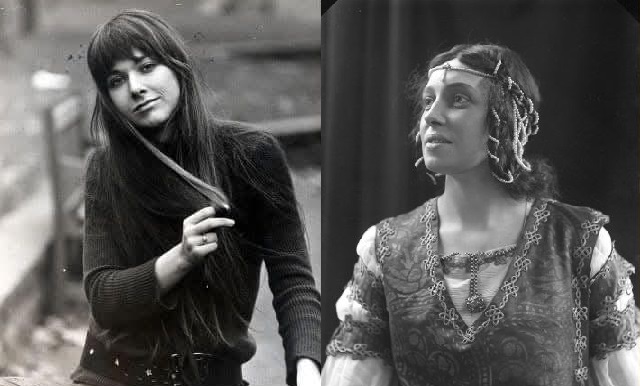
Gerda Lundequist and Sonja Kristina – the Gösta Berling connection

Sonja and Gerda - generational talents


It’s strange the connections you make in your life as well as in silent film which, after all is history itself and not just a representation of past events. Without knowing it at the time, I spent a number of pleasant afternoons in the company of Cecil Hepworth’s daughter Elizabeth Barbara – the young star of Rescued by Rover (1901) and her sister Margaret as my friends were renting their basement in the 1990s.


It was also a surprise a few years ago, to see Sonja Kristina, the pioneering singer, actress and leading lady of progressive rock, folk and beyond, posting on Facebook some year’s back about her Swedish grandmother Gerda Lundequist, a Swedish stage legend and the star of Gösta Berling's Saga which, as I think I mentioned is screening this Sunday 19th at the BFI! Knowing the connection, I asked Sonja for a few memories about her grandmother and it seems the “performance gene” runs strongly in their family!


Born in 1871, Gerda was the daughter of a hairdresser but was fostered by her mother’s sister a manufacturer’s widow. She had theatrical ambitions from an early age and she was enrolled in theatre school in Stockholm at just 15. At this stage in her own career, Sonja had already started singing in folk clubs and, also in her teens, enrolled at the New College of Speech and Drama before staring in the theatrical version of Hair along with the likes of Paul Nicholas, Elaine Page and the late Diane Langton.


Gerda Lundequist in costume in 1906


Gerda’s professional debut was at Svenska teatern in Stockholm 1889, and her breakthrough soon came her portrayal of Kristina in August Strindberg’s Mäster Olof at the old Royal Dramatic Theatre in Stockholm. She was soon starring in almost every conceivable major role in plays from Ibsen, Schiller, Moliere, Shakespeare and others establishing herself as Sweden’s finest actress and it must have been a huge coup for Mauritz Stiller to get her for the role of as Margaretha Samzelius, the matron at Ekeby in Gösta Berling.


Gerda’s daughter Cecelia married an English criminologist called Shaw and moved to the UK. Sonja remembers meeting her on a number of occasions:

I was 10 years old when Gerda died in 1959… she had come to stay with us in England when I was 6 and we visited with her in Stockholm and at her summer home.


Gerda’s professional reputation was one of strict principles and, not enjoying interviews, she soon refused all offers and was a very private person, protecting herself and her family from intrusion. Yet she was also described as a very warm and humorous person by those who did know her and this is confirmed by Sonja’s recollections:

I remember her sitting at my mother’s dressing table brushing her beautiful long auburn tinted hair before braiding it and putting it up. Her perfume was lovely and I will always remember the aroma of her favourite digestive biscuits with honey that she enjoyed as a night-time snack.


Sonja Kristina


Gerda was an ardent supporter of female emancipation in Sonja’s words and she was able to support talent through her work as artistic director at Helsingborg City Theatre and then later as a teacher at drama schools. She contributed to the independent women’s education centre Kvinnliga medborgarskolan vid Fogelstad, for which she was also a member of the board of trustees.


Sonja describes the school as a feminist and that her mother, recovering from TB, shared several stimulating and entertaining months with Gerda and her students at Foglestad.


She also relates the tutoring and encouragement she had from Gerda and her hugely experienced eye for talent: She liked to listen to me sing and encouraged me with gentle instruction on breathing technique and interpretation.


She remained such an important figure in Sweden hosting celebrity soirees at her apartment and performing on radio and television right up until the late fifties. Sonja’s mother was frequently asked for autographs by school friends and no doubt, had she grown up in Stockholm, the same would have been true then.


Gerda with Greta Garbo in Gösta.

But to Sonja and her family, the private side of her grandmother was no less precious and, especially the playful bond they developed.

Gerda was so mischievous, making grand entrances at public gatherings. Stopping traffic in the street to talk to horses - and policemen.


She was perfectly cast in Gösta Berling's Saga and, also, it seems as a mother and grandmother.


I am delighted that Sonja and her own grandchildren will be attending the screening on Sunday 19th and I hope you will too and witness one of the finest actors of the last 150 years pouring decades of experience into one of her precious few cinematic appearances!


You can book your place here!


The cast of Hair in 1968, Sonja spent over two years in the show, here on the lower right!


Sunday, 29 December 2024

Look sharp! My year in silents, 2024.


As Millicent Martin – Daphne’s mum in Frasier – almost sang, That Was the Year, That Was and I realise that’s a cultural reference to a satirical TV show popular in the UK 60 years ago but the films I’m about to list are from half a century earlier so… keep up! We’re increasingly in a world in which everything is happening at the same time, an all-at-once cultural smorgasbord from which every generation picks what they want and new controversies rise from old in cinemas, Talking Pictures TV, $treaming sites and our beloved retailers. This is the best I can do in the post festive drop down especially as I don’t really do New Year. It’s always best to look beyond and push straight on through to the other side, even if that’s 2025 and all that goes with it but we can take it, we’ve not only been there and seen it all before, we’ve experienced it ever-present in films, books and what used to be called “social” media. So, I remember the passing year and rage into the next, thinking of the very best in my opinion and in no particular order!


1.       Get Your Man (1927) with Meg Morley, BFI


She will make a fine wife, son. Imagine an innocent young girl… in an age when there aren’t any!


The BFI kicked off the year with a couple of fine seasons, one focused on the iconoclastic programming of the old Scala cinema and another on the almost unique filmography of director Dorothy Arzner who was able to smash the Hollywood glass ceiling with a mixture of brilliance and independence. She worked with Bow on her first talkie, The Wild Party (1929), also screened, and this rarely-screened gem which was shown on a precious 35mm recovery/restoration and even though it’s still missing a couple of reels, still impressed as Clara’s supernatural energies were allowed full expression


It was indeed, as the BFI blurb put it, “a triumphant celebration of female sexuality…” a modern day fairy-tale set in France and where Bow’s character wins over the heart of rich boy Charles “Buddy” Rogers in a lovely sequence set in a wax museum choreographed by Arzner’s partner Marion Morgan. Clara’s pluck blows away every obstacle and dusty preconception as l’ancien régime has to surrender to classless, young love.


2.       The Rugged Island: A Shetland Lyric (1933), with Inge Thomson, Catriona Macdonald, HippFest at Home


This film sits amongst better-known works of the thirties showing island life on the extremes but actually predates Robert J. Flaherty’s docudrama Man of Aran (1934) – the Irish island, not Arran. Director Jenny Gilbertson (née Brown) had made a number of short documentaries and was encouraged to make this film by the great Scottish documentary filmmaker John Grierson, director of Drifters (1929) and the man who coined the term "documentary" in a review of Flaherty's Moana (1926).


The result is every inch as powerfully evocative as these other films with Jenny’s previous experience of the island, the documentary A Crofter’s Life in Shetland (1931), showing a year in the life of the rugged folk of Hjaltland… more Norse than Gallic and only 30 miles closer to Scotland than Norway. She was self-trained and this is even more remarkable when you consider that she not only wrote but filmed and edited her work. The Rugged Island is a drama and yet it still feels like a genuine intrusion on the lives being portrayed, the irony here being that Gilbertson’s was sometimes described as an “amateur” and yet clearly she was consummate in terms of technique and direction with only one professional actor - Enga Stout – with the rest being her friends and others she’d cast locally.


This is exactly why I shall be returning in person for the next Hippfest in March ’25!


3.       East Lynne (1913) Restoration Premiere with Colin Sell, Kennington Bioscope


Oh, Willie, my child dead, dead, dead! and he never knew me, never called me mother!


As Christopher Bird said in his introduction, East Lynne is not a lost film as such but when quality is, as Kevin Brownlow says, the main thing archive cinema has to sell itself to modern audiences, this film has certainly been missing in terms of the vibrancy, contrast and tasty tints we glimpsed today. Chris obtained an almost complete nitrate copy from a private collector which, compared with the black and white copy held by the BFI is missing the first reel but comes with an extra three minutes and those higher quality tints. Together with fellow Bioscoper Bob Geoghegan and the BFI the restoration work is ongoing and the hope is to present the finished item at Le Giornate del Cinema Muto in Pordenone.


Even Rachel Lowe admired this British film and it’s a visual feast as it is with good use of depth-of-field, form and texture by director Bert Haldane and his photographer Oscar Bovill. That said, there are some impressive performances from a very modern-looking cast led by Blanche Forsythe as Lady Isobel, handsome Fred Paul and the steadfast Archibald Carlyle and who-ever it was playing Barbara Hare, the sister of the man falsely accused of a murder committed by Isobel’s would be paramour, Captain Levison, as played with pantomime menace by Fred Morgan.


This screening was part of the Bioscope’s 7th Silent Film Weekender and it’s hard to compete with the range and passion of this gathering of like minds in Charlie’s old workhouse.


4.       The Phantom Carriage (1921), with Stephen Horne, Kennington Bioscope


After a few years of this silent film business, you have seen most of the cannon and have your own list of The Greats but all such classifications are blown out of the window when you see a screening like tonight’s with the right venue, the right audience and a supernatural accompaniment from Mr Stephen Horne that not only sent chills but brought out the full flavour of Victor Sjöström’s film and, indeed his own performance.


Not only was Sjöström probably Sweden’s finest silent film maker, he ranks as one of the finest of any era. Here with his fourth adaptation of one of Selma Lagerlöf’s works, he shows again why he is such a good interpreter of her work. Selma’s work is passionate and poetic and deceptively complex in expression and narrative form but I think Sjöström got her depth of meaning more than his contemporaries Stiller and Molander. As his thoroughly-disturbing performance shows, he may well have had a personal connection with this story as Chris Bird suggested in his introduction, for the Swede’s father was abusive and alcoholic just as his character David Holm. A film that never ceases to smash through the door and grab you.


Gerda Lundquist


5.       Gösta Berling’s Saga (1924), with Matti Bye, Eduardo Raon and Silvia Mandolini, Il Cinema Ritrovato XXXVII


"Finally, the vicar was in the pulpit..."


It’s fair to say that my Christmas came early with this presentation of this latest version from the Swedish Film Institute which is not just a restoration of the Saga but a remix and extended cut being not only some 20 minutes longer than the 1975 restoration which most of us have only seen up till now via the Kino release. It’s also in a slightly different narrative order with the party sequences and their two dramatic exiles re-sequenced as well as variations elsewhere, with a more dynamic mix for the burning of Ekeby and Gösta’s rescue of Marianne, a longer intro and new intertitles that carry more of the original author’s poetic wonder.


Now, I’m not saying that Mauritz Stiller’s magnificent adaptation of Selma Lagerlöf’s epic novel is perfect in fact there’s a reason he was no higher than her second favourite film director of the Nobel Prize winning author*, but the ambition wins you over along with incredible lead performances. Lars Hanson oozes confusion guilt and self-loathing, Gerda Lundequist – Sweden’s Sarah Bernhardt, a legendary stage actor – brings her power and poise to the screen whilst Jenny Hasselqvist, who had a parallel career as prima ballerina with the Royal Swedish Ballet, is magnetic, micro-managing physicality with emotional expression. There’s also young Greta Gustafson who radiates an unknowing allure that would see her soon off to Hollywood with a name change, some dental work and flattering lighting.


The restoration is crisp and revelatory, never has the camera work of the great Julius Jaenzon here looked so fine from the gorgeous sweeps of the lakes and forests to the shots on set and the performer’s expressions. It’s an epic restored in an epic way and I can’t wait to see it again at the BFI on Sunday 19th January where I promise to keep my introduction short and to the point!


Ticket details here!


6.       Judex (1915-16), accompanied by many hands, Il Cinema Ritrovato XXXVII


I can’t deny that there was a sense of triumph having watched the whole series and thoroughly enjoyed Louis Feuillade’s sense of drama, his eye for dynamic framing, his direction and team building and his ability to keep the narrative ball rolling even when you think he’s backed himself into a dramatic dead end. That’s 12 episodes and one big Prologue with not a second missed for lack of sleep, breakfast or headache… probably!


It's not quite up there with Les Vampires but it does have the essentiality of Musidora playing Diana Monti aka Marie Verdier, a scheming opportunist who becomes more and more dominant the longer the story unwinds. Judex himself as played by René Cresté, is a goodie version of Fantômas, part Sherlock Holmes, maybe part Eugène-François Vidocq – an actual French criminal turned criminalist. Feuillade had been criticised for glorifying his evil masterminds and so here was one of good intent even if he does kidnap and fake the death of the businessman responsible for his father’s death and many others, Favraux (Louis Leubas) before imprisoning him for life in a remote castle. And that’s just the start…


7.       Love ‘Em and Leave ‘Em (1926), BFI with Meg Morley


This blog has been driven by obsession and a subjective emotional “canon” from its earliest days (no, please don’t look!) and Louise Brooks has, of course been the main one, with a copy of Pandora’s Box on DVD bought from a second-hand shop in Park Street, Bristol in 2005 starting off the whole interest – yes, Bristol, it’s really your fault! This film is one of the few remaining unseen on-screen and viewing the BFI’s worn, warm and wonderful 16mm flickering on the NFT2 screen, with Meg Morley’s wonderful syncopations and sparkling improvisations following an introduction from Bryony Dixon has, to paraphrase the poet, helped make not only my day, my week, my month and even my year.


They may have been chalk and cheese but Evelyn Brent and Louise Brooks make for a good team in this light-hearted drama in which the former plays the sensible big sister who has to rescue her less sensible sibling from all kinds of trouble. It’s a gas and we do get to see Brooksie dance which is always a bonus!


Conchita Montenegro


8.       The Woman and the Puppet (1929), with Günter A. Buchwald, Bonn Silent Film Festival 2024 streaming


Every so often a silent film not only surprises you but pulls you to the edge of your armchair and has you blinking at the screen in delight. So, it is with the story and the actress in La femme et le pantin (1929) in which Conchita Montenegro’s dancer not only beguiles and bewilders her puppet, Don Mateo, she completely un-mans him in the most feminist of ways reaching right out from 1929 with dazzling power and beauty. If anyone has a thousand ships that need launching… here’s your woman!


Based on Pierre Louÿs’ 1898 novel of the same name, the story was adapted as an opera in 1911 by composer Riccardo Zandonai, and it was also filmed as That Obscure Object of Desire (1977) by Luis Buñuel. The first film version was an American film made in 1920 and directed by Reginald Barker, starring Geraldine Farrar, which is a little surprising given Louÿs’ background of erotic prose and poetry. Indeed, he was the man to whom Oscar Wilde dedicated the original French publication of Salome. Director de Baroncelli’s film is presumably far bolder than any Hollywood film could have been as, indeed, is his star performer and, it’s difficult to see anything like a literal adaptation being made anywhere else but France at this time. It is an eye-popping and an expectation-confounding work!


9.       The Blue Bird (1918) with Neil Brand and Elizabeth-Jane Baldry, Le Giornate del Cinema Muto


Maurice Tourneur's film featured regular collaborators such as art director Ben Carré, cinematographer John van den Broke and editor Clarence Brown. This was silent psychedelia in full bloom at a time when the World needed to believe in eternal truths and the truth of eternity. When in the heart of their fantastic journey to find the Blue Bird, the two youngsters meet not only their dead grandparents but their dead brothers and sisters, there are at least ten of them... this was a time when infant mortality was high and life came with the flimsiest of "guarantees".


The film is a sumptuous collection of such moments and visual set pieces, a hyper-creative comfort blanket that smuggles through the simple message that there's not only no place like home but that kindness must spread out from there into the heart-broken World beyond. Tourneur draws pure and naturalistic performances from his cast of children, 12-year old Tula Belle as Mytyl and Robin Macdougall as Tyltyl who react and act with genuine thrill to every new wonder. It's a child's film with many adult concerns.


The accompaniment from Neil Brand on piano and Elizabeth-Jane Baldry on harp brought the magic out across the auditorium and melted our stubborn hearts.


10.   Saxaphon-Susi (1928) with Neil Brand, Frank Bockius and Francesco Bearzatti, Le Giornate del Cinema Muto


Miss Saxophone was the most legal of highs, a mood-altering event with fabulous cast and sincerely joyous accompaniment from a powerhouse ensemble that left the Teatro Verdi at severe risk of an outbreak of dancing! Up on screen we had Anny Ondra showing us how fine she could look and how well she could dance and also make comedy – not for nothing should she have been called the Czech Republic’s Queen of Happiness or maybe most of Europe’s. She plays Anni von Aspen, a poor little rich girl daughter of the lecherous Baron von Aspen (the marvellous Gaston Jacquet) who wants to trade places with her working gal pal Susi Hille (Mary Parker), a cabaret dancer who gets the chance to become a Tiller Girl in London. They swap assignments with Susi heading off to posh school and Anni having to learn her dancing ropes fast.


On the boat over they meet some fine English gentlemen including Lord Herbert Southcliffe (Malcolm Tod) who takes a bet that he can get in to meet the Tiller Girls backstage and then another bet that he will marry this special one called Susi (Anni)… It’s not much of a plot but it’s enough to make this amongst the most enjoyable and warmest of comedies with this fabulously charming cast.


Any programmers reading… I think I’d like to see this one again please! 


Ra Messerer


11.   The Second Wife (1927) with Gunter Buchwald and Frank Bockius, Le Giornate del Cinema Muto


To Uzbekistan and this extraordinary film from Mikhail Devonov based on a story by Lolakhon Saifullina, a polish woman who married an Uzbek man and converted to Islam. It’s a reflection of the enormity of the old USSR and the challenges Moscow faced in co-ordinating so many diverse cultures into one modernising state. Saifullina worked for the Sharq Yulduzi studio writing scripts sensitive to the issues of Uzbeki women her along with former legal consultant Valentina Sobberey. The result is a tale in which women and children are exploited by old male custom and dominance even as the modern day watcher is aware of the wider context of Stalin’s impending first Five Year Plan and the eventual costs of converting an agrarian economy into an industrialised one.


Director Devonov does not lapse into bucolic orientalism and focuses on the story and the depiction of prevalent practices of early marriage and polygamy. Here a merchant’s first wife Khadycha cannot have children and so he has a second wife, Adoliat (Ra Messerer) who can.  A child duly arrives and Khadycha tries to destroy her competitor. She is far from alone in malevolence as his brother Sadiqbai (Mikhail Doronin), steals money whilst his older brother is away and also preys on young boys, as things escalate elsewhere. It’s propagandist but still shows the harshness of unresolved “tradition” and male power.


Eille looks down at Alexandra Palace, photo credit Yves Salmon 

12.   Silent Sherlock, London Film Festival, Alexandra Palace Theatre with Neil Brand, Joseph Havlat and Joanna MacGregor with Royal Academy of Music Soloists Ensemble


This was the grandest of archival screenings at the London Film Festival for some time and featured the first fruits of the BFI’s restoration of Stoll Films Sherlock Holmes films. The Stoll corporation made three series of 15 episodes and two feature films, all featuring Eille Norwood as the great detective a performer that Conan Doyle approved of in the role, both on stage and on screen. The three films featured new scores from Neil Brand, Joseph Havlat and Joanna MacGregor who conducted the Royal Academy of Music Soloists Ensemble, leading from the piano.


The programme is ongoing and I can’t wait for the further adventures of both the BFI Restoration Team as well as The Great Detective in 2025.


My 1924 Danish promotional booklet... Book Now for 19th!!


*Lagerlöf berated Mauritz Stiller for his adaptation of The Gösta Berling Saga calling it “cheap and sensational”.

Sunday, 5 November 2017

Atonement… The Saga of Gosta Berling (1924)


“You won’t escape by turning yourself into a beautiful corpse…” says Lady Margaretha Samzelius as she saves Gosta Berling’s life. “Don’t you know that most people are dead already… Do you think I’m alive Gosta Berling?” Revived by a misery shared, Gosta scrubs out his suicide note and declares: “Life must be lived! One has to move on!” 

The Saga of Gosta Berling is about redemption but mostly it’s about the human frailties that make it necessary and the weaknesses in society. Not all can be put right in a life and this powerful, complex story, based on a huge novel published in 1891 by Selma Lagerlof, takes its own time in deciding on outcomes with the film coming with a ready-made break about halfway through its three hours running time.

“It was a disgrace to love him, a disgrace to be loved by him!”
It is, of course, the film that originally got Greta Gustafson noticed before Pabst put her into his Joyless Street and she could avoid the call of Hollywood no longer. Her director in this film, Mauritz Stiller, went with her but it was only ever Greta they (probably) wanted and, unlike his friend and fellow director, Victor Sjostrom, Stiller never really got to show what he could do in an American studio.

Here, Stiller makes relatively light work of this sprawl of a story thanks in no small part to a very strong cast featuring three of the very best stage-Swedes plus the young girl from the department store who, every time I watch this film, still looks like a learner for all her visceral impact.

The film is centred on the great house of Ekeby, situated on Lake Lofven, in a glorious-looking Varmland with its “blue mountains… dense forests and foaming streams…”. Here there is a wing occupied by landless knights: “men lacking purpose… knaves, noblemen and former officers. Their past may be shady, but all were knights of adventure, of the goblet and of gallantry!”

“I am a penitent, the highway is my home – the haystack my bed…”
Gerda Lundequist, grandmother of Curved Air’s Sonja Kristina as it turns out (and that explains so much!), was a performer of power and presence who had made her name on the Swedish stage where she was known as the Swedish Sarah Bernhardt. Now, I’ve only seen a glimpse of Miss Bernhardt in film, but Gerda has the clear edge by combining close-up subtlety with controlled use of the grand gestures of stage mime: she is so in touch with her character and very much in the moment!

Her Lady Margaretha carries the daily pains of a life crippled by forced compromise… She is a commanding figure, the lady of the House of Ekeby, and yet her temper finally snaps as she is reminded of the favours afforded to her by the lover she couldn’t marry (Altringer). One of the Knights of Ekeby, drunk and instantly regretful, torments her with this and she is exiled only to return and raise the house to the ground not only in revenge but also to burn the memories and wipe the slate clean: a new beginning for everyone.

“Tonight, their quarters will be destroyed and my shame erased.”
The film’s male lead is Lars Hanson and he has the make-up to prove it… He has a most un-Hollywood trajectory to follow from disaffected and alcoholic priest to joining the Knights of Ekeby, a similar bunch of ignoble failures who, unlike him, have run out of second, third and tenth chances. Hanson injects just the right amount of irresponsibility into the role and manages to burn bridges believably… he’s too honest to be a priest and to live in gentile society with its mannered hypocrisy. He has a nobility tainted by his love of drink and his willingness to surrender to failure along with these lords of misrule.

The cruel manoeuvres of Märtha Dohna (Ellen Hartman-Cederström who is another to give an excellent performance) who seeks to gain fortune by marrying him to her niece Ebba (Mona Mårtenson), forces further disgrace on Gosta who ends up close to the edge in that fateful meeting with Lady Margaretha.

Jenny with Sixten Malmerfelt and Karin Swanström
Then we have Jenny Hasselqvist, world-class prima ballerina by day and one of the most emotionally-subtle of silent actors by Klieg light. She has a face imbued with the same kind of depth and sorrows as Isabelle Huppert – someone who is always working but your darned if you can actually see it! Here Jenny plays a slightly spoilt rich woman who is cast out by parents after a dalliance with Gosta and then endures the ravages of small pox before emerging a more generous spirit. It’s good to see her go through this arc and she is such a fine technician; every movement of feature and form deliberated with grace and supernatural poise… (oh alright!).

In the end she lets the man she loves go so that he can save himself… All I can say is that I really hope it works out with the youngster Mr Berling!

An emotional control that is extended to an always-expressive physicality...
In comparison with these powerhouses Greta, aged 18 and in her first major role, looks a little lightweight but, of course, knowing what we know, you can see the raw talent that would soon make her a World star. Her character Elizabeth Dohna, arrives as the unfortunate wife of a foppish and useless husband and impresses more as events develop in complexity and her feelings for Lars’ Gosta are revealed. Greta’s a presence alright and Stiller brings out her innate skill in exuding hidden depths… Gosta’s been loved before but this we believe may be the deepest (and he’s bloomin’ lucky Marianne let him go…).

Greta
This is a huge film with sprawling narrative, great performances and the birth of the star Greta. The Kino DVD is from a aged digital transfer and the good news is that the Swedish Film Institute are restoring the film and it should hopefully be screened in 2018 with renewed visuals and additional narrative clarity  - the scene in which Gosta and Elizabeth escape from the wolves repeats some elements.

I look forward to seeing the full glory of Gosta Berling and to watching those performances in better detail. We all know about Garbo, silent fans know too Lars Handsome Hanson… but we need to make more noise about Jenny! As for Gerda Lundequist, she is a joy to watch and she deserves the recognition the restoration will bring. Gosta Berling was a gift for these actors and the fact it gives so much quality screen time to the women makes it all the more interesting.

"Don’t you know that most people are dead already…"