Showing posts with label Pola Negri. Show all posts

Monday, 8 May 2023

Primal Pola… Bestia (The Polish Dancer) (1917), FINA Blu-ray box


Pola Negri – Asta from Poland

Buffalo Bill…

She is a star in our homeland

Buffalo Bill…

Warsaw cabaret song circa 1917


This is the oldest surviving Pola Negri film but it’s also the only survivor of her Polish films made from 1914 to 1917 when she moved to Berlin to appear as the dancing girl in a German revival of Max Reinhardt's theatre production of Sumurun – she’d also been in a successful Polish run of this play in 1913 which got her noticed by Warsaw’s Sfinks film company. During the German production, she met Ernst Lubitsch, who would, of course, later direct her, and Swedish legend Jenny Hasselqvist, in a film version of that play, released in 1920 but, before that was Die Augen der Mumie Ma (1918), Carmen (1918) followed by Madame DuBarry aka, in the USA, Passion (1919) which was an international hit and opened the door even in America. A new wave of European sexual sophistication was about to blast past the Griffith Girls and their dated innocence, and, as it always does, Hollywood started acquiring as much Germanic talent as it could.


In 1917 it’s worth pointing out, especially after watching the excellent season of Jerzy Skolimowski films at the BFI and on their new Blu-Ray/DVD set, that Poland was, as ever, in political flux and divided between Austria-Hungary, Germany and the Russian Empire. Sfinks was the pioneering production company and was able to gain success through distribution to the Russian market. It’s no coincidence that Bestia, as directed by Aleksander Hertz – founder of Sfinks – has a similar style to Russian films of say Yevgeni Bauer and other pre-Revolutionary filmmakers, with largely static cameras capturing intensely well-choreographed players using every inch of the performance space in rich and layered sets.


Pola's Apache dance


Hertz was one of those who recognised the hit potential of Asta Nielsen in the Danish Afgrunden (1910) and their distribution of that film and that star to the Russian market, made enough for the company to start making its own films. Again, it’s no co-incidence at all, that Pola performs an Apache dance very similar to Asta’s, wrapping herself even more provocatively around her cowboy; a trained dancer unlike Die Asta also less of an actor perhaps but more of a natural Earth spirit. In Bestia she repeats a similar attempt to produce a Polish Asta in Slave to Her Senses (1914), sadly now lost.


Her acting was mainly based on the best example of the time, which was Asta Nielsen… We were imitating her characterisation. Big, black, boldly accentuated eyes, very pale face and lips – big, red and pouty. The acting technique was overloaded with expressive gesticulations which at the time was supposed to replace the dynamic of spoken words. Halina Bruczówna, fellow Sfinks’ star speaking in 1936.


Pola was just 19 when she filmed Bestia probably in the autumn of 1916 and the originally named Barbara Apolonia Chalupec, had already lived a lot of life, the daughter of an activist father who had fought against both Austria Hungary and the Russians, being sent to Siberia and costing the family almost everything as her mother struggled as a cook to bring her up. Ill health stopped her ballet career in her teens but she lied about her age to get into the Academy of Dramatic Arts where she obviously excelled at turning her lived experience into dramatic gold dust.


Ain't no party like a Pola party!


That this sole survivor of the actor’s early period survives at all is due to an American lawyer Jesse A. Levinson, who bought copies of Pola’s Polish films in the hope of capitalising on her success in his home country. He replaced the titles with new one in English and took out all references to the original filmmakers claiming the film as his own which whilst fraudulent, enabled it to survive whilst European chaos ended up in the destruction of most Polish films of this period. It’s hard to know what other editing decisions were made but as the EYE’s Elif Rongen-Kaynakçi points out in the fab booklet accompanying this release, it’s likely that the Apache dance may have had some of the more risqué moments excised.


What we see in this superb restoration from the Polish National Film Archive – Audio-visual Institute (FINA) is almost complete though at some 64 minutes long and is a richly satisfying example of a pure Pola performance, the Polish Asta indeed. Premiered in 2018, the institute have released a Blu-ray which I bought from the Cineteca Bologna which is a sumptuous box set complete with extras and a 58-page booklet in Polish and English.


Pola is electric throughout as if instinctively understanding the nascent art of film acting helped, as noted above, by the example set by Asta but there’s a difference between the two that does make the Pole present as more of herself. She’s Lubitsch’s wildcat already, sexy, witty, confident and with the biggest, blackest eyes in silent cinema. She’s more than able to catch and maintain our attention though joyful febrility and the feeling that she knows you’re looking and just why; well before Hitchcock she made voyeurs of us all. She improved as an actress without doubt but there’s few as explosively nuanced and more straightforwardly erotic humans ever been seen on screen.


Pola's room, complete with self-referential banners and photographs


Gathering myself I notice there’s a plot in which Pola plays Pola Basznikow, a young woman who enjoys the party life much to the annoyance of her father who paces around in a fury as Pola dances and drinks with friends. She nearly causes a fight between two competing males, before heading off with Dymitr (Jan Pawłowski) and from there to home. After a blazing row with her father, Pola decides to leave and enlists Dymitr’s help and finances to do it. The couple stay at an hotel run by untrustworthy friends of Dymitr and, sensing they’ll be looking for her to pay her way, she “borrows” Dymitr’s money and heads off on her own to Warsaw leaving the young man with vengeance filling in his heart and his empty wallet.


In the big city Pola soon gets noticed… and, after getting a job modelling hats, gets asked out by a customer who takes her to the ballet where she’s transfixed by the dancer on stage. Pola starts taking lessons herself and we switch forward to her as a rising star at the Cabaret Ardent. This is one of those skilfully constricted scenes within the frame of the static camera, customers sat at a table up front, tables in the middle ground and Pola on stage at the right. The scene shifts as the camera focuses on her dancing and the appreciation of those foregrounded customers one of whom is the playboy Aleksy (Witold Kuncewicz), smitten with what he has just seen but very much married to his wife Sonia (Maria Dulęba) with a daughter to prove it.


Pola knows none of this and begins an affair with Aleksy who furnishes her with an apartment and many fine dresses – the haute couture is delicious as it often is in films of this decade – fashion wasn’t democratised until the twenties but there was plenty of stunning design at play for the well to do. Alesky’s homelife is given sufficient attention to build up his conflicted stress and whilst this is a classic love triangle – with all the angles wresting on Alesky the Cheat – there’s enough to guarantee heartbreak.


And all the while, jilted and de-funded Dymitr has also made it to the city and is working as a waiter at the Cafe de Paris… 


Pola drives Aleksy mad but he's pretty dumb anyway


The restoration comes with a new score from film composer Włodek Pawlik whose jazzy score aims to reach across the century and to “…reflect the meaning of emotions and what is most important in real life and in the film… permanent values regardless of technology and time.” There are some funky surprises in the score which, the more I listened the more I grew accustomed to… heck, there’s plenty of ways to go wrong with a silent score but this is Pawlik’s view and it does settle down to a pleasingly upbeat groove with the film’s lovely visuals and Hertz’s maximisation of the drama and minimisation of the fuss: things go as they must but he makes sure we enjoy it for as long as possible. No spoilers mind…


Bestia is definitely worth seeking out to add to your Pola collection or indeed any collection of early film. It’s quite hard to find online, there’s someone selling copies on eBay but you can order from this Polish site if you can navigate the language.


Thursday, 30 May 2019

Humanising history... Madame Dubarry (1919), with John Sweeney, BFI Weimar Cinema

“I am an actor, and if I don’t play this part, I’m through with films! If I can’t play parts that I don’t look like, then I shouldn’t even be on the stage – I chose the wrong profession!”

Thus argued noted stage actor Emil Jannings on being told that he didn’t look regal enough to play King Louis XV in Ernst Lubitsch’s new film; four years later he would play the dilapidated doorman in The Last Laugh and he was, of course, eminently capable of playing the King. Lubitsch was so convinced he expanded the role and offered Jannings more work.

Made just a year after the Great War ended, Madame Dubarry was a lavish costume drama that was the most expensive film yet made in Germany. It led to director Ernst Lubitsch being labelled as the German Griffith and there are certainly parts of the film that show a debt. It's also possible that Orphans of the Storm – made three years later - was in part a response from the master to the younger man's smooth story-telling, controlled crowd scenes and subject matter. Lubitsch was more interested than DWG in “humanised” history, rather than simply finding identifiable emblems of “good or bad”… He concentrated on the impact on these events of a woman who barely comprehended her role in change, let alone the reaction she eventually faced.

Emil Jannings being "typically protean..."
There’s also not too much in common between Lillian Gish and Pola Negri... with the latter evincing an earthy humanity that convinces you that this humble seamstress could indeed earn the affection of aristocrats and Kings. In the US, the film was sold as her star vehicle, with little mention of its German origins: Polish star, “French story”.

Pola plays Jeanne Vaubernier a wild and carefree soul almost unconscious of her effect on men but with a pragmatic ambition driven by opportunism more than any political programme. She has a lover, Armand De Foix (an earnest Harry Liedtke) but sets her sights on any man of social standing who can offer her more. Thus, does she make her way in society first through the influential Don Diego then Le Comte Jean Dubarry and finally on to King Louis XV and the protean Emil. Jannings is measurably larger than life and seems to nailed the art of film acting very quickly, filling the screen with just the right amount of beaming charm along with the self-confident casual power that inhabits all the best monarchs.

A Lubitsch touch... the curtain reveals the opportunities now opening...
The pace of the story is so fast you wonder how things are going to develop beyond this point but life and French politics begin to overtake Jeanne. She gets the king to prevent Armand's execution and he becomes a member of the royal guard. At the same time she comes into range of the scheming Minister Choiseul (another great turn from Reinhold Schünzel) who hopes to advance his sister's position with the king. Meanwhile, France is a tinderbox of festering resentment at unfair taxes, food shortages and negligent aristocracy.

Jeanne and Armand meet and he is astonished to learn that she is the hated Dubarry; symbol of royal indifference and whimsy. "It is easy to forgive, " he says, "...but not to forget." Nevertheless, he gives her one last chance as he joins a band of proto-revolutionaries led by his friend Paillet. The situation is stirred up by both sides and Jeanne blows her chance by ordering Paillet's arrest. She is running out of friends and increasingly dependent on the King's favour. But, as his health begins to fade, the revolution looks ever more certain.


The action explodes in the last half an hour of the film and, having been focused on the individuals, the view is dramatically widened to show the revolt in the streets and the desperate battle of the citizenship against the army. As aristos hang from the lampposts, Jeanne is betrayed and sentenced to death: no one gets out of here alive.

Lubitsch shows much subtlety in focusing on character in telling this epic tale. There's a superb moment when Jeanne first arrives at Don Diego's house, her first taste of upper class living, as the curtain behind her pulls away to reveal the opulence of his cabinet. This shows the gap between the lives of the ordinary people and the nobles most effectively; why shouldn't Jeanne want to be part of this?

The director used over 2000 extras, and according to Herman G Weinberg in The Lubitsch Touch: a critical study (1977), he succeeds by making them act like individuals rather than a mindless mob… each one desperate for food, justice and crude revenge!

Motivated mob...
Madame Dubarry feels less melodramatic than an American film of the same period might have been and it’s more conflicted: you can feel sympathy for Jeanne without necessarily condoning her actions - she's not a pure white heroine by any means but she's true to herself even though she can't resist temptation. Try that one on for size Lil… there’s a worldly complexity in Negri’s approach that seems to come naturally and there’s an humour and charm working to humanise her selfishness.

Pola simply brings great energy to the role and, whilst there's the odd moment when she over-reaches, she's mostly naturalistic with a smile of pure unfettered joy. It's her innocent surprise at the benefits her looks bring that ultimately makes her likable. In the end you want her to be given one more chance even if the revolution demands that she must be punished.

One of Lubitsch’s best early dramas and told with a deftness that clearly got him noticed in Hollywood. As for Emil… he might had been a King but even he didn’t quite match the naturalistic brilliance and pure appeal of his Dubarry! His time would come later.

Harry and Pola in a tight spot
John Sweeney accompanied with regal assurance followed by revolutionary dynamism, pacing himself perfectly along the narrative as the film gets bigger and bigger to that devastating conclusion: Lillian is, of course, saved at the last from Madame Guillotine but there’s no mercy shown for Pola is bundled, unceremoniously to her death. Germany in 1920; if not an optimistic country then certainly a fatalistic one with, they hoped, no time for tyrants of any kind.

Madame Dubarry is an essential part of any Weimar “watch list”, and this is another reason to maintain calendar discipline and make sure you don’t miss a thing in the BFI’s Weimar Season – full details on the website.


Thursday, 24 May 2018

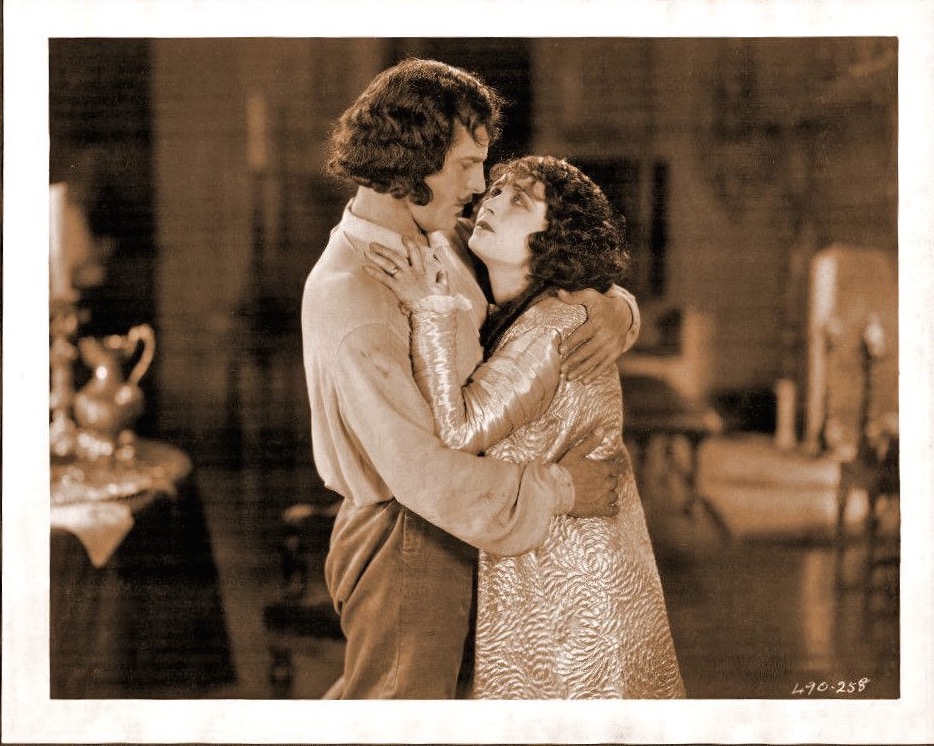
Her name was Pola … The Spanish Dancer (1923), with Meg Morley, Kennington Bioscope


Pola dancing, Meg Morley playing… it’s enough to make you forget the Lambeth Walk and  flamenco down the Kennington Road.

In his introduction, Amran Vance quoted Jeanine Basinger on Negri’s ability to present emotion throughout form and here her every extension was balletically convincing in a story which sometimes almost put the pain in Spain. You can’t take your eyes of Pola as she ignites the screen with a power and cultured restraint sadly lacking from Wallace Beery’s boorish performance as King Philip IV.

It’s an odd mix of humour and drama that never threatens to take itself too seriously, although if you think the way to a woman’s heart is to shoot her husband and then seductively surprise her on her wedding night; then be my guest. There was the odd snicker at rather than with, but this tone was not unusual in a time of Fairbanks thrills and Barrymore blockbusters: see, how they laugh in the face of death!

Stitch that Pickford!
Any gripes are dispelled by the ambitious direction of Herbert Brenon and the majesty of Negri in a role that lets her dance, fight and love as only she can. Even in the spaces of a vast royal garden party you can see her movement as she leads an energetic group of gypsies in dancing for the Queen. Pola’s gypsy Maritana is distraught as she reads handsome Don Cesar de Bazan (Antonio Moreno) his fortune and faces him with a passion Moreno struggles to match. The story was originally written for Rudolph Valentino and was re-tooled for the female lead, but you can’t imagine even he matching the swash in Pola’s buckle. She’s fierce – Lubitsch fierce – and there’s even a scene nicked from Die Bergkatze (1921) in which she douses herself in cologne.

Herbert Brenon had clearly done his homework and, after two so-so films in Hollywood, the former Barbara Apolonia Chałupiec scored her first major hit, one compared favourably with her old pal Ernst Lubitsch’s work with Mary Pickford in the similar tale of Rosita. Brenon gives Pola every opportunity to show her physicality, dancing and fighting as well as riding a horse and it suits the grand scale of his film in ways few leading actresses could match.

Antonio and Pola...
 Brenon has a cast of thousands and in addition to grand garden parties, shoots a mass carnival scene which is given extra atmosphere by tonnes of confetti and expert depth of field from cinematographer James Wong Howe. There’s excellent tracking work which gives a real feeling of atmosphere as the screen is filled with movement.

Against this are the acute emotions of court intimacy as Adolphe Menjou’s Don Salluste tries to manoeuvre King Phil into betraying his French wife, Queen Isabel of Bourbon (an excellent Kathlyn Williams) who really does deserve better. I liked the way the royal characters are introduced as poor old Velasquez tries to paint Phil and his favourite midgets only to be repeatedly interrupted by every significant new arrival.

Then the gypsies run out at the castle of Don Cesar de Bazan (Antonio Moreno) who is about to fall instantly in love, be declared bankrupt and have to go on the run: a rough night on balance. Luckily his fortune-teller reciprocates and even seeks him out the following day to return a purse one of the gypsies had stolen; the only money he has left it turns out.

I can't watch Adolphe without imagining his Irish brogue and I can't watch Wallace without thinking, "poor Gloria..."
The same young gypsy boy who had stolen the purse, Juan (Robert Agnew who was 23 at the time) turns up next as an ill-treated apprentice to a bullying nobleman. Ironically, Don Cesar defends him from his tormentor and ends up breaking the royal decree: no swordplay on carnival day. Things get really complicated as King Phil decides only the gypsy dancer will do for him and all manner of callous enabling is provided by Don Salluste as events spin seriously out of control…

Making sense of all this was Meg Morley whose exuberant and assured accompaniment was filled with so much content all providing subtle tone and colour to the spectacle. Her understated Latin lines and energy kept pace with every sweep, stomp and throw of the hair, not only from Pola but from Señor Moreno too.

Gimme a break 2017, it's a comedy-drama!!
Another superlative spectacle from Lambeth and London’s finest and, as if all of the above were not enough we were treated to three rare and, in one case, possibly unique, 16mmm films from director and collector, Chris Bird.

The first of these was a Georges Méliès film, Paris to Monte Carlo in Two Hours (1905) – imagine having something like that in your collection!? Prince Leopold can’t be bothered with a 17-hour train journey down south, so a mad motorist gives him a lift at what Phil calculated to be 214 mph. It’s magic Méliès with only one confirmed casualty, a man flattened by the car who is blown up so much he pops.

The great race begins
Next up was a Cecil Hepworth film, Miss Deceit (1915) of which this may have been the only copy remaining – anywhere! It features Johnny Butt as Podgmore, a financial manager who competes with his clerk Whatley (Arthur Staples) for the love of Miss Elysia de Seete (Chrissie White - British film’s first leading lady?). Podgmore keeps Whatley working overtime but the roles are reversed when the latter signs up and becomes a Sergeant. All the girls love a man in uniform, don’t they? Maybe…


Lastly, we faced the real horror of director-to-be James Cruze acting in Dr. Jekyll and Mr. Hyde (1912) alongside the delectable Florence La Badie. There’s a lot of potion drinking and gurning as the white-haired Dr J turns painfully into his black-haired and dentally-wayward alter-ego. I also liked the way that not only must the hair change but so must the hat, Hyde purposefully beating it into a jaunty signifier of his up-to-no-goodness. It’s fun and a prime example of the many films Cruze and La Badie were making at the time.

All three were meat and drink to John Sweeney, who took us on a rigorous journey river deep mountain high, via bizarre British love triangles and onto the good, the ugly and La Badie!

Florence and James
Ken Bioscope, you do spoil us rotten sometimes!!

Hyde's bad hat-titude in evidence!
Flo-La-Bad was a stunner
So was Pola
Look at Antonio's hair.
...she was a dancer (classically trained)