Showing posts with label William S. Hart. Show all posts

Saturday, 12 October 2019

Joan in a state of grace… Le Giornate del Cinema Muto, Pordenone Day Seven


“If I am not, may God put me there; and if I am, may God so keep me.”

It was the age of the epic, films as battleships of desire armed to the teeth with huge sets, passionate stars and grand themes of endless truth and beauty. Cecil B DeMille followed DW Griffith’s Intolerance with the eleven reels of Joan the Woman in late 1916 and hoped to ride on the wave of enthusiasm for novelistic features.

This was a world premiere of the 2019 restoration and Joan doesn’t disappoint in terms of itself: it is dynamic, rangy and forceful and probably hasn’t looked this good in 103 years with the battles, pageantry and operatic drama all so crisp and with the colourised flames at the inevitable ending looking stunning. It’s not particularly historical of course but this was DeMille and not Dreyer and Joan was also propaganda for an America yet to enter the Great War.

The film has a framing sequence that has Joan (Geraldine Farrar) appear before a British soldier (Wallace Reid) who has to decide whether to volunteer for a suicide mission; now, says the ghostly Joan, it is time for you to right the wrongs you did to me/my country… This does seems a bit harsh, holding a grudge for 685 years and then having a pop at a random Englishman only, he isn’t, as Mr Reid is playing a descendant of Eric Trent who was famously the lover of Joan a character made up for the film to show that Joan was all woman (yes, exactly like Lisa Stansfield).

"Gerry" Farrar
Fact Check: The Maid of Orléans was just 19 when she was murdered by the English and here Our Gerry (actual nickname) was 34. But, enough of my history snark, I was genuinely very impressed by Farrar in this film not just for her command and expression but also because she really did get stuck into a very physical role, horse riding and battling with the boys.

This is how Hollywood has always "done" history and there’s an entertainment to be constructed which needs meet certain objectives to play to the millions eager for more drama and scale. Joan therefore has an – unrequited – love story with an English nobleman, Eric Trent (also Wallace Reid natch) who raids her village only to be stopped in his tracks by her beauty and conviction. She saves him, he saves her, she saves him, he tries to save her… it may be a set-piece romantic arc inserted for pragmatic appeal but it does humanise Joan’s character away from the saintly battles and warrior religion that might not have been enough to insure box office glory: this is Joan as A Woman after all.

There’s a cast of thousands with some of my favourite character actors including Hobart Bosworth as the noble General La Hire, Tully Marshall as L’Oiseleur a manic monk and Raymond Hatton as the weak Charles VII…

It’s a visual feast and purely entertaining if you switch off the history and was accompanied with power and panache by Philip Carli: music to storm English battlements to!


“She’s... the greatest find of the year! Beautiful, wonderful emotional quality – bound for stardom.”

Years later Joan the Dancer enjoyed a breakout performance in Edmund Goulding’s Sally, Irene and Mary (1925) tonight’s big film with another fresh restoration. Crawford plays Irene one of a trio of women trying to find work and happiness on Broadway one of the most successful themes of the times. The ethereal Constance Bennett is Sally, an elegant dancer who lives in a sumptuous upper east-side apartment kept by rich Marcus Morton (Henry Kolker aged 51) or possibly her family who are in oil… “just like sardines!” quips her pal.

Mary (Sally O’Neil) is an Irish gal on her first big stage break much to the concern of her beau, plumber Jimmy Duggan (William Haines – hurrah!) although her mam (Aggie Herrin) and Jimmy’s (Kate Price) are delighted – those two are great together and there’s lots of celtic banter! O’Neil is very sparky and I’m surprised she didn’t have a bigger career but, as with Bennet and especially Crawford, you needed to be so tough to thrive, a point the film’s glib conclusion makes as well“Broadway broke them but it won’t break me…”


The film starts in some style as the three make their way to the Dainties Theatre for the show with a lovely sequence where Irene stops to admire a black boy’s street dance, although she does drop her bag smashing her mirror… what can that mean? Then we see them in action on stage and Joan Crawford is magnificent, the ultimate flapper, arms thrown over her head as she cuts the sharpest of Charlestons centre stage: all of Lucille Fay LeSueur thousands of hours practice in full view and that’s before we’ve seen much of her uncanny responsiveness on camera.

This promise is not maintained by the rest of the film even though the three leads are all so good; there’s just not enough story to really make this a great film especially in Joan’s case. Iren is pursued by two men but we don’t get enough back story and motivation just lots of party lounging, looks and a mad dash in one of their cars for a spite marriage.

Idiot casts Constance aside.
Sally is tormented by her sugar daddy’s fading interest, although it’s impossible to understand why… as he tries to pick up the new girl, Irene who, being a street-smart Irish girl, you would expect would have seen him a mile off. But, no… Irene can’t resist flirting with Marcus thereby alienating both Jimmy and her new pal Sally… which feels contrived. Maybe there are elements missing but overall the film, for all its stars and style, doesn’t carry you away as far as it could.

The score was from Donald Sosin with an ensemble providing drums, double bass and guitar (will try and find their names!) who added style and were outstanding on the dance and party sequences: had there been room in a packed Teatro Verdi we might well have danced too.

Margery Wilson and William S Hart
William S Hart’s The Return of Draw Egan (1916) also had a new score, from Ari Fisher and performed by musicians from the Conservatorio di Musica Giuseppe Tartini, Triest, conducted by Petar Matosevic. It was thoroughly enjoyable and the film ticked all the Hart boxes:

1.  Rolling a cigarette one handed, lighting a match with the other hand, inhaling and looking well hard
2. Bad-guy-to-good guy as Egan gets a new start as a sheriff
3. Past coming back to haunt him
4. Saved by the love of a good woman/girl played by Margery Wilson (aged 19)
5. Louis Glaum playing a rabble-rousing saloon girl

All good fun and, I think the tenth Hart film of the week for me!

All this aside there was a fun sequence of mostly British shorts accompanied by Stephen Horne including a rather sad visit of Jackie Coogan to the Stoll Studios – he looked so young and tired – and the very witty What’s Wrong with the Cinema (1925) from Adrian Brunel (probably).

John Sweeney also accompanied more rediscovered shorts from the Desmet Collection including a probable Lois Webber film Twins (1911) Lupino Lane and his brother Wallace in Hello Sailor (1927) and the mesmeric dancing of Parisian Revue Attractions No. 1 (1926).

We could have danced all night but we drank instead. Thirsty work all this watchin'...


Friday, 11 October 2019

All around the world… Le Giornate del Cinema Muto, Pordenone Day Six


Day six and we’ve reached peak Pordenone with a united nations of silents taking us from Denmark to Japan via Russia, Germany and of course the wild west of America. Many of these films are about human relationships and, as Lisa Stansfield once remarked, "Been around the world and I, I, I, I can't find my baby..." maybe today would be provide some clues?

Events started strangely as strange can be with the unique comedy stylings of Pat and Patachon oddball Danes with numerous names but who started out as Carl Schenstrøm (1881–1942) and Harald Madsen (1890–1949). They specialised in being a) tall and daft and b) short and dafter with simplistically unsettling stories based primarily on these attributes.

There were a variety of shorts followed by the feature, Filmens Helte [The Film Heroes] (DK 1928) which as someone remarked, was more impressive for its quality around the two stars as much as for their proto-Benny Hill humour. In fairness there’s lots of amusing gags but there’s also a lot of the boys staring at a Josephine Baker-alike wearing maximum scanty and improbably impressing the ever-present leggy girls. They end up staring as cowboys in a supposedly serious western and as the director tries to drown his sorrows in the bar at the premier, the after show buzz reveals that it has worked spectacularly well as a comedy… were you watching Mel Brooks??

Neil Brand saw them coming and accompanied with the required straight face maximising their uncanny comedic delights.

The Tall and the Short of it.
Talking of serious westerns, Wild Bill Hart was back for more edgy Bad-Guy-to-Good-Guy-with-the-help-of-a-good-woman action and you have to say it’s a winning formula and he made the most of it. Of today’s two films, A Knight of the Trails (1915) and The Silent Man (1917) the latter was the most impressive featuring Hart as Silent Budd Marr, a hardworking, God-fearin’ prospector, “a helping sort of hombre.” He is robbed of his stake by “Handsome Jack” Pressley (Robert McKim) and turns to the dark side by holding up the stage and taking not only his rightful gold but also Pressley’s wife Betty Bryce (Vola Vale – it’s almost as if the were optimising for search terms even before Google was invented).

But Pressley is a bigamist who plans to get Betty to work as a “hostess” in his bar just like his other wife (gasp!) who he used to get to Silent Budd. There’s church burnin’, horse chasin’ and gun fightin’ as the Silent turns to Noise and Budd get’s his due with the help of “Grubstake” Higgins, “Preachin’ Bill” Hardy and “Sure is Purdy” Betty’s younger brother “Determined” David. It’s a family affair, with nicknames.

William and Vola share a joke.
Joseph A. Golden’s serial The Great Gamble (US 1919) has been given a grand restoration and so I won’t give it The Great Grumble but, at this stage of the Festival, I wasn’t able to give it the attention the 320 minute, 15-episode, 31-reel cliff-hanger deserves. I gave it a go but the story of a baddie trying to steal an author’s inheritance by substituting a look-alike for his daughter… was a longshot attention-wise… serials tend to develop momentum so I’ll dip into this reconstructed “Russian version” later...


Sorry, but which sister are you? The Great Crumble (1919)
It was time for a White Russian, quite a few of them in fact with Yakov Protazanov’s Father Sergius (1918) starring the masterful Ivan Mozzhukhin as Leo Tolstoy’s troublesome priest – a film that is post-revolutionary in addressing religious concerns in a way unthinkable before February ’18; you weren’t even allowed to show the interiors of church on film before then. There’s also a portrayal of Nicholas II that wouldn’t have passed; sexually predatory and definitely for himself and not the people.

Tolstoy was critical of the Russian Orthodox Church and was excommunicated for his pains and his story as shown in this film has the main character struggling to reconcile his passions with his conscience. We see Father Sergius progress from the angry young Prince Kasatsky to an elderly priest, all the way fighting an obsessional libido that sees him pursue the strikingly out of his league Countess Korotkova (Olga Kondorova) as a young man before placing himself in a monastery. Yet the older he gets and the longer his beard grows he still struggles to be free of carnality, even after chopping a finger off to keep his mind on higher things.

Mozzhukhin plays with his usual intensity and clearly relished the chance to show his range but the film’s a bit slow in parts after the spectacular opening segments, but that may well be down to my own pacing after 50+ hours of film!

Gabriel Thibaudeau accompanied in style contributing to at least one person on my row shedding a tear of two for the old priest.

Ivan's Prince bothers Olga Kondorova's Countess
We needed some action, some fighting and shouting and we got it with Chushingura (JP c.1910-1917) a remarkable early Japanese film that was accompanied by the energetic benshi, Ichiro Kataoka along with a trio playing piano, percussion and traditional instruments: Ayumi Kamiya, Yasumi Miyazawa, Masayoshi Tanaka.

Directed by Makino Shozo, “the father of Japanese film”, and actor Onoe Matsunosuke (presumably the God Father or Uncle?) the film is the longest of some 60 Chushingura films over this period including the first from 1910. These films were based on an actual event from 1701 in which two noble families clashed at Edo Castle with Asano Naganori (Asano Takuminokami), the lord of Ako Castle in western Japan, attacked Kira Yoshihisa (Kira Kozukenosuke). Asano’s clan paid a heavy price for contravening the laws of the Tokugawa Shogunate, forbidding violence in the Castle, had to commit hara-kiri, and the clan was terminated leaving 47 warriors to become ronin; samurai without a master.

OK, obviously not *all* 47 are in this picture but it's a representation of their comradeship.
The 47 proceed to attempt revenge on Kira with tragic results often repeated in Japanese stories and film.

It was the most distinct film of the week and the benshi adds another dimension alien to western silent film with a spoken word accompaniment offering adding new narrative details. It’s an onslaught and I swear between watching the screen, the subtitles and the performance on stage, I could almost understand what Ayumi Kamiya was saying.

There were also some very interesting Weimar Shorts with a feature on mouse breeding (yes) and a party political for the centrist Social Democrats that could only make one think of back home in Britain...


Tuesday, 8 October 2019

Horses and eagles... Le Giornate del Cinema Muto 2019, Pordenone Day Three

“Women! God, how he hated them!”
Mamas' don't let your babies grow up to be cowboys
Don't let 'em pick guitars or drive them old trucks
Let 'em be doctors and lawyers and such
Mamas' don't let your babies grow up to be cowboys…

That was Wayland Jennings advice but at this stage it’s way too late for those of us riding alongside William S Hart as he blazes his trails in a strand that celebrates this most accomplished of silent actors and a genre that seemed to emerge fully-formed from the get-go.

Today we had two of not-so-wild Bill’s films In the Sage Brush Country (1914) and The Aryan (1916) which, it has to be said took a surprising turn. Hart’s roles include a number where he was on the wrong side of the , only to be rescued by the love of a good woman but it’s interesting that’s heroes can be anti from this age of territorial opportunism; the USA was founded on men who sometimes broke the law as evidenced by Alphonso J. "Al" Jennings – a genuine cowboy and criminal who made films based – seemingly – on his exploits, such as The Lady of the Dugout (1918). Al received a full pardon from President Teddy Roosevelt in 1907 as he had fought against the Spanish as a Rough Rider. Is it any wonder we British struggle to understand some American Presidents when it is the land of the free, i.e. strong, where second chances are always available… for the right kind of man.


In Sage Brush..., Hart starts off as wrong ‘un Jim Brandon who robs the Wolf Creek stage of a payroll intended for The Lost Hope Mine owned by Frank Wilding (Herschel Mayall). Wilding decides to use his daughter Edith (Rhea Mitchell) as the next courier as the bad guys would never suspect a woman. Brandon overhears the plan and from then on it’s only a matter of time before chivalry kicks in, over is attained and forgiveness obtained through good deeds. Crucially Brandon’s bad guys are trumped (ha!) by *real* bad guys, Mexicans, and they are just that bit more naturally dastardly aren’t they…

This was only the second film Hart directed and his attention to detail is apparent through costume and set design. It’s pacey and he’s magnetic as usual – a man with a classical theatrical background, channelling the spirits of America’s ground-breakers.

Bill and Bessie
The Aryan (1916), is a relatively recent discovery from Argentina – the same store in which the missing parts of Metropolis were found – and is more overt on the subject of race with Hart being described at one point as leading “his people” – Aryans – on to the promised land of the West. He must also overcome a deepfelt aversion to the opposite sex… who he blames for the loss of his fortunes.

Hart’s Steve Denton is a successful prospector who falls for the combined evils of drink and gambling and, with the sensual distraction of Trixie, “The Firefly” (Louise Glaum) he gets ripped off. He drags Trixie with him as punishment – a bit extreme you say? – well, it is that kind of film. Trixie had intercepted a telegram for Steve saying that his mother was dying and he must race back to see her… a device Hart added based on his own experience of continuing to run his theatre in 1909 when in the same situation.

It adds extra motivation for his hatred of Trixie but his punishment is unusual and ill-founded. The years pass and Denton switches off compassion and when a party of starving travellers arrives he refuses them food and shelter: it’s every man for himself in his America. Well, it is until a Christian woman in the form of the impossibly pretty Bessie Love gets his attention: she is Mary Jane Garth and the clue’s in the name. A conversion occurs and morally refreshed by the spirit MJ has brought he not only helps this all-white convoy but leads them onwards to the promised land.

Promotional booklet for The Aryan
The scenario was co-written by one C. Gardner Sullivan who inserted the strands about the then-popular (cf a film by Mr Griffith…), pseudo-scientific racial philosophy which occurs in the latter part of the film whilst the more straightforward melodramatics of the first was down to Hart: bad women and greed all lumped together.

Gunter Buchwald and Frank Bockius formed a musical posse, riding side-saddle for the great man as he wrangled with his troubled conscience, women, men and bad fortune. The Western and the music so heavy with eternal emotional truth.


“Unforgettable are the extreme long shots of battles staged on the Värska military exercise fields. They evoke the Olympian visions of Griffith in The Birth of a Nation and America.” Antti Alanen

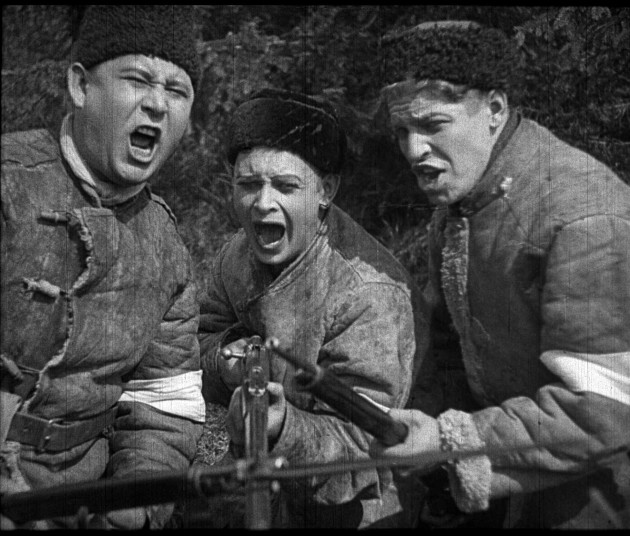
If it was all tumult out West, way, way out East we had war as Russia invaded Estonia in The Young Eagles (Noored Kotkad) (1927). Estonia declared independence from Russia following the 1917 revolution but they had to fight off both the Soviets and the Germans in the War of Independence, which lasted until 1920.

Today Estonia is about half the population of Wales and the fact it could martial a fighting force to fight off two of the strongest nations in Europe was remarkable. The story focuses on the “Young Eagles”: rich student Tammekänd (Arnold Vaino), blacksmith Laansoo (Juhan Nõmmik), and poor farmhand Lepik (Ruut Tarmo). All volunteer for the army and we see their journey through the ups and downs of what becomes a spectacular conflict near the climax with, as Alanen’s quote suggests, a huge battle scene filmed with the aid of the Estonian Defence League who provided both men and armaments.

Three eagles on their shirts...
The story is a bit flat initially and director Theodor Luts could have cut a chunk log the running time but it none-the-less a moving story and an educational one. This is one of the delights of Pordenone – it’s an education not just in the history of film but of the history in the films.  

For a young nation this film must have meant so much. At a time when my country constantly crushes its laurels with an arse-full of ignorance and assumptive authority, this film reminds us how hard some have fought to genuinely take back control.

Heroic accompaniment was supplied by Mauro Colombis on piano and Frank Bockius on percussion; positively aerobic!
What would Wm S Hart have said?
We were also showered with shorts today; I’m loving the animated Victorian Flipbooks sections and also the return to the Nasty Women shorts especially the eternally naughty Leontine as played by Sarah Duhamel here seen in Enfant Terrible (1911) and On Holiday (1910). Accompaniment was from Daan van den Hurk.

We also had the first of the Weimar Shorts stream which, actually now I mention it, did indeed feature a lot of streams and water in general including one nine-minute section of a ship at sea. There were some fascinating close-up sequences of bodily fluids too – Germanic versions of F Percy Smith’s microscopic landscapes. Accompaniment was from Jose Maria Serralde Ruiz.

There were other films but there was also wine to be drunk and conversations to be had… in Pordenone you have to get the balance right!

Monday, 7 October 2019

Waving not drinking... Le Giornate del Cinema Muto, Pordenone Part One

Ita Rina reclines in Estonia
Good morning, good morning, we’ve watched the whole day through good morning to you*… aka Watchin’ 9 to Half Midnight. Pordenone takes no prisoners and on my first full day I saw everything baring the odd break for comfort, coffee and an ice cream.

So, let’s start at the very ending because that’s a very good place to start*, smuggling booze from Estonia to Finland with Slovenian Ita Rina (Tonka of the Gallows, Spring Awakening et al) as a bombshell blonde in Waves of Passion (Kire Lained) and Estonian/German co-production from 1930. This film is part of the Estonian films strand and epitomises the wonder of this festival – something I’d never heard of yet which sprang to life on screen in emphatically entertaining ways; accomplished cinema muto – German angles, Russian cuts… that felt like a cross between a Bogart/Bacall or sixties crime caper with an, admittedly not quite convincing, rom-com tension between Rina and her teasing co-star/director Vladimir Gaidarov.

Rina plays Betty, the daughter of Mart Martens (Raymondo van Riel), a man being blackmailed by spirit king Jaan Kõlgis (Fritz Greiner – who bears an uncanny resemblance to Wallace Beery both physically and in spirit) into smuggling hooch up the coast to Finland. A writer Rex Ronney (Gaidarow) and his journalist pal Raimondo (Ernst Falkenberg) are tracking the crooks and Rex goes deep undercover in order to ingratiate himself with Kõlgis and bust the whole scam wide open… He reckons without Betty though and in spite of himself, falls hard and now needs to rescue her and her father from these drunken, dancing mobsters.

Ita and Vladimir
There’s fighting and sea chases a-plenty and events move on at some pace with Rina being the class act that anchors the reality whilst Gaidarow is not so good, possibly distracted by his dual role (he stuck to acting only in future). Austrian actor Fritz Greiner plays very nasty and brutish Beery well indeed.

Things were lifted by spirited accompaniment from Gunter Buckweld channelling his inner Gypsy/Grappelli on violin, Frank Bockius percussively perfect, and Stephen Horne on accordion and piano. It felt like a late-night improv in a Tallinn nightclub and the three improvised superbly with and around each other’s lines which is, after all, how they work with the shadows on the screen.

Sylvia Bremer & William S. Hart - The Narrow Trail (1917)
Before this we’d had the first in the William S Hart strand, The Narrow Trail (1917) which with its pacing, performance and glorious scenery – including San Francisco Bay, showed how much of the classic Western was in place by this time.

Hart is mesmeric in this film and, in spite of his 53 years, his Ice Harding is a believable leading man effortlessly shifting from heartless highwayman to a lovelorn loser in search of a perfect second chance, he covers it all with actorly grace whilst sitting in the saddle with the true conviction of a western soul.

He’s saved by the love of a good woman Betty Werdin (Australian-born Sylvia Breamer – the spit of Helena Bonham-Carter!) who has more in common with him than he knows. There’s an excellent fight sequence in which Ice takes on half a dancehall in something approaching method-brawling; it’s people like William and Lillian that brought authenticity to the early screen.

One of The Great Faces!
There was grand accompaniment from Philip Carli who brought dynamic delicacy to this typical Hart film, reflecting the man’s own persona. Before the film they screened a talkie introduction to his classic Tumbleweeds made in 1939, in which the 75-year old could still eulogise the old West with passion.

The day began with studio films promoting their stars and services and which not only gave us a glimpse of the likes of the Talmadges it also showed films being made on the huge lots. There was A Tour of the Thomas H Ince Studios (1920) in which the man who played a major role in setting up “factories of dreams” was shown to have an empowering fitness regime; all the better to manage and control the production process. We also learned how Paramount’s kit was the best at handling faults in spliced film… as if there was ever any doubt, they were “paramount” after all.

We did a bruising two rounds with Reginald Denny in the serial The Leather Pushers the story of a rich lad who resolves to win back his father’s business fortune through boxing. It’s perhaps not the obvious choice given his education and background but it was good fun – as will Hart and Westerns, the Boxing rags to riches – even with a broken right hand – trope was well in place by 1922.

I went down to the crossroads... RIP Ginger Baker
The Devil’s in the details of course as, erm Emil Jannings proved in Murnau’s Faust (1926) which I hadn’t seen since 2012 when it was screened at London’s Royal Festival Hall accompanied by a score composed by Aphrodite Raickopoulou. Donald Sosin performed the honours here and I think I enjoyed the film more; it’s so over-the-top and yet so compelling; Murnau and Jannings are surely brothers from another mother.

The local orchestre dell’Istituto Comprensivo di Pordenone Centro (Scuola "Centro Storico")
and Rorai-Cappuccini di Pordenone (Scuola “Pier Paolo Pasolini”) accompanied Hal Roche’s Little Rascals in Dogs of War (1923) and Baby Peggy (yay!) in Carmen Jr. (1923). This was very effective and some of the funniest films of the day were well supported musically showing that Pordenone is “growing its own” future generations of expert accompanists.

Music alone cannot guarantee success in silent screening and even maestro John Sweeney’s precision playing couldn’t keep me engaged with Albert Capellani’s La Glu (1913). The film starred the impressive Mistinguett as Fernande, a woman who marries a Doctor but just can’t stop saying no… her constant affairs become confusing and more to the point, perfunctory. Capellani’s good but even he struggles to digest the source motivations from the novel which begat the film.

Baby Peggy: no bull
The Pride of the Firm (1914) was directed by Carl Wilhelm and featured Ernst Lubitsch as Siegmund Lachmann a young man with retail ambition and healthy libido, who struggles to balance his “interests” in a work context. Like other film of his early period this one referenced Lubitsch’s own background as the son of a tailor who was less interested in retail than cinema. It’s more a series of situations/sketches than a feature narrative but it’s still fascinating to watch the director as an actor his eyes always so alive with mischief!

And that was the Sunday that was. Now, show me the way to the next coffee bar…

The dog remins Ernst of the films he may be missing... 

Sunday, 12 March 2017

Way out West with Vilma… Kennington Bioscope, Silent Western Saturday


In his introduction to The Winning of Barbara Worth (1926), Kevin Brownlow revealed that Samuel Goldwyn’s wife had been the Imelda Marcos of silent film preservation… The great mogul had stored all of his films in her closet and, in order to make room for her shoes, she cleared them out except for the ones featuring Ronald Coleman and Gary Cooper.

Those men are two big reasons to celebrate this remarkable film but it also features some of the most stunning cinematography of the era and if you think Abel Gance was impressive in capturing equine movement on frame than check out Henry King and his cinematographers George Barnes, Thomas Branigan and Gregg Toland. In close quarters to the excellent restoration projected tonight you could almost be alongside Ronald and Gary as the sun-baked, sand-drenched, landscape swirls around you in a crystal clear golden-yellow.

Vilma Banky
And on top of all that you have Vilma Banky… but today was about more than just one film and one generation but a celebration of the vast breadth of silent westerns; a genre so broad it deserves sub categorisation.

I hadn’t seen a single film on the programme for the inaugural Bioscope Silent Western Saturday, but it featured familiar names, Bronco Billy, Tom Mix, Rex the Wonder Horse… Somehow these once hugely-popular stars persist in memory alongside the real characters they emulated. More than just history, Westerns are part of America’s mythology – in some cases the real cowboys and cowgirls became performers on stage, circus and in film and eventually, inevitably, a cowboy-actor became president followed, more recently, by a low-down, no good, dirty double-crossing gambler.

William S Hart resists!
Programme 1: Shoot 'em Up Starter Thundering Hoofs (1924)

Kevin Brownlow introduced this action-packed opener with a clip from his Hollywood series in which he’d interviewed Hoofs’ director, Albert S. Rogell. Rogell explained how his star, Fred Thomson, former athlete and Great War veteran, had fallen under a four horse stage coach during the film’s set piece chase in which he has to jump on and pull the vehicle to a halt. He ended up in hospital with leg injuries while his director figured out how to finish off the scene using a stunt double - the ground-breaking Yakima Canutt.

Fred Huntley, Willie Fung and Fred Thomson in Thundering Hooves (1924)
Again, those blurred lines between reality and fiction. Thomson’s a likeable hero with considerable energy and the twinkling smile of a genuine star. His honest cow-poke, Dave Marshall, is more than a match for the scheming Luke Severn (William Lowery) and succeeds in relieving him of both the girl, Carmelita Estrada (picture-perfect, Anna May) and the horse, Silver King the Horse - played by, of course, Silver King, a horse.

The story was written by one Marion Jackson, which may or may not have been a nom de plume for Frances Marion, Thomson’s wife.

Lilian Henley played along with a lightness of touch and a refusal to over-play the wild-west chord sequence on the piano: all in keeping with Thomson’s playfulness and Hoofs’ romantic heart.           

Programme 2: The Early Western

John Oliver talked us through the genesis of the Western with a mix of Eastern-Westerns and Western-Westerns… Initially the genre was mostly filmed out East with the very first western, Cripple Creek Bar-room (1899), being filmed on a New York City roof. As films drifted towards better lighting conditions in the actual west, the authenticity increased along with the scale of the scenery.

Mabel Normand and Dark Cloud in The Squaw's Love (1911)
The Squaw’s Love (1911) directed by Griffith for Biograph showed how the treatment of Native Americans also changed over this time. Here they were the centre of the story – albeit including Mabel Normand in make-up – in an adventure of their own.

By the time of The Indian Vestal (1911) Indians were seen massacring a group of settlers and making off with a blonde child who becomes their medicine woman (Viola Barry). After years of providing mystical services for the tribe she meets a white trapper (Hobart Bosworth) and one thing leads to several others.

Custer’s Last Fight (1912) was historically interesting for showing how Custer was viewed thirty years after his demise but it lacked the dynamism of the fictional films being too concerned with fact. It was still fascinating all the same: even defeats need to be explained away by the ultimate victors.


Broncho Billy’s Adventures (1911) ended the morning on a light-hearted high as Billy (Gilbert Anderson) intervenes to make sure true love runs smooth as he fends off would be suitors for a hotelier’s daughter (Edna Fisher). Not your typical Billy but he couldn’t get the girl all of the time.

Meg Morley accompanied for this section with the surity of a sharp-shooter waiting to pounce on the slightest shift in tone and narrative. She and used some intriguingly unresolved progressions for Broncho Billy that stuck in my head for hours.

Programme 3: A Cowboy's Best Friend

Lunch consumed, the pace picked up in two fast and furious action films featuring horses, or rather ponies and a wonder horse. The pace was breakneck and, in spite of three horses being top billed in Rex’s film, the stories were dramatically compelling.

"Thrills? Man, you never knew what the word meant before!"
Saved by the Pony Express (1914) saw Tom Mix jumping on an off a succession of ponys to illustrate the importance of this fast moving postal service in saving your pal from wrongful conviction. Whilst in The Devil Horse (1926), we got to see how a horse could fight, fall in love and “hate Indians”; truly Rex was a wonder as well as being a horse – if not a politically-correct one.

John Sweeney played along at full gallop crashing down hard on the deeper notes with all the force of Rex’s thundering hooves.

Programme 4: Women Out West

Michelle Facey presented a session on female western stars and went so deep into her subject she uncovered a film featuring a troop of – currently – unknown actors. Michelle had clearly been burning the midnight oil lamp, locked in her North London garret with stacks of primary sources and the ghost of Vilma Banky, she brought back to screen a series of wonderful western women.

Josie Sedgwick was a crosspatch Calamity Jane in The Sawdust Trail (1924) and I just wish we could have seen a bit more to see her land one on the sneaky “Hoot”(yeah, sure…) Gibson.

Texas Guinan
A Girl of the West (1911) featured Lillian Christy as the pugnacious Polly Dixon, a girl who can handle horse, fists and rifle as well as any man as she proves in foiling an audacious robbery. Apparently the decade featured over 60 serials featuring such women of independent thought and deed: that sounds like a trend to me.

The Substitute (1911) was the mystery film and the only named contributor is Lillian M Rubenstein which is a shame because the actress playing Jennie Rock a fearless telegraph operator and station agent, is superb, full of character and guile. Another case for The Silent Detective…

Two Little Rangers (1912) was directed by Alice Guy Blache and featured Vinnie Burns a stuntwoman turned actress as the eldest of two feisty sisters who put paid toe “Wild Bill” Gray’s nefarious plans. At one point Vinnie’s character fashions a bow and arrow out of sticks and – presumably – a garter strap: there’s resourceful!

Vinnie Burns at Cliffhanger Point in Fort Lee, NJ for Two Little Rangers (1912)
Last up was Texas Guinan, once described as “the female William S Hart”, in South O'Santa Fe (1919). Texas plays a tough girl throughout and you’re in no doubt that she as deadly as the males.

Lillian Henley and Meg Morley took turns on the old Joanna.

There was so much detail to savour; it would be good to learn more…

Programme 5: William S. Hart The Narrow Trail (1917)

Kevin Brownlow showed us his own 35mm print taken from the original camera negatives and reminded us that once upon a time “they all looked like this”. The print was indeed very sharp, with the odd century-old blemish but an authentic look, free of digital clean-up – an analogue experience created by light patterning photosensitive cells.

For me this was the film of the day, an almost flawless 75 minutes of pacing, performance and glorious scenery – including San Francisco Bay.

Sylvia Bremer and William S. Hart
Hart is mesmeric in this film and, in spite of his 53 years, his Ice Harding is a believable leading man effortlessly shifting from heartless highwayman to a lovelorn loser in search of a perfect second chance, he covers it all with actorly grace whilst sitting in the saddle with the true conviction of a western soul.

He’s saved by the love of a good woman Betty Werdin (Australian-born Sylvia Breamer – the spit of Helena Bonham-Carter!) who has more in common with him than he knows. There’s an excellent fight sequence in which Ice takes on half a dancehall in something approaching method-brawling; it’s people like William and Lillian that brought authenticity to the early screen.

Neil Brand accompanied in emphatic style throwing in some resounding themes and noir flavours reflecting the film’s cinematic prescience: Laura and lassoes… whose heart can you really trust when the lies run so deep?

Programme 6: Mrs Goldwyn’s favourite men

The day ends as it began with Mr Brownlow introducing the stunning Barbara Worth. The film starts like an outtake from Greed as a young woman (Vilma Banky) buries her husband in the sand and then battles to save her daughter from a sandstorm. It’s a brutal beginning and photographed so clearly it could have been made tomorrow.

Vilma Banky in The Winning of Barabara Worth (1926)
The woman perishes but her daughter, Barbara, is found alive by a Mr Worth (Charles Willis Lane) and grows up to be played by Vilma. This western is definitely in the Civil Engineering sub-category and tells the story of how Mr Worth and his business rival, McDonald (Ed Brady) try to dam the Colorado River and irrigate the Californian plains.

Ronald Coleman plays Willard Holmes who works with the rival whilst Gary Cooper plays Abe Lee the boy Barbara grew up with. Their romantic rivalry runs parallel to business as the mood gets mean as McDonald refuses to recognise the need for additional reinforcements on the dam… In a film like this that’s never a good sign. Sometimes the story doesn’t quite match the splendour of the scenery but it is a magnificent thing all in all and fitting end to a day of surprises and high quality.

Cyrus Gabrysch accompanied filling the huge spaces with Death Valley cool as humanity fights for life and love against overwhelming heat and the onrushing Colorado River.

Ronald, Vilma and Gary
All thanks to those who organised and volunteered – it was the warmest day of the year outside on the streets of Kennington but inside we drifted the high plains sipping a heady brew of past glories tasted amidst live light and music.

Monday, 26 September 2016

The Big Countries…The Ghost That Never Returns (1930)/Hell’s Hinges (1916), Barbican with The Dodge Brothers


Long-time no Dodge for me and it was off to the September-sunlit steps of the brutalist Barbican for a double dose of specialist silent skiffling and much more. There’s enduring debate among silent cineastes about “correct” musical accompaniment with some opting for tradition and others favouring experimentation. I can see both sides but the key is always respect for the source material and music that works with and not over the visuals.

The Dodge Brothers provide that perfect blend and somehow the roots music of post-war(s) America played by modern musicians works well not just with Soviet psycho-drama but with one of the great templates of the Western genre. Neil Brand anchors the team as you’d expect but the Brothers Dodge are not only a very tight band they’re clearly in love with the subject matter too.

The party's started in Hell's Hinges: where's John Gilbert?
Dancing’s frowned upon ‘round these parts but it’s hard not to respond to the music in upbeat moments especially when the band starts chugging along in forceful unison as Jose Real travels by train to his day of freedom or when Blaze Tracy decides his town is going straight to Hell.

But the ensemble also plays it slow and atmospheric proving that their unique brand of Americana is remarkably flexible especially with the addition of a Theremin bassist Mark Kermode described as impossible to play and yet which he controlled with a steady hand and perfect pitch.

The Very Big Country, USSR circa 1929...
Mike Hammond leads this emotionally intelligent music, providing big guitar lines that floated carefully across the epic landscapes of both movies. Aly Hirji provided rhythm guitars, Alex Hammond percussion – including washboard! - and Mr Kermode is on bass as well as that socialist synthesiser, designed by a Russian, Léon Theremin, in 1928 to be playable by all.

Apparently it was not unusual for silent films to use local bands for accompaniment and following in that tradition the Dodge’s improvised most of the score working from title cards and not sheet music. A few contemporaneous tunes were included, again as per common practice, but the music of the moment proved the most compelling with Neil Brand’s piano sounding so at home in this context.

Boris Ferdinandov
This was the first time I’d seen The Ghost That Never Returns (Prividenie, kotoroe ne vozvrashchaetsya) and Abram Room’s direction did not disappoint those, like me who are readily impressed by the insanely-cut montage and the rabid experimentalism of Soviet silents.

The film features an impressive set showing prisoners held in cells stacked high in front of an inhumane controller. Ghosts in the machine, these men are doomed to hard labour at an unspecified South American oil field crushed by an industry serving only the greed of their grotesque and unknowable masters.

If a man survives ten years here, he is allowed a single day’s freedom on the condition that he returns… If he tries to run, he will be shot and,so far, no one has ever returned.

Jail from Hell
Jose Real (Boris Ferdinandov) is our hero and a man involved in syndicalist resistance against the grinding industrial-political axis. His day is coming and he receives a message that he is needed. At the same time Jose knows he will not survive his day-off… but he takes the chance all the same.

He catches a train – cue Dodge-overdrive – and eats a hearty lunch with a man on the train. As his wife and family get ready to greet him he sleeps through his stop and has to jump train many miles onward. He is followed by the man he met,who turns out to be the officer detailed to man mark him for the day, a strange chap, skilfully wielding a gun but also fond of wild-flowers… if only he could be liberated by socialism?

Missing his stop and his wife
In truth there are more than a few off-beat moments such as this; mad cowboys who play pool more intent on aggressive posturing than potting (“remind you of anyone?” as our Theresa May might say…). Never let it be said that a sense of humour was missing in these early years of the first Five Year Plan.

Will Jose make it back to see his wife and child? Will he escape his destiny or create a new one? The answer is probably in the strength of collective action; the dialectic moves film-makers in mysterious yet hugely entertaining ways.

Can't find my way home...
Mark Kermode said that an extra reel of the film has now been found in Germany and that this could explain more of the definitive narrative and yet… it’s a mood piece that works well in its abstracted form.

Now we headed back 14 years to California and the magnificent Hell's Hinges (1916). I’ve previously written about this film and it was a joy to see it on screen and with this live accompaniment.

Bob falls for the fallen Dolly
Directed by Charles Swickard along with an uncredited William S. Hart and Clifford Smith there is something proto-soviet about the film’s masses of people (I’m reminded Grigori Kozintsev’s King Lear with its large-scale choreography…masses of humanity trailing behind their leader, waiting for an answer) some of whom were John Gilbert and Jean Hersholt.

The town of Hell’s Hinges is in a state of constant motion as the human collateral surges from good to bad and random acts of brutality. There’s matter of fact-ness about life and death in the town emphasised by these inhuman crowds and it’s no surprise that the chances of Christian ministry surviving long are so slim.

Alfred Hollingsworth takes cover
But these two films are linked by “The Struggle” whether collectivist or Christian and, in both cases there are near impossible odds.

All that I’ve said about Hell’s Hinges still stands with knobs on and William S Hart is a force of hyper-nature: a wild man tamed by the truth-force of Clara Williams’ Faith Henley even as her feckless, faithless brother Robert (Jack Standing) fades away… Bob the Preacher: can he fix it? Can he heck…

Sleazy Silk Miller (Alfred Hollingsworth) sets him up for seduction with Dolly (Louise Glaum) and his resistance lasts about as long as it takes him to stroll form his newly-built chapel to the Saloon…

Blaze and the locals listen to Faith's faith
This ain’t gonna end well… and the resultant conflagration is a tsunami of ultra-violence rained down on this septic patch of ground by a Blaze inflamed by righteous indignation. Another failed western community destroyed in order for the survivors to move on with the (holy) spirit burning that much more brightly.

As with The Ghost… Hell's Hinges ends with The Struggle about to continue.

All the best tunes...
It also left us wanting more… Neil, Mark, Al… how about a Beggars encore next time?!

More details of the band are on their website. They have plans to release The Ghost on DVD and one hopes that their other film scores will also see the digital light of day.


Never The End...