Showing posts with label Kevin Brownlow. Show all posts

Friday, 2 February 2024

Rare Mary… Heart o' the Hills (1919), Kennington Bioscope with Colin Sell


I remember [Pickford] telling me that she couldn't bear the way [D. W. Griffith] directed adolescent girls. She said, "Oh, he directed them so they ran around like a chicken with its head cut off. And I would not do that sort of thing..." She already saw that naturalism was terribly important, even more than Griffith did. 

Kevin Brownlow


For the first time since the Pandemic, it was time to play Six Degrees of Kevin Brownlow and, as usual, the answer was two; Kevin had met and interviewed Mary Pickford on a number of occasions. This direct relationship with the “source material”, one of the major players, one of the three of four, who really made the cinema of Hollywood in the 1910s, predating even Kennington’s own Charlie and her husband Doug, even outshining her director on so many occasions, David Wark, distancing herself in a way Lillian didn’t as she set up her own production company in 1918 and took charge of her intellectual property as well as her career.


Kevin’s introduction focused on fellow film collector Bert Langdon and his own meetings with Heart o' the Hills’ cinematographer, Londoner Charles Rosher, who shot all of Pickford’s films from 1918 to 1927, became the first cameraman to win an Oscar for Sunrise and grabbed a second for The Yearling (1946). Kevin’s friend was able to screen his original 35m nitrate original not just of this film but also My Best Girl (1927) neither of which Rosher had seen in years.


Heart o' the Hills impressed Kevin in terms of its technique but also Pickford’s range; “characters no sooner look at each other, than they exchange blows…” The hillbilly dance is “a classic sequence” featuring the ethnic authenticity director Sidney Franklin was looking for. Kevin also singled out art director Max Parker for his creation of the backwoods locations and living spaces; as he says, there was nothing “cutsie” or sentimental about this endeavour and the producer herself also has to take great credit for that… Kevin concluded by saying: If anyone needs to be converted to Pickford, this picture should do the trick!


Pickford's character shows her scars from maternal beatings...


I suspect Kevin was preaching to the already converted but this is indeed a wonderfully spirited film and one that treats its audience with respect, another key element of Pickford’s approach. After all, she was a working-class women just like most of her audience, her agenda was to deliver the kind of stories they understood and morality they would agree with in a tough environment they would recognise. We don’t talk enough about silent film stars and class, except to note that they “escaped”, but I don’t think Mary, or Charlie and many others, pulled the ladder up.


Here Mary is Mavis, who’s father was shot in the back when she was young and whose mother Martha (Claire McDowell) has been worn down over time, fighting to keep going in their ram shackled homestead. Her best pal is young Jason Honeycutt (Harold Goodwin) who takes her out on fishing trips – some worms were sadly harmed in the making of this film – and other larks.


Jason’s father Steve (Sam De Grasse) is the opposite of fun and, as we quickly learn, many other things including honesty, fairness and virtue. He’s hard on his boy and Mavis while targeting Martha, her hand and, her land which, as Mavis shows Jason, is rich in coal, surprising for such an elevated location but there you go.


Hootenanny show-down! John Gilbert on the left.

Money comes to town in the form of “forrigns” Colonel Pendleton (W.H. Bainbridge) and his entourage including son Gray (a surprise appearance by young John Gilbert, just 22 here and on the brink of stardom) and his intended Marjorie Lee (Betty Bouton). Also with them is the scheming Morton Sanders (Henry Hebert) who is plotting with Steve Honeycutt to grab Martha’s land and swindle as much of the community as possible.


There’s a great confrontation between the two at the local hop, where Gray, who has caught the eye of Mavis and vice-versa, joins the dance only for Jason to try and out-manoeuvre him in a kind of strictly-come-country dance-off. In the end Mavis joins in and a proper scrap is narrowly averted.


Soon though she has worse to come as Steve pushes Martha to marry him and orders her to leave home. She takes her issue to the locals, led by her wise Granpap Jason Hawn (Fred Huntley) and they decide that dressing up in white hoods and costumes to confront the land-grabbers is the way to resolve this. 


Don't mess with Mary...


Now I’m not sure why it is that certain Americans like wearing their sheets in this way but I’m also not convinced it’s a Ku Klux Klan moment – although it might well be. It ends badly though as someone shoots Sanders and, of course, given motive, opportunity and her outspokenness, Mavis is soon standing trial accused of his murder.


As Kevin Brownlow points out, this film doesn’t pull its punches and the stakes are high. Mavis’ character also stays true to herself and the resolution is worth the wait. It’s an entertaining film with that mix of humour and grit our great grand parents knew and loved to see on screen. Pickford is mighty as you’d expect and Rosher packs as many glorious head shots in as possible as we watch her unconscious naturalism lead the emotional charge!


We were watching a 35mm print made from an original copy at the Mary Pickford Foundation and it was full of rich textures and stunning depth of field. This is one of the real pleasures of the Bioscope, the connection between the audience, the celluloid and the general ambience of this unique venue. The atmospherics are also heavily informed by the subtlety of the accompanist and in this case it was Colin Sell who not only as Kevin predicted, showed his powers of controlled syncopation for the dancing sequence but also played along so sympathetically with Pickford and the rest of the players.


The British version of the sheet music

We were also treated to a wonderful performance of the song released to accompany the film from Colin and the Bioscope’s MC Michelle Facey. On BBC programmes you sometimes witness “experimental” archaeologists attempting to recreate certain processes to illustrate and find out more about the techniques and the “taste” of the period. The Bioscope is a working example of this experimentalism and Facey and Sell recreated another key element of the spirit of this film and the emotional reaction this song would have brought. Glenn Mitchell had a copy of both the US and UK version of the sheet music and naturally we went with the British copy. Loveliness ensued… and the film was set up!


Early Mary…


White Roses (1910) directed by Frank Powell was screened first on a 16mm from Chris Bird’s collection and, whilst its plot was a little outlandish, it was all good fun with Mary’s character Betty for some reason in love with a very shy man called Harry (Edward Dillon). Harry hasn’t the courage to ask her directly so her arranges to send three colours of flowers to her and a note saying that she should wear red for yes and white for no… Sounds simple but he gives the task to a young lad (Jack Pickfor, who’s other sister, Lottie is also involved), who promptly gets robbed of note and flowers.


A well meaning man steps into help and buys replacements but there’s no note and so Betty wears white forcing Harry to propose to his cook in retaliation… That’s not the end of things but you really have to watch this to believe it! John Sweeney accompanied and suspended all our disbelief in the process.


Mary and Elmer wait for the law...

The Narrow Road (1912) directed by D. W. Griffith on rare and possibly singular* 16mm print made from a nitrate original by legendary collector John Cunningham, now from Chris Bird’s collection, the film is only otherwise preserved in the Library of Congress paper-print collection as a paper copy of the celluloid made for copyright purposes. It was another of the unique Bioscope occasions, watching Mary married to ex-convict played by the great Elmer Booth, who is torn between going straight at a wood merchants and his loyalty to fellow con and recidivist forger, Charles Hill Mailes.


Ashley Valentine accompanied with lovely lines and in tune with this short but powerful tale. As Michelle said in her introduction, some say DW was at his best for these Biograph shorts and on the evidence of this and others, I’d have to agree but part of that is down to the contribution of players like Pickford who would eventually fall out with him and others, such as Booth who would die tragically early in a car, driven by an inebriated Tod Browning.


 *According to Movies Silently, the film is featured on the Image Entertainment, Origins of Film DVD set, now deleted. This may come from another source although it doesn't - as featured above - look like anything like as clear as what we saw.


Monday, 29 March 2021

Train kept a rollin’… The Signal Tower (1924), Stephen Horne and Martin Pyne, San Francisco Silent Film Festival Streaming


“… so, remember… never think of anything but your duty, until the track’s clear and your train’s safe!”


I’d previously seen a screening of Kevin Brownlow’s own copy of this film with Cyrus Gabrysch accompanying ferociously at a breathless evening at the Kennington Bioscope and this was a chance to see the restored film Kevin had played a major role in constructing with the SFSFF. There were no 35mm copies and so Robert Byrne of the SFSFF, Patrick Stanbury and Mr Brownlow worked with surviving 16mm elements, scanning materials at 4k, digitally repairing and creating a new 35mm negative from which prints were struck that were then dye tinted by specialist chemists in Prague.


The results were screened at the 2019 SFSFF and are astonishingly good, crystal clear with the beauty of the Californian forests fully enhanced and the locomotives as impressively highlighted as the actors. What is it about boys and steam trains? The accompaniment from Stephen Horne, aided by Martin Pyne/Frank on percussion, brought out the full majesty of the setting and the mechanics as well as one of the most febrile of conclusions in silent film.


Virginia Valli wrote a letter to Picture Play magazine from location in Mendocino County “I’m… just about as deep into the wilds of Northern California as any picture player has ever ventured. It’s beautiful; great redwoods, the bluest sky I have ever seen and brown and yellow maple leaves lending a dash of colour to the deep green of the firs. It’s so beautiful it’s actually awe-inspiring.”


This restoration certainly confirms that former and emphasises the “awe” in terms of Clarence Brown’s setting – the entire movie was shot in situ with sets built near the railway tracks – but also his treatment of the locos. In his introduction the Bioscope event and his essay for the SFSFF festival, Brownlow emphasised Brown’s fascination with trains. Brown was an engineer by training and clearly relished filming these steam-powered giants, getting up at the crack of dawn with his cameraman, Ben F. Reynolds, to record the trains powering through the pines with steam billowing above them and into the narrow sunlight.


The company hade rented a stretch of track which had only one service a day and so were able to take their time in presenting the life of this remote outpost and, with plenty of time to stage the most explosive of life-sized stunts: no scale models were damaged in the making of this film.


You can understand Brownlow’s passion for this is a film to make the rail enthusiast’s pulse race that bit faster as this is a film to increase everyone’s BPM as Brown winds the tension to almost unbearable levels: a runaway train speeding down towards a defenceless passenger train, a signal man fighting the elements and time to dislodge the tracks and faced with the horrific dilemma of having to save the many whilst his wife is under imminent threat from a boozed-up Wallace Beery with only one thing on his mind; a very vulnerable Virginia Valli.


Rockliffe Fellows watches an actual train steam by in a signal towerpurpose built on location


Those misty Mendocino Mountains contain a signal box vital to the effective running of the railroads and manned by just two men each working twelve hour shifts. The always upstanding Rockliffe Fellowes plays one of these “Tower Men”, Dave Taylor, whose wife Sally (Virginia Valli of Wild Oranges and The Pleasure Garden fame) and young lad Sonny (Frankie Darro) live in an idyllic wooden house near the tower – three miles from the nearest town.


Dave’s partner Old Bill (James O. Barrows) is indeed old and one-handed and so is replaced by Joe Standish (Wallace Beery) a man who’s flash suit and polished shoes mark him out as self-obsessed from the start and who is referred to as a “railroad Sheik” by one of the company’s engineers.


Dave lets Joe take over old Bill’s old room and he soon sets his sights on Sally even though her cousin Gertie (Dot Farley) initially acts as a kind of shield for his unabashed “sheik-ness”. Sally sends Gertie away to pay more attention to her fiancé unwittingly removing her own last line of defence… Joe soon makes his move and Dave kicks him out.


Wallace Beery and Virginia Valli


A storm is brewing though and as events take a serious turn on the mountain, Joe arrives late and, drunk in the heart of a crisis, forces Dave to take over and, once again kick him out. But that’s not the end of Joe’s nuisance as Dave sees him heading towards his home through the wind and rain… As disaster looms he must choose between Sally’s safety and his responsibilities to protect the passengers.


Beery does his usual top-notch job – his intensity belying his lighter, more likeable edge whilst Valli was the perfect complement, with a vulnerability running alongside her desperate resolution to resist the demon in her house; the film would not work as well without her imbuing Sally with so much depth and without Beery’s ability to kid us that he’s just not going to be as bad this time. Rockliffe Fellowes meanwhile, is the perfect heroic straight man to the descending chaos, a natural straight-backed affability informing his character.


Full marks to young Darro as well, aided and abetted by Jitney the Dog.


The family under threat


Biographer Gwenda Young describes The Signal Tower as one of Brown’s most personal films and he even made an appearance as a switchman trying to stop the runaway train as well as being “Conductor Brown” the addressee of a telegram. The “home invasion” represented by Beery’s character cuts to the heart of every relationship and powerfully contrasts with the accelerating disaster without. For the many or for the crucial few?


It’s a dramatic scenario and one that required a great deal of precision musical engineering from accompanists Stephen Horne and percussionist Martin Pyne with the latter providing the locomotive power to the former’s heat and steam. Brown’s film is full of controlled rhythms and contrasts from the towering bucolic surrounds to the dynamic force of the locomotion and the wayward intensity of the human drama and the score successfully navigated this triple track escalation to the film’s pulsating closure.


For the musician, every note’s a dead man’s handle – for the train driver, everything stops if you release your grip but the music is dependent on the continuation of a thousand stabs of precise pressure: all the right notes and all in the right order with Beery’s leery menace as much a threat as the speed of those locomotives. Stephen’s themes were as strong as you’d expect and the rhythmic requirements brought out the forces pushing the ultimate dramas of family, lives and morality under threat.


So, now is exactly the right time to join the SFSFF and to experience this film which is online until the 4th April. There’s also a collection of some previous restorations and the promise of more to come. Full details are on their website here.


Wednesday, 11 September 2019

In Devon everything is fine… Lorna Doone (1922), with Costas Fotopoulos, Kennington Bioscope


The new Bioscope season kicked off with a screening of Kevin Brownlow’s own 16mm print of Maurice Tourneur’s florid Lorna Doone, in which the director proves that you can indeed fit a quart into a pint pot.

Richard Doddridge Blackmore’s novel has everything the moors the merrier in fact with passions surging like waterfalls, opening the doors to death on two occasions and muscles being rendered from the flesh of evildoers. This is, indeed – perhaps – a story that “outlives modern literature… never old, never new… a literary heritage of Civilization…” but all that aside Tourneur made a fun film even if Madge Bellamy looks a little too modern with her thick eyeliner and jazz-age pout.

Before we hit those highlights though, Kevin talked us through Tourneur’s backstory with clips from his own collection illuminated by Colin Searle’s sparklingly sure-handed piano improvisations. We started with The Wishing Ring: An Idyll of Old England (1914) which as a young collector her almost left behind in Keswick Library believing it to be a British film and, therefore, of less interest! He managed to grab the copy and it’s an interesting curio, very much highlighting the step-change in technique that the French director was about to help lead.

Whereas the camera is fairly static, the close-ups are limited and the staging is formal, by the time of Alias Jimmy Valentine (1915) there’s a stunning use of angled camera, meticulous stage direction over an open plan office which forms the basis of a bank robbery. It’s far too good not to copy and low and behold, a clip from Fritz Lang’s Spiders shows an almost identical sequence.

John Bowers and Madge Bellamy
Tourneur was regarded as on the same level as DWG and DeMille by the time of Poor Little Rich Girl (1917) with Mary Pickford playing the wealthy child in a cast full of very tall people and normal sized sets on which he was rightly confident that the protean Canadian could present as a 12-year old. This film and his famous The Blue Bird (1918) demonstrated his way with fantasy with the latter being described by one projectionist as like dreaming when you’re awake.”

 
By 1922 Tourneur had shifted away from the fantastic to the historic and Lorna Doone (1922), filmed near the Thomas Ince Studios in New York and not Devon, England as the director requested, is full of fluid moments of striking storytelling whilst being as plot heavy as a month of EastEnders.

One moment has always struck me especially hard and that is when the Doone Gang attacks young Lorna and her mother’s carriage; heavily outnumbered their carriage is driven into the sea and Lorna’s mother is pushed to the ground as her daughter is taken. The gang rides off, we can almost hear the girl’s pleas, the camera shows her mother trying to raise herself from wet sand, a cut showing the sea lapping around the carriage after the tide has come in and the back to the mother, face down in inches of water…

It's a sign.
The film is far from grim but it has the occasional moment of artful violence in between a narrative that just won’t stop. Set in the late seventeenth century it tells the tale of various families in the Exmoor across the borders of Devon and Somerset. It begins in the White Horse Inn – famous among the taverns of old England - I’m sure you probably know it… where two youngsters meet, John Ridd (Charles Hatton), son of a farmer and Lorna (Mae Giraci), daughter of the Countess of Lorne… it’s love at first sight and the young lad, on hearing his new friend is to travel through the dangerous lands of the Doone bandits, gives her his pen knife. In spite of warnings from others, the Countesses troop head off and duly get ambushed by the rogues on the coast – rather brutally, as above, with the head of the clan, disgraced former nobleman (wrongly so in the book) Sir Ensor Doone (Frank Keenan) who decides to steal the child.

But John has followed and watches on helpless vowing to revenge himself on every one of the Doones!

Flip forward and we find Lorna all grown up as Madge Bellamy and living an uncertain existence amongst the Doones. She has caught the eye of Carver Doone (Donald McDonald) the most unhinged of the clan but can rely on the fatherly support of the suddenly decent Ensor: maybe she has allowed the man to remember the best of himself? It’s an uneasy existence though as Sir Ensor bats down Carver’s marriage request…pronouncing that Lorna can chose who she marries, so long as he lives.

The hunkiest man in Devon and the strongest.
Meanwhile John has grown up into John Bowers – the strongest man in Devon! He is out juggling logs in a stream when he is swept down river into the waters of the Doone Valley. He wakes to find a beautiful brunette leaning over him and they quickly realise who each other is: Lorna pulling out John’s long-cherished penknife. They have not forgotten.

But it is not safe in the valley and Lorna helps John escape back to his world: there can be no reconciliation for fear of Doone reprisals apparently… John returns to his farm, his heart a perfect L, for Lorna, for love… His cousin Ruth (Norris Johnson) looks on, lost in her own longing… an incomplete triangle that will break before the film is done. Lost more besides.

The plot is of its age and genre but Tourneur makes sure that Lorna Doone flies by at an irresistibly entertaining pace. The cinematography from Henry Sharp is also superbly advanced and delivers the richness and range you’d expect for his director.

Madge miscast?
Costas Fotopoulos came with his Old Romantics Toolbox brim-full of longing poignancy, laced with dramatic dynamics and horse-chasing rhythms… he added the classic to the classic and ensured that we arrived breathless at stories end.

Lorna Doone isn’t the best of Tourneur but tonight, with Mr Brownlow’s film, his introduction and the playing of Colin and Costas, we wouldn’t have been anywhere else.

Thursday, 6 June 2019

Tailor-made woman… Souls for Sale (1923) with Meg Morley, Kennington Bioscope Silent Weekender Day 2


Would you like to sin. With Elinor Glyn On a tiger skin? 
Or would you prefer. To err. With her. On some other fur?
Rupert Hughes (as quoted by Mr K Brownlow, on the occasion of his 81st birthday)

This was one of the first silent DVDs I bought partly because of its cameos of Hollywood stars but mainly because of a fascination with Eleanor Boardman who was later to star in The Crowd and to feature so elegantly in Kevin Brownlow’s Hollywood series. Yes, there’s something about Eleanor and she’s also caught up in the William Haynes legend, with them both winning a contract through Goldwyn Pictures "New Faces of 1921" and maintaining a friendship through the years of their success and beyond: you got the feeling that they both rose above the daily Hollywood grind from the get go.

Souls for Sale is pretty light fare but it’s well made and does give a playful insight into the business of show people with Boardman’s character accidentally falling into the movies after escaping the clutches of her Bluebeard of a husband…

Charlie, Erich and Jean
The glimpses behind the scenes are, of course, precious, with Erich von Stroheim seen directing Greed, giving Jean Hersholt instructions, and Charlie Chaplin playing along by over-actively directing Mem/Eleanor in a “scene” from Woman of Paris. Elsewhere you can glimpse Hobart Bosworth, Barbara Bedford, Chester Conklin, Raymond Griffith, June Mathis, Marshall Neilan, Claire Windsor & many more! William Haines is also in there, his first credited appearance, as Pinky (!) the assistant director to Richard Dix’s square-jawed Frank Claymore.

Kevin Brownlow introduced on his birthday – no better treat for him than sharing in his passion – and explained that the film was partly a PR exercise to show that after numerous scandals, Hollywood wasn’t a bad place, full of upstanding professionals.

The film was based on a novel by a man named Rupert Hughes – Howard’s Uncle – who produced and adapted the screenplay and directed it. Mostly known as an historian and writer, Hughes couldn’t understand why a film company would buy an author’s work and then change so much. Here he made sure his work would see the screen as intended and the rigour of his research pays off in the detailed background to the film process.

Eleanor Boardman
Boardman was already famous as the Kodak Girl model and had already made three films but this was her first time as the main female star and so, just like her character she was in at the deep end. She’d tried to make a success on the stage in New York and made some head way but this, at 24, was her biggest break yet in the movies.

She doesn’t flunk it and, for me, gives a very relaxed and confident performance as Remember “Mem” Steddon (trips off the tongue doesn’t it…) who falls into film work as a refuge from her psychopathic husband (Lew Cody) and, against the wishes of her strictly-Christian parents – an echo of Boardman’s own folks’ disapproval. Boardman was perhaps a natural, very interesting to watch on camera and varied not only in her expression but her looks. She can handle comedy as well as drama and gives a taste of her dowdy desperation in The Crowd when watching her disastrous screen test: hands pulling her hair to a mess, tears running red down a face of real misery.

Less regal Garbo?!
She reminds me of a less regal Garbo, more down-to-earth and not quite the force or presence but still very watchable and adaptable, he relatively tall frame (over 5 feet 6… a giant in 1923!) making her both a graceful clothes horse as well as the equal of the men.

The film starts off with a shot of Mem in the back of a railway carriage with her husband Owen Scudder (Lew Cody), who is already starting to frighten her with his weird intensity – first example of Boardman’s ability to show unease. She’s desperate and jumps train at the first opportunity, landing in the middle of a desert.

Not a real sheik... Frank Mayo, Eleanor B and Richard Dix
She wanders for days and finally is saved by a Sheik on a camel… or rather handsome actor Tom Holby (Frank Mayo) who is on a location shoot for a film being made by director, Frank Claymore (Richard Dix). The crew rescue Mem with stars Leva Lamaire (Barbara La Marr… see what they did?) and Robina Teele (a feisty, Mae Busch) making sure the kid gets a break as well as medical attention. Snitz Edwards is also on hand as the lovelorn Komical Kale, who is unrequitedly in love with Leva who still mourns for her lost lover, Jim, who died as his plane was engulfed in flames.

Meanwhile Scudder with a history of marriage and murder behind him, manages to evade the cops at a railway station and then gets lucky and a little richer by taking advantage of Abigail Tweedy (Dale Fuller) who he convinces, cons and almost chokes before escaping. Of course, he’s not finished with Mem just yet…

After finding work in a hotel, the end of season forces Mem to try her hand in Hollywood and, we see her trying to sell her soul, to get into a picture, any picture… there’s a great casting session with even Eve Southern as Miss Velma Slade being told she’s only beautiful and there’s a pile of those in this town (the film was also intended to discourage people from the film business… ).

Billy Haines!
In addition to Chaplin and von Stroheim, Mem gets a tiny part in Fred Niblo’s The Famous Mrs. Fair and sees Marshall Neilan directing The Eternal Three with Raymond Griffith, Hobart Bosworth, and Claire Windsor. Star-spotting is half the fun although Kevin spoiled this by reading out the names of a table full at one point: including Barbara Bedford, Chester Conklin, William H. Crane, Elliott Dexter, June Mathis and ZaSu Pitts.

After a disastrous screen test with Frank Claymore and the crew, he realises that she’s made more for drama than comedy and gradually she starts to make her way with bigger and bigger parts. Eventually she gets her big chance in a circus film after Robina gets injured. By this stage Scudder is back on her trail and has decided that he’s in love with the now successful actor…

But, it’s a stormy night over the circus set and there’s not many places more dangerous than a film set based in a tent!


The ending is a tour de force as the storm hits and the flames rise higher – all tinted yellow in the Warner Archive/TCM restoration. One of the extras told Brownlow that the circus tent was soaked in paraffin for the fire… which Hughes didn’t let people know there were horses inside as he didn’t want them to clear a path for them; the result is chaotic but undeniably dangerous with a least one injury to a dancer.

As a defence of the film industry, that doesn’t show the health and safety standards in a good light but I guess the audience took it all as part of the drama.

Meg Morley accompanied in fine style matching the epic with the intimate in a film of many contrasting moods. There may have been a snatch of Liszt at one point but as ever Meg melds these themes into an overall improvisation that is unique to the moment and the setting.

Big productions!

The Old Swimmin’ Hole
(1921) with Meg Morley

Talking of William Haines, the next film starred Charles Ray who bears more than a passing resemblance to the former. Based on a poem by James Whitcomb Riley, the film was essentially a series of backwoods episodes all told without intertitles. Directed by Joe De Grasse it was charming if a little ambient, but like all poetry, something you had to just relax and focus on. Meg Morley accompanied again and in a quite different manner; lots of light tones and energetically reiterated figures that played so well along with the “children” on screen.

I spotted Laura La Plante in Pickford curls as Charles’ love interest, so different from her close-cropped platinum bob of later years.

Another exceptional collection of films overall for the weekend and I was sorry to miss the final parts of the second day. All credit to the programmers, players, projectionists and volunteers who make the Bioscope happen and happen so very well!


Monday, 18 March 2019

Feline spooky… The Cat and the Canary (1927), Kennington Bioscope with Jeff Rapsis


This film is not so much a horror classic but a major step forward in spooky-comedy, paving the way not just for Bob Hope’s talkie remake but a whole sub-genre of scarily-funny movies. Paul Leni’s film looks great and takes many visual tropes from the German style and injects laughs into the resultant combination of eerie unease. From the opening titles, showing the title revealed by a horned hand wiping away the dust, it makes its intentions known and it really does achieve that balance between the unexpected, the unnerving and the uncannily-timed.

This being the Bioscope, we were treated to a watch of Kevin Brownlow’s own 35mm, one that resulted from his own restoration for Photoplay. We also got an introduction full of the insider jokes and insights from the man who – nearly – met the all, capturing silent stars on tape from the fifties to the eighties and preserving the oral history of the birth of film.

Guest pianist Jeff Rapsis had flown over from Boston in the morning and was full of praise for the Bioscope – and it’s (thankfully) ongoing contribution to keeping alive the art of improvised accompaniment for which a live audience is just essential. “I have no sheet music, I have nothing prepared I just go with the film and the audience…”

Courageous Creighton Hale
The film had long languished in poor quality but in the 1960s KB found a good print and restored it from 35mm nitrate it parodies the horror film, which hadn’t really started to dominate, although it was popular on stage, where this story began John Willard’s 1923 stage play. KB interviewed the camera man, Gilbert Warrenton, who told him that they had to dig into the floor to get the right angles. Extra lights were also needed to create the right dynamics between dark and shard.

Leni used a gong to drill his play’s movements and claimed that the shadows were as important to the film as the characters… and so it was to prove. Kevin also got to talk with the film’s striking star, Laura la Plante, was too shy to be interviewed and by that time had forgotten every detail apart from the costumes. Ultimately, he feels that The C&C is a commercial film, superbly well-made and one that is critically under-recognised, certainly it had a major influence on the Universal horrors of the thirties, especially James Whale’s Cold Dark House.

Martha Mattox feels the chills
It starts with a dark and stormy night, as it simply had to, but the director of Waxworks and collaborator with Lubitsch, May, Dupont and a host of European film-makers, knew what he was doing… The opening section shows mad old Cyrus West’s spires cross fade into milk bottles which imprison him, wheelchair bound, as viscous black cats encircle this crippled canary: his greedy relatives waiting to get their share of his fortune all, as set out in his will, to be unveiled twenty years after his death.

The action moves to the interior of the West mansion and Leni treats us to the works, wonderfully lit settings with Gilbert Warrenton’s camera swooping round corners with alarming grace then careering down blustery corridors as drapes and curtains fly wildly in the wind. This is a place full of dark surprise, bad humour and menace.

There’s a knock on the old door and West’s faithfully grim retainer, Mammy Pleasant (Martha Mattox) – not very motherly or, indeed, pleasant – opens the door which is almost held back by sheer weight of cobwebs. Enter Roger Crosby (Tully Marshall) West’s lawyer, here on the dot, two decades after his death to reveal the contents of the will. Opening the safe he finds a moth and knows someone has forewarned themselves of the contents… but no one else has been in the house only Mammy and her un-living companion who stares down with intent from his portrait.

Laura La Plante
The guests, all soon to be suspects, all save the murdered… arrive and Leni gives us portraits of people with something to hide; eyes darting, greed nervously bubbling just under the surface and desperation enough to make anyone of them suspicious. There’s Harry Blythe (Arthur Edmund Carewe) who’s already dark eyes take on additional edginess and who almost snarls as his estranged cousin Charles "Charlie" Wilder (Forrest Stanley) arrives. Charles has more regular features but nervousness around the eyes and a mouth that suggests weakness and desperation.

Their more senior cousin Susan Sillsby (Flora Finch) arrives with her niece Cecily Young (Gertrude Astor) both clinging on to the hope that there will be a windfall to compensate for the many obvious disappointments that have etched themselves on their faces: Susan old with bitterness and Cecily just on the cusp as youth fades. Cue the comedy. Paul Jones (Creighton Hale) arrives in a miss-firing motor car, breaking to avoid crossing the path of a black cat and then running into the house convinced his engine’s back-fire was an assassin’s bullet. He’s no Bob Hope but he’s funny alright.

The entourage is completed by the arrival of Annabelle West (Laura La Plante) – youngest of the group and seemingly as sane as sixpence. La Plante takes top billing on the film and had some of the sharpest haircuts in all of silent film.

Gertrude Astor and Flora Finch are shocked!
Anna is revealed as the sole beneficiary and becomes the Canary and the trick is to work out who the Cat(s) might be with pretty much everyone looking as guilty as can be… personally I was hoping it might be Creighton Hale. The mysterious deaths begin to happen, sliding panels start to reveal clawed hands and an escaped lunatic is revealed to be on the loose. What’s more, Annabelle must be proven sane in order to qualify for her prize or else her inheritance will go to another.

Who’ll it be? And will anyone from this strange family emerge as the unlikely hero to protect the true heir? There’s the usual miss-direction and emotional disturbance of the humour but it’s still a fun watch: golden rule of all whodunits… make ‘em all look guilty and then gradually provide them with alibis/good character.
Jeff Rapsis brought a confident narrative-driven dynamism to his accompaniment, different from UK players or just a man with his own style? The top players go world-wide and so this is music without boundaries and here he was perhaps more influenced by the film’s origins as much as he was last year when playing for Salt for Svanetia (1930).

He gave it his all and came good on his stated aim of recreating the tone and collective response to this wonderfully funny and slightly scary film!

Michelle Facey and Meg Morley - two cool cats!
There were further feline treats in the first half tonight with lots of Felix the Cat films celebrating the mad-cat adventurer’s centenary. We saw Felix in Hollywood – even Mr Brownlow couldn’t spot all the characters… and snatched of a documentary on the cat’s cool creator.

Meg Morley accompanied and then played accompaniment to the popular hit, Felix Keeps on Walking, for the Bioscope’s resident chanteuse, Michelle Facey, to sing. Michelle sells these songs so well and I think we have the beginnings of a regular spot here… Pamela Hutchinson famously described the Bioscope as London’s Silent Speakeasy and will molls like Michelle and Meg, we only need some feathers and more-illicit hooch and we’re there!! It brings the music to life, a human voice singing clearly in the new, old-fashioned way.

Brava!!


Felix learns the Black Bottom from Ann Pennington
Our guides through the life of Felix, Glenn Mitchell and Dave Wyatt

Thursday, 31 January 2019

Blood and water... Mother (1926) with Lillian Henley, Kennington Bioscope


“Mother is a moving picture in every sense, here is a film that stands up as well as when it was made in 1926…” Kevin Brownlow

Lillian Henley hadn’t even seen this film and yet she was on a roll of revolutionary rhythms and, sat towards the Bioscope piano’s deeper notes, created a patient mix of Russo-romantic dynamics that fitted the narrative like Comrade Trotsky’s best winter coat. I had seen Mother before but this once again showed how the connection between accompanist and film can make for such a varied experience.  Lillian’s experience as an actress sometimes gives her a different take on accompaniment and here she was almost taking a cinematic stroll hand-in-hand with Vsevolod Pudovkin’s tale…. We are so blessed with such a diverse range of styles and whilst I’d really enjoyed Stephen Horne and Martin Pyne accompanying at the Barbican this was a different and none-the-less expressive performance.

Mother was introduced by Kevin Brownlow who having brought his own 16mm copy of the film, explained how the director, in his opinion and that of many others, stood alongside Eisenstein and Alexander Dovzhenko as the leading lights of Soviet cinema.

Pudovkin dropped his university science studies after he saw Intolerance and resolved to make films. He used actors in a Stanislavski style and not just non-actors cast for type as with Eisenstein and the star here is the theatrically-trained Vera Baranovskaya, one of Stanislovski’s favourite actors, and it’s easy to see why with a performance of controlled depth and intensity,

Vera Baranovskaya
Pudovkin acknowledged Griffith as his master and yet his work bears similarities to Abel Gance, whose La Roue he was very influenced by. He talked of producing “a plastic synthesis through editing…” and, for example, instead of showed a prisoner’s joy at release he focused on the nervous play of his hands and the corners of his smile cut with a flowing stream and a child’s joy… “photographing thought” in a very Gance-an way. Brownlow praised his lightness of touch in the film and use of landscape and nature all of which make for “an exhilarating experience” in his view. Tonight’s audience wasn’t going to disagree.

Mother was banned in Russia, even though set in 1906 it was perhaps too anti-authoritarian… and could only be seen in private showings. Overseas, the strike certainly made it a no-no for many westerners. It was banned in the UK because it showed strikers where to hide weapons… under the floor-boards lads! They’ll never spot it there!! Nice to know we haven’t changed.

Pudovkin later made Chess Fever and Storm Over Asia which he regretted as it showed the English, who he liked, in a bad light. Ah well, at least we had friends once…

Aleksandr Chistyakov
But this film is all the more powerful for being focused on a single family and, especially, the relationship between a mother Pelageya Vlasova (Baranovskaya) and her son, Pavel Vlasov played by Nikolai Batalov one of the most frequently seen actors in soviet film. Based on the 1906 novel The Mother by Maxim Gorky and bears similarities to the Bloody Sunday attrocities in which the imperial guard were ordered to open fire on a demonstration in St Petersberg in January 1905. That event led to long-term consequences yet this film is not a simplistic take on revolutionary innocence versus black-hearted oppression but a tragic story of a nation undermined by a careless, fatal, malaise.

Pelageya is married to an abusive alcoholic husband Vlasov (Aleksandr Chistyakov), a man who would steal even the family iron if it would get him another vodka. He lashes out at his wife and slaps down their son, Pavel as he comes to her aid.

He is a sad sack of a man who has been defeated by life and in the local tavern he’s an easy mark for a group of men looking for a patsy to help them break an impending strike. The problem is that Pavel is one of the groups organising the action. He meets a girl, Anna (Anna Zemtsova) who hands him a package, he goes home and hides it disturbing his sleeping mother just enough for her to see what he is doing.

Nikolai Batalov 
Come the day of the strike, Pavel and his group are ambushed at the gates of the factory and badly beaten. Pavel and a pal are chased into the tavern, yet whilst Pabvel makes good his escape his mate is grabbed by the inn-keeper. In the melee his gun is fired and Vlasov is shot dead.

 
Our sympathy shifts as the insurgent's mother becomes a widow, staring in vacant horror as her husband is carried lifeless into their rooms. Before long she has discovered what Pavel was hiding, a collection of firearms, and honest citizen that she is, believes the policeman when he promises that if her son only tells the truth he will be free. But, the family are now involved in the legal machinery of the Tsarist state and all other considerations are discarded as punishment becomes more important than the crime…

 “Righteousness, justice, mercy… “, the tribunal sits lazily on the question of Pavel’s life, more concerned with fine horses than the three words they are supposedly guided by. There will be precious little of any today and Pavel is sentenced to hard labour. Incredulous, his mother begs forgiveness – she had no idea that her faith in authority would be so misguided. But she is not alone and soon there is a plan to free Pavel and other prisoners…

The day of the strike
Now the film shifts tone and pace as the director drives on towards the family’s ultimate betrayal by their country in an ending possibly inspired by a smuggled copy of East is East. The use of montage is mesmeric, with repeated shots of partly melted ice on the river being juxtaposed with the movement of people towards the prison and then in aid of the rescue: it’s a relentless flow in both cases and very powerful.

 
Pudovkiz is so good on the details as well as the scale. As Vlasov’s body lies in death, he focuses on mother, then a dripping tap, then her dead husband, the floorboards, her son and back again: the monotony of grief and despair all contributing the a shattering narrative that Lillian understood so well.

On tonight’s undercard we had Will Rogers in a 1924 short for Hal Roach called Don’t Park There in which our modest hero struggles to find a parking space, yes, even in 1924. Some things never change including John Sweeney’s excellence on accompaniment.

Good to get my Bioscope 2019 underway and the coffee and sausage rolls were also good too!


Sunday, 22 July 2018

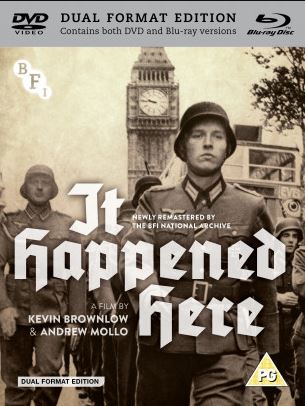
Still could… It Happened Here (1964) on BFI Blu-ray and DVD


“If we can get them all together working to one end, we’ll soon get the country back on its feet again… “

When I was five, in addition to remembering watching England win the World Cup, I was also convinced that The War was still going on, probably in North Africa. This was the result of misunderstanding the nature of programmes such as All Our Yesterdays, but even in 1966 the Second World War hadn’t really stopped…

Ten years before this an 18-year old schoolboy named Kevin Brownlow conceived of a counter-factual feature film that would examine the premise of the War not only lost but victory achieved on these shores. Joined by 16-year old Andrew Mollo the two would spend eight years in bringing their story to the screen and the story of how they did so is an epic in itself. Underfunded, the project ran on the pure energy of their enthusiasm and produced a film that was controversial then and remains so now simply through the act of allowing some actual fascists the chance to voice their views.

The film featured a host of amateurs and in Brownlow and Mollo’s driven pursuit of authenticity they filmed a group of British Blackshirts discussing their ideology with other members of the cast. They decided to let them speak for themselves and didn’t have an opposing voice on the grounds that the ideas were so patently ridiculous they fell immediately under the weight of their own delusions; the directors also didn’t want to dignify fascist fantasy with a counter argument for the unarguable. As it is, the raised eyebrows from the others says everything about their opinions on Jews, euthanasia and the Bolshevik threat to Aryan purity…

Stylish promotional cards from the original run
This sequence was edited out of the general release on the request of big money distributors United Artists despite objections from film makers and critics alike, but you can’t just bury fascism you need to know what it is and why it works… Thankfully this superb BFI restoration includes the section, taken from Kevin’s own 16mm dupe negative and a 35mm positive.

It Happened Here is a remarkable film in so many ways and like all good cinema it reflects the time it was made as much as the time is was representing as the contemporary reaction shows. Now, as the far right surges forward against a background of Western economic and democratic decline, is the perfect time to view it again. Brownlow and Mollo wanted to explain the nature of fascism and to dig beyond the narrative of consensual opinion that had reduced it to a two-dimensional metaphor for ultimate defeat; there was no guarantee of victory in 1940 nor, increasingly in 2018.

The story is set in 1945 and in a world in which Germany proceeded with Operation Sealion and invaded Britain, defeating all military and civilian resistance. By 1944, with America now involved in the war, the remnants of the Allied forces re-arm the British resistance and puts the security of the occupied country once more under threat.

Pauline Murray in her IA uniform
There are opening sequences featuring some excellent cutting from editor Brownlow which shows his appreciation for Eisenstein and Gance as he sets up the sense of violent defeat amongst the British. The main character is an Irish nurse Pauline – played by Pauline Murray a gifted amateur Brownlow had seen in another low-budget film – who is perfectly suited as our window into this confused world of fear and subservience.

There are some highly impressive shots of German troops hitting the tourist high-spots of London and marching through familiar spaces. Some of the film was shot in 16mm by Brownlow and the difference in grain with the 35mm adds to the feel of documentary: these are the films the Man in the High Castle would prefer we saw… There’s also an authentic look to the uniforms, locations and equipment thanks to Mollo’s sourcing actual war surplus kit and the presence of un-renovated areas in a London still scared by bombing.

Pauline’s husband was killed by the Nazis, but she wants to avoid the war and just carry on with life. It’s a compromise all the civilians must face, and the disturbing facts is that as with France and indeed the Channel Islands, most people prefer compliance to revolt: what happens here is the same as in Germany, we fall into line… The only way she can be a nurse is to join the Immediate Action Organisation which delivers health care with an iron fist all in the name of order and discipline.

This drives a wedge between her and her still free-thinking old friends… she has to decide which side she’s really on and take a stance.

"Hurrah for the Blackshirts..."
It’s a tremendous package from the BFI including a 36-page booklet with essays from Dr Josephine Botting, historian EWW Foster and Mr Brownlow himself. There’s also a newly-recorded hour-long interview with Kevin Brownlow with Vic Pratt, an interview with production assistant Johanna Roeber together with behind the scenes footage from 1956-1966. The “newsreel” featured in the film is also featured – terrifying enough on its own.

As one of the characters in the film observes: The appalling thing about fascism is that you’ve got to use fascist methods to get rid of it… we’ve all got a bit of it inside of us…and it doesn’t take much to bring it out. Think of that the next time the Daily Mail or Telegraph headline on “traitors” or the politicians talk about the Will of the People in absolute terms.

It Happened Here is a vital film and tribute to the cinematic ability and drive of the most remarkable film historians this country has produced, and it is an essential purchase – a good way to celebrate the man’s 80th Birthday. He has the enthusiasm of a man a quarter of that age – clearly doing what you love keeps you young!

It Happened Here is released in Blu-ray and DVD dual format on 23rd July and can be purchasedfrom the BFI Shop. The film is also being screened on 23rd July at the BFI with a Q&A with Kevin Brownlow and Andrew Mollo. Details on the BFI website.