Showing posts with label Maurice Elvey. Show all posts

Saturday, 19 October 2024

Elementary… Silent Sherlock, London Film Festival, Alexandra Palace


If it’s Wednesday it must be London and the magnificent, arrested decay of the Alexandra Palace Theatre which as the BFI’s Jean Mitri awardee Bryony Dixon said in her introduction was not only contemporary with Sir Arthur Conan Doyle’s Sherlock Holmes series as published in The Strand magazine but also the films based on his work made by the Stoll Picture Company. The Theatre was originally opened in 1875 and was screening films as early as 1906 with the tin projector room installed in the early twenties still remaining. After 80 years of closure, the venue is being restored in much the same way as these three films we saw screened, with just 44 more to go…


This was the grandest of archival screenings at the London Film Festival for some time and featured new scores from Neil Brand, Joseph Havlat and Joanna MacGregor who conducted the Royal Academy of Music Soloists Ensemble, leading from the piano. My mother was a huge appreciator of Ms MacGregor’s classical work and she would have loved this evening of exemplary musicality and performance.


The Stoll corporation made three series of 15 episodes and two feature films, all featuring Eille Norwood as the great detective a performer that Conan Doyle approved of in the role, both on stage and on screen. A vastly experienced stage actor, Norwood so impressed the author with his obsessive attempts to bring every detail of Holmes to light that he gushed about his “brooding eye” and his “rare quality, which can only be described as glamour, which compels you to watch an actor eagerly even when he is doing nothing.”


Screen presence - Eille Norwood  (Photo Yves Salmon BFI) 

That original materials survive for these films is remarkable but as Bryony pointed out, duplicate positives were made in the fifties and sixties and so the BFI was thinking ahead – not for nothing is it one of the leading archives in the world. For two of these films those duplicated formed the basis of photochemical and digital restoration whilst the third, the shattering The Final Problem (1923), was based on a tinted nitrate original and looked stunning.


That film left us literally on a cliff-hanger but the future of this series is ensured and I look forward to watching everyone… the French may have had Louis Feuillade but we had Maurice Elvey and then George Ridgwell, who directed the second and third series. The project is in collaboration with Iron Mountain Entertainment and will make this unique collection available on home media as well as on the big screen. Tonight, we had episodes from across the series all of which showed the flavour of the Eile Sherlock and the ways these wonderful stories were adapted for the big screen.


Sherlock and the King of Bohemia (Alfred Drayton)


A Scandal in Bohemia (1921), score Joseph Havlat


This was the seventh in the series and Norwood crams a lot of character into his screen time ably enabled by Elvey’s economy and focus. So many stock Sherlock moments are concentrated into this film that it underlines Doyle's desciption of “glamour”: one early example is the detective noticing that his companion Dr Watson (the ever-present Hubert Willis) has employed a new housemaid who has been over-rigorous in cleaning his shoes. I noticed that modern Sherlock writer, Stephen Moffat was on hand and probably making notes furiously!


Doyle was impressed with Norwood’s “quite unrivalled power of disguise…” and in Scandal we’re treated to a taxicab driver so convincing that The Strand reported he was nearly ejected from the studios as a trespasser! He also plays a non-conformist minister in his attempts to trick Irene Adler (Joan Beverley) into revealing the whereabouts of her incriminating pictures of her affair with the King of Bohemia (Alfred Drayton). Of course, Watson is fooled every time but Miss Adler proves to be altogether as smart as Sherlock… 


Miles Mander makes an appearance as Godfrey Norton, Irene’s true love interest and – surprisingly perhaps for those who have seen his later silent work, he’s not a bounder but a thoroughly decent chap!


Watson, Prof Coram (Cecil Morton York) and Sherlock


The Golden Prince-Nez (1922), score Neil Brand


The quirkiest of the three, this puzzler was the 14th of the second series – directed by George Ridgwell who covered series two and three after Elvey moved on – and  involved the death of one Professor Coram’s secretary, who died clutching his killer’s eyeglasses in his hand. Sherlock quickly deduces that the murderer was a short-sighted woman with a broad nose and so it proves just not the one the police grab. There’s always a twist and a logical explanation and this one was a doozy.


Norwood has such presence and also a twinkle in his eye – his Sherlock enjoys the challenges and, just like our puppy Mungo, likes showing off how clever he is! Here the mystery is “readable” by the viewers and we can join in matching wits with the detective and the guilty parties.


Percy Standing and Eille grappling...

The Final Problem (1923), score Joanna MacGregor


To Cheddar Gorge and the culmination of Sherlock’s final battle with his criminal nemesis, Professor Moriarty… This was the last of the series and was directed by George Ridgwell. Here Holmes faces his evil equal, Moriarty (Percy Standing) with both men nearing the end of their tether after a series of bruising score draws in the streets of London. Sherlock makes a number of early signifying references to being willing to stop the man even at the cost of his own life.


He thwarts the evil schemer one more time and, leaving instructions with the police of Moriarty’s gang’s secret lair, heads of for some relaxation with Watson at Cheddar Gorge… it’s not quite the Reichenbach Falls but you may guess what’s coming. This featured stunning tints - restored from an original nitrate print – which really brought out the flavours of the locations and the epic battle of wits.


The orchestrations were powerful and evocative with each composer taking a slightly different route but delivering compositionally and as scores illustrating these timeless tales. Norwood plus time equals more or less Cumberbatch and I have the spirit of Sir Arthur Conan Doyle on my side. MacGregor tackled her dual role with ease and the players brought out rich textures in each approach creating a seamless whole of pure invention, deduction and delightful problem-solving verve!


Neil Brand and Joseph Havlat take their bows (Photo Yves Salmon BFI) 

The Final Problem was written in 1893 and viewers of 1923 would have been fully aware that Sherlock would return as he did originally in 1903’s The Adventure of the Empty House… but, as then, the finale here seems final. But, gentle reader, do not worry about our favourite sleuth for he will return, along with Maurice Elvey, in the feature film The Sign of Four (1923).


And now we must await further developments and restorations for the rest of the series; this was a most exciting entrée to the programme and probably the biggest such undertaking since the Hitchcock Nine back in 2012. I can’t wait.


Joanna MacGregor (Photo Yves Salmon BFI) 
Alexandra Palace Theatre
Fourth row back, chap with the beard, looks quite concerned... that's me! (Photo Colby Todisco BFI)


Tuesday, 8 October 2024

History, man... Le Giornate del Cinema Muto 43, Day Four


In my part of the media when we’re not slapping you in the face with a paywall or clogging your smart phone with “behaviourally targeted” advertising, we aim for engaging and valuable content. Today at the Giornate was a high-value one with so many films, long and so short you could call them photographs. In short, Peak Pordenone with surprise after surprise and a sense of incredulity about what we had just seen, that it even exists let alone a century down the line. Blessed are the archivists and the programmers, the projectionists and the people who help you down the stairs in the Teatro Verdi.


Moxov Qiz [The Leper] (1928) with Abror Zufarov and Sobirjon Tuyokov


I’m starting again in Uzbekistan with an outstanding film – the best of the strand so far – and a powerful tale about the treatment of women in parts of the Muslim community in the early days of the last century – thereby also highlighting the corruption of the Tsarist regime. This would not be the first touch with issues that remain of modern concerns on today’s programme.


Directed by Oleg Frelikh this was based on a treatment by Lolakhan Saifullina (who co-wrote The Second Wife) of a novel by French author Ferdinand Duchêne, a magistrate in Algeria, where he observed the struggle between traditional life and modernity. A young woman, Tyllia-Oi (Ra Messerer, who was also in The Second Wife) marries a wealthy merchant Said-Vali (Grigol Chechelashvili) and soon falls foul of his temper by wearing the Russian style of clothes he favours rather than traditional dress – “don’t forget you’re a Muslim…”.


The local Russian authorities are all in the deep pockets of her husband but he still has reason to fear officer Igor Karonin (Andrei Fait who was also in Battleship Potemkin (1925) and much more) who intercepts a message for help from Tyllia-Oi and uses it to blackmail her into sexual favours. He provides some measure of protection for her but after he is sent to a new station in Moscow, she shows too much emotion to her husband when he breaks the news and he uncovers her affair.


Ra Messerer

His retaliation is savage and, branded am adulteress and, even though her father makes a complaint about her abuse, the Russians are easily bought off and won’t go against the wishes of the religious court which finds her guilty under Sharia law. She must return to her father who must give Said-Vali a full refund on her dowry… but the highest price is paid in the disgrace and the woman must bear full responsibility.


Frelikh directs with subtlety and grace even with this most disheartening story and there are plenty of compositions showing the location and nature as well as the way of life. The transitions between shots are immaculate and the cinematography of Vladimir Dobrzhanskii is outstanding. There was certainly a propogandist agenda to this film but given the source material – based on experience of North Africa – this kind of story is entirely possible in the culture of the time. . Forgetting religion, how many women live like this still?


Any country would be proud to have this film as part of their cultural history and the accompaniment from Abror Zufarov and Sobirjon Tuyokov was at once so evocative of their country as well as in perfect tune with this sad and sobering film, one that deserves wider exposure and I hope it gets a screening in the UK soon.


The Land of Promise (1924) with José María Serralde Ruiz


Directed by Ya’acov Ben Dov, this was another film with propagandist purpose and a “straight” documentary covering the “repopulation” (words can’t be careful enough…) of the land of Palestine by Jewish settlers in the years up to 1924. The initial screening in the UK was followed by a lecture by Leonard Stein of the World Zionist Organization, who claimed that prior to the Balfour Declaration, “Palestine had become a desolate country... a miserable swamp.” (Daily Telegraph, 22nd December 1924) and it’s one repeated in the film.


The arguments against and for this are there for all to research. The screening is a call to make ourselves better informed without rushing to judgement – this is what a trained historian is supposed to say. As a film it is very well made and not dissimilar to Russian works of the period in presenting the results of collaboration for the cause.


The accompaniment from José María Serralde Ruiz was well played by conveyed a level of anger that, for me, distracted from the viewing experience. It’s up to the viewers to be historical in their interpretation of this source material and the rights and wrongs of the document, the aims of Zionism and rights to land. If any film encapsulated the significance of cinema as a means of historical record then it’s this one.


And yes, Balfour has a lot to answer for but his government were shooting my great grandfather’s comrades in the streets of Liverpool a little over a decade before this during the Transport Strike.


Le Hugenot (1909) with Donald Sosin and Elizabeth-Jane Baldry


This short film will have been programmed to illustrate another key factor about the movement of people as Louis Feuillade’s short feature showed the religious persecution of the Huguenots in the 16th Century including The St Bartholomew's Day Massacre in 1572 with modern estimates of the numbers killed ranging from 5-30,000. Whilst the film finishes in a call for peace before God, tens of thousands fled France for protestant countries such as England and via boat.


The Pride of the Clan (1917) with Donald Sosin and Elizabeth-Jane Baldry


It was time for some fun and to marvel again at the epic skillset of Mary the 1st here directed by the genius Maurice Tourneur. Mary is Marget MacTavish who takes over as Chieftain after her father drowns at sea. She’s about to marry Jamie Campbell (Matt Moore) and there’s some silliness with couples in the clan biting sixpence in half so they can hang it around each other’s necks – HG Wells should have sued! But it’s all in fun even when Jamie is revealed to be of noble birth and his birth mother tries to sweep him away to polite society.


Well, you know Mary, d’yea think she’ll allow that the noo?


Excellent locations from Tourneur create a genuinely Caledonian feel and Elizabeth-Jane’s harp added further Celtic magic along with Donald Sosin’s lines crashing like so many waves against the granite cliffs of this hitherto unknown southern Hebridean island. Great fun!


Folly of Vanity (1924), with Philip Carli


Once again we were left on a high with this inventive film about the early married life of Alice and Robert Farnsworth as played by the mighty Billie Dove and Jack Mulhall in the style of a proto-screwball comedy. They’ve never had an argument in, oh, six months or so of marriage until Alice buys some fake pearls and wants to go to a party hosted by Mr (John St. Polis) and Mrs Ridgeway (Betty Blythe with the vamp-ometer set to kill!). Mr R has a famous pearl collection and these parties have a reputation for being, louche…


They go, they row as Mrs R tries to tempt Robert as her Mr drops temptation round Alice’s neck with a pearl necklace so she can rekindle its lost lustre… There’s a floor show at the party that wouldn’t be out of place at the Moulin Rouge and the charm continues when the guests are invited to the Ridgeways yacht/ocean liner with the couple intent of achieving both their targets.


So far so pre-code and boy, you ain’t seen nothin’ yet as Alice falls overboard and into the wildest party in the undersea empire of Poseidon. Henry Otto directed this green-tinted gratuity and he directed the steamy heck out of it with more mermaids than there are stars in MGM and an eye-poppin’ amount of flesh on view. The fact that England’s finest, Maurice Elvey directed the other parts of the film makes this all the more shocking, mind you, he’d be filming in Blackpool a few years later for Hindle Wakes and, well, there’s stuff goes on there that also blows the mind!


Lulu McGrath

Also seen:


Pre-Cousteau underwater adventures including J. Ernest Williamson’s Wonders of the Sea (1922) which seemed to be mostly Lulu McGrath in a swimming costume floating past the coral and angel fish. Neil Brand accompanied in fine style, resolve of steel not to musically quote Yellow Submarine.


Columbian films including Garras de Oro (1927) which was essentially an astonishing attack on Teddy Roosevelt’s failed attempt to enable Panamanian separatists to put the canal in more controllable hands. Columbia wins and Uncle Sam takes a bloody nose. How often does this happen. More history and suitably learned accompaniment for this spy thriller from Stephen Horne.


Then we had Feminist Fragments 2. Queer Eyes, Loose Lips and Detachable Limbs which was another superb collection of rare Nasty Women grooves including pro-wrestling, Alice Guy’s Les Fredaines de Pierrette (1900) and films that generally showed a surprising amount of feminist feeling or nuanced non-hetero-normative expression. There was also Queen Lyda Borelli the 1st as St Barbara the patron saint of explosives and she does exactly what it says on the pack of dynamite! Also, watch out for roller skates, they’re dangerous!


What's in the box Lyda?


PS I skipped Dreyer’s Leaves from Satan’s Book (DK 1920) and am of course sorry for that but I had a crisis in Croydon to deal with remotely. And no, that’s not code for something else…


Wednesday, 11 October 2023

Wakes Wednesday… Le Giornate del Cinema Muto 42, Day Five


Three piers, The Golden Mile, The Big Dipper, trams, a Tower to rival Paris, arcades and donkeys; even in it’s dotage Blackpool still defiantly breaks more hearts than any other UK seaside resort but, as we saw tonight, Llandudno’s subtle charms can compromise even the most careful girl. For, climbing the Great Orme, near the still-extant Victorian pier and staying at the Grand Hotel, where I worked two summer seasons as a student, Fanny Hawthorn risked her future with some posh fella on the lookout for more than fresh air and fun.


Maurice Elvey told the BFI in 1949 that Hindle Wakes was “the greatest play ever written” and one of the films he most enjoyed making and, in fact, he was so keen on Stanley Houghton’s play that he made it twice. This is more than just a “Lancashire film for Lancashire people” as the publicity had it, this was a liberating tale for all at a time of increasing class awareness and the growth of unions and the Labour Party. Houghton’s play was written just a year after the Liverpool general transport strike which, apart from causing Home Secretary Winston Churchill to send troops and a battle cruiser up the Mersey, did so much for union membership. My grandfather was a tram driver who withdrew his labour for the strike during which two men were shot dead and hundreds injured by the army.


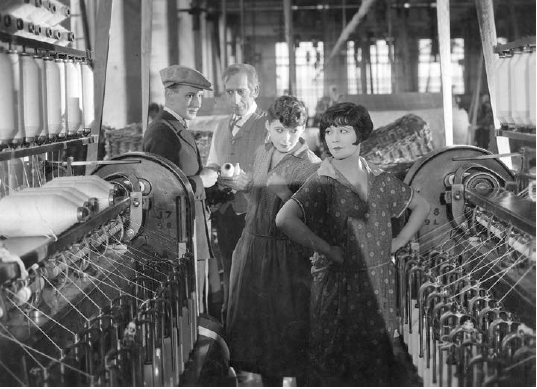
Elvey had produced plays by Chekov, Strindberg, Ibsen and he was a trade unionist who would have identified with the play’s message of working-class independence. He also wanted naturalism in the film and both Estelle Brody and Peggy Carlisle spent time in a mill to learn how to properly look like they were doing the work and to understand the culture, Peggy was from Liverpool and would have known Blackpool well but Estelle was an American: welcome to the real Playground of the World!


Watching this new BFI 35mm print – a full restoration is apparently ongoing – the film stands out as one of the major works of British silent cinema because of the expertise with which Elvey controls character and the narrative. It may be a bit slow-paced for modern viewers but everything is there to serve a purpose and every character will have their moments.


Fanny and Mary – Peggy’s haircut is so darn sharp! – feel like modern women all the more surprising given the date of their origin, years before they could vote. The fact that Fanny feels confident enough to exert her right to independence against all odds, is one of the great feminist statements of British silent film. I love her strength and sass as she refuses to let the situation of her dalliance with Allan Jeffcote (John Stuart) and the instant respect from mill-owner Nathaniel Jeffcote (a very fine showing from Norman McKinnel) who recognises someone with drive and grit like himself. She may be a bonny lass Mr Jeffcote but she’s far too good for your Alan!


Similarly, Fanny’s parents are mini masterpieces of characterisation with Humberston Wright as her intelligent yet timid father and Mary Ault as her firebrand of a mother who eye’s her daughter’s transgression as an opportunity to be exploited and just will not be silenced about it, if only there was an audio recording of her improvisations! Mouth almighty as they’d say in Lanky!


John Stuart, Humberston Wright, Peggy Carlisle and Estelle Brody

The sequences in Blackpool are outstanding especially the footage of the Big Dipper – show the restoration in the BFI IMAX and there’ll be folk passing out at that.


It’s a film that strengthens every time I see it and given the politics of 1926-7 as well as 1912, it is simply a remarkable statement about ordinary people’s right to self-determination. Away with the old morality and guilt, time to stand up and play a bigger part.


The score was composed and conducted by Maud Nelissen and performed live by Daphne Balvers (soprano & alto sax), Lucio Degani (violin), Francesco Ferrarini (cello), Rombout Stoffers (percussions & accordion) as well Maud Nelissen on piano. In the catalogue she talks of how she researched locations and culture for the film, immersing herself in mill town history and the times of the annual wakes weeks when t’ whole mill shut down and the workers went off together in search of precious joy. On the evidence of this lovely, soulful score she’s now an honorary Lassie from Lancashire.


This morning there was more Harry Piel serving up top-notch entertainment with Der Mann Ohne Nerven (1924) in which der mann himself plays without fear and spends a good portion of the action attempting to rescue the beautiful damsel Aud Egede Christensen (future Mrs Piel, Dary Holm) from a runaway balloon flying high over Paris bumping into church spires and industrial chimneys. All starts with a bundle of meta-confusion with story is about a famous novelist and his new book, Der Mann Ohne Nerven which, it seems to me, suddenly takes to life as characters start to pursue the man without fear or perhaps that’s the book we’re experiencing.


Plot, who cares, it’s Harry’s World and we’re just watching it.


Mr Neil Brand accompanied as fearlessly as Harry, no safety net and with suspended chords chasing his balloonatic pursuit across the sky.


Jaque Catelain modelling the latest in lounge wear

More gorgeous Sonia Delaunay design next with Marcel L’Herbier’s Le Vertige (1926) (also entitled The Living Image but literally Vertigo, with elements of Hitchcock’s later film of the same title as Stephen Horne pointed out) one of his major films I’ve not seen and quite possibly one of Jaque Catelain’s best performances, as a baby-faced Ivan Mosjoukine as someone termed him. He plays two parts, a young Russian army officer who is killed by General Svirsky (Roger Karl) the horrendous husband of his lover Natacha (Emmy Lynn).


After the Revolution to couple relocate to Nic and taking a trip to Paris Natacha sees a young man, Henri de Cassel (Jaque Catelain again) who looks exactly like her dead lover. Stranger and stranger with some spectacular design, old jealousies are revived and history begins to repeat itself.


Stephen Horne supplied uncannily stylish accompaniment.


Eugen Klöpfer tracking Aud Egede-Nissen

I’ve also managed to avoid seeing Die Strasse (1923) another of the canon revisited stream which was a digital restoration with reconstructed titles and a mix of sources. Karl Grune’s film is indeed impressive in terms of cinematic technique as well as its pointedly political take on German life encapsulated on one street.


There’s a bored middle-aged man who definitely doesn’t work in the publishing industry (Eugen Klöpfer) who sets out for a walk on the wild side of his street, twirling his umbrella and feigning interest in shop windows* as he approaches the local sex workers. There’s some amusing interplay between one such woman (Aud Egede-Nissen) and this nervy punter, a dance she’s played many times before. As we later find out, she shares a house with a small child and a blind man played by the protean Max Schreck; two vulnerable people who exist in the criminal uncertainties of this low life.


The man finally bucks up the courage to follow the woman into a night club where his seduction and exploitation can be controlled, it’s a tense voyage into the underworld, with a dreamlike quality that doesn’t make the realities being dramatized any less pitiful.


Partners in crime Günter Buchwald (violin and piano) and Frank Bockius (hitting things) accompanied in fine style with so many hints of contemporary club anthems, Ain’t She Sweet being ironically right on point!


Obligatory banging on about Liverpool... 

*In one of the shop windows he passes by there’s an advert for The White Star Line including Liverpool as one of the destinations. The White Star offices still stands in Liverpool as does The White Star public house just off Mathew Street and The Cavern were fifty years after Fanny and Mary, girls went for a good time increasingly on their terms.


The wifi's decent as well...

Liverpool has some fabulous architecture.


Saturday, 12 December 2020

Smile… Stars in Your Eyes (1956), Network Blu-ray out now!


This is a quite remarkable restoration from Network of a film that has been largely unseen for over fifty years and, it is a heart-warming time capsule of an era when the stage was still – just about - king and your “act” could earn you a decent living from Weymouth to Fleetwood and back again via Scarborough and Southend. Being of a certain age I grew up with the last of the golden age of British variety performers still on our TV screens from Arthur Askey and Ted Ray to Morecambe and Wise, whose careers were born on stage and who stayed there even after the advent of mass televisual entertainment.


In 1971, at a very tender age, I saw Jimmy Clitheroe, one of the performers in this film, on Blackpool North Pier in a bill including pianist Valentino (no relation to Rudy…), comedienne Joyce Howard, comedian Ken Goodwin (who my sister loathed) and Manchester mop tops Freddie and the Dreamers who ran amongst us in their shorts. This my friends, was Variety and, even today, our screens are still filled with the ghosts of family entertainment past because, strictly speaking, Britain has talent!


Jimmy was over fifty when I saw him but still four feet two and playing a wise-cracking kid and in Stars he does a turn as Nat Jackley’s son in a slapstick routine that’s almost Victorian; in 2020 we still talk about The Beatles and Elvis and in 1956 the ghost of Dan Leno still haunted light entertainment as well as the Good Old Days routines of Marie Lloyd who, even though she passed away in 1922, is impersonated by a young Janet Brown in the fascinating extra feature A Ray of Sunshine: An Irresponsible Medley of Song and Dance (1950). People have long memories when it comes to popular culture…


Pat Kirkwood sells The Man That Wakes The Man That Blows Reveille!

Directed by our old pal Maurice Elvey – this is a long way from Hindle Wakes if not the destination entertainment of its characters… Stars in Your Eyes is “dated” and that’s exactly what makes it so watchable and entertaining. If you didn’t know the mighty Pat Kirkwood before you’ll know her now and exactly why she was the first woman to have her own TV show in this country. Pat’s got charisma to burn, Hollywood looks, near infinite legs (they go all the way t’ the floor!) and lungs of the sweetest leather, selling her songs with all the thrill of a Lancashire Garland.


Alongside this Salford star’s power, we have Mr Nat Jackley another stage star a comedian of long neck and no fixed expression who somehow manages to control his disparate limbs with almost balletic grace as he winds himself across the stage in various routines. Nat’s the evolutionary evidence of the adaptations necessary to thrive in the Variety Period: he can sing, dance, acts a bit and has a winning personality. Would I credit him as a love match with Perfect Patricia? Probably not but they make a convincing couple at the heart of this story which is more about the business of show than any narrative complexity.


Nat Jackley's turn

Nat’s Jimmy Knowles and Pat’s Sally Bishop, performers improbably on their uppers with the increasing proliferation of the idiot box in households formerly given to theatrical entertainments. Their show kicks off the film with two brisk numbers before they learn that their tour is to be cancelled as a result of low-ticket sales. TV takes a gentle kicking throughout – odd given Pat’s success there – but Jimmy’s not keen at all on taking part in the very thing that’s killing off his trade.


With no work on the horizon, he finally relents and goes for an audition and it’s interesting to see the BBC stereotypes already established with the slightly fey Oxbridge type director Crawley Walters (Hubert Gregg) and his yes man, W1A-style assistant Dicky (Gerald Harper) who quickly adjusts his opinion when Crawley decides that no matter how funny Jimmy is, he’s just not “right” for TV…


Just not right for TV...


The meat of the story is provided by Jimmy and Sally’s efforts to help their pal, David (Bonar Colleano, the go-to Yank in many a Brit flick), a songwriter who has lost his sobriety and his muse Ann, played by Dorothy Squires later Mrs Roger Moore in a gender reversed A Star is Born scenario and a multiple litigant in a career of triumph and disappointment. Ann’s a big success now but David's a bum, drinking away every penny and needing Jimmy to bail him out of a clip joint (ask yer dad!). David has just one asset, a run-down theatre left in his parent’s estate and which he’s aiming to sell dirt cheap just to cover his debts.


Jimmy and Sally collude with Ann to spur David onto putting on a show there with all of their out of work variety friends and, whilst the show must go on, there are property developers intent on ruining everything by hiring a bunch of thugs.


Dorothy Squires projects in her first film. She married Roger Moore you know...

OK, not the most complex plot in history but it is a great excuse to show off the theatrical chops of the cast even if Gene and Fred could sleep easy; this is the best of wholesome British musical theatre! Maurice Elvey directs with efficiency and in his fifth decade of film making martials his cast of dozens well for the set pieces on stage. It’s thoroughly entertaining and all the more so because I know my parents and grandparents would have watched these performers in theatres from Liverpool all the way up the coast to Blackpool. And in 1971 my Dad was still keen to show us his comedy heroes from Sid James (twice!), John Inman and Mollie Sugden to Freddie and Jimmy; a reminder of the times when we all laughed together.


No phones...

There’s an excellent booklet as we’ve come to expect from Network with a mix of new essays and original promotional material. Then there are the extras, a trio of Adelphi shorts, including the aforementioned A Ray of Sunshine: An Irresponsible Medley of Song and Dance (1950) in which Ted Ray, a Liverpudlian who was in the same class at school as my Auntie Eva (I know, I never get tired of those Scouse connections…) gets drunk with the alarmingly flexible and long-limbed Lucille Gaye filling the gaps with jokes and incredible flips and high kicks in between performances from the legendary Ivy Benson's All-Girl Band, Wilson, Keppel and Betty (Patsy here, Betty’s daughter… ), Janet Brown and many more. There’s also The Morton Fraser Harmonica Gang who I’m sure did a couple of sessions for John Peel in the early eighties… they have fantastic timing and the comedy cohesion of thousands of stage hours.


Ted Ray and Lucille Gaye who has to be seen to be believed

Compared by Max Bygraves, we also get The Nitwits on Parade (1949), a group of, yes, madcaps! who influenced The Bonzo Dog Doo Da Band as well as impressing several very young Beatles. Finally, there’s The Kilties are Coming (1952) a variety showcase with rare performances and interviews with young Scottish lads and lassies including McDonald Hobley!


This is a very special package from Network and one to be supported by everyone with an interest in post-war British popular culture. The restoration of Stars in Your Eyes was funded by a Kickstarter campaign and it is to be hoped that this release can pave the way for more. I’m in but then they had me at Pat Kirkwood to be honest… I’ve not seen her since Band Waggon (1940) with Stinker Murdoch and Big-Hearted Arthur Askey.


I thank you, Network! It's a bloomin' marvel.


Order your copy now direct from their online shop and all good retailers. 


There's a trailer here to help free your wallet so your pounds will follow...


Wilson (from Liverpool), Keppel...
...and "Betty"
Ted Ray
Janet Brown, who later impersonated Mrs Thatcher
Ivy Benson's All-Girl Band!


Sunday, 7 April 2019

Murder on the dancefloor... Palais de Danse (1928) with Costas Fotopoulos, BFI


“We are a nation that suffers from… mock modesty and it applies to British film… there is no reason why our films should not rank higher… Are we downhearted, emphatically no!”

Speaking thus in 1929, Maurice Elvey bemoaned the attitude of the British to our own cinema and, commenting as above, issued a rallying cry for the creative arts to stand up and be counted. Dr Lucie Dutton in her excellent introduction addressed this ongoing narrative of “mock modesty” and offered this film as yet another example of domestic cinema’s quality. Elvey himself wouldn’t have ranked Palais de Danse on a level with say his own Hindle Wakes (1927) but it’s clear to see that the former is not only highly competent but stylistically adventurous and entertainment.

Lucie quoted the above from a 1929 radio interview and an earlier interview in which Elvey also talked about wanting to make stories that touched on the common experience of the audience: “depicting human emotions in a reasonable way… (and) just the sort of happenings that must have happened to themselves.” This film, as with Hindle, helps explain why audiences at Granada cinemas voted him the most popular director in 1927.

One of my favourite sequences in Hindle Wakes is that showing the dancing in the Blackpool Tower Ballroom and here Elvey filmed 1500 extras in the Tottenham Palais (built in 1910 and only demolished as recently as 2003), Percy Strong’s camera following the mass as the circle the dancefloor marshalled impeccably by the director (was anyone better with crowds than Maurice?) and his assistant, one David Lean.  It’s hypnotic and poignant, these were are grand-parents’ moves, it was how they met and how they courted.

Mabel Poulton promotes the Danse
The film is packed full of cross-fades, dolly shots, montage, and Germanic camera mobility and it draws you into the Palais and moves the narrative onwards so effectively. At one point, Lady King (Hilda Moore), enjoying a rendezvous with “Count Alban” (aka No. 1 played by the marvellously menacing John Longden, who also co-wrote the story), are followed as they stand up from their table in Eugene’s Club and move over the room to open a door revealing a roulette table. There are also plenty of “Elvey Touches” such as when the legs and feet are shown of the professional dancers/escorts as they march out from their changing rooms to face another day of being bought and danced with… or when our modern Cinderella (Mabel Poulton) is first caught up in the show, nervously reacting to the extreme close-ups of “Prince Charming”, Tony King (Robin Irvine) as he attends to her in a tableaux vivant at the start of the film.

In the same way that, say Julian Barnes or Ian McEwan are easier reads than other middlebrow heavyweights who use too much technique (yes Martin and, especially you Will…), Elvey focuses on the story and only uses that which advances the process. I’d say he is under-rated from what I’ve seen and there are a growing number who would agree with Dr Dutton in recognising his importance in the development of British cinema from the 1910s onwards.

Mabel Poulton is an actress new to me but she’s excellent in the film as the daughter of a disabled war-veteran road worker who is plucked from her father’s side opposite 415–419 High Road Tottenham, to fill the glass shoes of a missing Cinders in the aforementioned tableaux. She catches the eye of the Hall’s owner and auditions for the leading professional dancer, Number One (Longden) who is extremely impressed after a false start in which she dances ballet.


She is allocated the number 16 and is soon foxtrotting her feet off on the daily drag round the dancefloor. The other dancers are well observed especially Number 2, played by a perpetual motion gum-chewing Chili Bouchier, as the world-weary girl with the curls who comes out with such lines as “c’mon you flat-footed son of a saxophone!” – I think we’ve found the English Marie Prevost!

It’s a culture shock for our innocent Cinders and there’s another great sequence in which she backs away, mesmerised and horrified at the mass of human interaction, shadows falling in constant motion one her face and the walls. She retreats staring at the action and finally sneaks out of the door, pausing only for one last look.

Her Prince Charming returns and gradually No 16 falls in love with Tony King but it’s not a relationship approved of by his mother nor his father, Sir William King (Jerrold Robertshaw) a judge “of few words but long sentences”. Tony pleads with her ladyship – “this is 1928, times have changed…” but not by that much and the class divide stands firm even as Lady King finds out who her Count really is.

As Number 1 starts blackmailing his Lady, Cinders overhears and tries to help… things are about to get a lot more complicated; there’ll be more dancing and a heck of a fight before the day is done in a thrilling, if completely predictable, ending.

The curved entrance to the Palais de Dance on Tottenham HIgh Road
Costas Fotopoulos accompanied with sure-footed flourishes that captured the mood and the period; rhapsodic elements mixed with jazz-age poignance. Just what the film asked for.

Palais de Danse could easily have been a Hollywood or French comedy-drama and proves Mr Elvey’s point precisely by its quality – it’s not his best work but it is very good all the same!

For more on British Silent Film, I can recommend theBritish Silent Film Symposium which takes place at Kings College London on 11thand 12th April – it’s a fascinating line up of research and films and plays a major role in the ongoing rehabilitation of British silent film.

Are we downhearted? Emphatically no!

Chili Bouchier, the English Marie Prevost?

Sunday, 18 November 2018

Comrades in films… Silent Guns, Kennington Bioscope Great War Centenary Day


There’s film of history and film as history: films that are essentially primary source in themselves, how else to view almost any cinema after the Great War in which six million men served, 725,000 British servicemen died and over 1.75 million were wounded, half of which left with life-changing injuries.

My great Uncle Alec lived the rest of his life with shrapnel in his skull whilst my granddad William saw much that changed his attitude to class, politics and religion; he also almost died twice. The First World War touches us still but for those making film during, after and about the conflict in the silent era it was an act of personal and professional exegesis. Even in Hollywood some had fought in the war, William Wellman and Richard Arlen were both fighter pilots a decade before they made Wings, whilst in Europe, as you’d expect, connections were everywhere.

The styles of cinematic representation differed even then from the forensic neo-documentary approach of the British reconstruction films such as today’s Q Ships (1928) to the more dynamic and crafted approach of perhaps the first true war blockbuster, King Vidor’s extraordinary The Big Parade (1925).

A shoulder to cry on - Comradeship (1919)
There are no winners in war but today there were two films that stood out, Vidor’s film and, to the delight and surprise of a fair few, Maurice Elvey’s Comradeship (1919) which was so deftly made it could have been made in California that year or ten years later in Ealing.

It’s so affecting that I’d like to demand both a re-screening as soon as possible as well as a Blu-ray and DVD release. I’m also agitating for a posthumous damehood for Peggy Carlisle who is excellent in the film and clearly one of the all-time great Scouse silent stars… they should get some stars for Mathew Street!

But first the Parade that was Big… this is a film that set the template for so much of what was to come from Wings, Hell’s Angels and All Quiet… right the way through to Band of Brothers and Saving Private Ryan. The scene where John Gilbert, Karl Dane, Tom O'Brien and their company begin a slow walk in line with bayonets fixed through a forest littered with dead French soldiers is still unbearable tense. Slowly single soldiers fall, picked off by snipers, then two, then three as machine guns are trained on the men, then grenades and bigger guns… it is as if the real war is gradually being rolled out after a first half of comradeship and Gilbert’s character’s inevitable fall for the irresistibly-appealing Renée Adorée – the best leading actor in the film.

Renée Adorée 
Then, as even his closest buddies begin to fall, Gilbert is trapped in a crater with one of the Germans, he’s already fatally shot the man but, as with a dying animal, can’t deliver the coup de grâce… he gives the man a cigarette as he dies and, in an instinctive improvisation, pushes his face away repeatedly: he just cannot look at him.

There are a few moments of 1920’s artifice but whilst some might snigger as Adorée clings on desperately to Gilbert’s departing truck, the absolute panic as she searches for him as the thousands of soldiers depart is visceral and the way the soldiers can’t resist pawing at her an animalistic foretaste of the de-humanisation to come. The psychological impact of the war drives the story and that’s exactly why it still works so well: these people were far more familiar with the realities of war than us.

John Gilbert in the fight of his life...
It doesn’t get much more laudable than the second-highest grossing silent film ever and MGM’s biggest until they torched Atlanta 14 year’s later. Comradeship, however, was today’s revelation, the Stoll Company’s first feature film and one aimed at helping publicise the Comrades of the Great War; a post-conflict support group for ex-servicemen who, as King George V hoped, would keep alive the “splendid spirit” of the battlefield in peace time.

In Dr. Lucie Dutton’s fascinating introduction, she revealed that stage actress Lily Elsie, here making her only feature film appearance, donated her fee to the Comrades as did Louis Parker on who’s story the film is based, Director Elvey gave half his salary and Stoll 60% of box office receipts. It was a cause close to Oswald Stoll’s heart and even today the Stoll Foundation is active in supporting ex-service men.

Inventive mirrored shot of Lily Elsie in Comradeship (1919)
Elevy said that this story is “the finest I have ever read in my life and will make a very fine film…” not untypical enthusiasm for his current projects according to Lucie and it is indeed a fine story and one that entertains and engages and says so much about the period in which it was made. It’s an examination not just of the binary outcomes of the conflict but the deep impacts it left on the national psyche – the emotional elements are every bit as important as in The Big Parade.

Instead of John Gilbert we have Gerald Ames (whose teeth are not in the same league) as John Armstrong who runs a drapery in the small town of Melcombe, he is a pacifist at the start of the war but this will, of course, have to change – let’s hope we none of us ever have to go through the same moral calculations.

He is assisted in his shop by a fuzzy-haired blonde Peggy played by Peggy Carlisle who was all of 15 years old at the time and would become an Elvey regular after her cameo in Lloyd George she would feature in The Rocks of Valpre (1919) – screened at the British Silent Film Festival in 2015 – as well as the lost Keeper of the Door (1919) and the superlative Hindle Wakes (1928). She’s a terrific presence in this film and has to do a lot of the emotional heavy lifting after being betrayed and left pregnant by a German spy, Otto (Dallas Cairns) who also works as a cutter the store.

Peggy Carlisle by a happier tree
Otto busies himself taking pictures of key landmarks and, after events escalate, he leaves with a note saying he will return as John’s master (we relay don’t like Otto). Local landowner Lieutenant Baring (the always watchable Guy Newall) always suspected Otto but the draper gave him the benefit of the pacifist's doubt.

John meets Baring’s cousin, the elegant Betty Mortimer (Lily Elsie) and it’s respectful-love-for -one’s-betters at first sight. After war breaks Betty decides to turn their home, Fanshawe Hall, into a wounded soldiers' hospital and she also takes in Peggy after her step-mother disowns her.

There are some excellent exterior shots in this film – Elvey always has that and it adds so much “volume” to his best films – with cinematographer Paul Burger excelling with some prize shots of Peggy set against a row of trees, her movement making her anguish clear even from a distance; she is alone and in need of friends like Betty.

Peggy Carlisle, Gerald Ames and Teddy Arundell
John goes to war and meets up with a fine fellow called Ginger (Teddy Arundell) a proto-Karl Dane who plays the accordion badly but will always stick with his pals. On leave he rescues Peggy from assault and they begin a tentative relationship whilst, at the same time, John sees Betty give a locket to Baring and jumps to the wrong conclusions.

Back in the war, the chums have a fateful encounter with Otto and as Gerald returns blinded and peace is declared, it seems his chances of happiness and purpose have disappeared for good. But this is when comradeship comes to the fore and I wasn’t the only one wiping something from my eye as steadfast humanity endures.

Some felt at the time that the film had come too late but fascinating shots of German artillery in the Mall – there for children’s delight and as proof of victory – along with the plot concerning the Comrades of the Great War, would have been very important to a society in shock: who was really celebrating in 1918-19? Society needed to be seen to be standing tall.

Offering help and comfort for the 800,000 disabled ex-servciemen
There’s also a very deft conclusion with Elvey making like Lubitsch with a close-up of just Betty and Gerald’s hands: will they, won’t they… you’ll have to watch and find out!

Meg Morley accompanied, fresh off the plane from Australia and her playing was soulful and naturally so supportive. Her next trick was to transform herself into John Sweeney some two-thirds of the way through the Anglo-German A Romance of the Great Battle of Jutland/Die Versunkene Flotte (1926). Their change-over was seamless and John followed Meg’s lines; total pros these guys!

This film was a fascinating mix of military drama and tangled romance with Agnes Esterhazy’s Erica choosing German naval commander Barnow (Bernahrd Goetke) over his best pal, Royal Naval captain Dick (Henry Stuart). War breaks out and they determine to remain friends even as Barnow commits himself to his men’s lives. Erica is sorely tempted by Lt Arden (handsome charmer Nils Asner), and spills the beans on the eve of the Battle of Jutland as the greatest navies in the World prepare for the defining sea battle of the Great War. Jutland was a “score-draw” despite heavier British losses, that showed the Germans they had no chance of winning outright given the resources and size of the Royal Navy: after Jutland the Germans accepted that they had been contained as a surface fleet.

The SMS Szent István sinks 
It is very well done and features extensive found-footage from the conflict including the capsizing of the Austrian battleship SMS Szent István in 1918… which adds extra reality with the horrific sight of hundreds of figures swimming away from the massive hull as it rolls over.

Kings College's Dr Lawrence Napper introduced and said that this, mostly German production was part of a process of more balanced relationships between the former enemies, by this stage the Germans are recognised as men with honour as well as ruthless efficiency.

Lawrence also introduced Q Ships (1928), a more typical battle reconstruction film, directed by Geoffrey Barkas and Michael Barringer for New Era Films (an offshoot of British Instructional Films) which showed the role of armed cargo ships in entrapping German U-Boats. After Jutland the prospect of another great face-off between battleship-led fleets diminished and submarines became the key German naval weapon as they attempted to interrupt supplies to the Allies. There’s very little fictional drama and the focus was very "procedural" as they tried to show the actuality. Admiral Lord Jellicoe – who commanded the British fleet at Jutland – even features in the film to add authenticity and it was not uncommon for former combatants to be featured.

Even the mud was imported in the quest for accuracy and authentic ships and weaponry was used along with narratives based on actual medal-winning events. The films were “memory spectacles” for old troops who would watch them on the afternoons of Remembrance Sunday.

John Sweeney played his own respects with accompaniment that let the story breathe as the Brits chased an enemy submarine.

Oooh, Q-Ships is on Grapevine DVD
There were also three sections compiling shorter films: in America at War: Hollywood in the Air, Kevin Brownlow talked through his interviews with Colleen Moore in relation to Lilac Time, the film she made with Gary Cooper and, mostly, William “Wild Bill” Wellman on Wings which left me wanting to watch that film again on the big screen. After The Big Parade, Wings was another blockbuster and Howard Hughes was watching, again and again as he put together Hell’s Angels.

Hollywood on the Ground had Glenn Mitchel and Dave Wyatt introducing a mixed bag of which my favourite was Pearl White’s Pearl of the Army (1916) – it may be incomplete but it shows how one of the pioneers of women in action adventure films worked. There were also some classy comic cuts from Harry Langdon, Natalie Kingston and Vernon Dent in All Night Long (1924).

As a treat, Colin Sell accompanied these two segments and showed that he may well have had some previous experience… only “Samantha” knows for sure and she’ll never tell!


Lastly there were shorts from this side of the pond with Europe at War which included a fascinating single reel of a Herbert Brenon feature in which the Germans invade Chester. Victory and Peace (1918) came too late and was dogged by bad-luck and self-sabotage and so only this one reel survives: it’s powerful in its way as the city is bombed and children die – but propaganda that was simply after the show. You can watch the film for free on the BFI Player.

Nurse and Martyr (1915) was a highly-propagandist take on the execution of Edith Cavell featuring the rather too glamourous Cora Lee in the lead and an unknown actor as Elsa, a no-mark German who blames Cavell for her own failings and gets revenge by selling her out. An unnecessary addition to the story which, as the Fifeshire Advertiser noted, will “touch the heart of a nation… the British ‘Joan of Arc’…”

Edith (Cora Lee)  is betrayed by evil Elsa
Congratulations and thanks to all at the Bioscope and Cinema Museum who make these days possible. At the end Michelle Facey reminded us of the main importance of these films: “we shall not forget” those who sacrificed all for their country in a war that finished a century ago but which shaped the Twentieth Century and beyond.