Showing posts with label Harry Piel. Show all posts

Wednesday, 11 October 2023

Wakes Wednesday… Le Giornate del Cinema Muto 42, Day Five


Three piers, The Golden Mile, The Big Dipper, trams, a Tower to rival Paris, arcades and donkeys; even in it’s dotage Blackpool still defiantly breaks more hearts than any other UK seaside resort but, as we saw tonight, Llandudno’s subtle charms can compromise even the most careful girl. For, climbing the Great Orme, near the still-extant Victorian pier and staying at the Grand Hotel, where I worked two summer seasons as a student, Fanny Hawthorn risked her future with some posh fella on the lookout for more than fresh air and fun.


Maurice Elvey told the BFI in 1949 that Hindle Wakes was “the greatest play ever written” and one of the films he most enjoyed making and, in fact, he was so keen on Stanley Houghton’s play that he made it twice. This is more than just a “Lancashire film for Lancashire people” as the publicity had it, this was a liberating tale for all at a time of increasing class awareness and the growth of unions and the Labour Party. Houghton’s play was written just a year after the Liverpool general transport strike which, apart from causing Home Secretary Winston Churchill to send troops and a battle cruiser up the Mersey, did so much for union membership. My grandfather was a tram driver who withdrew his labour for the strike during which two men were shot dead and hundreds injured by the army.


Elvey had produced plays by Chekov, Strindberg, Ibsen and he was a trade unionist who would have identified with the play’s message of working-class independence. He also wanted naturalism in the film and both Estelle Brody and Peggy Carlisle spent time in a mill to learn how to properly look like they were doing the work and to understand the culture, Peggy was from Liverpool and would have known Blackpool well but Estelle was an American: welcome to the real Playground of the World!


Watching this new BFI 35mm print – a full restoration is apparently ongoing – the film stands out as one of the major works of British silent cinema because of the expertise with which Elvey controls character and the narrative. It may be a bit slow-paced for modern viewers but everything is there to serve a purpose and every character will have their moments.


Fanny and Mary – Peggy’s haircut is so darn sharp! – feel like modern women all the more surprising given the date of their origin, years before they could vote. The fact that Fanny feels confident enough to exert her right to independence against all odds, is one of the great feminist statements of British silent film. I love her strength and sass as she refuses to let the situation of her dalliance with Allan Jeffcote (John Stuart) and the instant respect from mill-owner Nathaniel Jeffcote (a very fine showing from Norman McKinnel) who recognises someone with drive and grit like himself. She may be a bonny lass Mr Jeffcote but she’s far too good for your Alan!


Similarly, Fanny’s parents are mini masterpieces of characterisation with Humberston Wright as her intelligent yet timid father and Mary Ault as her firebrand of a mother who eye’s her daughter’s transgression as an opportunity to be exploited and just will not be silenced about it, if only there was an audio recording of her improvisations! Mouth almighty as they’d say in Lanky!
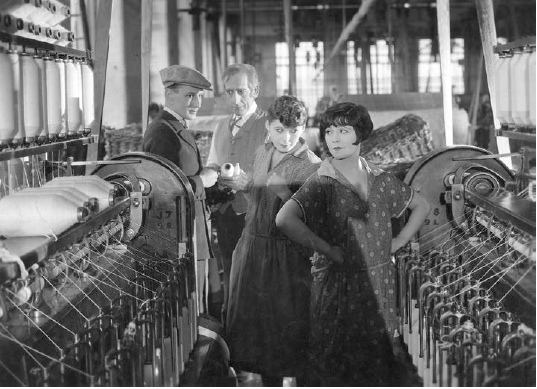

John Stuart, Humberston Wright, Peggy Carlisle and Estelle Brody

The sequences in Blackpool are outstanding especially the footage of the Big Dipper – show the restoration in the BFI IMAX and there’ll be folk passing out at that.


It’s a film that strengthens every time I see it and given the politics of 1926-7 as well as 1912, it is simply a remarkable statement about ordinary people’s right to self-determination. Away with the old morality and guilt, time to stand up and play a bigger part.


The score was composed and conducted by Maud Nelissen and performed live by Daphne Balvers (soprano & alto sax), Lucio Degani (violin), Francesco Ferrarini (cello), Rombout Stoffers (percussions & accordion) as well Maud Nelissen on piano. In the catalogue she talks of how she researched locations and culture for the film, immersing herself in mill town history and the times of the annual wakes weeks when t’ whole mill shut down and the workers went off together in search of precious joy. On the evidence of this lovely, soulful score she’s now an honorary Lassie from Lancashire.


This morning there was more Harry Piel serving up top-notch entertainment with Der Mann Ohne Nerven (1924) in which der mann himself plays without fear and spends a good portion of the action attempting to rescue the beautiful damsel Aud Egede Christensen (future Mrs Piel, Dary Holm) from a runaway balloon flying high over Paris bumping into church spires and industrial chimneys. All starts with a bundle of meta-confusion with story is about a famous novelist and his new book, Der Mann Ohne Nerven which, it seems to me, suddenly takes to life as characters start to pursue the man without fear or perhaps that’s the book we’re experiencing.


Plot, who cares, it’s Harry’s World and we’re just watching it.


Mr Neil Brand accompanied as fearlessly as Harry, no safety net and with suspended chords chasing his balloonatic pursuit across the sky.


Jaque Catelain modelling the latest in lounge wear

More gorgeous Sonia Delaunay design next with Marcel L’Herbier’s Le Vertige (1926) (also entitled The Living Image but literally Vertigo, with elements of Hitchcock’s later film of the same title as Stephen Horne pointed out) one of his major films I’ve not seen and quite possibly one of Jaque Catelain’s best performances, as a baby-faced Ivan Mosjoukine as someone termed him. He plays two parts, a young Russian army officer who is killed by General Svirsky (Roger Karl) the horrendous husband of his lover Natacha (Emmy Lynn).


After the Revolution to couple relocate to Nic and taking a trip to Paris Natacha sees a young man, Henri de Cassel (Jaque Catelain again) who looks exactly like her dead lover. Stranger and stranger with some spectacular design, old jealousies are revived and history begins to repeat itself.


Stephen Horne supplied uncannily stylish accompaniment.


Eugen Klöpfer tracking Aud Egede-Nissen

I’ve also managed to avoid seeing Die Strasse (1923) another of the canon revisited stream which was a digital restoration with reconstructed titles and a mix of sources. Karl Grune’s film is indeed impressive in terms of cinematic technique as well as its pointedly political take on German life encapsulated on one street.


There’s a bored middle-aged man who definitely doesn’t work in the publishing industry (Eugen Klöpfer) who sets out for a walk on the wild side of his street, twirling his umbrella and feigning interest in shop windows* as he approaches the local sex workers. There’s some amusing interplay between one such woman (Aud Egede-Nissen) and this nervy punter, a dance she’s played many times before. As we later find out, she shares a house with a small child and a blind man played by the protean Max Schreck; two vulnerable people who exist in the criminal uncertainties of this low life.


The man finally bucks up the courage to follow the woman into a night club where his seduction and exploitation can be controlled, it’s a tense voyage into the underworld, with a dreamlike quality that doesn’t make the realities being dramatized any less pitiful.


Partners in crime Günter Buchwald (violin and piano) and Frank Bockius (hitting things) accompanied in fine style with so many hints of contemporary club anthems, Ain’t She Sweet being ironically right on point!


Obligatory banging on about Liverpool... 

*In one of the shop windows he passes by there’s an advert for The White Star Line including Liverpool as one of the destinations. The White Star offices still stands in Liverpool as does The White Star public house just off Mathew Street and The Cavern were fifty years after Fanny and Mary, girls went for a good time increasingly on their terms.


The wifi's decent as well...

Liverpool has some fabulous architecture.


Tuesday, 10 October 2023

Forde every stream… Le Giornate del Cinema Muto 42, Day Four


Tonight’s special was Pêcheur d'Islande (1924) with accompaniment from Gabriel Thibaudeau and Frank Bockius (again) and I wonder if it is possible that in future years we will look back on this GCM as The Bockius Edition, so involved has the percussionist been in the screenings I have enjoyed the most as well as this accompaniment; excellent interplaying, spirited lines and improvisation.


As for the codfish, I suppose someone had to make a film about the fragile mortality and crashing uncertainty of the Bretton fishermen in the Icelandic sea, the anguished weeks and months for those at home waiting for loved ones to return as other members of the family were despatched in colonial wars or just dropped dead off camera; the sheer uncertainty of life on the edge, extrapolated in visceral ways on screen, making the point with the bluntest instruments of cinematic convention being used to generate expectation - hopes raised not once, not twice but three times - before finally jabbing the audience right on the nose. Pêcheur d'Islande is that film. As the advertising had it at the time, it’s an “…affirmation of crushing fatalism which brings to the scale of the elements our humble and proud humanity.”


The film looks a dream and there are fabulous performances from Charles Vanel, Sandra Milovanoff (see above), Roger San Juana and Madame Boyer, yet the fatalism crushes the film relentlessly. The tragedy was not earned, it was imposed.


Mabel resists Ford's crushing fatalism

And yet, only a few hours ago I was so happy… The morning saw a top-quality slapstick session and you just get the warm giggles the second you see a line up of Mabel Normand, Mack Sennet and yes, even Ford Sterling. The gang are At Coney Island (1912) and are probably making things up on the spot with Mabel shining brightest. The same can be said for Harold Lloyd and his practically perfect From Hand to Mouth (1919) two-reels that pack as much in as Gance of von Stroheim did over ten – well, certainly more gags. Harold’s going hungry and gets caught up in  trying to save a young girl (his first film with future wife, Mildred Davies) and her inheritance. There’s bent lawyers out to cheat her and Snub Pollard out to kidnap her with only one hungry Harry and his instant wit to help her; they don’t stand a chance!


What can I say about the man who went on to direct Arthur Askey, a Liverpool-born funster of World-historic proportions, in The Ghost Train (1941)?


Walter Forde’s last silent film is packed with inventive routines: a baby and a doll mix up in the toy store, serving up toy soldiers just like chips on newspaper with oil for gravy and trying to wrap balloons in brown paper for a bespectacled Rees-Mogg-model junior toff. Forde’s an inventor, he’s not sure what of, but it seems to work until it blows his landlord’s house up. He gets a job in a toy shop and meets an attractive young woman Pauline (Pauline Johnson) who just happens to work for the War Office, he invites her for dinner cooked by his uppity roommate, Cuthbert (Arthur Stratton) who, in a constant battle of wills, refuses to act the role of his butler.


Walter making a right pig's ear of things

Walter’s invention of a remote-control tank could be a game-changer but a group of spies finds out and set’s off to stop him demonstrating the kit to the Minister for War. Their leader is modelled on a similar mastermind in Fritz Land’s Spies and sits at a huge desk, pushing buttons for everything he needs, drinks, photographs, cigarette and lighters… There’s a very funny bit of business on the Underground as the baddies chase Walter up lifts and down emergency spiral staircases in scenes reminiscent of Keaton in The Cameraman and elsewhere. The gags are mostly good and Forde lets things flow without over-extending his ideas, no wonder he worked so well with Big-Hearted Arthur.


He gets his chance to demo for the Minister but the enemy agents kidnap him and Pauline, and, as Walter pushes his pal Cuthbert too far, the real-life tank runs amok to comic effect. The filmmakers were clearly delighted to get the loan of kit and crew and have the crushed cars, walls and buildings to show for it.


Hurry up Harry!

Harry Piel’s taken some stick at the Festival for his repetitions and improbably plotting – but things mostly came together for the epically daft Rivalen (1923) in which we finally got to see his acting as well as his directing and writing. Piel is dynamic and eye-catching with Fairbanks wit and physicality  allied to Houdini-esque escapology with one section in which he is lowered into a lake in a glass pyramid and then seen in a studio tank struggling to escape.


It's possible that the film was a sequel to Das schwarze Kuvert as well as being followed by Der letzte Kampf according to Hemma Marlene Prainsack and Andreas Thein in the programme notes. That would make sense of the bad blood between Piel’s character Peel (see what they did there?) and the evil Dr Ravello (Charly Berger) – he’s got a robot! – and the fact they’re both pursuing the same woman, rich industrialist John Evans’ daughter Evelyn (Inge Helgard). The pace has the relentlessness of a serial and the outlandish sci-fi plot barely makes sense nor does it need to.


I loved the “Heaven and Hell” masked ball with the theme, held in Evans’ castle with lots of Teutonic debauchery and outrageous set designs from Hermann Warm who worked on Caligari and Albert Korell. It provided and interesting contrast with the even more spectacular work of the French Sonia Delaunay who is also being highlighted during the festival.


Accompaniment was from Günter A. Buchwald and Frank Bockius – The Man Who Never Sleeps – and they lifted the film and the fun with their swinging affinity.


Fishing about on the river

No greater contrast could be found than in the long-lost documentary, Amazonas, Maior Rio Do Mundo (1918) which was only rediscovered this year and even made the news in The Guardian. It’s a fascinating document of the life and importance of the huge waterway which revealed hitherto unknown details about Brazil Nuts – they’re encased in fruit!? – as well as rubber and mahogany. Vegetarians and omnivore’s alike looked away for the scenes of manatee hunting but at least they killed what they ate. It reminded me of the basking shark hunt filmed by Flaherty for Man of Aran only real. A window into the past that was seemingly shattered exists again.


Accompaniment was from José María Serralde Ruiz and it was definitely Amazon prime!


Mack and Mabel provided my third trip to Coney Island in a few weeks after Eleanor and James in The Crowd (BFI) and Clara and Antonio in It (Kennington Bioscope). They used to say it was The Playground of the World, a bit like Blackpool… and that’s exactly where we’re headed tomorrow on Wakes Wednesday! I can not wait!


I want you to crush him, fatalistically!


Sunday, 8 October 2023

We can be heroes… Le Giornate del Cinema Muto 42, Day Two


And so, from the sublime to the gorblimey and back again as my granddad might of said; from a France vs Wales rugby match (I know, during the Rugby World Cup as well!), to a runaway table, (literally, a table that runs away,) via three cowboys and a little baby and Charlie Chaplin’s brother Syd playing “Charlie’s Aunt” with all the comic aplomb of Arthur Askey in his prime; it was an incident-packed day from the serial winners of the Silent Film Premiership.


Where to bloody start though as the actors probably said to the director, Cecil Hepworth in his remarkable The Doll’s Revenge (1907) which featured as part of the closing Feminist Archive Fragments segment. During the film a doll comes to life invents the Robot dance a century too early and then proceeds to eat the severed limbs of an annoying boy; I loved it! Also eye-popping was a tinted colour copy if Émile Cohl's Clair de Lune Espagnol (1909), in which a silly senor upsets the Moon and there’s a musical dialogue from Stephen Horne and Frank Bockius using a Swanee whistle to pay tribute, surely, to The Clangers (possibly an in-joke too far for the Brits, but the World needs to know of these cuddly moon-dwellers…).


Kraftwerk, Peter Crouch's Robot Dance, Die Puppe... Cecil invented everything.

What made this section so sublime was that it followed perhaps the hardest hitting of the films screened so far, William Wyler’s Hell’s Heroes (1929) as accompanied by John Sweeney and Frank Bockius – who put in a very decent shift over the 90 minutes and the 60 in extra time.). After the first half an hour of this film, after the four main characters, all outlaws have terrorised a small town, robbed their bank and killed  in the process, as they made their getaway across the parched desert I was thinking what could possibly redeem these characters, especially with no heroes in sight apart from the two six-gun totin’ preacher, the Sheriff (Walter James) too busy ogling the bar’s dancer Carmelita (Maria Alba).


I, of course, was wrong – which is kind of this blog’s USP - José (Joe De La Cruz, who sees a hearts during the raid, gets shot and collected by the same vehicle but the other three Bob Sangster (Charles Bickford), "Barbwire" Gibbons (Raymond Hatton) and "Wild Bill" Kearney (Fred Kohler) escape to the desert. They survive a sandstorm and lose their horses whilst Bill has also been shot in the shoulder by the posse. They proceed on foot, their only hope a well spring miles ahead, they come across an abandoned waggon and inside find a dying mother (Fritzi Ridgeway) who hands them her baby, appoints them godfathers and asks them to promise to take his to his father, a teller at the very bank they have just robbed.


As moral set ups it is a clever one and the tough guts, perhaps aware that their chances of survival are limited make the calculation to try and save the baby… but even that is unlikely when they find the spring dry, other wells poisonous and hundreds of miles of sand in every direction.


John Sweeney played with thunderous command on the Giornate’s world-class piano and Frank Bockius added so much drive and tone on percussion; these two really play well together (not a soccer reference) and their ideas are always in service of the film. But, as the film moves towards its Christmas climax in the town’s church, a choir, sat on both sides of the Verdi broke into Silent Night, and it sent a shiver around the auditorium and right down my spine. This was 1929, a film about the ultimate redemption, for a Christian audience… the humanity still shines through and the audience erupted for Frank, John and every singer dotted around us.


This collective connection was also made by Sydney Chaplin’s turn in Oh! What a Nurse! (1926), which was easily the best of his performances I’ve seen and the audience in the Verdi laughed louder and more often than for anything else so far. Syd’s got those familial skills alright and he’s got charm too to match the quick changes of expression, lightness of touch and stage-hardened physicality. He plays newspaper reporter who draws the short straw in covering for the love expert column writer Dolly Whimple. Dolly has advised June Harrison (Patsy Ruth Miller) not to marry Clive Hunt (Gayne Whitman) who proves her right by coming into to have it out with her at the newspaper. Jerry dresses up as Dolly and, before you know it, he’s caught up in mod business and ill deeds that mean he must dress as a nurse to save June… OK, it sounds daft but you really don’t know how daft and funny until you’ve seen Syd in his high heels. All in the great British tradition natch!


Charles Reisner directed and Donald Sosin kept up with the crazy on keyboards.


Le P’tit Parigot: 1 La Premiere Partie (1926) was the feature length starter for a six-part comic serial which is playing across every day of the festival. Georges Biscot plays Georges Grigny-Latour, the titular titch who just happens to be the star of the French rugby team, the only Parisian in the side and, duh, the smallest. He has energy and charm but he’s no Chaplin, Charlie or Syd. It’s a thoroughly enjoyable romp though, consistently daft with George banging heads with his establishment Dad,


Special mention must be made of the absolutely stunning costume and scenic design from Sonia Delaunay. There’s a nightclub scene with outrageous modernist designs and clothing, as well as a startling amount of nudity – there never was a pre or post code in France? The dancer Marcelle Rahna, is featured in one of these striking outfits here and she’s the Giornate’s poster girl for 2023.


Mauro Colombis accompanied anticipating every twist and turn.


Ain't no party party like a Sonia Delaunay party!


More horses and guns but back to the wining ways of Harry Carey in two films that again showcased his meticulous yet relaxed acting style – fluid, able to shift on a dime from smile to anger – good with horses and, it turns out, children. In both Blue Streak McCoy (1920) and The Fox (1921), Harry ends up acting as either a mentor or guardian for a young boy, which says much for his appeal. The Fox, directed by Robert Thornby, was my favourite featuring a lot of action, a complex criminal gang, led by Alan Hale, and a Hole in the Wall Gang type outfit hidden in the desert who require the US Cavalry to take down in an epic confrontation.


Philip Carli rode along with his compadre in perfect step and clearly had a blast.


Harry's big country

Now for Harry Piel, a prolific German actor, director, writer and producer who made some 150 films and yet is little known today. Part of the reasons for this is that a large number of these were destroyed in an allied bombing attack although his membership of the Nazi Party and association with the SS arguably had a bigger impact.


All this was in the future when he wrote and directed Erblich Belastet (1913) and Das Abenteuer Eines Journalisten (1914) two films that are full of action and purpose. The latter is the more impressive and comes under the category of Sauerkraut Western as our hero heads west after being wrongly accused only to find his accuser already there and hunting him down. Betrayal, retribution and redemption are strong themes and I look forward to seeing more.


José María Serralde Ruiz accompanied with style.


There’s more, much more, but tomorrow’s apparently another day and moving forward is the only way: we have to jump for it.
