Showing posts with label GCM42. Show all posts

Sunday, 15 October 2023

Of time in this city… Le Giornate del Cinema Muto 42, Day Eight


Is an interest in silent film nostalgia for a time before we were born? Let’s ask Albert Camus shall we, who said that: A man's work is nothing but this slow trek to rediscover, through the detours of art, those two or three great and simple images in whose presence his heart first opened. So, the fascination is more in understanding the working parts as much as the feeling and in the historical, creative circumstances for the filmmakers and film audience alike. 


Camus also said that the artist must contact the reality of his or her time, wresting from it something timeless and universal so what we are searching for is people who have done achieved this for their time and to look beyond the ludicrous concept of “dated” in assessing the content and the context.


Succeeding today was William de Mille who came up with some very pertinent questioning of his own in Conrad in Quest of His Youth (1920) in which Thomas Meighan’s Conrad has something of a mid-life crisis and tries to regress to childhood. So, not too far off Camus’ concepts but in a more homely way which is frankly more on my level and that of Thomas Meighan, pretty well-educated but in pharmacology not philosophy. Thomas plays the titular Conrad, who a few years after the First World War is living in comfort, supported by his faithful valet, Dobson (Charles Ogle) and wondering what it’s all for. Conrad is jaded and decides the best way to reconnect with his zest for life is to revisit his childhood by calling three old friends back to the cottage they used to spend summer in.


It's all too much for Conrad - he's watching a Pat and Patachon...


Ah, but you can’t just go back Conrad, as his pals quickly tell him but he’s not listening and decides to track down his first love, with future director and Mr Louise Brooks, A. Edward Sutherland playing him in flashback with Kathlyn Williams playing the older woman Mrs. Adaile, who gently rebuffed him. Conrad tracks her down to Italy and tries to rekindle their previous affection; can reliving young love work for either?


No spoilers, but Conrad is to discover that you can over-analyse and that sometimes you need to just stop thinking and simply engage with “Life” to find that chance of happiness. It’s a perfect little fable and Meighan is his usual self, intelligent, sensitive and always watchable.


Donald Sosin accompanied with the air of a man completely in touch with his creative consciousness (and moral compass).


Also connecting with the timeless and universal and in doing so creating it, was Daan van den Hurk whose emphatic new score for Buster Keaton’s Sherlock Jnr (1924) made me enjoy this very familiar film anew. The music highlighted pretty much every section of the Orchestra da Camera di Pordenone and it just grew in momentum and delicious tonality with the film. After an opening prologue including the earworm main theme, the music chased around with Buster in the quieter early stages only fully coming to life when his projectionist’s dreaming begins. From then on, it’s a symphony to silent style pretty much as Keaton intended but given extra emphasis and depth as the adventure of the Projectionist and all the films he has shown is laid before us.


Daan reveals Buster’s own symphonic approach as the film and the music crescendos with stirring strings and full-bodied brass – and tha’ knows, I love a bit o’ brass as Hindle Wakes’ Fanny Hawthorn might say. It was one of those uplifting orchestral moments Le Giornate does so well and congratulations must go to Daan, the full orchestra (70+ players?) as well as Ben Palmer who conducted so well. I was up in the Gods again but, by ‘eck the sound filled the space so well. A thrilling sonic adventure all round!


Most of us tired after a full week, the Verdi still erupted with the joy of recognition or holding this shared fascination close!! In the best showbusiness tradition, Le Giornate always leave ‘em/us wanting more!


Charlie and Monta Bell


Before Buster there was Charlie with a film I’ve not seen before, The Pilgrim (1923) which featured Chaplin’s 1958 score arranged by Timothy Brock and performed by the Orchestra da Camera di Pordenone as conducted by Ben Palmer.


It’s a film full of Chaplin’s movement and impish humour with heart as his escaped convict steals a pastor’s clothes as he bathes and then gets mistaken for the new vicar and has to follow through as the citizens are so friendly. This was Chaplin’s final film with long-term collaborator and paramour, Edna Purviance and once again her character provides the key to Chaplin’s redemption as a former cell-mate recognises him and wants in on “the action”. It’s an old argument but there’s enough comedic violence and pointed situations to make political points and some evangelicals were also upset by The Life of Charlie. Who knows what modern US politicians would have made of the closing sequence on the US/Mexican border… or what their fundamentalist Christian brethren would. Chaplin was another able to create something timeless and universal out of the realities of his time.


Marlene by the wall next to Harry Piel.

A Marlene Surprise!


I need to pay more attention as I had no idea that our Marlene was going to feature in Harry Piel’s Sein größter Bluff (The Big Bluff) (1927) nor that he was going to play himself and his brother as well as write, direct and produce. Nobody likes a show-off Harry apart from Marlene that is.


This was a lively adventure which featured car chases filmed in the South of France, double crosses and quadruple bluffs which make me extra thankful for being woken up by my esteemed colleague Ms Hutchinson of Worthing just as Giornate fatigue kicked in and I was able to re-join the film as it stepped up a gear in search of stolen diamonds with a hoard of gangsters chasing it as well as the twin Piels. Over the Festival we’ve seen Harry advance his work to such a level of polished populist filmmaking that this had so many elements of a sixties caper movie; he wasn’t Pabst or Murnau but as this 76th film shows, he was a skilled crowd-pleaser, no matter whatever came after 1932…


Dietrich often played down her silent films not wishing to be deemed as too old school but by 1927 she was beginning to feature more and here she plays Yvette, “a ‘lady’ who puts her intellectual – and other – qualities exclusively into the service of worthwhile enterprises”, in this case acting to steal the jewels before her rivals can. She’s a perfect fit for a Lang-type super spy/secret agent and stands out in her scenes for poised screen energy. Having just watched A Touch of Evil I can see how she refined this persona of intelligence and bold sexuality. The perfect fit for Harry’s anti-hero and twin heroes with floppy fringes and fast cars: the name’s Piel, Harry Piel.


Accompaniment was from Masterclass student Timothy Rumsey who did a splendid job, I look forward to hearing more in future!


Madeleine Renaud and Maurice Touzé

I Married the Sea, Part Deux - Vent Debout [The Headwind] (1923)


After the French fishermen of Pêcheur d’Islande (screened on Tuesday) gave their life to the Atlantic Ocean, Jacques Averil (Léon Mathot) finds himself drawn to the sea to rebuild his life after his father ruins the family business and commits suicide. Viewed as a part-timer by the tough nuts on the fishing boat, he asserts his authority through violence emerging as top sea dog and winning grudging respect. This maritime Fight Club does move beyond the sea and there are many turbulent times on land as a potential fortune to be made from fossil fuels presents itself.


After being flung into an alcoholic depression after the accidental death of the ship’s cabin boy, Guillot (Maurice Touzé), Jacques meets Marie Richard (Madeleine Renaud) begins to find his legs on land again. So, my headline isn’t entirely appropriate, will he divorce the sea and marry a human? And, will he be able to avoid financial ruin from the land-based sharks aiming to drag him down?


Meg Morley accompanied with the smooth transitions we’ve come to expect and melodies for drama in all weathers and surfaces!


So, returning to the questions at the top; why exactly do I write this blog? Well it’s an attempt to capture the feeling of what has been screened and the experience of the location, audience and accompaniment for the screening. It’s a diary, one featuring well over 1000 screenings now and which evolves over time and circumstance. Like any diary it’s a discipline and I only keep on because I enjoy trying to that slow trek to rediscover, through the detours of art…  I hope you do too and thank you so much to everyone who has read so far!


See you next year for #GCM43!


The Queen of Le Giornate Blogging is, of course, Pamela Hutchinson and if you haven’t already caught her daily reports on Silent London head over there right now!


The orchestra and crowds pack the Verdi for this year's finale.


Saturday, 14 October 2023

Quirks, strangeness and charm… Le Giornate del Cinema Muto 42, Day Seven


And so, to penultimate day and, as the minstrel sang, “I’m still standing…” or rather sitting, a lot, in the dark, watching. Today there was charm Sonia Delaunay’s innovative shaping and it was approaching midnight when Mae Murray moved to a convent, taught children, had her ankles runover by truck and, oh my, was inspired to take up her bee-stung lips and walk! If there was such a thing as a typical day at Le Giornate, this wouldn’t have been it, at all.


So, let’s start at the very ending as that’s a very good place to start as dozens of cinemutophiles (TM P. Hutchinson of Worthing) staggered out of the Verdi trying to process what we’d just seen with Circe, the Enchantress (1924) which progressed from a saucy mythical entree, Circe/Cecilie Brunner (Murray) turning men into pigs (I know, right?), through nightclub low-jinks with her gaggle of male admirers, to the aforementioned redemption sequence. It was undoubtedly great fun and considering it was a lost film for so long, a miracle of mythical proportions that it exists at all especially as it shows us so much of why Mae was a true star.


While she is more than capable of inhabiting the role of an enchantress ancient and modern, we also get a chance to see her dance as well as pout and she can dance having, as Artemis Willis puts it in the catalogue notes, pioneered the path from Ziegfeld Girl to Hollywood star. There’s one number influenced by modern ballet – say Denishawn or even Isadora Duncan – then a dance with a jazz ensemble. This is American cabaret and there’s even a moment when Cecilie jumps into a water feature in the club and her men follow her. There’s one gay character, not even coded and there’s William Haines too who always has a twinkle!


Interesting that this festival has feature both Billy and his friend Eleanor Boardman who won the "New Faces of 1922" contest and travelled to Hollywood together. He’s good as Cecilie’s most passionately lost paramour surrounded by harder hearts in the group all still unable to resist their lady’s allure. It’s only when surgeon Peter Van Martyn (James Kirkwood, Sr.) arrives on the scene that things change as he’s got the moral strength to stand apart and Cecilie finds that very attractive.


The film has some ten minutes missing but the sense remains even if the final turn-around is a jolt. It matters not as Murray the Enchantress is in full bloom. Willis quotes Florence Lawrence writing in the Los Angeles Examiner, “The story…gives the piquant star a vivid and chameleon-like characterization. She is alternately the spoiled and petted darling of a circle of rich adorers, and the wistful woman, beseeching attention from the one worthwhile man in the whole of her acquaintance.”


Accompaniment was from a spirited trio comprising Günter Buchwald (piano and violin), Aaron van Oudenallen (sax and woodwind) plus Frank Bockius who I believe is a percussionist and without whom no GCM 42 day is complete!


Peter C. Leska, Mady Christians and Diana Karenne

Eine Frau Von Format (1928) proved to be the most delightful of any of the Ruritanian stream, with a superb performance from Mady Christians which caused my hardened heart to melt with a pitch perfect performance of wit and intelligence, timing and a smile that charms as it disarms. Christians enjoyed a long and successful career including as Priscilla Queen of the Deserters in The Runaway Princess (1929) and many more. She’s got such presence and whilst obviously not a stunner in the manner of Russian diva, Diana Karenne, she draws the eye with expressiveness and energy.


She plays Dschilly Zileh Bey the ambassador from Türkisien who has been sent to negotiate the acquisition of an island from Princess Petra of Silistria (Karenne, who it was good to see again after the rediscoveries of her work screened at this year’s Cinema Ritrovato Bologna). In this she must compete with the ambassador from neighbouring Illyria, Count Géza von Tököly (Peter C. Leska) and we’re into classic romcom territory from the get-go. The Count tries to woo Princess Petra and moves her reception forward a day so that he can be alone with the Princess, but Dschilly responds by reversing that and leaving him to think on his feet as guests arrive in their dozens to rain on his private parade. This is only the beginning of a light-hearted competition that demonstrates its operatic origins as it makes light of the diplomatic love triangle, if that’s what it is?


In their catalogue essay, Amy Sargeant and Jay Weissberg quote a positive review from La Dépêche (02.08.1930) “It’s a lively, graceful work, with all the colour of Viennese operetta and in a thoroughly modern vein. It takes place in the midst of enchanting locales, on a marvellous island that bears a strong resemblance to those of Lake Maggiore, and the perfume of the Borromean Islands wafts ceaselessly in the luminous air.”


Meg Morley provided her own musical travelogue with accompaniment that was as airily in touch with the film’s tone as well as location in time and space. There were some sumptuous recurring motifs and the playing generated the same good humour as Mady on screen, in terms of all-round engagement a festival highlight!


Hope Hampton

Now, you’ve either got or you haven’t got style and for sure Sonia Delaunay’s stands out a mile. Here we had a collection of short films showing her design as well as her influence in the case of Ballet Mécanique (1924), that classic of cubist/Dada cinema from Fernand Léger, a member of the Delaunay circle, along with Dudley Murphy. Then there was striking haute couture in two-colour Kodachrome which highlighted model and actress Hope Hampton’s shock of red hair as much as the designs from Vionnett, Poiret et al. Hampton was in The Gold Diggers (1923), James Cruze’s Hollywood (1923), The Truth About Women (1924) and fair few others into the talkies.


Others shorts from Germaine Dulac and Marcel Duchamp were shown along with L’ÉLÉLÉGANCE (1926) directed by Sonia Delaunay and Robert Delaunay and The Delaunay Keller-Dorian Colour Test (1928). All of which made my chance meeting with some friends in Venice and our visit to the Peggy Guggenheim Collection make artistic sense of the last eight days. Cinema was part of the artistic innovation of the early part of the last century and there was a boldness and dynamism which still strikes as “new” and challenging in 2023.


Masterclass student Andrea Goretti provided artful accompaniment! Welcome on board.


Now for the quickfire round:


The slapstick special today included Modern Love (1929) which gave a rare chance to hear Charley Chase talk, the film was an early sound film with a mix of sound and music with title cards before we get to dialogue. Charley was in his usual mess as his dress designing wife (Kathryn Crawford) has had to keep their relationship secret and then gets an offer of work in Paris with a new customer, François Renault played by the super Jean Hersholt. It’s a fine mess but you know our hero will win through and it’ll be a lot of fun in the process. It must be said that this hybrid format was not that popular at the time and the recording quality of the voices was not hi-fidelity, age or original process/both.


The Oath of the Sword (1914) a story of a Japanese family whose son goes to study in the USA and who pledges an oath with his beloved to return on his return. Time passes, as does he with flying colours but all this Americanisation is as nothing when he returns to find she has married a US airman… cue the sword and that oath…


Harlem Sketches (1935) directed by Leslie Bain was a slice of cinéma verité showing the black community of Harlem in New York City. The title cards talked of their “miserable existence” and there is much poverty in evidence as well as defiance and humour. The film was banned in some American states, including Ohio, whose censorship commission turned down the print: “Reason for Rejection: Showing Negroes of Harlem banded together in groups carrying banners displaying Communistic ideas. Advocates equal social rights for Negroes.”


That future the artists in Europe could see wasn’t coming anytime soon to certain communities, was it?


Mady makes her point.


Wednesday, 11 October 2023

Wakes Wednesday… Le Giornate del Cinema Muto 42, Day Five


Three piers, The Golden Mile, The Big Dipper, trams, a Tower to rival Paris, arcades and donkeys; even in it’s dotage Blackpool still defiantly breaks more hearts than any other UK seaside resort but, as we saw tonight, Llandudno’s subtle charms can compromise even the most careful girl. For, climbing the Great Orme, near the still-extant Victorian pier and staying at the Grand Hotel, where I worked two summer seasons as a student, Fanny Hawthorn risked her future with some posh fella on the lookout for more than fresh air and fun.


Maurice Elvey told the BFI in 1949 that Hindle Wakes was “the greatest play ever written” and one of the films he most enjoyed making and, in fact, he was so keen on Stanley Houghton’s play that he made it twice. This is more than just a “Lancashire film for Lancashire people” as the publicity had it, this was a liberating tale for all at a time of increasing class awareness and the growth of unions and the Labour Party. Houghton’s play was written just a year after the Liverpool general transport strike which, apart from causing Home Secretary Winston Churchill to send troops and a battle cruiser up the Mersey, did so much for union membership. My grandfather was a tram driver who withdrew his labour for the strike during which two men were shot dead and hundreds injured by the army.


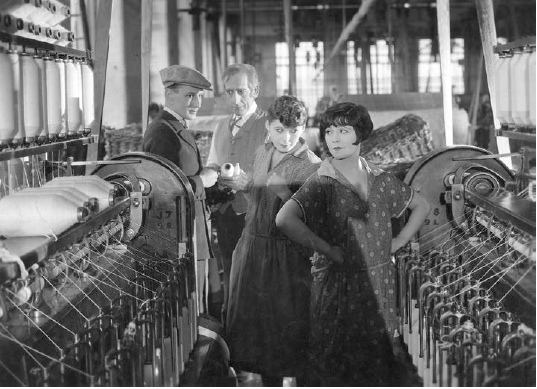
Elvey had produced plays by Chekov, Strindberg, Ibsen and he was a trade unionist who would have identified with the play’s message of working-class independence. He also wanted naturalism in the film and both Estelle Brody and Peggy Carlisle spent time in a mill to learn how to properly look like they were doing the work and to understand the culture, Peggy was from Liverpool and would have known Blackpool well but Estelle was an American: welcome to the real Playground of the World!


Watching this new BFI 35mm print – a full restoration is apparently ongoing – the film stands out as one of the major works of British silent cinema because of the expertise with which Elvey controls character and the narrative. It may be a bit slow-paced for modern viewers but everything is there to serve a purpose and every character will have their moments.


Fanny and Mary – Peggy’s haircut is so darn sharp! – feel like modern women all the more surprising given the date of their origin, years before they could vote. The fact that Fanny feels confident enough to exert her right to independence against all odds, is one of the great feminist statements of British silent film. I love her strength and sass as she refuses to let the situation of her dalliance with Allan Jeffcote (John Stuart) and the instant respect from mill-owner Nathaniel Jeffcote (a very fine showing from Norman McKinnel) who recognises someone with drive and grit like himself. She may be a bonny lass Mr Jeffcote but she’s far too good for your Alan!


Similarly, Fanny’s parents are mini masterpieces of characterisation with Humberston Wright as her intelligent yet timid father and Mary Ault as her firebrand of a mother who eye’s her daughter’s transgression as an opportunity to be exploited and just will not be silenced about it, if only there was an audio recording of her improvisations! Mouth almighty as they’d say in Lanky!


John Stuart, Humberston Wright, Peggy Carlisle and Estelle Brody

The sequences in Blackpool are outstanding especially the footage of the Big Dipper – show the restoration in the BFI IMAX and there’ll be folk passing out at that.


It’s a film that strengthens every time I see it and given the politics of 1926-7 as well as 1912, it is simply a remarkable statement about ordinary people’s right to self-determination. Away with the old morality and guilt, time to stand up and play a bigger part.


The score was composed and conducted by Maud Nelissen and performed live by Daphne Balvers (soprano & alto sax), Lucio Degani (violin), Francesco Ferrarini (cello), Rombout Stoffers (percussions & accordion) as well Maud Nelissen on piano. In the catalogue she talks of how she researched locations and culture for the film, immersing herself in mill town history and the times of the annual wakes weeks when t’ whole mill shut down and the workers went off together in search of precious joy. On the evidence of this lovely, soulful score she’s now an honorary Lassie from Lancashire.


This morning there was more Harry Piel serving up top-notch entertainment with Der Mann Ohne Nerven (1924) in which der mann himself plays without fear and spends a good portion of the action attempting to rescue the beautiful damsel Aud Egede Christensen (future Mrs Piel, Dary Holm) from a runaway balloon flying high over Paris bumping into church spires and industrial chimneys. All starts with a bundle of meta-confusion with story is about a famous novelist and his new book, Der Mann Ohne Nerven which, it seems to me, suddenly takes to life as characters start to pursue the man without fear or perhaps that’s the book we’re experiencing.


Plot, who cares, it’s Harry’s World and we’re just watching it.


Mr Neil Brand accompanied as fearlessly as Harry, no safety net and with suspended chords chasing his balloonatic pursuit across the sky.


Jaque Catelain modelling the latest in lounge wear

More gorgeous Sonia Delaunay design next with Marcel L’Herbier’s Le Vertige (1926) (also entitled The Living Image but literally Vertigo, with elements of Hitchcock’s later film of the same title as Stephen Horne pointed out) one of his major films I’ve not seen and quite possibly one of Jaque Catelain’s best performances, as a baby-faced Ivan Mosjoukine as someone termed him. He plays two parts, a young Russian army officer who is killed by General Svirsky (Roger Karl) the horrendous husband of his lover Natacha (Emmy Lynn).


After the Revolution to couple relocate to Nic and taking a trip to Paris Natacha sees a young man, Henri de Cassel (Jaque Catelain again) who looks exactly like her dead lover. Stranger and stranger with some spectacular design, old jealousies are revived and history begins to repeat itself.


Stephen Horne supplied uncannily stylish accompaniment.


Eugen Klöpfer tracking Aud Egede-Nissen

I’ve also managed to avoid seeing Die Strasse (1923) another of the canon revisited stream which was a digital restoration with reconstructed titles and a mix of sources. Karl Grune’s film is indeed impressive in terms of cinematic technique as well as its pointedly political take on German life encapsulated on one street.


There’s a bored middle-aged man who definitely doesn’t work in the publishing industry (Eugen Klöpfer) who sets out for a walk on the wild side of his street, twirling his umbrella and feigning interest in shop windows* as he approaches the local sex workers. There’s some amusing interplay between one such woman (Aud Egede-Nissen) and this nervy punter, a dance she’s played many times before. As we later find out, she shares a house with a small child and a blind man played by the protean Max Schreck; two vulnerable people who exist in the criminal uncertainties of this low life.


The man finally bucks up the courage to follow the woman into a night club where his seduction and exploitation can be controlled, it’s a tense voyage into the underworld, with a dreamlike quality that doesn’t make the realities being dramatized any less pitiful.


Partners in crime Günter Buchwald (violin and piano) and Frank Bockius (hitting things) accompanied in fine style with so many hints of contemporary club anthems, Ain’t She Sweet being ironically right on point!


Obligatory banging on about Liverpool... 

*In one of the shop windows he passes by there’s an advert for The White Star Line including Liverpool as one of the destinations. The White Star offices still stands in Liverpool as does The White Star public house just off Mathew Street and The Cavern were fifty years after Fanny and Mary, girls went for a good time increasingly on their terms.


The wifi's decent as well...

Liverpool has some fabulous architecture.