Showing posts with label Rudolph Valentino. Show all posts

Tuesday, 30 June 2026

The best in silents… Il Cinema Ritrovato 40, Bologna


It’s just struck me that not only was this edition number 40 of the Ritrovato but that was the number in centigrade the temperature hit from time to time. Four dozen or so films to see out of 500 on offer in just eight days, crossing the city, finding the shadows in long medieval streets and I’m an old white guy from Merseyside wearing socks and old band t-shirts? No problem. After locking my flight bags in my room on the day of my departure – all perfectly normal, no sign of heat exhaustion or “sauteed Brit-brain” there – I’m now sat on the tarmac dredging the cranial swamp for the best silent treats of the week.


Matinee Idols Death Match


OK, this wasn’t what they called the strand, that was Women’s Male Stars who were developed to meet the largely female audiences of the growing matinee by the increasingly commercialised studios. In practice this was a competition to decide which of the following was going to be crowned the Male Matinee Idol of the Festival or, to be fair, who was going to come second as Rodolfo “Rudy” Valentino was nailed on in the rather interesting playboy to cabin boy coming of age film Moran of the Lady Letty (1922).


Rudy can't fail. Just ask Dorothy, his friend.


In a lesson to Capital from the Proletariat, Rudy’s character learns purpose in hard work and also finds love with Comrade Moran (Dorothy Dalton) who turns out, to be the very womanly Letty Sternerson. All this after he’s fellow sailors called him Lilly of the Fields… projection methinks! Love and Merchant Seamen is a big topic but mark this one for future reference. It’s a rollicking good adventure!


The ill-fated Wallace Reid has drawn the short straw in terms of his surviving work and his career was also tragically cut short after a studio accident left him addicted to Morphine. But he’s a charming performer and you can see enough in this restoration of Sick Abed (1921) although his is in the rather unheroic position of having to feign sickness in order to avoid a financially troublesome trip into work. He’s a charmer but there are better examples of his full appeal although his chemistry with Bebe Daniels is spot on.


Now for the Irish contender and Male and Female (1919) with Thomas “Tommy” Meighan as the Admirable Crighton who steps up to save the aristocratic by useless family who employs him after a shipwreck. He wins the heart of Gloria Swanson even though their hearts are approximately a foot apart, but class tells after they are rescued and the butler heads off for a new life in the country of opportunity south of Canada…


Torrence takes the competition far too seriously.

Contender No. 4 please… Tol-able David (1921) and its young Richard Barthelmess fighting to defend his family against a bunch of murderous men who are occupying his neighbour’s house. This is quite the best of the four films and as directed by Henry King is a deserved part of the canon. Barthelmess has to act young but this is a right of violent passage with all too believable and nasty stakes. When I say nasty, I mean the extraordinary Ernest Torrence who shows his dark side which such glee: one of the definitive bad men of this era who could also flirt with Clara Bow in Mantrap or do comedy till the cows came home….


Enrico Guazzoni’s World


No Ritrovato is complete without two things:

    Divas

    Films of antiquity and the ancient world


On the latter point we were spoiled with a new restoration of Enrico Guazzoni’s Quo Vadis? (1913) which take the tableau style as far as it could go with multiple depth of field slowly revealing the full effect of a well designed and choreographed set piece whether in a palatial room or at the Circus Maximus. There are crowds of thousands and the effect is to offer a deep and stylised window into the Italy of emperors and Christian revolt. I’m sure it will all work out… but this is a major film in the history of long-form cinema. What’s that Mr Griffith? Oh, your thing… that’s not due for a couple of years yet. The Hell it is.


Over ten years later an attempt was made to revive the Italian Golden Age with The Last Days of Pompei (1926) – an adaptation of the English novel by Lord Bulwer-Lytton, as had been the two competing versions of 1913. As UCL’s Maria Wyke points out this attempt to recreate the recent cinematic as well as antiquarian past  “… tries to reject the detached tourist gaze on the city of 19th century imaginings for an impassioned, participatory vision of ancestral suffering.” Cecil B deMille could only watch and admire.


Pina Menichelli beguiles in Alla Deriva


We also had three films featuring one of the three main Diva of the cinematic golden age with Pina Menichelli in three of the seven she was directed by Guazzoni, including La Casa di Nessuno (1915), Una Tragedia al Cinematorafo (1915) and Alla Deriva (1913) which, as Giovanni Lasi writes in the programme, revolves around the presence and intense performance of the actress “… with her ability to hypnotise the viewer with magnetic and unsettling gazes…”. Consider me cross-eyed.


1906 given voice


I missed a couple of Japanese films with Benshi accompaniment but was treated to the Italian version for the 1906 compilation strands which was a delight, especially late night in the Piazzetta Pier Paolo Pasolini. Here Gabriel Gabriel Thibaudeau played piano with Alice Zecchinelli on drums and Julie Linquette providing what could be described as  vocalise combining sound effects, dialogue and narration. This was especially funny for Aux bains de mer (1906) as she provided commentary from a middle-aged couple watching events on the beach and then in the hand-coloured tour de force that is Aladin ou la lampe marveilleuse (1906) from the genius Albert Capellani.


It was one of the most joyous sections of the week and peak Ritrovato under those stars as our laughs drowned out the incessant cicadas.


Aladin and there's also a lamp...

The Child of Paris/ L'enfant de Paris (1913) with Gabriel Thibaudeau & Fabiana Sommariva


Proving that it was not just the Italians but also the French who were leading the cinematic World Cup in the early 1910s, Léonce Perret’s film positively barrels along even though it is based on an unpromising premise of a young girl seemingly orphaned by the death of both parents in quick succession and then kidnapped by a criminal gang for reasons that they only make up on the fly… It is tense and content rich with a high level of cinematic technic from the director and his cameraman, Georges Specht. It’s two hours long and whilst there are some padded sequences overall you are gripped by the search and the chase from Paris to Nice.


There is so much pleasing technique in the film from backlighting, low-angled shots, close-ups and surprising camera movements which allied to the location shooting and a plot involving chases across France, trails gone cold then warmed again, persistence and steadfast heroism sees good win out. After all the shibboleths drummed into audiences about film development, you keep on finding innovations “out of time”… we see more every year with these restorations.


Depth of field, lighting, framing... such a complex shot.


Finish Films and Cleaning Women…


If it was Wednesday it had to be Finnish film day with two excellent titles from Finnish actor and filmmaker Teuvo Puro; the first Meren kasvojen edessä (Before the Face of the Sea) (1926), accompanied by the mighty Stephen Horne and the second Noidan kirot (Curses of the Witch) (1927) projected in the Piazza Maggiore and accompanied by Helsinki’s finest Cleaning Women.


Silent film is as much about travelling in space as well as time and I shall be saying more about both films in the coming days but just to say that the three cleaning robots (CW01, CW03 and CW04) that form the band know how to support the narrative of the film screening above them and how, despite their unusual dress senses, to focus musical energy in dramatic sympathy.


Suomi tuntee elokuvan!


Sisterly solidarity in Noidan kirot 

Vögel sind seltsam, aber die Liebe ist blind: Asta and Connie Restored


Cheating here but two German films for one with Conrad Veidt first up in a comedy, Liebe Macht Blind (1925) accompanied by Herr Neil Brand with the usual informed wit and wealth of reference. Connie is a psychiatrist Dr Lamare in love with his patient, the very married Diane (Lil Dagover). Her husband Viktor is having an affair with a woman played by one of Britain’s finest silent actors, the sublime Lillian Hall-Davis who is as eye-catching as always. It’s Veidt’s mad professor who takes the comedy biscuits though even after Emil Jannings pops up to spoof his role in The Last Laugh.


The film was considered lost until a pristine nitrate copy was discovered in Chile and another piece of Connie’s range was preserved in all its quirkiness.


Asta messes about on the river.

Less manic but equally important was the restored version of Urban Gad’s Der Fremde Vogel/The Strange Bird (1911) accompanied by James Shelby. The film was one of the first pictures he made with fellow Dane Asta Nielsen in their initial German contract. It’s a tale of an outing on the waterways of the Spree Forest, near Berlin during which Asta’s character forms a romantic attachment with a boatsman (Carl Clewing). The restoration has added some four minutes to the screen time and has added the tints missing for so long from. Shot almost entirely on location – to great acclaim – it’s presents Nielsen’s naturalistic emoting and physicality in ways that we revolutionary for the time. Europe’s first silent superstar was beginning to shine…


What Price Glory? (1926) with Gabriel Thibaudeau


The Ritrovato Road is long with many a wind and turn and, sometimes Pilgrims, we’re a bit less than match fit depending on a mix of self-care and the demon drink that my wide’s forebears signed the pledge against (no such thing in Liverpool I have to say…). So it was that my first attempt as watching this quite fabulous restoration failed after a missed the first skirmish with the Hunn lost to Morpheus sweet charms… I dreamt a parallel film that soon took off on its own narrative…


Back for a second try with a strict agreement between myself and Mr M Fuller of Bristol, to wake each other should an old war wound cause us to lose consciousness, we both saw the entirely of Raoul Walsh’s spectacular and, whilst there is perhaps too much larking about and attempts at mutually assured destruction from leading men “Big” Victor McLaglen and Edmund Lowe as they fight over who’s best and, mostly, who gets the hand of Delores del Rio, it’s undoubtedly a major film.


The combat scenes are extraordinary especially with the colourisation of the explosions so well done it’s hard to work out how they were done – double exposure possibly but there’s no overlap of the images. But the war scenes are so well handled and their intensity explains just why the boys’ squabbling are so necessary – they both recognise the reality of the war and their chances of survival… what else is there to do but enjoy yourselves whilst you still can.


Josephine Baker


Someone had mentioned that it was only when you see Ms Baker on film that you realise what a complete package she was: acting, looks, timing, range and humour all quite remarkable but it when Josie dances that my ears popped and musicians Meg Morley on piano with Alice Zecchinelli on drums, set the Jazz tempo to “11” as we saw probably the most energetic and distinctive Charleston I’ve ever witnessed (no one’s doing this on Strictly Come Dancing that’s for sure…).


Baker had longer-stronger legs than most mortals and greater strength than most of the stage-trained actor-dancers around her with the result that she was able to move faster and harder to create the most bewildering spectacle that drew from jazz dancing as well as throwing in some moves that I’ve not seen from other dancers of this era.


Josephine Baker

If it was just this and only this she did then she would still be a legend but her charm and ease with story-telling, her quickness of thought and expression also marks her as a fine dancer. In Siren of the Tropics she somehow manages to rise above the racist subtext - the idea that she doesn't belong in the Paris of her rich white love interest (and his rich white girlfriend) and that she should go “home”. She wants none of that and decides to take her chance in the new world of America.


There’s the obvious irony that she had to leave the US to finally be accepted as a leading lady on screen. As in these French films she was also a sensation in the clubs and revolutionised dance.


What I like best is her impish grin and dimples, she is having the time of her life and it is liberating.


Best festival freeby, evah!!


Sunrise (1927) – Piazza Maggiore


What more can I say about Sunrise? Looking back a week after this stunning World Premier moments stay with me and I can’t wait to watch it again… Albert Camus famously suggested that all art was a search for those first few things that really moved us and there’s something in that with silent film but also in the native experience of this film and Timothy Brock’s music.


Edna, Charlie and a friend


A Dog’s Life (1918)/Shoulder Arms (1918) – Piazza Maggiore


The version audiences have watched for decades was reconstructed from back-up camera angles and second-choice takes, assembled from degraded C and D negatives after the original A negative deteriorated beyond use.

Dave Kerr, Moma


Dave Kerr of the Museum of the Moving Image asked how many of us had seen these two films and after a considerable number of hands went up in the throng he said maybe not… Seems like the former workhouse boy from Kennington was not just a creative genius but an organised one who kept copies of all of his films based on what he considered to be the best takes.


Grade A were used to create copies for the American market and Grade B – almost but not quite as good – were mostly used to cut films for the European and wider markets. So, all of these years, we haven’t seen the very best takes in regional releases nor any others. The restoration team went in search of the material featured in the best canister and, using elements from across the world, from C and D as well as B, came up with about 95% of Grade A material within which to re-construct these films in the way that they were first seen 108 years ago.


Whether it was the suggestion, the occasion, the heat or Timothy Brock’s world-class re-construction of Chaplin’s later scores for these films but Mr Kerr’s point was well made and, with every impish thought shadowing across Charlie’s face, every quicksilver improvisational spark or perfectly executed punchline, it felt like we were indeed watching a more beautiful version of what we already loved. And you know, that can’t be bad.


Hi co-conspirators were also at the best with Edna Purviance revealing and equivalent level of imp to her partner and the two firing off each other with knowing smiles on their faces. Maybe this was something quickly learned from Mabel Normand but Charlie and Edna glance to camera both to make sure we not only know what their thinking but also how much fun they’re having.


This happens even in the middle of Shoulder Arms with it’s faithful representations of life on the font line taken to extremes – the boys sleep underwater in their flooded trench - but as a mark of respect to the millions fighting over there. It’s a mark of Chaplin’s ability and status that he managed to make this film – it’s a matter of how important and loved he was by those who were fighting or who had family fighting that they queued in their millions to see the funny side.


Tonight, the aforementioned Mr Brock conducted the all’ Orchestra Senzaspine in a reworking of earlier reorchestrated Chaplain music to fit the new material. It was again another powerful performance in the piazza and one enjoyed by thousands, in the seats, the bars and on the stage. Charlie’s made something that will last forever and he’s made Edna and his other friends immortal.


In an era of fake prizes, THIS is exactly worth having!


See you next year Bologna! Keep it cool.


Sunday, 16 January 2022

Blood and Sand (1922), Daan van den Hurk and Tijn van der Sanden, Nederland’s Silent Film Festival


To the Spaniard, the love of the bullfight is inborn. A heritage of barbarism – its heroes embody the bravery of the knights of old…


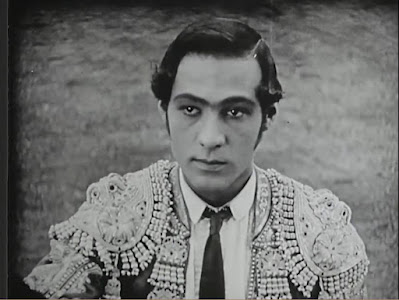
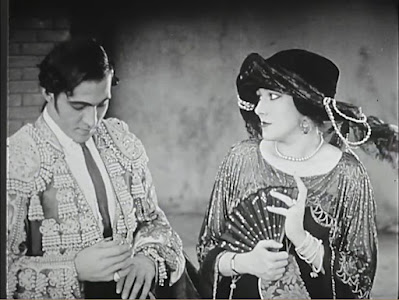
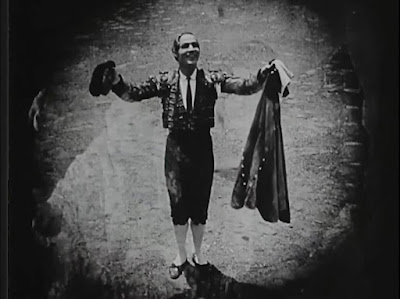
Enter Rodolfo Pietro Filiberto Raffaello Guglielmi di Valentina d'Antonguella for the opening screening of this year’s Nederland’s Silent Film Festival, playing a bullfighter and a Latin lover with a sexuality as exotic in his own way as Pola Negri (don’t mention the funeral) and other Europeans deployed by Hollywood to break boundaries and post-Victorian taboo. Valentino’s Juan Gallardo is driven by desire in life and love, and whilst being a masculine ideal is also at the mercy of his passions when torn between his true love Carmen the wanton Doña Sol, a spoilt, rich man-killing vamp who dominates and discards at will.


Blood and Sand leaves you emotionally rung with its derivative charm, wearing its Bizet firmly on its embroidered sleeve, elevated by superb performances and, as we now know, Dorothy Arzner’s innovative editing making us feel the heat of the bullfight even when matador, the bull and “the beast with ten thousand heads” are thousands of miles apart. As festival director, Daan van den Hurk said, no bulls were harmed in the making of this film, but it seems so purely because Arzner’s editing of stock bullfighting footage and Fred Niblo’s shots is seamless. The frenzy and the threat feel real as Juan takes on man and beast in a “sport” the film clearly disapproves of.


Daan was also multi-tasking, providing stirring accompaniment with the assistance of flamenco guitarist Tijn van der Sanden whose fleet fingered flourishes added diegetic immediacy to the film as well as dramatic flavouring. I loved the way the two worked together and it sounded fantastic on my new speakers, not as good as live but hopefully one day we’ll all be in the same room.


Meet the family


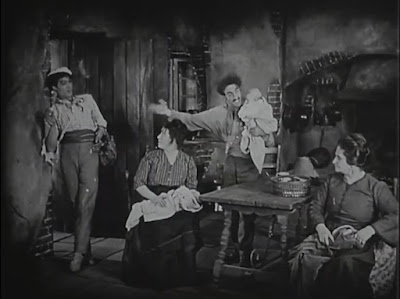
June Mathis wrote the screenplay based on Thomas Cushing’s smash hit play, which was itself formed from Vicente Blasco Ibáñez’ novel, Blood and Sand. It tells the tale of a poor boy from Seville, Juan (Valentino), “a son of the people” whose natural bravery enables him to become a toreador. His humble beginnings are set out complete with wise and loving mother Angustias (Rose Rosanova), sister Encarnacion (Rosita Marstini) and comedy brother-in-law Antonio (Leo White). Despite being called Zapaterin, Little Shoemaker, Juan has no interest in learning his father’s trade and dodges working with Antonio, a saddle maker, in order to go play at bullfighting.


Juan and friends head off to Andalucia where the locals enjoyed watching the amateurs from Seville. Juan does well but one of his friends is not so lucky with a watching bandit, Plumitas (Walter Long), accompanied by a title card noting that bandits and bullfighters both “risk life to gain a livelihood.” Juan avenges his friend’s demise and is not discouraged, dreaming of building his mother a fine house when and if he succeeds.


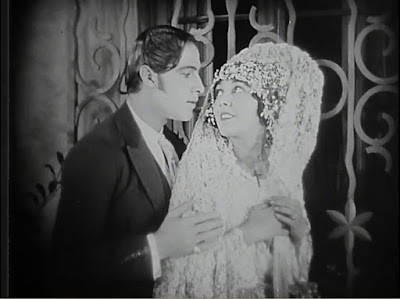
Naturally Juan gets talent spotted and ends up impressing the crowd mightily on his debut including his childhood sweetheart Carmen (Lila Lee) and the two grow close as his career advances and marry.


He searched deep into men’s hearts, ever willing to excuse weakness and, in a master ledger, recorded the lives of those who interested him.


And he can dance...
 

Throughout proceedings, a local philosopher keeps popping up, almost at random… Don Joselito (Charles Belcher) “a student of humanity” who will act as a guide to the morality of events passing comment and offering advice… ultimately condemning bullfighting. That beast with ten thousand heads… the audience bloodlust driving the barbarism that costs lives.


Gallardo’s success makes him the idol of Seville’s café culture and he gains a manager (Fred Becker) along with a matador, El Nacional (George Field) who “fought for living and not for glory” as well as a popular picador, Potaje (Jack Winn) and old Carabato (Gilbert Clayton) who served Juan “in order to cling to the arena and retain his pigtail” – worn by the fraternity. The film may disapprove of the sport, but it takes a delight in the details.


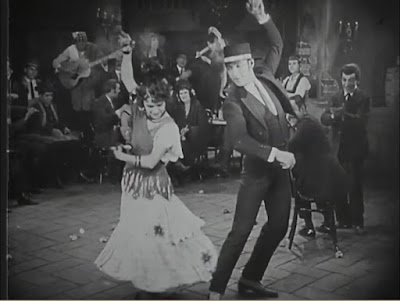
There’s a lovely scene in one of those cafes when we get the chance to see Valentino dance – he had made his way initially in Hollywood by dancing and teaching dance – and you can see his poise on the dance floor alongside and a dancer named Rosa. The women gets just too close though and Juan’s loyalty to Carmen makes him push her onto the floor… it’s a foreshadow of things to come.


Rudolph and Lila Lee
 

Men were Doña Sol’s hobby. A bullfighter was a new experience.


Time passes and Juan is famous across Spain, and he catches the eye of the daughter of the country’s bull-breeder, Doña Sol, played by the “exotic” Nita Naldi, who was born Mary Nonna Dooley to Irish parents in New York…  Juan’s reaction to this new attention is primal, and he willingly accepts her gift of a ring given by Cleopatra to Ceasar… he’s flattered but still loyal to his wife, but Doña Sol is not easily dissuaded.


The two begin an affair, with Doña Sol dragging out the dark aggression in the man, a strange sadomasochistic edge to his fifty shades of betrayal. He doesn’t feel comfortable in her world of refined hypocrisy and artificial emotions, but he can’t resist the animal games she makes him play.


A page from Don Joselito’s book reads: Juan Gallardo has reached his goal. Will success spoil him or will his love for little Carmen overcome the plaudits of the populace and the cruelty of the national sport?


Which sets up the finale perfectly!


Rudolph and Nita Naldi

Blood and Sand has Glamour and Alvin Wyckoff’s cinematography captures some lovely atmospheres, Juan’s wooing of Carmen, the mock action in the stadia and the streets supposedly in Seville. Valentino has the star power and is able to convey humour as well as sexuality, he doesn’t take himself too seriously – an attractive feature for most of those watching – but he is passionate beyond reason when push comes to shove. Here his masculinity is used against him by the vamping Naldi… who else could carry this all off and still remain heroic?


The version screened was from a Lobster print of the David Killiam restoration which is shorter than the recent version released by Kino on Blu-ray. This has the tinting restored and comes in at over 25 minutes longer with a smashing score played by the Monte Alto Orchestra and a booklet including an essay from noted Valentino expert Donna Hill. Well worth purchasing if you haven’t got it!


And remember, as Don Joselito says, Happiness and prosperity built on cruelty and bloodshed cannot survive.


Sunday, 21 March 2021

Rudy can't fail... The Eagle (1925), with Neil Brand, 10th Hippodrome Silent Film Festival


Back when Arthur was young, I went to watch Kevin Brownlow introduce this film at East Finchley’s ultimate picture palace, the Phoenix Cinema, and he shared his coversations with one of the silent era’s most calmly professional directors along with clips from films I just had to see. Since then, I’ve watched them on the big screen; Flesh and the Devil (1926), The Signal Tower (1924) and The Goose Woman (1925). Brown never disappoints and brings out the best in his actors; a real warmth of performance amongst the smoothly worked narratives.


Watching first time my focus was on Rudolph Valentino as this was the first of his films I’d seen (and I still haven’t seen either The Sheik or The Son of the Sheik…) but now I was watching as much for Louise Dresser, who was so heart-breaking in The Goose Woman and is grand again here playing Csarina Catherine the Great as passionate and impetuous with a penchant for young officers and for executing those who don’t please her.


Her scenes with Valentino as the dashing Lt. Vladimir Dubrovsky, are wry – if conflicting - with sexual role-reversal as the predatory monarch tries to get her man tipsy, offers him a career path based on favour and generally behaves like a man. Dubrovsky has enlisted to be a fighter and not a lover and absents himself even though he knows this will seriously affect his prospects both in military life and, well, just life.


Louise Dresser and Rudolph Valentino


This isn’t any man Catherine is sexually harassing though, it’s one played by Rudolph Valentino. No other silent actor comes with quite so much baggage as the Latin lover, the man who broke so many hearts that people seemingly took their own lives rather than face up to life without him… Surely, he had to take himself that seriously too? But no, what we find is a very handsome man who can act and who has a deliciously inclusive sense of humour to prick the bubble of heroic pomposity: think Antonio Banderas in an Aldomorvar film: a little camp but in that masculine way only the most “secure” can carry off.


Valentino’s Dubrovsky is one of the bravest officers in the imperial elite and arrives at a parade for the Csarina at the film’s start full of promise. He’s a man of action and spotting a runaway carriage he leaps onto the Csarina’s favourite horse, and she did like her horses… (“not true…” says History) and sets off in pursuit – Brown’s cameraman fast behind – pulling level, jumping on and pulling the horses to a halt in classic cowboy style.


The party he rescues includes a beautiful young noblewoman, Mascha Troekouroff, played by the delectable Vilma Bánky, who has great chemistry with Valentino and pretty much every single thing around her. She would star with him again in Son of the Sheik, her beauty and intelligence matching his own with a challenge that his persona needs; she’s not being swept off her feet by anyone.


Rudolph and Vilma


Pleasantries are exchanged and there’s an instant connection but Mascha ‘s head is not easily turned and her Aunt Aurelia (Carrie Clark Ward) is the one waving enthusiastically after Dubrovsky as their carriage pulls away. He laughs but his quick thinking has earned him that awkward appointment with his Czarina who is more than happy to see her horse returned unharmed…


It’s not a good day on balance for Dubrovsky as he receives the news that his father is seriously ill because of his estate and fortune being stolen by the by the villainous Kyrilla Troekouroff (James A. Marcus on fine form). Dubrovsky won’t take this lying down and soon turns himself into a Robin Hood figure – The Black Eagle – who leads his father’s remaining loyal staff into an escalating set of countermeasures aimed at over-throwing the usurper.


Encountering a man who has been employed to teach French (incidentally, the language of the Tsarist court even up to the pre-revolutionary period…) to Kyrilla’s daughter, Dubrovsky takes his place as a means of breaking in and causing chaos. Yet, when he arrives, he sees that his student is to be the beautiful girl he rescued in the runaway carriage.


James A. Marcus as the Fearless Kyrilla!


Thus, things go as rom-coms go with enough will-they/won’t-they to keep you guessing as Bánky and Valentino work their humorous rapport as far as they can without popping the dramatic bubble. Kyrilla is revealed as more bullying buffoon than despot as the threats of imminent retribution from the Black Eagle un-nerve him more and more: you do wonder how he ever managed to take control of the Dubrovsky estate… still, he does have a bear chained in his wine cellar for playing “jokes” on guests.


Brown directs with deceptive efficiency and with more than the odd flourish. Not for nothing was he “blind-tasted” as Lubitsch by one Hollywood insider according to Kevin Brownlow, with some innovative shots including an amazing dolly shot along the full length of Kyrilla’s banquet table. It’s a very well-made film with sumptious sets from the legendary William Cameron Menzies, and the restored print is in superb condition; watching it is indeed, as Mr Brownlow said at the Phoenix, “…seeing silent film as it really was”.


Accompaniment was provided by Mr Neil Brand who had dressed for the occasion and entered his music room in colour before sitting down to accompany in back and white. His themes went well beyond those chromatic limitations though and he gave us the rich romance and visceral daring the film deserved. As festival director Alison Strauss put it in her introduction, we were watching “together, alone” and the improvised music gives the immediacy that binds us as viewers, sat in front of screens from Worthing to the Winter Palace.


Who is The Black Eagle?! 

The Eagle is now available on spruced up Blu-Ray from Kino and is well worth filing between Camile and The Four Horsemen of the Apocalypse if you like your Latin Lover in alpha order or, Monsieur Beaucaire and Cobra if you’re going by date.


The Hipp-fun carries on and you can still catch up on most of films, intros and Q&As via the festival website and the Falkirk Community Trust YouTube channel.


Sunday, 1 March 2015

Gloria and Rudy… Beyond the Rocks (1922)


There are very few people who are so famous they can be recognised by their first or last name only and even fewer who 90 years after their heyday can still be identified this way… here are two of them and what a combination they make…

This film was lost for a long time and in her autobiography Gloria Swanson named it as one of the three works who disappearance she regretted most. Luckily for the rest of us it was found in the Dutch archives in 2003 and then restored and released by Milestone films. You can see why Miss Swanson was so fond of it; she plays the romantic lead opposite Rudolph Valentino and wears some of the gorgeous gowns she was renowned for. Rudy can’t fail with his wardrobe either.


As the New York Times review put it “Gloria Swanson can wear clothes. So can Rudolph Valentino. And the talents of each are given full play…" but the reviewer did not consider it an interesting photo play: “Not (for) those who want a little character and a little truth in their entertainment, anyhow.” I’d disagree even if only on the grounds of the rather large characters acting on the screen: this is primary source material that confirms so much about the nature of contemporary stardom.

Directed by Sam Wood and based on a story by Elinor Glyn, Beyond the Rocks is an undemanding romantic drama which successfully relies on the magnetism of its two leads and their ability to convey the nobility of duty chosen over love. “We must be stronger than our love…” is the central call and naturally the whole audience is willing them not to be… but with so many unlikely surprising shifts and co-incidences – like Paul Auster on speed and without the existential depth – we can be sure that “fate” will find a way to relieve them of their self-sacrifice,

A typical English scene...
Gloria plays Theodora Fitzgerald the youngest daughter of the retired Captain Fitzgerald (Alec B. Francis) who lives in modest comfort in a Dorset fishing village. She has two half-sisters whose mother was clearly less good looking than hers and who see her as their meal ticket to an easy life: she must be married well.

Theodora is out in a rowing boat not far from the yacht of a rich playboy Lord Hector Bracondale (Rudolph Valentino) when she suddenly falls into the water – maybe there was a freak wave? Oddly enough for a dweller on the coast, she doesn’t appear to be a good swimmer and, spotting her difficulty, Hector dives into the drink to rescue her.


Once on dry land the Captain recognises her noble saviour as do her sisters who dismiss him as not the marrying kind (yes, but he’s rich enough girls!). There’s an instant spark as Theodora gifts him a damp but fragrant Narcissus and he departs eye’s sparkling with delight.

But business is business and well-to-do but middle aged Josiah Brown (Robert Bolder) is chosen as the man to marry and through duty to her, sweet but dim, father, Theodora goes through with the wedding even after Pa offers her a way out (are you blind man: why would Gloria Swanson want to marry a dumpy man twice her age!?).

Robert Bolder
They head to Europe on their grand tour of a honeymoon and, Josiah being too clapped out to climb, Theodora goes off mountain climbing with new friend American adventuress Jane McBride (Mabel Van Buren).  Theodora slips whilst taking a photograph – so careless – but once again Lord Hector is amazingly on hand to come to the rescue… it’s as if Fate’s trying to tell them something.


Hector follows them to Paris and grows closer to Theodora as the two wander through the gardens of Versailles he tells her of the love between a coachman and a noblewoman. Briefly Hector and Theodora imagine themselves as the two lovers before coming back to reality as Hector makes his move… The two pull apart almost immediately and stare disconsolate at the ground: they cannot be a couple and they resolve to be “stronger than their love” in order to protect Theodora’s marriage.

Gertrude Astor
Hector goes away but and confesses all to his sensible sister Lady Anna Anningford (June Elvidge) but when she arranges a party and invites the Brown’s he arrives intent on stealing a kiss from Theodora in the evening’s pageant.

Theodora is strong and writes letters to her husband and to Hector. She leaves them in the hall for collection where Hector’s one-time girl Morella Winmarleigh (Gertrude Astor – who would cross with Gloria on more than one occasion…) switches them: Joseph will get Hector’s letter and vice versa. Oh calamity!


No spoilers: what happens next I won’t reveal but you may not be a million miles off with a guess or three.

Henny Vrienten's musical score greatly enhances the action helping Valentino and Swanson to rise far above the limitations of the storyline.

The Milestone DVD is available direct or from Amazon.com.

Alec B. Francis is good too!

Wednesday, 1 October 2014

Murray Mae but Rudolph will... The Delicious Little Devil (1919)


Long believed lost, this film was rediscovered in the early 1990’s and is a precious example of early Rudolph Valentino as well as the bee-stung lips of Mae Murray. This was Murray’s twentieth film and she certainly has star billing out-pouting Pickford (as you’d expect) and throwing herself around like a ditzy dervish.
Mae in full flow
Murray had a few years on Pickford and her performance background had been dance rather than straight drama. She was part of Vernon Castle’s troop on Broadway, became a star in the Ziegfeld Follies and then made her first film in 1916 at the grand old age of 30… Movement aside – and there’s no denying the sheer zest! – Murray had great timing - she wasn’t quite the actress Mary was but then who was?

Here she’s ranges from delicious to quite demented in a vehicle high on laughs and improbable, knowing, narrative. She’s not really a devil but she pretends to be…

Edward Jobson and Rudolph Valentino
Mae plays Mary a youngster with a good heart and an irrepressible joie de vivre that makes it hard for her to hold down regular employment. She gets a good job at a hotel but can’t resist play-dancing with one of the guests shawls… her co-workers are impressed and listen wide-eyed to her story of a childhood of carefree spinning in what looks suspiciously like a medieval European town… but her boss is not and he fires her on the spot.

Back home she lives with her mother and Uncle Barney McGuire (Richard Cummings) with her father Patrick (Harry Rattenbury) seemingly too lazy to be bothered even living with either child or wife?

Ma,Uncle Barney and Mary
Paddy turns up when he’s told there’s a new wage-earner in the house only to be disappointed as she has quickly re-joined the ranks of the unemployed… What is she to do?

Meanwhile, over at the out of town Peach Tree Inn, manager Larry McKean (William V. Mong) is trying to think of the big idea that will save the joint from closing. Talking with aged owner Mr Musk (Burt Woodruff) and his wife (Martha Mattox) he comes up with the idea of a new jazzier approach led by a woman with a dark past (and a bright future…). He’s looking to bring a touch of sophisticated sleaze to the suburbs.

"A good future for a girl with a past."
Mary sees this intriguing ad in the local paper (Press advertising to the rescue again!) and finds a backstory for her non-existent “past” in the strange tale of the Duke de Sauterne who has been causing a scandal in Europe romancing a famous dancer, Gloria du Moine, who has left him and gone into hiding.

Mary turns up at the auditions to find Larry rapidly offending a long line of dancers thereby narrowing the odds to an elegant tall woman (Gertrude Astor) applying too much foundation and Mary who stands below the lady grabbing as much of the cast-off dust as she can.

Larry falls for it... never sell to a salesman eh?
Mary clumsily slips and looks to have lost her chance until her wayward syncopation gets the band playing some righteous rag-time. Mary jitters around and Larry is impressed… all the more so when that phoney history is revealed.

Mary’s opening night is a hoot as she descends down the Peach Trees long staircase to perform the Peacock Walk; her own creation. For all her moves, Murray plays this for laughs, especially as she almost gets stuck after bending over backwards just a little too far.

The Peacock Walk almost ends with a cramped crab...
Amongst the audience is young Jimmy Calhoun (fresh-faced, mascara-encrusted Rudolph Valentino!) who is instantly impressed with Mary’s flexibilities. He is the son of construction tycoon, Michael Calhoun (Edward Jobson) a self-made man expecting perhaps too much of his son and heir.

Jimmy romances Mary and all looks good until Dad tries to show her up at a dinner party – he thinks she’ll drink too much and make a fool of herself but Mary doesn’t drink – not even to maintain her exotic cover story – and she doesn’t rise to the bait, much to her dark-eyed boyfriend’s pleasure.

What an absolute cad!
But the evening takes a turn when the Duke de Sauterne (Bertram Grassby) arrives to reclaim his girl. Turns out the Duke is no gentleman at all and had to leave Paris after his many misdemeanors were in the process of catching him up.

Mary and Jimmy eat carefully...
Spotting the fake du Moine he doesn’t let on, clearly fancying his chances of leveraging his knowledge to disreputable effect…


Will Mary get revealed as a good girl with a bad future and will gentleman Jimmy manage to win her in the face of the Duke’s aggressive persistence… even if he does will his father let him marry so far below his station? There’s a lengthy car chase, some fisticuffs and a chance reunion that combine to settle things in a frantic closing section.

Crickey, Jimmie's a bit macho ain't he?!
Robert Z. Leonard directs Harvey F. Thew’s scenario with pizazz and it’s an energetic hour of top-notch tom foolery. Murray maybe didn’t have the striking USPs of the top tier but she acts very well and, excessive face-pulling aside, makes for a very likeable little devil.

Mr Valentino performs longing looks to no doubt dazzling effect in spite of the heavy make-up of the time. It’s Murray’s film but clearly we’re going to see a lot more of him!

I watched the Milestone DVD (the film is on a double disc with Swanson Valentino film Beyond the Rocks) which features a sprightly performance of a 1922 cue sheet by the Mont Alto Motion Picture Orchestra! Milestone and Mount Alto always do right by these precious little devils.