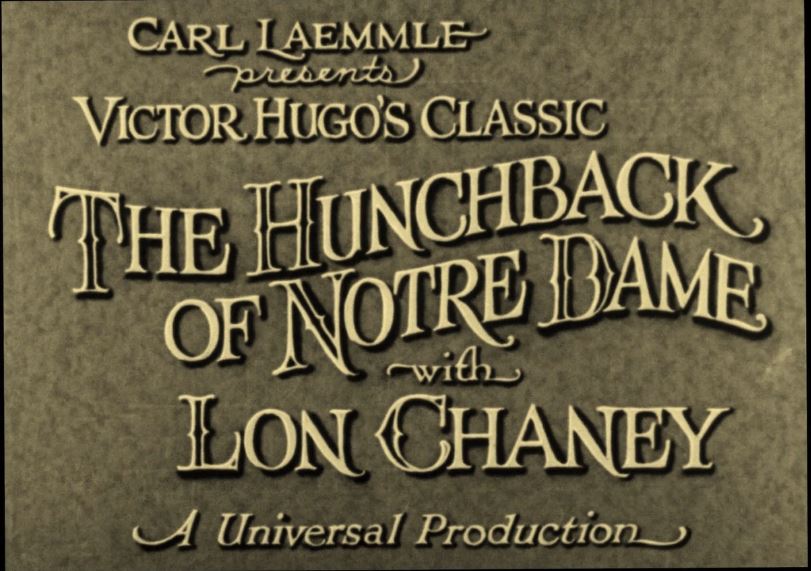
To the towns people he was an inhuman freak, a monstrous
joke of nature – and for their jeers he gave them scorn and bitter hate.
This is the UK Blu-ray debut of this Universal classic and
it is a 4k transfer of the recent restoration from NBC Universal from two 16mm
prints, which looks fabulous and really carries across the scale and daring of
this huge feature – a million-dollar super-production. Surprisingly, I haven’t
seen The Hunchback of Notre Dame before and so this disc held and extra
fascination. Lon Chaney’s transformation is under more scrutiny than ever
envisaged for the original screening experience but, once again, it is his performance
and not the make-up that convinces and you soon forget the all too obvious
prosthetics and just become submersed in this classic tale.
Victor Hugo’s novel of 1831, Notre Dame de Paris was,
according to Kim Newman, as much about history and architecture as the
hunchback. Then, as now, the building was under threat and Hugo’s novel helped
to raise interest in the cathedral and, indeed, the author took part in
restoration that helped preserve the building. According to Newman, the book helped
create a social movement… but still has a lot more humour than the film, with Esmeralda
charged with enchanting a goat, a satire on the French justice system. More on that
goat later…
 |
| From an era of epic set design... the star of the film? |
The film changed more than the story with a number of
characters flipping from good to bad and a revision of the ending. This is a
primal story that is clearly malleable in terms of meaning, sense of place and
dramatic sweep with the cathedral the biggest character and narrative device, a
place to hide, to haunt and to swing down from as well as being the ultimate
sanctuary. There is nowhere else that Quasimodo can be and when Esmeralda is
falsely accused, he carries her there shouting “sanctuary, sanctuary!”. But Notre
Dame is also a place hiding the shadowy plotting of Jehan (Brandon Hurst) although
the main villain in the book was his brother, the Archdeacon Claude Frollo, here
played by Bristol’s finest Nigel De Brulier, as a good man.
It's also a refuge from the poverty beyond with the film
retaining some political overtones, bemoaning “the King’s justice” and the
struggle of the 15th Century poor more reflective of Hugo’s time – during
the early reign of King Louis Philippe I after the revolution of 1830, all far
removed from the days of the Republic. Hugo was elected to the National
Assembly of the Second Republic after the 1848 revolution calling for the end
of misery, poverty and the death penalty as well as other 19th
Century concerns such as universal suffrage and free education. By 1923 all of
these things were recognised as undeniably good so writers Perley Poore Sheehan,
Edward T. Lowe Jr. and Chester L. Roberts were preaching to the converted.
The film starts with The Festival of Fools, the one day of
the year when those “crushed by tyranny” could give themselves to unrestrained
pleasure… His Majesty King Louis XI (Tully Marshall, who I always associate
with the Clara Bow comedy Mantrap (1926)) rides through the throng, “a crafty
oppressor of his people, whose dungeons were always full… “ which may be a
little harsh on "Louis the Prudent" as he was called in the 1480s who
founded what became the French postal system, built roads and unified France
under a more administratively solid monarchy. It’s not my period but the needs
of the story must…
 |
| Torrence, Chaney and De Brulier |
We also see the poor of Paris huddled in the cavernous Court
of Miracles … led by King of the Beggars, Clopin (man-mountain Ernest Torrence,
who I also always associate with the Clara Bow comedy Mantrap),
the enemy of kings… 400 years early. He
too is at the festival, watching from the steps of Notre Dame as the revelry
gets wilder, he is chided by the Archdeacon before his brother Jehan crosses
over to plot with Clopin… the downfall of Louis and a new world he can mould
with the help of his lucky hunchback.
That freak is my slave, he will be useful to us…
There, high above the crowd, is Quasimodo, the “ugliest
man in Paris” who will this evening be crowned King of Fools. He looks down on
the crowd, pulling tongues and dangling precariously off the buttresses. Lon
Chaney makes most of these moves himself, physically transformed so much that
the outlandish prosthetics are barely necessary.
 |
| Patsy Ruth Miller |
In his video essay, film historian, Jonathan Rigby describes
the impact the film had including its blockbuster two-month stint at the Empire
Leicester Square, which featured an “Impersonate Quasimodo” competition
featuring seventeen contestants designed to encourage British acting talent. As
Charles Laughton, Quasimodo in 1939, later said, Chaney wasn’t just a great
actor but a magnificent dancer and clearly this physicality was an
influence although we don’t know if Laughton entered the competition.
Having danced onto the screen, we get to meet the other main
players, the newly promoted Captain Phoebus de Chateaupers (Norman Kerry,
playing slightly gormless here) and his fiancée Fleur de Lys (Winifred Bryson)
who watch the festival from across the cathedral square. Fleur’s attention is
caught by a dancing goat – told you – who is being coached by a pretty gypsy
called Esmeralda (Patsy Ruth Miller) who, even from a distance of a hundred
metres, takes de Chateaupers’ mind completely off goat dancing.
Esmeralda is the most connected character in this film,
being not only the adopted daughter of Clopin, who bought her off some gypsies
because he always wanted to adopt but couldn’t be bothered with all the
paperwork, as well as the object of Jehan’s wicked desires, not to mention her
new admirer, who is forgetting all about his fiancée. Later in the day after
Quasimodo’s coronation as King of Fools, he sees Esmeralda dancing and then he
too has lost his heart to her fresh face and regular features, not to mention
high-level armography and syncopation.
 |
| The kindness of Esmerelda |
Passions run fierce and Jehan orders his man to kidnap Esmeralda,
as that is the surest way to any woman’s heart, only for Quasimodo to be
arrested and sentenced to a lashing. Before that, Esmeralda meets de
Chateaupers, who takes her to a tavern before discovering that she’s not that
kind of girl, suggestive moments when he pulls down the strap of her dress to
reveal her naked shoulder before edging it back up again as she reveals her
true heart.
From this point Esmerelda motivates the central characters
and not anachronistic revolutionary thoughts. She shows mercy to Quasimodo as
he calls for water after a brutal lashing in front of the cathedral… and if he didn’t
know she was the girl for him beforehand he does now and his loyalty will not
waver.
De Chateaupers takes Esmerelda to a nobles’ party only for Clopin
to raise an army of beggars in order to go and “rescue her”, forcing her to
intervene and go with her stepdad, to be with her own people. Minor character
and coded gay poet, Gringoire (Raymond Hatton), rescued by Esmerelda after
accidentally ending up in the Court of Miracles, brings the captain a note
arranging a meeting with her in Notre Dame. She intends it as a last farewell
and it almost is for De Chateaupers who is stabbed in the back by Jehan, who
implicates Esmerelda.
 |
| No you don't Norman... |
Will her Captain live to tell the truth or will Esmerelda
fall victim to Louis XI’s lousy justice with a public hanging at Notre Dame? So
many questions for the final part of the film and director Wallace Worsley
masters his cast of thousands and stunning sets to full affect for a dynamic denouement.
But it is his players that really bring the action with Chaney peerlessly
acting through his make-up, dancing his feelings and ringing those bells for
all he’s worth with a frightening intensity. Patsy Ruth Miller is also second
MVP with a charismatic performance most of the others struggle to match,
several roles perhaps being under-written given the need to squeeze so much
into a single film from the epic source material.
The Blu-ray is released on 17th October in a Limited-Edition
O-Card Slipcase* and has the usual Masters of Cinema extra special features:
·
1080p presentation on Blu-ray from a 4K restoration
conducted by Universal Pictures
·
Music by Nora Kroll-Rosenbaum & Laura
Karpman (presented in uncompressed LPCM stereo)
·
New audio commentary with author Stephen Jones
and author / critic Kim Newman
·
New interview with author / critic Kim Newman on
the many adaptations of Victor Hugo’s novel |
·
New interview with film historian Jonathan Rigby
·
A collector’s booklet* featuring a new essay by
journalist Philip Kemp, richly illustrated with archival imagery
*Both the booklet and the slipcase are limited to the
first 2000 copies so I would urge you to order your copy now and you can do sodirect from the Eureka site.
It’s another important silent release from Eureka, an essential
part of any silent film fan’s shelf and one that has not looked or sounded
better since the 1920s!
A feast for your eyes...