Showing posts with label Conrad Veidt. Show all posts

Sunday, 30 June 2024

Re-building Jerusalem… Ingmarsarvet (1925)/ Till Österland (1926), Il Cinema Ritrovato XXXVII


These films were screening as part of the Gustaf Molander strand featuring seven of his works from the silent era to the fifties a period of huge change in the Swedish film industry. Indeed, in his introduction, Jon Wengström of the SFI, talked about Molander’s two films adapting the bulk of Selma Lageröf’s Jerusalem as representing perhaps the last echoes of the golden age of Swedish cinema before so many major talents left for Hollywood. Fitting then that these should be about an attempt to find the promised land by a group of swedes not all of whom thrived once they arrived...


Till Österland (1926) with Neil Brand


Starting at the ending, Till Österland (To the East) the fourth film adapted from Selma Lagerlöf’s two-part epic Jerusalem which was published in 1901 not long after she had visited the Holy Land. A Swedish-Soviet-German co-production it featured extensive location filming in Jaffa and Jerusalem as well as Borane, Dalarna in Sweden in order to replicate the sweep of the author’s themes of love, land, faith and fortune.


It’s quite astonishing that what remains of Till Österland include some of the film’s major dramatic turns and takes us to the emotional finale. The first reel is entirely missing but all of the title cards survive along with about a quarter of the moving images for which we should be very thankful were spared by the Gods of Silent Cinematic Destruction… As a consequence, the relationship between the leads is very well covered with pleasing amounts of Mårtenson, Hanson and Hasselqvist performance time there to bring something I thought I’d never see to a very satisfying close.


Lars Hanson and Ivan Hedqvist

The film quality is also very fine indeed for this restoration/reconstruction which was completed only a few weeks ago, and matches that of the first film – in fact it’s colourways were used as a guide to re-tinting the almost-complete Ingmarsarvet (1925). You never know what to expect from this kind of recreation and it was a series of surprises as the parts of the film you most hoped still survived, kept on appearing; the main human story felt emotionally intact!


We also get to see some of the excellent cinematography of Julius Jaenzon - as well as Carl-Axel Söderström – given a totally different landscape to capture. For the man who shot so well against the Sun in Victor Sjostrom’s first adaptation of the work, The Sons of Ingmar (1919), it was indeed fascinating to see.


What’s missing would appear to be more coverage of the events in Jerusalem where the colonists struggle to survive in the unfamiliar conditions although it is very pleasing to see Lars Hanson actually in the Holy Land and the recently-added “Whirling Dervish” scene adds so much weight to the realisation of who the man who looks like Jesus really is. That said, Lagerlöf had described an altogether more brutal story:


“This is the Jerusalem of soul-hunting, this is the Jerusalem of evil-speaking, this is the Jerusalem of lies, of slander, of jeers. Here one persecutes untiringly; here one murders without weapons. It is this Jerusalem which kills men.”


Lagerlöf had made the same arduous journey to the Holy Land in 1899, inspired by the migration of 37 Swedes from the village of Nås in 1896. According to Swedish writer, Ingrid Carlberg, their photographs can still be found in the American Colony Hotel along with Selma’s. Reviewing the book in The Independent, Carlberg tells of the impact Lagerlöf’s “effortless storytelling” and prose had on her and, of course, being a Brit, I’ve previously had to rely on Velma Swanston Howard’s contemporary translation which has had mixed reviews in terms of its maintenance of authorial respect. That said, the story is still compelling and at times you’re wrong-footed by the shifts in tone, the magical reality and the visions that may or may not be real.


Mona Mårtenson


From this reconstruction we don’t see the broader struggles of the Dalecarlians community who left for Jerusalem at the end of the previous film. The first part of the book is merciless with characters being bought to life only to be extinguished by the heat, the light, shame and starvation. One man dies in disappointment after the golden vision of Jerusalem he saw on first arrival is not matched by the reality of dirty streets, beggars and lepers. Gunhild, one of Hellgum’s early converts, suffers after the group are demonised by other missionaries, who view them as immoral for their refusal to sanction marriage. The shame reaches back home where her mother dies in grief leading to the young woman’s decent into misery, she is soon gone herself, faith ill-rewarded. Hellgum himself is barely mentioned now that they are where he asked them to go and Conrad Veidt was also absent from the film which was made back-to-back with the first.


The leader of the mission is an American woman, Mrs Gordon, who, in the book, was inspired to form the new faith by the sinking of L’Univers, not Hellgum as in the film. She is based on Anna Spafford, the wife of a well-to-do lawyer and Presbyterian church elder, who was travelling to Europe on the SS Ville du Havre with her daughters when it collided with another ship and sank, with Anna being one of the few survivors. The Spafford’s established a Christian utopian movement eventually travelling to establish a commune in Jerusalem where they hoped good works would hasten the Second Coming of Jesus. They were treated with suspicion and they did indeed encourage the exodus from Nås. Truth is stranger than fiction, even Selma’s.


Gertrude is nursed back to health by Ingmar’s cousin  Hök Gabriel Mattsson, (Harald Schwenzen), who has held a candle for the schoolmaster’s daughter even since he attended her father’s school. He doesn’t think he has a chance, assuming Gertrude still loves Ingmar, and yet she has moved on from her old passion ever since her vision of Christ and their arrival in the Holy Land. The two form a close bond but Gertrude doesn’t want to be unfaithful to her Lord and Hök doesn’t want to get in his cousin’s way.

Mona Mårtenson, Jenny Hasselqvist and Ivan Hedqvist


Back home and Ingmar has grown to love his wife Barbro (Jenny Hasselqvist who relishes the chance to play this complex character) whilst at the same time being bound to Gertrude by his promise. Barbro has revealed herself to be a forgiving and principled individual who not only is beloved by the peasants of Ingmar’s Farm but also provides financial support for the family of the man who jilted her. She too feels a responsibility to Gertrude and wants to divorce Ingmar so that he can be with her.


That unbearable moral conundrum at the end of the first volume and Ingmar’s Inheritance has twisted itself even further out of joint and there’s a tremendous tension in the final furlongs of the narrative as each character slowly understands the reality of their feelings for each other. Selma is not going to let any of this go though and there’s an excess of human complication which she and now we can see, Molander, makes light work, which in comparison with Sjostrom is really his stock in trade!


Neil Brand gave the film full cinematic themes and dynamics, it must be so hard to accompany a reconstruction like this with the moving picture sections suddenly shifting to extended intertitle or stills but Neil held and enhanced the remains and played a significant role in making it feel like a whole film again. He’s had some considerable practice at this sort of work and it showed in emphatically stirring ways!


Mona Mårtenson and Conrad Veidt

Ingmarsarvet (1925) with Andre Desponds and Frank Bockius 


I’ve written about Ingmar’s Inheritance/ Ingmarsarvet (1925) before but this is much longer than the film I saw at 114 minutes as well as being tinted and looking, post digital restoration, as good as it’s done since the initial release. It really does support Jon Wengström’ s suggestion that this was the last of the “golden age” with a clarity and depth of detail that allows the audience to appreciate the landscapes – so important to the story after all – as well as the players. In terms of the source material, Sjöström followed his author’s text more closely and made two feature films out of less than 105 pages of Jerusalem whereas Molander crafted one from the remaining 240 of Volume One and another from the 400 of Volume Two (see above) including adding some of his own inventions.


Ingmar’s Inheritance (Ingmarsarvet) steps back a few chapters and starts with Strong Ingmar (Ivan Hedqvist) taking young Ingmar (Arne Lundh) to the death bed of his father and telling him of the family’s ranking and importance. Elias (John Ekman) is married to Karin Ingmarsdotter (Märta Halldén) and his decent into an abusive alcoholic wastrel is shown again but, unlike book and Sjostrom film, he causes his own demise by riding his trap too hard, hiding what remains of his wife’s wealth – little Ingmar’s inheritance - in the pillow on his death bed.


The years pass and Ingmar (now Lars Hanson) is fully grown and a teacher at the school run by Schoolmaster Storm (Nils Aréhn), looking longingly across at the old homestead, which is managed by Karin and the man she was always destined to marry, Halvor (Mathias Taube). Ingmar himself has his eyes set on Storm’s daughter Gertrude (Mona Mårtenson) who is almost despairing of his romantic instincts until he agrees to accompany her to the village dance. At the dance, Ingmar impresses not only Gertrude but Strong Ingmar who challenges him to honour the family traditions of farming and hard work. He takes him to the fast-flowing river at Langforsen’s Gap and persuades him to build a sawmill there which he can use to make a fortune and thereby buy back the family farm.


Conrad Veidt, for my daughter the film's standout performer. Yes, ahead of Lars!

Across the village, the faithful have gathered to pray, not dance and Pastor (Albion Örtengren) leads his fragile flock in hymns and routine religious rhymes at the missionary house. A storm is brewing and will bring unexpected fantasy and glamour in the form of Conrad Veidt’s wandering preacher, Hellgum, who takes refuge from the wind and rain and immediately takes command of the pulpit. In the book Hellgum is married to one of the women in the village but here he is more sensationalised with a not entirely trustworthy magnetism and religious passion – I’m not sure that Selma would have approved; her Hellgum is far subtler. Still, this is Conrad Veidt, and he’s absolutely the man for this gig and plays the febrile duality for all it’s worth every second on the screen as the “lone wanderer who brought a message from the Holy City of God…”


Meanwhile, the storm begins to terrify the revellers at the dance as Strong Ingmar talks about the myth of the wild hunt of Odin come to reap the souls of the unwary and Molander indulges in some very folkloric fantasies as ghouls, gods and wild animals sweep unnaturally through the woodlands. Ingmar returns and looking from the window appears to see the ghost of his father looming large in the darkened sky telling him to honour the family traditions.
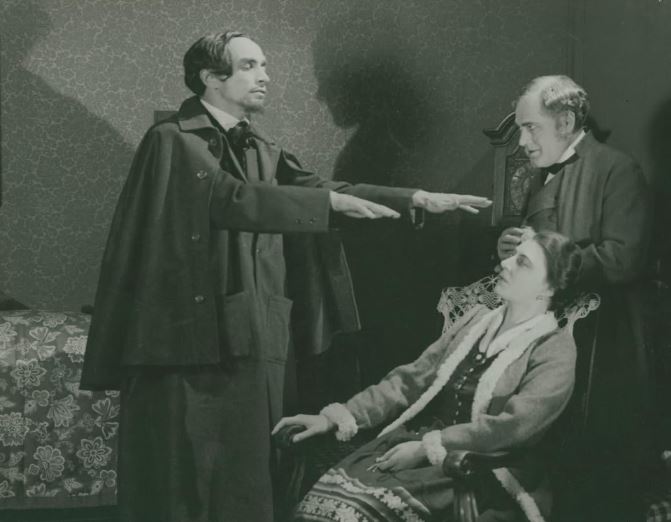

Conrad Veidt, Märta Halldén and Mathias Taube

It is a very effective change in pace and signals Ingmar’s pursuit of both his family farm and Gertrude’s love as well as the beginning of Hellgum’s religious conversion of many in the village. The storm stops as Hellgum speaks – is he/isn’t he a prophet? - and he tells them of the faith that will bring safety during the storm… a new belief he acquired during the sinking of the liner Universe. This is another well-directed segment and harrowing still as men try desperately to pull women and even children off the lifeboats after the ship goes down, there’s little nobility on show and the fight to survive is grim.


Hellgum volunteers to jump off the lifeboat to save the women and children and survives after a vision from God showing that unity, brotherhood and sacrifice will save the world. He is moved to gather brethren and follow a path to a life in Jerusalem in a new Christian community. Undoubtedly, the notion of powerful new faith was something much closer to the contemporary audience, indeed, Lagerlöf partially based the story on an emigration that took place in 1896 from Nås in the Dalarna County.


Mona Mårtenson and Lars Hanson

Ingmar and Gertrude are much more convincing to modern eyes in their love and in his desire to restore his birth-right. But the path to true love must never run smooth and, as Ingmar is off building his water mill, Gertrude attracts the not entirely holy interest of Hellgum…  Once again Strong Ingmar is on hand to set things in motion and after he warns Ingmar, the young man races back home to confront his sweetheart. He duly gains the wrong impression and appears to have assaulted Hellgum only for the preacher to explain that Ingmar fought off two attackers. Ingmar forgives Gertrude’s momentary doubt and their balance is restored but for how long?


The story turns as Karin, so practical and therefore previously resistant, is cured of her unexplained inability to walk during one of Hellgum’s gatherings at Ingmarsfarm… she agrees to sell the farm to fund the Hellgumists’ exodus to the Holy Land thereby leaving an opportunity for Ingmar to buy back the family farm. Sadly, the farm is slightly out of his price bracket and it is here that we find Sweden’s multi-talented superstar Jenny Hasselqvist as Barbro the daughter of rich Berger Sven Person (Knut Lindroth) who was once a farm boy for the Ingmars. Barbro has been disappointed in love and looked on with considerable interest in the direction of Ingmar, so Dad does what all fathers might and offers to loan Ingmar the money as dowry for Barbro’s hand in marriage.


So now we have a classic Lagerlöf moral conundrum and Ingmar is not just driven by familial pride, he feels a responsibility to all those workers on the farm, especially the elderly who look on him with pleading eyes as he wrestles with his conscience. If you don’t want to know the result, please look away now.


Lars Hanson. Ingmar imagines...

Spoilers!!!


Ingmar follows his head and not his heart and, although neither solution would give him peace, he feels he has betrayed Gertrude who is devastated. His ensuing wedding with Barbro is not a happy occasion and he can barely look at his new bride, but his misery is about to be compounded as his former love, flees to the woods in desperation, has visions of putting his eyes out in revenge before seeing a vision of Christ and undergoing a conversion.


The real kick in the tale is when, seeking rest at a peasant’s cottage, Gertrude sleeps on a pillow bought at auction from the Ingmar’s Farm… she finds the money hidden by Evil Elias and a note explaining that it’s Ingmar’s inheritance. In a heart-breaking final meeting, Gertrude calls Ingmar away from his wedding to tell him that she has transferred her love to Jesus and that she has found his money. Realising that this find could have enabled him to have his love and his farm, he collapses in a sad rage… but the worst is that Gertrude is in a rapture beyond his earthly love.


Lars Hanson and Jenny Hasselqvist


So, we see various conflicts, Ingmar’s love for Gertrude and for the land, his true inheritance is farming and not necessarily the farm or money. He makes most sense as a many working the land as he will prove in the final part. His inheritance is also steadfast loyalty and a willingness to do the right thing. He faces tough choices but I couldn’t help but think of the more complex world that would arrive in the future. In capturing the way of life in old Varmland Lagerlof and her directors were unaware of the biggest challenges of the new century; you wonder what happened to the Ingmars in the time of mechanisation and the post-industrial world?


Taken together these two films come in a 114 plus 42 minutes so just over two and a half hour combination; it would make for an interesting screening with a break in the middle perhaps. Here excellent accompaniment was provided by Andre Desponds on piano and Frank Bockius on  percussion; the two under-pinned the lyricism and romance whilst also driving beats into the more dramatic passages. Frank demonstrated elsewhere his command of tone and tempo and here he was a gift for yet another piano player!


Congratulations to the SFI Jon Wengström and to Magnus Rosborn who worked on the Molander as well as Jörgen Viman who did the same for the Stiller!


For more information on Selma's trip to Jerusalem there's an interesting post on the National Library of Israel's The Librarians' website from Hadar Ben-Yehuda.


Jenny Hasselqvist


Monday, 27 May 2024

All you need is Lagerlöf… Bologna Preview – Swedish Restorations


Not one but three restored films based on Selma Lagerlöf’s novels to screen at Il Cinema Ritrovato Festival.


Gösta Berling saga (1924)


It was probably in 2018 that I first heard of the restoration of Mauritz Stiller's Gösta Berling saga (1924), and a few years after I’d started my fascination with the story, its original writer and its stars after viewing the Kino DVD… Sure it was Greta Garbo’s breakthrough role, but it also featured vital performances from Lars “Handsome” Hanson, Gerda Lundequist - "The Swedish Sarah Bernhardt" – and Jenny Hasselqvist, Royal Swedish Ballet prima ballerina and an actor in so many European films: has anyone ever managed to combine both careers so well?


The initial restoration was screened in San Francisco pre-pandemic but now, at last, next month’s Il Cinema Ritrovato will screen the film as part of the 1924 selection. This new digitally restored Gosta will be unlike any other I’ve seen and is based on the analogue reconstruction from 2018, but with some changes in the editing work according to the Swedish Film Institute. The film now has a running time of 206 mins (simulating 18 fps) which is a good 22 minutes longer than the Kino version. It was originally measured by the Statens Biografbyrå in March 1924 at 4534 meters, which with a display speed of 18 frames per second would correspond to 221 minutes. The film has subsequently been shortened and re-cut several times over the years, and so this latest reconstruction moves it as close to the original release as it’s been.


As Jon Wengström, Senior Curator of the SFI’s Filmarkivet / Archival Film Collections explained:“The main sources for the restoration was an existing duplicate positive from our collections, and tinted nitrate print from the collections of Cinemateca Portuguesa (Lisbon). A brief scene was also added from a safety print in the collections of Gosfilmofond (Moscow).”


Gerda Lundequist, whose grand-daughter is rock singer Sonja Kristina... 


Jörgen Viman was the SFI’s Film Archivist on the restoration or “recreation” as he puts it, of the film explains further that tinted nitrate prints were also borrowed from the Cinémathèque française in Paris and the Deutsche Kinemathek in Berlin, as a reference for the film's continuity. Having just re-read Paul Norlen’s 2009 translation of Selma Lagerlöf’s extraordinary debut from 1891 it will be fascinating to compare Stiller’s focus. Lagerlöf creates such a powerful, magical-reality and seems to write from inside her subjects… I wonder what Powell and Pressburger would have made of her work and the interpretation of Stiller, Sjöström and Molander are all so tonally different.


The film's subtitles have also been recreated based on the wording in text lists submitted to the Statens Biografbyrå. These intertexts have now been based on Alva Lundin’s original designs - only three of the 405 text boxes have survived and another three were found reproduced in a trade journal from the time. Sadly, Lundin’s original painted illustrations of the text have not survived but you can read more about her work on the Women Film Pioneers Project website!


The film’s colour ways have been recreated though using the tinting scheme of the Portuguese nitrate print. The colour shading of the intertexts is also based on a description in another trade magazine article – bless these secondary sources!


Jenny Hasselqvist and Lars Hanson in Till Österland 


Till Österland (1926)


At the start of the pandemic, I read Selma’s epic Jerusalem Parts I and II (1901-2) as translated by the American Velma Swanston Howard in 1915. The story was set in the traditional rural heartlands of Dalarna and involves a group of villagers who gain a new faith and emigrate to Jerusalem as happened in the parish of Nås in 1896. It gave rise to four cinematic adaptations with Victor Sjöström making the first two films, The Sons of Ingmar (Ingmarssönerna) (1919) followed by Karin Daughter of Ingmar (Karin Ingmarsdotter) (1920) which failed to repeat the success of the first film leading the director to turn his attention elsewhere. Gustaf Molander picked up the project and completed the story with his brace, Ingmar's Inheritance (Ingmarsarvet) (1925) and Till österland (1926).


The two directors had many differences in approach with Sjöström’s narrative much closer to Lagerlöf’s text and more focused on the interior life of her conflicted characters whilst Molander broadened the palate, taking more liberties and setting up more action. Sjöström made two feature films out of less than 105 pages whereas Molander crafted one from the remaining 240 and another from the 350 pages of Volume II, including adding some of his own inventions. The feeling is much the same but the pace has changed and the cinematic vision of the narrative is one aimed at creating a hit film with hot actors, most of whom feature in both films.


Mona Mårtenson and Conrad Veidt

Ingmar's Inheritance has Lars Hanson, Mona Mårtenson and Jenny Hasselqvist as well as a powerful turn from the non-recurring Conrad Veidt. It’s still extant but the follow-up has long been incomplete and unscreened. Not any more as Till Österland has been restored, as far as possible, to create a 42 minutes long mix of the surviving film and other elements; it’s narrative structure now intact.


One additional scene, showing the dance of the dervishes, was found in a compilation film but the main thing is that the existing footage is now properly put in context, with the film’s original intertitles accompanying the surviving footage, and some stills and explanatory titles where footage is missing. All in all, the fragment now has a running time of 42 mins (simulating 20 fps), and the surviving footage is now shown with recreated tinting.


Filming in Jerusalem

Magnus Rosborn was the archivist working on the film and his summary is… “The surviving scenes have mainly been taken from a duplicate negative made from a duplicate positive which in turn was produced in 1977 from the film's then fragmentarily preserved – but now lost – original negative. In addition, another scene has been taken from a duplicate negative for the film Selma Lagerlöf 80 år (1938), which has been preserved in Sveriges Television's archives.”


The intertitles have been taken from the film's preserved original text boxes and the colours of the film have been reconstructed using handwritten tinting and toning notes copied into the duplicate positive. The missing scenes have been reconstructed with the help of those text boxes, production stills and newly made explanatory texts.


Before the premiere in 1926, the film was measured at the censorship review at 2587 meters which corresponds to a playing time of 113 minutes, so whilst approximately three quarters of the film's moving image material is still missing, we are now able to finally see what becomes of the characters in what was Volume II of Jerusalem. Fasten your seatbelts, it’s going to be a bumpy ride…


Victor yes, Mauritz maybe and Gustaf.. well!?

What did the author think of these films? According to Paolo Cherchi Usai in The Oxford History of World Cinema, it was the Selma’s admiration for Sjöström’s films that led her to sign over the film rights for all her books to Svenska Bio and he adds that the director “found in her work the ideal expression of the active role played by nature in the destiny of characters torn between good and evil.” The author was certainly not low on opinion and was initially unsure about The Phantom Carriage (although pleased with the result) and berated Mauritz Stiller for his adaptation of The Gosta Berling Saga calling it “cheap and sensational”.


Well… we can see more clearly for ourselves in just one month’s time! Bring it on!


Details of Il Cinema Ritrovato can be found on their website.


The Swedish Film Institute website is here.

Tuesday, 31 October 2023

Conny and Valerie II - Contraband (1940), BFI, Cinema Unbound: The Creative Worlds of Powell + Pressburger


Powell and Pressburger’s second film was also their second with Conrad Veidt and intended to be a follow-up to their first, The Spy in Black (1939). Released in May 1940, it was a propaganda film aimed at highlighting Britain’s readiness for action during what was still The Phoney War, with volunteer sailors beefing up the Royal Navy to help in protecting out extended coastlines and preventing the wrong kind of goods, contraband, from ending up in enemy hands.


It's a stirring film that also re-unites Veidt with his SIB co-star, the vibrant Valerie Hobson and for both Powell quotes Pressburger as having written “… two stunning parts… which they simply could not refuse, even if England were to be invaded the next morning.” It’s another one of those films in which Hungarian and Kentish humour percolates through and the two leads are entangled in a sure fire rom-com scenario from their meet-cute when Valerie’s Mrs. Sorensen refuses to put her life jacket on only to be threatened with being put in irons by Veidt’s Danish merchant seaman Captain Andersen. He might be joking but don’t worry fans of human bondage, they’ll be tied up together later in the film.


Hobson has been a revelation to me, I’m way behind on 30s-40s British film, and although I have seen her in Great Expectations and Kind Hearts and I know that she had a very unfortunate second marriage to a certain John Profumo, whom she never gave up on. Here she is just about 23 and for a girl from County Antrim, sounding very English, and matching the embodiment of Weimar cinema, 47, blow for blow as the kind of confident female lead war seems to bring out in British cinema: she can look after herself, is forthright and decisive and only gets caught by the Captain if she wants to.


Conrad Veidt

This season is also highlighting Pressburger’s writing – I know, I know, late to the party… - with the programme notes quoting Powell’s A Life in Film and Emeric’s grandsons providing ample evidence of the family skillset: they’re both filmmakers of note. Having now seen 11 of the surviving 13 Powell “quota quickies” you can appreciate the impact the Hungarian had on their collaborations. Certainly, Spy in Black showed his instant success in turning a predictable story into an exciting one with edgy male and female leads. Powell appreciated Pressburger’s novelistic range and there’s no doubt that he fills his characters with so much personality and purpose his decade in German film being well spent.


The film moves quickly and manages to balance its drama with a light touch and it’s great to see Veidt in such a role, cracking jokes, being somewhat relaxed and playing a hero for once. His freighter Helvig is stopped in the channel by the Royal Navy who send them for cargo inspection at what were termed Contraband Control Ports. All his well but their cargo full of iodine is “contraband” and has to be cleared before they can proceed to Denmark. They must wait a night in port and, as Gene Kelly, Frank Sinatra and Jules Munshin would later demonstrate, a lot can happen to a sailor in just a few hours on shore.


Valerie Hobson in a hat

Firstly, the troublesome Mrs. Sorensen steals Anderson’s landing passes along with and spivvy “talent scout” called Mr Pidgeon (Esmond Knight). Knowing he’ll be in a lot of trouble without them, he sets off with first mate Axel Skold (Hay Petrie), to track them down to London via the train to Victoria. He finds both on the train and, after Pidgeon flies away, sticks to Mrs S like a glue man.


From this point the film becomes something of a travelogue for London in the Blackout, with the couple eventually united and trying to find their way across town using torches and taxis in a shadowed capital bracing itself for what may come. Mrs S has had a very suspicious phone call with her Aunt in Chester Square, filmed in that very square, and there’s more geography to come as Anderson takes his new companion to dine at the restaurant of Skold's brother Erik (also Hay Petrie), where there’s lots of funny business as Danish food is delivered in copious amounts and the Captain explains the significance of his fob watch and its Danish sailor song. The characters are rooted in another country, neutral at this time, which, all things considered, is odd. But they knew what they were doing.


Our heroes are tied up at the moment.

All the while the Captain is checking this watch as the clock counts down on the train they must catch at Victoria but they soon find themselves with even more serious worries when they are captured at her aunt’s house by a group of German spies led by Van Dyne (Raymond Lovell), who knows Mrs. Sorensen is a British spy after an incident in Düsseldorf. Away to the elaborate hide out where the interrogation begins as Van Dyne tries to establish ways of making our girl talk.


Powell marvelled at Alfred Junge’s work on the set for this hideout and the final third of the film is played out here as our heroes try to escape and prevent the German’s from spreading deadly misinformation. After the two escape they enlist his countrymen from the restaurant to try and locate the secret base, knowing it’s next to a cabaret with a singing man playing a ukelele and in a certain direction based on Anderson’s reading of the stars… they pore over the map calling out locations from Piccadilly to Soho; the old town ain’t changed that much! All is set for a fast-paced finale and lots of West End frolics, one of which originally featured a young Deborah Kerr as a cigarette girl… Mickey was suitably impressed.


There's also some very funny business in the workshop next to the hideout where busts of Neville Chamberlain are manufactured. As Powell said, Mr Peace in Our Time was already a laughing stock by ths stage and the delays in the film's release only increased the dark humour of the former Prime Minister's likeness being shot at by enemy agents and, when he uses one to knock out one of the baddies, Veidt says "they always said he was tough..."


Pieces in our time... Neville and Conny

Contraband is less cohesive than The Spy in Black, and less suspenseful but it’s still enjoyable given the two leads chance to play off each other and for the writer and director to evolve their technique. It’s another step on the way to the more playful and deeper efforts of Blimp and Canterbury but the War was just starting as were the Archers. Next up was a hugely successful diversion, Korda’s epic The Thief of Bagdad (1940) for which Powell directed most of the action sequences and the famous Genie section, along with several others as production was switched to the US following the outbreak of the Blitz. There was nothing phoney about the war from this point onwards and the cinema had to reflect this more and more.


Andrew Moor argues in Powell and Pressburger, a Cinema of Magic Spaces, that these early films show a more Germanic influence, unsurprisingly given Pressburger’ s background and Powell’s time at UFA, and even treat British soil as “alien”, certainly for the main protagonists. Only after the war progressed do the two start addressing Britain as “home”, given the needs of a patriotic industry supporting the home front. That said, this England and Scotland, will be one full of strangeness and wonder and there will always be sympathetic, humanity from around the globe, friends and enemies alike.


An expressionist flurry as Conrad awakes from a dream

Ice cool as the Nazi spies put the pressure on

Imperious

Hay Petrie in hospitality mode.

The film was called Blackout in the US, which Powell preferred.

Sunday, 22 October 2023

The Archers origin… The Spy in Black (1939), BFI Cinema Unbound: The Creative Worlds of Powell + Pressburger


Since talkies took over the movies, I had worked with some good writers, but I had never met anything like this… Michal Powell, A Life in Movies


So, here it is, the first of the twenty films Michael Powell and Emeric Pressburger made together which would some of the finest ever released in Britain and beyond. Having seen A Matter of Life and Death (1946) on Monday introduced by Thelma Schoonmaker (Powell’s wife and a film editor of world-renown) and Scottish director Kevin Macdonald (Emeric’s grandson), it was interesting to watch and compare with a film bookending their Second World War collaborations both in terms of style, budget and viewpoint. It’s never darkest than before the dawn and colours of AMOLAD are contrasted by the bleak greys of this starker spy thriller released in August ’39 just weeks before the declaration of war on 1st September.


After Powell’s first major feature, The Edge of the World, Alexander Korda offered him a contract at Denham Studios and put him to work on potential projects with limited appeal and budgets. The director’s experience on so-called quota quickies, such as the comedic Hotel Splendide (1932) and the business thriller Rynox (1932) – screened last Monday before AMOLAD - showed Powell could make the most of limited budgets and scripts and by this stage he was confident enough in his abilities to make the most of any opportunity even if it meant heading to Hollywood.


This project was based on a 1917 novel by J. Storer Clouston and a scenario from Roland Pertwee which did not impress Powell at all, cue a re-write which Korda’s co-producer, Irving Asher, also had his doubts about: “… someone is supposed to re-write the script; he has already messed everything up, transformed the masculine role into a feminine role, invented a few new characters…” A voice piped up announcing himself as the re-writer, Emeric Pressburger, who read out his notes “… about a film that had nothing to do with the original script…” as Powell told Bertrand Tavernier in an interview for Midi-Minuit Fantastique, October 1968. A slightly different sequence of events is described in his memoire.


Conrad Veidt and Valerie Hobson

He had stood Storer Clouston’s plot on its head and completely restructured the film…


Powell had already met with his star, Conrad Veidt, who was hard to impress to put it mildly, but Powell’s vision of his character as “… a man who has a fanatical conception of his work…” piqued him and was realised by Pressburger’s re-write. Korda agreed and the course was set for an adventure on the Western Isles only fifty miles as the gannet flies from Foula as Powell put it. Whilst Mickey had been making the quickies, Emeric had been scripting in Germany and other European productions, the two were no overnight success, they had learned their craft. Emeric had been hired by his fellow Hungarian “Alex” who, Powell felt sure, had manipulated the situation to get him involved in this film.


From separate directions writer and director imagined not only a fuller role for Veidt but also one that would allow Valerie Hobson to shine in her role as a double agent. Powell describes the four pulling the script together with Veidt and Hobson acting out script revisions on a daily basis and honing their narrative along with their working bond.  The film is remarkable for the treatment of The Enemy; even once the war had started, their German characters were always people even ones compelled by alien duty, and this can be found in everything from Colonel Blimp, Battle of the River Plate, One of Our Planes and more. How much more stirring to show the intelligence and dignity of the other side rather than just caricatures. The War Ministry didn’t always agree though.


Back in Spring ’39 though and hopes of peace were still present, the motivation for this film is therefore somewhere in what Powell described as Korda’s aim to establish Denham Studios as a ready-made propaganda unit for when war was inevitably declared. In doing so, Powell believed that he saved the British film industry.


The Old Man of Hoy

Location and place are very strong themes in The Archers work and Powell went up to Scapa Flow in the Orkneys and visited not just the Old Man of Hoy, as featured in the film, but also Storer Clouston to get as much information on the locale and the story as possible from the author. He also had a small team with him, “a wildcat filming unit” who could take not just reference shots but shoot atmospheric and establishing shots using doubles. The trip helped inform the set design of Vincent Korda – Alexander’s brother – who faithfully recreated the tight spaces of Hebridean buildings and enabled Powell’s sense of place to be supported on their tight budget.


The results are impressive still with Powell’s creation of an urgent and unsettling Isle of Hoy, with Veidt imperious and sensitive as the principled German U-Boat commander, Captain Hardt and Hobson magnetic the spy Fräulein Tiel masquerading as a schoolmistress and Hardt’s commander in this operation. Also good is Sebastian Shaw as the drunken and faithless Lt. Ashington who is willing to sell out the Royal Navy in revenge for his treatment. Hardt has little respect for this lack of professional loyalty but is set on leading a squad of U-boats to pick off dozens of Royal Navy ships in what could have been a pivotal moment for the war.


It's a tense film, set mostly in darkness and which has rich characters as well as many surprises in a twisty script that is tribute to Pressburger’s skill, a man Powell had been waiting for, a writer of novelistic vision and who could create spies and others with plenty of grey…


“There were close-ups of Conrad Veidt that were as good as any of eth German expressionist films. Veidt knew how to use the muscles of his face and eyes and I knew how to photograph them…”


Powell’s next film involved working with Veidt again on The Thief of Bagdad and, after that Contraband with Connie paired again with the remarkable Miss Hobson. Powell had learned his lessons well from Rex Ingram and he knew that filmmaking was teamworking, not just with his new writer but also with cast and crew. The Spy in Black was how it began and the films started to flow thick and fast as the war began and these alliances brought further fruit.


Of those who would feature again in Archers’ films, Marius Goring plays Hardt’s second in command, Bernard Miles plays a German hotelier and Esma Cannon has a bit part as a Scottish lassie.


We watched a 35mm print of the BFI restoration, supported by the BBFC, that looked fabulous on the big screen. You can also watch the film for free on the BFIPlayer whilst details of the full programme of the Powell and Pressburger season is on the BFI site: a Season of Seasons! Four films for me so far and dozens more to follow, see you on the Southbank.


Thursday, 15 June 2023

When Connie met Johnnie… The Beloved Rogue (1927), John Sweeney, Kennington Bioscope


Michelle Facey’s well-researched introductions are a major feature of this temple of film ephemera, and she also turns a good phrase which is why I just have to steal her quip about the two main stars of tonight’s main feature. It truly was the meeting of two different cinematic cultures and Michelle showed a shot of Mr Barrymore, in costume, greeting Herr Veidt with a collection of some of Hollywood’s finest including script writer of this film, Paul Bern (the future, tragically short-lived, Mr Jean Harlow), Ernst Lubitsch and others.


I’d watched the Kino DVD of The Beloved Rogue some time ago but tonight we were treated to a 16mm copy that, as all the talk of the BFI’s Film on Film Festival reinforced, was a completely different experience, especially with this venue, this crowd and the wonderful improvisations of John Sweeney’s accompaniment. The source for the 16mm was different to that of the Kino version, no tints and missing the final chapter – a DVD transfer or the same generation print was used to close out the film – and, it looked and felt different, with the Bioscope’s projector whirring away at the back of the auditorium, there were new or newly-imagined details. The only true photographic memory is, of course, celluloid, a physical interaction with what has happened, light’s traces changing chemical compounds in ways digital is deluded if it imagines its impersonations are anything other than a facsimile.


John Barrymore’s attempt to out-Fairbanks Douglas has met with mixed reviews over the years, not least from himself (he described himself as a “ham” after the premier) and whilst his fan Orson Welles who liked the film but felt his idol was “not at his best”. But, whilst Barrymore felt he missed the mark by over-playing the colourful lead, François Villon: poet, womaniser and drinker who somehow also embodies the spirit of France, it’s not the easiest of briefs.


Jane Winton looks admiringly at John Barrymore


Based on an actual 13th century poet, The Beloved Rogue includes many florid moments invented (or over-invented) to add zest to this camp fantasy. It’s an all-too-easy target and yet… there’s an extraordinary energy around the crowd scenes in particular and Alan Crosland directs with style and free-running energy. The superb Conrad Veidt all but steals the show as a greasily ambiguous Louis XI and Marceline Day uses her clear, open expression to swoon-inducing effect as his beautiful ward Charlotte de Vauxcelles.


If there’s something about Johnnie and definitely Connie, it has to be repeated that there’s something about Marceline too, she has a very modern face and physique, and her wide eyes express something familiar and grounded. One of the great silent straight women, for Buster, for Harry Langdon, for Clara (Dorothy Arzner’s The Wild Party) and here for the good, the bad and the downright ugly. But that’s no way to talk about Conrad Veidt but here this most protean of silent performers seems to be inhabited by Richard III, doubled over in unctuous concern, turning his 6 feet 2 ½ inches frame into something frail and uncertain, deliberately allowing the 5 feet 10-inch Barrymore the higher ground. Veidt is morally ambiguous in effortlessly European ways and maybe John felt the pressure, just a bit…


Barrymore certainly shows a different side to his style as he throws the kitchen sink at creating a character big enough to fill William Cameron Menzies’ immense sets, rightly highlighted by Michelle as a stunning contribution to the film’s enjoyment. John certainly prepared well for the role and for a 45-year-old he’s rather ripped in the slightly odd torture scenes after he is captured by the film’s real baddie, the Duke of Burgundy. John’s in his shorts and gets beaten, flogged, dipped into flames and then winched high, before being selected as brutal entertainment for the wedding of the day…


Conrad Veidt

Set after Joan of Arc’s execution in 1431 (she came back strong after that didn’t she?) the film starts in a most un-funny way with the burning of Villon’s father at the stake… He was a patriot and fought in the name of a united France against the English and their Burgundian allies. His wife (Lucy Beaumont) prays that their son will inherit his spirit but, fully grown sadly he seems more concerned with spirits… Is this a redemptive story of fool to hero or does Villon play the fool to bide time?


Francoise’s roguish tendencies are fully developed as he gleefully steals wine to get drunk with his friends and leads the All Fools Day street celebration as the King of Fools. This section is very well realised by Crosland who generates a visceral charge by moving his camera through the celebrating hordes as snow swirls across the city. Snow in April: Paris in the Snow-time? Just what we need after a week of high temperatures.


Amongst the revellers is the striking Jane Winton as The Abbess, Mack Swain, striking in a different way, and Slim Summerville as Villon’s buddies Nicholas and Jehan as well as Angelo Rossitto (later to star in Tod Browning’s Freaks) as Beppo the Dwarf. As the party gets started Francoise is in pursuit of one of his favourite things as he evades the constabulary and comes down the rooftops to cheat an innkeeper of some wine. He heads of linking arms and skipping with Nicholas and Jehan – there’s a lot of skipping. Jigging and general dancing for joy: how else to convey energetic adventurism to scale?


William Cameron Menzies' sets are stunning


Having been crowned King of Fools, Francoise regales his rapt audience with a poem and them mounts a statue of the King just as the Duke of Burgundy arrives for an audience with his cousin. Francoise makes merry at Burgundy’s expense, knowing him as a man of ambition who wants the crown for himself. But King Louis, a “slave to the stars” has his judgement clouded by the advice of his astrologer and is loath to confront his rival. He comes out of the palace and has no option to support Burgundy against the crowd and ends up banishing Villon from Paris – “his life”.


Riding with him is his ward Charlotte who is appalled to finally see the reality of the poet she idolises: is the most inspiring wordsmith in France really an uncouth drunken fool? But things are about to get worse as she is promised in marriage to Burgundy’s lieutenant, Thibault d'Aussigny (Henry Victor), part of Burgundy’s plot to gain quick access to Paris.


In exile, Villon turns into a gallic Robin Hood as he hijacks the King’s gifts to Burgundy and climbs the walls to use the King’s catapult to fire the food and drink at the city in order to feed the poor. He ends up catapulting himself to avoid capture and crash lands, of course, into the rooms of Charlotte de Vauxcelles, what are the odds eh? This sequence features a stuntman diving against foreground scenery with the camera at a right angle; the result turned vertical into horizontal and adds further momentum to the film’s relentless pace.


Every day's a Marceline Day

The young noblewoman soon learns that this surprise invader is the Francoise Villon, a man whose words have touched her like no other but, again not pausing for breath, they are rudely interrupted by Thibault and his troops, there follows an altercation involving bears in barrels, recently deceased poultry and a heavyweight chandelier. Francoise escapes and takes Charlotte with him over the rooftops he knows so well to the safety of his mother’s house. Queue emotional reunion and the sadness of a mother deceived by her own hope: will her son ever amount to the man she wants him to be?


The route forward accelerates as the King finds it expedient to order Francoise death but the poet saves his skin by convincing Louis that their lives and death are inter-dependent: with this swift turn of phrase, he guarantees his life as courtier. Now able to influence events in the way his mother always wished, he is still a commoner which means he can never marry Charlotte, but all are soon overtaken by events as Burgundy kidnaps her and is intent on completing her marriage to his cause.


Villon and his friends, plus an army from the goodly poor of the Cour des miracles, the slum districts of Paris, as also featured in The Hunchback of Notre-Dame, borrowed here in strictly un-historical manner natch. But there must be swash and there will be buckle and it’s a rip-roaring finale with the cast of thousands are moved so well among the towering sets.


The film was believed lost until Mary Pickford revealed she had one in her archive and I wonder again how would we feel about The Beloved Rogue if it were still a lost film? As ever we need to count our blessings and thank the collectors, the restorers and the historians for preserving film in all its forms.


The rug stays cut when Josephine cuts it


Talking of which, the first half of the show combined a series of contemporary trailers for silent films including Ben Hur (1925) – which I’ve still to see on the big screen – a Marie Prevost film (it does exist but only on celluloid and with Serbo-Croat intertitles, one day maybe…) and others including King Cowboy (1928) starring Tom Mix and a-lot of Josephine Baker in Siren of the Tropics (1927)… oh my, there was steam coming off the screen! The art of the trailer is a valuable sub-genre all its own, cinematic striptease perhaps, revealing just enough, not too much and it provided quite the challenge for the accompanying Colin Sell who, of course, dealt with the flurry of action, emotion and revelation, with customary flair and sang froid! Grace under pressure these pianists!


It's been a great first half year for the Bioscope and my thanks and admiration goes as usual to all those involved in making these celluloid adventures possible. See you in September for more quiche, conversations and classic, rare, film!


The Cinema Museum where resides the Kennington Bioscope

A 35mm film projector, yesterday at the Museum.