Showing posts with label The Goddess (1934). Show all posts

Friday, 21 April 2017

Shanghai Star - The Goddess (1934), BFI DVD


“Older people went misty-eyed when they heard Ruan’s name… She represented a time for them when hopes weren’t jaded, when you didn’t have to talk in double speak, when a revolution promised better lives.” Mark Cousins remembering a recent visit to China.

This one is almost too much, the natural dignity of Ruan Lingyu outstanding in a desperate tale of motherly love against all odds provided by a brutal environment and a society determined that it’s all her fault. This is a third world away from the sweet stories of Hollywood and sees Lingyu’s character employed as a prostitute – a goddess by any other name – and enduring the overbearing “protection” of a crime boss in order to provide for her son.

Even when the kindly head of the school stands up for her he is shouted down by those who cannot see beyond her profession… can’t see even Barbara Stanwyck playing this, not overtly. Yet the Greta Garbo of Shanghai takes it all in her stride and is magnificent.

Ruan Lingyu
Written and directed by  Wu Yonggang, The Goddess is remarkably bold in its subject matter and reflective of a country in flux between the revolutionary forces of Mao Zedong’s Chinese Communist Party and the nationalist Kuomintang Party led by Chian Kai-chek who had achieved a temporary ascendancy in Shanghai which clearly allowed the urban creative elite full expression.

In the Shanghai of 1934 there were as many as 100,000 women scraping a living as a prostitute: around one on thirteen… In the year of the Long March Chinese society warlords and politicians struggled for control whilst a newly urbanised peasantry lived in squalor.

Shanghai street-work
The film was one of Ruan Lingyu’s last as she committed suicide within a year of its completion – she was only 24 and on this evidence a performer of the highest order with a range of controlled, natural emotion that cuts through in a very modern way.  If not the Chinese Garbo of legendary cliché but, as with Greta, someone who works their interior world very hard and yet gives only glimpses of the powerful turmoil just bubbling below.

She’s almost matched by the baby-faced Zhang Zhizhi who plays her pimp, a compulsive gambler and a bully who can smile and smile and indeed be a villain still. But he’s not necessarily the clichéd control freak and psychotic bully boy; he’s weak and irresponsible - another believable character.
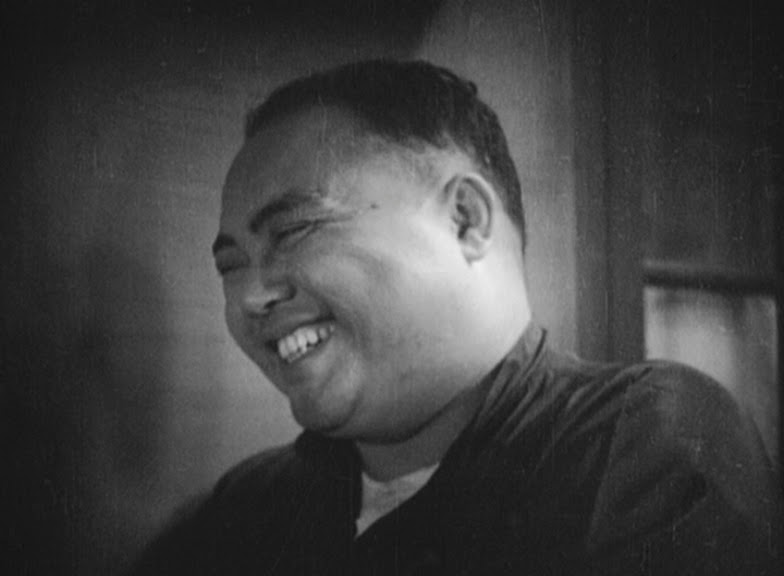
Zhang Zhizhi - nowhere near as friendly as he looks
Then there is the woman’s son, played by a talented youngling called Keng Li who gives a very good account of himself… The Chinese Jackie Coogan? No, he’s his own boy.

Wu Yonggang’s screenplay had been partly inspired by his observing prostitutes forced smiles as they greeted customers: what horrors lay behind those phoney faces? Wu had spent time in Hollywood and his experience is clear from any number of clever tracking shots, expert close-ups and a wonderful overhead as the woman engages with another client and the two walk off together to more hotel room misery…

Cold hotel morning
The woman seeks to find a way to support her son using the only option open to her. She is almost run in by the police but takes shelter with her soon-to-be protector who starts to make her work for him. Not wanting her boy to suffer as she has she starts to hide away money in order to enrol him in school. But prejudice is rife and the other school governors are not so open-minded nor are the parents. Meanwhile the gambling-pimp finally finds the stash of money, is he about the throw away the only chance the boy will ever get?

Last chance at school?
No spoilers:  Even if this was a Hays dodging pre-code Hollywood film, there would be retribution in store but here the twists and turns have the ring of truth and you’re never certain of the end game as the story plays its course. It remains a genuinely moving experience and a story the resonates strongly still.

Chinese composer Zou Ye’s newly commissioned score moved graceful alongside the film interweaving modern themes with more traditional sequences: a bridge connecting us to the time and the place… Zou Ye conducted the Chinese Philharmonic Orchestra for this recording of a  score commissioned by the KT Wong Foundation, an independent body dedicated to fostering cultural exchange between China and the rest of the World.

Brilliant actor at work
Sadly, Ruan’s personal life was no less complicated than this film and under huge pressure from the press following her complicated love life, she took an overdose and died less than a year after The Goddess. Her death led to questions being asked about the uncontrolled behaviour of the tabloid press and the rights of celebrities to privacy and a life… and we think we’re so different?

The Goddess is extraordinary proof of the talent that was lost.

It’s available on BFI DVD from 23rd April and you can pre-order it directfrom their online shop now!


Tuesday, 14 October 2014

Ruan Lingyu in The Goddess (1934) with Zou Ye & ECO, LFF, Queen Elizabeth Hall


It might seem curious that a “goddess” may be an ethereal protector of life as well as a sex worker… but in this case they are very much inter-twined: the lead character can only achieve one by being the other.

I know not even next to nothing about Chinese culture in the thirties and this film was like entering another cinematic universe with those dancing feet of 42nd Street represent a charming, sugar-coated parallel world in which good things happen to those who wait. Not so here where you may wait a lifetime and never gain happiness: a culture with a conflicted desire to modernise and which was still firmly rooted in the nineteenth century.

Ruan Lingyu
In the desperate Shanghai of 1934 there were as many as 100,000 women scraping a living as a prostitute: around one on thirteen… In the year of the Long March Chinese society was in flux as warlords and politicians struggled for control whilst a newly urbanised peasantry lived in squalor. For a society still viewed as relatively guarded in western eyes, it is surprising to find a film of such unflinching honesty.

The Goddess (神女) was showing in the splendid Queen Elizabeth Hall on London’ Southbank as part of this year’s London Film Festival and also as a continuation of the BFI’s Electric Shadows series of Chinese film past and present.

Another hotel morning...
The film was famously Ruan Lingyu’s last film as she committed suicide within a year of its completion – she was only 24 and on this evidence a performer of the highest order with a range of controlled, natural emotion that cuts through in a very modern way.  If not the Chinese Garbo of legendary cliché but maybe a forerunner of the Isabelle’s Adjani and Huppert: someone who works their interior world very hard and yet gives only glimpses of the powerful turmoil just bubbling below.

Ruan Lingyu and Zhang Zhizhi
She’s almost matched by the baby-faced Zhang Zhizhi who plays her pimp, a compulsive gambler and a bully who can smile and smile and indeed be a villain. But he’s not the clichéd control freak and psychotic bully boy; he’s weak and irresponsible another highly believable character.

Then there is the woman’s young son, played by one Shuiping who gives a very good account of himself… dare I say the Chinese Jackie Coogan? No, he’s his own boy.


The film was written and directed by Wu Yonggang who’s screenplay had been partly inspired by his observing prostitutes ‘forced smiles as they greeted customers: what horrors lay behind those phoney faces? Wu had spent time in Hollywood and his experience is clear from any number of clever tracking shots, expert close ups and a wonderful overhead as the woman engages with another client and the two walk off together to heaven knows how much hotel room misery…

The film is unflinchingly frank throughout as the woman seeks to find a way to support her son using the only option open to her. She is almost run in by the police but takes shelter with her soon-to—be protector who starts to make her work more… profitably.

But she wants more than just subsistence; she doesn’t want her boy to suffer for her faults and starts to hide away money in order to enrol him in school.

Delight at the school play
For a while she succeeds until gossip becomes too much and the kindly principal investigates to see if the boy’s mother is indeed a woman of ill-repute. She reveals the truth but he is impressed with her determination and willingness to sacrifice all to give her son the best possibly chance in life.

But prejudice is rife and the other school governors are not so open-minded nor are the parents. Meanwhile the gambling-pimp finally finds the stash of money, is he about the throw away the only chance the boy will ever get?

The Headmaster calls
No spoilers:  Even if this was a Hays dodging pre-code Hollywood film, there would be retribution in store but here the twists and turns have the ring of truth and you’re never certain of the end game as the story plays its course. It remains a genuinely moving experience and a story the resonated strongly for every parent in the room.

Chinese composer Zou Ye’s newly commissioned score moved with subtle grace alongside the film in perfect step courtesy of the thirty-piece English Chamber Orchestra conducted by Nicholas Chalmers. It was a perfectly judged accompaniment that interwove modern themes with more traditional sequences: a bridge connecting us to the time and the place…


There was long and loud applause at the end from the mixed audience of bearded silent cognoscenti and Jermyn Street bespoke-tailored concert buff-age: we really liked the music but, for most, I would think the vision of Ruan Lingyu will live in the min a while longer.

As Stanley Kwan said in the programme notes: “I was stunned by her performance, which was subtle and rich – an emotional tour de force. It was amazing to me that such a thing could be achieved in silent cinema…”

The Goddess is available in reasonable quality, free-to-view at the Internet Archive, not a patch on this crystal clear restoration though! Catch it if you can: the cinematic world was clearly always bigger than it seemed.