Showing posts with label Cyril Cusack. Show all posts

Sunday, 29 September 2024

Irish Archers? The Outcasts (1982), BFI Flipside No. 49 Blu-ray


A sense of time when magic had a meaning... I wanted to create a myth that was relevant to human experience.

Robert Wynne-Simmons


This film is set in a time before the potato famine, when Ireland was a much more populous place and a happier one. Maybe that’s a projection – a long standing one – but so much of the country becomes so hard to view at this distance, especially when every one of you was called James speaking personally, that it’s much clearer to imagine. So it was that a man from Sussex, educated in Cambridge University, came to write and direct what was the first independent Irish film made in half a century.


Robert Wynne-Simmons had previously tackled William Blake and then the screenplay for the ultimate “folk horror” film, Blood on Satan's Claw directed by Piers Haggard the man who really coined the phrase. Wynne-Simmons had been working in Ireland and managed to, just about, secure the funding for this labour of love which both answers the question about what Irish cinema could be and highlights the riddle of why not more? It is after two viewings, a film to bewitch and fall in love with, something the director has been shocked by when he meets people who have been so deeply affected by the tale.


Cyril Cusack is the big name in the film and he was, according to his director, very proud to have been in both this film and the last independent Irish film, Guests of the Nation a silent film from 1934, directed by Denis Johnston, and including Barry Fitzgerald. The Irish Film Board was set up in 1981 to boost the local industry, and Outcasts certainly benefited from this backing along with Channel 4.


Cusack is of course wonderful; he was a master of nuanced uncertainty and always conveyed mystery in his thoughts in ways utilized so well by Michael Powell and Emeric Pressburger whose style of “magic realism” runs through this film like the words Galway Bay running through a stick of seaside rock. But there’s a young performer called Mary Ryan who steals the film with an almost mystical connection to the camera that you wouldn’t credit from someone who was stage trained and with scant film experience.


Mary Ryan

Ryan plays Maura, a woman out of step with her fellow villagers and even her family. She describes herself as a “mistake” and her father’s regular if “well-intentioned” beatings are testament to her inability to bend to his will. She is out of joint, seeing things her sisters don’t and being relentlessly teased by the locals as we see at the film’s beginning when two other girls throw her petticoat into the mud, forcing her to face the indignity of wearing them. People are cruel but she has a strength in not responding, almost as if she sees through their mundane games.


Like much else in the film, the explanation is left open to the audience to interpret, as the BFI’s Vic Pratt says in his booklet essay, ambiguity abounds; slippage of meaning is manifest... Maura’s sister Janey (Bairbre Ní Chaoimh) is due to be married to Conor Farrell (Tom Jordan) who has, it seems, put her in the family way. Their issue is discussed with local civic leader Myles Keenan (Cyril Cusack) who arrives imperiously on horseback with a shiver at the prospect of his old adversary Scarf Michael (Michael Lally), who appears to him as a reflection in a pool. This apparition and the plaintive fiddling is surely in his imagination or is it?


The wedding is agreed with old grudges put aside by stubborn, grounded men, as much a part of the scenery as the buildings and even the clothes feel rooted in the muddied earth, the dampness working its way up the hems as the actors struggled against the elements. This is a “folk film” before it’s a horror and the old behaviours and traditions are as mysterious as any witchcraft. For the wedding party the youngsters run to the house and then a band arrive carrying fiddles and dressed as Straw Men, Maura stares at these unknowable men who ae welcomed in to serenade the party without question. That’s wyrd in the old sense of the word and as frequently quoted by Dr Diane A Rodgers in her excellent and informative commentary. Another level of the uncanny is added by the faraway sounds of Scarf Michael’s fiddle… causing anxiety among the adults.
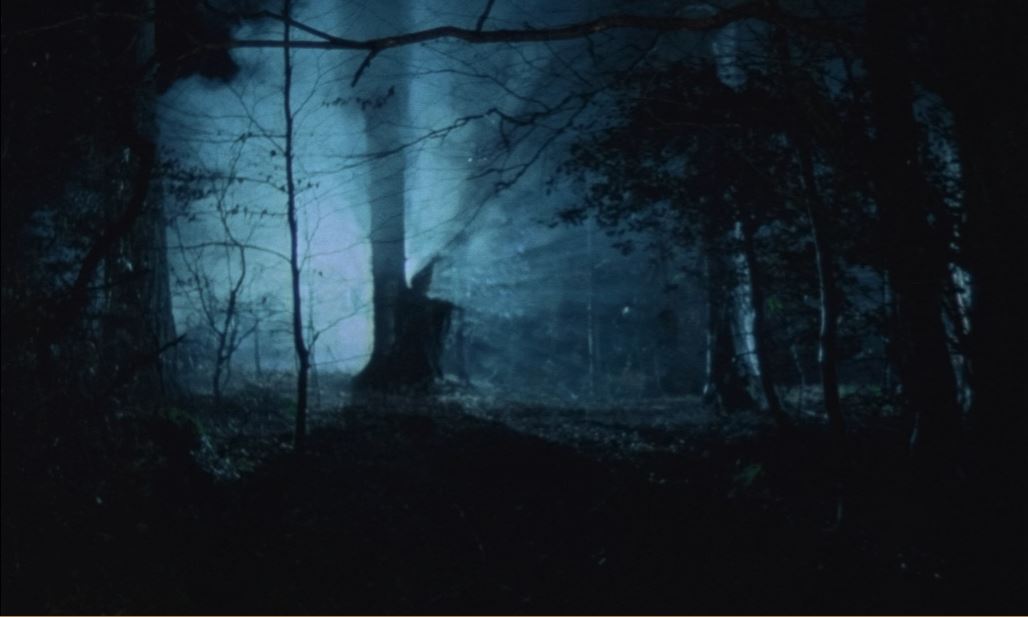

Michael Lally appears
 

As the evening progresses the younger members of the group wander off into the woods, leaving Maura alone as they pair off. She waits in the eerie darkness with slivers of moonlight hinting at the uncertainty of what’s beyond. Now she sees the figure of Michael, who appears to be there and not there until he solidifies and approaches her. She joins him as he exacts magical revenge on her tormentors as the drink and make love and she enjoys the tables turned while it lasts.


The next morning, she wakes in a graveyard with Michael – he often sleeps in such places “for the company” – only to find herself covered in snow. It’s as if the world has changed but the reality was more prosaic as the unexpected snow had slowed production even as it allowed for this deft stroke from the director. Soon though the locals are turning on Maura and blaming her for blighted potatoes and consorting with the unnatural Michael. Will he save her, and, even as he holds back from revealing the truth of what he knows and she longs to find out, we wonder what will become of her…


Wynne-Simmons’ team clearly laboured with a love of the subject and in his essay in the booklet he is quick to credit them feeling privileged by the way in which both cast and crew responded to the creation of this ‘other world’.


People and the earth

Séamus Corcoran, the lighting cameraman, had a deep understanding of the countryside and of the light in people’s eyes. Consolata Boyle created costumes that seemed to grow out of the ground itself. Stephen Cooney’s beautiful music was enhanced by dark didgeridoos from his native Australia, emphasising how the human subconscious unites all the world.


As the Englishman telling this most resonant of Irish folk tales there’s a touch of Bruce Chatwin’s belief in the universality of folkloric “songlines” which echo down from the past through our generations be they describing Cooney’s outback, the Pilgrim’s Way to Canterbury or the invisible ties that bind in Isle of Kiloran. Maura experiences her landscape as a revelation and one that she will have to discover how to share with her family and others outside of her higher consciousness.


Extras are magical:


·         New 2K restoration by the Irish Film Institute

·         Newly commissioned audio commentary by Dr Diane A Rodgers

·         Writing Folk Tales (2024, 9 mins): a newly recorded interview with director Robert Wynne-Simmons

·         The Fugitive (1962, 31 mins): Robert Wynne-Simmons’ first film with an outsider at its heart is this dark tale of violence, guilt and retribution shot on 8mm film amidst Mods and Rockers violence on the backstreets of ‘60s Brighton

·         The Outcasts in Pictures (2024, 15 mins): a gallery of stills from the film with audio commentary by director Robert Wynne-Simmons

·         The Wanderings of Ulick Joyce (1968, 5 mins): this distinctive animated short by Gillian Lacey was inspired by Irish folk tales, and was made with the assistance of the BFI Production Board


With the first pressing only, there’s a very impressive booklet including director’s statement, new writing on the film by the BFI’s Vic Pratt, an archive essay by Dr Diane A Rodgers and recollections of The Fugitive by Robert Wynne-Simmons.


It’s out now, so get your order in quickly – this is a film you’ll want to watch over and again, a puzzle open to interpretation and one that will touch each of us in different ways. A wonder.


Sunday, 3 December 2023

On Chesil Beach… The Small Back Room (1949), BFI, Cinema Unbound


What I really want sir is a bit of expert guessing and some expert advice on how to handle it when we get our hand on one…


This is another one of those films that just has to be seen on the big screen and the BFI’s restoration-in-progress digital 4k presentation brought home every nuance and, especially, bead of sweat on David Farrar’s brow as he battled alcohol addiction in his nightmarish confrontation with a giant bottle of scotch and then struggled to retain composure in a very personal battle with a fiendish German bomb lying amongst the shifting pebbles of Chesil Beach. This confrontation between man and booby-trapped explosive has never seemed so tense, more visceral and further away from my own experience of that stretch of beach from Abbotsbury to Weymouth.


This is also a return to top quality Powell and Pressburger after three well-made and under-rated films that are all good but just not this good. We’re set up for Sammy Rice (Farrar) and this fateful meeting by a devastating cameo from Renée Asherson as an A.T.S. corporal who has to relay the doomed attempt to defuse another of the bombs by another officer, and it’s never hit me so hard as she repeats his words, his brave joking about the situation – Wembley being packed for the FA Cup final between man and bomb – before getting to his last words as he realises the bomb has an inexplicable second wire… Not only has a character we like lost their life but we relive the detail through someone else’s grief. That’s inventive and leaves the audience helpless as the next man steps up.


Kathleen Byron

The Small Back Room is packed with such moments; overloaded with great cameos, humour and spirit. If you don’t want to live in a world in which Sidney James runs your local pub and Kathleen Byron has your best interests at heart, then I can’t help you. This is probably David Farrar’s finest moment or jointly with Black Narcissus and in both cases that’s down to Kathleen; it takes two to tango and whilst Sammy can’t dance – not with a tin leg he can’t – the relationship between Byron’s Susan and him is the core of the film. Kathleen perseveres with Sammy not just because she can see how far he’s fallen but because she sees how far he could still rise and she’s not willing to give up on her love, not by a long chalk!


Based on the 1943 book by Nigel Balchin, a psychologist who wanted to show the inner struggles not just of addiction but also of brave men injured and worn down by the War. Sammy has lost his leg in an unsuccessful attempt at bomb disposal and this has led to constant pain, suppressed by a mixture of “dope” – codeine? – and drink. He is too proud to take his tin leg off in front of Sue and every day is a constant struggle between using the drugs or hitting the hard stuff. She is with him all the way though, as they keep a bottle of Scotch to test his mettle in his flat and, whilst she lives across the hall, she and her cat, seem more at home in Sammy’s place.


Robert Morley and Jack Hawkins

The film is also about the “boffins” of the small back room tasked with developing new weapons. Sammy reports into Professor Mair (Milton Rosmer) and the unit is overseen by a-low content careerist called R.B. Waring (Jack Hawkins giving it the full narcissist...). Politics abounds and nothing appears to have changed with their low-content glad-handing minister, (Robert Morley credited as "A Guest") paying a visit and having to be entertained by a made-up experiment. He has no more idea what they do than the next fop and is by no means secure in his position and this could have all kinds of unpleasant ramifications for the team.


The unit is involved in testing a new gun and there’s a splendid sequence at Stone Henge with Sammy watching the test as Colonel A.K. Holland (Leslie Banks, last seen by me in the Powell Quota Quickie, Fire Raisers!) not impressed with the evidence of his own eyes; on the battlefield this new gun could cost lives. There’s another set piece when the unit has to present its findings to a committee of the Minister of War, civil servants, rival scientists and the General. It’s played partly as farce with loud roadworks obscuring the details and the minister looking at paintings for the ministry during Sammy’s reading of the statistics. But then the General asks him for his opinion and, to his credit he tells it like it is even though it’ll cost him the approbation of his seniors.


Michael Gough and David Farrar

“I’ll… hand it over to Susan. She’s got it all worked out in the way women always have… She’ll take it and make it into what she wants…”


But Sammy is mired in his own disability and frustrates Susan’s attempts to not only count his blessings but also to exert his force of personality and expertise. In the novel he’s over-thinking everything and relying on her to provide momentum, overlooking his achievements in a pattern Balchin well recognised from his patients’ struggles with what we would now term PTSD and imposter syndrome. He’s a work in progress and that’s something seen on both paper and on screen.


Yet Sammy is sharp as a tack and compassionate with it, a natural leader of men with more moral courage than most. Even as he is so hard on himself, he shows such emotional intelligence in dealing with a nervy co-worker, Corporal Taylor (another quietly striking cameo from Cyril Cusack), who is having marital issues and doesn’t want to accept his own weaknesses at work. Sammy firstly asks his advice about trembler fuses and then coaxes him to ask for help, agreeing to his leaving early to help his wife. Beautiful interplay between the two, Farrar raising his game alongside Cusack in another of the film’s poignant moments.


David Farrar and Cyril Cusack


The film starts with Captain Dick Stuart (Michael Gough) making his way to see the unit and explaining the mysterious items that may or may not be new German bombs. Sammy Rice is your man advises Professor Mair and with Susan’s help, Stuart locates him in the pub run by "Knucksie" Moran (Sid James) who has just advised her man against drinking whiskey, he knows he can’t handle it. Back at Sammy’s flat Stuart explains the explosive enigma and Sammy’s hooked… Mair’s right about his intuiting and expertise. The two take an instant liking as does Stuart to Susan who he offers to walk home before she tells him she lives across the hall. It’s one of Gough’s best roles too.


We’re hooked too and are rooting for these three from now on. If any film shows the importance of the Archers’ combination of script and direction it’s this one, the quality doesn’t really drop throughout and the whole team is magnificent. A micro-managed masterpiece of dramatic thought on screen. I look forward to the finalised restoration from the BFI, it’s worth every second of their painstaking devotion!


You've got to make up your mind whether you want to spend your whole life being a person it's just too bad about or not...


Try harder Sammy.


Sunday, 26 November 2023

The Archers’ final shot… Ill Met by Moonlight (1957), BFI, Cinema Unbound, film on film


Though they would work together again, this was the last film Powell and Pressburger made through their Archers production company and as with the first of their collaborations it was a war story shot in black and white. Much had changed in the intervening 18 years and, unusually for the pair, this was not an original story but one based on the memoires of W Stanley Moss who was indeed involved in the successful kidnap of the German general Heinrich Kreipe, commander of the German forces on Crete. Kreipe was successfully shipped off to Egypt and only released in 1947. He was reunited with his kidnappers on a Greek television programme in 1972… and, an educated man, much like the British officer who led the audacious mission, Major Patrick "Paddy" Leigh Fermor the two apparently remained friends. Kreipe perhaps was a real-life example of one of the Archers’ “good Germans” exchanging Latin quotes with Paddy during his capture.


For today’s screening there was much delight when we arrived to find that the last two members of the cast, Dimitri Andreas (80) who played the young Niko and George Eugeniou (now 92) who played Charis, introduced the film in an interview with Jo Botting, Curator of the BFI’s National Archive. Both men were still passionate about their director’s work, it was Dimitri’s first film and he had been introduced to Powell by George as he was looking for a boy who had experience with goats. He has gone on to have a long career in film, incredible how the World can turn with one chance encounter, but seeing his youthful energy you can understand what Powell saw in him and why his talent has endured.


George Eugeniou, Jo Botting and Dimitri Andreas


George Eugeniou also shares this disposition and talked not only of Powell but also his involvements with Joan Littlewood as a member of her theatre company and then his role in Sparrows Can’t Sing (1961) one of the classics of kitchen sink drama and her only film. He featured in small parts in both Pressburger’s Miracle in Soho as well as Powell’s Peeping Tom and is still angry at the way that film effectively ended the director’s mainstream career in this country, especially when compared with Hitchcock’s more clearly exploitative Psycho. George founded the Theatro Technis Company Limited in 1957 and has dedicated most of his career there with the aim of presenting "radical and total" theatre aimed at breaking down barriers between nationalities, religions, genders, sexual orientations, classes, ages and languages. The Technis is still a vibrant presence based in Crowndale Road in Camden and more details can be found on their site.


It was a privilege to see both men and to learn of the impact the film and the Archers had on them and, as Dimitri then came and sat beside me in Row D, to watch them on screen, 67 years ago, on the BFI’s 35mm copy was the kind of surreal treat you only get on the Southbank; the audience and the filmmakers watching film as history, history as film…


Dirk Bogarde and George Eugeniou

George plays one of the local Cretan resistance fighters, mountain “wolves” waiting to prey on the fat German sheep who populated the valleys during the occupation. Major Patrick "Paddy" Leigh Fermor (Dirk Bogarde), also known to the locals as Philedem, after a traditional Cretan song he liked so much his comrades used it as his nickname. He’s undercover travelling to one of his Cretan contacts to discuss his audacious plan of abduction with a local (Wolfe Morris) who suggests that commandeering the general’s car is the only chance even though this will mean passing through numerous roadblocks.


Another British officer, Captain W. Stanley "Billy" Moss (David Oxley) arrives on the island and we get to meet the rest of the team, Captain Sandy Rendel (Cyril Cusack), who hasn’t washed for six months, Zoidakis (a barely recognisable Michael Gough with huge moustache), car-spotter Elias (John Cairney), Yanni (Paul Stassino) and the excitable Charis (George Eugeniou). Plans are made and the team lies in wait, stopping the car with Paddy and Billy dressed in German police uniforms before knocking out the driver and driving off with the General (Marius Goring) squashed under three men in the back seat.


Dimitri Andreas

They successfully evade capture, speeding through the road checks – 22 in all – and escaping to the hills before the Germans realise that their commander is missing. Now the adventure really starts as the small unit has to escort the General at altitude across the hills to rendezvous with a British boat. On their way they encounter a young boy, Nico (Dimitri Andreas) who helps them pull the general along on a donkey – Geneva Convention dictating that capture generals deserve appropriate travel provision – runs local errands and ends up playing a crucial role.


Along the way, there’s ample opportunity for Goring and Bogarde to trade glamour and tonality, whilst the cinematography of Chris Challis is of course splendid although what we’re seeing is not Crete but the Alps Maritime in southern France near the Powell’s hotel; how the crew musts have loved humping their heavy cameras up to those “views”.


At the crucial point neither of the British officers knew the morse code to contact the Royal Navy motor launch ML842 and they had to wait for another officer – in this case Sandy – to turn up and show them how. I have seen this listed as an example of the film’s shortcomings but it’s absolutely the case. The gods were with the Cretans and British that night.


Dirk and the actual Paddy...


Powell vs Pressburger…


As with their previous film, The Battle of the River Plate (1956), the fourth most popular film in Britain in 1957, Ill Met also did good box office being the seventh – the films were released just six months apart - and yet the cracks were certainly appearing between the two creators and, more to the point, around them. Powell described it as one of The Archers' "greatest failures” in Million Dollar Movie (Heinemann, 1992) and partly blamed Emeric’s script although he was also disappointed in Dirk Bogarde, a great actor but “a charmer… as subtle as a serpent, and with a will of steel.” Dirk gave the film a lighter tone and didn’t follow direction, drawing the other actors with him, all except regulars Goring and Cusack one imagines.


For his part, Kevin Macdonald quotes his grandfather in The Life and Death of a Screenwriter (Faber, 1994), about the contract dilemma they faced with John Davis, a situation which would restrict their independence but would guarantee more productions. He’d become a good friend of Leigh-Fermor and whether this made him over-think the script is anyone’s guess but he and Powell just could not agree on the film’s narrative objectives. Macdonald mentions that the location was a constant issue, chosen partly because of the difficulties in Crete at that time but also to assuage Powell’s then girlfriend. Dirk Bogarde is quoted on the intensity of the ill-feeling which impacted the entire set and film editor Judith Buckland was amazed that the bitter disagreement she saw did not ruin the men’s friendship.


At the end of the day, what we saw on screen still has moments of magic, Goring know the score and gives good General (he had made it to Colonel in the war) whilst Bogarde couldn’t help but give a Byronic twist to the Englishman on an daring mission – he had also served in the army from 1943, mainly as an intelligence officer. David Oxley is less convincing as Captain Bill Stanley Moss but his role is less well developed, yet he’s likeable enough as are the rest of the troop* in what stands as a celebration of a remarkable action.


And, returning to the opening interview, there’s no denying the inspiration the experience gave to two young actors who would both go on to make their mark!


* There are also two small parts for Christopher Lee and David McCallum, the former speaking as a German police officer and the latter pointing meaningfully in silence at the more code signal on the beach…


Saturday, 25 November 2023

Wild at heart… Gone to Earth (1950), BFI, Cinema Unbound, film on film


For me making Gone to Earth was as happy an experience as a return to childhood…


Michael Powell, though Kentish to his core, also had forebears in Worcestershire and Wales and in the second volume of his autobiography, A Million Dollar Movie, he wonders why the myths of these past generations are more potent than our own childhood memories at least when concerning his ability to recreate the atmosphere and feeling on screen. He felt he hadn’t put enough Kent into A Canterbury Tale, whereas he was more satisfied with the atmosphere of this film made on location and with plenty of Shropshire folk. Perhaps it’s just easier working with myths especially in a film with a simpler story and fewer characters than ACT?


“When Esmond Knight roared, ‘Drop that dratted fox, gurl!’ or ‘Put ‘un in a coffin!’ it was the very tone and accent of my father’s bailiff, Joe Wood, whom he bought with him… to Kent.”


The landscape is remarkably well photographed by Christopher Challis and has a beautiful warmth on the BFI’s 35mm National Archive print, Technicolor bringing out the full flavours of striking Shropshire valleys and stark rolling hills, the complex contours of the bleed between England’s lush green and Wales’ abundant granite grey. This sense of place gives the film a character quite unlike anything else Powell and Pressburger produced and the swirling score from Brian Easdale is as heart wrenching as anything he produced for them.


Jennifer Jones and Foxy


The pair were also delighted with their star, American Jennifer Jones who, despite struggling a little with the accent, gives a performance of raw power, almost a part with the starkness of the countryside and her character Hazel’s choice between the carnal Squire Jack Reddin (tooth and claw…) played by David Farrar and the civilising pastor Edward Marston played by Cyril Cusack. Jones is as free as Pamela Brown in IKWIG, but, unlike Catriona Potts, she has yet to understand who she really is, being certainly a child of nature and the land as her protectiveness towards her pet fox shows, yet still unsure of human convention.


"What a beautiful woman, great-hearted girl, inspired actress, restless soul!"

Michael Powell


I haven’t fully appreciated Gone to Earth, an adaptation of Mary Webb's novel Gone to Earth (1917), until tonight’s screening with a packed NFT3 mostly rapt in appreciation of the visual delights on screen, apart from the odd guffaw at Farrar brooding from his high horse! Jones is indeed stunning, acting with a physicality matching her characters’ wildness and well-cast according to members of my party who have read the book which is, they both say, as much a celebration of and call to protect nature as it is about women’s role in rural society.


David Farrar

By gum Hazel, you’re…jam… you’re butter…


Jones is wild as the wind in the early stages, dressed almost in rags running the pathways across the rolling landscape barefoot before emerging in more” conventional” womanly form in the fine green dress she buys from Much Wenlock on market day. Her cousin Albert (George Gole) is struck almost dumb by her appearance describing her first as “jam” and next, the ultimate compliment, as butter! His mother is less impressed and won’t let her niece stay the night affronted by her look and resemblance to her gypsy mother. A fox amongst so many tightly wound chickens.


Trudging home barefoot she bumps, quite literally, into Squire Reddin racing along with his horse and trap. He offers her shelter whilst drinking her in with his eyes and getting her to put on a dress owned by his dead wife, he peers at her as she tries it on and is lost in lustful reverie, announcing to himself that deciding “she’ll do”. Reddin is almost a recluse in the book and whilst clearly taking part in the rural community of fox hunting broods mostly alone with his long-suffering manservant, Vessons (Hugh Griffith) the two locked in something like a proto-typical Steptoe and Son relationship. Vessons tries to protect her from the Squires animal desires only to later turn against her when she’s finally brought into the house supplanting his role, upsetting their balance. Why does she not belong?


Cyril  Cusack


Hazel accompanies her father to the local fair and the newly arrived vicar Marston is transported. He’s played by the protean Cyril Cusack, here, a kindly but naïve Christian man who doesn’t quite know how to save the woman who strikes him so firmly. In the book the local community come to love Hazel but here she exposes the hypocrisy not just of the so-called good man of the town but Marston’s mother.


Marston wants to “save” and civilise her and she is placed in clothes that gather up to her neck, constraining her within polite expectations and formality, the costume design from Ivy Baker and Julia Squire plays an even bigger role than usual. Hazel sings with beautiful eloquence yet she talks only in short, stabbing sentences that remind me of Paul Auster’s character in City of Glass who grows up in isolation only learning to speak when finally exposed to the outside world. Hazel is more expressively confident in caring for her Foxy than with people although she grows more fluent as she engages with her twin paths of possibility.


The couple are married and yet even as this happens and Hazel is subsequently baptised in a pond near the church, Reddin is always nearby, sneering from his horse and doing everything but twirl his moustache. Truth is, he’s just as entranced by Hazel as Marston and as the fight to capture her heart both fail to realise that they are both biting off more than they can chew.


For her part, Hazel seeks advice from beyond this realm and following her mother’s scribbled book of folklore and magic, takes herself atop God’s Little Mountain and recites a magical incantation as she pledges herself follow whatever nature reveals as her choice. She wants to hear the faerie music and, suddenly through soft gusts of wind is carried the mysterious sound of a harp. The camera cuts away to reveal her father playing someway off, but she believes the coincidence and makes no attempt to rationalise the moment.


This is a supreme Powell and Pressburger moment… subtle but clear and part of a story that blends characters and countryside in ways that are just a magical realist step away from either Black Narcissus or The Red Shoes: there’s the same passion, struggle with human nature and men struggling to control women. You can waste too much time trying to rank their films and if this film has been in the lower reaches for many it can only be because it just doesn’t quite have the story dynamic to match those truly great films. Whatever, it is still The Archers in their prime if not at their very best.


The writer and director, by Powell’s own account, agreed suspecting that the film was “not great, or even big, by their american producer David O. Selznick’s standards…” but they underestimated his affection for their star (he was besotted) and he announced he was going to take over the film and upset by a perceived lack of screen time for Jones, had the film re-cut and partially re-shot by director Rouben Mamoulian and retitled as The Wild Heart*. According to Powell, this was only after he’d shown it to King Vidor, William Wyler and Josef von Sternberg all of whom admired the film and did not want to work on it.


Selznick unsuccessfully attempted to sue Korda's company for not keeping to the spirit of Webb's novel, and in the end London Films was given the British rights to the film, while he retained the American rights which is why both versions can be seen now. It’s certainly an irony that the only way to get a Blu-ray copy of Gone to Earth is to obtain the US Kino Lorber disc of The Wild Heart which has the original – and far better – film as an extra. It looks slightly anaemic in comparison with the 35mm we saw tonight so hopefully, someday, we’ll get a domestic release with the depth and vitality this film deserves.
