Showing posts with label Ingmar Bergman. Show all posts

Monday, 6 February 2023

Childhood’s end… Ingmar Bergman, Volume 4 BFI box set, out now.


‘After the strokes had been administered, you had to kiss Father’s hand, at which forgiveness was declared and the burden of sin fell away.’ Ingmar Bergman recalling his childhood.


The BFI’s digital odyssey covering the epic and unique career of Ingmar Bergman reaches it’s crescendo with his final films, but not his final works as he continued on television and stage until 2007. This set includes both versions of his semi-autobiographical masterwork, Fanny and Alexander, the TV series (filmed first but released after reworking for cinema in 1984) and the film he intended to be his last big screen statement in 1982. Both are daunting but as soon as you set yourself down with snacks and suitable libations, you quickly become lost I the sheer human simplicities he addresses and the audacious connection he always seemed to have with us as viewers.


Fanny and Alexander drew on some of his upbringing with his father a Lutheran pastor would indeed hit his children with a carpet beater but there was love too, painful shades of grey with a God of love and hate. Bergman sets the story in the 1900s, with a vivid Christmas celebration introducing us to the family and even though there will be torment there is also so much joy in this film along with magic, the world seen through the eyes of his ten-year old protagonist, Alexander played with incredible assurance by Bertil Guve. In his booklet essay, Philip Kemp – who else are you going to get to write about this one? – also notes the Dickensian aspects to the story, maybe Swedish children have as much connection with these tropes as the British?


The budget was Bergman’s biggest. the most expensive film made in Sweden up to that point, at over $6m, with more than 60 speaking parts and some 1,200 extras. It took a year of pre-production and a mountain of editing to produce the longform TV version and the ruthlessly edit it down to the three hours plus cinema version. It won four academy awards and was recently ranked as number 53 in the Sight and Sound Hundred Best Films poll…


Alexander directs: Bertil Guve 


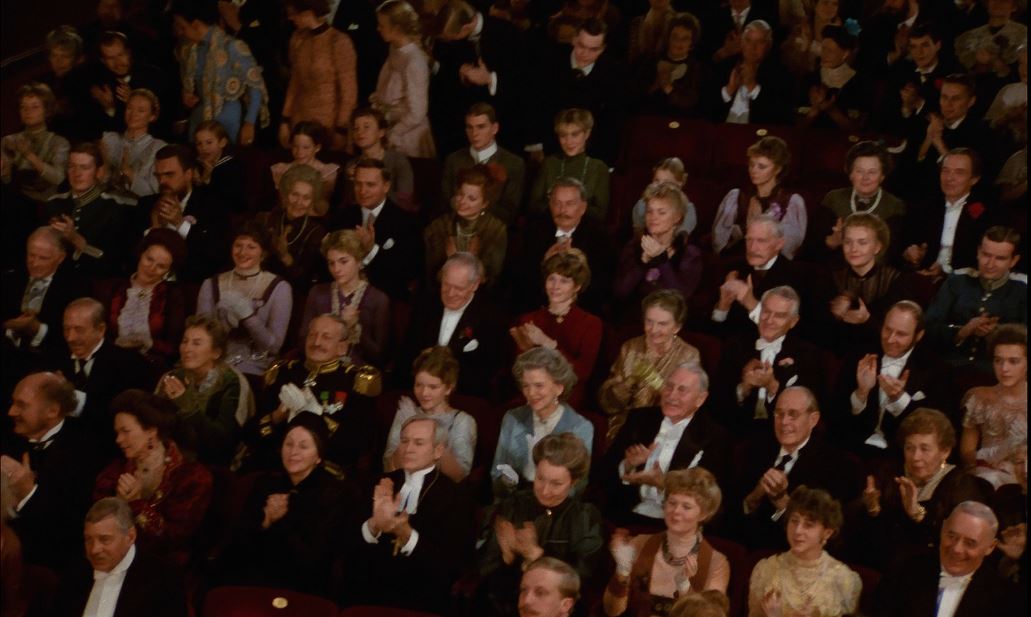
The film begins with young Alexander moving cut out characters in a toy theatre, before searching for the rest of his family in their huge, richly-decorated house; a director in search of his characters? Here’s also a boy with a rich imagination, seeing a statue’s arm move as he hides beneath the dinning room table.


What follows is as rich and magically real as a Dickensian Christmas with Bergman dealing with the extraordinary behaviours and imaginations of his players in a casual way, oddness just happens and we’re expected to deal with it. The story begins and ends with the warmth of the Ekdahl family and the imperious, heart-warming matriarch Helena as played by the remarkable Gunn Wållgren, a woman who manages to convey world-weary yet still youthful energy. Helena looks on her family and is concerned and delighted in equal measure.


She has three sons, Carl (Börje Ahlstedt) fearful and in debt, the other theatre restaurant manager Gustav (Jarl Kulle) warm yet careless in love and the third Oscar (Allan Edwall), the manager of the family theatre. Oscar is the oldest and his mother’s most reliable son, happily married to the beautiful but much younger Emilie (Ewa Fröling) and father of Alexander and his sister Fanny (Pernilla Allwin). Rehearsing Hamlet, Oscar suffers a stroke and the children’s world is to be turned upside down. In time Emilie is married to the handsome Bishop Edvard Vergérus (Jan Malmsjö) who offers her love and a new more spartan existence for the family. Things do not go well… his puritanical authority soon brings the children and especially Alexander, into fierce conflict and the beatings begin as Bergman releases the spirit of his father on screen.


Gunn Wållgren
 

Max von Sydow was to have played the part of the Bishop Edvard Vergérus, but a mix up between an over-zealous agent and a frugal SFI meant by the time he said yes to Bergman it was too late and he  cast Malmsjö instead as the conflicted cleric. As it turns out he was inspired casting, a light entertainer usually, here his dramatic shifts were perfect for the stepfather who ultimately is frightened by his wilful, new son although, according to Kemp, the boy took some time to get over the fact that he was more used to seeing the actor singing Puff the Magic Dragon. His smile and good humour make his unyielding will to punish and constrain all the more unpleasant: it’s a nightmare.


The struggle between Alexander and the Bishop is the heart of the film and plays out in unexpected ways, everything does in fact and with twists and turns that my prose can’t do justice too. It’s the most intense and cinematic ride… a glorious drama with a cast alive to the depths of meaning expected from Bergman. As Oscar says in his Christmas speech at the theatre, see below*, sometimes the little world succeeds in reflecting the big one so that we understand it better… as with the best of Bergman, all art in fact, you don’t leave it, it stays with you, meaning infused consciously and subconsciously to eventually filter through over days, months and years. In different circumstances the film will take on new aspects and I watched with my daughter, wife and 91-year old mother-in-law, a PhD in English Literature and MAs in English and Film. She wrote about Fanny and Alexander at length when studying, but refused to let me crib from her essay… but we had some great conversations.


Much as he seemed to have enjoyed the whole project, Bergman was well into his sixties and he later said in a TV interview, Farewell to Film, ‘my body is tired and it hurts, and you realise these are signals, warnings to take it easy… Altogether this is a good place to stop.’ From this point onwards he would focus on TV and theatre, alternatively less pressurised and also more gradual experiences than cinema. But what a legacy he left in all three disciplines.


The family that plays together, stays together...


I’m also quite pleased with myself for having spotted that one of the actors in the theatre is named, Tomas Graal (Heinz Hopf) a reference perhaps to two silnet films from 1917 featuring Bergman’s mentor and friend, Victor Sjöström, as Thomas Graal, a scriptwriter, with both directed by another epic Scandinavian, Mauritz Stiller. You could spend weeks in the two versions of this huge film and still find new connections and meanings.


The other films on this six-disc set are:


Cries and Whispers (1972), I saw last year when the BFI re-released it in cinemas for its 50th Anniversary. It’s one of Bergman’s greats, and one of the first in colour, a cross-over success that led Francois Truffaut to suggest that maybe his other films would have been more popular with the vibrant red that dominates this raw tale of illness, familial love and honesty. It strikes chords with such force though and Bergman felt that with this film and Persona, he had gone as far as he could in touching wordless secrets that only cinema could uncover.


Wordless secrets eh? Bit of a challenge for the amateur blogger but safe to say Bergman dealt in these issues successfully and used cinematic language to the fullest of his ability to address feelings and relationships that we all recognise and which we all struggle to articulate.  This doesn’t make him a paragon just exceptionally observant.


There’s so much more in these films and these BFI sets are to be treasured.


Liv Ullman, Ingrid Thulin and Kari Sylwan


Scenes from a Marriage (1974) Berman doesn’t terrify with his honesty much more than in this film featuring his long-term partner, the genius Liv Ullman.


Autumn Sonata (1978), Bergman directs Bergman, aka When Ingmar met Ingrid… a powerhouse film!


Fårö Document 1979 (1979), the ten-year follow-up to the documentary Bergman made about his adopted home.


From the Life of the Marionettes (1980) a TV movie about the events before and after a murder in a strained marriage.


After the Rehearsal (1984), another TV film, this time about a controlling director putting on a performance of Strindberg's A Dream Play.


Ingrid Bergman in Autumn Sonata (1978)


All look sparkling and restoration-fresh with After the Rehearsal  the only one to have been only available in standard edition, it still looks grand. Special features include a 100-page perfect bound book featuring new essays by Geoff Andrew, Catherine Wheatley, Leigh Singer, Andrew Graves, Philip Kemp and Ellen Cheshire.


You can order the set from all good home entertainment online retailers but especially the BFI Shop, in person or online.


*My only talent, if you can call it that in my case, is that I love this little world inside the thick walls of this playhouse and I’m fond of the people who work in this little world. Outside is the big world and sometimes the little world succeeds in reflecting the big one so that we understand it better. Or perhaps we give the people who come here a chance to forget for a while…


Friday, 15 April 2022

Hearts in darkness… Cries and Whispers (1972), BFI Anniversary Release, Liv Ullmann Season


Today I feel that in Persona—and later in Cries and Whispers—I had gone as far as I could go. And that in these two instances when working in total freedom, I touched wordless secrets that only the cinema can discover… Ingmar Bergman


There’s no doubt that Ingmar Bergman sought out the inconvenient truths of our existence and, unblinking, showed us at our weakest and most human. As he sat beside Sven Nykvist’s camera, he looked at his performers straight in the eye as they acted to interpret his writing in ways that even he couldn’t have imagined, sometimes and perhaps often. For all the talk of authorship, he needed actors he could trust to rise to the occasion and go beyond whether through instinct, training or dazzling natural ability.


In one of his most stunning works, he brought together three of his acting muses and created a four-hander of such force that it’s more than capable of bruising audiences today. This restored Cries and Whispers is being released across country to mark its 50th anniversary as well as forming part of this month’s season of Liv Ullmann films, which, launched by the great woman herself, dominates April on the Southbank. Ullmann talked of the joys of our being able to, once again, experience film collectively and, in the case of this one, it’s good to have people you care about with you.


Bergman asks, are familial ties enough, does love come unconditionally and even at the end, can we still pull away from totally committing to others. The story was inspired by a persistent dream the director had of four women dressed in white in a red room and there’s a striking use of colour with each character framed in close-up saturated with red light. Red for love and fear; fight or flight, denial, anger and acceptance? All of these things, for those caught in the most difficult moment of their lives. Bergman wrote in his book Images that “red represents for me the interior of the soul. When I was a child, I imagined the soul to be a dragon, a shadow floating in the air like blue smoke—a huge-winged creature, half bird, half fish. But inside the dragon, everything was red.”


Ladies in red... (oh, come on!)

Bergman also wanted to write a tribute to his mother yet the lead character who carries the most grace, is called Agnes, and her eldest sister Karin – his mother’s name – is full of confusion and regret. All of the women represented parts of his mother’s character though so, as is usual with Bergman, nothing is black or white.


Agnes is played by the wonderful Harriet Andersson, one of the director’s earliest collaborators and almost twenty years after Summer with Monica, in early middle age and offering a quite terrifying portrayal of a woman confronting her imminent death. Karin has cancer and not long to live, and Anderson’s performance is intense, her eyes wide with the adrenal certainty of her certain demise, she cries out but is far braver than she could ever know. If you’ve reached an age of morbid understanding, something you can only live through, it’s impossible to not respond without being mindful of your own fears, your own enduring grief.


Harriet Andersson

Agnes is cared for by her maid,  Anna wonderfully played by Kari Sylwan, who’s interior responses provide some of the more comforting moments of the story in which Agnes’ sisters are both constrained by an inability to commit to their sister’s final moment. This of course is wonderful grist to the mill for actors of the quality of Ingrid Thulin as “uptight” Karin and Liv Ullmann as “immature” Maria… things are far more complicated than those two operative words suggest and the watched hangs onto their every word and action looking for the simple truths most other directors would use to flavour this narrative.


The story is told in past and present tense as well as fantasy so it is very much like a dream floating gently off the screen, especially with those anchors of emotional certainty removed and these two sisters struggling to connect with each other and themselves. There’s no doubt their love for their sister, they wait in the red room adjoining her bedroom, concerned at every cry as the doctor assures them that Agnes is getting close to the end but they’re held back by denial and grief. There’s nothing unnatural, it’s important to say that as this is film for thought, the cinema of self-reflection as we all have to confront this reality once life resumes outside in the night and daylight.


Ingrid Thulin

In silent film there was an obsession with “photographing thought” with few greater exponents than Bergman’s mentor Victor Sjöström, and indeed Ingmar himself with the aid of his incredible performers. There’s an intimacy that reflected the fact that three of the leads were long-term collaborators with the director and there’s also the presence of two of his daughters, who both play Maria’s daughter at different ages, Linn Ullmann and Lena Bergman. Liv Ullmann also plays Maria’s mother in flashback, adding to the compressed family feeling… what was it Philip Larkin said about parents?


As Maria faces the end, her sisters face each other and their failed relationships with two thoroughly inadequate husbands, Karin’s Fredrik (Georg Årlin), an officious older man and Maria’s Joakim (Henning Moritzen) who is emotionally disconnected too. Karin is so repulsed by Frederik she mutilates herself to avoid having sex with him whilst Joakim tried to kill himself after learning of her affair with Doctor David (Erland Josephson). Needless to say, both are still around as their wives face the family crisis.


As the priest (Anders Ek) says when Agnes finally succumbs, she had more faith than him and as the truehearted Anna reads her mistress’ diary, she learns of her capacity for happiness which, as for us all, maybe only fleeting but is life’s greatest achievement after all.


Ingrid Thulin and Kari Sylwan


Cinematographer, Sven Nykvist, captures every thought and whisper and the film is beautiful to view. He deserved his Oscar and this film deserves to be seen on the big screen so, I urge you to head to the Southbank and elsewhere for the full experience. Few films are this heartfelt or as richly rewarding.


Details of the 50th Anniversary re-release screenings are on the BFI site.


Liv Ullmann


Sunday, 10 April 2022

An Audience with Liv Ullmann and Persona (1966), BFI Liv Ullmann Season


It was because my face could say what he wanted to say. That made me the one he wanted to work with ... because it was my face and I also understood what he was writing…


The very last audience question for Liv Ullmann came from a French woman who had written a dissertation on her work with Ingmar Bergman to earn her Baccalaureate, “you made so many films with Ingmar, how did you manage to stay happy?” The answer was simple and got the biggest laugh of a very enjoyable conversation between film writer, Christina Newlands and the revered Norwegian actor and director; I’m a happy person, all my friends could tell you that. Over and again Ullman has stressed that the secret to her “method” was indeed, acting and the art of pretending; using your dreams and emotional back catalogue to drive your characters.


She described herself, a Norwegian, directing an Australian actress, Kate Blanchet, in an American play, A Streetcar Named Desire and witnessing her embellish the ending in a way she’d never seen before, as Blanch looks forward to the next stage in her life with strength and not resignation. Before that she’d given numerous examples of the power of her own imagination enabling her to play an experienced woman aged 19 or a middle-aged actor in Persona, an older woman with a younger man in Cries and Whispers (both she and he were 35) and other roles Bergman realised he could fulfil through her even , perhaps, if he couldn’t write the character to fulfilment on his own.


Liv in Persona

Very occasionally she went against his instruction such as in Faithless (2000) the film he scripted, allowing the old man in this partly autobiographical story, to forgive his younger self’s cruelty to a lover by having him look directly at younger actor during the harrowing reveal. Bergman refused to forgive himself but Liv Ullman, not for the first time, gave him what he deserved even when he was so specific as to call the main character “Bergman”.


One suspects that it was this very ability to give the director what he didn’t always expect or think he wanted that made him describe them as “painfully linked” after directing her for the first time in tonight’s feature Persona. Initially she thought he was proposing and they did have a relationship for five years which led to his fathering of writer Linn Ullmann with Ullmann, but what he meant was that the two of them were intertwined in term of creative imperatives. He’d had this feeling before perhaps, having relationships with actresses Harriet Andersson (1952–1955) and Bibi Andersson (1955–1959) who, in addition to being a close friend of Liv’s by this point, was also her co-star/other-half in Persona…


Live Ullman live… and utterly charming, self-depreciating and yet full of honesty and wisdom. The comments she made about the performance of her star in Faithless, Lena Endre, are very similar to those she made about the star of Sofie (1992), Karen-Lise Mynster: “I was thinking to myself, ‘try not to think what you would have done!’ … then suddenly she was doing so much more that I had never even thought of… it was the first time in my life that I was proud to be an actress. Because I saw that it didn’t come from make believe, it came from feeling.”


Persona


This was “a once in a lifetime opportunity” said the person introducing from the BFI and she was not wrong. This felt not just like a masterclass in acting and cinema but also in life and how to live it. A standing ovation all round reflected the warmth in the room and there may just have been something in my eye.


I think you should play this part until it’s played out, until it’s no longer interesting. Then you can drop it, just like you eventually drop all your other roles.


Liv introduced Persona in the evening’s main (screening) event this time in conversation with series programmer Sara Lutton. She had met Bergman who had told her he wanted to cast her in his next film but then Ingmar pulled a sicky which he often did when he’d changed his mind about a project. After some time in hospital, he emerged with the script for Persona which was also to star Liv’s best friend, and former Ingmar lover, Bibi Anderson. The result remains a disturbing classic, as likely to make the top-ranked films of all time Liv quipped, as her “musical” Lost Horizon is a contender for the worst – she is nothing if no humble and funny.
 

Liv and Bibi Anderson. Those high heels?


Persona is still striking with fierce, conflicting and bare-knuckled emoting from Bibi and Liv all masterfully captured by Bergman with the aid of Sven Nykvist’s cinematography and Ulla Ryghe’s pin-point editing – absolutely amongst the MVPs as the personas start to move across the screen between and around the players… There’s also an experimental score from Lars Johan Werle that certainly impressed members of Pink Floyd for far less successful experimentation on Ummagumma. His music creates an atmosphere of disturbance and is used sparingly alongside more deliberate visual avant-gardism which punctuates the film, cut up and montage, flash frames of silent film, erotica, burning nitrate… the fourth wall takes the occasional battering.


The story concerns a famous theatre actress Elisabet Vogler (Liv Ullmann) who is suddenly struck mute during a performance of Electra and is in hospital for assessment by a doctor played by Margaretha Krook, who can find nothing wrong with her physically or mentally. From the doctor comes the above quote, as she sees Elisabet as play acting for whatever reason… is the nature of the play significant, does she have deeper issues with parenting and her father? Her husband, when he makes a brief appearance certainly seems much older… but the film is so rich in possible interpretation we’re all like the boy at the avant guard opening, reaching out to a bright and blurred image of Elisabet, or is it someone else?


Bibi Anderson


The doctor assigns the friendly nurse Alma (Bibi Andersson) to look after Elisabet as she sends her to her house on the island of Fårö (locations included Bergman's property there at Hammars). Alma gently fills in the gaps in the silence and is ostensibly a more straightforward personality – well she’s still talking and introduces herself in plain terms at their first meeting, 25, engaged, interested in film and theatre but not going to either as much as she’d like… an open book apparently


But, amongst the atmosphere of rocky seaside calm, Alma and Silent Lis develop a deeper entanglement with Alma falling into the unfathomability of the actresses’ state of being. They are more than just face to face, and are beginning to connect beyond the surface, intermingling I unspoken ways beyond the mask of flesh and feature…


Is it possible to be one and the same person at one time – I mean two people? God, I’m being silly.


There’s so much interpretation of the film, as with Antonioni’s L’Avventura, there’s no definitive narrative based on the evidence of the film, the “meaning” as illusive as a lost woman or, indeed, a lost identity. That secrets endure after 57 years says much for the film’s continued popularity, a puzzle still and one that retains significance. Persona has certainly impacted David Lynch, with Mulholland Drive most obviously owing a debt and many more, although I was surprised that Abba were among the influenced with Knowing Me, Knowing You (aha!) profiling Anna and Agnetha just like Bibi and Liv.


Liv said that as they worked, Bergman would always sit right next to the camera making him another unspoken partner in the action. The three friends who made this picture operated on a level of open connection few of us experience in our working lives… the results are extraordinary and mark that rare film which means exactly what you want it to if you’re willing to push yourself inside the screen. Go on, take off your mask.


The Liv Ullmann series runs until the end of April and more details are on the BFI site.


The tremendous cry of our faith and doubt against the darkness and silence is the most terrifying proof of our abandonment.


Sunday, 25 July 2021

Bergman Begins… Ingmar Bergman Volume 1, BFI Limited Edition Blu-ray box set - out now!


I wouldn’t call this a great or harrowing drama. It really is only an everyday drama. Almost a comedy…


Well, this five-disc set is a feast of film covering the start of the legendary director’s career with eight films from 1944 to 1950, six directed by him and the other two featuring his script (and, as it transpires, some direction).


Much like the pupils in the opening film, Torment (1944), force-feeding themselves Latin in an attempt to cram it through their final exams, Bergman has seemed to be almost a chore for some of the admittedly lazier boys in class. He’s unavoidably part of the curriculum but his aversion to Hollywood happy endings and focus on long takes and mood presents a barrier to simply enjoying his work for the less familiar. I was that lazy student but, as I sat down to do my filmarbete i hemmet I soon abandoned my notebook and just fell for the rich characters and on screen.


Sometimes we can study too much and look for the early signs of patterns established much later but, honestly, watching these films from a time when Bergman had no idea how his career would pan out, is a positive joy. So, ahem, here’s “to joy” and to switching our analytical minds off as we relax and float down the stream of Swedish films second great coming. Not that I can stop myself looking for the influence of Victor Sjöström from the first… Bergman learned a lot from his friend, but he is clearly also picking up ideas from expressionism as well as neo-realism.


Alf Kjellin and Mai Zetterling in torment...

There’s also a good deal of humour in these films and I love, for example, the man who learned his craft in the theatre having his narrator introducing his first directed film, Crisis (1946) with the words above, followed by “let’s raise the curtain” just as one of the characters does exactly that in Ingeborg Johnson’s music room… he’s confident enough to play on words and with the form from the beginning.


The first film on the set is Torment (1944) for which Bergman wrote the screenplay and direction was provided by the experienced Alf Sjöberg – who directed the rather marvellous polar-bear hunting epic Den Starkaste (1929) - apart from the closing section which, as the latter was unavailable, ended up becoming the first film directed by Bergman and powerful moments they are too. That said Alf won the Cannes Film Festival Grand Prix for his work which is full of impressive atmospherics and technically advanced dynamics.


It’s always hard to know the split between script and directorial interpretation but the opening shot of Torment features the two leads, Alf Kjellin as Jan-Erik Widgren and the eternal Mai Zetterling as Bertha Olsson, in close-up huddled together against some existential menace, comforting each other as a world of threats mingles in the darkness around them. As filmmaker and writer Leigh Singer says in his excellent video essay, this sees Bergman start as he means to go on with this focus on uncertain love, extreme close-up and the invisible torments that plague us all. Bergman himself gives great credit to Alf Sjöberg in the Guardian Interview from 1982, also included here, film and style have many godfathers.


Stig Järrel torments Alf Kjellin

Torment is painful to watch at times given the moral situations of the leads, Widgren’s discomfort at school reflecting Bergman’s own experiences, as he struggles to cover the work and to meet the expectations of his exacting, cruel, Latin master known un-affectionately as "Caligula" (Stig Järrel) whilst meeting his parent’s expectations and falling in love with Bertha, the girl who works at the local tobacconists. Caligula is a superb creation from writer and performer, a monster in the classroom who covers his own frailty and fear with aggression and manipulation. This is a coded attack on Adolf Hitler, a man with complicated resonance for Bergman…, an inadequate who constantly excuses himself because he’s “ill” but who keeps on returning to cruelty.


He not only victimises Widgren, possibly as he senses weakness, but also preys on Bertha who is driven to drink by his unrelenting attentions. Once the “triangle” of love and abuse is complete something is going to have to give but, whilst there are life lessons to be learnt, there are also teachers who believe in nurturing and kindness…


Experiencing her lessons - Inga Landgré

Crisis (1946), Bergman’s first film as both writer and director, follows the theme of inter-generational friction in ways that easily pass the Bechdel Test. Bergman’s women are well wrought even as his male characters are also nuanced and riven with faults. Here there’s also a tussle between town and country as a woman from the city, Jenny (Marianne Löfgren) arrives in her home village to try and reconnect with the daughter she left there 18 years before. Jessie now owns a beautician’s and wants her daughter, Nelly (Inga Landgré) to come and join her.


The central character is Ingeborg, marvellously played by Dagny Lind, who must decide whether her claims as mother are to stand in the way of Nelly’s decision to find out what the life beyond is like. Matters are complicated by Jack (baby-faced Stig Olin who is in Torment and several others here) and occasionally employed actor who is with Jenny but quite fancies Nelly and has a way of gaslighting those around him.


Sisters? Marianne Löfgren and Dagny Lind

Jack offers to help Ingeborg to the station on one visit and uses the occasion to skilfully cast doubt on her motivations for wanting to “keep” Nelly; is she really selfish? The answer is no and nor is she stupid… she knows Nelly needs to find out about life for herself, the only way to learn is to go through it and that she does. What is so interesting about all these characters though is that everyone has good and bad to varying degrees, shades of grey, mistakes and misfortune.


All of this is already being expressed though framing and mis-en-scene as with later works and, as Singer again points out, if you want to tick off Bergman’s later preoccupations you will find them all here: physical journeys, signify major life changes, the restrictions of social institutions on independent feeling, sexual jealousy, doomed romance, a Godless universe… But these are eternal questions and ones that Bergman’s self-examination would never leave unaddressed.


Inga Landgré and Stig Olin
 

The director was also gathering a troop of regular actors as any theatre producer might and as he did throughout his later career. His next film, Music in Darkness (1948) directed from Dagmar Edqvist’s script, features marvellous Mai Zetterling again (anyone else see a resemblance to Emily Blunt?) whilst Stig Olin is in Port of Call (1948) and Prison (1949) both written and directed by Ingmar.


He’s also in Eva (1948), written by Bergman but directed by Gustaf Molander – another silent stalwart who had directed Alf Sjöberg as an actor in Ingmarsarvet (1925) a partially lost film that also features Swedish superstar, prima ballerina and actress, Jenny Hasselqvist.


Thirst (1949), released as Three Strange Loves in the United Kingdom, has a screenplay by Herbert Grevenius and features Birger Malmsten who is in no less than six of these films including the last… To Joy (1950). This is the only one of the films I’d seen before and one which sees Bergman really hitting his stride now as writer and director. This also has an excellent performance from his pal Victor Sjöström who really had no limits. Four years into his career and still with so much said and left to say, what a remarkable man he was. Here Bergman’s belief in the alignments of music and film come to the fore in the form of Beethoven’s 9th Symphony… it’s a powerful argument.


Victor Sjöström and Stig Olin in To Joy
 

This is, of course, an essential set and these restored gems come with a hefty side-order of extras: 

The Guardian Interview: Ingmar Bergman (1982, 62 mins, audio only): Ingmar Bergman pays tribute to Alf Sjöberg, the director of Torment, discussing his influence and impact on his own career

Ingmar Bergman: First Cries, Early Whispers (2021, 20 mins): a new video essay by writer, filmmaker and film journalist Leigh Singer

100-page perfect-bound book featuring new essays by Jan Holmberg (CEO of the Ingmar Bergman Foundation), Philip Kemp, Geoff Andrew, Jessica Kiang, Alexandra Heller-Nicholas, Kat Ellinger and Laura Hubner


It is out now and can be ordered direct from the BFI Shop either online or in - socially distanced - person. You won’t regret it! Hurry too as it’s a limited edition!


Prison (1949)

Port of Call (1948)

Music in the Dark (1948)

Thirst (1949)

Sunday, 15 November 2020

Plays from yesterday... Play for Today, BFI Blu-ray box set


“…why resurrect Play for Today? What could today’s television industry learn from it? Looking at the seven plays in this Volume One BFI set alone, what stands out is the natural diversity of their subject matter and their brave search for originality.” Marcus Prince, TV programmer for BFI Southbank


After watching through this new set I can confirm wholeheartedly that Mr Prince is not just whistling Dixie; these plays are strikingly vibrant even after all of these years and the quality of performance and writing stands the test of time both in terms of emotional and historical resonance. For some, like myself, these plays were watched and understood as a pre-teen but they were a shared family experience and hearing my parents discussing them is one of my earliest memories of critical appreciation.


I only directly remember one of the plays, Shakespeare or Bust (1973), probably because it was one of three featuring Brian Glover, Ray Mort and Douglas Livingstone as Art, Ern and Abe, three Leeds miners in search of cultural and other adventure. But I recognise the style of the plays as well as the performers especially Alison Steadman who is joint record holder for most PFT appearances on nine, most memorably as Abigail and Candice Marie, along with Nigel Hawthorne. Here she’s an expectant mother alongside Bernard Hill (just the seven appearances) and they show exactly why they have enjoyed such long careers on their way from Rochdale here to Essex and Port Talbot as well as Arundel's Isle.


Gemma Jones in The Lie


Perhaps the most a-typical is the first play, The Lie (1970) written by Ingmar Bergman and directed by Alan Bridges as part of an international co-production entitled The Largest Theatre in the World. It is more cinematic than the others as you might expect given the writer’s day job and typical of his concerns about relationships. This was the third play in season one and features Frank Finlay and Gemma Jones as Andrew and Anna Firth a professional couple in a sterile marriage, stifled by their careers and living all too comfortably in the fug of material wellbeing. After ten years of marriage they have two children, a nanny and sleep in separate bedrooms, but their balance is about to be upset as Andrew suffers at set back in his working life and turning back to fall on home comforts, discovers there’s far less warmth there than he thought.


Anna’s career is still on track and she has a long-standing secret lover, Ellis (John Carson) who himself is married. There’s an excruciating dinner party – avocado prawn starters all round – with Anna sat next to Ellis and Andrew with Ellis’ wife. The story is full of betrayals as you might expect from the four times married Bergman, but are lies better than revelations?


Frank Findlay, a lost soul swimming in a fish bowl?


There’s a striking cameo from Joss Ackland as Anna’s brother, a writer having a nervous breakdown and wearing make-up and nail varnish as he simmers away in hospital. Is he the author’s voice; driven to nervous exhaustion by being too honest to make the compromises that enable the others’ unhappiness? I wonder what becomes of him?


In Passage to England (1975) there are more deceptions and also the first sighting of the wonderful Colin Welland, writer and actor who in ten years would hoist his Oscar a lot and declare that the British were coming. Back in the seventies the adage was that British cinema was alive and well and on television and Play for Today surely played a major part in keeping things afloat prior to the cinematic revival heralded by Chariots of Fire.


Here Welland plays Onslow, captain of a small cargo boat, the very English Morris Dancer who, along with his partner Graham (Niall Padden) get an offer they could and should refuse from a young Ugandan Asian called Anand (Tariq Yunus); a bar of gold at bargain price if they smuggle him, his cousin Pramila (June Bolton) and sick uncle Dharam (Renu Setna) to England. The play balances a serious subject with a light-heartedness that serves to wrong foot the viewer even now with a nuanced discussion of the British and their empire.


Colin Welland was born in Liverpool


Written by Leon Griffiths the story is mostly set in the Amsterdam docks which director John Mackenzie uses to atmospheric effect much as he would do in The Long Good Friday; who doesn’t love a dock-side drama?


There’s more Welland, this time as writer of altogether more earnest and needfully complex tale of post-imperial national identity with Your Man from Six Counties (1976) in which a young Catholic boy Jimmy (Joseph Reynolds) goes to stay with his Uncle in the west of Ireland after his father is killed by a loyalist bomb in Northern Ireland.


Location is again an important part of the context and it looks very much as if all the shooting was done in situ from the hills and fields to cottages and pubs of County Sligo, you can even see flat-topped Benbulbin Mountain near Drumcliff, where W.B. Yeats is buried. There’s a very fine cast backgrounded with local faces that could only ever be Irish, with Donal McCann as Uncle Danny and a young Brenda Fricker (first Irish woman to win an Oscar for My Left Foot in 1989) as his wife Mollie. Young Jimmy is like a fish out of water, a city boy in the country, carrying a pet rook once rescued by his Dad, in a cage. Irish mythology may have it that these birds symbolise the souls of the dead yet, to local farmers, they’re a menace to be shot and hung out to dry.


Donal McCann and Brenda Fricker


Danny tries his best to bring Jimmy back to life and to put his father’s violent death behind him and yet the latter’s best friend Pat (Paul Antrim), a rebel in thought if not deed, wants to encourage the boy to hero worship his “martyred” father and to follow in his footsteps more forcefully than he has ever managed. Both Danny and Pat have something to learn about the boy and Mollie acts as the play’s moral heart trying to pull them together for the lad’s sake. Welland’s script allows so much room for interpretation especially as Katie Crosson observes in her booklet essay, “No two viewpoints are identical… “ meaning that there is no single straightforward narrative: you have to make your own mind up.


‘I want to have this baby and I want to see it being born and I want to feel it being born… and if you’re not interested in helping me why don’t you just sod off.’


Mike Stott’s Our Flesh and Blood (1977) is ostensibly more straightforward but is no less a deft thought-piece on contemporary masculinity as Bernard Blincoe (Bernard Hill) has to come to terms with his wife Jan (Dame Alison Steadman – if not yet, then soon…) and her desire for a baby on her terms. Bernard views this development with trepidation and his anxiety dreams turn into reality as Jan aims for a natural birth. At the hospital he gets a nervous young doctor, a reassuringly sassy sister (Diana Davies) and an old school consultant, Richard Briers on fine form and, amidst the comedic chaos finally catches up with Jan…  


Bernard Hill and Alison Steadman (who was also born in Liverpool)


The play has a lot to say about the role of the sexes at the time, men either pompously insistent or next to useless when the waters break, but this was not yet a country in which men routinely attended childbirth or in which couples were allowed too much of an opinion about how they were to have their baby. It’s a heart-warming glimpse of the future.


Back to Brian Glover on a barge to Stratford in Shakespeare or Bust (1973) for a mix of past and future as his earnest Art looks not just for the nation’s poetic truths but also comradeship and fairness. Peter Terson’s three heroes have working class pride and sense of self but also innocence as they happily punch above their weight on this aquatic road trip. They meet dropout boat dwellers who don’t share solidarity even as they’re happy to take Art’s coin, lock-keeper’s happy to mix with the man who turned their pub into a wine bar and follow an odd couple in a very posh boat; an older man with a yachting cap (Peter Honri) and his much younger boat dressing Hélène (Katya Wyeth). Abe reckons he stands a chance and the three sup their pints barely blinking in their awe-struck appreciation of this alien glamour.


Almost nothing knocks these lads back though and Art’s enthusiasm is infectious even if Ern can’t stop missing his wife and Abe just wants the one he can’t have. They relish every new turn as passionately as their drink and in the end are rewarded with surprises against the longest odds.


Ray Mort, Brian Glover and Douglas Livingstone


Back of Beyond (1974) is an altogether more mysterious affair with Rachel Roberts absolutely superb as the sad and mysterious Olwen; a woman hiding in solitude. Desmond Davis’s play is another to use locations to good effect, this time the Brecon Beacons and Llanelli-born Roberts looks like she grew up along with these hills.


There’s more mystery with John Bowen’s A Photograph (1977) featuring the great John Stride as pompous intellectual Michael Otway and Stephanie Turner as his long-suffering schoolteacher of a wife. There’s a great essay in the booklet from series producer/booklet commissioning editor Vic Pratt and this is further proof, if any were needed of Play for Today’s insistence on making its audience think.


Rachel Roberts yn ysmygu sigarét


Most of these plays have hardly been seen since first airing and the odd repeat. There were over 200 plays in the series and whilst some were wiped by a cost-conscious BBC, most survive and these seven provide not only proof of the quality and diversity but also a mouth-watering entrée to what we can only hope will be the start of more releases and screenings.


Play for Today: Volume 1 is released on 19th November and can be ordered direct from the BFI website now! 

There’s a trailer available here but for many this is Christmas come early.