
I was angry then and I’m bloody angry now. Tony
Garnett
I was lucky enough to see Tony Garnett talk after a screening at Elstree of The Boys (1962) in which he acted, a few years back. Tony decided that he would never be as good an actor as he wanted to be and set about forging his career as a ground-breaking producer for Ken Loach and others. He still retained his passion for social justice as the above quote reveals; said with a smile but with a steely glint.
His production of The Spongers (1978) still provides
the fiercest of gut punches and not for nowt has Jimmy McGovern described it as
‘the best television programme ever made’, and he wouldn’t have been the only
one influenced by its realism and raw power. All of the plays in this new BFI
set reflect discussions on social care, education, race and employment
relations that are very much ongoing and none more so than disability rights.
 |
| Cheeky messaging at the play's start |
The Spongers is based on an actual case in Salford
in which council support for a child with Down’s Syndrome was withdrawn for the
usual reasons of cost and the child ended up in a hospital where the care was hopelessly
inadequate rather than in the expert and supportive environment she needed.
There are more than three classes in this country and the
“Disability Class” cuts across them all in its own silent way, whole families
impacted by circumstances not of their making and desperately trying to pull
social, medical and educational support together under their own steam. You’re
very lucky if you have income but you better hadn’t be poor.
Here Christine Hargreaves features as Pauline, a mother
on benefits with four children including Paula, a child with Down’s. Paula
McDonagh’s performance is very affecting even now especially when she has a
meltdown which feels all to real to be comfortable but she is at the heart of
the family and supported by loving friends as well as relatives.
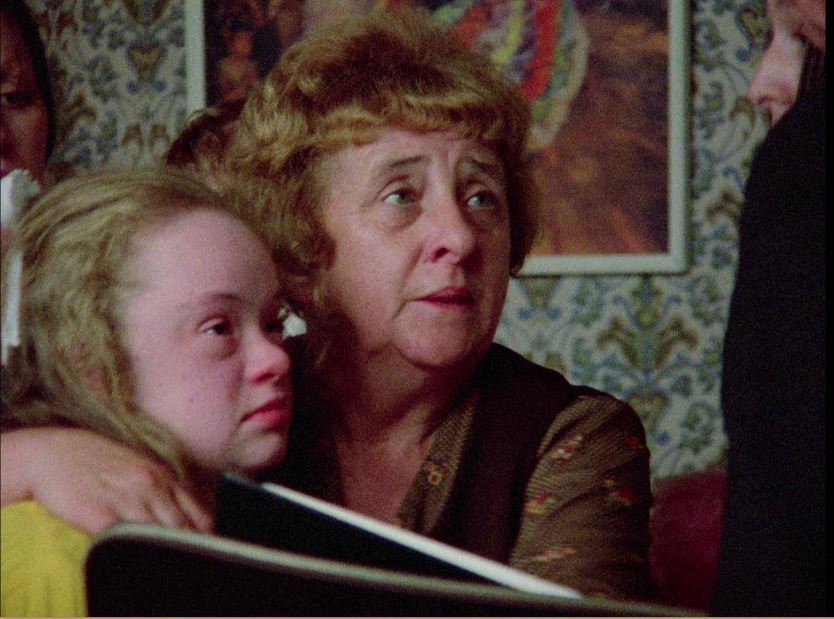 |
| Paula McDonagh and Gertie Almond |
Times are hard and as the play opens the bailiffs arrive
to reclaim a few hundred pounds worth of debt, a fortune for Pauline who,
despite the attempts of a well-meaning social worker, has to sign off her
possessions. Whilst she’s in a downward spiral of debt so too are local
authority cuts removing the support for Paula and she is placed in
unsympathetic environments that start to impact her mental health.
This all happens under a Labour government and with a Labour council – led by Councillor Conway played by Bernard Atha who had been a Labour councillor in Leeds and gives the debate between what is possible and what can be afforded extra grit. There are social workers and a dedicated support worker for the estate called Sullivan played by PFT ever-present Bernard Hill with passionate subtlety – he’s as helpless as Pauline to channel events.
 |
| Bernard Hill and Christine Hargreaves |
Directed by Roland Joffé – his first film, Tony Garnett who
“threw him in the deep end and he swam…” - the play mixes a good deal of natural
humour and local warmth amidst the gloom. We’re setting up for the Queen’s Silver
Jubilee and there are street parties, singalongs and working men’s clubs in which
Auntie Gertie (Gertie Almond) sings in the Northern way and is always ready
with a quip and The Last Word!
But there’s no escapism left for Pauline who, having been
married on a dual income for sixteen years, has slipped into debt following her
husband’s departure and is now faced with agonising decisions if she wants to
keep her family together. Her father, played by scouser Peter Kerrigan, tries
to help and can’t believe as a child of thirties depravation, that his country
is in such a state. It’s that feeling of helplessness that resonates still, even
in this most prosperous of nations. Disability and ill fortune can condemn so
many even as we find billions for failed track and trace systems and even more
nuclear weapons that we will never need.
 |
| Frankie Miller and Ken Hutchison |
Things are tough in Glasgow too and the two Peter
McDougall plays, both directed by John Mackenzie show different aspects of the
area, “Greenock Industrial and the Greenock Pastoral” as termed by David
Archibald in his booklet essay on these most Scottish of plays. Martin Scorsese
reportedly described Just A Boys’ Game (1979) as a Scottish Mean
Streets… and it’s not hard to see why with this no holds barred vision of
working-class brutality. Singer Frankie Miller is perfect as cock of the walk Jake
McQuillen reminding me so much of the lads in seventies’ Liverpool, you’d cross
the road to avoid. Jake doesn’t need to put out as he never backs down and has
the cold-eyed certainty of a fast gun; he knows he can take anyone on his day.
His supremacy is about to be challenged by a “young team”
(Mogwai were watching…) led by the razor blade toting McCafferty. In the
pivotal battle Jake moves towards the gang telling him that “your tea’s oot’
and local catch phrase was born. The rules of the street pass on from
generations and Jake’s Granda (Hector Nichol), even in extreme health is a hard-boiled
bastard and his Grannie (Jean Taylor Smith) gives better than she ever gets.
Tough love or just survival… there’s so much nuance in performance and players
that you’ll be left thinking about the visceral actuality for days.
 |
| Jon Morrison and Billy Connolly |
Another musician also features in The Elephant’s
Graveyard (1976), this time banjo-player/comic and former shipyard worker, Billy
Connolly who plays poetic postie, Jody who meets up with a bored IBM worker
Bunny (Jon Morrison) up in the Greenock hills as they both bunk off work for
the day. Jody is pushing 40 whilst Bunny has just started work and, over two bottles
of stream-chilled fortified wine – you’re heads the next day!? – they start to
set their worlds to rights and amidst the macho bluster and boyish “dares”
start to establish a bond of sorts. The barriers come down and they even share
a vision of cowboys being ambushed by Indians over a brook.
Despite their ages they have the same concern with how to
live their lives and perhaps look back to the childhood freedoms of days in the
woods for some clues. I like the robustness of the dialogue and the humour too.
In the end you’re still wondering… what was really being exchanged and is Jody
a vision of Bunny’s future or, maybe, just a smart-arsed postman.
Lovely music from young Carl Davis by the way, whatever
became of him?
 |
| Get your hair cut Davies! |
No less than Daniel Day-Lewis described Phil Davies’
astonishing performance in Barrie Keefe’s Gotcha (1977) as one of his
early acting inspirations. He plays an unnamed fifth former who, on his last
day at school finds his gym teacher Ton (Gareth Thomas) and another teacher Lynne
(Clare Sutcliffe who is also to be seen in eth BFI’s new release of I Start
Counting) embracing in a storage room. Disaffected by his lack of consequence
and Ton’s slaps, the kid holds them hostage by holding a lighted cigarette over
his motorbike. Even the threat of immolation can’t help them remember his name
and when the head (Peter Hughes) joins them, we see the three try to talk him
round with only Lynne genuinely concerned with the boy and not the situation.
As someone who attended comprehensive school in the Seventies,
I remember some dramas but, again, under a Labour regime, it was clear that not
all schools were equal and that success was elusive. As with social care, you
need to ride your luck with education especially if you can’t pay for it. Keefe
went on to script The Long Good Friday and if you know that you’ll
recognise this.
Gotcha was presented with another short school
play, Brian Clark’s Campion’s Interview, in which a head teacher (Julian
Curry) attends an interview for another headship and uses it to inform the
gathered mix of educationalists exactly why they are failing his current
school. It’s a smart script and well played by Curry who maintains an almost
matter of fact calm as he lines up each and every failure of policy and
leadership. The two plays together stir and shake.
 |
| Bryan Marshall and Gareth Thomas drink to a common cause? |
In terms of production values and cinematic
entertainment, Stocker’s Copper (1972) is the pick of the bunch not that this
tale of industrial action and police suppression goes any easier on the viewer.
Based on events in 1913 when a squad of specially trained policemen were sent
from Glamorgan to break a strike at a Cornish clay mine. As the silent bobbies
sit grimly on the train approaching their destination only one turns and
remarks on the huge creamy mountains of china clay, Herbert Griffith (Gareth
Thomas) who with the out of context innocence, remarks that it looks like snow.
Herbert – played so well by Thomas – is able to encompass
a whole range of contradictions without crumbling under the weight of
conscience. A former steel worker, he became a policeman for a steady wage and
the “special training” his particular force offers; he understands the process
of industrial action and even the need for it but he knows he has the right to
beat down on it once the law is beached.
 |
| Jane Lapotaire and Gareth Thomas |
He stays with the family of one of the strike’s leaders, Manuel
Stocker (Bryan Marshall, excellent here as he is in I Start Counting…),
with Stocker’s wife Alice (Jane Lapotaire) putting the need for income over the
awkwardness of the arrangement. Tom Clarke’s screen play is canny and uses this
device to explore the relationships between labour and the law as well as the
many things the two working class men have in common. He pits Manuel’s stern
resolve against the openness and seeming honesty of Herbert and the
relationship is fascinating as you know all too well how things may end up.
The labour movement was on the rise across Europe and
strikes were to be of increasing concern. The Home Secretary Winston Churchill
sent troops to put an end to the Liverpool Transport Workers Strike in 1911 – including
my tram driving great grandfather – and he also sent a battle cruiser up the
Mersey for good measure. Yet these unions we ultimately to prevail. Not without
many heads being broken and when the push comes to shove, Stocker’s Copper
is unsettling viewing.
There’s another a splendid score from young Carl Davis
along with the magnificent Treviscoe Male Choir and St Dennis Silver Band
reminding us of the solidarity and comfort music can bring.
 |
| Victims of Apartheid |
Lastly, we have Victims of Apartheid (1978),
scripted by Tom Clarke and directed by Stuart Burge which feels the most of it’s
time (I generally hate the concept of dated, how can any work of art know how
it needs to be viewed in future?) but, for all that, still disturbing in this
era of “All Lives Matter” relativism and denial.
South African actor John Kani plays George an anti-apartheid
campaigner itching to return to the fray in his home country but also suffering
what we’d now term as PTSD after being tortured by the authorities who drove a
nail through his foreskin and made him stand on tip toe to avoid tearing his
flesh. Kani is jobless and having been dumped by his wife, is being supported
by various well-intentioned British activists including Canon Caper of
Christian Underground (Peter Jeffrey) who offers him money to look after Henry
(John Matshikiza) another supposed refugee from South Africa.
George’s life is chaotic and he has a new girlfriend, sex-worker Carrie (Coral Atkins) which says much of his position in this new society. The question is raised early on as George takes Henry on a bus ride and talks to the black bus conductor about his new friend conceding that whilst there is “racialism” in Britain there is no colour bar. The bus conductor’s response says it all: You got racialism, who needs a colour bar.

So, how “dated” is the vision of domestic racialism we see in this play exactly? It would be well over a decade later that Apartheid legislation was finally repealed in June 1991, pending multiracial elections held under a universal suffrage in April 1994. It was only then that Kani would tell the Financial Times that he felt ‘liberated from the responsibility of relevance’. The case continues…
The BFI are to be congratulated once again for making
these works available and the Blu-ray transfers are top notch. The booklet is
packed with high-quality essays commissioned by the tireless Vic Pratt and add
so much context to films that still present as fearless. They were certainly challenged
at the time with Gotcha shouted down for a repeat by Mary Whitehouse and her
league of complainers and other’s such as Peter MacDougall’s Just Another Saturday
– about Orange Day marches, rescheduled.
These plays put fear into the hearts of some in the
establishment. Shall we ever see their like again on the BBC?
You can pre-order Play for Today Volume 2 direct
from the BFI shop, in person (hoorah!) or online. It’s out on 17th
May and is an absolute delight! Rated: *****





