Showing posts with label Norman Kerry. Show all posts

Monday, 8 September 2025

When Erich met Irving... Merry-Go-Round (1923), Flicker Alley Blu-ray


“…inexcusable and repeated acts of insubordination… extravagant ideas which you have been unwilling to sacrifice… and your apparent idea that you are greater and more powerful than the organization that employs you.”

Irving Thalberg’s letter of termination to Erich von Stroheim


I’d seen the new restoration of this film at last year’s Le Giornate del Cinema Muto in Pordenone but sometimes in the rush of a festival you don’t always pick up everything about a film, especially one with such a complicated backstory as this. According to von Stroheim biographer Richard Koszarski in his book-length audio commentary, Erich spent something like 33 days directing the film, 20-25% of the total according to the accounts of Universal’s new Head of Production, Irving Thalberg, who fired him and Rupert Julian who replaced him and yet this film could hardly be more “Von”.


Koszarski quotes from the meticulous diaries of James Winnard Hum who was sent to man-mark the Austrian spendthrift by Thalberg, a 24-year-old “Boy Wonder” who was busily turning Universal into a business with a command-and-control structure that was not going to co-exist with the old ways of director-led films. Thalberg had more to offer than just a belief in budgets and schedules but having already had to intervene on the director’s over-spent Foolish Wives (1922), when von Stroheim wanted to keep on shooting, was not going to allow him to risk Universal’s financial well-being not matter how “inspired” the ideas. Foolish Wives had been a smash but maybe studios will one day learn that Thalberg’s creative due diligence was a necessary counterbalance to unfettered and expensive creativity.


So, enter Mr Julian, a director badly in need of a hit and who would later claim more of the film’s ideas as his own than were his due. Koszarski reads out von Stroheim’s script outline during his commentary and it’s quite clear that not just the story but the shooting instructions were followed pretty faithfully with the result that the film, with most of the original cast and crew intact, carries the hallmarks of its author and original director.


This means a film that is marked by the harshness of certain characters and the cruel fate of others all against a backdrop of a fantasy Viennese noble demimonde that von Stroheim convinced everyone was his too. The extremes of the characters’ backgrounds makes the cruelty all the more painful as fairground organ grinder Agnes Urban (Mary Philbin) is forced to keep on playing just as her mother is breathing her last by her monstrous boss, Huber (George Siegmann). This is further contrasted with her soft-focus flirting with handsome Count Franz Maxmilian von Hohenegg (Norman Kerry) who has the luxury of visiting her incognito feigning to be a necktie salesman.


The Count’s life is unreal as a matter of course though, marked by duty and ritual that obscures feelings and curtails freedom. He is due to be married to the daughter of the Minister of War (Spottiswoode Aitken), the Countess Gisella von Steinbruck (Dorothy Wallace) in a decision Emperor Francis Joseph (Anton Vaverka) has decided is in everyone’s best interests. All of this is far from the carefree Count’s mind as he slums it in Vienna’s playground, the Prater amusement park, and seeks out its main attraction, the Merry-Go-Round.


The film opens with a mix of stock shots of Vienna showing the gothic history, the night life and the sordid underbelly as a young mother says goodbye to her son and throws herself off a bridge into the Danube. Then we join the Count as he shakes off a luxury hangover care of his manservants’ attentions including a risqué glimpse of the Kerry derriere which caused issues with the censors – more so, according to Koszarski, than the sexual violence later in the story. You can always count on the moral arbiters to miss the real point can’t you?


Life is so different for the workers at the Prater fairgrounds with Huber treating everyone, including his wife Marianka (the great Dale Fuller!), who he pointedly gives a tiny portion of his meal to, not to mention Agnes and her father Sylvester (Cesare Gravina who will later play alongside her in The Man Who Laughs) as they try to care for Ursula, his wife, her mother, who is in the last stages of serious illness.


The visit of the handsome stranger lifts Agnes spirits and, given the poverty of her life, the comparison with his true status is almost comical still wheel of fortune wheel of fire… the Merry-go-Round if life and just in case we’re not sure about the cyclical nature of fate and despair, every so often a silver0skinned devil appears laughing over a carousel spinning helplessly below.


The pathos is broad-brush but the finesse of the cruelty is such that this is merely another tragicomic aspect of the hopeless duality of love, life and grinding duty. I really don’t know exactly how socialist von Stroheim was but this critique of naked greed and careless class couldn’t be more on point for the times. He may be mourning a “lost Vienna” but not if it was this unfair.


And still comes the misery, Nicki (Charles King) is Agnes’ friend, and he loves her even though his deformity and humped back preclude her romantic interest – in his mind at least. He has an orangutang which is his livelihood, but also a friend who looks at Huber with savage eyes (no less than the rest of us). He watches in anguish as she falls for the handsome Franz as there is nothing he could or would do to stop it.


The greatest indignity of all awaits Agnes when, inevitably, the truth will out and she endures a humiliation in front of her “betters” and her father that is difficult to watch. This is as intended by von Stroheim but the director of 75-80% of the film deserves a lot of credit for largely taking script, cast and crew and making the film in the uncompromising fashion we identify with his predecessor.


There are also some very fine performances on screen and is this the best Mary Philbin role? She’s full on committed and never really crosses over the line towards purely melodramatic being believable sad and humiliated and in love all at the same time. Cesare Gravina is so intense and has just the face for this kind of gothic tale in which the cavernous depths of man’s everyday cruelty to man are ultimately compared with the First World War. Norman Kerry is, of course, a big lunk, but that’s what the role demands and many a better actor would struggle to complete his story arc… you have to see it!


The restoration features a newly commissioned orchestral score composed and conducted by Robert Israel, which contributes greatly to the emotional vibrancy of the cast and story and it’s a very rewarding watch and re-watch.


The restoration is fabulous and there’s an extra looking at it in more detail and much more:


·         Audio Commentary by Richard Koszarski - Go behind the scenes of the troubled production and explore Merry-Go-Round’s incredible filmic legacy with an in-depth commentary track from cinematic historian Richard Koszarski

·         Vienna Actualities - Explore Vienna in the years before World War I with 17 minutes of historical footage, courtesy of Filmarchiv Austria

·         Old Heidelberg (1915) - A new restoration of a feature from director John Emerson and producer D.W. Griffith, which served as an influence on Merry-Go-Round and also boasts Erich von Stroheim’s very first acting role

·         Restoring Merry-Go-Round - Go behind the scenes of the brand-new restoration with film restorer Serge Bromberg

·         Photo Galleries - Production stills, publicity, and other rare documentation

·         Souvenir Booklet - Featuring a new essay on the production by Richard Koszarski and notes on the restoration by Serge Bromberg and Lucie Fourmont

·         English SDH Subtitles

·         Reversible Cover Artwork – always a bonus!


Full details are available on the Flicker Alley website and those that re-sell US Blu-rays to the UK. It’s a fascinating part of the changing face of Hollywood as well as being one of Erich’s best concepts brought to life with a little help from his “friends” Rupert and Irving!


Monday, 9 October 2023

What goes around, finally comes around… Le Giornate del Cinema Muto 42, Day Three


Monday night and it’s time for something mighty begun by Erich von Stroheim and completed by Rupert Julien as the studio system clamped down on all that trust, creativity and budget abuse… not to mention Erich's "...flagrant disregard of the principles of censorship”. Lewis Milestone later claimed this as the moment when “the age of the director” was superseded by the producer system. Maybe Merry-go-Round (1923) is also then, the first example of a film that suffered as a result of no single vision?


It's certainly a film with many powerful moments, not least the finest performance I’ve ever seen from Mary Philbin as Agnes the poor fairground worker who is romanced by a Prince incognito played by Norman Kerry. There’s part of the problem as Norman is better at the confident Prince than the lovelorn warrior and the segment after WWI could have done with some trimming, re-editing. There’s also some issues with tone with the unremitting cruelty of the demon Merry-go-Round owner, played by George Siegmann who terrorises his staff, doesn’t care of they live or die and tries to sexually assault, feels very von Stroheim whilst the more romantic interludes, perhaps Julien – accounts vary.


But all this said, the film is dramatic and keeps you guessing right until the far from Hollywood ending – it’s not all joyous. It was a smash hit and tonight it looked as fabulous as is possible. It is the most complete version to date and the restorers of this new version spent 20 years conducting a worldwide search, comparing each of the elements shot by shot, to restore tints and scenes in order to reconstruct the whole film in its original form. It's a Hollywood classic with excellent support from Cesare Gravina as Agnes' Punch and Judy man father, George Hackathorne as the steadfast "hunchback" Bartholomew, Edith Yorke (Ursula Urban), the fab Dale Fuller as the wicked fairground owner's terrified wife and Dorothy Wallace as the Countess Kerry's Count is contratually obliged to.


Their efforts were supported further by two hours of finely wrought accompaniment from Mauro Colombis, Romano Todesco and Frank Bockius – currently the hardest working drummer in show business! The three combined as a tightly together as with the film and for the second night running my arms hurt from too much clapping: just stop it guys!


Ludwig Trautmann


Getting to know almost forgotten German, actor, director, writer, producer… Harry Piel’s tricks and flicks. Not for nothing was he known as "the dynamite director" as cars and illicit diamond factories blew up in today’s first film, Das Teufelsauge (The Devil’s Eye) (1914), a breathless adventure spinning at a Paul Auster level of coincidence much like yesterday’s Das Abenteuer Eines Journalisten (1914) whilst also featuring two drops from bridges into water, one more than Erblich Belastet (1913). It was clearly a winning formula although there were gasps when a horse appeared to fall off a bridge and certainly there was a high risk of equine injury when our hero and his pursuers are chased down a very steep sandbank on horseback.


Ludwig Trautmann plays François Rennée, an attaché) who is romancing Countess Rita Pignatelli (Anny [Anni] Timm) but, dressed as a Pierrot at one of her parties, gets accused of stealing her crown jewel, The Devil’s Eye… Even though she’s a woman of influence he has to go on the run, and charges off a clown on horseback, jumping of bridges into moving cars, performing a kind of pierotte parkour, a clown in constant motion off to prove his innocence. It’s inventive, comic-book fun and an improbable story well told by Piel.


The other Piel film was Das Rollende Hotel (The Rolling Hotel) (1918) was altogether gentler with a young private detective trying to help his friend Editor Tom marry the girl he loves rather than the suitor her father prefers on financial grounds. Even this took us into a wild chase with scenes high in the snow and of a portable hotel/caravan which, as you’d expect, crashed off a bridge and into the waters below! This was a very entertaining film with a lively cast including Heinrich Schroth as Detective Joe Deebs, Josef Ewald as Tom and the girl he wants to marry is Addy played by Käthe Haack who, in reality, chose Heinrich Schroth.


Italia Vitaliani

La Madre (1917), featuring Italia Vitaliani, an almost forgotten Italian Diva from the great age and who was first cousin once removed of Eleonora Duse, who was considered as her rival on stage for technique and naturalistic playing. La Duse influenced everyone from Bertini and Borelli to Asta and it’s rare to see her cousin on screen. Giuseppe Sterni’s film was only recently found and restored in the Netherlands and allows the actress to run through her expressive repertoire as the mother of a would-be artist who finds the wrong muse… she preservers to save him from himself and in her anguish provides him with the perfect portrait.


Diva film are perfect little arias that make sense unto themselves, every time I watch I relax and float down stream suspended entirely by belief.


Alternative title

The programme had this next section as Slapstick – Prog 2 "Clowns and Cretins"? I understand why this subtitle was chosen but “cretins” is now an ableist slur used to cover a whole range of neuro-atypical conditions. Yes, André Deed used a number of screen names but Cretinetti Che Bello! was made in 1909, we’re all historian enough to understand the title but we shouldn’t be reducing the significance of this word which, as the father of an ASD son I find uncomfortable.


On the bright side Deed is on fine form, with a typically surreal adventure – whatever his name he was anarchic and innovative, tearing himself apart and pulling himself together again.


As for the clowns, the famous Fratellini Brothers, François, Paul and Albert, get a chance to show parts of their act and then to fill out the thinnest of plots as they try and work out why Dolorès Braga (Yane Odoni) is the only person in the tent not laughing at their jokes. Dolorès, I’m with you babe, I was traumatised as a small child at Blackpool Tower Circus and I now can’t look at a clown without crying…


Madeline Hurlock, Ben Turpin and Dave Morris

In the battle of two mythical mid-European states Ben Turpin emerged as a surprise winner on account of laughs per minute and the coherence of his ideas in When a Man’s a Prince (1926) leaving Elinor Glyn’s project, The Only Thing (1925) in it’s wake as a confusion of anti-royalist/anti-revolutionary/pro-glamour. Ben’s on top form and the timing is impeccable throughout with a great supporting cast including Madeline Hurlock as a flirty lady-in-waiting, Dave Morris as Grand Duke Ludwig and Blanche Payson Hilda, The Princess of Amazonia!


On the plus side, having seen Eleanor Boardman in the deliberately “unglamourous” The Crowd, last month at the BFI, it’s great to see her on the big screen showcasing the kind of style she was famous for. She doesn’t have much to work with but does have good chemistry with the equally decorative Conrad Nagel and the two form a classy bubble in a story also full of Glyn’s entitlement and exploitative cruelty.


Boardman is Thyra, Princess of Svendborg, politically forced into a marriage with the ageing King of Chekia (Edward Connelly) and there’s a running joke about how he has ‘orrible big ears as do all of his family, even the one working with the revolutionaries. Its hardly a prospect that would delight and carries uncomfortable echoes of royal marriages before and since. Anyway, she fancies the British noble, he fancies her and yet what could stop her fulfilling her duty? A revolution perhaps, and one involving perhaps a bit too much tortured female flesh and outlandish cruelty for my liking. Mildly grumpy on Day Three... 


King Charles, Eleanor Boardman and Conrad Nagel


Another fine day in Pordenone, feels like Wednesday but it’s still barely Tuesday. Weds is Hindle Wakes Day, in fact it’s Wakes Week in so many ways… (niche Yorkshire/Lancashire reference that will make sense come the day!!


Don't dream of clowns...


Sunday, 16 October 2022

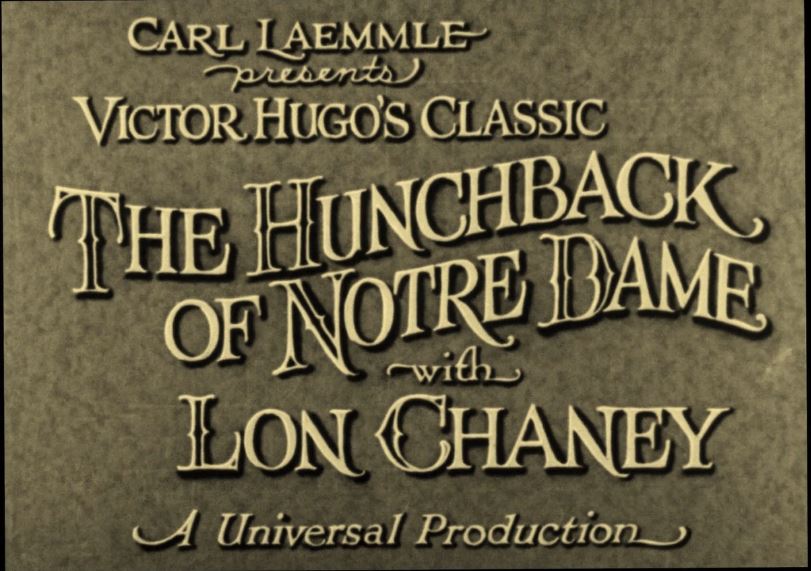
Sanctuary much… The Hunchback of Notre Dame (1923), Eureka Masters of Cinema Blu-ray, Out Now


To the towns people he was an inhuman freak, a monstrous joke of nature – and for their jeers he gave them scorn and bitter hate.


This is the UK Blu-ray debut of this Universal classic and it is a 4k transfer of the recent restoration from NBC Universal from two 16mm prints, which looks fabulous and really carries across the scale and daring of this huge feature – a million-dollar super-production. Surprisingly, I haven’t seen The Hunchback of Notre Dame before and so this disc held and extra fascination. Lon Chaney’s transformation is under more scrutiny than ever envisaged for the original screening experience but, once again, it is his performance and not the make-up that convinces and you soon forget the all too obvious prosthetics and just become submersed in this classic tale.


Victor Hugo’s novel of 1831, Notre Dame de Paris was, according to Kim Newman, as much about history and architecture as the hunchback. Then, as now, the building was under threat and Hugo’s novel helped to raise interest in the cathedral and, indeed, the author took part in restoration that helped preserve the building. According to Newman, the book helped create a social movement… but still has a lot more humour than the film, with Esmeralda charged with enchanting a goat, a satire on the French justice system. More on that goat later…


From an era of epic set design... the star of the film?

The film changed more than the story with a number of characters flipping from good to bad and a revision of the ending. This is a primal story that is clearly malleable in terms of meaning, sense of place and dramatic sweep with the cathedral the biggest character and narrative device, a place to hide, to haunt and to swing down from as well as being the ultimate sanctuary. There is nowhere else that Quasimodo can be and when Esmeralda is falsely accused, he carries her there shouting “sanctuary, sanctuary!”. But Notre Dame is also a place hiding the shadowy plotting of Jehan (Brandon Hurst) although the main villain in the book was his brother, the Archdeacon Claude Frollo, here played by Bristol’s finest Nigel De Brulier, as a good man.


It's also a refuge from the poverty beyond with the film retaining some political overtones, bemoaning “the King’s justice” and the struggle of the 15th Century poor more reflective of Hugo’s time – during the early reign of King Louis Philippe I after the revolution of 1830, all far removed from the days of the Republic. Hugo was elected to the National Assembly of the Second Republic after the 1848 revolution calling for the end of misery, poverty and the death penalty as well as other 19th Century concerns such as universal suffrage and free education. By 1923 all of these things were recognised as undeniably good so writers Perley Poore Sheehan, Edward T. Lowe Jr. and Chester L. Roberts were preaching to the converted.


The film starts with The Festival of Fools, the one day of the year when those “crushed by tyranny” could give themselves to unrestrained pleasure… His Majesty King Louis XI (Tully Marshall, who I always associate with the Clara Bow comedy Mantrap (1926)) rides through the throng, “a crafty oppressor of his people, whose dungeons were always full… “ which may be a little harsh on "Louis the Prudent" as he was called in the 1480s who founded what became the French postal system, built roads and unified France under a more administratively solid monarchy. It’s not my period but the needs of the story must…


Torrence, Chaney and De Brulier

We also see the poor of Paris huddled in the cavernous Court of Miracles … led by King of the Beggars, Clopin (man-mountain Ernest Torrence, who I also always associate with the Clara Bow comedy Mantrap), the enemy of kings… 400 years early.  He too is at the festival, watching from the steps of Notre Dame as the revelry gets wilder, he is chided by the Archdeacon before his brother Jehan crosses over to plot with Clopin… the downfall of Louis and a new world he can mould with the help of his lucky hunchback.


That freak is my slave, he will be useful to us…


There, high above the crowd, is Quasimodo, the “ugliest man in Paris” who will this evening be crowned King of Fools. He looks down on the crowd, pulling tongues and dangling precariously off the buttresses. Lon Chaney makes most of these moves himself, physically transformed so much that the outlandish prosthetics are barely necessary.


Patsy Ruth Miller

In his video essay, film historian, Jonathan Rigby describes the impact the film had including its blockbuster two-month stint at the Empire Leicester Square, which featured an “Impersonate Quasimodo” competition featuring seventeen contestants designed to encourage British acting talent. As Charles Laughton, Quasimodo in 1939, later said, Chaney wasn’t just a great actor but a magnificent dancer and clearly this physicality was an influence although we don’t know if Laughton entered the competition.


Having danced onto the screen, we get to meet the other main players, the newly promoted Captain Phoebus de Chateaupers (Norman Kerry, playing slightly gormless here) and his fiancée Fleur de Lys (Winifred Bryson) who watch the festival from across the cathedral square. Fleur’s attention is caught by a dancing goat – told you – who is being coached by a pretty gypsy called Esmeralda (Patsy Ruth Miller) who, even from a distance of a hundred metres, takes de Chateaupers’ mind completely off goat dancing.


Esmeralda is the most connected character in this film, being not only the adopted daughter of Clopin, who bought her off some gypsies because he always wanted to adopt but couldn’t be bothered with all the paperwork, as well as the object of Jehan’s wicked desires, not to mention her new admirer, who is forgetting all about his fiancée. Later in the day after Quasimodo’s coronation as King of Fools, he sees Esmeralda dancing and then he too has lost his heart to her fresh face and regular features, not to mention high-level armography and syncopation.


The kindness of Esmerelda

Passions run fierce and Jehan orders his man to kidnap Esmeralda, as that is the surest way to any woman’s heart, only for Quasimodo to be arrested and sentenced to a lashing. Before that, Esmeralda meets de Chateaupers, who takes her to a tavern before discovering that she’s not that kind of girl, suggestive moments when he pulls down the strap of her dress to reveal her naked shoulder before edging it back up again as she reveals her true heart.


From this point Esmerelda motivates the central characters and not anachronistic revolutionary thoughts. She shows mercy to Quasimodo as he calls for water after a brutal lashing in front of the cathedral… and if he didn’t know she was the girl for him beforehand he does now and his loyalty will not waver.


De Chateaupers takes Esmerelda to a nobles’ party only for Clopin to raise an army of beggars in order to go and “rescue her”, forcing her to intervene and go with her stepdad, to be with her own people. Minor character and coded gay poet, Gringoire (Raymond Hatton), rescued by Esmerelda after accidentally ending up in the Court of Miracles, brings the captain a note arranging a meeting with her in Notre Dame. She intends it as a last farewell and it almost is for De Chateaupers who is stabbed in the back by Jehan, who implicates Esmerelda.


No you don't Norman...

Will her Captain live to tell the truth or will Esmerelda fall victim to Louis XI’s lousy justice with a public hanging at Notre Dame? So many questions for the final part of the film and director Wallace Worsley masters his cast of thousands and stunning sets to full affect for a dynamic denouement. But it is his players that really bring the action with Chaney peerlessly acting through his make-up, dancing his feelings and ringing those bells for all he’s worth with a frightening intensity. Patsy Ruth Miller is also second MVP with a charismatic performance most of the others struggle to match, several roles perhaps being under-written given the need to squeeze so much into a single film from the epic source material.


The Blu-ray is released on 17th October in a Limited-Edition O-Card Slipcase* and has the usual Masters of Cinema extra special features:

·         1080p presentation on Blu-ray from a 4K restoration conducted by Universal Pictures

·         Music by Nora Kroll-Rosenbaum & Laura Karpman (presented in uncompressed LPCM stereo)  

·         New audio commentary with author Stephen Jones and author / critic Kim Newman

·         New interview with author / critic Kim Newman on the many adaptations of Victor Hugo’s novel |

·         New interview with film historian Jonathan Rigby

·         A collector’s booklet* featuring a new essay by journalist Philip Kemp, richly illustrated with archival imagery


*Both the booklet and the slipcase are limited to the first 2000 copies so I would urge you to order your copy now and you can do sodirect from the Eureka site.

It’s another important silent release from Eureka, an essential part of any silent film fan’s shelf and one that has not looked or sounded better since the 1920s!

A feast for your eyes...


Sunday, 12 July 2020

Dark Lady in love shock… Is Money Everything? (1923), Miriam Cooper


It was such a horror I’m glad I don’t remember anything more about it…

Four decades before Lennon and McCartney wrestled with the relationship between love and money, Miriam Cooper and Norman Kerry were involved in earnest consideration of the same issue under the guidance of Glen Lyons. The results are pretty conclusive and if the Scousers had been paying more attention they could have saved themselves hours of writing in Paul’s living room and the resultant two minutes and twelve seconds of pop glory but perhaps you can never have enough evidence?

I wasn’t really here for the answer just for the chance to see The Dark Lady of the Silents as Miss Cooper entitled herself in her autobiography, written “with” Bonnie Herndon and published in 1973 when she was – probably - 82. As I may have mentioned in the past, the star of Griffiths’ Intolerance and Birth of a Nation (not Oh, KKK…), has always stood out for me. There is indeed something about Miriam and if it’s not necessarily her acting, it’s certainly her look, at once striking and almost modern with big, soulful eyes that manage to be more knowing and yet less emotionally engaged than Lillian’s or Mae’s.

She is highly watchable and holds the attention on screen in spite of her honest assessment that she wasn’t a great actress and that her strong features and those dark eyes, described to her in the book as “sensual” and “liquescent” by two breathless academics after one screening of BoaN, touched many a watcher. She certainly did not lack the disciplined desperation of the poorer class nor the ability to transport herself into a role and suggested that an imagination born of necessity was key to her success.

Miriam Cooper
“… when Mr Griffith told me, ‘you’re a Southern girl watching your brother go off to war’, I didn’t have to act, I was that girl.”

She draws some fascinating parallels with her contemporaries – all of them young, pretty women, often without fathers and seizing the chance the pictures provided to support their families. These were also characteristics that appealed in inappropriate ways to DWG too and Mary Pickford wasn’t the only one who thumped the old racist. Cooper wonders how so many youngsters could write about the silent era and rightly points out that so much of the contemporary sources were PR guff: I’m not making anything up. I was there… Yet, she clearly is inventing some events and storylines throughout her story, not that this stops the book being entertaining. She tells all in a stylishly frank way, dishing dirt and opinion as freely as you’d expect from a grand dame but we’ll never really know if her first cinema make-up was applied by Mack Sennett or whether Lil and DW were closer than professionally required?

Only three of her forty shorts and five of her twenty one feature films survive, BoaN, Intolerance, The Woman and the Law – Griffiths’ director’s cut of her main story in Intolerance - husband Raoul Walsh’s Kindred of the Dust (1922) and Is Money Everything? So, unlike her hated love rival (?) Theda Bara, she at least has some major films extant and even this film allows us to see her in a run-of-the-mill feature in decent shape the Grapevine DVD being taken from a 35mm print.

Norman Kerry
Miriam took a pay cut down to $650 a week to make Is Money Everything? as times were still unsure for her and Walsh who was yet to breakthrough. She filmed in Detroit whilst he soon set off for Tahiti to make Lost and Found on a South Sea Island. They were also starting to drift in their marriage and she wonders whether she still loves him in her diary as quoted in the biography. Absence made the hearts fonder although they did eventually divorce in 1926.

 
Cooper describes the film as apt because of their money worries but it’s also about a couple faced with a choice of success in business or with their marriage which might explain why I find her portrayal convincing enough! She plays Marion Brand, wife of John Kerry’s ambitious grocer, John. John’s a god-fearing man at the start of the film and one who eschews violence, much to the pleasure of his father-in-law, Reverend John Brooks (John Sylvester).

After marriage he buys into the town’s grocery business and starts to make a real success… which increasingly is at the expense of other local businesses. His ruthlessness impresses a rich city woman, Mrs. Justine Pelham (Martha Mansfield) travelling through town, and it won’t be the last time the two cross paths as John transposes his grocery acumen to Wall Street.

The pressures of earthly success drive the Brands apart...
The family moves to high society in New York and whilst Marion begins to get isolated, the city slickers flock to John’s new success yet some, notably Justine’s husband, Roy (William Bailey) and leading financier Phil Graham (Lawrence Brooke), clearly do not like his impact on their capital nor his aggression. Pelham sends his wife to extract as many secrets as she can but Justine has her own more romantic agenda and sets about tying to woo John away from Marion.

The films only around the hour mark, yet it’s light on the detail of the money making and heavier on the social life of the Brand’s new society. There’s a long sequence on a hunt during which Justine pretend to have fallen from her horse in order to entrap John but, corporate killer he may be, he does not lack in love or loyalty to his wife.

But, as the money keeps pouring in, the pressures on the Brands’ marriage only increase as the temptations of unchristian power and desire beckon… Marion is there suffering in almost every scene and if there’s to be a way out, she will have to be the one to take drastic measures.

Martha Mansfield plays The (One Who Would Be) Other Woman
So… not a classic but Glen Lyons directs well and creates a watchable morality tale that was no doubt a crowd pleaser across the mid-West. Throughout it Miriam Cooper draws the eye and for the reasons she and Bonnie Herndon articulate in the biography, quoting film historian Walter Coppedge, “Of dark liquescent eyes and a strangely still but magnetizing beauty, Miriam Cooper’s looks were oddly provocative: she had sex and breeding, and she moved with an inviting grace… Griffith’s ‘Dark Lady’… struck a contrast with the two other types he developed…” these being the “vivacious freckle-faced hoyden” (Constance Talmadge) and the “ethereal innocent” (Lillian Gish).

Further viewing: One of Cooper’s best-looking survivors is the sixteen minute The Confederate Ironclad (1912), directed by Kenean Buel and available to view in stunning quality at the National Film Preservation Society website – which is full of wonders!

It is also well-worth watching The Woman and the Law (1915) on the Eureka Intolerance set, you see more of Miriam and the narrative is naturally far more focused than the strands we see in the main film. Plus, there is just more of the dark eyes and the timeless connectivity of Ms Cooper!

Further reading: If you can find a copy, don’t hesitate to pick up The Dark Lady of the Silents – as Miriam says, she was there and even at a distance of sixty years, her recollections are invaluable especially when place in the context of the more forensic studies of those academics who weren’t.

Lobby card bonus:


Tuesday, 7 August 2018

All Tomorrow’s Crawfords… The Unknown (1927) with Costas Fotopoulos


Joan’s eyes… so reflective they almost show the director and crew illuminated by the Klieg lights. So laser sharp, a flick of the lashes glancing so pleadingly towards the camera or in soft-focus, delivering a glistening tear as heartbreak turns her soul.

This was the film when Crawford truly hit her stride as she paced Lon Chaney’s own exhausting rigour and fed of the insane energies fueling his performance. There are those who like Joan and others who like Norma Shearer but whilst the latter had warned her pal about the Chaney experience, the younger actress clearly had a better balance with the man of a thousand grimaces; a face like a talking book. This might say something or nothing about Shearer vs Crawford, but the latter grabbed it as an opportunity to focus her career with the same energy, commitment and ruthless dedication she applied to her dancing and everything else.

Joan Crawford
There’s a great quote she gave after the film was released: “I want the Joan Crawford I am this year, to be only a building block for the Joan Crawford of next year. I want to be prepared for those years that come when youth is gone. I haven’t done a single thing, not a single thing, with which I’m content.”

And, that’s all it takes to become the biggest star in Hollywood and to build a career that lasted for a lifetime.

The first time I saw this film I thought it striking but quite unpleasant and that’s not only par for the course for writer/director Tod Browning, but also for a long line of films that came after him from David Lynch to Russ Meyer, Herschell Gordon Lewis, Roger Corman, Quentin Tarrentino and many more; tales to unsettle. But not many can do this with the style of Lynch or Browning who, a former circus artiste himself, knew the dark side of the business and the attraction it held for the outcast and outlandish. He knew the transgressive fascination the tented world held for the mainstream; clowns, jugglers, strongmen and horses – we all like a freak-out.

Lon Chaney and Nick De Ruiz
But The Unknown is unsettling not just because of the setting but because of the intensity of Chaney’s character, his lack of morality and his willingness to do anything, to himself and others, in order to get what he wants. Chaney manages to convey all of this with skill, he’s scaringly true. He is maybe even more frightening than he is in the Phantom as his motivations are easier to read and believe: there is no mask to hide the real horror of the man without care. And you really – really - wouldn’t want him throwing knives at you with his feet, let alone on a moving podium…

Chaney plays Alonzo the Armless, a circus performer who is extraordinary skilled at using the only limbs he apparently has left: his legs and feet.

He loves Nanon Zanzi (Joan Crawford) and she is part of his act, stripping down to a skimpy costume as he throws those knives at her and shoots the straps of her dress off… The male gaze is all over Joan and, indeed the male gauze for the love scenes… Crawford’s legs should have been down for a best-supporting role they’re featured so thoroughly and there’s not a dress that’s not tailored to within a half-inch of her figure. Those eyes are given ample chance to shine and her young face – always slightly not-Joan… shown in close-ups crafted with all the care of Brown’s Garbo or Sternberg’s Marlene.


Her physicality is a match for Chaney’s own and that’s one thing Shearer couldn’t match: Crawford has a dancer’s athleticism and she’s fearless. Ferocious in fact. She had to be with a story like this… there were a few twenty first century sniggers in a packed NFT 2, although they quickly died away. The idea of a two-thumbed man, hiding his arms for profit is bizarre as is the woman who is not just frightened of male intimacy but, specifically, their arms and hands. The sheer commitment of the performers carries all before it until you’re sitting in shock watching the lengths to which mad love can drive man and beast…

Norman Kerry’s circus strongman Malabar the Mighty seems a mite luke-warm next to his co-stars, he’s handsome, muscular and noble but here reduced to the role of love interest – a benign corner of the triangle, a sweet-hearted mirror to better reflect Chaney’s fire. Malabar longs to caress Nanon but she has been the victim of unwanted male contact too many times: she cannot bear the embrace of his manly mits and fulsome forearms.

Norman Kerry and his, um, arms...
Alonzo being armless, Nanon feels less threatened and gives her affection knowing that there’ll be none of the advances that unsettle her so. Alonzo uses this to try force her and the muscle man apart and it seems to be working… Then, out of the blue, we discover that Alonzo is far from harmless: he is a fully-armed escaped killer whose malformed thumbs have meant that he hides his hands in order to avoid detection by the police. The moment when his tightly strapped corset is opened is all the more shocking for our imagining what discomfort the actor had to endure during filming… every bit a shocking as the revelation of the Phantom’s face.

Soon he has more to hide after killing Nanon’s father Antonioni, the circus owner with his double thumb spotted by Nanon: he must keep his arms to himself and yet how can he have his love without revealing himself.

The most frightening laugh you will ever see...
By now the story has developed a cast-iron logic of its own and we believe everything even Alonzo’s last desperate leap of faith makes total sense…  but we are caught up in his fevered World and as if to illustrate the extremes, the young lovers are filmed behind a gauze by Browning, as if to emphasise the fairy-tale quality of their love. Desperation and devotion will collide in the shocking ending which still makes me shuffle uncomfortably in my seat as innocence unravels as perceived friend attempts the most dastardly revenge for the loss of his lover…

Costas Fotopoulis accompanied with assured lyricism and relishing every startling twisted nerve. He played along to the dramatic excess with restrain and period charm, gothic chords and yearning lines back-dropping the intense, bizarre, emotion on screen.

Mordaunt Hall reviewed the film of release for the New York Times and was reservedly ecstatic: “The narrative is a sort of mixture of Balzac and Guy de Maupassant with a faint suggestion of O. Henry plus Mr. Browning's colourful side-show background… Mr. Chaney really gives a marvellous idea of the Armless Wonder… he even scratches his head with his toe when meditating.

Miss Crawford is not only beautiful, but she gives a most competent performance...”

So… not just a pretty face. “Competent”, oh Mordaunt, she’d have you for breakfast mate!


The Unknown was screening as part of the BFI’s Joan Crawford season: Fierce – it runs until October and features many of her classic roles but maybe they all started here; the Joan Crawford of tomorrow, next year and after youth.


Thursday, 30 April 2015

Brave hearts and chieftains… Annie Laurie (1927), Barbican with Shona Mooney Trio


Hollywood has long specialised in the cod-Celtic but Shona Mooney’s authentic, soulful folk reclaimed this one for Scotland!

Her score had been commissioned for the Hippodrome Festival of Silent Cinema to accompany this film’s re-emergence after a crisp restoration by U.S. Library of Congress and the show came thundering down to England to strike a blow for the Highlands just a few hundred yards from where William Wallace was executed in 1305 (Smithfield, just outside Barts…).

Tha wee bonnie lassie, Lillian
The film was directed for MGM by John S. Robertson and represented an attempt to broaden Lillian Gish’s appeal. Sandwiched between her two films with the great Victor Sjöström – The Scarlet Letter (1926) and The Wind (1928) - Annie Laurie feels lightweight but it’s good to see Gish in more flirtatious mode and I don’t think I’ve seen her smile so much... That’s not to say that she doesn’t get a chance to stress-test her character and there is one extraordinary moment when her face is in open-eyed shock when, through she is able to summon forth tears - supernatural control but, in this film, from someone who is less intense than usual*.

The film is loosely based on the legendary rivalry between the Scottish clans of MacDonald and Campbell which resulted in the Massacre of Glencoe of 12th February 1692.

Some men in kilts
The feud between the clans is presented in a half-comic way here even though events kick off with the killing of one of the MacDonald’s men by the Campbells who attach a note to the body to make sure their neighbours get the message (sometimes it’s just good to talk boys…).

The MacDonald Chieftain (Hobart Bosworth) calls on his son Ian (Norman Kerry with an odd moustache and a strange shirt with plunging neckline… they did realise how cold it is in Scotland didn’t they?!) to extract revenge and heads off with his men to steal the Campbell cattle and the life of one of their men – “A Campbell for a MacDonald!” he cries as he dumps the body in the mix of their evening revels.

Norman Kerry and Lillian Gish
 The squad also takes the Campbell Chieftain’s niece, Enid (Patricia Avery) with them after she has caught the eye of Ian’s brother Alastair (Joseph Striker). She had been wandering in the castle grounds with her best friend and cousin, Annie Laurie (Gish) who desperately tries to stop the kidnap.

Negotiation takes weeks and, by the time the clans gather to return Enid, she has fallen for her handsome captor and refuses to return. The Campbell Chieftain (Brandon Hurst) curses her, her lover and their first born: feelings are running high.

Enid and Annie
Annie tries to make Enid stay and her eye is caught by that of the young “Pup” MacDonald – something stirs… which is all very frustrating for Donald Campbell (the normally likeable Creighton Hale who is here, not so much…). As Donald tries to woo Annie her thoughts begin to drift to the far hunkier Ian. As comic relief Sandy (Russell Simpson) says: these barbarians have a way with women.

Donald is not quite the lute playing fop he appears though and opinion on just exactly who is the barbarian must be suspended pending further data.

Lillian Gish and Creighton Hale
Enid invites Annie to visit and sends Ian to escort her. The two bond after he carries her across a babbling brook (see Mr Griffith, Lillian doesn’t always need to half drown in order to make a movie…) and on the return journey she receives the shock of a kiss. She runs away but they both know this is it.

As relations thaw all round, Ian and Annie dance at a coming together of the clans and Donald’s jealousy rises up a notch or three. Walking together Annie and Ian are surrounded by Duncan and his men, Ian calls on her to leave the Campbells but she isn’t ready and after she leaves, Donald’s boys subject Ian to a walk through a tunnel made by their raised swords. As he walks through they strike his back, flaying his skin and leaving deep scars, Annie runs back to intervene and there are some excellent shots of her panicked face through the steel.

Annie really likes the 'tache
Ian keeps too much of his pride and cruelly rejects Annie for not declaring her true love… Job done thinks scheming Donald.

Events now begin to broaden in scope as the Campbells look to find favour with the English King and to outmanoeuvre the MacDonalds. Annie hears of their plot to take the latter’s land with the monarch’s help if the MacDonalds refuse to sign a new agreement and rushes off to warn Ian. But will the man ever sober up enough to drop his grudge against her and in time to prevent the Campbells not only taking their land but their lives as that fateful day in Glencoe approaches…

Annie pleads with unyielding Campbells
It’s a well-made film with some interesting cinematography from Oliver Marsh especially with what looks like hand-held camera-work for the main battle and a chase sequence. The story may be less than historically accurate but it’s an entertaining ride.

The experience was elevated from an interesting to exciting one by the genuinely uplifting, intelligent and precise composition of Shona Mooney. Shona played the fiddle and was accompanied by Alasdair Paul on guitar and flute as well as Amy Thatcher in accordion and piano. This well-drilled group played very tightly along with the action with energy and invention.

Amy Thatcher, Shona Mooney + Alasdair Paul
The music worked so well with the film, matching sound effects and themes to the action to witty and winning effect; from a knock on the door to the emotional cadences of Miss Gish’s acting. I am sure Lillian would have approved whilst the rest of us were on our feet clapping for an encore!

If you get the chance to see the film with Shona’s accompaniment I wouldn’t hesitate and it is to be hoped that the combination gets more opportunities to show how the unique combinations of silent film and fresh music can move an audience.

More details of Shona Mooney’s music are on her site. She has had a very active career since winning the BBC Radio Scotland Young Traditional Musician of the Year in 2006 recording numerous albums and touring the World. She specialised in Eighteenth Century Scottish music and so her affinity with Annie Laurie is not surprising: more authentic, in fact, than the Californian scenery and title card dialect used in the film…


*Off screen her mother had been taken ill and Gish confessed to being less involved in her preparation for this film than in say La Bohème (1926) or The Wind. It’s no bad thing – in terms of the film – as she gives a relaxed, naturalistic performance and is more lighthearted as a result.