Showing posts with label Reinhold Schünzel. Show all posts

Sunday, 8 December 2019

Five fingers of fear... Eerie Tales (1919), BFI with Stephen Horne


This was my twenty third Weimar screening of the year in which Europe celebrated its centenary from Kennington, to Cambridge and Bologna to Pordenone via a superb season at the BFI in the early Summer. I’d even seen Claudio Macor’s new play, Different From the Others based on Richard Oswald’s ground-breaking film of the same name and featuring a cast of young performers interpreting the roles of the Weimar superstars, Conrad Veidt, Reinhold Schünzel and Anita Berber, a woman who loved life and narcotics all too much but who inspired so many. Eerie Tales (aka Uncanny Stories or Unheimliche Geschichten) was made directly after and featured the same three stars.

For today’s screening we had our own Weimar dream team, with an informed and entertaining introduction from Veidtspert Miranda Gower-Qian and accompaniment from Stephen Horne. Miranda explained the background to the film in the theatre of Max Reinhardt with all three leads well-established in theatre and cabaret. Veidt was already renowned as The Walking Cadaver whilst Berber was a huge and outrageously successful cabaret star, the three knew each other well and, as Miranda said, there’s a sense of familiarity and playfulness informing the film which helps to compensate for its limited budget and the fact that there remain missing segments even after the restoration.

Richard Oswald had already directed a number of literary adaptations (his second name taken in tribute to a character from Ibsen's Ghosts) as well as horror films and the episodic opera Tales of Hoffman before he came to Eerie Tales. The film features five stories all framed by a sequence in an antiquarian bookshop in which paintings of The Devil (Schünzel), Death (Veidt) and a Strumpet (Berber), become animated after closing time and relax by leafing through the stock for the most sinister stories.

The Apparition by Anselma Heine


Here Veidt plays a man who rescues a woman (Berger) from the violent attentions of her former husband (Schünzel). No matter where they go the deranged man follows and the two soon fall under each other’s spell: hero and rescued damsel. They take rooms in a hotel and the woman, feeling unwell retires early… the man goes downstairs to enjoy some after dinner drinks and, returning with un-chivalrous intent in the early hours, he finds her room not just empty but cleared of all furniture and with the walls scorched bare… What madness can this be? The answer is still shocking.

Schünzel clearly relishes the chance to extend his flexible features as the spurned husband – his face contorted by the madness of rejection.

The Hand by Robert Liebmann


It’s Veidt’s turn to show his uncanny expressiveness in the second segment. He and Schünzel are in competition over Anita again and, like gentlemen, they agree to throw dice for her. Schünzel throws a ten but Veidt responds with an improbably eleven – to the winner the spoils! But things don’t quite work that way as the sore loser throttles the victor who falls dead, his hand twisted by the desperate final struggle.

The cheat takes advantage of the girl’s grief but if he thinks he’s in the clear he has another thing coming…

This section gives us a precious glimpse of Anita Berber performing on stage as Schünzel’s character looks on before seeing a ghostly Veidt stage left. Berber has arguably the least to do in Eerie Tales (she dies twice which is unfortunate) but the trained dancer carries herself well and brings a cabaret cutting edge to proceedings: she knows where the next whiskey bar is alright and much more besides.

The Black Cat by Edgar Allan Poe


Next up is a classic from the man who may well have invented both the detective and horror genres: The Godfather of Ghoul anyone? Once again, our three are caught in a love triangle and as the debonair Conrad sweeps in to win the maid, Schünzel snuffs out the object of attraction whilst at the same time throwing her precious pet cat against the wall.

Veidt smells a rat but the police are baffled: yet how many lives does a cat actually have. As usual with Poe it’s the very matter-of-factness of his narrative that evokes the greatest chill…

The Suicide Club by Robert Louis Stevenson


Oswald brings a consistent creepiness to all of these stories not just through his use of the same actors but through his expressive visuals and – forced - economy. This tale of a most unusual gentleman’s club is given considerable spin by Veidt’s unnerving turn as the titular club president but the director’s eye for detail has him use repeated motifs of playing cards and an expressionist ticking clock to ramp up an unnatural tension before Stevenson’s more conventionally heroic tale twists its way through.

The Haunting by Richard Oswald


The last tale is written by the director and is the lightest: perhaps he wanted to send his audience away with a spring in their step after the preceding death and disturbance. The intertitles are in verse and the cast dressed in fairy tale garb for the story of an injured knight who takes advantage of his host’s generosity by making merry with his wife. Schünzel plays the bawdy Baron and Anita Berber gets her chance to shine as the girl who can hardly say no. Her husband (Veidt) decides to teach both a lesson and mild amusement ensues… with tension maintained by three far from straight faces!

Stephen Horne matched Oswald’s tones with his usual array of instrumentation and clearly relished throwing gothic chords in the more extreme moments as well as laying down uncanny themes on accordion and flute.

Eerie Tales is clearly a staging post between the major works of Weimar gothic but it’s very entertaining and with a sold out NFT 2, clearly a popular choice in a year in which the BFI has programmed boldly from this era and hopefully seen the returns. Here’s to more in 2020!

Anita dances

Thursday, 30 May 2019

Humanising history... Madame Dubarry (1919), with John Sweeney, BFI Weimar Cinema

“I am an actor, and if I don’t play this part, I’m through with films! If I can’t play parts that I don’t look like, then I shouldn’t even be on the stage – I chose the wrong profession!”

Thus argued noted stage actor Emil Jannings on being told that he didn’t look regal enough to play King Louis XV in Ernst Lubitsch’s new film; four years later he would play the dilapidated doorman in The Last Laugh and he was, of course, eminently capable of playing the King. Lubitsch was so convinced he expanded the role and offered Jannings more work.

Made just a year after the Great War ended, Madame Dubarry was a lavish costume drama that was the most expensive film yet made in Germany. It led to director Ernst Lubitsch being labelled as the German Griffith and there are certainly parts of the film that show a debt. It's also possible that Orphans of the Storm – made three years later - was in part a response from the master to the younger man's smooth story-telling, controlled crowd scenes and subject matter. Lubitsch was more interested than DWG in “humanised” history, rather than simply finding identifiable emblems of “good or bad”… He concentrated on the impact on these events of a woman who barely comprehended her role in change, let alone the reaction she eventually faced.

Emil Jannings being "typically protean..."
There’s also not too much in common between Lillian Gish and Pola Negri... with the latter evincing an earthy humanity that convinces you that this humble seamstress could indeed earn the affection of aristocrats and Kings. In the US, the film was sold as her star vehicle, with little mention of its German origins: Polish star, “French story”.

Pola plays Jeanne Vaubernier a wild and carefree soul almost unconscious of her effect on men but with a pragmatic ambition driven by opportunism more than any political programme. She has a lover, Armand De Foix (an earnest Harry Liedtke) but sets her sights on any man of social standing who can offer her more. Thus, does she make her way in society first through the influential Don Diego then Le Comte Jean Dubarry and finally on to King Louis XV and the protean Emil. Jannings is measurably larger than life and seems to nailed the art of film acting very quickly, filling the screen with just the right amount of beaming charm along with the self-confident casual power that inhabits all the best monarchs.

A Lubitsch touch... the curtain reveals the opportunities now opening...
The pace of the story is so fast you wonder how things are going to develop beyond this point but life and French politics begin to overtake Jeanne. She gets the king to prevent Armand's execution and he becomes a member of the royal guard. At the same time she comes into range of the scheming Minister Choiseul (another great turn from Reinhold Schünzel) who hopes to advance his sister's position with the king. Meanwhile, France is a tinderbox of festering resentment at unfair taxes, food shortages and negligent aristocracy.

Jeanne and Armand meet and he is astonished to learn that she is the hated Dubarry; symbol of royal indifference and whimsy. "It is easy to forgive, " he says, "...but not to forget." Nevertheless, he gives her one last chance as he joins a band of proto-revolutionaries led by his friend Paillet. The situation is stirred up by both sides and Jeanne blows her chance by ordering Paillet's arrest. She is running out of friends and increasingly dependent on the King's favour. But, as his health begins to fade, the revolution looks ever more certain.


The action explodes in the last half an hour of the film and, having been focused on the individuals, the view is dramatically widened to show the revolt in the streets and the desperate battle of the citizenship against the army. As aristos hang from the lampposts, Jeanne is betrayed and sentenced to death: no one gets out of here alive.

Lubitsch shows much subtlety in focusing on character in telling this epic tale. There's a superb moment when Jeanne first arrives at Don Diego's house, her first taste of upper class living, as the curtain behind her pulls away to reveal the opulence of his cabinet. This shows the gap between the lives of the ordinary people and the nobles most effectively; why shouldn't Jeanne want to be part of this?

The director used over 2000 extras, and according to Herman G Weinberg in The Lubitsch Touch: a critical study (1977), he succeeds by making them act like individuals rather than a mindless mob… each one desperate for food, justice and crude revenge!

Motivated mob...
Madame Dubarry feels less melodramatic than an American film of the same period might have been and it’s more conflicted: you can feel sympathy for Jeanne without necessarily condoning her actions - she's not a pure white heroine by any means but she's true to herself even though she can't resist temptation. Try that one on for size Lil… there’s a worldly complexity in Negri’s approach that seems to come naturally and there’s an humour and charm working to humanise her selfishness.

Pola simply brings great energy to the role and, whilst there's the odd moment when she over-reaches, she's mostly naturalistic with a smile of pure unfettered joy. It's her innocent surprise at the benefits her looks bring that ultimately makes her likable. In the end you want her to be given one more chance even if the revolution demands that she must be punished.

One of Lubitsch’s best early dramas and told with a deftness that clearly got him noticed in Hollywood. As for Emil… he might had been a King but even he didn’t quite match the naturalistic brilliance and pure appeal of his Dubarry! His time would come later.

Harry and Pola in a tight spot
John Sweeney accompanied with regal assurance followed by revolutionary dynamism, pacing himself perfectly along the narrative as the film gets bigger and bigger to that devastating conclusion: Lillian is, of course, saved at the last from Madame Guillotine but there’s no mercy shown for Pola is bundled, unceremoniously to her death. Germany in 1920; if not an optimistic country then certainly a fatalistic one with, they hoped, no time for tyrants of any kind.

Madame Dubarry is an essential part of any Weimar “watch list”, and this is another reason to maintain calendar discipline and make sure you don’t miss a thing in the BFI’s Weimar Season – full details on the website.


Saturday, 18 May 2019

Nobody’s perfect… Heaven on Earth (1927) with Stephen Horne, BFI


"The city had a jewel-like sparkle… the vast cafés reminded me of ocean liners powered by the rhythms of their orchestras. There was music everywhere." Josephine Baker, after visiting Berlin in 1925

Think of Weimer cinema and you’re probably thinking heavy drama; tough lives lived in shadows and expressive hyper-realism and yet, there’s also a huge amount of fun, with, “bee-dle-dee dee dee dee…” a fair amount of transgressive naughtiness as Germany got well ahead of itself and everyone else for a while.

Heaven on Earth is a very, aha, earthy farce that confronts the question many of us don’t ponder enough: what to do if you inherit a saucy night club? Now, imagine if you’re a politician who has, albeit accidentally, set his stall against the vice-ridden den in question, earning a standing ovation for taking a stand against the commodification of human desire and weakness.

Nighclubbing...
It’s a very neat set up and the multi-talented Reinhold Schünzel is just the man to make the absolute most of it! Schünzel, who enjoyed a long career from 1915 to the fifties, co-directs with Alfred Schirokauer, co-produces, co-writes and plays the lead, Traugott Bellmann, the politician in question who has seediness foisted upon him after a cousin dies and leaves him the club plus five thousand Marks.

Traugott starts off the film getting married to the lovely Juliette (Charlotte Ander) the daughter of wine merchant Louis Martiny (Otto Wallburg) who couldn’t behappier with his new son-in-law until he forgets his notes for his maiden speech and ends up improvising a prohibitionist policy that focuses on the Heaven on Earth club to which Martiny sells so much wine!

It’s a quandry soon overtaken by Traugott’s mixed-blessing and now he has to try and balance his two worlds without the other finding out. Almost immediately he starts receiving odd guests at his house, all keen to welcome the new cabaret owner and get booked…

A promotional booklet for the film...
First up is an all-black jazz band called The Smile Band, who wear cute little hats and look like they played up a riot! Jazz was very fashionable in Berlin at the time and cooler audiences naturally preferred authentic black performers embracing them as part of a progressive arts movement away from Germany’s miserable recent past.

Then we see a group of dancing girls who look staid when they arrive at Traugott’s door before revealing scanty costumes and the raciest of routines, much to their host’s delight and then despair as his wife investigates the commotion. Schünzel had a background in club culture and his turn as well as these artists’ are genuine: you want to learn more.

Charlotte Ander looks on as Reinhold Schünzel checks Maria Kamradek's teeth...
Traugott begins to enjoy his nightlife and soon begins a flirtation with a handsome young woman (Maria Kamradek) who later rocks up at his house having answered an advert to be a housemaid…

Losing the battle to separate his loves and lives he tries to off-load the club but not before his father-in-law finds out and comes looking for him. He escapes by cross-dressing… unconvincing to all except for one with his broad shoulders, manly hands and increasing exasperation.

Schünzel is hilarious: naturalistic and with great timing, he’s a relaxed and very “modern” performer… at one point, bored with the pretence of cross-dressing, he puffs out his cigarette with all the grace of a Hamburg docker. He’s also quite stocky for a girl and his broad shoulders and jaunty smile would be unlikely to convince most, but, as Herr Lubitsch proved a number of years earlier with Ossi Oswalda, some men are easily confused but not always disappointed. As Joe E. Brown’s character says to Jack Lemmon’s in Some Like It Hot, when he finds out he’s not the girl he thought she was: “nobody’s perfect…”

We’d got our cabaret, mein herr, and Mr Stephen Horne was right there with us with a cheeky jazzed-up accompaniment on piano and accordion… all those years in East Berlin dive bars (possibly) informing his typically sympathetic playing. Also, “bee-dle-dee dee dee dee…”, one man, many tunes.


Saturday, 28 March 2015

Richard Oswald's house of horror... Uncanny Stories (1919)


From the enduringly-disturbing Dead of Night (1945) through to the Hammer comic-thrillers Tales from the Crypt (1972) and Vault of Horror (1973) I’ve always liked horror compilations: short-sharp shocks featuring tales of the mildly unexpected with enough time to develop an idea without over-staying its welcome. Most horror films lose their impact after the scene setting or maybe I just don’t like long drawn out un-pleasantries which have increasingly relied upon prescribed physical shocks for visceral impact.

The same is true of the genre in fiction and from the short stories of Edgar Allan Poe and Robert Louis Stevenson onwards, horror has been a dish best served in controlled portions. That way, even if the entrée fails to excite the pallet there is always the main course left… and maybe just desserts…

Reinhold Schünzel, Richard Oswald and Conrad Veidt
Richard Oswald had already directed a number of literary adaptations (his second name taken in tribute to a character from Ibsen's Ghosts) as well as horror films and the episodic opera Tales of Hoffman before he came to Uncanny Stories or Eerie Tales (Unheimliche Geschichten) in 1919. He made the film directly after Different from the Others and, whilst he may have wanted a simpler project, he took two of that film’s main performers for this project, rubber-faced Reinhold Schünzel and the angular Conrad Veidt. They were joined by Anita Berber who was just 19 at the time and already no stranger herself to the outer limits of Weimar self-expression… (she was posthumously described as the "Devil's spawn" by Adolf Hitler: well, he’d know…)

Anita Berber
A small but perfectly formed cast for these five tales of mystery and the imagination…

The stories are framed by a sequence in an antiquarian bookshop in which The Devil (Schünzel), Death (Veidt), minus his horse Binky… and a Strumpet (Berber), animated after closing time from oil paintings on the wall, relax by leafing through the stock for the most sinister stories.


 The Apparition by Anselma Heine

Reinhold Schünzel
Here Veidt plays a man who rescues a woman (Berger) from the violent attentions of her former husband (Schünzel). No matter where they go the deranged man follows and the two soon fall under each other’s spell: hero and rescued damsel.

They take rooms in a hotel and the woman, feeling unwell retires early… the man goes downstairs to enjoy some after dinner drinks and, returning with un-chivalrous intent in the early hours, he finds her room not just empty but cleared of all furniture and with the walls scorched bare… What madness can this be? The answer is still shocking.

Schünzel clearly relishes the chance to extend his flexible features as the spurned husband – his face contorted by the madness of rejection.

The Hand by Robert Liebmann

Conrad Veidt
It’s Veidt’s turn to show his uncanny expressiveness in the second segment. He and Schünzel are in competition over Anita again and, like gentlemen, they agree to throw dice for her.

Schünzel throws a ten but Veidt responds with an improbably eleven – to the winner the spoils! But things don’t quite work that way as the sore loser throttles the victor who falls dead, his hand twisted by the desperate final struggle.

The cheat takes advantage of the girl’s grief but if he thinks he’s in the clear he has another thing coming…

The Black Cat by Edgar Allan Poe

Three's a crowd...
Next up is a classic from the man who may well have invented both the detective and horror genres: The Godfather of Ghoul anyone? (With apologies to James Brown….)

Once again our three are caught in a love triangle and as the debonair Conrad sweeps in to win the maid, Schünzel snuffs out the object of attraction whilst at the same time throwing her precious pet cat against the wall.

Veidt smells a rat but the police are baffled: yet how many lives does a cat actually have. As usual with Poe it’s the very matter-of-factness of his narrative that evokes the greatest chill…

The Suicide Club by Robert Louis Stevenson


Oswald brings a consistent creepiness to all of these stories not just through his use of the same actors but through his expressive visuals and economy.

This tale of a most unusual gentleman’s club is given considerable spin by Veidt’s unnerving turn as the titular club president but the director’s eye for detail has him use repeated motifs of playing cards and an expressionist ticking clock to ramp up an unnatural tension before Stevenson’s more conventionally heroic tale twists its way through.

The Haunting by Richard Oswald


The last tale is written by the director and is the lightest: perhaps he wanted to send his audience away with a spring in their step after the preceding death and disturbance.

The intertitles are in verse and the cast dressed in fairy tale garb for the story of an injured knight who takes advantage of his host’s generosity by making merry with his wife. Schünzel plays the bawdy Baron and Anita Berber gets her chance to shine as the girl who can hardly say no.

Her husband (Veidt) decides to teach both a lesson and mild amusement ensues…


I watched a copy of the 2002 restoration which was aired on ARTE which is a little better than the version on YouTube… The film is now available on DVD from Amazon.de but with German intertitles only… a staging post on the route to Caligari and proof of Oswald’s diversity.

Berber back to the day job in The Hand
Of the players, Veidt’s versatility needs little exposition and here he is matched by Schünzel. Anita Berber has arguably the least to do (she dies twice which is unfortunate) but the trained dancer carries herself well and brings a cabaret cutting edge to proceedings: she knows where the next whiskey bar is alright.

Saturday, 13 December 2014

Justice through knowledge! - Different from the Others (1919)


This is a remarkable film and one that survives only in partial form: that it survives at all given what was to come is all the more extraordinary…

Paragraph 175 in the German Criminal Code made homosexuality illegal and contributed to the loss and wreckage of so many innocent lives whilst also acting as a fertile area for blackmail and extortion. Shockingly it wasn't repealed until 1994 (after decades of amendments) which shows, in nothing else, how incredibly advanced this film was and how brave. In an age when many leading straight men, like Conrad Veidt, might still think twice about playing a gay character, the future star of Caligari took up the challenge for director Richard Oswald’s film.

Dr. Magnus Hirschfeld
The script was co-written by Oswald with Dr. Magnus Hirschfeld a “sexologist” who also part-funded the film through his Institute for Sexual Science… Hirschfeld was a man on a mission to educate people about the normalcy of the homosexual condition – its existence in nature across, species and for humans across class and the social divide:

“Love for one of the same sex is no less pure or noble than for one of the opposite. This orientation can be found in all levels of society, and among respected people. Those that say otherwise come only from ignorance and bigotry.”

His words could be from decades later and indeed there are similarities in story with the 1961 British film Victim in which Dirk Bogarde’s married lawyer is blackmailed over his sexuality. Sadly there are probably still some who would find the film shocking: this is still a hot topic as the recent debate over equal marriage has illustrated.

Paul and the parents
Chunks of the film are missing but the restoration viewable on the Kino DVD pieces the story together with additional title cards and the odd still. The film was censored from the get go and became something only fit for scientists to watch and study which makes it strange that what’s left focuses so much on the male interactions and not their family members of both sexes: too inflammatory?

Conrad Veidt plays successful concert violinist Paul Körner and the film opens in his well-appointed flat as he reads newspaper stories describing inexplicable suicides of young men. He suspects he knows the reasons for their demise and has a vision of great homosexual men who were victimised for their orientation: Leonardo da Vinci, Pyotr Tchaikovsky, Oscar Wilde and others.

Fritz Schulz and Conrad Veidt
He is approached by a young violinist Kurt Sivers (Fritz Schulz) who wants to become his pupil and,  after getting agreement from his parents the two begin working together and very quickly form an attachment.

Meanwhile Körner's Father (Leo Connard) and mother (Alexandra Willegh) try to push him towards marriage and he refers them to his specialist, Dr Magnus Hirschfeld (who plays himself) who explains his sexuality to them: “… he is not to blame for his orientation. It is not wrong, nor should it be a crime…”

Bollek spots his opportunity...
Körner and Kurt get spotted out walking by one Franz Bollek (Reinhold Schünzel) someone we learn very quickly has been blackmailing the violinist and who decides to pump him for further funds in the light of this new “evidence”.

Körner tries to hide this from Kurt but after the two surprise Bollek in their flat a fight breaks out and all is revealed. Kurt runs away leaving Körner heartbroken. He thinks back to his days at school and his expulsion after being found kissing another male student, then onto university where he couldn’t connect with any women.

School days
He tried hypnotherapy as a cure but it was only when he met the Doctor that he was able to respect his own sexuality.

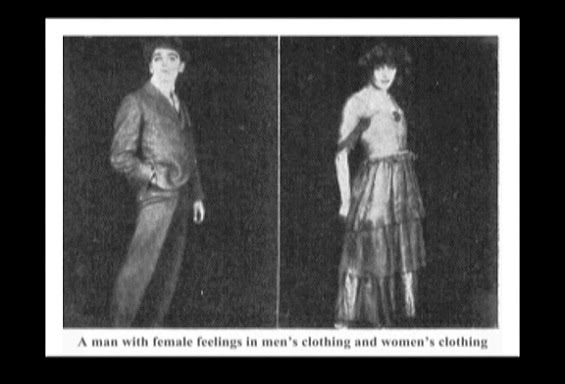
Kurt’s sister Else (Anita Berber), has her own feelings for Körner but he takes her to one of the Doctor’s lectures in which he espouses his theory of graduated sexuality – men with female elements and vice versa with some frank photographs of "virile women" and "a man with female feelings...".  Obviously research into human sexuality has advanced but how would this have played to audiences 95 years ago? Else starts to understand and to support her friend in different ways.

Virile women and a man with feminine thoughts
Mild spoilers: Körner reports Bollek for blackmail and the two have their day in court in something like a dual trial one for extortion and the other for breaking Paragraph 175… how will the two gain justice?


Too much of the film is missing to judge its overall direction but I like Oswald's settings and the way he deals with the romance. The lack of episodes involving the families does diminish the broader drama but that's nobody's fault but the censors. There is however, more than enough of Veidt’s acting to be convinced of his excellence. He’s an extraordinarily protean performer not only using his shallow cheeks and electric eyes to convey emotion but also the torture expressed through his malleable physique.

Conrad Veidt
Reinhold Schünzel makes for a thoroughly dis-likable rogue whilst Fritz Schulz is good as the vulnerable young man who might just provide hope for a better future.  As the good Doctor implores:  “You have to keep living; live to change the prejudices... …restore the honour of this man… and all those who came before him, and all those to come after him. Justice through knowledge!”

An appeal made all the more poignant given the ensuing decades in which intolerance was refined into a grotesque art form in Germany. Justice will out and you have to keep on believing that...

Available from Kino and Amazon.