Showing posts with label Urban Gad. Show all posts

Friday, 18 February 2022

Die Asta Blues... Dora Brandes (1916)/Poor Jenny (1912) with Stephen Horne, BFI Asta Nielsen Season


She acts, that’s the thing… she does not just pose before the camera… She impersonates a character, she makes it live and have meaning, a hundred meanings…


Once more unto the BFI to take my place in seat A11 and marvel at the depth of talent possessed by Asta Nielsen. I’ve seen Asta before but mostly in her greatest hits, Hamlet (thrice), Joyless Street (twice), Afgrunden (so many times…) but it’s a real connoisseur’s delight to be able to dig deep into a body of work that is very rarely screened in this breadth and depth. Tonight, there we four different films showcasing her dramatic skills as well as the more madcap, melodramatic moral tales and Asta as a businesswoman, entirely summarising the future in both subject and performance.


As you watch you can begin to fully understand just why she was so popular and it’s that rare occurrence when star quality is fully deserving of the adoration because Asta was, as has been noted so many times, developing the art of screen acting as she went. In her programme notes, season curator Pamela Hutchinson notes how Asta was the pin up for both sides in the Great War and even in the USA, where her films often fell foul of censorship, the New York Times critic gave the rave review quoted at the top in 1921.


Asta the clothes horse in one of Dora's posh frocks


Whilst, if she had socks, they’d be strewn all over the floor by the end of each film, Asta has something deeper and her ability to connect is almost unparalleled in this era. So often at the start of her films, she’s seen smiling straight to the audience before the action begins, melting hearts and renewing her intimacy with the watchers and unflinching honest look, the only time she’s out of character, or at least the character she’s about to play. As a person she’s a mystery and her pre-show smiles just hint at the complexity to come whilst showing how easily she can draw us in… it only takes a few seconds looking at those huge dark eyes.


So, it proved with some of the scenarios she worked with and as Hutchinson recounts, Asta made a joke of the minimalistic scripts she was given and was then able to expand with her uncanny expressiveness. No were else in London can you find anything like what we’re now seeing… nothing as pure as the crafting of some of the first interior monologues on screen. Asta has the blues but no one's ever expressed them in such a physical way... she draws you in and leaves you drained.


Directed by Magnus Stifter, following her break with husband/director/writer Urban Gad, Dora Brandes is a melodrama that plays with the already well-worn Star is Born tropes. Asta plays the titular Dora, a successful actress who finds herself having to chose between an older man, politician Grev d'Albert (Max Laurance) and a much younger journalist, Gustav Calvia (Ludwig Trautmann).
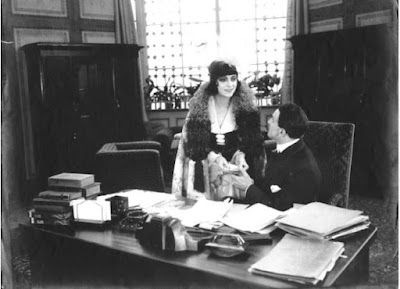
 

Asta with Ludwig Trautmann

d’Albert is to be sorely disappointed as she choses the man at the start of his career and the two live in bliss albeit in an increasingly hard to fund happy home, with Dora having retired from the stage. Gustav has political ambition of his own though but lacks the funds to make a go of it, he asks d’Albert for financial help but is refused. Dora makes the fateful decision to ask the old man herself, knowing that he still holds a candle and thinking only of her love’s future. She tells Gustav she got the money by selling jewellery and, none the wiser, he proceeds to get elected as an MP.


Only a chance encounter with d’Albert in a club as he celebrates his win, reveals the truth to Gustav - d’Albert has a signed letter from Dora to prove she accepted the money. This is too much for the young man and he returns home and kicks Dora out…


So, high on pride and ambition, Gustav continues to make his way as Dora drifts down into an alcoholic underworld. It is only years later when he and d’Albert end up on opposing sides and the old man threatens to expose his secret that Dora reaches out to her old friends… it’s not too late to save honour, love and career is it?


Asta and Leo Peukert in Poor Jenny

Poor Jenny (1912) was from the early days of the Asta series written and directed with Urban Gad who the actress insisted at the time came with her to Germany to carry on the work begun with Afgrunden. It’s a more typical rags to riches and rags again narrative but, as she joked, this was more than enough to feed her dramatic energy.


Another striking point is how different the actress looks in these productions, here she starts off with a centre parting and simple plaits and looks so different from Dora. Her protean qualities were reinforced by her slim figure and atypicality… she was a clothes horse, physically expressive with long fingers and a dancer’s grace whilst her strong, largely regular features could be varied so much by make-up and, her look.


Asta Nielsen is Jenny Schmidt, a poor cleaner who meets a wealthy man Eduard Reinhold (Leo Peukert) returning home after a long night out as she scrubs his stairs. Eduard impulsively kisses her and agrees to meet her the next day. The date goes well, too well, and despite resistance, Jenny is led inside Eduard’s flat only to return home the next day with explaining to do. She’s thrown out by her father (Emil Albes) and, ends up being a kept woman.


Pride coming before the fall


Falling out with Eduard, she finds another lover Kellner Fritz Hellmann (Hans Staufen) and there’s a superb sequence for city spotters, on the top of a double decker bus/tram, driving down a main street in Berlin as the two talk. It’s a stunning sight and the actors’ naturalism reinforces the window on this long-lost reality… time travel via silent film. Such happiness cannot last though, Jenny is outside of accepted society and she will not be able to rely on the good faith of such men for ever.


Stephen Horne accompanied with subtlety and variety using piano and flute. With an actor who absorbs more concentrated attention than most the music follows Asta’s lead and there were many poignant lines along with a thunderous run of repeated scales that would have done Philip Glass proud as the climax was reached for Dora.


There was also an excellent recorded introduction from Julie Allen, Professor of Comparative Arts and Letters at Brigham Young University in Utah. Nielsen is a performer of world historic importance and we should count ourselves so lucky at this moment: do not miss her!


The Asta Nielsen season continues apace through to March, full details are on the BFI site. 


Jenny in the bar about to hear very bad news...

Asta also chomps a mean cigar!

Only Gish comes close in terms of the physical demonstration of emotional trauma.


Monday, 14 February 2022

Character comedy... Zapata’s Band (1914)/ The Eskimo Baby (1918), with Costas Fotopoulas, BFI Asta Nielsen Season


Greta Garbo talked of Asta Nielsen’s range and these two comedies showed exactly how deep the Dane went into character no matter what the premise and how she could turn pretty much any silliness into watchable and, indeed, laughable. Zapata’s band is a straightforward comedy structure with a group of actors finding themselves in a comedic situation, mistaken for the outlaws they are playing, but The Eskimo Baby is something else entirely with Asta tasked with playing an Inuit woman brought back from Greenland to the bewildering world of Berlin. Everything stands or falls on the actresses’ ability to improvise comic situations as well as some kind of character depth, and, remarkably for someone who found comedy difficult, she’s mesmerising and genuinely funny in ways fellow Danes Pat and Patachon, have ceased to be (sorry lads).


Robert C Allen writing in Sight and Sound in 1973 described her self-assurance as enabling this comic force with the character which emerges from her comedies being “… the unstoppable extrovert, constantly plotting and endowed with more energy and determination than all the other characters put together.” Being honest, I expected Eskimo to be a one-note joke stretched thinly up to 66 minutes but Nielsen genuinely pulls you in and makes us even delight in her face-pulling in a newly discovered mirror… Florence Turner eat your heart out*.


Freddy Wingardh and Asta Nielsen


It sounds pretentious but Asta is that Inuit, childlike and fascinated in her new world, pure-heartedly delighting in the bizarre simplicity of the brief, a character who rubs noses instead of kissing, likes the smell of old men who remind her of polar bears and who’s attachment to the explorer who found her, Knud Prätorius (Freddy Wingardh) is deeper than the audience is led to expect. On this point both films have a daring that you simply don’t expect based on say, the films of DW Griffith and many more contemporaries. The denouement of Eskimo is a genuine jaw dropper even more so than when Asta’s character kisses a girl in Zapata and, she likes it.


We join Knut and Ivigtut (Asta) on the train into Berlin as she begins her relentless response to the novelties presented by everyday civilisation by hanging up and down from the emergency cord, stopping the train and forcing the man who found her to explain her away. Ivigtut is a child in the big city and bemuses Knut’s parents even as she charms with her energetic enquiries. Less impressed is Knut’s long-term love interest who soon grows jealous of her man’s new friend.


Sure, everyone laugh at the Inuit...


Ivigtut can’t sleep in the bed they give her so she improvises a sleeping bag and kips down on a polar bear rug on the floor, it’s what you’d do although for all I know Inuit’s were driving snow ploughs by 1918. Dressed in Eskimo clothes, woolly jumper, hair done up in a high twist and, gasp, trousers, she’s not considered appropriate for polite society and escapes to the department store to try and acquire modern dress without payment. Knut has to come and rescue her but she’s already charmed the store staff by the time he arrives.


It's the thinnest of story lines entirely reliant on Nielsen’s ability to convince as the stranger in a strange land. Your eyes are drawn to her throughout and this is the superstar showing off, firmly in character no matter how little she is given to work with. The twist at the end only works because of the groundwork she is able to put in… even Ivigtut has hidden depths in Asta’s hands and I suspect pretty much any other player would struggle to make the premise anything more than just annoying. Nielsen manages endearing and funny.


Lights are funny


There’s less character and more action in Zapata’s Gang, directed by husband Urban Gad from his own story.  A group of actors are filming a story about outlaws in Italy only to find themselves mistaken for the real felons after being robbed of their clothes by the gang who’re looking for a disguise.  Years before her Prince of Denmark, Asta dresses up as the famous outlaw leader, Zapata, revealing, not for the first time, her legs, or in this case, just the right one as contemporary outlaw fashion seemingly dictated.


The coach and extras due to meet them at the pass don’t make it as the translator runs off with more than his commission. So it is that when a coach with three passengers arrives on cue, it’s Countess Bellafiore (Mary Scheller), her daughter Elena (Senta Eichstaedt) and their maid. Their camera’s rolling and, remaining in character, the gang stops the coach and plays out a robbery but one of the actors gets a little too much motivation in his performance, menacing Elena with his sword. “Zapata” stops him and kisses the young woman who’s jewels “he” returns, launching a risqué subplot years ahead of Ossi Oswalda and Ernst Lubitsch.


Asta takes aim

The actors then find their clothes taken and walk to the nearest town only to find that the Countess has raised the alarm and they are chased back to the hills. Now they’re on the run, stealing food to survive and they pick up another member as “Zapata” is reunited with Elena who wants to join the roughnecks and live the life her status and wealth deny her… she doesn’t realise that her choice of partner is even more adventures. But she still thinks “Zapata” is a man… or does she?


Confusion of all sorts abounds as the actors and the gang and the civilians and the police chase in ever decreasing circles… it’s a riot and, once again, Asta shows her versatility with another character-led comic turn even if its much broader than her Inuit.


Elena is confused


I couldn’t help but think of a young Carl Dreyer’s criticism of Asta’s looks at the start of the film where she introduces herself by knowingly looking straight through camera to audience, the look, the smile, nuzzling against a fruit tree, she is the thinking persons sex symbol and this is a trailer for an unprecedented cinematic allure. In twenty years, they’ll all be doing it, but without Asta maybe Pola, Greta, Jean or Marilyn would have needed to learn from someone else.


The Asta Nielsen season continues through February and March and full details are available on the BFI site where you really should reserve your tickets before bandits steal them!


*Florence pulled alot of face during the course of Daisy Doodad's Dial (1914) which you can find on YouTube courtesy of the BFI National Archive!

Sunday, 13 February 2022

Asta arrives... The Black Dream (1911)/The Film Primadonna (1913), with Costas Fotopoulos, BFI Asta Nielsen Season

Asta and Valdemar - great Danes


I realised that this woman was the first artist in the medium of film. * 


Seasons like this only come round once in a blue moon, at least for the silent cineaste. Not since the Weimar season have so many silent treats been gathered together in the UK and here, we have dozens of films featuring Asta Nielsen mostly made before 1920 and pre-dating living memory. For this we have the BFI and programmer/historian/Astavangelist Pamela Hutchinson to thank and, if you see this woman, please buy her a drink and a vegan cupcake!


Nielsen too cannot be lauded enough, being one of the major players who developed the nascent art of screen playacting, but also one of the first genuine stars, acting and producing with a global appeal albeit with a bigger impact in Europe than across the Atlantic. Before Asta, few took the time to casually swat flies away sat in a sunny café or otherwise relished the miniature pleasures of the moments between “lines”, whether flies there were or not this helps create the impression of reality. She presents drama in as natural and relatable way as any modern performer and her pact between character and audience remains as unbreakable as when she first swivelled her hips in leather skirt.


A graduate of the Royal Danish Theatre who had spent most of her twenties in rep with various companies, Nielsen made her screen debut with Urban Gad's sensational Afgrunden in 1910. The Black Dream (Det sorte Drøm) was her second film with husband-to-be Urban and followed similar themes of love, sex and retribution: in the end lives must be at stake for miss-spent passion... we’re years away from the culture of getting away with it all.


Asta arrives on horseback

Asta plays a circus performer, Stella, who rides horses acrobatically in front of her adoring public and Gad shows this is very economical ways with Asta riding her horse into a foreshortened area set, rising to acclaim in a single take with no camera movement… bigger budgets were soon to come you two! Nielsen’s leggy costume is a world away from Griffiths’ Victorian waifs and this is a real woman (on a very real horse) willowy and probably taller than average? There’s no tale of the tape on Wikipedia but we want to know, don’t we?


Stella is being pursued by the scheming toff Aldolf Hirsch (Gunnar Helsengreen) but her true love is Johann Graf von Waldberg (Valdemar Psilander, the other great Dane of early cinema who died tragically young). Hirsch forces himself on Stella and is knocked to the ground by Johann. Hirsch challenges him to a card duel and, presumably cheating, leaves him defeated and in debt. Unable to raise the money, Johann considers suicide only to be stopped by Stella who has a plan to save them if she can steal pearls from Hirsch for Johann to sell and clear his debt.


It's a long shot but it just might work…


This scene alone is worth studying for the amount of expression Asta puts in...

There are very few intertitles here, barely half a dozen and this puts the onus on director and actors to tell the story. That they manage this with such subtlety and impact is impressive given the vintage. Asta Nielsen plays a large part in this but Gad was also a ground breaker in his own right with his well-paced narratives, surprising range of shots and compositional sense (...around the streets, the actors, the horse... Die Asta!). This film also has an abundance of exterior shots (including some with a window-full of fascinated on-lookers!) that give a great view of contemporary Copenhagen not to mention curious locals who pop up around the edges of the action.


Asta is also featured in an array of beautiful costumes, she was a clothes horse and whilst not being a conventional beauty, is positively protean acting sexy in such a relaxed way breaking ground and the fourth wall whilst still in character, luring the viewer in without the need for a nod or wink. Her looks were a debating point at the time, certainly in Denmark where her dark colouring and slenderness did not conform to some standards. Indeed, one Carl Theodor Dreyer was particularly cruel writing that she “… truly has some terribly unfortunate features. She is lanky and overgrown, flat like an ironing board in back, flat-chested and with no calves to speak of…” **


Luckily for Asta the rest of Europe begged to differ and she was – literally - the shape of things to come. Besides, even if some male gazes were less impressed, Asta loved the camera and the optical device loved her back… sincerity is the sexiest look of all.


THAT foot up on the bed... nothing happens without consideration


By the time of The Film Primadonna (1913), Asta was established as a superstar and this film, directed and written again by Mr Nielsen, sees her playing a huge film star, Ruth Breton, a post-modern, meta move with modern equivalents abounding from A Hard Day’s Night to Spice World. It’s great to see the studios and the set up as sequences are filmed and Asta part directs and walks confidently across stage preparing for her exit. Then we see the reddened dark room and the production lab with Ruth studies the rushes and calls out bad lighting.


Sadly, only less than a quarter of the film survives but we have most of the first reel that shows Stella as a slightly controlling and flighty woman, encouraging the endeavours of screenwriter and actor Walter Heim (Fritz Weidemann) for her own ends. Walter is useful as far as he goes but Ruth starts to become attracted to a Count von Zornhorst (Paul Otto) and… the film ends with the restoration pleading for further information should anyone know where to find the film.


Here's hoping as it’s a good-looking film and we get to see Asta acting as Ruth but also as Ruth acting as a blonde woman made good judging from the rags in the early scenes.


Costas Fotopoulos accompanied both films with assured and lovely lines, in touch with tone and narrative pace. I wonder what affect Asta has on the players improvising for these films... there's surely some unique alchemy at play in following her lead and we love to hear it. 


Asta's Ruth paying attention to every detail

We may be short on the ending here but there’s PLENTY more to come and the Asta Nielsen season continues through February and March and full details are available on the BFI site where you can, and must, reserve your tickets!


*German producer Paul Davidson who signed contracted Asta for a massive $80,000 a year in 1911, a stunning amount for the time (millions in modern terms) for an actress who had made just a few films. He was spot on.


** Julie K Allen in Importing Asta Nielsen: The International Film Star in the Making 1910-1914 (Kintop Studies in Early Cinema) who also confirms that the actress got just $200 for Afgrunden… a film she made only hoping to enhance her profile for theatrical roles.


PS Also worth checking out The Black Dream on the Danish Film Institute site which looks in much better quality than my old DVD.


Bonus screen shots!!

The Film Primadonna


The Black Dream 


Saturday, 18 December 2021

Astamania… Der fremde Vogel (1911), DFI digital streaming


"It is incredible what this extremely thin person is able to call forth from within herself. If one wanted to forge all of the incarnations of the modern woman with all the deepest abysses of her soul into a single type… this Danish woman… would be the most fruitful object…”   German film critic, Josef Aubinger, Zeit im Bild 3 (1913)


This was Asta Nielsen’s seventh film of 1911 after her breakthrough with the audacious, leather skirted specificity of Afgrunden (The Abyss) the previous year. Already she was conquering Europe and was working in Germany with her partner, director Urban Gad, after the massive success of this first film which ran for an unprecedented several weeks at the Kosmorama in Copenhagen, where films usually switched in three or four days, as well as extended runs in Paris and other major cities.


She had originally hoped to use the film as a means of boosting her theatrical career in Denmark1 but, despite its success, snobbery held her countrymen back and it was a German film companies that saw the potential. Within a few months Deutsche Bioscop had engaged both Asta and Gad to make a series of films that would be sold on the strength of their names.


Asta


The “first Asta Nielsen series” of films made in Berlin started in the late summer and she was heralded for her acting skill and for her popular as well as critical appeal with the trade paper Der Kinomatograph hailing her first film as changing the cultural conversation “all of a sudden (making) artists enthusiastic fans of cinema pantomime”, with film drama having previously been considered “kitsch”, now being taken seriously because of Nielsen’s ground-breaking persona, skill and charisma.


The films were also getting longer too following the example of Afgrunden and using Asta’s ability to sustain longer and more complex narratives; the Kinodrama or social drama2, with a length of up to an hour


Asta was breathlessly described as the “Duse of the art of cinema” or the “Fortuna of the art of cinema” not necessarily to initiate intellectual debate, but in a marketing attempt to legitimise the new media and the actor’s contribution as Uli Jung and Martin Loiprdinger point out in their introduction to Importing Asta Nielsen: The International Film Star in the Making 1910-1914 (Kintop Studies in Early Cinema) 3. This aside there clearly was a more serious consideration of probably the first actor with named recognition – and a fan base - outside of comedy and the likes of Max Linder and Andre Deed.


Extraordinary light and shade captured by Guido Seeber


The actor’s versatility was another hallmark of this remarkable first year of success with Paul Ehren of the Union-Theatre cinema chain journal commenting: Up to now, she has surprised us again and again. She has appeared to us as a flirtatious female, as a fighter for her beloved husband: we have seen a humiliated woman, then, in turn a proud domineering temperament – always someone else and yet always herself, always unmistakeable – Asta Nielsen.


But there was more, as Jung and Loiprdinger point out, Nielsen’s films featured challenging subjects that were not only risqué, yes, that leather skirt, but also representing women in situations that were reflective of a society advanced beyond traditional cultural representations. As they say, in some countries her films were the reason for formal or informal censorship, some were age-restricted and others were just banned, all of which adds to the view of her star power as she moved as quickly as Charlie, Elvis or The Beatles to alter the landscape of what was now possible in terms of audience devotion.


Asta and Carl go boating


Asta and Carl Clewing

Der fremde Vogel also known in English as The Course of True Love, and in the USA as The Strange Bird (!?), features some of this challenging subject matter and whilst it is that curious mix, to modern eyes, of romantic comedy and melodramatic tragedy, it asks questions about a woman’s right to chose who she wants to love. Whilst this is by no means uncommon for stories of this time, Asta’s power creates a heightened sense of lovelorn desperation that goes far enough the perfunctory conversions of the dilemma to melt even the hardest heart of a modern viewer.


Written and directed by Gad, he gave it the subtitle of A Romantic Tragedy in the Spreewald, which is a large inland delta of the river Spree to the south of Berlin, including the Spree Forest, now a UNESCO biosphere reserve but always an atmospheric swampy mix of hundreds of tributaries and wooded isolation.


Asta plays May, the daughter of an English landowner, Sir John Wolton (Hans Mierendorff) on holiday in Germany for a mix of socialising and fishing. One of Wolton’s friends, fellow Brit, Herbert Bruce (Louis Ralph) falls for his daughter and by the conventions of English class and social etiquette, no less prescriptive than southern German Junkers, the audience might expect that that would be it.


Hans Mierendorff waits for a bite


But May is a woman who knows her own mind and is fascinated with Max the Strapping Boatman (Carl Clewing) as he takes her off to get food for the group’s picnic breakfast. There’s some wonderful location shooting with smart cinematography from Guido Seeber capturing the characters in and on the lush waterways with some great shots of Asta confidently punting and showing her curves on tight-fitting black dresses. If that sounds a bit to Daily Mail sensationalist well the Danish film star did cause a stir when she “flaunted” her naked calves and feet at one point dragging her boat ashore.


There are some lovely scenes with Carl and Asta boating as well as relaxing by a hay stack, both naturalistically improvsing their characters’ sexual fascination. Max takes May to his house and his fiancé Grete (Frau Karsten) is naturally put out and reports the liaison to Wolton and Bruce who manages to progress from outrage to entitled ownership very quickly.


Plans are made to separate the couple and to bring May to her senses, locking her up to prevent any escape from her responsibility to love a man of suitable station who has been personally selected and authorised by her father. May is made to write a letter disclaiming her new love whilst attempts are made to pay Max off… but, as with the many waterways, the course of true love never runs straight and May manages to escape with Max. Soon the race is on as Wolton and Bruce follow in hot pursuit…


Now, now dear. Be reasonable...


The film is screening on the Danish Film Institute and whilst there’s no English sub-titles, the intertitles are brief and infrequent including three asking Wo bleibt das Fruhstuck? as May dawdles with Max, holding the food hostage to her fascination. The fascination is all in watching Asta’s total mastery, already, of her medium, knowing that the ever-growing audiences would lap this all up, fixating on every aspect of her performance in ways that Pickford, Gish and Talmadge were still a year or three away from accomplishing.


The film, along with so much more, is here on the excellent Danish Film Institute website.


Next year the BFI has a Asta Nielsen Spring Season curated by Pamela Hutchinson which will be the first time in decades that Die Asta has had this kind of focus in the UK. It’s going to be great although I doubt that we’ll have the Asta Nielsen Waltz played as happened during the screening of Der fremde Vogel at the opening of a cinema named after the actress in Dusseldorf in November 1911… but you never know?


Pamela explains more on her Silent London site and you can watch for details on the BFI site.


1. Julie K Allen, Ambivalent Admiration – Asta Nielsen’s Conflicted Reception in Denmark 1911-14 – see below


2, Andrea Haller, Advertising Asta Nielsen and the Long-Feature Film – the Case of Mannheim – see below


3. Uli Jung and Martin Loiprdinger Importing Asta Nielsen: The International Film Star in the Making 1910-1914 (Kintop Studies in Early Cinema)


Thursday, 28 November 2019

#TheyAlso… Claire (1924), Kennington Bioscope with John Sweeney

Lya De Putti
Good programming from the Bioscope tonight with two films variously entitled Passions of Men and The Woman Always Pays… even in the early years there were important social questions being raised especially in Europe, in this case Germany and Denmark.

What a year it’s been for Weimar Cinema and out of the blue comes a rarity to Kennington extracted by Bioscope stalwart Tony Fletcher from the BFI archives – not lost but certainly a film that hasn’t been seen for some time.

Directed by Robert Dinesen, Claire (aka Passions of Men), stars the incredibly watchable Lya de Putti, the sharpest profile in Berlin with pencil-thin eyebrows capping sublime arches over eyes flickering the deepest darkest black… There’s something about Lya and that’s exactly what this film is about as the plot is essentially a story of her efforts to evade unwanted male attention; that might be a proto-feminist theme and it’s certainly not the only film of this period dealing in man’s inhumanity to woman.

Frida Richard playing another mum in The Path of Grete Lessen (1919)
Claire lives with a rich older man (Eduard von Winterstein, Claudius in Asta’s Hamlet) who has taken her in along with her mother (Frida Richard, who played the manically possessive mother in Lupu Pick’s New Year’s Eve aka Sylvester (1924)) with the aim of marrying her – he’s over fifty and she’s just twenty which means she was about sixteen when he made an offer that couldn’t be refused. The film repeatedly has Claire “facing the World” – a woman with little power and reliant on the kindness of male strangers.

Claire is, however, made of stern stuff and refuses the old man’s take it or leave it offer, leading the old buzzard to turf both her and her mother out immediately. He soon relents and chases after them on horseback in terrific shots along a snowy lane lined as far as the eye can see by winter trees. He loses the women and falls off his horse, losing the use of his legs in the process.

Eduard von Winterstein - a face made for drama
Claire gets a job as a poorly paid administrator whilst her mother grows increasingly frail in their one-room apartment. They can’t afford to eat properly and the old woman collapses and is almost gassed for want of a decent meal. A kindly Doctor (Theodor Loos) helps and even waves his fee after Claire tells him they can’t afford him again. Claire attendance at work is affected by her mother’s plight and she is dismissed by her boss unless that is, she would like to make up for her tardiness in kind.

On her way home she catches the eye of a con artist (Erich Kaiser-Titz) who spies the chance to romance only to have his plans interrupted by the police. He makes a break for it and hides thousands of Marks worth of forged notes in Claire’s bag. Claire gets arrested trying to buy her mother a chicken for supper… but has a lucky break when the police commander believes her story even when she opens her purse to reveal the rotten notes.

By the time she gets home her mother has passed away and, alone in the world as the Doctor says, accepts his kind offer of work as his assistant. The two go close and she frets over the visits of a woman who turns out o be his sister. The film could end with their embrace and the Doctor’s highly prominent hair fetish – he just can’t stroke it enough – where it not for the surprisingly early release of the forger.

Theodor Loos in kindly Doctor mode
This is where the plot gets a little convoluted when he works out where Claire lives and – successfully - tries to drive a wedge between her and the Doctor. Claire’s options begin to narrow but, as she has done all along, she refuses to sacrifice her independence and morality and, after a chance encounter, meets her former master’s son (Eberhard Leithoff) who pleads with her to return and look after him as his mental and physical health declines.

Trouble is, the old fellow is still infatuated with Claire and he has the gun in his pocket to prove it! Will Claire’s luck finally run out – I know it doesn’t sound like she’s had much – or is there one more twist to prevent the woman from paying?

Claire is convoluted fun and John Sweeney enlightened the narrative with romantic flourishes and dramatic interventions that ensured we were firmly focused on the extraordinary expressiveness of Lya. Michell Facey introduced and told of the Hungarian actress’ success in Germany – including Variety and her off-screen/in-trailer relationship with Emil Jannings – before she tried her luck in Hollywood. She couldn’t sustain success there and died tragically young after surgery to remove a chicken bone led to infection. By coincidence tonight was the anniversary of her death in 1931.

Asta on the tram
Claire was a rather calming experience after the Bioscope audience was left shaken and rather stirred by young Asta Nielsen’s outrageously sexual dancing in Afgrunden (1910). Colin Sell ventured that the actress might have had control of her costume design because the fabric used could hardly have been more revealing as she writhed her way around circus cowboy (Poul Reumert) in a deliberate, distended demonstration of dominance over her bound “captive”. Syncopated BDSM with a beat and a swing... as it were.

The alternate title for this film is The Woman Always Pays and even as early as 1910, Asta was questioning why this should be with a character who is dependent on male patronage and who cannot be free of the “male passions” that plague Lya too. They were making sophisticated films for women as well as men and you can only wonder what Die Asta – the first true European film star along with Max Linder – did for her sisters over this time?

She is famously one of the inventors of screen acting and her ability to express cinematically – nuanced and naturalistic – is something to behold. On the big screen she’s stunning, using fine-motor physical control that, as Angela Dalle Vacche has said, seemed to anticipate the close-up's subliminal impact.

Colin Sell accompanied with remarkably steady hands despite the on-screen excitement and combined so well with this remarkably advanced film which, blemishes aside, stands as one of the pinnacles of early European cinema.

"And she can dance..."

Thursday, 31 May 2018

Nevertheless, they persisted… The Suffragette (1913), Make More Noise with Wendy Hiscocks, Barbican


These films were being shown as part of the Barbican’s Nevertheless, She Persisted: Suffrage, Cinema and Beyond - the Art of Change – a season to mark the centenary of some women first getting the vote. Very few films survive documenting either the suffragette movement in action or fictional depictions and those that do, tend to have a negative view of the disruption.  This was a point made by researcher, writer and performer Dr Naomi Paxton in her introduction and even when the films were sympathetic they had to overcome censorship. Naomi researches the performative propaganda of the suffrage movement and it was fascinating to hear her thoughts on this selection of shorts, newsreel and the main feature: more noise was being made and by a mass movement across society.

By 1914 there were over fifty suffrage societies with the Women’s Social and Political Union (whose colours were the iconic purple, white and green), the Women’s Freedom League (green and gold) and the National Union Woman’s Suffrage Society (red, white and green) who were the oldest and largest.

The men of Widnes, where my grandfather lived, supporting suffrage
These groups were adept at using media as it was to get their point across… whether it was those colour ways of their branding, the use of photographs taken in the heart of protest marches or post cards of suffragette leaders doing routine household tasks to show they weren’t distracted from the daily tasks of motherhood. They were fighting a propaganda war but, unlike the movement satirised in our main feature, never aimed at injury and assassination – the only lives lost being their own.

The first part of the programme included a series of short films that were drawn from the BFI’s Make More Noise compilation: the cinema of suffrage. They were a mix of newsreel, comedy and reportage from 1901 to 1918 including two reports on the Derby day death of Emily Davison. In the first the race was shown with no comment on the incident but in the second we could clearly see her step out and be smashed down to the ground as she attempted to pin a rosette on the King’s horse… Footage of her funeral followed; clearly a major event with tens of thousands lining the route.

A democratic revolution
There are crowds throughout this footage, Trafalgar Square rammed with tens of thousands with banners showing support from across the country in largely peaceful process. There’s anxiety in the air though as the police look on anxiously in Whitehall and scuffles break out forcing a quick exit for Sylvia Pankhurst in one sequence. It’s amazing to have history captured so eloquently on screen especially at a time when the capitol’s streets are once again full of protest, for the NHS, against Donald Trump and Brexit… the vote wasn’t the ultimate aim of democracy and “noise” continues to be made.

The fiction in this mix is mostly comedic – a reaction against the disruption and one picking up on contemporary bemusement as well as anxiety. But this is Britain and so the idea of strong, independent women is both a funny thing as well as an odd idea… things being always as they seem to be anyway.

Chrissie White shows that wife is not the weaker...
Thus we have Wife the Weaker Vessel (1915) in which a man gains revenge on his pal for accusing him of being hen-pecked by lining him up with a fitness instructor for his wife – played by Chrissie White (aka Tilly) who was in so much British film at this time. Here, as elsewhere, she demonstrates a keen feel for comedy as well as some impressive physicality, eventually having her husband cowering as she raises her fists. These moments do cut both ways though and in Milling the Militants, a man called Brown dreams of abolishing the suffragettes only to wake and have to face up to his fatherly responsibilities. 

Anarchy in the UK: Alma Taylor and Chrissie White as Tilly
Then in the Tilly series, Alma Taylor and Chrissie White play merry havoc with social norms by cheeking their way through anarchic adventures which must have made the women in the audience feel just that bit more amused than the men. The girls disrupt a gathering at their parent’s house, lead the angry guests on a merry chase sat on the handlebars as their boyfriends cycle away. 

The women’s movement was so ingrained in society and so many women went to the pictures… perhaps cinema was more subtly supportive than the government may have thought?

Asta Nielsen rising up!
Now onto the main feature, a tricky proposition in which the Danes and the Germans pass comment on the matter of the British suffrage movement.

Asta Nielsen plays socialite Nelly Panburne, a thinly veiled Pankhurst, who has her pick of suitors from the upper echelons and yet who opts for the unobtainable Lord William Ascue (Max Landa) ...not a million miles from Lord Asquith, Britain’s PM at the time. Nelly’s mother, Mrs Panburne (Mary Scheller), is an aristocratic wife who has decided to join the struggle… even though she could presumably find other entertainment. (By contrast her counterpart, Emmeline Pankhurst, founder of the Women’s Social and Political Union (WSPU), was middle class and from solid Lancastrian socialist stock.)

There's no denying that Asta's character is bored of expected behaviours
She and her “sisters” suck Nelly into their world by showing her people in poverty (hey, sign me up too!!) and, overcome by their zealous fervour, she decides to become a suffragette. Nelly’s first bit of civil disobedience is to smash a shop window for which she is imprisoned. In jail she goes on hunger strike and there is a fairly uncomfortable demonstration of the attempt to force feed her with a rubber tube.

Under Asquith’s odious “Cat and Mouse Act” from 1913, suffragettes were allowed to go on hunger strike and then released when they were too unwell to take part in any further protest… giving the women enough rope to starve themselves. Here Nelly manages to avoid the feeding and is released in good health to a hero’s welcome from the suffragettes. 

Meanwhile Lord Ascue is the driving force behind an attempt to outlaw the suffragette movement. But, being a Liberal, he was having a relationship with one Lola Rodrigues who – scorned – gives her love letters over to the suffragettes so they may use them to blackmail her former lover and stop the legislation.

Book nibbling: so seemingly casual...
Nelly is given the task of delivering the ultimatum to Ascue but, before she leaves, her mother gives her a time bomb which she is to place in his study. Still ignorant of who her enemy is, Nelly plants the bomb and then realises to her horror that her intended victim is also the love of her life…

Once home Nelly tries to draw Ascue away to an assignation, but he already has a meeting planned in his house at precisely the time when the bomb is due to go off. Nelly finally breaks free of the hold the suffragettes have on her and goes to try rescue the Lord. The film is genuinely thrilling for this last section as Nelly struggles to get past the men of officialdom as the clock ticks down on their leader 's meeting… 


At the end there’s a sly intertitle saying “she who rocks the cradle rules the World” which cuts to a picture of Asta and her husband surrounded by four babies… this is so over-the-top it has to be pointed. We’ll never know for sure but I wouldn’t be surprised if Asta felt that cradle rocking wasn’t necessarily the be all and end all…

She is such a relaxed and empowered performer, streets away from anyone else in the film in terms of technique in front of the camera. It’s little moments that make her appear so genuine and relaxed, picking up her mother’s pen on the desk as she talks with her or biting the corner of her book as she thinks. If a group of people were able to go back from the future to view her, they’d be hard pressed to know if she was acting. That’s us that is. Asta Nielsen, the future of cinema performance… you heard it here last.

Asta is also glammed up for this role and in addition to blonde highlights in her enormous hair, wears a range of quote outrageously opulent gowns that show just how extravagantly stylish the 1910s could be… how could she be so willing to give up these posh frocks for the poll box?
 
Asta Nielsen
Composer-pianist Wendy Hiscocks accompanied and brought her considerable experience to bear on the changing tones brought by the mix of news reportage, genuine tragedy and the complexity of Asta’s comedy.  She’s one of those pianists who has absolute surety on the keyboards and gracefully anticipated and responded to every change up on the screen.

Make More Noise is available on BFI DVD  (cheaper at BFI Shop than the other place...) with Lillian Henley’s lovely accompaniment whilst The Suffragette is on the EditionFilmuseum set, Four Films of Asta Nielsenwhich is essential for all those fascinated with the actor who at the very least, co-invented naturalistic film performance half a world away from Hollywood and with foresight and style all of her own.

She persisted and she took control.

* Even the granting of suffrage in 1918 was very limited - women over the age of 30 were given the vote in provided they also met certain property qualifications. It wasn’t until 1928 that suffrage was extended to all women over the age of 21, equal with men… That was the year Emmeline Pankurst passed away, having helped change British society for ever.

She who rocks the cradle?
Good question!
