Showing posts with label Seena Owen. Show all posts

Tuesday, 22 September 2026

Unfinished empathy? Queen Kelly (1929), BFI with Neil Brand and Pamela Hutchinson


A work of barbaric splendour…

LA Times


Culture doesn’t exist in a vacuum and I don’t just mean Ed Sheeran here. There was a bleak strand of early twentieth century art that contended not just with unprecedented global tragedy but also the loss of faith in Gods and governments: godlessness is next to heartlessness and so it goes. As ever you could escape to fantasy but there were some pointing straight into the heart of darkness even as they did so. This was not so much Victorian gothic as post-war-punk with stories showing that the sun will, in all probability, not come out tomorrow as things brewed in what proved to be merely the long halftime between wars to end all wars.


As Pamela Hutchinson suggested in her excellent introduction, Queen Kelly was possibly part of one of these strands, the theatre of the cruelty, certainly in style if not deliberate intent. Erich von Stroheim was developing his cinema whilst, at the same time as in Europe, Antonin Artaud was evolving his Manifeste du théâtre de la cruauté. Here Artaud detailed the aims of evoking a visceral reaction from his audience by means of presenting a wordless humiliation for his characters. Empathy would be our weakness as we engage with the basest levels of humanity through the look of degradation. Or, to put it another way, be repulsed by Tully Marshall’s gurning face as the revolting Jan Vryheid, as he licks his lips in anticipation of marrying Gloria Swanson’s help-less Patricia “Kitty” Kelly with whom we couldn’t sympathise more.


After a failed romance with a very handsome prince, Kitty is called to Poto-Poto, an area of a town in Tanzania, to visit her dying aunt. Now, such contact, normally signals an unexpected windfall, but this is not Hollywood as we know it, it’s Von’s version and Kitty’s aunt has summoned her with the strangest notion that she should marry her nightmarish protector and Tully surely never worked so hard to be so thoroughly unlovely. Kitty has not just loved and lost, she has been physically abused and driven to the point of attempted suicide. Now, after hope is offered, it is not just pulled away but replaced with a Tully worse than death. Cruel and absurd.


How did Kitty end up so far away from the good grace with which she started the film and her promising love match…? Queen Kelly is a confounding film in every respect and so much so that it is not surprising that it was never properly finished let alone released: it was too much for its star and its producer not to mention the looming approbation of the all to easily offended Will H. Hays. Had he had to pass the film after the introduction of the 1934 code he couldn’t as he surely would have fainted in the first few minutes of screentime for an over-exposed Seena Owen as mad Queen Regina V.


The full story of this film is well beyond the terms of reference established by the “editorial board” of this blog – partially-informed hot-takes won’t cut it and it is also such a complex and un-historied part of cinema history that you’d need a whole book and a mass of library time to do it justice. Luckily esteemed film writer, historian and programmer Pamela Hutchinson has provided just that and it is a page-turning joy with eye-popping revelations that connect three most interesting characters in ways that haven’t been done before. On the Writers on Film podcast, Pamela says that there’s a Netflix biopic of Joe Kennedy due which start in the early thirties. Well, they really ought to revisit the script as this book would itself make a great film. Hollywood has never been that great about filming itself but maybe it’s been short on real stories? Here’s one!


Pamela was on hand to introduce the film and to explain how her painstaking research was similar to that informing the team from Milestone, Dennis Doros and Amy Heller: Swanson’s extensive archive including von Stroheim’s original script as well as a surprising amount of materials retained (given their general business practice of the time) by Joe Kennedy. A 4k restoration has been produced and was premiered last year in Venice, some parts are still missing – not everything was filmed for a start – and so there are new intertitles and gaps filled by recycling footage and stills which gives the flavour of the full film which now runs at an hour and three quarters. The Great Footage Fetishist (a marvellous pun from Von Stroheim’s nemesis, Irving Thalberg) would have had it at three times that length but you can’t always get what you want Erich… as you well knew by this point. And yet, still you tried…


Gloria Swanson and Walter Byron at the peak of Kiity and the Prince's romance
 

Reviewing the films of Erich or “Von” as he was abbreviated by close friends and enemies, you encounter the rich irony of a man who claimed to be of Austrian noble/military background (opinions vary) and yet who wanted to capture reality on screen like no other. Watching Greed, you feel the lunatic urge to acquire money tipped over the edge until it dooms the main characters in that classic ending. Blind Husbands (1919) in which he starred showed again the unlimited cruelty of humanity whilst Merry-go-Round, a film he was unable to complete due to Thalberg sacking him, still carries his mark as all manner of cruel horrors are inflicted on poor Mary Philbin’s character.


That Swanson chose Von for this project showed she wanted his skills if not his budgetary control. She had just had a hit with the then almost unfilmable Sadie Thompson – a story of prostitution which other studios tried to stop for tactical reason* but which allowed her to play a more mature role. It was a success and it’s hard to believe she was still just 28, somewhere between Sadie Sink and Sydney Sweeney in today’s money but a star in ways that have no contemporary equivalent.


Kitty is a nun as the film opens, an innocent but playful novice in the mid-European country of Kronberg which is of no fixed period as per the conventions of the time. It is ruled over by the mad Queen Regina V – is there any other kind? – who seethes with clothes-less rage in her boudoir with only her pet do for coverage. She may be the boss but she cannot quite control her intended consort, Prince Wolfram (handsome Leicester-born Walter Byron) who spends his time acting like a bachelor rather than a fiancé.


Seena Owen: nothing says "mad Queen" so much as a cat in the bath...

He does at least take his military duties seriously and out leading his troop across the country roads he encounters Kitty who catches his eye when her bloomers fall down. I’m no expert but I wasn’t sure that nuns ever wore bloomers but in Kronberg apparently they do and the results lead to Wolfram putting them in his saddle bag – the sure way to any girl’s heart. It’s a funny sequence and shows how Von was adept at the sweet as well as the sour: military progress halted by the stirrings of the heart. We know he’s setting us up for a fall but the higher fly the hearts of the Prince and his increasingly lapsing nun, the harder they will fall.


So, it proves as, after finally finding her clothes, Regina V starts making arrangements, moving the date of her marriage forwards and otherwise closing down Wolfram’s room to manoeuvre. Everything comes to a head with the most sadistic twist as she chases Kitty away with her whip, spittle flying from her face of fury as she shows no mercy. The movements of the film are slow but symphonically structured so that when such twists occur the audience is dragged down with them.


Most of the existing film is set in Kronberg and there is proportionately less in Africa partly because Swanson, having realised that her character’s taking over management of her aunt’s “hotel” actually meant brothel and this was so well presented as such by Von that she called him a madman and asked Joe Kennedy to fire him. On budget alone this was justified as with only less than half the film completed – it was supposed to run to five hours – Von was already overbudget for the whole thing.


Here's Tully!!

The new Milestone Film’s “reimagining” improves on their previous efforts with the inclusion of some new materials and new title cards based on Von’s scripts. We see enough of Poto-Poto to really feel Kitty’s fall to the ultimate depths in no small part due to Tully Marshall’s exuberant evil. It is at this point that we’re almost without hope, we are in the Cruelty sweet spot exactly as Von intended and that is the biggest compliment you can pay to the work of Milestones’ Doros and Heller. They also bring out the full flavour of what is an extraordinary and powerful performance from Swanson and the role she fought so hard to see preserved in some way. It’s here Gloria.


Neil Brand, so steeped in the musical language of Hollywood composition, was the perfect accompaniment to the grand statement in its need for an emotional anchor as well as expression. How do you add flavour to the intensity on show, how do you not over-play when the going gets Tully and when The Faces are so loud and expressive? Neil knows and this was a masterclass of composed improvisation and quicksilver composition supporting and glorying in Swanson!


I want to watch it all over again.


*The Curse of Queen Kelly, Pamela Hutchinson Sticking Place Books (2026)


You can order the book direct from the publishers here where you’ll also find more information and wonderful reviews, it is sincerely one of the best books on film of recent years.


Von directed some very relaxed performances too!


NB These screen grabs are from the new trailer for the restoration which give some idea of how good the results now look! 


Sunday, 18 December 2022

Home truths… Back Pay (1922), with Andrew Earle Simpson, Undercrank Productions DVD


The story of Hester Bevins is as old as sin, but sin is just a little bit younger than love, and often the two are interchangeable…


This film is about karma but in terms of its survival, it’s hardly been instant given that we can only now rewatch it a century after its release. Any film directed by Frank Borzage you’d expect to be not only commercially viable but also available and yet it took a Kickstarter campaign from composer Andrew Earle Simpson, supported by Ben Model’s Undercrank Productions to produce the DVD I now hold in my hand (typing with my right!). My name is on the credits along with hundreds of others world-wide who have pitched in on this one and it feels good to be a small part of preserving these films not just in digital formats but also in memory and wider study.


The only copies of Back Pay and its companion on this project, Borzage’s The Valley of Silent Men (1922) are held as part of the Marion Davies collection in the Library of Congress, and Back Pay is presented from a new 2K scan of the LOC’s 35mm acetate duplicate negative, printed from the sole surviving 35mm nitrate print.  It includes the film’s original tinting scheme and looks fabulous, especially as it also includes Grace Waller’s original art titles and “art” is what they are with illustrations enhancing the witty script from the great Frances Marion, who adapted from the short story of the same name by Fannie Hurst.


It’s 1922 and there’s still plenty of women involved in Hollywood and Fanny Hurst was arguably the most popular writer in America with a stonking twenty nine films based on her stories. Hurst chronicled the lives of working class urban lives and was, according to Grace Paley in The Stories of Fannie Hurst*, “…a pioneer in writing about working women, from maids to secretaries to garment workers, from prostitutes to artists,” weaving these together into “… captivating, deeply human stories that capture her characters’ struggles, triumphs, conflicts, and loves.”


Seena Owen


You can see the huge cinema going everywoman audience relating to this and especially Back Pay, which ponders the right of women to hold ambition in ways reflective of post-War equality – in the US as in the UK – women’s role in the war effort had earned them more respect and recognition. It’s easy, but remiss, to overlook this context in viewing what is a melodrama and also to take the proximity of the Great War for granted; four years on, countries were still full of physically and mentally damaged veterans who had lost their place in a society that didn’t always understand their sacrifice. In this way Back Pay reminds me a little of Maurice Elvey’s Comradeship (1919), which dealt with the social and welfare aftermath of the conflict.


Hester Bevins had spent her life in Demopolis, one of those small, changeless towns which stand like sentinels beyond the outer gates of New York.


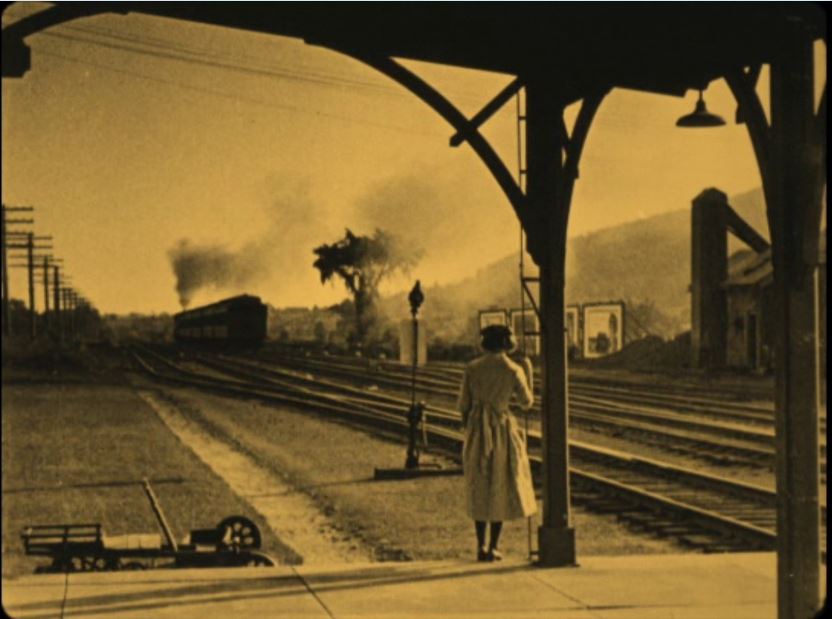
Here we start with a small town called Demopolis in which young Hester (Seena Owen) is gradually suffocating, every train heading away breaking her vaguely ambitious heart just a little bit more and with all around her seemingly satisfied with their lot. “She was filled with a passion for excitement and luxury – and certainly neither of these could be found in the boarding house of Mrs Elmira Simmons…” with every mealtime a thudding reminder of the past, present and potential future if she stayed.


Her one bright spark is boyfriend Jerry (Matt Moore) who loves her even more deeply than he loves the town and his job at the General Store. He’s scrimping and saving but $150 a month isn’t going to buy Hester the lifestyle she wants as she tells him they’re simply too poor to marry.  Borzage and his cameraman Chester A Lyons, capture some idyllic scenes of country life, especially the town’s annual picnic with egg and spoon plus sack races, dancing and music; it’s like something from a Sjostrom outdoor adventure with some craggy-faced locals providing realist flavour.


Hester and Jerry make their way for some peace and quiet and have their faithful disconnection as he proposes and she smiles briefly before declining as they talk into the night. She sings a partially finished song for them and tells him she will finish it later… only much later, as she decides she must find herself in New York. Hester’s train leaves Jerry abandoned as Frances Marion writes, two decades before Cole Porter, that to say goodbye is to die a little…


To New York City and a jump five years ahead, years of struggle… in which old beliefs and high ideals went one by one… Until luxury claimed her – on its own terms. Hester’s journey is only thus hinted at but she is now living in a fine appartement maintained by her wealthy boyfriend, the presumably married, and certainly much older, Charles G. Wheeler of Wall Street (J. Barney Sherry). She has other friends with names such as Kitty (Ethel Duray) and Speed (Charles Craig) and life is one long, well-dressed, well-watered, party with jazz music on tap and plenty of joie de vivre. Hester has a Rolls from Charles but now wants a $22,000 fur coat from her sugar financier, and she’ll get it too by making him have to out-compete friend Speed’s generosity.


The wages of sin is death. If sin has any wages, some of us are going to collect a lot of back pay!


On a weekend away, she asks to get dropped off in the old town and, spotting Jerry, reconnects with the man who has never stopped loving, or waiting, for her. Jerry is now on $200 a month but, as Hester says, that wouldn’t even cover her mink stole. Hester still loves Jerry but she loves the high life more… The story moves on and, as the parties continue, Hester in platinum gown dancing on a chair, we see Jerry fighting in Europe, and calling out Hester’s name as the bombs fall in No Man’s Land. The film is about to pivot as Hester reads of Jerry’s heroism and his return, injured from the front… everything she knows is about to be challenged by the conflicting realities of love, war and commerce.


I love a good location
 

It's a measured film, slow by modern standards but the narrative doesn’t feel forced from Borzage who is more than willing to let his talented cast pull the viewer along. In this so much rests on the almost ever-present Seena Owen whom I have not seen before but is so good here. I must seek out more of her work.


The new score from Andrew Earle Simpson is also very enjoyable, lyrical and rich in tone it provides the sincerest of accompaniments and elevates the whole experience; I’d love to hear it live. Until then, we have this excellent release from Undercrank which in addition to a 4k restoration of The Valley of Silent Men** also includes a video essay on Borzage at Cosmopolitan, Randolph Heart’s company for which he made these films. The sets also have informative Film Facts that run along the intertitles to explain the background to the films.


The set is being generally released in February/March 2023 and you can order direct from Undercrank right here.


* The Stories of Fannie Hurst, (The Feminist Press at CUNY, 2004) Fannie Hurst, edited by Susan Koppelman and with and introduction from Grace Paley.


** This film does raise the question of whether Ben Model can see Steve Massa’s house from his roof… if there is a Valley of Silent Men, these two surely live in it, along with Mr Simpson!


Saturday, 6 July 2013

The birth of the blockbuster… Intolerance (1916)


“There’s almost nothing in the entire vocabulary of cinema that you won’t find in this film…” Orson Welles*

This was DW Griffith’s follow up to The Birth of a Nation and a film intended to show that, contrary to appearances, he was unwilling to tolerate intolerance… Armed with a hefty budget following Birth’s huge success, DW was able to consolidate massively on the techniques employed in the earlier film and his ambition ran riot creating narrative elaborations which are still a challenge for modern viewers.

Featuring incredibly lavish sets, 125,000 extras and 7,500 horses, Intolerance is technically far more advanced than the modestly budgeted Birth.  There is an abundance of camera mobility and smooth cutting between all the scenes (even BoaN had rough edges…). 

Thinking big on a budget...
There is also "the single most amazing shot in the history of film" as Billy Bitzer’s camera descends from some 150 feet in the air down towards the throng, as Byzantium celebrates its initial victory over the Persians. The camera lingers in medium shot showing the main characters amidst thousands of extras. Griffith repeats this graceful moment a number of times and it must have had the impact of a dozen Imax screens in 3D… genuinely astonishing.

Around a repeated framing shot of Lillian Gish sitting over a crib, representing Eternal Motherhood, Intolerance weaves four separate tales from different periods in history, all of which are intended to show the impact of intolerance on the scale of human misery.

Two roles for Constance Talmadge
In every tale it tends to be Griffith’s women who are the focus and there are striking, very different, performances from Mae Marsh, Miriam Cooper and Constance Talmadge in particular.

This a complex and difficult narrative to describe without getting bogged down… but I’ll have a go.

New York City 1914 

The Mother and the Law is set in “modern day” America in 1914 and shows innocent working class folk being crushed by a mixture of industrial relations disputes and moral crusaders. Interestingly Griffith demonises the female “Uplifters” who force goodness on their lowers and do more harm than good. Was this another instance of his struggle to accommodate changes in suffrage?

Mrs Jenkins and the "Uplifters"
Here Mary T. Jenkins (Vera Lewis) the sister of mill boss (Sam de Grasse), comes under the sway of the Uplift movement and causes her brother to invest too heavily in their activities. This leads to his having to cut wages by 10%... a strike ensues which is forcibly put down by militia and the factories armed protectors.

How the other half dance...
I had to check here but there were numerous examples of force being used against trades unions and strikes being curtailed by organised violence from the Great Railroad Strike of 1877 to the 1912 Lawrence Textile Strike…

“They squeeze the money out of us and use it to advertise themselves by reforming us…” feels a little like DW mistrusting liberal sentiment though…

Mae Marsh from girl to woman
The victims of the strike are forced out and have to move to the City. The Dear One (Mae Marsh) struggles in near poverty whilst The Friendless One (Miriam Cooper) falls in with the wrong crowd, a Musketeer of the Slums (Walter Long) who leads her down the path of prostitution.

Robert Harron, Walter Long and Miriam Cooper
The Boy (Robert Harron) is also led into a life of crime. Harron is superb and it’s so sad that he died just a few years’ later after failing to get the lead in Way Down East (R Bartlemass got that).

The Boy tries to go straight inspired by his developing romance with the Dear One but shortly after they wed, he is framed by the Musketeer. Their child is born after he is sent down and Dear One loses even this after the Uplifters decide she is an unfit mother.

Ready for my close-up Mr Griffith...
The Boy is released and confronts the Musketeer who is shot in a jealous rage by the Friendless One (why couldn’t they just have had names DW!?)… But it’s the Boy who gets tried for the murder as she nervously keeps her deadly secret.

Will injustice prevail?  Will the modern day Pharisees crush hope through their selfish desire to do good on their terms…

Babylon 539 BC  

Nothing could be further from working class struggle than the splendour of ancient Babylon although any similarities with Hollywood excess are more than co-incidental.

This segment is really where the scale of Griffith’s vision  really becomes apparent… literally.


Griffith said afterwards that he should just have made the Babylonian story but without the juxtaposition and the immensity, Intolerance just wouldn’t be the same…

Here the very secular conflict between Prince Belshazzar of Babylon and Cyrus the Great of Persia has its foundation on the religious intolerance arising from two rival Babylonian gods, Bel-Marduk and Ishtar. The film doesn’t go into the precise differences in belief but it’s clear that the Babylonians are more than a little decadent…

The Princess Beloved
All is excess in the court of Prince Belshazzar (Alfred Paget) who offers to build an even more splendid city than Babylon for his favourite, The Princess Beloved (Seena Owen).

Against this royal backdrop stands out The Mountain Girl played by Norma’s little sister Constance Talmadge. Constance has all of the Talmadge energy with a more comedic flavour and helps rescue this section and the whole film from earnest indulgence… She not only roughs up most of the male cast but can seemingly handle archery, battle-gear and chariot riding.

“…touch my skirt and I’ll scratch your eyes out!” she says as she munches on a spring onion…

The Mountain Girl impresses the Prince
The Mountain Girl rejects the advances of warrior-singer Rhapsode (Elmer Clifton) as her Prince gives her royal pardon to marry who she likes… she’s the most loyal subject in the whole city.

The High Priest of Bel-Marduk (Tully Marshall - who I’d last seen in The Devil’s Needle), plans to betray his Prince as he secretly worships Ishtar… Cyrus’ armies approach the city and all hell breaks lose.

These battle scenes are amongst the most impressive in all silent film and, as with Ben Hur, involved a lot of actual violence amongst the immense cast of extras. Assistant director, Joseph Henabery’s interview with Kevin Brownlow in The Parades’ Gone By gives an excellent first-hand account of this along with the making of Intolerance… Griffith’s ability to martial story and crew is truly remarkable.


The siege is an epic struggle, literally with…war machines, elephants, beheadings and bodies falling off the massive battlements all in glorious tints of red, purple and blue as the siege of Babylon is won by Belshazzar’s forces.

Then we have Bitzer's stunning camera move: a 1000 Caligari’s in one as the camera swoops down over the huge set teeming with a living mass dwarfed by the sheer scale of the set…

Carry on Babylon
Meanwhile the mind is further boggled as… “in the Temple of Love – The sacred dance in memory of the resurrection of Tammuz.” Babylon and on… more de Mille than Griffith…

But it’s not over as the rebellious priests prepare their ultimate betrayal and the massed armies return under brooding red skies…


Renaissance France 1572 

This section is shorter yet no less affecting as religious intolerance leads the Roman Catholic royal family to order the death of Protestant Huguenots in St. Bartholomew's Day Massacre.

In the court of the conflicted King... 
There’s a good cast with Frank Bennett as the conflicted King Charles IX of France dominated by his spiteful mother Catherine de Medici (Josephine Crowell) and his effeminate younger brother Monsieur La France, Duc d'Anjou (Maxfield Stanley)… From a modern perspective this looks like Griffith’s “intolerating” women and gay men…

This man has two dogs in his doublet...
There’s a romantic sub-plot between Brown Eyes (Margery Wilson another Griffith child-woman) and
Prosper Latour  (Eugene Pallette ... who’s long career included  Going Straight with Norma T and Mantrap with Clara B). The wonderful Spottiswoode Aitken plays Brown Eyes' father – I’ve  recently seen him in BoaN, Nomads of the North, The Eagle and The Goose Woman.

Spotiswood Aitken (middle), Margery Wilson and Eugene Pallette
Catherine has an audience with the King to secure his signature to the order for the massacre of St Bartholomew. At first he refuses to sign…but the intolerants sway him after a long session: “We must destroy or be destroyed.”

St Bartholomew’s morning, the bell toll and the massacre begins…


Judea c. 27 AD
This is the shortest section but the pivotal one in terms of Griffith’s “message”. “The Nazarene” (Howard Gaye) attends the Wedding at Cana where the groom is George Walsh and the bride is Bessie Love…

Bessie Love (centre)
He turns water into wine and makes the wedding party much to the displeasure of the Pharisees… “meddlers then as now. ‘There is too much pleasure-seeking among the people.’”

The Pharisees are shown as self-righteous hypocrites and the ancient version of the Uplifters and the Catholic extremists in France.

Is one of the Pharisees Erich von Stroheim?
Jesus prevents an adulteress about to be stoned: “He that is without sin among you, let him first cast a stone...”

Precisely DW.

The Nazarene is last seen labouring under the weight of the cross outside the Roman Judgement Hall, after the verdict of Pontius Pilate: “Let him be crucified.”

=============================================                          

The cuts between stories get quicker as the film nears its climax(es)… and the stories simply smash together – “Intolerance, burning and slaying.” A very modern mix of suspense, spectacular action and the hope for a happy ending… but not everyone can be saved.

As the film winds up, angelic hoards descend over a bloody battle field and the fighting stops, prisoners dissolve into a prison wall, children play in the fields… and we see the last glimpse of Eternal Motherhood… Lillian has been sitting there a long time!

Battlefield playground...
“When cannon and prison bars, wrought in the fires of intolerance…
And perfect love shall bring peace forevermore.
Instead of prison walls – Bloom flowery fields.”

As Mr Welles said, Griffith was anchored in Victorian theatre and “old fashioned” in parts of his outlook yet his technical mastery was so modern: this was the birth of the blockbuster.

I watched the Kino DVD which is taken from an excellent quality 35mm print and runs out at 3 hours 17 minutes. It features an excellent score from experienced film composer Joseph Turrin that expertly mixes a modernistic movie tone with more contemporary themes.

Interestingly, Intolerance was also released in two other versions focusing on the single stories, The  Mother and the Law and Babylon… this latter film featured a less downbeat resolution for Constance’s character. This clip is on the Kino DVD along with excerpts from Cabiria (1914) and TheLast Days of Pompeii (1913), both of which influence Griffith and have featured on this blog.

It helped to provide an enjoyable watching experience in spite of the film’s length and convolution. Griffith’s best? Flawed certainly but a masterpiece that is still exhilarating as much as it is challenging.

 *From the introduction to “The Silent Year: Films from the Collection of Paul Killiam”

Ruth St. Denis and Ted Shawn
Top trivia: The Denishawn Dancers played the Dancers of Tammuz… A sixteen year old Louise Brooks joined them six years later, progressing to dance alongside Ted Shawn before being fired by Ruth St. Denis for wanting life handed to her on a “silver salver”…. A phrase she kept locked away for rainy days!