Showing posts with label John Gottowt. Show all posts

Monday, 16 May 2016

A light in the museum… Waxworks (1924), with Stephen Horne, Barbican


This was the last screening in the Barbican’s season of Weimar expressionist films (as opposed to films that are just very expressive…) with Stephen Horne, introducing as well as playing, quoting Lotte Eisner’s later-life conviction  that there were only two fully-fledged expressionist films - Von morgens bis mitternachts, and Caligari – along with the third segment of this film which, as Stephen promised, was well worth the wait!

As the Sun cracked the flags in the Barbican’s concrete courtyards, a substantial audience clearly preferred silence to shining as we gathered at the Centre’s lowest point: The Pit cinema.

Olga charmed by Emil
Waxworks was directed by Paul Leni who subsequently made The Cat and Canary, The Man Who Laughs and others in Hollywood. It is one of the first portmanteau horror/fantasy films with three stories all contained in a framing sequence set in a house of wax.

Leni recruited three of the Weimar’s leading men: Jannings, Veidt and Krauss who were respectively, corpulent, terrible and cutting!

Luna Park
A fairground – Luna Park – a whirl of double-exposed rides and lights, a young poet (William Dieterle) paper in hand, looking to respond for an advert for “an imaginative writer for publicity work in a waxworks exhibition”. He arrives at The Panopticum, a booth run by an elderly showman (John Gottowt) and his young daughter Olga Belajeff.

Haroun
“Can you write startling tales about these wax figures?” asks the Showman before introducing his milky-faced cast of characters: Spring Heeled Jack (Werner Krauss), Ivan the Terrible (Conrad Veidt) and Haroun-al-Raschid, Caliph of Bagdad (Emil Jannings). Seeing the Caliph’s detached arm, the poet decides to write a story of how he came to lose his limb… the camera flicks out of focus and we’re in a wonderful, cartoonish Arabia looking on a paper-mache palace and plastic palm trees.

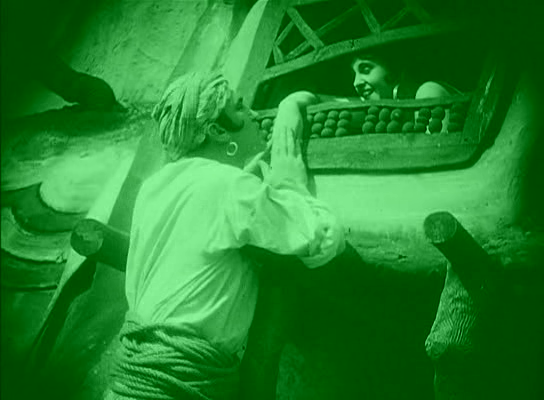
Assad canoodles with Zarah
The poet casts himself as Assad the Baker with the showman’s daughter as his wife – Zarah – one of the most beautiful women in the city not already married to the Caliph (he has a wife for every day…). The baker bakes and makes eyes at Zarah whilst the Caliph is pampered on the roof of his palace losing, badly, at chess. Distracted by the smoke from the baker’s oven the Caliph, perfectly reasonably, sends his Grand Vizier and his men to kill the baker but when they arrive they are distracted by Zarah’s beauty…
The Caliph's Palace is almost like a living thing...
The Caliph decides to investigate this woman for himself whilst Assad, forced to prove his manhood after Zarah realises that if she can catch the Grand Vizier’s eye she could do better, heads off to the palace to steal the Caliph’s magical Wishing Ring…

Cue a masterclass in kingly carousing from the protean Jannings, fleshy-grotesque in heavy padding, over-weighted turban and wicked moustache… he smiles, he gurns he licks his lips but he has charm enough to stop Zarah – and the audience – from running. Can Assad complete his task and keep his head and his wife? Have you read the Arabian Nights?

Ivan
Next up the Poet turns his gaze towards Ivan the Terrible and a far more sinister tale ensues as Conrad Viedt’s Czar exhibits a sinuous delight in watching the grains of sand count down his tortured victims’ last seconds of life as they pass from chamber to chamber in his hourglass. It’s a horrible concept that perfectly encapsulates his silicon psychopathy.

Time waits for no man
But Ivan trusts no one, not even his poisoner-in-chief, who he has hunted down and killed but not before the man can write his master’s name on the terrible timer. Ivan is unaware as he continues his abuse of his subjects – terrible and not at all awesome in this context. When he does find out his solution reflects the tortured hyper-paranoia you hope haunts every psychotic despot – those to come and those passed.

Jack
The long day closes with that Eisner-authenticated expressionist sequence in which Spring-Heeled Jack comes to life and pursues the young couple in shadows and light as Leni let’s rip with every trick from the expressionist cookbook! Conrad Veidt’s sunken-cheeked ferocity aside, it is the film’s most genuinely haunting moment and right till the close you eye the Jack waxwork a little nervously.

Waxworks is a sight for sore eyes (hayfever and long drives…). Leni’s sets are superb throughout and Helmar Lerski’s cinematography brings them to life from the oppressive low-beamed ceilings of the Kremlin to the nightmarish exposures for jumping Jack flash.

Jack's menacing montage
Stephen played with his customary lyricism and control – playing the electronic keyboard always anchored with the Barbican’s splendid Steinway. Flute and accordion were also played all in sympathy with the film and as part of a remarkably well-structured improvisation. Waxwork’s range of moods presents a challenge to any musician, especially the curious mix of comedy, drama and horror (not to mention Emil!) but, once again, Mr Horne made it look like he’d spent weeks planning this all out with the ghost of Paul Leni or, possibly his animated wax figure…

Waxworks is available in its fully-restored length complete with tints, from Kino and you can order direct as well as from the long river that winds past localised tax-returns…

Friday, 19 December 2014

Stumm kraftwerk… Algol: Tragedy of Power (1920), The Barbican with Stephen Horne


Piano, flute, accordion, synthesiser, bell, book, bowl... Theremin! The question has to be asked: just how many hands does Stephen Horne actually have? He played all – save the book (a weighty biography of David Lean) – during a suitably kitchen-sink improvisation to accompany this remarkable, sprawling, science-fiction epic. What’s more, he appeared to be playing at least three at a time during certain passages…

In his introduction, Stephen revealed that he’d recorded a score for an Edition Filmmuseum DVD which is still in the works. Tonight’s music – a “gilding of the improv lily” as he put it – was based on the original but expanded to fit this stellar reconstruction. His performance was a blur of sensitive tonality as he switched between themes as easily as instruments: modern silent cinema's most elegantly-innovative one-man band!


Magical machine
Algol: Tragedy of Power (Algol. Tragödie der Macht) proved to be far grander in scope than I’d expected, featuring a huge range of locations, a cast of hundreds and stunning sets from Walter Reimann, production designer of Caligari – the expressionist spring to Algol’s autumn in 1920.

As my learned mother-in-law explained, the film touches on so many classical themes in its tale of power corrupting absolutely… indeed, whilst it is nominally science fiction it could easily be a gothic fantasy with wizards and double-dealing devils. As Arthur C Clarke once noted, any sufficiently advanced scientific culture would be indistinguishable – to us - from magic and here the “science” isn’t ever explained it is just is, working to offer fantastical change and opportunity.

Watching any German film of this time you’re also always aware of the context… a man over-reaches by, literally, becoming power to the World; his good intentions succumbing to a disingenuous offer of help from another planet. Any contract with a devil must always come at a price… and there was more to come.

The wheels of industry turn
Directed by Hans Werckmeister, Algol was a lost film for many years and was only recently recovered, leading to the Edition Filmmuseum restoration. What is now on evidence still feels like it may be missing the odd fragment as the story sometimes makes an unexplained leap or two. There is also no English translation on the print and so tonight’s projectionist had to project one onto the title cards: live music, live visual mix… silent cinema really comes to life at the Barbican!

The story is in four parts with a prologue establishing the existence of a shadowy planet, Algol, which watches down on Earth with unknowable intent embodied in the figure of Algol (John Gottowt) a being who rules and perhaps is that world. Trivia... in reality the Algol System is in the Perseus Constellation and is known as the Winking Demon Star because of its unusual light variations.

John Gottowt
On Earth men hack at coal in the saturnine darkness of mines – hell is underground as well as out in space and, indeed, one of the characters is even called Peter Hell (although Hell is German for bright, intelligent or fair). Robert Herne (Emil Jannings) is one of the strongest of the miners toiling away with the aid of his love Maria Obal (Hanna Ralph) a woman who’s thoughts run as deep as the mines and who holds a candle not just for Robert to work by but, in her heart, for Peter Hell (A Cottage on Dartmoor’s Hans Adalbert Schlettow).

They are visited by the daughter of the mine owner, Leonore Nissen (Gertrude Welcker) who, having come of age, is to inherit the business. She views the workers with a mixture of compassion and tredidation with a little more than passing concern for Robert as she is almost squeezed against the rock face by his masculine bulk.

Hanna Ralph
It’s always a pleasure to watch Herr Jannings at work and, as ever, he is a master of physical expression, looming large over his pickaxe, a surly mountainous man… unimpressed by this new owner and her efforts to reach out.

It is now that Algol intervenes, travelling from his world to emerge in the mines in the guise of a worker. Robert takes him under his wing and offers him board at Maria’s house. Algol takes a shine to her to the extent that he wishes he could be human at one point but Maria’s heart is torn between Robert and Peter who soon announces that he is leaving to travel.

Algol enraged
At some point Algol decides to challenge this new world and as his thoughts turn dark he vows to become a devil: to torture these humans who he wanted to emulate.

He spots Robert’s heightened sense of social responsibility and ego, then offers him a year-long deal during which he will have access to power from Algol with which to make his mark. The bargain echoes those made in The Student from Prague, in which Gottowt played another demonic figure with a sinister trade to make, and Faust in which it was Janning’s turn to bargain.

Emile Jannings
Robert seizes his chance with both hands and establishes a mighty power plant capable of supplying the whole World indefinitely. Endless energy means there’s no need for coal and fearing for their livelihood the miners round on Leonore. Robert arrives to save her and his former colleagues: half of the plant’s profits will go to them and the country shall be a paradise for the partially employed as the rest of the World pays all it can to secure the endless energy…

The World enslaved by power
Robert marries Leonore whilst Maria is frightened away by this new enterprise and heads off with returning Peter to the pastoral peace of the neighbouring state: a place where the simplicity of life on the land seems to make the people happier.

Time moves on and new generations arrive; Robert is feted as the most important man on the planet and plans to pass the secret of the perpetual power onto his effete son Reginald (Ernst Hofmann). But Reggie is easily distracted and is targeted by Yella Ward (Erna Morena) a vamp of the highest order who entraps the young man with her huge dark eyes, imploring him to take his father’s secret before she will give of hers…

Yella has Reggie just where she wants him...
Meanwhile, old Peter has passed and his son has grown up to be the spitting image… complete with his father’s nobility and leadership qualities. They have to trade their produce for power from the Herne plant and as the demands become ever more ruinous he vows to take the fight to Robert: share the power with the World and do not use it for selfish profit...or else.

Peter makes his way to the Herne estate and climbs over the wall to encounter Robert’s daughter Magda (Käthe Haack) and there’s an instant connection of course... She leads him to her father who welcomes the son of his old friends. He won’t like what he has to say though…

Peter leads a revolt...
No spoilers…  All the pieces are in play for the final act - will Reggie be able to ward off Yella's manipulations, can Magda and Peter overcome their parent’s differences, has Algol only set out to destroy and when will there be a harvest for the World? It’s a huge story and one that has enduring relevance...

Werckmeister pulls the elements together well even though there are those narrative jumps that may be down to lost material… for a film with such an obviously-large budget you’d expect he’d have enough spare to make the few additional shots that would better explain Algol’s motivations or show Robert revealing his secret to Magda?  Minor quibbles aside,  Algol is most definitely an experience and a bare-knuckle ride through many moods from the alien mystery of Algol, the grinding mining, grand houses, poor houses, garden parties, orgies, industrial espionage, political intrigue, pastoral idyll to weird dirty dancing – after almost two hours and hundreds of shots you certainly know that you’ve been in a cinema!

Sebastian Droste: "Two ladies, And I'm the only man, ja!"
Janning’s performance matches this intensity throughout as does John Gottowt's - Algol’s fury seems to know no bounds… Counter-balancing this is the show of elegant restraint from Hanna Ralph as Maria who always knows… The expansive cinematography of Axel Graatkjaer and Hermann Kircheldorff adds to the feeling of Algol as a major event and this must have been one of the biggest releases of the post-war period. We are lucky to still have it.


Along with The Student of Prague, this film has been on the Edition Filmmuseum forthcoming releases list for some time with its projected DVD having it twinned with Karl Grune’s Schlagende Wetter (1923). There is a tantalizing two minute sample on the site from which I have appropriated some of the images above… As you can see, it’s their copyright so, please go ahead gentlemen and release the darned thing soon: you have the power.

Saturday, 25 October 2014

Clear-view mirror… The Student of Prague (1913)

 
“Where thou art shall I be unto the hour when I seat me on the stone of thy grave…”

This film is often described as being perhaps the first true horror feature film, or maybe that’s just the first actually scary horror feature… It stars and is co-directed by one of the most influential figures in German silent film, Paul Wegener, later a Pharaoh, a Mummy, a Sheik and a Golem... and is now a magnificent 82 minutes long.

I had previously only seen a dilapidated cheap DVD print from an hour-long multi-generational video and wondered why such a major film hadn’t been restored. Well I might be the last silent kid on the block to find out but the film has been revitalized by the Filmmuseum München using a variety of sources including prints from as far afield as Japan and the USA: and what a joy it is to behold – almost like finding a lost film.


The Filmmuseum have produced a version closer to the original length and have also included a performance of the original score by Josef Weiss which further adds to the feeling of Prague Regained. The music has been adapted for the chamber orchestra Orchester Jakobsplatz which is on a mission to revive the musical heritage of Jewish composers.

Even through the grey haze of the truncated version this is a rewarding film to watch and you can only imagine the impact it would have had on contemporary audiences. But with the 2013 restoration now we can truly see how powerful the story is…

Wegener and Rye plan their story in Prague
The Student of Prague (Der Student von Prag) was co-directed by Stellan Rye along with Wegener, was scripted by Hanns Heinz Ewers based, in outline, on Edgar Allan Poe’s story William Wilson* with a bit of Faust thrown in for good measure…

It concerns a talented swordsman and penniless student, Balduin (Wegener) who is fed up with his lot and all but ruined, the high-life having drained his funding and his hope (bet he wasn’t on a full grant!). The film open with him morosely ignoring the revels of his fellow pupils and the charms of the dancing waitress Lyduschka (Lyda Salmonova, who has to do a lot of dancing and climbing too…).


He is approached by the mysterious Scapinelli (John Gottowt) an old man with a reputation for sorcery and other miss-deeds, who tells him that there are other paths he could follow.
The two go walking and encounter the local hunt of Graf von Schwarzenberg (Lothar Körner). The Graf’s daughter son, Komtesse Margit (Grete Berger), is engaged to be married to her cousin Baron-Waldis Schwarzenberg (Fritz Weidemann), but the two argue – she does not love him – and her horse bolts running past Balduin and into the river.

The young student doesn’t hesitate and rescues Margit from the water with some difficulty judging from Wegener’s attempts to lift Miss Berger: clearly weighed down by her voluminous and water-logged under-garments. Smitten, he returns to her house where he realises that the social gap between them is too large to ever permit a relationship… especially with her promised to the Baron.


Deflated Balduin frets alone in his apartment when suddenly Scapinelli appears and unloads a pile of coins and bank notes offering them to the young man in simple exchange for just “one thing in his rooms”. Not seeing the catch, Balduin signs on the dotted line and is shocked when Scapinelli takes his reflection from the mirror.

But Balduin cannot see the harm in losing his reflection, blinded by his new good fortune and the possibilities it brings. He works his way into the world of the wealthy and gradually gets Margit’s attention. All seems to be going well but the Baron does not take kindly to his new competitor.

Can you spot Lyduschka?
At the same time, Balduin is being stalked by Lyduschka and there is an excellent scene in which she scales the walls to spy on the lovers from the balcony with ancient Prague gloriously visible in the background. She sees Balduin’s illicit promise to Margit and finds message from him arranging a rendezvous with her… Lyduschka makes sure finds its way to the lady’s intended.

The young nobleman challenges Balduin to a duel and, even knowing the latter’s skills as a great swordsman, selects a blade as his weapon of choice. If he expects the fencing expert to use his skills to avoid serious injury his uncle tries to make certain by getting Balduin to promise to leave him unharmed.

But it is now that the full extent of Scapinelli’s evil scheme becomes apparent, as he sends Balduin’s double to fight the duel and to kill his opponent...


No spoilers: A wedge is driven between Balduin and Margit, he climbs into her room to try and explain yet his doppelganger appears out of the shadows just as she realises her love has no reflection. There can be no escape and as the confrontations escalate can Balduin kill his own shadow without destroying himself?

The two Balduins are filmed really well…the film’s tour de force of special effect with Wegener acting well against his shadow self. A double-exposure trick that’s been done a lot worse many times since but is here executed to near perfection with the spruced up images only highlighting the sublime technique on view.


Prague in the sunshine makes for an excellent backdrop adding quality depth of field to what could have been a shallow gothic melodrama. Wegener does well as the “student” (I think he was in his late thirties at the time) yet is matched by John Gottowt’s fiendish energy as Scapinelli…

The Student of Prague is still available on the abbreviated cheapo DVD but to get a clear view of the two sides of Paul Wegener wait for the Edition Filmmuseum DVD set which has been in the works for well over a year – I’ve been checking regularly but there’s no release date as yet. Don’t hesitate when it does become available!


*A version of William Wilson featured as part the 1967 horror compilation, Les Histoires Extraordinaires. Directed by Louis Malle it starred Alain Delon as the eponymous lead who becomes haunted by his own reflection. In this version of events Wilson is sadistic and his counter-part seems intent on preventing his wrong-doings. In spite of also featuring Brigitte Bardot the sequence fails to engage and is vastly overshadowed by Fellini’s Toby Dammit, the final story in the set. Featuring a magnetic Terrence Stamp, Toby Dammit is a tour de force showcasing Fellini’s still outstandingly-original cinematic vision.

There’s a nice review of that mixed bag to be found on Dusty Video Box’s site here. The Student of Prague is undoubtedly the better take on the tale in spite of the gap in technology… just goes to show that substance wins over style, sound and colour…