Showing posts with label Cyrus Gabrysch. Show all posts

Tuesday, 14 April 2026

Spring Silence... Kennington Bioscope 9th Annual Silent Weekend Day Two


This is Part Three of the Cinema Museum Silent Spring long weekend, I’m putting my hot takes out in reverse order because… why not!? A brilliant few days incorporating the British Silent Film Symposium 2026 run by Kings College London and the 9th Kennington Bioscope Weekender.


Ypres (1925) with Cyrus Gabrysch, introduced by Lawrence Napper


“… fantasy must cower before the stark realities of mankind’s agony – such as Ypres.”

Former soldier Blair Philips writing in The Stoll Herald, November 19251


Philips was qualifying his description of this film as being like a “dream…” emerging from “the mist of yesterday…” which would still be a living nightmare for those who survived one of the bloodiest and most desperate battles of the Great War.


Directed by Walter Summers, using a mix of reconstructions of the Battle of Ypres mixed with contemporary footage from both side, this was one of a number of films aiming to pay tribute to the loses and bravery of a nation still in mourning. Produced for British Instructional Pictures, Ypres followed on from The Battle of Jutland (1921), Armageddon (1923) and Zeebrugge (1924) in this approach and also focused on the experience of individuals to humanise the almost inconceivable events.


A series of maps are also used to show how the British and Commonwealth soldiers in particular were able to, just about, defend the Ypres Salient – a bulging line of attack/defence which emerged as the warring parties fought their way up through North-Western Europe as the Germans attempted to outflank their opposition and cut off supplies from the French ports. It’s a film and a series of events I could easily spend a lot more time on – so watch this space and read Lawrence’s book (link below).


Summers manages to make an entertaining as well as instructional film and the comic asides were more necessary for the audience then rather than now, although we don’t have to look far to see the horrors of war as filtered through the modern apparatus of “instruction”.


“Whole companies were annihilated and the marvel is how anyone remained to break up the infantry attacks which were delivered again and again.”

An officer of the 1st Gloucestershire’s who was at Gheluvelt


Rediscoveries and restorations Part II, with John Sweeney, introductions from Dave Glass and Glenn Mitchell


The Cattle Rustler’s End (1911), starring J. Warren Kerrigan as Curley Temple (Shirley not!?)  and Pauline Bush as his sweetheart Fannie, was a pacey tale of illicit love and cattle theft directed by a young Allan Dwan. Fannie’s father disapproves and so the couple meet by a tree where, unfortunately, a cattle rustler has also hidden the branding tools of his evil trade. One thing leads to another and Curley is accused and, as usual, it’s left to the woman to sort things out. This was another rare gem transferred from a nitrate 35mm print for digital restoration by Bob Geoghegan’s Archive Film Agency.


Racing for Life (1924), a five-reeler directed by Henry MacRae and starring Eva Novak and William Fairbanks, featured some extensive time-dilation as motor cars raced around their practice lap and, in the minute or so of elapsed time, our hero, seemingly miles away, has to fight off his kidnappers – including his own brother – race on foot, steal a police motorbike and run across the track to the pit in order to start half a lap behind the others.


This was, without doubt, great fun though and, coming on 35mm from Tony Saffrey’s collection, almost the first time in a century that this extraordinary race has been seen and it was a thrill!!


There was also time for a quick Mabel Normand film, Mabel lost and Won (1915) from Bob Geoghegan’s collection and which is so rare it doesn’t even have an IMDB page! Once again the KB brings you the rarest of the rare as well as the finest of everything else (yes, I work in marketing and I cannot lie!).


Charles Vanel, one man alone with his cod...

Pêcheur d’Islande (Fishers of the Isle) (1924), with Stephen Horne, introduction by Liz Cleary


I was rather grumpy (Liverpool FC might have lost again?) when watching this in Pordenone in 2023 but this film was transformed for me here with Liz Cleary’s introduction being a large part of that. Liz became interested not just in the film but in the novel from which it was drawn, as well as the location and the way of life depicted, being driven to find out more and even to visit the locations. Inspiration is infectuous but she also added so much context to enable me to see the strength and purpose of the film.


Perhaps it’s also as I’ve just watched Rose of Nevada, Mark Jenkin’s new film about the lives of trawlers on a small fishing boat. If you go to Whitby, Fleetwood or former fishing villages such as Aberdaron in North Wales, you will see grave after grave marking generations of deaths at sea and for this reason too, the film’s downbeat yet also inspiring narrative rings so true. Without giving any spoilers away, sometimes in cinema deaths have to actually mean something and not simply be a plot point… Also, the exhausting practicalities of line fishing here and trawling as in Rose are humbling in themselves.


Pierre Loti abides...

Liz’s pilgrimage to the film’s locations, Paimpol and Ploubazlanec in northern Brittany, gave us a sense of the unchanging waters and she also gave us the background of former naval seaman Pierre Loti’s 1886 novel on which the film is based. Loti was an extraordinary character as the photograph above might suggest and the story drew on his experience of the Far East as well as the Atlantic – his ability was in his description of the land and the sea and director Jacques de Baroncelli crafts a poetic tale that pulls the viewer in with stunning locations, and compositions as characters fade in and out of each other’s thoughts: the shooting of one character features flashing images of his loved ones in the manner of Abel Gance.


Charles Vanel – who really did have an issue with transport in his career (c.f. The Wages of Fear) – is an unknowable rock of conflicted emotion as Yann the fisherman and elfin Sandra Milovanoff is sadly beguiling as Gaud – the woman who does battle with his affection for the stormy seas.


Stephen Horne’s accompaniment included Breton folk songs as well as his own improvisations, as usual it made for the perfect connection between the sentiments and the time.


Harry, Bebe and Snub play with shoes


Focus on… Rolin’ with Glenn Mitchell and Dave Glass, accompaniment John Sweeney


Glenn Mitchell and Dave Glass resumed their ongoing mission by discussing the history and early output of Hal Roach’s Rolin’ company before it rebranded as the Hal Roach Studio and the Kings of Comedy did battle – Sennet vs Roach! Here we find a number of soon to be extremely famous folk such as Snub Pollard, Bebe Daniel’s and Harold Lloyd, just not the Harry we’re that familiar with.


Initially Lloyd played the role of Willie Work in one-reelers but by 1915 “Chaplinitis” was in full bloom and he wore an odd two-whisp moustache and tight-trampy clothes as Lucky Luke – the Chaplin you can meet between reels?  Giving them Fits (1915) was Lloyd, Pollard and teenage Daniels’ debut for the company and is a riotous tale of events in a shoe shop in which Harry is for some reason called Luke the Fluke – a chance-based play on words.


Luke proved popular enough to move to two-reels and under his own name, “Lukes” as opposed to Rolin’s. Pollard also got his own series and in 1918 Roach started making films with a fellow called Stan Laurel and the rest was, eventually, history. You can’t help but be infected by Glenn and Dave’s enthusiasm and this reflects the high energies of these wonderful comedies and the fast-developing world of the business of laughter on screen: there was no luck involved, just talent and application.


Irene (1926), with Stephen Horne, introduction by Kelly Robinson


Colleen Moore knew the score alright and she was one of the most vivacious personas cinema has ever seen: an icon of the Jazz Age who even had an F. Scott Fitzgerald-autographed mini-copy of The Great Gatsby in the library of her legendary dolls house. Kelly Robinson showed the evidence in her introduction to this zippy film which showcased Moore at the height of her powers and popularity.


Directed by Alfred E Green, Colleen plays the titular Irish-American as the daughter of the Ma and Pa O’Dare – played by Cork’s wonderful Kate Price (who even mimes in Oirish) and Charles Murray who presents as drunk for most of the story. Is it just me or whether The Irish only ever drunk and/or policemen in most silent films? Anyway, Irene is the scatty but definitely smart heart of the family of five, sorry foive!, who scrape by in an apartment until she loses her job.


Madame Lucy – whose business motto is “Pay cash – look what happened to the Light Brigade – they charged!”


Colleen and Kate from Cork

After being kicked out by Ma who, y’know, was only joking… Irene moves to New York and gets a job – that luck of the Irish! – delivering parcels to the posh estates on the Boston Park Road. This is where she meets handsome and likable rich person Donald Marshall (Lloyd Hughes) who has just invested in a fashion house run by one Madame Lucy who, you’ll never believe… is Aberdeen’s George K. Arthur who inherited his aunt’s business and her name, somehow?


Lucy declares that to make any woman beautiful is a simple art and, well, soon Irene arrives with some parcels and Donald decides she should be the proof of this theory – much to “Madame’s” dismay. Irene asks for two pals to accompany her – there’s a lot of female solidarity in the film – and Lucy spends most of the remaining storyline extremely unconvinced to comic effect of course. I like George in this role and he sparks well with Colleen’s feisty resilience.


There’s a grand finale at a fashion show that was filmed in Technicolor and on the BFI’s 35mm print this has faded so the section from a copy held in Russia was used – it was colourful but lower quality, Moore’s smile radiated through though. It’s another fine exhibit in the case for Colleen Moore being one of the stars of the age and of enduring charm. My Gen-Z daughter was impressed with her pep and sisterly attitude, especially when sharing roller skates with another late-night reveller who missed the last bus.


Stephen Horne accompanied with the style and verve Colleen demands – Moore not less! A good time was had by all!!


Sadly, I had to away before the grand finale with the UK premier of the latest restoration of The Three Musketeers (1921). It’s available direct from the Film Preservation Society on Blu-ray and hopefully will be screened somehow and somewhere else.


A fabulous long weekend of silent frolicking – details of Day One and the Silent Film Symposium to follow in the coming days… Thank you to all at the KB and KC!


1.       The Great War in Popular British Cinema of the 1920s: Before Journey’s End, Lawrence Napper, Palgrave Macmillan (2015)


Thursday, 20 March 2025

Museums of Dreamworlds… Kennington Bioscope Programme of Antiquities


This was a collaboration between the Bioscope, the BFI and the Department of Greek and Latin, at my daughter’s alma mater, University College London as part of Museums of Dreamworlds: Silent Antiquity in the BFI National Archive. Introduced by the BFI’s Bryony Dixon, and presented by Professor Maria Wyke from UCL it was a selection of films from 1901 to 1927 all of which drew their inspiration from the classical world of Greece and Rome – very loosely in some cases!


As Professor Wyke said, silent film used classical art as well as theatre and literature to prove itself and to legitimate this new media as one of documentary substance as well as artistic merit. This went hand in hand with a period of archaeological discovery as well as this new era of storytelling in which characters from still popular myth and legend could come alive on screen.


A century onwards it’s comic book legends that inform our blockbusters and remakes of older films, mainstream film is less interested in education than entertainment but there were films here that took joy in sharing the incredible landscapes of antiquity whilst also sharing what we know of the artistic and political culture of the time… even in the most comic of ways.


This film screening is associated with the AHRC-funded research project Museum of Dreamworlds (2023-2027). The project asks “…how did silent cinema design its Greek and Roman dreamworlds? What did cinema gain from recreating the distant past? What did the past gain from being recreated in moving images?”


Tonight, we found some answers and some more questions and we also discovered how Helen’s fabulous face and fancy for the tailors of Troy led to the war between Sparta and Troy: even now we know these stories so well we can understand these jokes. Classical culture runs deep it’s moral lessons still embedded in our Saturday matinee memories. The films were mostly from the BFI archive with the exception of one from Christopher Bird's collection as noted below.


Visit to Pompeii (1901) with John Sweeney


Directed by George A. Smith and Charles Urban, for the Warwick Trading Company, UK this British travelogue documents, in long panning shots, the state of the excavations at Pompeii in 1901 and the journey up to Vesuvius in a railway carriage. For those of us who’ve been to the city it’s clear that it is not frozen in time as 124 years later the digs are ongoing.


As ever it’s a joy to watch especially for the looks to camera of wealthy tourist, local militia and workers hefting mounds of earth away from the historical treasure below. The demographic may have changed but we still wander round in a daze, amazed at the completeness, competence and, most unnervingly, the familiarity of a city from two millennia past.


Dans l’Hellade / In Ancient Greece (1909) with John Sweeney

 This was a lovely surprise and a copy from Christopher Bird’s collection on 28mm digitally scanned by the Cinema Museum. Made for the French company, Pathé Frères, France it was directed by Charles Decroix, it starred dancer Stacia Napierkowska who replicates an approximation of Greek ballet for Andrée Marly swathed in billowing fabric and moving with the disciplined freedom one imagines of Isadora Duncan breaking away from the conventions of ballet. Viewed as somewhat scandalous for its depiction of a courtship dance, it’s a contemporary expression in search of Greek meaning and was enlivened tonight by John Sweeney’s fluid accompaniment.


The Death of Caesar, by  Jean-Léon Gérôme

Julius Caesar (1908) with John Sweeney


Cinema sought credibility from literature too and so we have this adaptation of Shakespeare’s play directed by J. Stuart Blackton, William V. Ranous for the Vitagraph Company and consisting of 15 tableau representing the various moments of the play. One of these is a replication of The Death of Caesar, an 1867 painting by the French artist Jean-Léon Gérôme, which illustrates another visual inspiration for early cinema. It’s a surprisingly energetic and effective summation of the film with come fabulous mime from the actors as plots are hatched, the man is brought down and Mark Antony battles to re-establish order even if it means the death of the noblest Roman of all… Roman politics eh? Times change but not much.


Julius Ceasar is no more...

The Private Life of Helen of Troy (1927) with John Sweeney


Directed in the US by Alexander Korda – whatever happened to him!? – this was two frankly hilarious fragments – one some 20+ minutes and the other about five – which broke the real deal about the so-called Trojan Wars. Turns out it was Helen’s (María Corda) shopping habits that launched a thousand ships and not just her face. This is not to say that her face wasn’t important, it just got her more interested in self-actualisation through acquisition of princes and power dresses.


This was all too inconvenient for her husband, King Menelaus (deadpan Lewis Stone in convincing wig) who is tired of public duty – all day shaking hands!? – and just wants to go off fishing. What he also doesn’t want is to go to out after a long day glad-handing but as the witty intertitles say: the problem is that the wife wants to go to the theatre and the husband doesn’t so… they go to the theatre. But Helen goes further and heads of with the handsome Paris (Ricardo Cortez) to the shopping heaven of Troy leaving Menelaus’ plans for a day by the river in ruins… reluctantly he starts building the thousand ships and planning war…


There’s a light touch and some excellent comic timing and even with just about a third of the running time we were engaged. The BFI holds the only film stock in the world and as Bryony Dixon said, hopefully someone has the rest in an attic or a garage!


Facing off against the Hydra!

The Odyssey / L’Odissea (1911) with John Sweeney


Directed by Francesco Bertolini, Adolfo Padovan, and Giuseppe de Liguoro, for Milano Films, this spectacular was from the golden age of Italian silent epics from the men who had previously directed L’Inferno (1911) based on Dante’s Divine Comedy. The approach is similar with incredibly detailed tableaux packed with dozens of props and actors – the camera doesn’t move much but the actors do create the sense of scale needed. As with L’Inferno the narrative follows the distinct stages of the literary source with Odysseus (Giuseppe de Liguoro) undertaking his long journey home against a host of mystical and heavenly obstacles.


There are some very impressive shots and effects with Zeus’ lightning bolts raining down on Odysseus’ ship, the men battling a giant cyclops, a three-headed monster devouring some of the crew and the ship floating through the sirens some of whom, as with the “nudes” in L’Inferno, male not female. Even so, Cecil B DeMille was watching… It’s great fun and illustrated again how much of these stories are still embedded in our minds.


Bending Her / Roaming Romeo (1928) with Cyrus Gabrysch


Finally, a divine comedy directed by and starring our own Lupino Lane as Belle-Hure and brother Wallace as Horatio Babaorum in a story obviously inspired by the success of the distinctly less funny Ben Hur (1926). They play two slaves on board a Roman galley who after some marvellous business teasing their guard with feet and a broken oar, escape through a hole in the side of the ship, swim ashore and steal the clothes of two conveniently bathing soldiers. They very quickly get caught up in affairs at the local palace as Belle romances the princes (Anita Garvin). It’s a hoot and Lane shows off his remarkable athleticism and Chaplinesque charm, he and Wallace were of course cousins of the great Ida Lupino and part of an acting dynasty like no other even the Chaplins!


Such spoofs where a sure sign of the recognition classical tropes had already established in cinema as what first presents as tragedy and history eventually becomes comedy. Cyrus Gabrysch added to the energies and the programme ended on a high with those who had come for the history being surprised by the hilarity!?


A splendidly entertaining evening worthy of an emperor and thanks go to the Bioscope Team as well as the BFI and UCL. If you want to know more about Museums of Dreamworlds: Silent Antiquity in the BFI National Archive you can find details on the UCL website and also on Instagram which as Bryony has pointed out is the modern equivalent of early film: short reels and focused subjects!


Sunday, 15 December 2024

Queenie Marie… The Sideshow (1928), with Cyrus Gabrysch, Kennington Bioscope


There was magic in the air tonight in Kennington, together with passion and the Christmas joy of sharing a present, unwrapped in front of the entire room – a film no-one had seen before, a surprise to everyone, not a sideshow but very much the main event. The Bioscope’s MC, Michelle Facey, has been in pursuit of this film for over two years as part of her ongoing mission to restore Marie Prevost to cinematic consciousness and to help rehabilitate an actor so wronged by the puerile taletelling of Mr K Anger as well as a studio system that discarded her in such a callous way in the thirties.


Anyone whose seen Prevost in Lubitsch’s Marriage Circle or even her brief but vital role in Three Women, knows what a powerful performer she was and how she holds the eye like few others from the period with relaxed expressiveness, flashes of wit across her huge eyes and a smile that knows far more than it seems to be letting on. She’s got range and moved from being one of Mack Sennett’s bathing beauties to sophisticated comedies as well as dramas like this one, adding charm and depth to her already compelling screen magnetism.


Michelle had been searching out more of Marie’s films and tonight’s 35mm print was from a 2003 restoration held in the vaults of UCLA which took much dogged negotiation including providing proof of the Bioscope and Cinema Museum’s capabilities as well as a reference from the BFI. Nothing phases Facey when it comes to film history and tonight was yet another special evening with this screening of a film that has only been shown three times this century and not in the UK since – probably – its year of release.


The Sideshow is not a major film but it is a very unusual film and one with much to recommend in terms of entertainment and historical context. It’s a Prevost vehicle which represents her at near the height of her popularity and noteworthy for that reason alone in showing us her star power but it’s also a film that features a little person as a major character and not just a circus amusement. 'Little Billy' Rhodes plays P.W. Melrose, a cigar-chomping owner of his own circus, having risen through the ranks after starting out as a side show performer himself.


He's an astute and determined businessman who looks after his people and, mostly, has good grace and sound judgement. A couple of drunken men show him disrespect as his right-hand man Gentleman Ted Rogers (Ralph Graves) hails the acts in the circus side show – even after Ted tells them he owns the circus – but Melrose has heard it all before a thousand times and walks off chewing on his ever-present cigar.


It's a really good performance from Rhodes who was abandoned by his father once his condition was identified and, after experiencing what he described as dreadful poverty, was taken in by a showman who acted as his manager as he progressed from Vaudeville to Broadway and then onto films. He later appeared in The Wizard of Oz but here is not only the smartest man in the room, he’s also romantically interested in a new arrival at the circus.


Cue Marie Prevost as acrobat Queenie who has come in search of work after her family trapeze act disbands. She has an instant rapport with Ted but Melrose fall for her too. Meanwhile strange accidents keep on happening at the circus, an explosion in the payroll caravan and the death of a trapeze artist which looks like his equipment was sabotaged. Queenie comforts his daughter and Melrose tells her mother that he’ll keep on paying her late husband’s wages as long as he’s running the circus. Queenie tells him he’s a good man but his gruff exterior hides his broken heart.


It's pretty clear that someone is working on behalf of a competitor who has already tried to buy Melrose’s circus and now wants to lower the price… well, they should definitely pick on someone their own size.


Billy, Marie and Ralph Graves on a very collectable lobby card!


The film shows a lot of circus life both in the big tent with genuine acrobats, magicians and clowns along with the sideshow staples, the Tall Man (R.E. 'Tex' Madsen), “Fat Lady” (Martha McGruger), Thin Man (Chester Morton), Fire Eater (Jacques Ray), knife-thrower (Steve Clemente) and his long-suffering assistant (Janet Ford), Tattooed Man (Bert Price) and, putting Lon Chaney to shame, an Armless Man (Paul Desmuke) who can open his own bottles and light his own cigarettes! As with Little Billy in real life, the options for these outsiders were limited in the America of the time and “show” business in a human zoo was better than most.


Erle C. Kenton directs this tale very effectively and there’s some excellent scenes aboard a train as double crossers try to dispose of Ted by getting him to stick his neck out and look for the next signal, an old trick which involves pushing the distracted passenger off to their doom. Elsewhere, the sheer number of sharp objects dangerous practices on site easily enables the creation of a sense of jeopardy as Melrose’s crew finally realise that there’s a traitor in their midst leading to a breathless finale.


The review in Variety February 1929 damned with faint praise, “It’s not badly done and the old circus stuff somehow holds together for a story…” before being so grossly offensive it made Kenton’s point for him by saying that it was “impossible” to make a hero out of a “freak”. You wonder at the mentality which cruelly pervaded this America that some want to make great again as if all compassion and understanding was holding it back somehow.


Against this is the marvel of Marie who is exactly the kind of advanced caring soul the planet always needs and who’s acting always contains such humanity and heart as much in comedy as drama. This may have been a mid-budget Columbia “quickie” but she gives it her all as she always does, grounds the story and raises the emotional stakes in the manner of a true star.


Cyrus Gabrysch, the Bioscope’s founder, accompanied in dramatic fashion losing the audience in this rarity as yet again Kennington hosted the rare and almost impossible to see and appreciate. Had Michelle not fought so hard to bring Marie to Charlie’s house we would have had to rely on secondary sources such as Variety which we can all now attest was wrong-headed on this film and which utterly underestimated the persuasive Prevost!

.

Marie in a basket... what could possibly go wrong?


On tonight’s undercard we also saw some delightful shorts:


Bill and the Greasy Pole (1911) in which “Bill” must carry a twenty-foot pole through Paris to a fir and… it’s very difficult to hold onto.


Rope Making by Hand in Kent (1912) was truly fascinating showing the entire process from raw materials to groups twisting long sections together using wooden tools and elbow grease. I could watch this film for hours.


A Christmas Carol (1910) was the Edison version and summed up Dickens’ classic in around a dozen minutes. Directed by J. Searle Dawley it featured both Viola Dana and her sister Shirley Mason (their family name was Flugrath) as Bob Cratchit’s children. Scrooge’s nephew was played by Harold M. Shaw who later married their elder sister Edna Marie Flugrath who was also an actor.


A marvellous Christmas treat especially with maestro John Sweeney accompanying!


So, the Bioscope goes from strength to strength and thank you to all the collectors, programmers, projectionists, and helpers who make everything work so well. A particular cheer for the dynamic Michelle Facey for her Prevost perseverance and excellent introduction which showed such diligence and commitment to her subject. We sometimes forget that the KB runs on passion alone and what a spectacular engine that is!


Here's to 2025!


Spot the Flugraths!


Thursday, 14 September 2023

Live Cinema lives… It (1927) with Cyrus Gabrysch, Kennington Bioscope 10th Anniversary


This was the Kennington Bioscope’s 10th Anniversary edition and the package was so sweetly wrapped it even had a Bow on it. Cyrus Gabrysch is, he said, often accused of starting the whole thing but what he and then John Sweeney thought would be a connoisseurs-only cinema club was transformed by a brave dog fighting his way up the stairs of a lighthouse to relight the beacon. Kevin Brownlow’s copy of a Rin Tin Tin film provided the moment when the audience erupted with applause for the heroic hound and Cyrus realised something special was happening.


Michelle Facey quoted Pamela Hutchinson’s famous description of the KB as a silent speakeasy and, Cyrus felt it was also like the Left Bank cinema groups that inspired Truffaut, Godard, and Rohmer; maybe the Cinema Museum screenings will also assume an historic position as the place where silent film – film always on film – was resurgent through the Teens and the new Twenties that began not with a bang but with a fever as all cinemas we closed and the Bioscope moved fearlessly online with MC Facey becoming the face and voice of the silent resistance on KB TV.


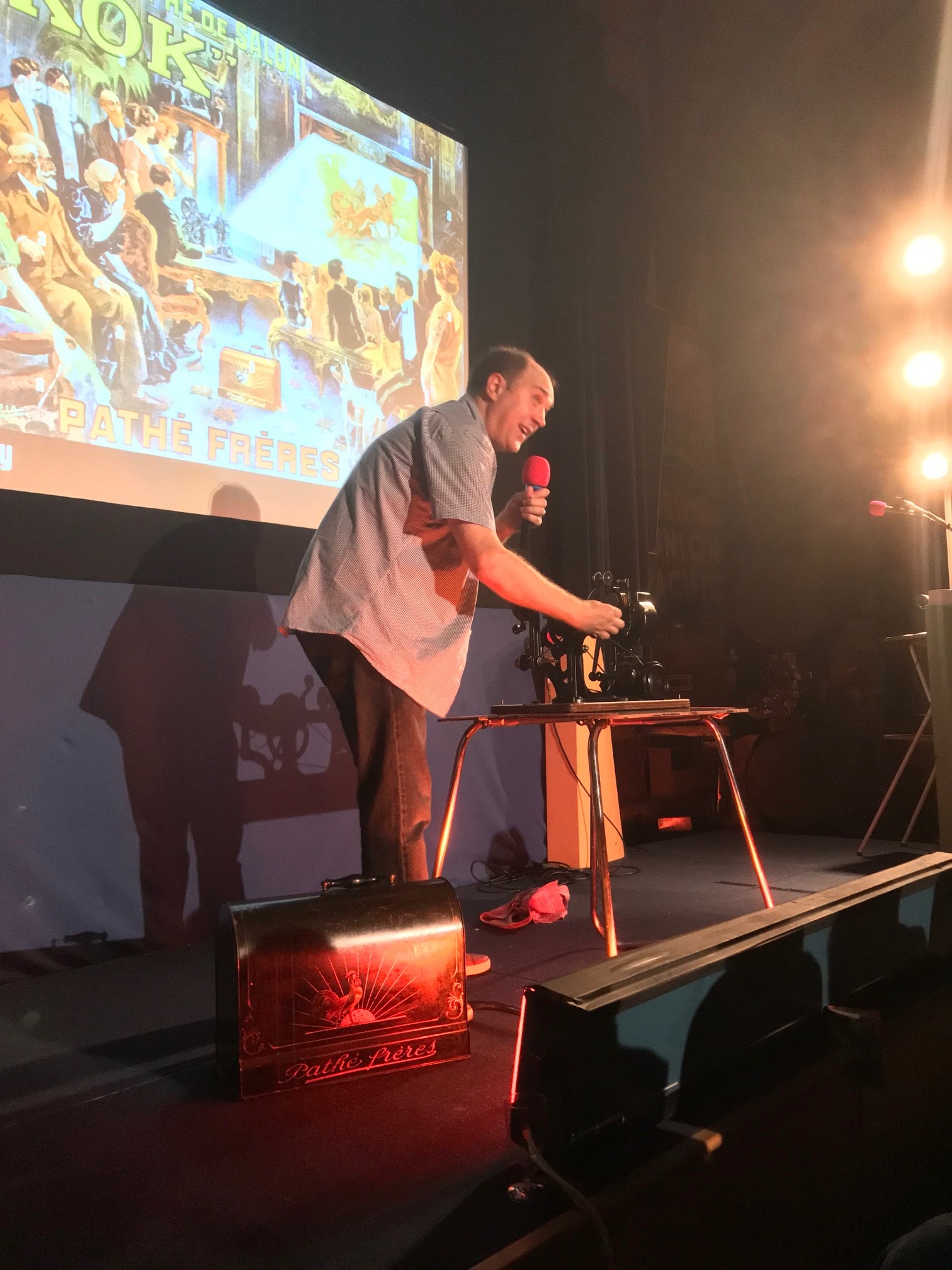
The Bioscope has always dealt with the material issue of cinema and tonight was no different with a first half dedicated to 28mm films introduced by Chris Bird, projecting 101-111 year old celluloid on 107-year-old equipment: film as history, history as film… moving history, it moves and it flickers even the hand-cranked 28mm projector Chris demonstrated on stage to audience applause. We should all be so functional after so long in the dark.


The Pathé-Frères 28mm KOK Cine Projector and Camera


We began with a couple of Pathé films, demonstrating French ingenuity in animation, Émile Cohl, one of the fathers of animation and then Méliès style trickery with Wonderful Armour?, as a devil and two women knights defied all logic and the evidence of our own eyes, as they detached body parts with a smile. Colin Sell did well to keep his head but, with the elegant Samantha looking on in silent support, he followed the action with all the concentrated control of a man who worked with Barry Cryer for decades.


Then to the USA for Lest We Forget a Mr and Mrs Sidney Drew filmin which the flowers of romance get very tangled and, as Chris stressed, the only copy, in the World, of Episode 30 (of 119) of the Hazards of Helen a very tightly wrought drama in which Helen Holmes appeared to swing off bridges, jump on to moving trains and dive into turbulent waters to retrieve stolen goods. We wondered if she used a stunt double, and John Sweeney too, who accompanied with fast-flowing lines and cliff-hanging drama all with no visible safety net.


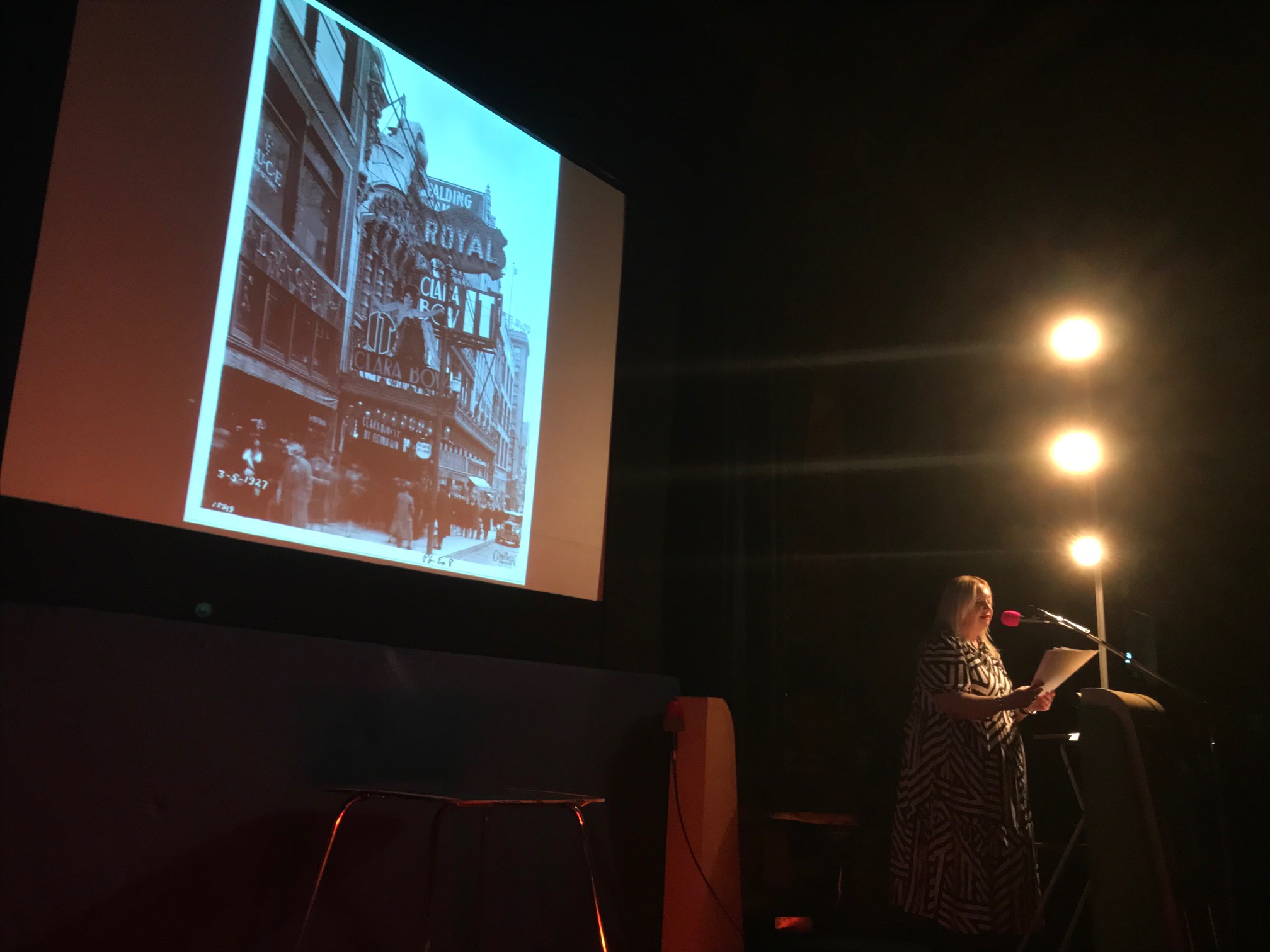
Follow that Clara Bow. And, of course, she did.


Clara in a business meeting with Antonio Moreno


This was a 35mm print from Photoplay – company by-line “Live Cinema” - which had the natural warmth of a pre-digital restoration and looked stunning on the big screen. I say stunning and I mean Clara Bow who, despite a cameraman buddy complaining how difficult her kineticism made her to catch on film, featured in close-up after close-up that left the watched hanging on her every smile. The discussion pre-screening with my neighbour was who would be a modern-day equivalent of Clara and we struggled to come up with anyone as naturally powerful and so exuberantly un-mannered on screen.


If ever an actress has transcended the sum of her parts and if ever a star has been completely under-estimated then that must be Clara Bow. In her career from a 17-year-old in Down to the Sea in Ships in 1922 to a wise-cracking, talkie comedienne in Hoop-la in 1932… Clara made only a few classic films, although relatively few were preserved as Michelle pointed out. She never had something like The Crowd, Pandora’s Box or The Wind, to show what she could do dramatically but, in every one of the films she did make, there is ample evidence that she was an actor of considerable ability. And this is true for It made in a period in which she made some 16 films in about a year, Paramount making as much as they could from their asset. 


There was indeed something about Clara, more than just acting; something genuine and heartfelt that, coupled with her looks, earned her the respect of a large part of the cinema-going audience through these years. Watching It years later, her eldest son Rex Bell Jnr, remarked that he could see all the expressions and feeling he had seen from “mom” on a daily basis: she wasn’t just acting she was giving part of herself to the watcher. When called on to cry she would call on a childhood memory of one of her friends dying in her arms after being consumed in a house fire: those huge shining eyes would well up with genuine tears of sorrow.


If It is one of the great films it is because it perfectly captures the essence of Clara. Clarence Badger directs well enough and makes the most of his star and story, you can’t take your eyes off her and this is not just the compulsion of trying to find new angles on that prettiness but because she’s radiating so much joy. She is It and she’s supposed to be. It’s a tough role when you think about it, no one ever had to live up to a billing founded on such an uncompromising premise: there’s no “it or miss” you just have to be on target with the casting. Tag, you’re it!!


Based on Elinor Glyn’s story, they paid the English writer some $50,000 to appear in one scene in order to clarify exactly what “it” meant and, needless to say, this was considerably more than the vastly underpaid main star had accumulated from her previous half dozen features.


Events are based in the large family-run Waltham’s department store where the heir to the business, Cyrus Waltham (Antonio Moreno), is about to take over following his father’s departure to spend more time with his gun. Junior’s best friend, Monty (William Austin), is reading an excerpt from “It” in Cosmopolitan and trying to interest his friend in this new conception of humanity although in his case he’s more “what?!” than “It!”. Talking of which there’s a young Gary Cooper flashing by as a journalist… Clara noticed him too.


Sweet Santa…


My second trip to Coney Island this week after The Crowd at the BFI...


Whilst Cyrus focuses on his new responsibilities, his pal scans the store looking for an assistant with “it”. His eyes alight on Clara’s character, Betty Lou, and he knows he’s found his woman but, try as he might, he cannot get Cyrus’ attention even though Betty already has him in her sights. She’s not about to let him out of her grasp though and this begins a game of It! and mouse as confusion and comedy mix with the odd dash of pathos and anything that gives Clara the chance to run through her extraordinary emotional gears.


It’s an absolute blast and Clara is well-supported by William Austin, nostrils flared like a Jazz-Age Kenneth Williams and Antonio Moreno who just about convinces as her love interest even though there’s no way he had the same amount of “it”! But who has?


Cyrus Gabrysch’s anniversary accompaniment was suitably celebratory, running wild with Clara and holding us aloft with the film’s dazzle and comic drama; that rare Wednesday evening atmosphere we’ve all come to treasure. Ten years after Cyrus and John started playing and Rin-Tin-Tin single-doggedly saved that lighthouse, so many others continue to create these magical evenings, I than you all and raise a glass to the next ten years of history being watched and being made!


Chris Bird demonstrates the kit

Cyrus Gabrysch explains the Rin Tin Tin connection

Michelle Facey introduces It.

Clara in colour, a precious glimpse of Red Hair one of many Paramount carelessly did not preserve.


The KB is a little bit like this... 

Gratuitous extra Clara...

Are you being served?


Friday, 21 April 2023

The music of chance... Strolling Players (1925), with Cyrus Gabrysch, Kennington Bioscope


Sex and silent film, it’s full of objectification and attitudes that today we frown upon and yet… here we find four men sizing up young Lya de Putti, whose heads transform into pig’s as they imagine our heroine with no clothes on. OK, those clothes do seem to disappear but I think Karl Grune was making a point, wasn’t he? To put this even further in context, Felix Salten, the writer of the film later went on to write Bambi; so, make of that what you will.


The sexist pig-heads was one of a number of striking visual set pieces that illustrate Grune’s story of a star being born, a tale as old as time indeed, as young actress meets successful player, Axel Swinborne (Eugen Klopfet), and we all know the rest… or do we, for this film ends in a way that, whilst I obviously can’t reveal, does leave the audience surprised.


We were watching the BFI’s 35mm print of Strolling Players (Komödianten or Comedians, certainly more Max Wall than Jimmy Tarbuck!) and this is, possibly, the only celluloid copy left in the World, yet another reminder of the rarities on view at the Kennington Bioscope and the vital role played by our national film archive. Why travel a thousand miles when you can see these treats in Lambeth? Blessed are the hobbyists, the collectors, the projectors, the historians and the programmers!


The story spins on coincidence – we are all after all merely players on the stage and there’s more than one reference to Shakespeare – starting with the arrival of a group of strolling players at makeshift theatre/public house in the village of Gotten. They’re performing Faust and it’s fair to say that the locals aren’t giving the cast the respect they might possibly deserve despite the presence of a looming Fritz Rasp looking almost cherubic in blonde curls and a striking leading lady (Lya De Putti), listed just as “The Sentimental”.


The director of the troupe (Viktor Schwanneke) knows this rejection well and as he’s always done and no doubt always will do, rouses his weary gang for a morale-boosting meal.


Miles away in the big city, we see Swinborne’s latest triumph and his determination to take a holiday on the completion of this run. He duly heads off on a train only, and what does this say about the safety of German trains at this point, to catch the train door handle on his waistcoat and fall out at high speed. Rescued by railwaymen, he’s taken to the inn where the players are staying and Lya volunteers to tend to him after he’s unceremoniously dumped on an upstairs bed.


The next morning the great actor is remarkably unscathed – what a lucky break as he remarks… and going down stairs to find out where he is, catches the players in rehearsal, in the very play he has just starred in, right at the moment for his cue to rush in and find his faithless lover and then shoot her dead. Maybe it’s the new lease of life or just the look on Lya’s face, he offers to join them for the evening’s performance and, unlike the previous evening’s Geothe, tonight is a huge hit and he raises everyone’s game.


His faithful dresser (Hermann Picha) comes to collect him the next day and just as he thanks the director for his generosity, he tells Lya that she could be a successful actress if she lets him guide her career. She’s persuaded and heads of to, of course, guaranteed success.

Lya de Putti, a World-class slinker!

In the cut and thrust of theatricality there’s always complications and, just as Swinborne comes to love his protégé so do others, including a handsome young prince (Owen Gorin) and no wonder given the stunning fashions on display for the Austro-Hungarian aristocrat de Puti. She has to choose between her loyalty to Swinborne and her primal attraction to the younger man… it’s a tough call and this emotional maze confounds our expectations in a denouement that dodges and dives in every effort to avoid the predictable.


Lya’s magnetic presence does much to elevate the film, she may be posh but she’s got a look that connects in a very earthy way and as she was to show in Variety and many more, she knows how to play the camera and to pull the watcher in with earnest, raw expression. She’s part Pola, neo-Nazimova - that hair! - with a hint of a more virtuous Valeska Gert - a Euro-pudding of the most adult-deco proportions. 


Cyrus Gabrysch underpinned this emotional commitment with improvisations that captured the emotional storms and romantic sweep of this tug of love. This was a fiercely committed approach that was buoyed by clusters of muscular chords and lilting lines; I haven’t seen Cyrus play for sometime but he was lost in music and completely plugged in to the action on screen. Stirred and shaken.


Ralph Lewis and Norma Talmadge


Going Straight (1916) with Colin Sell


As if this BFI gem wasn’t rare enough, we were also treated to another early Norma Talmadge film, following on from last time’s stunning 16mm copy of A Helpful Sisterhood (1914). As with that film, I’d already seen Going Straight (1916) but never like this 35mm versions, which whilst showing its age, which I like, was full of gorgeous texture and tints showing Norma in fabulous close up as the 21 year-old showed the growing confidence in her craft.


Norma featured in hundreds of short films for the Vitagraph Company from 1910 to 1915. Then, having joined Triangle Pictures, she made longer form films of which Going Straight, was one of the first. Directed by Chester M. Franklin and Sidney Franklin the picture clearly shows the guiding influence of DW Griffith who oversaw a lot of the production at Triangle. There are expert intercuts and parallel scenes, close ups reminiscent of Pig Alley and the action is tightly marshalled throughout.


Talmadge is superb, acting naturalistically and given ample close ups to demonstrate her restrained playing which has more in common with Gish and Pickford than some of the more dramatic queens of the era. She plays Grace the wife of successful businessman, John Remington, played by Ralph Lewis. The two live in wedded bliss with their young family in one of those sizable wooden properties we brick-bound Brits envy. However, despite this apparent normality, both Grace and John were once part of a group of professional criminals known as the Higgins gang. Grace finds a clipping about their trial and a flashback explains their violent past.


Eugene menaces


Higgins/Remington’s second in command was Jimmy Briggs, played by the excellent Eugene Pallette, full of violent menace, who, after doing his time spots John, who offers to help him on the straight and narrow. Unwilling to change his greasy spots, Briggs threatens to reveal Grace’s criminal past and John has little option but to join him on one last robbery. He goes to commit the crime with Briggs whilst Grace stays over at a well-healed friend’s house after a card party. As it turns out – in a coincidence not too uncommon at the time – Briggs and John are burgling the same house.


What could possibly go wrong?


It is undeniably melodramatic but Talmadge is believable and understated even in the most fraught moments. She has a number of close ups that allow her to illustrate the emotional shifts in the story and her facial transitions are quite the special effect and as viewed on this wonderful 35mm copy, stunning. She’s another whose looks appear to be almost “out of time” and could have made her successful in any period of screen acting. It’s a face you enjoy reading on many levels and has a fascination and a depth that would grow to place her in the upper echelons by the early Twenties.


Colin Sell’s fingers danced along creating a sprightly symphony to accompany the players’ hard work and as with all good accompaniment the sound and vision blurred into a deliciously satisfying whole – sorry, the new range of home-made catering at the Bioscope naturally encourages such comparisons!


Another special occasion in Kennington, introduced majestically and expertly by Michelle Facey as we have come to expect!


Thursday, 28 October 2021

Back home… The House on Trubnaya (1928), with Cyrus Gabrysch, Kennington Bioscope


Thus, it can be seen that even the most unworldly peasant can make a valuable contribution to the labour movement… As with Michael Powell, Boris Barnet was not phased by the strictures of propaganda and weaves his way around the need to deliver this core messaging whilst still providing entertainment. This film is funny, inventive and superbly edited with the actors giving sardonic and engaging performances that make light of the script ultimately conspired by five different writers. The original script dated back to Lenin’s era and a call for the common comrade to be ready to participate in democratic process whilst Stalin’s era was driven by a lengthening process of pulling more from the country to work in the city. Barnet meets both these objectives with wit and irreverent undercurrents which pull in the viewer in more subtly and completely than more earnest polemic.


I’m second-guessing historically but by the end of the film I was all for marching my support for Parasha Pitunova (Vera Maretskaya) as elected deputy of the Moscow maids' Trade Union.


In addition to some wonderful location shots of Moscow - Yevgeni Alekseyev’s cinematography is a wonder – there’s also a fantastic set showing the flights of stairs inside the tenement on Trubaya, like Dante’s Hell each level denoting a different level of position and snobbery with some of the worst at the lowest levels. It’s a superb way to illustrate the neighbourly interactions as well as the building’s “society” and, in a hectic start, Alekseyev’s camera pulls in and out as we witness the chaos – two men chopping wood on one landing, pausing to let a disabled child squeeze past, whilst others squabble over laundry as another day in civilisation begins.


Inside the house on Trubnaya

Barnet plays with expectations and form throughout notably when Parasha is chasing a duck in the streets and grabs it just as a tram moves at speed towards her, the driver leaps out and is suspended – freeze-framed - in mid-air as the title card reads: “… but wait, we forgot to tell you how the duck ended up in Moscow.” All this after some ten minutes of set up including rapid cuts, reversed film, montage (natch) and the goings on in the staircase set. This was Barnet’s fourth film but it’s his Revolver in terms of pushing the boundaries.


But wait, I forgot to tell you how I ended up in Kennington…


This was my first visit to the Cinema Museum since March 2020 and it was a delight to see the Kennington Bioscope back up and running. The KB carried on through the pandemic with KBTV on YouTube and whilst the path to the old place is all still familiar, what a time we’ve had. The old team was back together in the flesh and as star of stage and small screen, KBTV’s MC Michelle Facey introduced and John Sweeney warmed up for the first films… we were about to party like it’s 2019.


Still Dot Moving

Our first film was Still Dot Moving, a new silent short made by print-maker Julia Vogl which was a mesmerising sequence of original prints superimposed and almost glowing with a vibrant rhythm as John Sweeney overlayed his musical response. This was startling and unlike anything you might expect from the context but it was a fine way to return to the screen. John Sweeney’s accompaniment was as intricate and mesmeric as Julia’s images and this was the perfect example of the continuing possibilities of film and live music. 1


John then introduced us to the ground-breaking Russian dancer and film maker Alexander Shiryaev, who not only founded character dance in Russian ballet at the Mariinsky Theatre but also (probably) invented stop motion animation. Shiryaev’s interests were strictly in support of his work – helping to show his dancers his intended movements and choreography – and were only discovered in the 1990s. As John said, his ability to capture movement using these techniques was remarkable and the three films screened, one paper animation, another stop-motion and a third showing Shiryaev performing a Cossack dance with his wife, dancer Natalia Matveeva, were captivating especially when aided by such a practiced dance accompaniment!


Alexander Shiryaev

A Lupino Lane short comedy followed, Goodnight Nurse (1929) a new scan of 35mm nitrate and one of a number restored by the KB’s David Wyatt and Dave Glass following a Kickstarter campaign. It showcased the Brit’s speed of movement and athleticism which matched those who’d gone over to Hollywood before if not necessarily in terms of originality, then certainly flexibility and comedy!


Accompaniment for this was provided by the sprightly hands of Radio’s Colin Sell who’s worked with more than a few old jokers in his time and was the perfect comedy accomplice for Ida Lupino’s Uncle, the man who used to dance The Lambeth Walk. The Lupino Lane restorations are now available on DVD and you can purchase them from Amazon soon.2


Yes, but what about the duck?


After Boris stops his film with the endangered duck, the tram driver is unfrozen and jumps backwards into his reversing tram and we’re run back to scenes of Parasha about to depart from her village where she has been staying with her aunt. She’s off to stay with her Uncle Fedya (Aleksandr Gromov) in Moscow but, just as she climbs on board with a wicker bag containing food and the present of a white duck (uncredited, sadly) her train departs just after one arrives with Fedya on it.


Cue dreamy views of Parasha’s train slicing through trees and fields on route to Moscow and then her disorientation in finding that Fedya is not where he’s supposed to be. She wanders all night ending up with the above Duck Distress before, as chance would have it, being spotted by someone she knows.


Semyon in his motor

In the first ten minutes, Barnet has already shown us Semyon Byvalov a young chauffeur (Vladimir Batalov) preparing his car and then driving through Moscow with his sweetheart Marisha-maid (Anel Sudakevich). The narrative threads now intersect as he picks up his old friend and takes her to Trubaya. Here she gets work as a maid with the very odd couple of Mr. Golikov (Vladimir Fogel), a hairdresser, and his slovenly wife (Yelena Tyapkina) who seems to have perfected the art of lounging. Mrs. Golikov refuses to allow a union member to be their maid – probably more on economic than political grounds – so the newly arrived innocent is perfect for her purposes.


The Golikov’s are key characters, especially the hairdresser. He is hyperactive and ridiculous, washing their plates in the absence of a maid and after drying them flinging them across the room to smash. She is full of undeserved airs and graces… the sort of bourgeoise the Revolution was supposed to galvanise and re-purpose.


Another interesting sequence with Vera Maretskaya followed by (hand-held) camera through a crowd

But Parasha is of good intention and only sees other’s better motives. She is befriended by Fenya (Ada Vojtsik) who is politically active and takes her to union meetings. The workers arrange a play about the French Revolution which completely bewitches Parasha who, having not seen theatre before, attacks Golikov on stage as his character is assassinates Semyon’s… this wins her the love and support of the audience but Golikov immediately sacks her.


Our irritable boss has reckoned without the impact his young maid has created and soon he learns that she has been elected to the post of deputy by the maids’ trade union. This immediately elevates the standing of her former employers and Mrs Golikov is not alone in being keen to to ride this particular tide yet can her husband control himself for long enough to act in his and, more importantly, others' best interests? 


Parasha on the march

The House on Trubnaya is very clever slapstick mixed with social observation and the required political messaging: if all bosses are as venal and self-serving as the Golikov’s – even over a decade on from the Revolution – then workers need to join unions to support themselves and others. It never lectures just wends its peculiar way scoring laughs over political points and that’s exactly why it’s so watchable now.


Cyrus Gabrysch accompanied in style and relished this return to the silent film “club” he helped found! Welcome home Mr Gabrysch and everyone else involved in this wonderful collective!


1. More about Julia Vogl's work on her website and her Instagram.

2. More details of  the Lupino Lane project on their Kickstarter page.


No ducks were harmed in the writing of this post.