Showing posts with label Jack Pickford. Show all posts

Thursday, 31 October 2024

The dark night… The Bat (1926), with John Sweeney, Kennington Bioscope


It was the KB Halloween Edition and MC Michelle Facey was accompanied by a raven and genuinely spooky tales not just about our main feature but also the fate of Roland West’s yacht, Joyita, which, to cut a unsettling mystery short, became known as the Marie Celeste of the Southern Seas after all passengers and crew disappeared leaving only and empty vessel listing and carrying mute evidence of a desperate conflagration. None where ever seen again and the ship’s former owner, director of this film, also vanished from the industry after the mysterious death of his lover Thelma Todd in 1935.


Whoever the fool was who directed Babylon (2022), there’s more things in Heaven and Hollywood than dreamt of in your ridiculous screenplay. Anyway, as usual Madame Mystery, sorry, Facey, was on song – unlike her raven – illuminating the stories of cast and crew and West’s seminal film about a costumed anti-hero who dresses like a bat, swoops around like a bat and genuinely terrifies in the manner of a large flying rodent. This is as she says one of the great Old Dark House films along with The Cat and the Canary, The Final Warning and Seven Footprints to Satan. Trilling, comedic and genuinely intriguing, we don’t know who The Bat is until the end and, having been told not to reveal the secret by an intertitle at the start, we must keep our silence as with The Mousetrap.


We were watching Ben Model’s recent restoration of The Bat which included a 2k scan from the UCLA Film & Television Archive’s original 35mm materials and it looked splendid on the big screen and with John Sweeney accompanying. I have the Blu-ray to watch having been on of the project funders and this will also be available from Ben’s Undercrank Productions site – link at the bottom. I’ve never seen the film before and whilst it’s not quite as tightly presented as The Cat…, it’s certainly an entertaining romp with plenty a twisted dark turn. Possibly too many but what the heck, it’s Halloween!


Directed by Roland West who also adapted from the play by Mary Roberts Rinehart and Avery Hopwood which was first produced in 1920 to much success. Events kick off with a daring robbery by the seemingly superhuman Bat, who is so confident he has written to millionaire jewel-fancier, Gideon Bell announcing his intention of stealing his Favre Emeralds at midnight. Despite the presence of the police, The Bat succeeds by climbing up the outside of the elegant skyscraper and pulling Bell out the window taking his prize.


The Bat is audacious and even leaves a note on a kind of Bat-Post-It note announcing his intention to visit the country for his next crime… Bob Kane was influenced by the film in creating The Batman but the template is more like one of the Caped Crusader’s rogues’ gallery, Cat Woman, The Riddler or even The Joker who himself was influenced by The Man Who Laughs (1928). Talking of which, what a great Harley Quinn Olga Baclanova would have made… a proto Gaga!


Before his trip though The Bat drops in on Oakdale Bank to enhance his short-term liquidity only to find that another has got there first to steal $200,000 from the safe. He notes the number plate of the felon and, no honour amongst thieves, sets off in pursuit in his car, a mobile vehicle for the Bat. The subject of his pursuit arrives at a large darkened house and, climbing in through the basement proceeds to climb up the laundry shaft and then a hidden stairway to a secret lair of his own. There's a cat and mouse as well as a bat in this tale.


Sojin Kamiyama, Louise Fazenda and Emily Fitzroy

As it happens, this is the mansion of the recently deceased Courtleigh Fleming, the president of the very same Oakdale Bank, where a whole bevvy of suspicious suspects are in place. Chief suspect for this unauthorised withdrawal is Brooks Bailey played by Jack Pickford who frankly always looks guilty of something. Apparently West shot during the night hours which gave his players that extra edge and it certainly has a sleep-deprived mania generated by the cast drowned in the shadows of these huge sets designed by the great  William Cameron Menzies with help from Harvey Meyers.


Brooks is accompanied by Miss Dale Ogden (Jewel Carmen aka Florence Lavina Quick aka Mrs Roland West) who is the niece of Cornelia Van Gorder (the ace Emily Fitzroy) who is renting the property and Dale not only convinced that her Brooks is innocent, she wants to marry him too. She presents him as a new gardener even though he knows less than I do about horticulture as quickly exposed by Cornelia who is generally the smartest person in every room of the house. No competition in this respect is her nervy maid, Lizzie Allen (played by the excellent Louise Fazenda) who provides enough comic relief for two films if I’m honest but she’s such a reliable pivot for the crime and the grime.


After breaking contract with Fox in 1921, this was Jewel Carmen's last film


This is an ambitious story, and I’d love to see it on stage for there are still another six characters to introduce, all of whom have their suspicious edges – almost everyone is a suspect apart from Lizzy – especially the men, Dr. H. E. Wells (Robert McKim) and his black bag, the moody Detective Moletti (Tullio Carminati), Billy the Butler (Sojin Kamiyama) and “prevalent at the time” racist tropes… There’s Detective Anderson (Eddie Gribbon) with his two guns, is he as clueless as he seems? And what’s more suspicious than Fleming’s nephew, Richard (Arthur Housman) who wants to frighten Cornelia away so he can lease the mansion?


You’ll just have to watch and find out and ideally with a live audience and as skilled an accompanist as John Sweeney who treated us to some full-blooded flourishes and mystical melodies for this gently fretful but funny silent spooky treat!


Some new blood – creatively speaking – was unveiled for the first part of the programme which was accompanied by Le Giornate del Cinema Muto Masterclass alumnus Andra Bacila who is studying at the Royal Academy of Music and who we will hear a lot more from in future. She accompanied The Red Dance (1928) in Pordenone and here sprinkled musical illumination for three wonderful shorts starting with La course aux potirons (1908) concerning runaway pumpkins in Paris, an hilarious film I'd also seen in Italy.
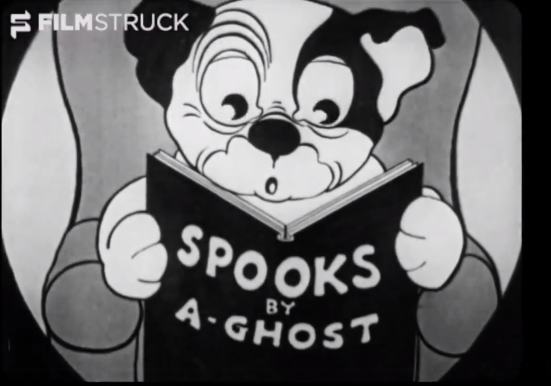

Pete the Pup is petrified!

After this was some wonderful invention from Walter Lantz with the mixed live and animation featuring the director and his cartoon dog, Pete the Pup, in Pete's Haunted House (1926) followed by a stunning The Devilish Tenant (1909) from Georges Méliès which was a trick film honed to perfection. It was hand coloured which as Chris Bird reminded us, meant that every frame on every copy was coloured individually - remarkable and beautiful film to see.


The last film was courtesy of a lucky find on eBay and was a rare surviving copy of a Cecil Hepworth film from 1922, One Too Exciting Night, a spoof on Griffith's One Exciting Night, itself an Old Dark House Mystery. What we saw may well be the only surviving copy anywhere but that's how they roll at the Bioscope - the rare, the extraordinary and the exceptional. We are privileged and all for just a few quid!


Frighteningly good!


Louise Fazenda gives her all!


To buy the Blu-ray of Ben Model's restored The Bat, please follow this link to the Undercrank Productions website - it is a very worthy release including some delightful extras. Blessed are the Kickstarters!


There's more about the mystery of the good ship Joyita here, a fascinating tale from the Bow Creek to Anatahan maritime history site.


This "near-mint" copy of the first appearance of The Batman in March 1939 last sold for $1.7 million in auction, and is now valued at $2.2 million. So, it's not just classic film enthusiasts who should check their lofts for lost treasure... I know where one copy is but I'm not telling. 


More gorgeous screen shots from the Blu-ray!


Gotham, before the Bat Signal


Friday, 29 January 2021

Mary, Lottie and Jack… Fanchon the Cricket (1915), Flicker Alley Blu-ray/DVD


It’s 1915 and we’re approaching peak Pickford in the second of eight feature films she made in the year of her old mucker DW’s Birth and one of six to be directed by James Kirkwood with scenarios from Mary’s pal Frances Marion also in the majority. Pickford was not yet in full command of the means of production as Cari Beauchamp notes in the Flicker Alley booklet, but she was fiercely protective of her career and determined to put in a typecast-proof performance as the wildcat “waif” that – now – we view as exemplary.


Fanchon provides an abundance of opportunities for Mary to demonstrate her winning ways and to explode out of the screen against the gorgeous backdrops of Delaware Gap, Pennsylvania. Some have criticised Kirkwood’s pacing but he certainly knew how to make the most out of his friend Mary; just pick the right location and let her roll. So many times, Mary demonstrates her extraordinary energy with her bodily ability to express emotion standing out amongst the dense woodland, against river and lake and a cast who are quite unable to draw the eye away from her.


Mary Pickford sits on the fence


Beauchamp describes the waif as an “inspirational” character in amongst a contemporary cinematic universe of matrons, vamps and adventuresses; “… there is a modernity to the waif with her backbone of steel as she stands up against hypocrisy, bullies and entitlement.” Watching with my Gen-Z daughter she would agree and it’s striking that such characters were on screen for the majority of cinema goers who were women yet to gain the vote.


Mary’s Fanchon is girlish but knowing and she knows what she wants in her man; someone who choses to love her and who is steadfast; she takes charge of her romantic situation and having worked her opportunity, expects the men to be honourable. If not… she’ll go her own way. She, genuinely, does not need a man to define herself and – according to our count – Fanchon passes the Bechdel test on a number of occasions.


Frank Standing and Lotte Pickford


Set in Eighteenth Century France and based on George Sand’s novel La Petite Fadette, the narrative is fairly light for first half of the film before fitting in – some – of the source material’s complexities. That strikes me as good work from Frances Marion (and Kirkwood) which allows the focus to be on Fanchon the free spirit and her pursuit of Jack Standing’s Landry Barbeau. Landry is from a family of good standing while Fanchon lives in a woodland hut with her grandmother (Gertrude Norman) who’s old and wizened enough to be regarded as a witch.


Fanchon’s problem – apart from lack of contemporary fashions – is that Landry is seeing a more respectable women called Madelon played by Lottie Pickford. Lottie was her sister’s junior by one year and, on this display, not in the same league as an actress (who was?) but she does a decent job as the spoilt brat determined to hold on to her man as much for pride as anything else. There’s also a cameo from Jack Pickford as a local bully who Mary has to fight in scenes that surely must have taken place in the family home in Toronto.


Jack vs Mary


Jack picks on Landry’s brother Didier (Richard Lee) who is described as a “half-wit”. It is interesting to see how films from this period treat mentally disabled characters and whilst Didier is a sympathetic character, the only one who treats him as an equal is Fanchon with the local youngsters tiring of him and chasing him away when it suits and his father (Russell Bassett) pushes him around. Are we supposed to see Didier and Fanchon as similarly outcast, he for neurodiversity and she for outrageous independence and “poor” blood? That’s maybe a stretch but why not?


Cinematography is from Edward Wynard and there are breath-taking shots of the locations – most of the action is outside adding a string sense of place to the action – as well as the lead. Kevin Brownlow is not the only one to have pointed to the visceral impact of Mary Pickford in this film; her hair is as long as I’ve ever seen it and sometimes forms a sunlit halo over her supercharged features and she’s definitely not the “the girl with the curls” but someone wiser and more artful.  Even with a dearth of clos-ups, the actress conveys an emotional impact few could hope to match and here it’s so very natural. How many scenes are just made up of her reacting to events off screen in well-chosen locations or amusing herself by playing with her shadow or just skipping with arms aloft, powerfully pantomiming joy and resilience.


The locals don't know what to make of Fanchon


Gradually the story solidifies as Fanchon starts to impress Landry, as someone with more spirit than Madelon but he must overcome not just his own doubts but the approbation of their peers and his own father. The gap between them seems too large to cross but Fanchon is nothing if not irrepressible but she’s also totally honest; she wants happiness on her own terms…


Fanchon is the only film to feature all three siblings and it’s very sad that at the time of her death, Mary thought it was lost. The Mary Pickford Foundation found a nitrate duplicate at Le Cinémathèque Française and combining this with an incomplete nitrate print at the BFI, a multi-national effort led to this crystal-clear restoration.


The MPF commissioned a new score in modern style from Julian Ducatenzeiler and Andy Gladbach which moves along very well with the film if occasionally foreshadowing the emotional journey. We enjoyed it, it’s upbeat and inventive and has the spirit of Pickford’s character. Those looking for organ or piano traditionalism may not agree but as a package this is a fun film and a side of Pickford we really need to see more of.


The Flicker Alley set is available direct from their site and really does the MPF proud in making available more of the work that explains her status as one of the founders of cinematic acting and one of the first superstars.


Sunday, 10 September 2017

Closer up... The Goose Woman (1925) with Cyrus Gabrysch, Kennington Bioscope


I’ve seen this film before but I’ve never really seen it until now. Sometimes in our eagerness to view a film we put up with substandard digital copies – legally of course – but in the end you will always pay, without hesitation, to watch something as splendid on screen as Louise Dresser. Tonight we were treated to the restored 35mm print courtesy of UCLA, Robert Gitt and Kevin Brownlow which featured far more content and clarity as well as the dramatic enhancements of Cyrus Gabrysch’s energetically complex accompaniment.

The Goose Woman is a very good silent film but what raises it to the level of exceptional is the performance of Miss Dresser as the woman for whom all vanity has dissolved. She’s caked in her disappointment as surely as her pigs are snout-deep in in the mud of her swampy small-holding.

Director Clarence Brown is no slouch either and there are very few moments in film as powerfully sad as the accidental destruction of the last recording of Dresser’s fallen opera singer Mary Holmes (once Marie de Nardi…) in her pomp. Placed on the table by her son, Gerald (Jack Pickford), Mary’s precious shellac rolls slowly from the kitchen table smashing on impact with the cruel stone floor. Having lost her voice giving birth to the unwanted boy now he – unintentionally – destroys her last memento… and her self-loathing simply won’t allow her to forgive him. She pushes him out and then finds that the gin bottle she’d hidden in the kettle has evaporated away… like her life.


There are many such symbolic moments showcasing the “Brown Touch” – Gerald’s interrogation by the police is punctuated by his nervous distraction at a dripping tap, one cop shuffling coins and another cracking nuts… You can only agree with what he said to Kevin Brownlow half a century ago when the latter showed him his copy: “I hadn’t realised I was that good!” Kevin also showed the film to Mary Pickford on one of her rare trips to London and she was impressed with brother Jack’s performance – thirty years after she lost him to alcoholism in 1933. It’s always a privilege to hear Mr Brownlow’s introductions – he is literally on first-name terms with silent cinema history.

Dresser wore very little make-up for the production, far less than Jack Pickford from the look of some scenes, and allowed herself to take her character to believable extremes. She relishes the degradation of a woman whose life has been destroyed by her failings and yet who has a sense of her own ridiculousness. She’s a drunk, she keeps geese, you got a problem with that?

Jack and Constance
Yet so much of her situation is down to her being judged – her pregnancy supposedly cost her voice but more likely it sank her in shame. When she reveals a terrible truth to Gerald about his parentage, we don’t see specifics just his reaction and that of his sweetheart Hazel (Constance Bennett, a star in waiting).

Things are about to get a whole lot worse as a rich neighbour is shot dead and through her gin-glasses Mary devises a plan so cunning you could pin a tail on it and call it a fox: she’s going to reclaim her fame by pretending she saw the murder and show the world that she’s still Marie de Nardi! But as her fortunes begin to rise, the police inspector being a fan laps it up, she inadvertently puts Gerald right in the frame…


Brown handles these complications with such economy, the pay-off is superb, enabling his performers to slide through the narrative with the focus purely on their emotions. Of course he was Garbo’s favourite director: he let her breathe.

He also manages to infuse the story with humanity and comedy balanced against the dramatics. When Mary staggers off to find out what the murder scene looks like she’s pursued all the way by one of the geese… The animal in question is uncredited but she had an agent, you can be sure of that!

The pace of the film is deceptively unrelenting and Cyrus set the keyboard alight with classical flourishes as he bantered with Dresser and matched her note for note. The movie is richly toned – a gothic setting that influenced Sparrows – and this gave the pianist lots of room for rich textures of his own: all the stars were aligned on this one!

The packed house at the Bioscope burst into applause even as the credits started and deservedly so.


Earlier on we’d been treated to a couple of enjoyable oddities. The first was a dizzying compilation of railway “ghost shots” from Lyman H. Howe, Ride on a Runaway Train (1921),  which I hope never to see on Imax. The sequences showed some impossible angles and were sped up to create a disorientating feeling of being just in control… literally a rollercoaster of images and impossible railways!

Then there was watcher’s digest version of The Patent Leather Kid (1927) starring Richard Barthelmess and Molly O'Day from the Paul Killiam Silents Please TV series in 1961. The film was cut to less than half an hour and featured Mr Killiam’s narration explaining the narrative and other background. It worked remarkably well and from a time when silent film was largely regarded as a quaint relic, no doubt helped the flame to burn.

Molly and Richard
Richard B plays a cocky boxer who has courage only when wielding his fists; having been enlisted to fight in the Great War he has to find a way to be brave with guns and bombs… He’s saved by the love of comrades and of Molly O’Day with a bitter sweet ending marking it as definitely post-Big Parade.

Next up at the Bioscope is the Italian sky pirate film Filibus (1915) which pormises to be another treat!

Saturday, 8 March 2014

Thoroughly modern Lillie … Exit Smiling (1926)


"Lillie's great talents were the arched eyebrow, the curled lip, the fluttering eyelid, the tilted chin, the ability to suggest, even in apparently innocent material, the possible double entendre". Sheridan Morley in The Oxford Dictionary of National Biography

From the first moments of her appearance in this film, you know you are watching one of those rare performers whose style and skill simply connects perfectly with the modern viewer: reader, let me tell you of the actress out-of-time that is Beatrice Lillie.

Born in Toronto to a concert singer mother and a British army officer who later became a Canadian government official, Bea didn’t lose touch with the old country and made her West End stage debut in 1914 earning sufficient fame to end up marrying Sir Robert Peel (the fifth Baronet and great grandson of the Tory PM of the same name).

Beatrice Lillie
She was a highly successful stage performer on both sides of the Atlantic and needed to be as Bobby didn’t have wealth, nor the ability to generate a new fortune – spending the first night of their honeymoon on a losing streak in the Monte Carlo casino. Then, during one trip to Broadway, Bea was engaged to play in Exit Smiling, her first and only silent film.

Sometimes experienced stage actors struggled to transpose their skills to the big screen where every exaggerated inflection required to be seen in the stalls can be magnified a thousand fold.  But Lady Peel was a natural with her expressive understatement, timing and droll understatement perfect for the medium.

She thought this film rather cheesy and, whilst it’s true that her performance gives it more interest than the story may otherwise have demanded, Exit Smiling is an amusing film, well observed and paced and with a wonderful supporting cast.


Directed by Sam Taylor based on Marc Connelly’s play of the same name, Exit Smiling tells the tale of a fourth division traveling repertory company inflicting a drama called Flaming Women on the mid-West.

Beatrice plays Violet the company’s maid who doubles up as bit-part player by night and all-round dogsbody by day: cleaner, cook and seamstress all in one. She’s desperate for her big break to join the others in a proper part and almost gets her chance when the show’s leading lady – Olga (Doris Lloyd from Walton, Liverpool – wonder if she knew my Great Grandmother?) – is delayed after an incident involving the consumption of more than several beer bottles.


The play begins and quickly we can see the quality of thespian endeavour the company provides: Violet almost forgets her maid’s hat, and her lady, Dolores Du Barry, arrives closely followed by an evil moustache twirling scoundrel who means her ill. The lady’s beau arrives in the form of Cecil Lovelace (Franklin Pangborn) whose camped-up cowboy quickly engages in an unconvincing struggle with the assailant as they panto-fight over a gun

Some long acts later, the show heads towards its dénouement as Dolores vamps it up in order to distract the villain just long enough to save her true love, some elements of the audience watch with rapt attention. A little drama can go a long way…

Scouser Doris Lloyd vamps it up to confound the cad!
They head off to their next engagement in their own railway carriage which includes a saloon car, sleeping bays and storage space for props and scenery. Is this just the kind of long-haul company that Mary Pickford and Lillian Gish would have started out with in their teens?

At one of the stops they are joined by a sad young man, Jimmy Marsh (Jack Pickford) who leaving East Farnham for some unknown but obviously bothersome reason.

Jimmy admires Violet's style
He instantly catches Violet’s attention as she rehearses her vamp moves between carriages and she tells him that she’s an actress, impressed he confesses that he's always wanted to meet an actress, seeing only the surface self-confidence of her display.

Violet manages to persuade him to audition for the company and with her help (and that of a discretely held onion) manages to convince the hard-hearts of the seasoned pros. He’s in and very soon he’s playing the leading bad guy.

Beatrice Lillie and Jack Pickford
This is great for Violet who falls hook, line and sinker for this fresh-faced young man but she never shows him and he can never see anyone other than the up-beat, helpful individual who does her best for him.

The show goes on and on as they schlep from small town to small town and the friendship between the youngsters grows as the supporting characters are revealed: the old pro who once played with Elmer Booth (he of Griffith’s The Musketeers of Pig Alley), greedy show-runner Orlando Wainwright (DeWitt Jennings) and the camp Cecil.

Show people: DeWitt Jennings and Franklin Pangborn
Meanwhile we cut back to Jimmy’s home town as we learn the reason for his leaving as his girlfriend (oh no!) Phyllis (Louise Lorraine) tries to convince her bank manager father of his former teller’s innocence whilst he offers her Jesse Watson (Harry Myers) as, in his view… a perfectly acceptable alternative.

But Jesse isn’t quite the man he seems as we are shown local crook Tod Powell (Tenen Holtz) asking him for a “loan” knowing who the money was really removed by and who put Jimmy in the frame.

Tod puts the squeeze on sneaky Jesse
The innocent man is miles away on a train… or is he? Jimmy steps out of the actor’s carriage to greet another day only to find that they’re arriving at East Farnham: he can’t be seen here and he certainly can’t play on stage!

Violet, as she always does, has a plan and it’s an imperfect but funny one. Events descend into chaos as the strands come together and all matters come to a head in a breathless – poignant – finale which it would be cruel to reveal: you really have to see it for yourself.

Exit Smiling is available from Warner Archives complete with a new, orchestrated score from Linda Martinez which matches the story’s energy even if occasionally out of step with Lillie’s nuanced expression. But, she's just so quick...


Sadly that was it for Beatrice Lillie’s silent films although she returned occasionally to cinema work from early talkies up to Thoroughly Modern Millie in 1967. She much preferred stage work – feeding off the audience reaction and enjoyed a long varied career on the boards, no doubt with her own changing room and a maid of her own.

It’s available direct from Warner Archives or from the usual Amazons.
