Showing posts with label Gertrude Welcker. Show all posts

Monday, 27 May 2019

Wind and wuthering… Chronicles of the Grey House (1925), with Cyrus Gabrysch, BFI Weimar Cinema


If you’re looking for the Lil Dagover/Kate Bush connection, step right this way. This film was atypical for the Weimar period in being filmed on location and we’re rewarded with magnificent shots of harsh Prussian heathland that kept on reminding me of the Yorkshire moors north of Haworth. To cap it all we also have a ghostly Lil returning to help her Heathcliff, in this case Lord Hinrich, wearing a long flowing dress and waving her arms expressively… although you couldn’t be sure, she may have been singing, “it’s me, your Bärbe, I’ve come home…”

Others have looked further north for comparisons, with Lotte Eisner seeing the film as “full of the poetry of the Swedish open-air…” and British critic, Tony Rayns describing the influenced of Stiller and, presumably Sjostrom, differentiating director Arthur von Gerlach’s style from Lang’s “architectural” cinema or Wegener’s “theatrical”.

Wild and windy moors...
That said, The Chronicles of the Grey House may well be the most melodramatic of the films I’ve seen in the BFI’s Weimar season but it is also one of the best-looking; there’s plenty of the big sky over Luneberger Heath. Von Gerlach directs the extreme emotions so well within the context of his shots, with interior action interwoven with complex lighting and design whilst cinematographer Fritz Arno Wagner’s exterior shots use dynamic angles to emphasise the character’s setting and mood.

Based on Theodor Storm’s novel A Chapter in the History of Grieshuus, Thea von Harbou crafted a screenplay that pulls no punches in terms of the dramatic effects of fate and fortune on its characters. It’s the kind of film where a legal notice can trigger imminent death or even a chance remark about your inheritance and yet where even a knife to the chest won’t kill a man with right on his side, not immediately at any rate!

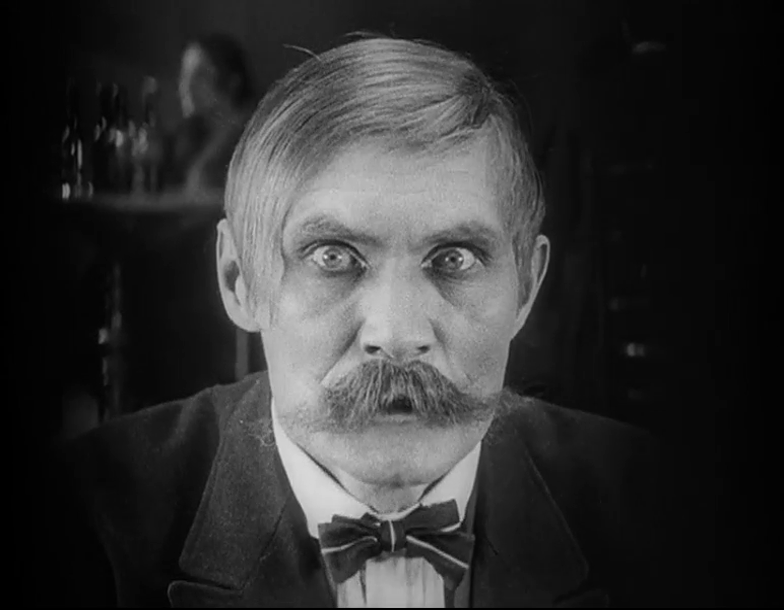
Dramatic framing in the old grey house
Set in a seventeenth century feudal community, the story revolves around the battle to inherit the land and fortune of Burgherr von Grieshuus (Arthur Kraußneck). His favoured son, Hinrich (Paul Hartmann), is handsome, good-hearted, brave and has great hair whilst his brother, Detlev (Rudolf Forster) is, as his father says, a “pen pusher”, sneaky and clearly a stranger to conditioner; his locks are lank and greasy.

Hinrich loves a peasant girl, Bärbe (Lil Dagover) who lives in a humble cottage, working hard on her crops; this woman’s work is never done. A group of ruffians attack her small-holding and Hinrich, after what feels like an eternity stuck in the dreaming, rides to the rescue with his hounds of love – the family crest is a hunting dog and these are like very large dalmatians – routing the rag-taggle band with Fairbanksian good humour.

He takes Bärbe back to the Hall where she can live under his protection but he wants more even though, as a serf, she is completely inappropriate and his father just cannot allow it. The young lord refuses to put his foot on the heart-brake and the baron rips up his will in front of him – there’s a thin line between love and anger after all.

Lil Dagover and Paul Hartmann
Brother Detlev arrives with his grabby new wife, Gesine (a malevolent Gertrude Welcker) and tries to get his father’s assurance about his inheritance. Von Grieshuus is having none of it and assures his worthless offspring that he’ll have to wait a very long time to cash in on his wealth… whereupon, he promptly has a heart attack and collapses. Just don’t count your chickens eh?

The Baron dead intestate, there begins an increasingly desperate squabble between Detlev and Hinrich over which of them should inherit.  Lacking moral or physical courage, Detlev tries to use the law to outwit his brother and after Hinrich and Bärbe marry, he tries to get her to declare the marriage void as her low-birth would render him a serf, just like her (although, presumably this would be a good thing for the sneaky weasel?). Bärbe is heavily pregnant and falls seriously ill when confronted by Detlev’s dodgy document.

Lank-haired Rudolf Forster and Gertrude Welcker
Hinrich is enraged and is next seen running up that hill to confront his scheming sibling, with tragic consequences all round… But, as with Emily Bronte’s book, there’s redemption to come after life as this is not the last we see of Bärbe.

It’s a very highly-strung story that shifts into a higher dramatic gear after the early fun and ends up with an operatic, Germanic romantic ending.

There are some great set pieces, notably a confrontation between the newly-weds and the usurpers in the local church; the Lord and Lady of the manor are placed on a raised balcony with grand staircase, in an unlikely representation of their position – much higher even than the priest at his pew, the locals looking up at their betters in a building that looks like it has grown up out of the soil… Art and set designer Robert Herlth had worked on The Last Laugh the year before and art director Hans Poelzig had done the same for Der Golem.


Lil Dagover is a class act throughout, her eyes just huge with emotion and so very bright: enough to give the film crew reflected “Klieg eyes”. She’s also a very impressive physical actor as you’d expect from someone who has been flung over Conrad Veidt’s shoulder so often (Caligari’s proto hammer horror); no one faints quite like Lil and no one drapes themselves unconsciously out of a bed so convincingly! She brings the heart to this tale and, as the peasant girl stuck in the middle of two rich boys quarrelling over money, she has our sympathy.

At the end she saves the man with the child in his eyes, with her eyes… but that’s enough Kate Bush isn’t it?

Art direction from Der Golem and Der letzte Mann alumni
Cyrus Gabrysch accompanied having not seen the film before but was right on mood as soon as the gothic credits started to run. Cyrus’ playing matched the rhythms of the narrative with powerful romantic flourishes and a game of narrative tag with the film unfolding just over the lid of his piano: it’s pass and move in soccer terms, always giving the strikers on screen the chance to score.

Plenty of moments of pleasure so far in the BFI’s Weimar Cinema season with a lot more to come – details on their website!


Sunday, 26 May 2019

Organised crimes… Dr. Mabuse the Gambler (1922), BFI Weimar Cinema Season

“Expressionism! – it’s a game of make believe! But why not? Everything today is make-believe…”

270 minutes of Fritz Lang on a warm Saturday afternoon is probably the hardcore choice but, it must be done. My first time seeing this film and my hot take is that it’s starts like thunder, sags a little and storms back for the second part and an extended finale which wouldn’t be out of place in the gangster movies of the next decade. OK, maybe I sagged a little and not the film but it’s a lot to take in and the pacing wasn’t meant for single sittings.

After the first super-hero (of sorts) with Der Golem, now it was the turn of the first super-villain and Rudolf Klein-Rogge is mesmeric as Dr. Mabuse who can hypnotise at distance, project a hallucination into the minds of a theatre-full of people and disguise himself with all the alacrity of Eille Norwood’s Sherlock Holmes.  Given the bad Doctor’s ability with mass deception, it’s easy to see why this character was so tempting for those like Siegfried Kracauer, to see him as a foretaste of what was to come; but whilst this may or may not have been a particular feature of Germanic political culture, it is not a unique one.

Who shall I be today?
Mabuse is a one-man army, not just in terms of his protean qualities but also his ability to shape people and events. Klein-Rogge makes you believe in this indomitability with a fierce performance that burns through his exaggerated make up: he is genuinely scary and quite clearly capable of anything…

He had been married to Thea von Harbou but by now she was Lang’s partner and wrote the screenplay for the director’s first major success, based on Norbert Jacques’ popular novel and with the intention of creating a “portrait of the time”. Accordingly, we see Mabuse as master of a whole range of mischief from forgery, stock market manipulation – a disaster capitalist no less – murder, extortion, kidnapping, drug-dealing … you name it. All of this would have been very familiar to audiences suffering from post-war economic misery and a society bitterly divided by the “stab in the back” of 1918 and the failure of the old order.

Panic in the stock market
The opening act is audacious, as Mabuse’s gang rob an envoy taking key industrial documents to Switzerland and the threat of these being revealed causes a Bear Market in which the Doctor buys up stock. They deliver the document as intended though and the market starts to rise, allowing Mabuse to make a killing by selling. After this you wonder why he needs the money from all the other criminal activities but maybe he’s after more than just the money?

Like every supervillain, Mabuse has a colourful group of henchmen; sweaty Spoerri (Robert Forster-Larrinaga) who needs cocaine to function so nervous does his master make him, counterfeiter Hawasch (Charles Puffy), generic loose-cannon muscle Pesch (Georg John) and Fine (Grete Berger) who acts as a lookout and house cleaner. There’s also a dancer at the Folies Bergère – isn’t there always? - Cara Carozza (Aud Egede-Nissen) whose loyalty extends to love even though the object of her desire is clearly disinterested.

For his next trick, Mabuse he hypnotises a young industrialist Edgar Hull (Paul Richter) and makes him lose at cards for his own profit. This attracts the attention of state prosecutor Norbert von Wenk (Bernhard Goetzke – who has a look of Michael Shannon for me at least...) who has already spotted a pattern of similar incidents.

He's been to Hull and back...
To von Wenk and the authorities in general, there is just enough evidence to suggest a "Great Unknown", and Mabuse’s disguises mean that he is only seen as a psychoanalyst; cutting edge medicine at the time and a magical mix with the practice of gambling – luck and secret knowledge of the subconscious all gathered in one unsettling package with wild eyes and way too much mascara. It’s bordering on the science fiction Lang would follow up with and says a lot for the state of Weimar society in terms of people, how they appear and how they really are. The man of many faces hides his truth and there would, of course, be a lot more of this to come.

Von Wenk persuades Hull to show him the city’s underground to track down his unknown adversary and there are glimpses of nightclubs one of which features and uncredited performance from Anita Berber dancing in a tuxedo. Mabuse has already arranged for Cara to instigate a relationship with Hull and so the cat and the mouse are confused. There is an epic showdown at one card-club in which von Wenk, in heavy disguise, manages to resist Mabuse’s mind control… but, naturally the Doctor escapes.

Gertrude Welcker giving it plenty of "weary blood".
Von Wenk meets a bored countess, Dusy Told (Gertrude Welcker) married to a boring Count, Graf Told (played with foppish glee by Alfred Abel who looks like the Kemp brother’s Uncle – too old for Spandau, but he liked the style…). There are lots of juicy quotes from the Countess about ennui, she can’t even be bothered to join in the gambling and is looking for adventure: von Wenk can offer her that and, rather unprofessionally, falls in love with her…

“We have weary blood, Mr von Wenk! We need sensations of an altogether peculiar kind, to be able to endure life!”

Now all of the pieces are in pace for the grandest of chases and, with less than half the narrative covered, there’s no way I’m tellin’ you anything copper, it’s more than me life’s worth and the Doctor… he has ways of making sure secrets are kept!

It’s well-crafted but long – which is fine! – and there’s a compelling narrative with so many knowing contemporary touches… in 1922 audiences were in need of entertainment, "weary blood" infected so many. As with every true criminal genius, this wasn’t to be the last of Dr Mabuse, who returned with Lang in 1934 and 1960 (the director's last film).


Friday, 19 December 2014

Stumm kraftwerk… Algol: Tragedy of Power (1920), The Barbican with Stephen Horne


Piano, flute, accordion, synthesiser, bell, book, bowl... Theremin! The question has to be asked: just how many hands does Stephen Horne actually have? He played all – save the book (a weighty biography of David Lean) – during a suitably kitchen-sink improvisation to accompany this remarkable, sprawling, science-fiction epic. What’s more, he appeared to be playing at least three at a time during certain passages…

In his introduction, Stephen revealed that he’d recorded a score for an Edition Filmmuseum DVD which is still in the works. Tonight’s music – a “gilding of the improv lily” as he put it – was based on the original but expanded to fit this stellar reconstruction. His performance was a blur of sensitive tonality as he switched between themes as easily as instruments: modern silent cinema's most elegantly-innovative one-man band!


Magical machine
Algol: Tragedy of Power (Algol. Tragödie der Macht) proved to be far grander in scope than I’d expected, featuring a huge range of locations, a cast of hundreds and stunning sets from Walter Reimann, production designer of Caligari – the expressionist spring to Algol’s autumn in 1920.

As my learned mother-in-law explained, the film touches on so many classical themes in its tale of power corrupting absolutely… indeed, whilst it is nominally science fiction it could easily be a gothic fantasy with wizards and double-dealing devils. As Arthur C Clarke once noted, any sufficiently advanced scientific culture would be indistinguishable – to us - from magic and here the “science” isn’t ever explained it is just is, working to offer fantastical change and opportunity.

Watching any German film of this time you’re also always aware of the context… a man over-reaches by, literally, becoming power to the World; his good intentions succumbing to a disingenuous offer of help from another planet. Any contract with a devil must always come at a price… and there was more to come.

The wheels of industry turn
Directed by Hans Werckmeister, Algol was a lost film for many years and was only recently recovered, leading to the Edition Filmmuseum restoration. What is now on evidence still feels like it may be missing the odd fragment as the story sometimes makes an unexplained leap or two. There is also no English translation on the print and so tonight’s projectionist had to project one onto the title cards: live music, live visual mix… silent cinema really comes to life at the Barbican!

The story is in four parts with a prologue establishing the existence of a shadowy planet, Algol, which watches down on Earth with unknowable intent embodied in the figure of Algol (John Gottowt) a being who rules and perhaps is that world. Trivia... in reality the Algol System is in the Perseus Constellation and is known as the Winking Demon Star because of its unusual light variations.

John Gottowt
On Earth men hack at coal in the saturnine darkness of mines – hell is underground as well as out in space and, indeed, one of the characters is even called Peter Hell (although Hell is German for bright, intelligent or fair). Robert Herne (Emil Jannings) is one of the strongest of the miners toiling away with the aid of his love Maria Obal (Hanna Ralph) a woman who’s thoughts run as deep as the mines and who holds a candle not just for Robert to work by but, in her heart, for Peter Hell (A Cottage on Dartmoor’s Hans Adalbert Schlettow).

They are visited by the daughter of the mine owner, Leonore Nissen (Gertrude Welcker) who, having come of age, is to inherit the business. She views the workers with a mixture of compassion and tredidation with a little more than passing concern for Robert as she is almost squeezed against the rock face by his masculine bulk.

Hanna Ralph
It’s always a pleasure to watch Herr Jannings at work and, as ever, he is a master of physical expression, looming large over his pickaxe, a surly mountainous man… unimpressed by this new owner and her efforts to reach out.

It is now that Algol intervenes, travelling from his world to emerge in the mines in the guise of a worker. Robert takes him under his wing and offers him board at Maria’s house. Algol takes a shine to her to the extent that he wishes he could be human at one point but Maria’s heart is torn between Robert and Peter who soon announces that he is leaving to travel.

Algol enraged
At some point Algol decides to challenge this new world and as his thoughts turn dark he vows to become a devil: to torture these humans who he wanted to emulate.

He spots Robert’s heightened sense of social responsibility and ego, then offers him a year-long deal during which he will have access to power from Algol with which to make his mark. The bargain echoes those made in The Student from Prague, in which Gottowt played another demonic figure with a sinister trade to make, and Faust in which it was Janning’s turn to bargain.

Emile Jannings
Robert seizes his chance with both hands and establishes a mighty power plant capable of supplying the whole World indefinitely. Endless energy means there’s no need for coal and fearing for their livelihood the miners round on Leonore. Robert arrives to save her and his former colleagues: half of the plant’s profits will go to them and the country shall be a paradise for the partially employed as the rest of the World pays all it can to secure the endless energy…

The World enslaved by power
Robert marries Leonore whilst Maria is frightened away by this new enterprise and heads off with returning Peter to the pastoral peace of the neighbouring state: a place where the simplicity of life on the land seems to make the people happier.

Time moves on and new generations arrive; Robert is feted as the most important man on the planet and plans to pass the secret of the perpetual power onto his effete son Reginald (Ernst Hofmann). But Reggie is easily distracted and is targeted by Yella Ward (Erna Morena) a vamp of the highest order who entraps the young man with her huge dark eyes, imploring him to take his father’s secret before she will give of hers…

Yella has Reggie just where she wants him...
Meanwhile, old Peter has passed and his son has grown up to be the spitting image… complete with his father’s nobility and leadership qualities. They have to trade their produce for power from the Herne plant and as the demands become ever more ruinous he vows to take the fight to Robert: share the power with the World and do not use it for selfish profit...or else.

Peter makes his way to the Herne estate and climbs over the wall to encounter Robert’s daughter Magda (Käthe Haack) and there’s an instant connection of course... She leads him to her father who welcomes the son of his old friends. He won’t like what he has to say though…

Peter leads a revolt...
No spoilers…  All the pieces are in play for the final act - will Reggie be able to ward off Yella's manipulations, can Magda and Peter overcome their parent’s differences, has Algol only set out to destroy and when will there be a harvest for the World? It’s a huge story and one that has enduring relevance...

Werckmeister pulls the elements together well even though there are those narrative jumps that may be down to lost material… for a film with such an obviously-large budget you’d expect he’d have enough spare to make the few additional shots that would better explain Algol’s motivations or show Robert revealing his secret to Magda?  Minor quibbles aside,  Algol is most definitely an experience and a bare-knuckle ride through many moods from the alien mystery of Algol, the grinding mining, grand houses, poor houses, garden parties, orgies, industrial espionage, political intrigue, pastoral idyll to weird dirty dancing – after almost two hours and hundreds of shots you certainly know that you’ve been in a cinema!

Sebastian Droste: "Two ladies, And I'm the only man, ja!"
Janning’s performance matches this intensity throughout as does John Gottowt's - Algol’s fury seems to know no bounds… Counter-balancing this is the show of elegant restraint from Hanna Ralph as Maria who always knows… The expansive cinematography of Axel Graatkjaer and Hermann Kircheldorff adds to the feeling of Algol as a major event and this must have been one of the biggest releases of the post-war period. We are lucky to still have it.


Along with The Student of Prague, this film has been on the Edition Filmmuseum forthcoming releases list for some time with its projected DVD having it twinned with Karl Grune’s Schlagende Wetter (1923). There is a tantalizing two minute sample on the site from which I have appropriated some of the images above… As you can see, it’s their copyright so, please go ahead gentlemen and release the darned thing soon: you have the power.