Showing posts with label Play for Today. Show all posts

Sunday, 3 April 2022

Down but not out, in Britain… Play for Today Volume 3, BFI Blu-ray Box Set out on 11th April


Does your mind get clouded sometimes? All clouded up…


Adopts film trailer baritone: In a world in which social security is on the verge of collapse, centuries old religious bigotry defines our boundaries and government is undermined by self-seeking cynicism… and that’s just the first three plays on this vibrant new set that are as relevant today as they ever were.


I was just turned ten years old when the family watched Edna the Inebriate Woman and I still remember the reaction from my parents, the debate and the agreement that things were not right. Even as a child I knew what were called “tramps”, people, mostly men, who were wrapped in huge coats who’d walk from Liverpool up and down as far as Preston in one case, eking out a living, finding shelter where they could. It was part of the everyday and, whilst it seemed almost romantic to younger eyes, this play removed all idea of a life on the open road being anything other than hand-to-mouth rough.


With this play and others on the BFI’s stunning box sets, you wonder how much of a part the Play for Today series had on forming my opinions and politicizing the nation. Sure, a decade of such plays preceded the victory of Thatcher, but people were still more aware of society’s problems, just differing in their view of what needed to be done. The legacy of these plays is, perhaps, not a purely political one but in raising awareness and developing consensus around the faults in our society. That these persist, is undeniable and Brexit, no matter how misguided some of us may feel, was in many ways, an attempt to reach for a bigger solution to problems we all of us accept.


Patricia Hayes

Edna the Inebriate Woman by Jeremy Sandford


First broadcast 21st October 1971


Jeremy Sandford, who co-wrote Cathy Come Home (1966) with its director, Ken Loach, slept rough for two weeks in preparation for writing this play and at times it feels as though the dialogue has come straight from the road. The narrative is far from straightforward and we feel the same dislocation and confusion as Edna does as she searches for support and the home she has barely known. As Sandford later noted: “…the style of ‘Edna’ is intended to be impressionistic since I aimed to represent the world as seen through Edna’s disorientated perceptions…”


As Katie Crosson notes in her excellent booklet essay – the quality of these has been exemplary – the play is very didactive in addition to being authentic, funny and heart-wrenching, but Sandford had a point to make and an hour and a half was barely scratching the surface. Edna is an example, one of so many who fell through the cracks at a time when were less sophisticated, more judgemental, in the response to traumatic vagrancy. Then as with I am Daniel Blake in 2016, some critics probably felt the scenarios were “unrealistic” but having been through modern PIP assessments for my son, the bureaucracy of “care” is seemingly indifferent to actual fact.


What is without question is the sheer excellence of Patricia Hayes performance as Edna, making light of the grotesquery injecting fierceness and spirit into a character that would be hard to love. Edna is aggressive, constantly rude, often inebriated – drinking turpentine – and unreasonable in the face of authority and the terrifying certainty that she is, as she always has been, alone and unloved. Later in the play we find out what made her so and we can appreciate that she has to fight when there is simply no reason to trust. Edna is also funny and she is also wise, there is just a glimpse of the role she could play in helping others when she walks with Teresa (Kate Williams) a young woman on the start of a similar path.


Edna’s restless journey must forever continue though, flitting, as she says, always flitting and the play has a large cast reflecting the journey from roadside to battles for income support, a bed for the night and a system that presents prison as the better option. At one point Edna is put in a mental hospital where she is drugged and given involuntary electric shock treatment despite not having a mental illness… the things that could happen if not necessarily did happen. The dosshouse in Blackfriars Road, grim as it looks, was an actual dosshouse whilst Edna’s refuge at the Jesus Saves home, is an ideal of the kind of tolerant support she needed and even this is taken away as local residents’ complaints force it to close. Care in the community…


Sandford later chaired the National Homelessness Alliance and worked on many projects both on and off screen to tackle the issues of this play and, as Katie Crosson notes his legacy is measured not by Edna alone, but in his wider contribution to the causes. For this play alone, this box set is worth your time and money.


The band march down "Fenian Alley"

Just Another Saturday by Peter McDougall


First broadcast 13 March 1975


I was ordered to stand at the brother’s command, To receive the bright orange and blue...


To Glasgow and the continuing celebration of King William III’s victory at the Battle of the Boyne in 1690… I remember an Orange Day walk in Liverpool as a child, still England’s most Catholic city, the sectarian divide was real enough with separate schools if not strictly separated communities. It took me years, for instance, to realise that the King Billy painted in big white capitals on a wall in Walton near my grandparents, wasn’t just some local scally with a spray can. Far different in Glasgow though, where the first Catholic to play for Rangers wasn’t until 1989.


Football is the entre to this play’s sectarian divide as we open with seventeen-year-old John (John Morrison) waking up in his bedroom with a Rangers FC poster on the wall next to a No Surrender rosette. John is the “stick swinger”, the mace thrower who will lead Muirhill Flute Band who today will join with many others to celebrate the victory of the Dutch protestant king over the deposed catholic King James II of England and Ireland, VII of Scotland.


John’s nervous but sings the words of Orange Order songs as he prepares to join a ritual he does not entirely understand. Directed by John Mackenzie, there are superb scenes of the marches around which part of the play were filmed and with which the writer, Peter McDougall used to walk as a teenager like John. The two collaborated on The Elephants’ Graveyard (1976) and Just a Boys’ Game (1979), both of which have already been included on the BFI’s PFT box sets but this was McDougall’s first script and one that was deemed too incendiary in the early part of the decade.


The words presage the violence that will erupt during the march when the band leader Rab (Ken Hutchison) leads them through “Fenian Alley” and as the Irish flags hang angrily form windows the two sides come to blows. John is shaken and disgusted by what he sees, are these folk not as Scottish as he after all. Later he shares a drink with catholic mates including Paddy (Billy Connolly) when the brother of one of the injured Catholics comes looking for revenge. Will the cycle ever be broken?


The play packs a visceral punch and we only have to look across the water to see how easily hatred still stirs.


Adrienne Posta

Bar Mitzvah Boy by Jack Rosenthal


First broadcast 14 September 1976


Jack Rosenthal’s play is rich with characters from his Jewish heritage. It’s another clash of modern sensibilities versus centuries old tradition told with a lighter touch than Saturday, so much humour even as our hero Elliot – a superb turn from 14-year-old Jeremy Steyn – does the unthinkable. Director Michael Tuchner, brings out the best in an excellent cast and this just may be the best performance I’ve seen from Adrienne Posta who is so calmly centred as Elliot’s older sister and the smartest person in the room, hotel reception or the synagogue, where she allowed to attend at this point in time…


The pressure is on for Elliot as his, and more importantly, his parents’ big day approaches. He has to learn his speech and the recital from the Torah, but his mother Rita (Maria Charles) must get her hair right and his father Victor (Bernard Spear) lazily expects this right of passage to confirm his own manhood. This latter point is the problem for Elliot as not only is he not convinced that he is about to become as man, he’s not sure his role models are either… His grandfather Wax (Cyril Shaps) and potential brother-in-law, Harold (Jonathan Lynn, a legendary writer in his own right) are both overly sentimental and wimpish, especially when measured against the forceful women.


Dr Julia Wagner’s booklet essay explains the play’s impact in portraying Jewish culture and the skill of Tuchner’s direction and Rosenthal’s words in enabling the play to overcome potential stereotyping just as it creates a surprisingly intense family drama with only Lesley and Elliot keeping their heads in the Green’s sitting room as all around are losing theirs’.


Thora Hird not suffering fools...

The Mayor’s Charity by Henry Livings


First broadcast 29 November 1977


And so, to the legend that is Thora Hird in this heavily spiked comedy of Machiavellian local governmental manners. Livings’ script is a gift to Thora and the likes of Frank Windsor as the ambitious Ex-W/O Higham, Terence Rigby, the old school manipulator Mr Brabazon and Roy Kinnear as Roderick Major, the brother-in-law of Thora’s Olive major, the newly appointed mayor. Director Mike Newell moves the plot forward at speed and there’s a lot of detailed plotting, both in and around the play as Higham looks to sweep all before him by playing off different factions after being Olive’s choice as Mace Bearer, a master of ceremonies.


Some of the humour is broad, with a farcical French visit then a NSFW Scottish cabaret singer but there’s a serious point about local politics at a time of unrest in the year of the Queen’s Silver Jubilee. There’s a union dispute to deal with and petty politicking from people who ought to put their constituents first; as Higham cries out what about service?! Some folk are only in it for themselves whilst most feather their own nests… plus ca change eh Thora?


The Portrait of Nigel Havers...

Coming Out by James Andrew Hall


First broadcast 10 April 1979


“Nigel Havers… father was the attorney general at the time and was really upset that his son was appearing in this TV play which garnered all these headlines in the papers like 'Gay sex shocker' and things like that…” James Andrew Hall, Bournemouth Echo, 2017


Directed by Carol Wiseman, Coming Out is not quite the tentative closeted story you might expect form its vintage, the main characters are completely secure in their sexuality and the debate is more about whether that should be a matter of public record. Anton Rodgers plays Lewis Duncan, a hugely successful writer of very macho detective fiction who is living with his younger lover, Richie (Nigel Havers) just not in an open way. He doesn’t consider his sexual preference to be big news although is well aware that it might damage his marketability.


He writes a sensational magazine column under the pen name of Zippy Grimes, suggesting that homosexual encounters are more prevalent than society allows, he receives a flood of confessional letters from a pained populace still hiding its secrets. His publisher Harry (Hywel Bennett) is ecstatic and encourages him to meet with some of the respondents and reluctantly he does with a number of vignettes exposing the sadness of seventies repression. But he won’t revisit his Zippy persona…


Cue the dinner party from Hell with his painter friend Gunnar (Michael Byrne) and his belligerent other half Gerald (Richard Pearson) who relishes the chance to challenge Lewis’ complacency with all the means at his disposal not forgetting his own struggles having survived the era of illegality with the blackmail and suicides that went with it. There are home truths and a betrayal that will any of this change Lewis’ position?


Archie Pool, T-Bone Wilson and Trevor Thomas

A Hole in Babylon by Jim Hawkins and Horace Ové


First broadcast 29 November 1979


Last, but not least, is a play based on the 1975 Spaghetti House siege that took place in Knightsbridge, London. Three black gunmen attempted to rob the restaurant late at night after being tipped off that some £40,000 of takings would be on the premises. One of the workers escaped to alert the police leaving the men to hold the rest hostage from 28th September to 3rd October. During that time the event became politicised as the men claimed to be acting on behalf of Black Liberation organisations.


Directed by Horace Ové, from a script he co-wrote with Jim Hawkins, the play attempts to examine how the three men ended up in the raid as well as detailing the course of the hostage situation. T-Bone Wilson plays Frank Davies the leader of the group, an apparent recidivist offender who may well be more sinned against than sinning. Then there’s a university drop out with a dream to teach black kids, Bonsu Monroe (Trevor Thomas), and Wes Dick (Archie Pool) a would be poet.


Ové’s flashbacks of their lives was based on interviews conducted for over a year with the main protagonists and the black community of Ladbroke Grove especially. The result gives the men their due and, to the horror of The Daily Mail, cast doubt on the official version of events and the idea that the political elements were just an attempt to change the nature if the crime. Who can say for sure but there is so much room for doubt given the structural issues confronting men forced into this kind of risk?


In his booklet essay, film writer Kaleem Aftab, puts it more authoritatively than I can: By using Jamaican patois in the title, Babylon being not just the police but the white establishment, Ové knew what he was up against, and in many ways, still is.


Perhaps the hardest hitting of the BFI’s Play for Today volumes, you can pre-order Play for Today Volume 3 direct from the BFI shop, in person or online. It’s out on 11th April and is an absolute delight!


Rated: ***** and with much gratitude; these releases continue to be essential.


Sunday, 9 May 2021

Back in the DHSS… Play for Today Volume Two, BFI box set


I was angry then and I’m bloody angry now. Tony Garnett


I was lucky enough to see Tony Garnett talk after a screening at Elstree of The Boys (1962) in which he acted, a few years back. Tony decided that he would never be as good an actor as he wanted to be and set about forging his career as a ground-breaking producer for Ken Loach and others. He still retained his passion for social justice as the above quote reveals; said with a smile but with a steely glint.


His production of The Spongers (1978) still provides the fiercest of gut punches and not for nowt has Jimmy McGovern described it as ‘the best television programme ever made’, and he wouldn’t have been the only one influenced by its realism and raw power. All of the plays in this new BFI set reflect discussions on social care, education, race and employment relations that are very much ongoing and none more so than disability rights.


Cheeky messaging at the play's start

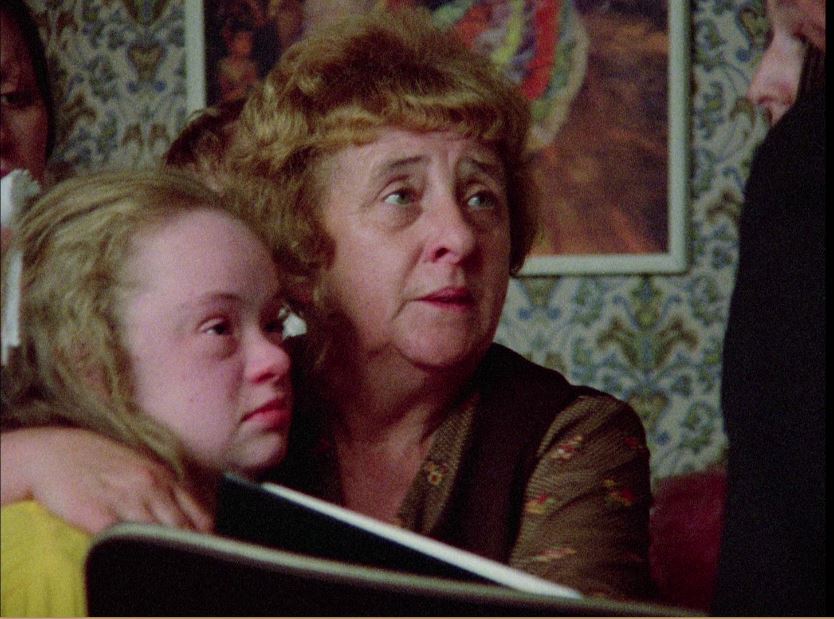
The Spongers is based on an actual case in Salford in which council support for a child with Down’s Syndrome was withdrawn for the usual reasons of cost and the child ended up in a hospital where the care was hopelessly inadequate rather than in the expert and supportive environment she needed.


There are more than three classes in this country and the “Disability Class” cuts across them all in its own silent way, whole families impacted by circumstances not of their making and desperately trying to pull social, medical and educational support together under their own steam. You’re very lucky if you have income but you better hadn’t be poor.


Here Christine Hargreaves features as Pauline, a mother on benefits with four children including Paula, a child with Down’s. Paula McDonagh’s performance is very affecting even now especially when she has a meltdown which feels all to real to be comfortable but she is at the heart of the family and supported by loving friends as well as relatives.


Paula McDonagh and Gertie Almond

Times are hard and as the play opens the bailiffs arrive to reclaim a few hundred pounds worth of debt, a fortune for Pauline who, despite the attempts of a well-meaning social worker, has to sign off her possessions. Whilst she’s in a downward spiral of debt so too are local authority cuts removing the support for Paula and she is placed in unsympathetic environments that start to impact her mental health.


This all happens under a Labour government and with a Labour council – led by Councillor Conway played by Bernard Atha who had been a Labour councillor in Leeds and gives the debate between what is possible and what can be afforded extra grit. There are social workers and a dedicated support worker for the estate called Sullivan played by PFT ever-present Bernard Hill with passionate subtlety – he’s as helpless as Pauline to channel events.


Bernard Hill and Christine Hargreaves


Directed by Roland Joffé – his first film, Tony Garnett who “threw him in the deep end and he swam…” - the play mixes a good deal of natural humour and local warmth amidst the gloom. We’re setting up for the Queen’s Silver Jubilee and there are street parties, singalongs and working men’s clubs in which Auntie Gertie (Gertie Almond) sings in the Northern way and is always ready with a quip and The Last Word!


But there’s no escapism left for Pauline who, having been married on a dual income for sixteen years, has slipped into debt following her husband’s departure and is now faced with agonising decisions if she wants to keep her family together. Her father, played by scouser Peter Kerrigan, tries to help and can’t believe as a child of thirties depravation, that his country is in such a state. It’s that feeling of helplessness that resonates still, even in this most prosperous of nations. Disability and ill fortune can condemn so many even as we find billions for failed track and trace systems and even more nuclear weapons that we will never need.


Frankie Miller and Ken Hutchison


Things are tough in Glasgow too and the two Peter McDougall plays, both directed by John Mackenzie show different aspects of the area, “Greenock Industrial and the Greenock Pastoral” as termed by David Archibald in his booklet essay on these most Scottish of plays. Martin Scorsese reportedly described Just A Boys’ Game (1979) as a Scottish Mean Streets… and it’s not hard to see why with this no holds barred vision of working-class brutality. Singer Frankie Miller is perfect as cock of the walk Jake McQuillen reminding me so much of the lads in seventies’ Liverpool, you’d cross the road to avoid. Jake doesn’t need to put out as he never backs down and has the cold-eyed certainty of a fast gun; he knows he can take anyone on his day.


His supremacy is about to be challenged by a “young team” (Mogwai were watching…) led by the razor blade toting McCafferty. In the pivotal battle Jake moves towards the gang telling him that “your tea’s oot’ and local catch phrase was born. The rules of the street pass on from generations and Jake’s Granda (Hector Nichol), even in extreme health is a hard-boiled bastard and his Grannie (Jean Taylor Smith) gives better than she ever gets. Tough love or just survival… there’s so much nuance in performance and players that you’ll be left thinking about the visceral actuality for days.


Jon Morrison and Billy Connolly


Another musician also features in The Elephant’s Graveyard (1976), this time banjo-player/comic and former shipyard worker, Billy Connolly who plays poetic postie, Jody who meets up with a bored IBM worker Bunny (Jon Morrison) up in the Greenock hills as they both bunk off work for the day. Jody is pushing 40 whilst Bunny has just started work and, over two bottles of stream-chilled fortified wine – you’re heads the next day!? – they start to set their worlds to rights and amidst the macho bluster and boyish “dares” start to establish a bond of sorts. The barriers come down and they even share a vision of cowboys being ambushed by Indians over a brook.


Despite their ages they have the same concern with how to live their lives and perhaps look back to the childhood freedoms of days in the woods for some clues. I like the robustness of the dialogue and the humour too. In the end you’re still wondering… what was really being exchanged and is Jody a vision of Bunny’s future or, maybe, just a smart-arsed postman.


Lovely music from young Carl Davis by the way, whatever became of him?


Get your hair cut Davies!


No less than Daniel Day-Lewis described Phil Davies’ astonishing performance in Barrie Keefe’s Gotcha (1977) as one of his early acting inspirations. He plays an unnamed fifth former who, on his last day at school finds his gym teacher Ton (Gareth Thomas) and another teacher Lynne (Clare Sutcliffe who is also to be seen in eth BFI’s new release of I Start Counting) embracing in a storage room. Disaffected by his lack of consequence and Ton’s slaps, the kid holds them hostage by holding a lighted cigarette over his motorbike. Even the threat of immolation can’t help them remember his name and when the head (Peter Hughes) joins them, we see the three try to talk him round with only Lynne genuinely concerned with the boy and not the situation.


As someone who attended comprehensive school in the Seventies, I remember some dramas but, again, under a Labour regime, it was clear that not all schools were equal and that success was elusive. As with social care, you need to ride your luck with education especially if you can’t pay for it. Keefe went on to script The Long Good Friday and if you know that you’ll recognise this.


Gotcha was presented with another short school play, Brian Clark’s Campion’s Interview, in which a head teacher (Julian Curry) attends an interview for another headship and uses it to inform the gathered mix of educationalists exactly why they are failing his current school. It’s a smart script and well played by Curry who maintains an almost matter of fact calm as he lines up each and every failure of policy and leadership. The two plays together stir and shake.


Bryan Marshall and Gareth Thomas drink to a common cause?


In terms of production values and cinematic entertainment, Stocker’s Copper (1972) is the pick of the bunch not that this tale of industrial action and police suppression goes any easier on the viewer. Based on events in 1913 when a squad of specially trained policemen were sent from Glamorgan to break a strike at a Cornish clay mine. As the silent bobbies sit grimly on the train approaching their destination only one turns and remarks on the huge creamy mountains of china clay, Herbert Griffith (Gareth Thomas) who with the out of context innocence, remarks that it looks like snow.


Herbert – played so well by Thomas – is able to encompass a whole range of contradictions without crumbling under the weight of conscience. A former steel worker, he became a policeman for a steady wage and the “special training” his particular force offers; he understands the process of industrial action and even the need for it but he knows he has the right to beat down on it once the law is beached.


Jane Lapotaire and Gareth Thomas


He stays with the family of one of the strike’s leaders, Manuel Stocker (Bryan Marshall, excellent here as he is in I Start Counting…), with Stocker’s wife Alice (Jane Lapotaire) putting the need for income over the awkwardness of the arrangement. Tom Clarke’s screen play is canny and uses this device to explore the relationships between labour and the law as well as the many things the two working class men have in common. He pits Manuel’s stern resolve against the openness and seeming honesty of Herbert and the relationship is fascinating as you know all too well how things may end up.


The labour movement was on the rise across Europe and strikes were to be of increasing concern. The Home Secretary Winston Churchill sent troops to put an end to the Liverpool Transport Workers Strike in 1911 – including my tram driving great grandfather – and he also sent a battle cruiser up the Mersey for good measure. Yet these unions we ultimately to prevail. Not without many heads being broken and when the push comes to shove, Stocker’s Copper is unsettling viewing.


There’s another a splendid score from young Carl Davis along with the magnificent Treviscoe Male Choir and St Dennis Silver Band reminding us of the solidarity and comfort music can bring.


Victims of Apartheid


Lastly, we have Victims of Apartheid (1978), scripted by Tom Clarke and directed by Stuart Burge which feels the most of it’s time (I generally hate the concept of dated, how can any work of art know how it needs to be viewed in future?) but, for all that, still disturbing in this era of “All Lives Matter” relativism and denial.


South African actor John Kani plays George an anti-apartheid campaigner itching to return to the fray in his home country but also suffering what we’d now term as PTSD after being tortured by the authorities who drove a nail through his foreskin and made him stand on tip toe to avoid tearing his flesh. Kani is jobless and having been dumped by his wife, is being supported by various well-intentioned British activists including Canon Caper of Christian Underground (Peter Jeffrey) who offers him money to look after Henry (John Matshikiza) another supposed refugee from South Africa.


George’s life is chaotic and he has a new girlfriend, sex-worker Carrie (Coral Atkins) which says much of his position in this new society. The question is raised early on as George takes Henry on a bus ride and talks to the black bus conductor about his new friend conceding that whilst there is “racialism” in Britain there is no colour bar. The bus conductor’s response says it all: You got racialism, who needs a colour bar.


So, how “dated” is the vision of domestic racialism we see in this play exactly? It would be well over a decade later that Apartheid legislation was finally repealed in June 1991, pending multiracial elections held under a universal suffrage in April 1994. It was only then that Kani would tell the Financial Times that he felt ‘liberated from the responsibility of relevance’. The case continues…


The BFI are to be congratulated once again for making these works available and the Blu-ray transfers are top notch. The booklet is packed with high-quality essays commissioned by the tireless Vic Pratt and add so much context to films that still present as fearless. They were certainly challenged at the time with Gotcha shouted down for a repeat by Mary Whitehouse and her league of complainers and other’s such as Peter MacDougall’s Just Another Saturday – about Orange Day marches, rescheduled.


These plays put fear into the hearts of some in the establishment. Shall we ever see their like again on the BBC?


You can pre-order Play for Today Volume 2 direct from the BFI shop, in person (hoorah!) or online. It’s out on 17th May and is an absolute delight! Rated: *****


Sunday, 15 November 2020

Plays from yesterday... Play for Today, BFI Blu-ray box set


“…why resurrect Play for Today? What could today’s television industry learn from it? Looking at the seven plays in this Volume One BFI set alone, what stands out is the natural diversity of their subject matter and their brave search for originality.” Marcus Prince, TV programmer for BFI Southbank


After watching through this new set I can confirm wholeheartedly that Mr Prince is not just whistling Dixie; these plays are strikingly vibrant even after all of these years and the quality of performance and writing stands the test of time both in terms of emotional and historical resonance. For some, like myself, these plays were watched and understood as a pre-teen but they were a shared family experience and hearing my parents discussing them is one of my earliest memories of critical appreciation.


I only directly remember one of the plays, Shakespeare or Bust (1973), probably because it was one of three featuring Brian Glover, Ray Mort and Douglas Livingstone as Art, Ern and Abe, three Leeds miners in search of cultural and other adventure. But I recognise the style of the plays as well as the performers especially Alison Steadman who is joint record holder for most PFT appearances on nine, most memorably as Abigail and Candice Marie, along with Nigel Hawthorne. Here she’s an expectant mother alongside Bernard Hill (just the seven appearances) and they show exactly why they have enjoyed such long careers on their way from Rochdale here to Essex and Port Talbot as well as Arundel's Isle.


Gemma Jones in The Lie


Perhaps the most a-typical is the first play, The Lie (1970) written by Ingmar Bergman and directed by Alan Bridges as part of an international co-production entitled The Largest Theatre in the World. It is more cinematic than the others as you might expect given the writer’s day job and typical of his concerns about relationships. This was the third play in season one and features Frank Finlay and Gemma Jones as Andrew and Anna Firth a professional couple in a sterile marriage, stifled by their careers and living all too comfortably in the fug of material wellbeing. After ten years of marriage they have two children, a nanny and sleep in separate bedrooms, but their balance is about to be upset as Andrew suffers at set back in his working life and turning back to fall on home comforts, discovers there’s far less warmth there than he thought.


Anna’s career is still on track and she has a long-standing secret lover, Ellis (John Carson) who himself is married. There’s an excruciating dinner party – avocado prawn starters all round – with Anna sat next to Ellis and Andrew with Ellis’ wife. The story is full of betrayals as you might expect from the four times married Bergman, but are lies better than revelations?


Frank Findlay, a lost soul swimming in a fish bowl?


There’s a striking cameo from Joss Ackland as Anna’s brother, a writer having a nervous breakdown and wearing make-up and nail varnish as he simmers away in hospital. Is he the author’s voice; driven to nervous exhaustion by being too honest to make the compromises that enable the others’ unhappiness? I wonder what becomes of him?


In Passage to England (1975) there are more deceptions and also the first sighting of the wonderful Colin Welland, writer and actor who in ten years would hoist his Oscar a lot and declare that the British were coming. Back in the seventies the adage was that British cinema was alive and well and on television and Play for Today surely played a major part in keeping things afloat prior to the cinematic revival heralded by Chariots of Fire.


Here Welland plays Onslow, captain of a small cargo boat, the very English Morris Dancer who, along with his partner Graham (Niall Padden) get an offer they could and should refuse from a young Ugandan Asian called Anand (Tariq Yunus); a bar of gold at bargain price if they smuggle him, his cousin Pramila (June Bolton) and sick uncle Dharam (Renu Setna) to England. The play balances a serious subject with a light-heartedness that serves to wrong foot the viewer even now with a nuanced discussion of the British and their empire.


Colin Welland was born in Liverpool


Written by Leon Griffiths the story is mostly set in the Amsterdam docks which director John Mackenzie uses to atmospheric effect much as he would do in The Long Good Friday; who doesn’t love a dock-side drama?


There’s more Welland, this time as writer of altogether more earnest and needfully complex tale of post-imperial national identity with Your Man from Six Counties (1976) in which a young Catholic boy Jimmy (Joseph Reynolds) goes to stay with his Uncle in the west of Ireland after his father is killed by a loyalist bomb in Northern Ireland.


Location is again an important part of the context and it looks very much as if all the shooting was done in situ from the hills and fields to cottages and pubs of County Sligo, you can even see flat-topped Benbulbin Mountain near Drumcliff, where W.B. Yeats is buried. There’s a very fine cast backgrounded with local faces that could only ever be Irish, with Donal McCann as Uncle Danny and a young Brenda Fricker (first Irish woman to win an Oscar for My Left Foot in 1989) as his wife Mollie. Young Jimmy is like a fish out of water, a city boy in the country, carrying a pet rook once rescued by his Dad, in a cage. Irish mythology may have it that these birds symbolise the souls of the dead yet, to local farmers, they’re a menace to be shot and hung out to dry.


Donal McCann and Brenda Fricker


Danny tries his best to bring Jimmy back to life and to put his father’s violent death behind him and yet the latter’s best friend Pat (Paul Antrim), a rebel in thought if not deed, wants to encourage the boy to hero worship his “martyred” father and to follow in his footsteps more forcefully than he has ever managed. Both Danny and Pat have something to learn about the boy and Mollie acts as the play’s moral heart trying to pull them together for the lad’s sake. Welland’s script allows so much room for interpretation especially as Katie Crosson observes in her booklet essay, “No two viewpoints are identical… “ meaning that there is no single straightforward narrative: you have to make your own mind up.


‘I want to have this baby and I want to see it being born and I want to feel it being born… and if you’re not interested in helping me why don’t you just sod off.’


Mike Stott’s Our Flesh and Blood (1977) is ostensibly more straightforward but is no less a deft thought-piece on contemporary masculinity as Bernard Blincoe (Bernard Hill) has to come to terms with his wife Jan (Dame Alison Steadman – if not yet, then soon…) and her desire for a baby on her terms. Bernard views this development with trepidation and his anxiety dreams turn into reality as Jan aims for a natural birth. At the hospital he gets a nervous young doctor, a reassuringly sassy sister (Diana Davies) and an old school consultant, Richard Briers on fine form and, amidst the comedic chaos finally catches up with Jan…  


Bernard Hill and Alison Steadman (who was also born in Liverpool)


The play has a lot to say about the role of the sexes at the time, men either pompously insistent or next to useless when the waters break, but this was not yet a country in which men routinely attended childbirth or in which couples were allowed too much of an opinion about how they were to have their baby. It’s a heart-warming glimpse of the future.


Back to Brian Glover on a barge to Stratford in Shakespeare or Bust (1973) for a mix of past and future as his earnest Art looks not just for the nation’s poetic truths but also comradeship and fairness. Peter Terson’s three heroes have working class pride and sense of self but also innocence as they happily punch above their weight on this aquatic road trip. They meet dropout boat dwellers who don’t share solidarity even as they’re happy to take Art’s coin, lock-keeper’s happy to mix with the man who turned their pub into a wine bar and follow an odd couple in a very posh boat; an older man with a yachting cap (Peter Honri) and his much younger boat dressing Hélène (Katya Wyeth). Abe reckons he stands a chance and the three sup their pints barely blinking in their awe-struck appreciation of this alien glamour.


Almost nothing knocks these lads back though and Art’s enthusiasm is infectious even if Ern can’t stop missing his wife and Abe just wants the one he can’t have. They relish every new turn as passionately as their drink and in the end are rewarded with surprises against the longest odds.


Ray Mort, Brian Glover and Douglas Livingstone


Back of Beyond (1974) is an altogether more mysterious affair with Rachel Roberts absolutely superb as the sad and mysterious Olwen; a woman hiding in solitude. Desmond Davis’s play is another to use locations to good effect, this time the Brecon Beacons and Llanelli-born Roberts looks like she grew up along with these hills.


There’s more mystery with John Bowen’s A Photograph (1977) featuring the great John Stride as pompous intellectual Michael Otway and Stephanie Turner as his long-suffering schoolteacher of a wife. There’s a great essay in the booklet from series producer/booklet commissioning editor Vic Pratt and this is further proof, if any were needed of Play for Today’s insistence on making its audience think.


Rachel Roberts yn ysmygu sigarét


Most of these plays have hardly been seen since first airing and the odd repeat. There were over 200 plays in the series and whilst some were wiped by a cost-conscious BBC, most survive and these seven provide not only proof of the quality and diversity but also a mouth-watering entrée to what we can only hope will be the start of more releases and screenings.


Play for Today: Volume 1 is released on 19th November and can be ordered direct from the BFI website now! 

There’s a trailer available here but for many this is Christmas come early.