Showing posts with label SFI. Show all posts

Sunday, 5 January 2025

Preview. The remaking of Gösta Berlings saga (1924). BFI screening on 19th January!


The BFI are screening Gösta Berling's saga on 19th January and if you haven’t already booked I suggest you click on this link right away to make sure of the best seats for what will be a spectacular Sunday with the best musical accompaniment!


The Swedish Film Institute have been working on restoring one of the major works of their golden silent era for years and first presented a restored version a few years back at the San Francisco Silent Film Festival but, this wasn’t enough and they were motivated to further enhance what had been done by the desire to present something as close as possible to Mauritz Stiller’s original vision and… here we are!


I’ve been speaking to the person responsible for the project, the SFI’s Jörgen Viman, Film Archivist and man on a mission. He says that the initial motivation to make a new print was that the existing ones were only in black and white. They discovered that there were tinted nitrate materials in French, German and Portuguese archives and borrowed from all three to create a digitized template for re-tinting the film.


I found images that we were missing completely, and these are euphoric moments. I also discovered images that were similar, but still not exactly the same. The camera angle was slightly different.


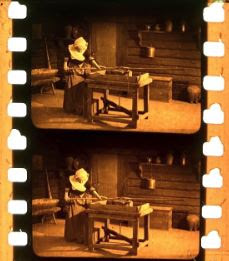
An example of one of the tinted source nitrates, many sprockets were fixed...


Source materials


Examining the images in detail he discovered that that there were differences in content and approach, these being all further highlighted by a black and white print from Moscow. The project was now not just about restoring the tints but also missing parts of the narrative and I can well understand the satisfactions of an archivist on this trail especially when he discovered after painstaking work sifting through the SFI’s filming reports, text lists, text signs and other documentation, that there were originally two slightly differing negatives.


Running to the same length these featured different angles with Stiller and his legendary lensman Julius Jaenzon using two cameras as was standard practice for at least parts of the filming. Trying to make sense of Stiller’s intended narrative was always going to be difficult as films often varied from the script which still survives in this instance. Luckily Swedish censorship was diligent and so there was a record of all of the intertitles – praise be to those who have the viewers’ delicate sensibilities at heart.


None of these records showed how the images were edited around the text and so a long and laborious process was begun reviewing the materials side-by-side to identify the best quality takes from scenes of varying length and angles from those two cameras.


One of only six surviving images of Ava Lundin's original intertitles


405 Intertitles…


In terms of the intertitles only three of Ava Lundin’s lovely painted inserts survive but Jörgen found three more reproduced in a magazine from 1924 that helped the team create a font that was a close as possible to the originals. Anyone who has worked with typography knows what a challenge this is but luckily all but the letter z were present in lower case on the six intertitles although the capitals were more elusive especially as they varied by context in the sentences.


Jörgen then used Photo Shop to recreate everyone of the 405 intertitles, originally painted by hand now by digital programming with no less attention to detail and layout. I remember a world of graphic design before digital artwork and it is such an underappreciated art with text placement needing to balance, avoid line breaks and to be readable as easily as possible. Jörgen centred the text and also aligned left and right creating a consistent read area throughout the film. I noticed in Bologna that some of the English text had changed as well, perhaps moving them closer to the original Swedish?


The reconstructed intertitle, only 404 to go...

Tinting and colour ways


Obviously it was not possible to recreate Alva Lundin’s painted images on the title cards but the magazine article revealed that they were all toned in dark brown which no other document mentioned. This may not always look the case though as the eye gets used to the colour that is in the image before the text. As Jörgen says: If the image is blue, the eye perceives the text as more strongly toned than if the image before is yellow, for example.


Now for the colour of the images the restoration team mostly used the Portuguese nitrate print, but there were variations with that print showing all the night images in light green, while the same sequence were tinted blue in the French material. Swedish convention was – as with Hollywood films – to use blue for night and this they did with exception of one scene only found in the Portuguese copy – which they left in dark green. You’ll see it when Gösta finds the little bird on the road.


Re-creation is an interpretation that is based on facts, but also experience and collaboration.


New footage…


This is what gets most of us excited about any restoration and watching the restoration in Bologna last June there were many occasions when I wanted to stop the film and compare with my old Kino DVD but this would have been rude of course!


There are a number of images from slightly different places throughout the film and it felt like the key sequences in which first the Major’s wife, Margaretha Samzelius (the Swedish theatre legend Gerda Lundequist) and then Marianne (my favourite prima ballerina/actress Jenny Hasseqlvist) are disgraced at Ekeby parties, were separated, giving both more impact for me.


There are new images in the latter scene where Gösta (Lars Hanson) and Marianne dance – I always love seeing Jenny dance! – which fills out the depth of feeling between the two as their attraction is revealed on stage leading to Marianne’s father refuses to have anything more to do with her.


Jörgen says that the section that perhaps took the longest to put together was the sequence that took place on the ice with many options from the footage and different camera angles. He says that the sequence where one of the wolves is attacked by his own pack was filmed from two completely different directions, leaving him with the task of re-editing one of the most exciting and important sections of the film.


Thank you for your time and for your diligence Jörgen, what I saw at Il Cinema Ritrovato you have done a splendid job and I can’t wait to see it all over again on Sunday 19th January at the BFI and to introduce the results of your work as succinctly as possible!


Book your tickets now at the BFI website!


Tuesday, 25 June 2024

Ekeby at last! Gösta Berling’s Saga (1924), with Matti Bye, Eduardo Raon and Silvia Mandolini, Il Cinema Ritrovato XXXVII


"Finally, the vicar was in the pulpit..."


Sometimes at these festivals your day is done after you’ve just seen something that resonates with such force you don’t want to spoil the mood or otherwise break the spell that was so brilliantly cast by the film and musical accompaniment. So it was that I retired to just stay as long as possible in the moment of having just seen and been seen, by Mauritz Stiller’s magnificent adaptation of Selma Lagerlöf’s epic novel. Now, I’m not saying the film is perfect in fact there’s a reason he was no higher than her second or third favourite film director of the Nobel Prize winning author, but like Heaven’s Gate, Greed and several works by Monsieur Gance – one of which was frustratingly counter-programmed against this one… - the ambition wins you over along with incredible performances.


Lagerlöf’s name is on the film after, against her better judgement, she signed off on Stiller and Ragnar Hyltén-Cavallius original script which changed during production; she called the result “cheap and sensational”. The film takes considerable liberties in its mash-up of the novel’s narrative with some events happening at different parts of the arc and to different characters and, indeed buildings… Characters are changed with Gösta himself much more charming – how can he fail, he’s played by Lars Handsome? - whilst Countess Elisabeth is not quite the strong character she becomes as she leads the fallen priest towards a better, humbler life. She’s played by Greta Garbo of course in her first film, yet to master her craft and here just 19 and about to learn very quickly in Hollywood.


Needless to say, the Majoress and Marianne are women of agency in both, with the latter pushing Gösta away, refusing his offer to stay with the woman who has lost her beauty after smallpox although Jenny Hasselqvist still looks wonderful to my eyes. More than ever though this screening showed the Swedish Sarah Bernhardt, the great Gerda Lundequist, in full force as Margaretha Samzelius, the Major’s wife and mistress of the estate of Ekeby in Varmland. She has the most expressive face and know exactly how to play for the camera with delicate hand movements and shifts in expression that bely the fact she only made four films. One of these, One Night/En Natt (1931) was shown as part of the Gustaf Molander strand and she is fabulous too in a smaller role; along with Bea Lilley in Exit Smiling, her display in Gösta is one of the greatest of those who only made a single silent film.


Gerda Lundequist


Selma’s women are so strong – as you’d expect from her own life story – and this is one of the most fascinating aspects of this epic, so many female characters are creating their own direction, making their own mistakes and standing up for what they believe in… which raises the question, was Selma Lagerlöf “woke”? She was certainly a force to be reckoned with and a pioneer with a big prize to prove it!!


The magic realism of the novel is dropped almost completely in favour of the pure drama and the poetic world created by Lagerlöf is given less room for melding myths and legends with the characters such as Sintram, the cavaliers… dozens of finely wrought episodes punctuate the main story with meanings only emerging from within the text as you search for the link. Lagerlöf was so adept at subtext but also so disciplined in building the “spirit” of the book; the place and the people of Varmland are vibrantly interconnected in ways that are frankly still inspiring. *


Now then, back to the digital wonders on screen, this latest version from the Swedish Film Institute is not just a restoration of Gösta but a remix and extended cut being not only some 20 minutes longer than the 1975 restoration which most of us have only seen up till now via the Kino release, but also in a different narrative order with the party sequences and their two exiles are re-sequenced and there are variations elsewhere, with a more dynamic mix for the burning of Ekeby and Gösta’s rescue of Marianne, a longer intro and new intertitles that carry more of the original author’s poetic wonder.


Lars/Gösta and Jenny/Marianne (after the ravages of smallpox)


Never has the camera work of the great Julius Jaenzon looked so fine from the gorgeous sweeps of the lakes and forests to the shots on set and the performer’s expressions. It’s the quality this film deserves and to be able to focus on individuals’ emoting is a delight with Jenny Hasselqvist and Lars Hanson being, in their own ways, two of the most talented of all silent actors, the former all force and subtlety and the latter bringing her world-class balletic movement and grace to the fore along with a remarkable ability to radiate changing emotions through very controlled raising of the angle of her face, a flash of the eyes or hands raised in grief.


As with the original release, the film was split into two parts with Matti Bye’s specially written score forming the basis for extemporisation with Eduardo Raon on harp for the first part and Silvia Mandolini, on violin, for the second. Eduardo has been a feature of this edition of Il Cinema Ritrovato and his use of effects peddles brings a whole range of tonality and atmospherics which served the statelier pace of the first half. Silvia’s violin could have been played by the demonic Sintram himself for the fiery climax and the iconic chase across the ice as wolves pursue Gösta and Elisabeth was breathless before the piano and strings played out an inspiration and elegiac conclusion.


For a film I’ve waited a decade or more to see online and a restoration I first heard mentioned in 2018 in Pordenone… there was a lot at stake; I set bad personal expectation when I had a Lars and Gerda t-shirt made for the occasion. The SFI delivered though as did Stiller, the film and all his cast with the aid of these three musicians. Selma might not have completely approved but this film is part of her living legacy and I hope it, along with other famous works from Stiller and Sjostrom especially, along with the two Molander films screening later in the festival, will see interest in her work increase.


As the authorial voice at the end of the book ponders… “the giant bees of Fancy have thronged about us… but how they are to enter the beehives of Reality is surely their own affair.”


Make of that what you will dear reader.


Hang on lads, I've got an idea...


*Translating in words and film

I am basing this on a reading of the most recent translation, the first in a century, from Paul Norlen – previously awarded the American-Scandinavian Foundation Translation Prize in 2004 – who is closer to the spirit and intent of the original work than contemporary translators such as the well-intentioned but over fussy and interventionist, Velma Swanston Howard.


In terms of filmmakers “getting” her work, according to Paolo Cherchi Usai in The Oxford History of World Cinema, it was the author’s admiration for Sjöström’s films that led her to sign over the film rights for all her books to Svenska Bio and he adds that the director “found in her work the ideal expression of the active role played by nature in the destiny of characters torn between good and evil.”


Greta in glorious tints!!
Lars in even more clarity

Even more snow for Jenny

Sadly that inter-title has been changed... 


Monday, 27 May 2024

All you need is Lagerlöf… Bologna Preview – Swedish Restorations


Not one but three restored films based on Selma Lagerlöf’s novels to screen at Il Cinema Ritrovato Festival.


Gösta Berling saga (1924)


It was probably in 2018 that I first heard of the restoration of Mauritz Stiller's Gösta Berling saga (1924), and a few years after I’d started my fascination with the story, its original writer and its stars after viewing the Kino DVD… Sure it was Greta Garbo’s breakthrough role, but it also featured vital performances from Lars “Handsome” Hanson, Gerda Lundequist - "The Swedish Sarah Bernhardt" – and Jenny Hasselqvist, Royal Swedish Ballet prima ballerina and an actor in so many European films: has anyone ever managed to combine both careers so well?


The initial restoration was screened in San Francisco pre-pandemic but now, at last, next month’s Il Cinema Ritrovato will screen the film as part of the 1924 selection. This new digitally restored Gosta will be unlike any other I’ve seen and is based on the analogue reconstruction from 2018, but with some changes in the editing work according to the Swedish Film Institute. The film now has a running time of 206 mins (simulating 18 fps) which is a good 22 minutes longer than the Kino version. It was originally measured by the Statens Biografbyrå in March 1924 at 4534 meters, which with a display speed of 18 frames per second would correspond to 221 minutes. The film has subsequently been shortened and re-cut several times over the years, and so this latest reconstruction moves it as close to the original release as it’s been.


As Jon Wengström, Senior Curator of the SFI’s Filmarkivet / Archival Film Collections explained:“The main sources for the restoration was an existing duplicate positive from our collections, and tinted nitrate print from the collections of Cinemateca Portuguesa (Lisbon). A brief scene was also added from a safety print in the collections of Gosfilmofond (Moscow).”


Gerda Lundequist, whose grand-daughter is rock singer Sonja Kristina... 


Jörgen Viman was the SFI’s Film Archivist on the restoration or “recreation” as he puts it, of the film explains further that tinted nitrate prints were also borrowed from the Cinémathèque française in Paris and the Deutsche Kinemathek in Berlin, as a reference for the film's continuity. Having just re-read Paul Norlen’s 2009 translation of Selma Lagerlöf’s extraordinary debut from 1891 it will be fascinating to compare Stiller’s focus. Lagerlöf creates such a powerful, magical-reality and seems to write from inside her subjects… I wonder what Powell and Pressburger would have made of her work and the interpretation of Stiller, Sjöström and Molander are all so tonally different.


The film's subtitles have also been recreated based on the wording in text lists submitted to the Statens Biografbyrå. These intertexts have now been based on Alva Lundin’s original designs - only three of the 405 text boxes have survived and another three were found reproduced in a trade journal from the time. Sadly, Lundin’s original painted illustrations of the text have not survived but you can read more about her work on the Women Film Pioneers Project website!


The film’s colour ways have been recreated though using the tinting scheme of the Portuguese nitrate print. The colour shading of the intertexts is also based on a description in another trade magazine article – bless these secondary sources!


Jenny Hasselqvist and Lars Hanson in Till Österland 


Till Österland (1926)


At the start of the pandemic, I read Selma’s epic Jerusalem Parts I and II (1901-2) as translated by the American Velma Swanston Howard in 1915. The story was set in the traditional rural heartlands of Dalarna and involves a group of villagers who gain a new faith and emigrate to Jerusalem as happened in the parish of Nås in 1896. It gave rise to four cinematic adaptations with Victor Sjöström making the first two films, The Sons of Ingmar (Ingmarssönerna) (1919) followed by Karin Daughter of Ingmar (Karin Ingmarsdotter) (1920) which failed to repeat the success of the first film leading the director to turn his attention elsewhere. Gustaf Molander picked up the project and completed the story with his brace, Ingmar's Inheritance (Ingmarsarvet) (1925) and Till österland (1926).


The two directors had many differences in approach with Sjöström’s narrative much closer to Lagerlöf’s text and more focused on the interior life of her conflicted characters whilst Molander broadened the palate, taking more liberties and setting up more action. Sjöström made two feature films out of less than 105 pages whereas Molander crafted one from the remaining 240 and another from the 350 pages of Volume II, including adding some of his own inventions. The feeling is much the same but the pace has changed and the cinematic vision of the narrative is one aimed at creating a hit film with hot actors, most of whom feature in both films.


Mona Mårtenson and Conrad Veidt

Ingmar's Inheritance has Lars Hanson, Mona Mårtenson and Jenny Hasselqvist as well as a powerful turn from the non-recurring Conrad Veidt. It’s still extant but the follow-up has long been incomplete and unscreened. Not any more as Till Österland has been restored, as far as possible, to create a 42 minutes long mix of the surviving film and other elements; it’s narrative structure now intact.


One additional scene, showing the dance of the dervishes, was found in a compilation film but the main thing is that the existing footage is now properly put in context, with the film’s original intertitles accompanying the surviving footage, and some stills and explanatory titles where footage is missing. All in all, the fragment now has a running time of 42 mins (simulating 20 fps), and the surviving footage is now shown with recreated tinting.


Filming in Jerusalem

Magnus Rosborn was the archivist working on the film and his summary is… “The surviving scenes have mainly been taken from a duplicate negative made from a duplicate positive which in turn was produced in 1977 from the film's then fragmentarily preserved – but now lost – original negative. In addition, another scene has been taken from a duplicate negative for the film Selma Lagerlöf 80 år (1938), which has been preserved in Sveriges Television's archives.”


The intertitles have been taken from the film's preserved original text boxes and the colours of the film have been reconstructed using handwritten tinting and toning notes copied into the duplicate positive. The missing scenes have been reconstructed with the help of those text boxes, production stills and newly made explanatory texts.


Before the premiere in 1926, the film was measured at the censorship review at 2587 meters which corresponds to a playing time of 113 minutes, so whilst approximately three quarters of the film's moving image material is still missing, we are now able to finally see what becomes of the characters in what was Volume II of Jerusalem. Fasten your seatbelts, it’s going to be a bumpy ride…


Victor yes, Mauritz maybe and Gustaf.. well!?

What did the author think of these films? According to Paolo Cherchi Usai in The Oxford History of World Cinema, it was the Selma’s admiration for Sjöström’s films that led her to sign over the film rights for all her books to Svenska Bio and he adds that the director “found in her work the ideal expression of the active role played by nature in the destiny of characters torn between good and evil.” The author was certainly not low on opinion and was initially unsure about The Phantom Carriage (although pleased with the result) and berated Mauritz Stiller for his adaptation of The Gosta Berling Saga calling it “cheap and sensational”.


Well… we can see more clearly for ourselves in just one month’s time! Bring it on!


Details of Il Cinema Ritrovato can be found on their website.


The Swedish Film Institute website is here.