Showing posts with label Ben Palmer. Show all posts

Sunday, 15 October 2023

Of time in this city… Le Giornate del Cinema Muto 42, Day Eight


Is an interest in silent film nostalgia for a time before we were born? Let’s ask Albert Camus shall we, who said that: A man's work is nothing but this slow trek to rediscover, through the detours of art, those two or three great and simple images in whose presence his heart first opened. So, the fascination is more in understanding the working parts as much as the feeling and in the historical, creative circumstances for the filmmakers and film audience alike. 


Camus also said that the artist must contact the reality of his or her time, wresting from it something timeless and universal so what we are searching for is people who have done achieved this for their time and to look beyond the ludicrous concept of “dated” in assessing the content and the context.


Succeeding today was William de Mille who came up with some very pertinent questioning of his own in Conrad in Quest of His Youth (1920) in which Thomas Meighan’s Conrad has something of a mid-life crisis and tries to regress to childhood. So, not too far off Camus’ concepts but in a more homely way which is frankly more on my level and that of Thomas Meighan, pretty well-educated but in pharmacology not philosophy. Thomas plays the titular Conrad, who a few years after the First World War is living in comfort, supported by his faithful valet, Dobson (Charles Ogle) and wondering what it’s all for. Conrad is jaded and decides the best way to reconnect with his zest for life is to revisit his childhood by calling three old friends back to the cottage they used to spend summer in.


It's all too much for Conrad - he's watching a Pat and Patachon...


Ah, but you can’t just go back Conrad, as his pals quickly tell him but he’s not listening and decides to track down his first love, with future director and Mr Louise Brooks, A. Edward Sutherland playing him in flashback with Kathlyn Williams playing the older woman Mrs. Adaile, who gently rebuffed him. Conrad tracks her down to Italy and tries to rekindle their previous affection; can reliving young love work for either?


No spoilers, but Conrad is to discover that you can over-analyse and that sometimes you need to just stop thinking and simply engage with “Life” to find that chance of happiness. It’s a perfect little fable and Meighan is his usual self, intelligent, sensitive and always watchable.


Donald Sosin accompanied with the air of a man completely in touch with his creative consciousness (and moral compass).


Also connecting with the timeless and universal and in doing so creating it, was Daan van den Hurk whose emphatic new score for Buster Keaton’s Sherlock Jnr (1924) made me enjoy this very familiar film anew. The music highlighted pretty much every section of the Orchestra da Camera di Pordenone and it just grew in momentum and delicious tonality with the film. After an opening prologue including the earworm main theme, the music chased around with Buster in the quieter early stages only fully coming to life when his projectionist’s dreaming begins. From then on, it’s a symphony to silent style pretty much as Keaton intended but given extra emphasis and depth as the adventure of the Projectionist and all the films he has shown is laid before us.


Daan reveals Buster’s own symphonic approach as the film and the music crescendos with stirring strings and full-bodied brass – and tha’ knows, I love a bit o’ brass as Hindle Wakes’ Fanny Hawthorn might say. It was one of those uplifting orchestral moments Le Giornate does so well and congratulations must go to Daan, the full orchestra (70+ players?) as well as Ben Palmer who conducted so well. I was up in the Gods again but, by ‘eck the sound filled the space so well. A thrilling sonic adventure all round!


Most of us tired after a full week, the Verdi still erupted with the joy of recognition or holding this shared fascination close!! In the best showbusiness tradition, Le Giornate always leave ‘em/us wanting more!


Charlie and Monta Bell


Before Buster there was Charlie with a film I’ve not seen before, The Pilgrim (1923) which featured Chaplin’s 1958 score arranged by Timothy Brock and performed by the Orchestra da Camera di Pordenone as conducted by Ben Palmer.


It’s a film full of Chaplin’s movement and impish humour with heart as his escaped convict steals a pastor’s clothes as he bathes and then gets mistaken for the new vicar and has to follow through as the citizens are so friendly. This was Chaplin’s final film with long-term collaborator and paramour, Edna Purviance and once again her character provides the key to Chaplin’s redemption as a former cell-mate recognises him and wants in on “the action”. It’s an old argument but there’s enough comedic violence and pointed situations to make political points and some evangelicals were also upset by The Life of Charlie. Who knows what modern US politicians would have made of the closing sequence on the US/Mexican border… or what their fundamentalist Christian brethren would. Chaplin was another able to create something timeless and universal out of the realities of his time.


Marlene by the wall next to Harry Piel.

A Marlene Surprise!


I need to pay more attention as I had no idea that our Marlene was going to feature in Harry Piel’s Sein größter Bluff (The Big Bluff) (1927) nor that he was going to play himself and his brother as well as write, direct and produce. Nobody likes a show-off Harry apart from Marlene that is.


This was a lively adventure which featured car chases filmed in the South of France, double crosses and quadruple bluffs which make me extra thankful for being woken up by my esteemed colleague Ms Hutchinson of Worthing just as Giornate fatigue kicked in and I was able to re-join the film as it stepped up a gear in search of stolen diamonds with a hoard of gangsters chasing it as well as the twin Piels. Over the Festival we’ve seen Harry advance his work to such a level of polished populist filmmaking that this had so many elements of a sixties caper movie; he wasn’t Pabst or Murnau but as this 76th film shows, he was a skilled crowd-pleaser, no matter whatever came after 1932…


Dietrich often played down her silent films not wishing to be deemed as too old school but by 1927 she was beginning to feature more and here she plays Yvette, “a ‘lady’ who puts her intellectual – and other – qualities exclusively into the service of worthwhile enterprises”, in this case acting to steal the jewels before her rivals can. She’s a perfect fit for a Lang-type super spy/secret agent and stands out in her scenes for poised screen energy. Having just watched A Touch of Evil I can see how she refined this persona of intelligence and bold sexuality. The perfect fit for Harry’s anti-hero and twin heroes with floppy fringes and fast cars: the name’s Piel, Harry Piel.


Accompaniment was from Masterclass student Timothy Rumsey who did a splendid job, I look forward to hearing more in future!


Madeleine Renaud and Maurice Touzé

I Married the Sea, Part Deux - Vent Debout [The Headwind] (1923)


After the French fishermen of Pêcheur d’Islande (screened on Tuesday) gave their life to the Atlantic Ocean, Jacques Averil (Léon Mathot) finds himself drawn to the sea to rebuild his life after his father ruins the family business and commits suicide. Viewed as a part-timer by the tough nuts on the fishing boat, he asserts his authority through violence emerging as top sea dog and winning grudging respect. This maritime Fight Club does move beyond the sea and there are many turbulent times on land as a potential fortune to be made from fossil fuels presents itself.


After being flung into an alcoholic depression after the accidental death of the ship’s cabin boy, Guillot (Maurice Touzé), Jacques meets Marie Richard (Madeleine Renaud) begins to find his legs on land again. So, my headline isn’t entirely appropriate, will he divorce the sea and marry a human? And, will he be able to avoid financial ruin from the land-based sharks aiming to drag him down?


Meg Morley accompanied with the smooth transitions we’ve come to expect and melodies for drama in all weathers and surfaces!


So, returning to the questions at the top; why exactly do I write this blog? Well it’s an attempt to capture the feeling of what has been screened and the experience of the location, audience and accompaniment for the screening. It’s a diary, one featuring well over 1000 screenings now and which evolves over time and circumstance. Like any diary it’s a discipline and I only keep on because I enjoy trying to that slow trek to rediscover, through the detours of art…  I hope you do too and thank you so much to everyone who has read so far!


See you next year for #GCM43!


The Queen of Le Giornate Blogging is, of course, Pamela Hutchinson and if you haven’t already caught her daily reports on Silent London head over there right now!


The orchestra and crowds pack the Verdi for this year's finale.


Saturday, 8 July 2023

Mother courage… Stella Dallas (1925)/Lady Windermere’s Fan (1925), Cinema Ritrovato XXXVII, 2023 (Part 3)

Mssrs Horne and Brock take the applause in the Piazza Maggiore


Il Cinema Ritrovato is an experience that leaves you emotionally disrupted, it’s not just all that time spent in darkened cinemas, the relentless watching, pattern recognition, interpretation but also the human connections on screen and off… it leaves you open, and delightfully vulnerable to the enhanced flavours on screen and, in the case of silent film, the invention of the accompanists. Here we had two outstanding new scores that, coupled with the sense of occasion, location and performance produced moments of engagement modern studios would barely comprehend.


The best silent scores don’t pummel you into submission with dozens of drums, decibels and Dolby, they embrace the visuals in sympathy with the narrative and the actors, they duet with the directors and audience to connect our sympathy and imagination, interpret our response and subtly guide it too; a multi-verse of meaning, one that opens up a portal removing you from reality… irresistible forces, for un-resisting volunteers for a kind of magic.


This is no job for anything less than the most experienced of compositional pilots though and in the Piazza Maggiore and then the Teatro Auditorium Manzoni, first Stephen Horne and then Timothy Brock, who conducted the Orchestra del Teatro Comunale di Bologna, provided scores that enhanced two of the very finest Hollywood performances and silent films. Consider them as restorers, replicating the high impact of these films’ first screenings, Time Lords able to whisk us back to the feelings our grandparents felt. We are all companions now.


Helen Morgan in Applause

There was also an emerging theme across the programme this year – Rouben Mamoulian’s early talkie Applause (1929) featuring another selfless matriarch with Helen Morgan’s Kitty Darling - and one that was at the heart-breaking centre of both these films; the sacrifice of mothers willing to lose everything so that their daughters might succeed. If you think that sounds corny, take a break from the 21st Century and think back to the women who made a difference in your own family; Jenny, Jessie, Lil, Mabel… they all changed the course and there were entire generations watching just these films.


Stella Dallas (1925)


Directed by Henry King and adapted by Frances Marion from Olive Higgins Prouty's novel, Stella Dallas of course walks that fine line between melodrama and drama. It features characters bound by the constraints of their time and it perhaps a backwards view of social mores even for 1925 but, the story was driven by grief as much as anything else. Prouty wrote the novel soon after the death of her three-year old daughter in 1923 and I’m sure for Prouty this was a case of if only; a tribute to the one lost and the lengths she would have gone to if only she could have.


Any decent into pulpy drama is completely offset by the fiercest performance from Belle Bennett who’s own 16-year-old son had also died either just before she got the part or soon after: whatever the motivations her Stella rings very true and every time I see watch it becomes greater with Stephen’s score so sympathetic and emotionally intelligent.


Belle Bennett


Stella herself, is something of a misfit, a woman of ambition to escape her small-town working-class routes who becomes involved with a rich businessman’s son, Stephen Dallas (Ronald Colman) who has fled from his father’s suicide and disgrace only to start rising again after they marry. New York calls Stephen to business success but Stella doesn’t want to leave the town she knows so well and nor does she want to disrupt the upbringing of their daughter Laurel (Lois Moran, 16-years old and playing both girl and woman in one of the odder practices of the time).


The gap between mother and father grows and Stella spends time with an earthy good-time fella name of Ed Munn (Jean Hersholt who is so very good at playing bad) and needless to say this doesn’t sit well with Stephen who misses the companionship of more refined women such as his former sweetheart Helen Morrison (Alice Joyce) who is now widowed with three boys of her own.


You can see the direction of travel but the humiliations have only just begun as Laurel’s teacher spies Stella having fun with Ed and expels her from school leaving her devastated when the rest of the class fail to turn up for her 10th birthday party. The story moves on a few years and as Laurel comes of age, she forms an attachment with a young rich boy called Richard Grosvenor (Douglas Fairbanks, Jr 15 at the time!) but is ashamed of her mother with her crude ways, working class manners and dress sense.


Stella overhears some of the rich set mocking her and begins to think she can only be holding her daughter back. By this stage she and Stephen have run aground and knowing of his attachment to Helen, Stella asks her competitor directly for help… what follows shows her strength of character and amidst the tragedy she shows her class in sacrifice something only another mother truly understands during the film’s iconic closing sequence.


Faced with such intense emotional extremes, Stephen Horne’s score is perfectly composed and he knows just how to under-score Belle’s expressive restraint and combines with the actress to leave the audience smiling through tears of recognition. Ben Palmer helped to orchestrate and Timothy Brock superbly martialled the sixty-piece orchestra under the stars. There’ll be a Blu-ray release at some point and hopefully further performances of one of the great modern scores of this silent renaissance.


Lady Windermere’s Fan (1928)


Irene Rich and May Mcavoy

As the cricketing Ashes started back in the UK, rain unexpectedly stopped play in Bologna and the screening of Ernst Lubitsch’s take on Oscar Wilde’s play was shifted to the splendid Teatro Auditorium Manzoni; a purpose-built modern auditorium with splendid acoustics, all the better to experience the power of Timothy Brock’s new score as conducted by him and played by the mighty Orchestra del Teatro Comunale di Bologna.


Given the sophisticated wordplay of Oscar Wilde, he seems an unlikely candidate for silent film but here Ernst Lubitsch takes on Oscar using the wit and sophistication of his direction. Sure, there are some excellent performances but Ernst’s inch-perfect positioning, cross-cutting and way with purely visual messaging ensures that this take on a wordy, comedy of manners works bursts into sensational silence on screen.


The director hardly needs to use title cards as the mood is established, explained and maintained throughout in what is one of the neatest of film: so balanced and perfectly timed, shot and performed… That “touch” is fully in evidence now – the delicate use of key signifiers to lift the tale above predictability and to convey small explosions of meaning in unexpected ways. Take that fan, for example, it’s everywhere: a symbol of marital love, a potential assault weapon, distraction under duress and incriminating evidence. It’s just a fan but Lubitsch uses it to pivot the whole story. That fan is also the undeniably fine hands of Irene Rich and you have another symbol of motherly sacrifice, unbreakable choices that have to be made and confirmation that true love does indeed conquer all.


All begins with Lady Windermere (May McAvoy) facing the troublesome decisions of where to seat her dinner guests at her impending birthday party: where to put the dashing and entertaining Lord Darlington (Ronald Colman on the wrong side again…), right next to her ladyship… at the head of the table perhaps? The Lord arrives to bring handsome substance to her reverie and, whilst she presumes he’s come to see her husband he has her more in mind which, frankly, is caddish behaviour. Meanwhile Lord Windermere (Bert Lytell) is discovering something just as disturbing as a Mrs. Edith Erlynne (Irene Rich) has written to him claiming to be his wife’s mother who was lost to disgrace a long time ago with her daughter having grown up believing her dead and a great moral example. Hold onto your hats, it’s going to be a bumpy ride…


Mrs. Erlynne’s elegant blackmail is expressed through sight of a cheque and the Lord having to add a one to the five hundred he’s started writing following one smiling glance… His wife must never know of her mother’s disgrace and so she begins to lead an “extravagant” life with Windermere’s support, “…not accepted by society but the subject of its gossip…”


There’s a terrific scene at the races when “society” spies in fascination at the intriguing interloper: spy glasses from both men and women including The Duchess of Berwick (Carrie Daumery) leader of the pack. We see multiple points of view until Mrs E. sits down just in front of a group including Lady Windermere her husband, admirer and the gossips. Examining the back of her head with her binoculars the Duchess is delighted to see that Mrs E is going slightly grey and then, seeing her jewels, ponders where her money comes from. All wonderfully bitchy in Oscar Wilde’s immortal way.


Lord Lorton in pursuit

Sat with them is one of London’s most eligible Lord Augustus Lorton (Edward Martindel) who spies this fine filly and is intrigued. As the lady leaves he follows with the director showing their pursuit in longshot, small figures against a backdrop of advertisement-plastered walls: the view on screen narrowing as Lord closes in on Lady… Lorton goes to visit and Lubitsch uses the manner of his entrances to illustrate the developing relationship: at first formal, waiting to be shown through by the maid and then advancing from front door to drawing room with barely a pause: his familiarity only halted by Edith’s last minute swerve: he’s keen.


Meanwhile Darlington can’t help himself and casts aspersions about Lord Windermere’s relationship with Edith. Lady W can scare believe it but sure enough she discovers chequebook evidence of multiple payments to this strange woman… Rumbled, Windermere refuses to reveal all and asks his wife to take his word. Things come to a head though as Windermere asks to re-introduce Edith to society at his wife’s birthday party but she threatens to use the lovely fan he has bought her to assault the interloper… Having invited Edith, Windermere’s un-invitation isn’t seen in time before she arrives to potential humiliation. Cue Lord Lorton who arrives to sweep her into the room – her daughter, the two men chasing her affections and so many idle tongues gathered all in one room…


Lady Windemere hedging her bets

The film is Lubitsch in the raw; it’s very pared down with the focus on character and movement. The sets are elegant and but, as with the racecourse, recede far behind the foregrounded players all of whom are sophisticated and in the cases of the main leads, sensitive. Wilde and Lubitsch is a marriage made in Hollywood though: two men of subtle wit and piercing insights into polite society constrained by manners and rules almost designed to prevent happiness. Any triumph of love is almost accidental and always against the odds: perhaps these folk aren’t much different from those who watch them in the dark?


Timothy Brock’s score, powerful in the auditorium, every section clear and characterful, matched the wit of director and source material and breezes along delightfully in tune with Irene Rich’s powerhouse performance. We overdosed on sheer style and verve, the applause long and repeated almost congratulating ourselves for being there as much as the dozens of players on stage. What a night and what a week!! Brava Bologna, Bellissima!!


Up in the gods waiting for the show to begin... and what a show!


Sunday, 27 February 2022

It’s a miracle… South (1919) & the Heroic Age of Antarctic Exploration on Film, with Neil Brand, BFI Dual Format


I wonder if three spools of film ever went through more exacting experiences before they were developed.’ (F Hurley, Shackleton’s Argonauts, Sydney 1948).


SHACKLETON


A century after the death of Sir Ernest Henry Shackleton CVO OBE FRGS FRSGS on South Georgia at the start of his last great adventure, the Shackleton–Rowett Expedition, the BFI have paid tribute by rereleasing South along with a host of extra films dedicated to all those who pursued the unknown. This was the golden age of polar exploration and there were compelling motivations of national prestige and personal glory that drove Ernest Shackleton and his team to the South Pole and, when all went wrong, they proved to have remarkable qualities above and beyond mere pride. Ultimately Shackleton could have opted for an easier life after South, the war, the Russian Civil war… but something compelled the 47-year old to return.


Shackleton had previously been on two missions to the South Pole, once as third officer on Captain Scott’s expedition from 1901-04 when his health failed and he had to return home early and the next time as commander of his own Nimrod Mission in 1909 when his team got to within 97 geographical miles of the Pole, a record which earned him a knighthood. After Scott had narrowly lost the race to Amundsen in late 1911, the biggest challenge remained the crossing of the Pole from shore to shore, from one sea to the other.


It was this that Shackleton set off to achieve in 1914 as part of the Imperial Trans-Antarctic Expedition referring to the transcontinental route as the "one great object of Antarctic journeyings". One ship, the Endurance, would take the team from South Georgia through the Weddell Sea to Antarctica and then, after a crossing of 1,800 miles they would join up with supplies left by a second ship, the Aurora, which would then take them to New Zealand, completing an epic journey from the South Atlantic to the South Pacific… in one mind-boggling, map-defying stretch.


Endurance sets off from Buenos Aires

On 8th August, just five days after the outbreak of the First World War the ship set sail and a few weeks later, Shackleton joined them and the show really got on the road. In the circumstances the team had naturally asked British officials whether they should go on but the answer came: “proceed”. The hope was that it would all be over by Christmas after all...


As with Scott’s expedition of 1911, Shackleton’s was a miracle of fundraising with a commercial eye on the future so, just as Herbert Ponting was to record Scott so Frank Hurley was nominated to do the same for this latest adventure. Interesting in this case that a film about so much British pluck was led by an Irishman and filmed by an Australian… let’s just say that this was a film about pluck full stop not to mention discipline and courage.


FRANK HURLEY

Frank Hurley

The film starts with shots of various members of the crew, including Shackleton himself and you search each line and every nuance of expression for a clue to his character: this is what a brave man looks like… even if the close-ups were taken after the event with him in uniform ready to do his bit in the War.


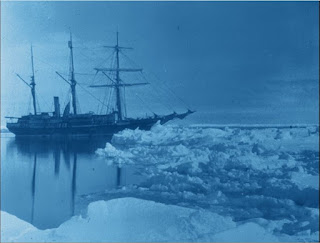
We then see the Endurance as it sets off from Buenos Aires, waved off by a large crowd as Shackleton’s pre-publicity had encouraged world-wide wonder, and then makes its way south to the Antarctic landmass, smashing its way through ice and passing by enormous ice bergs. It looks unstoppable, reinforced steel providing an extra cutting edge for the spring ice floe: this is the best modern science can offer and surely nature will not be able to stand in its way. There are stunning shots from high overhead up the foremast as one member of the crew sits on the bowsprit steering the ship through the weakest parts of the ice; Hurley was some sailor as well as cinematographer.


Hurley’s camerawork is not only brave but technically so impressive, far more mobile than you might expect as he pans across and upwards to show the depth and range of this forbidding landscape and, through use of close-ups and point of view, places the crew and consequently the watcher in the heart of this deadly landscape. Unlike Ponting, brave though he was, Hurley was in the middle of the main drama itself – he too was stranded and in peril - yet he kept on working.


Steering through the ice

The film proudly shows us the packs of dogs who were to be the expedition’s backbone once they landed and there’s a typically British fascination with animals both domesticated and wild throughout with a long section on penguins and seals near the end (eat your heart out Herbert P!).


Before the Endurance was able to make land it became trapped in the ice in mid-January 1915. At first this seemed just a temporary setback but then the predicament became much clearer and much more serious. The crew tried many times to hack a channel through the ice to enable the ship to make progress and to break through to clear water but this wasn’t to be.  After some days they were resigned to a long wait for the ice to thaw and they kept themselves busy with research, hunting and football matches. Obviously, we only see what’s on film and what Hurley edited and was perhaps allowed to show but clearly the command from Shackleton was strong and effective: moral appears to be high. They knew they had a long wait ahead… until the arrival of the arctic spring later that year.


Yet, when the thaw did start in September 1915, a far more serious challenge arose as the force of the shifting ice started to compromise the Endurance’s hull and the ship began to be lifted from the water. Hurley’s shots of the stricken ice-breaker are amongst the most iconic of the whole journey especially those he shot at night using dozens of magnesium lights… it’s haunting, not just because of the eerie phosphorescent glow but also because you realize that the men could be watching their best hope of survival being crushed and sunk.


The men try to cut a way through the ice

Shackleton had the men strip everything of use from the Endurance before she finally sank in November and he established a camp using tents, shacks built from the ship’s timbers and upturned lifeboats. One of these, the twenty-foot James Caird, with some major adjustments from the team's carpenters, was used to make Shackleton’s heroic journey from Elephant Island to South Georgia. Before that the crew had had to use the boats to make their way from the melting ice floes to land an epic adventure in itself.


That Hurley’s film survives is one thing but that it survives in such good quality is another. He buried film canisters in the snow during parts of the escape in order to preserve them in the event that things didn’t quite work out…  When Shackleton departed on that final stage, Hurley remained behind with the rest of the crew and the gaps in the story are made up of illustrations and then later footage of both the forbidding ice wall Shackleton and his men had to climb in order to reach help.


In the end Shackleton returned with help and ensured that every one of his crew returned safe: the greatest survival epic of the golden age of polar exploration at a time when far less was known about these still treacherous waters…  Whatever the merits or otherwise of Shackleton’s motives you cannot doubt his leadership and courage nor that of the men, like Hurley, who followed him come thick and thin ice.


Endurance high and dry

Hurley later remarked that the earlier Australian expedition he had been on was a means to a scientific end whilst the British focus was on the adventure first with science an added bonus. Be that as it may, there was certainly great domestic interest in viewing the strange creatures of the South as Ponting’s film had already proved and there’s some twenty minutes of crowd-pleasing wildlife footage once it’s clear that the men survived. This is all the more remarkable given that according to Bryony Dixon in her booklet essay, Hurley was persuaded by the Ernest Perris, editor of his sponsor, the Daily Chronicle, “…to return to South Georgia (in the middle of a war, we should remember) to capture images that would be popular with the public of Antarctic wildlife (penguins) and the whaling station.”


THE SCORE


This splendid transfer comes with a stirring new orchestral score from Neil Brand which perfectly captures the spirit of the times and of adventure as it used to be: indomitable, brave and with the passion to overcome all obstacles - they endured!


I hope that the overall effect of the score is to help us go through the screen and onto those icy wastes with those men...


This set includes a feature on Neil Brand’s approach to the scoring and, it is every bit as revelatory as the music as the composer explains his relationship with the film and the reasons behind his choices. Neil uses the film in teaching at the Royal Academy of Music and one of the reasons is the sheer relatability of the events; when the ice crushes the Endurance we all feel as the men must have felt, that this was probably their doom, their only means of return destroyed leaving them a thousand miles from the nearest human.


Endurance finally succumbs

Neil chose a small ensemble combining flute, piccolo, cello, violin, viola and horn – no piano, no safety net – to enable an uplifting and febrile composition that could change with the sudden shifts in mood of the film. This works so very well, music full of the hope and determination of these men as their near disaster plays out against the deceptive tranquillity of the sublime white silence and stark, sunlit cinematic contrast. It’s the most extraordinary meditation on human perseverance against all odds, as they determinedly fight for their ship and then their lives. As Neil says, this film has been a major part of his professional life for twenty years and this familiarity has enabled him to construct a deeply resonant musical response.


Long-time collaborator Ben Palmer helped with the score and the mucisians from the Covent Garden Sinfonia who he then conducted for the recording: Francesca Barritt (violin), David Campbell (clarinet/bass clarinet), Kira Doherty (horn), Simon Gilliver (flute/piccolo), Matthew Kettle (viola) and Alexander Rolton (cello)


Having been unable to attend the IMAX screening with live accompaniment, I hope the show is screened again with the musicians – this is a story we all need to see and hear right now. Neil previously scored the film in 2002 and you can listen to that to as an option on these discs too.


Trapped but the team played on

EXTRAS


The set also includes extra footage of the expedition – the football match with Endurance marooned in the ice, perhaps the purest example of the team spirit, and there’s also extra animals and terrifying icebergs.


There’s also an audio commentary from Luke McKernan, who worked on the restoration, and a bumper 38-page Illustrated booklet with new essays and credits for all content including contributions from the BFI’s Bryony Dixon, Naomi Boneham and Charlotte Connelly, Masaki Daibo, Eirik Frisvold Hanssen, and Quentin Turnour, which gives a truly international perspective on the Heroic Age of Antarctic Exploration – Japan, Norway and Australia, so many were pulled south.


There’s footage from these countries expeditions as well as other British adventures: 

Fram’s South Polar Expedition (1910-12, 22 mins) documents parts of the legendary ‘race to the Pole’ won by Roald Amundsen and his Norwegian team. This the English version of the film footage seen in cinemas and theatres in 1913.


Nihon nankyoku tanken (1910-12, 19 mins) is the extraordinary and rare footage taken in the second year of the Japanese expedition to Antarctica led by Nobu Shirase.


Australasian Antarctic Expedition Films aka The Home of the Blizzard (c1916, 68 mins) film taken by Frank Hurley of the 1911–1914 scientific expedition to the Magnetic South Pole led by Sir Douglas Mawson.


Other films in the set, range from 1898 – 1922 and include visual references to these and other notable Antarctic expeditions. Additional special features include film and audio extracts, including from Shackleton himself in short audios My South Polar Expedition (1910) recorded a week after returning to New Zealand and Shackleton Speaks (1910) naming his Nimrod crew.


800 miles to South Georgia Island... 

WHAT TO DO NEXT


It’s a wonderful and inspiring package and absolutely essential for all those fascinated with the spirit of adventure both in cinematic and Antarctic terms.


You can order now from the BFI online shop. Go on, be bold!


Endurance's Captain Worsley

Captain L Hussey with his moral-boosting banjo

Some of the Endurance's 70 dogs

Hurley's haunting night shots of the frozen ship

Shakleton's men needed to climb this huge glacier in South Georgia

It took them 36 hours to finally find refuge at Stromness Whaling Station.


Monday, 4 September 2017

Emotional capital… London Symphony (2017) with the Covent Garden Sinfonia, Barbican


Most of us have a relationship with London, whether we are merely visitors, were born here or migrated here, as I did, some 33 years ago. I first lived in Croydon, spending most evenings commuting into the West or East Ends, just 15 minutes, trains-willing, from East Croydon to Victoria… real London was calling me. All the same, it was good to see this huge and much derided, borough represented early on in this stunning new film and Kingston upon Thames too – where I also worked - as well as the more obvious icons of this diverse city.

In all, over 300 locations were used in London Symphony including every bridge from the Thames Barrier to Hampton Court miles up the river that both divides and brings together the metropolis; stiches on the wound that still brings life to the city.

City of glass and mills: New and Old
This was the UK premier of the live score performance of Alex Barrett’s silent cinematic tribute to his home town and whilst it contains his vision it also connected with the audience in a most individual way; the significance of place varying from watcher to watcher. That was where I walked after a break up, there was where I almost got that job and that pub… what can I say; I was barred! For such a big city, London has so much intimacy when you stop, look and listen.

The broad narrative of Alex’s film was decided long ago as was the music that would accompany it from James McWilliam, who’s score, originally designed to come first, actually came afterwards… It’s a tribute to the understanding of both men that their partnership worked either way: a rare thing to find such well-defined creative objectives and strategies agreed with such surety from the get-go.

A discoteque
The film has a loose narrative split into four parts that roughly cover dawn to night focusing specifically on: the new and the old – a city in constant flux; the peace of open spaces; worship in the multi-culture from religion to business, money and education and then finally, the journey home or the nightlife as the West End explodes with a montage of theatre signs.

It is unflinching, showing us some truths that hit all the harder as they emerge from this context: poverty, a man scrabling for food in bins, a food bank being organised behind the scenes... At one moment a pool of half-dried vomit by a doorway... London is ugly sometimes and everyday, most places somewhere.

Worship
James’ score follows the beats of the intricate cutting but also runs counter – as it has to, this is London after all… helping to highlight the images in startling ways. This is a film you could watch over and again and still find new meanings and identifications. Both the images and the music achieve the balance between mood and specified meaning and not always at the same time leaving you propelled in constant readiness for the next revelation: a three-eyed pigeon view of the North and the South (banks).

Ben Palmer, conductor of the Covent Garden Sinfonia, praised the score for its intricacies and subtlety; passages that carved an elastic thread around the visual story only to land with precision on a specific moment when “real time” punctuated the flow… Watch out for one especially intrepid fox…

A river does run through it...
The music was poignant and modern, appropriately enough. Alex spoke about the ongoing validity of the silent film form as a means of analytical expression after all, as he said, just because you can break dance doesn’t mean to say you should close down the ballet. He’s a student of what has come before, notably Walter Ruttmann and his Berlin, Symphony of a Great City (1928) but Alex was also intent on creating something new and not just an old "style". By the same token James’ music doesn’t drench the images of London in respectful chord progressions, he’s creating his own counter-points and juxtapositions. The two work together to throw up constant surprises.

Peaceful brook, manic tube... strange hat
Which is why London Symphony works so disarmingly well: it is a new view of the city but also one millions will recognise. As was said in the questions and answer session, this is what future generations will study when they want to find out what London was actually like in the 2010s. Nothing stands still and, even now, our perceptions of London’s limitless multiculturalism are already changed by the results of Brexit and what seemed to many in the staunchly “remain” capital like a protest vote against "change".

Brexit? Ha! London can take it as it has so many things in the past and will continue to do so in the future. For, if there was one overwhelming feeling you took from this film it was the ability of the city to survive and flourish with hard-wired diversity strengthening resilience along with London’s insistence on growing old disgracefully… Our capital is burning out but constant renewal means that it will never fade away.

One of those bridges
The film had received huge support from the silent-film community and been successfully crowd-funded with hundreds of contributions. Whilst this was the first time I had ever seen my name on a cinema screen, it also featured the acting debuts of a number of more generous funders including Girl in a Bar (with drink) and Woman on the Tube (with attitude) both of whom gave convincing performances of Gish-ian subtlety and Pickford verve!

I’m given to understand that both now have agents.

Pandora's jars...
Alex, James and their collaborators have re-written the rule book on modern documentary by showing that music and images can still convey more about the essence of place than standard spoken word narratives. You can’t just simply sum up a city of London’s depth and breadth with words… and perhaps the only way to truly capture it is through the fleeting glance, wordless reflections and thematic hints. Let the audience make of it what they will… After all, on a day-to-day basis that’s about as good as it gets: you don’t need to understand London to live here… to love it.

The Symphony plays on throughout the Kingdom and I would strongly urge you not to miss it in cinema if you can. Please do not be The Person who doesn't see it...  Book Now! Full details are on the film's website.

It's ⭐️⭐️⭐️⭐️⭐️ from me!

All images plundered from the film's trailer, with apologies.