Showing posts with label Sonja Kristina. Show all posts

Sunday, 26 January 2025

A thank you… Gösta Berlings saga (1924), BFI with John Sweeney


“ONCE there was a story that wanted to be told and sent out in the world.... As yet it was only a confused jumble of stories – a big, formless cloud of adventures rushing hither and thither like a swarm of stray bees on a summer's day, not knowing where they will find someone who can gather them into a hive.”

Selma Lagerlöf, The Story of a Story 


Gerda Lundequist’s family were there, my family were there and the silent film community turned out in numbers too for the screening of the Swedish Film Institute’s exhaustive restoration of one of the most important films from the golden age of Swedish silent film. It’s a long film and I tried to keep my introduction as broad and brief as possible before we launched ourselves back to the 1820s and Mauritz Stiller’s interpretation of Selma Lagerlöf’s classic novel featuring some of the finest actors of the period all accompanied by John Sweeney’s tirelessly epic improvisations on piano.


Gerda Lundequist plays Margaretha Samzelius, the matriarch of Ekeby, a grand estate in rural Värmland, and it was a genuine privilege to be joined by her granddaughter, singer and actress Sonja Kristina as her children and their children watched this rare example of their forebear on screen. Sonja knew Gerda as a child, meeting her in Sweden and England and the reconnecting with her grandmother in this sparkling restoration must have been special indeed.  Seeing Sonja’s young grandchildren cheer and wave in their animal masks as their Great, Great Granny was announced was also reminder of the familial joy of belonging.


Gerda Lundequist

For the rest of us there were other connections to be made not least the warmth of being a part of an audience of like-minded people who share the same love of cinema and specifically silent film, gathered again in this secular temple of committed, collaborative – endlessly generous – cineastes. People who programme who preserve and promote this era of film, “classic” but also timelessly true regardless of age or form. The emotions displayed by Gerda Lundequist and her peers are still part of human language and we connect with them in old familiar ways: yes this is true even after so long the family that stays together plays together.


Stiller did not have Victor Sjöström’s way with picking out the deeper humanity and magical reality from Selma Lagerlöf’s works and she was initially dismissive of this film only to have changed her mind by the mid-1930s when she met with Greta Garbo and thanked her and Stiller for the film. Garbo was just 18 when she started filming and still Gustafson before Stiller renamed this hottest of properties “Garbo” and she too was grateful to the man she later deemed her favourite director (sorry Clarence Brown!). He may have told her to lose weight and to stop moving like a farmer’s gatepost but he brought out her star power enough for Louis B Mayer to snap her up as soon as he could after seeing Gösta Berling in Berlin. Stiller came to America with her but he was never able to find the freedom and control he needed.


This was Stiller’s last Swedish film and with his departure was gone one of the fathers of the Golden Age. Soon his lead actor, Lars Hanson, was also to follow to play another cleric, The Reverend Arthur Dimmesdale in The Scarlet Letter (1926) alongside Lillian Gish who had insisted that Louis B Mayer make the film. Gish and LB were impressed with the cut of Hanson’s cassock and whilst The Internet has her requesting him post Gösta, this film came first. His performance is as assured and dynamic as Gerda’s and the scene in which she confronts him over his failings by sharing her own is one of the most moving in the entire film.


Jenny Hasselqvist posing for Henry Goodwin (1921)


You have to admire Stiller’s choices for the film, the stakes were high in terms of the pressure to succeed and off the largest budget assigned to that point by AB Svensk Filmindustri, and, whilst he took a big chance on his youngest lead, he was able to persuade not only the country’s leading stage actress and film actor but also its leading prima ballerina. Jenny Hasselqvist had worked with the director before on the little seen but very worthwhile Johan (1921), Guarded Lips (1921) as well as her first film, The Prima Ballerina (1916) just after she had started in that role at the Royal Swedish Ballet. As Marianne Sinclaire she represents a more forceful and knowing partner for our de-0frocked priest after the two are caught kissing during a play. Her control and physicality is brought to good use by Stiller as she is left in the cold, literally, by her cruel father and later gets caught in the burning inferno of Ekeby.


Garbo’s Elizabeth Dohna has deep eyes and longing looks and needed a good deal of coaching, lighting and editing from Stiller to hold her place among these consummate professionals.


All this we could see on the restoration and I am convinced that this screening led many to re-evaluate the film. The previous restoration is black and white, not so well paced and looks murky in parts whilst here the SFI have been able to sharpen the story as well as the image. The re-editing of some parts and introduction of tints and new sequences gives a richer story, as close as possible to the one first seen a century ago over two parts in March 1924.


I’d previously seen the restored film in Il Cinema Ritrovato 2023 in Bologna with a small ensemble accompanying but John Sweeney was a one-man orchestra, exploring his way expertly across the new running time and evoking the deeper humanity and grandeur of the film, connecting with the deeper meanings smuggled in from the original book which in many ways is so different from the film. It’s 400 pages long in the recent translation from Paul Norlen and whilst Sjöström would have turned that into three or four films, Stiller’s edit is remarkable for capturing the essence of these characters even if some of them changed…


Selma Lagerlöf calls the tune

At the end of the screening, I was thanked by complete strangers in the aisles as well as those I know but in truth I am the one who is grateful for the SFI, especially Jörgen Viman, Film Archivist, for restoring the film, the BFI for screening it, Bryony Dixon in particular and who kindly invited me to introduce it. I also must thank John Sweeney for playing so wonderfully and Sonja Kristina and her amazing family old and new, and all of you who attended and communed in the dark with these century-old ghosts. Thank you for reading too!


Thank you too to Selma Lagerlöf, who at the end of her Gösta Berlings saga leaves us with the cryptic clue to life:


Dear Reader… Here the giant bees of imagination have swarmed around us during years and days, but to get into the beehive of reality, they will truly have to keep their eyes open.


* The Saga of Gösta Berling (Penguin Classics), by Selma Lagerlöf, translated by Paul Norlen (2009) is available from all good bookshops and Amazon.


Cover of my 1924 Danish programme 


Thursday, 16 January 2025

Gerda Lundequist and Sonja Kristina – the Gösta Berling connection

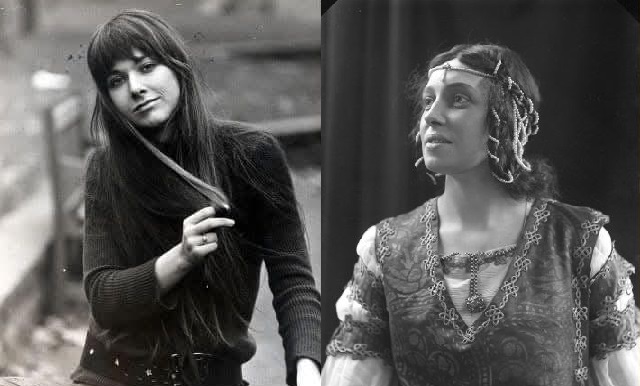
Sonja and Gerda - generational talents


It’s strange the connections you make in your life as well as in silent film which, after all is history itself and not just a representation of past events. Without knowing it at the time, I spent a number of pleasant afternoons in the company of Cecil Hepworth’s daughter Elizabeth Barbara – the young star of Rescued by Rover (1901) and her sister Margaret as my friends were renting their basement in the 1990s.


It was also a surprise a few years ago, to see Sonja Kristina, the pioneering singer, actress and leading lady of progressive rock, folk and beyond, posting on Facebook some year’s back about her Swedish grandmother Gerda Lundequist, a Swedish stage legend and the star of Gösta Berling's Saga which, as I think I mentioned is screening this Sunday 19th at the BFI! Knowing the connection, I asked Sonja for a few memories about her grandmother and it seems the “performance gene” runs strongly in their family!


Born in 1871, Gerda was the daughter of a hairdresser but was fostered by her mother’s sister a manufacturer’s widow. She had theatrical ambitions from an early age and she was enrolled in theatre school in Stockholm at just 15. At this stage in her own career, Sonja had already started singing in folk clubs and, also in her teens, enrolled at the New College of Speech and Drama before staring in the theatrical version of Hair along with the likes of Paul Nicholas, Elaine Page and the late Diane Langton.


Gerda Lundequist in costume in 1906


Gerda’s professional debut was at Svenska teatern in Stockholm 1889, and her breakthrough soon came her portrayal of Kristina in August Strindberg’s Mäster Olof at the old Royal Dramatic Theatre in Stockholm. She was soon starring in almost every conceivable major role in plays from Ibsen, Schiller, Moliere, Shakespeare and others establishing herself as Sweden’s finest actress and it must have been a huge coup for Mauritz Stiller to get her for the role of as Margaretha Samzelius, the matron at Ekeby in Gösta Berling.


Gerda’s daughter Cecelia married an English criminologist called Shaw and moved to the UK. Sonja remembers meeting her on a number of occasions:

I was 10 years old when Gerda died in 1959… she had come to stay with us in England when I was 6 and we visited with her in Stockholm and at her summer home.


Gerda’s professional reputation was one of strict principles and, not enjoying interviews, she soon refused all offers and was a very private person, protecting herself and her family from intrusion. Yet she was also described as a very warm and humorous person by those who did know her and this is confirmed by Sonja’s recollections:

I remember her sitting at my mother’s dressing table brushing her beautiful long auburn tinted hair before braiding it and putting it up. Her perfume was lovely and I will always remember the aroma of her favourite digestive biscuits with honey that she enjoyed as a night-time snack.


Sonja Kristina


Gerda was an ardent supporter of female emancipation in Sonja’s words and she was able to support talent through her work as artistic director at Helsingborg City Theatre and then later as a teacher at drama schools. She contributed to the independent women’s education centre Kvinnliga medborgarskolan vid Fogelstad, for which she was also a member of the board of trustees.


Sonja describes the school as a feminist and that her mother, recovering from TB, shared several stimulating and entertaining months with Gerda and her students at Foglestad.


She also relates the tutoring and encouragement she had from Gerda and her hugely experienced eye for talent: She liked to listen to me sing and encouraged me with gentle instruction on breathing technique and interpretation.


She remained such an important figure in Sweden hosting celebrity soirees at her apartment and performing on radio and television right up until the late fifties. Sonja’s mother was frequently asked for autographs by school friends and no doubt, had she grown up in Stockholm, the same would have been true then.


Gerda with Greta Garbo in Gösta.

But to Sonja and her family, the private side of her grandmother was no less precious and, especially the playful bond they developed.

Gerda was so mischievous, making grand entrances at public gatherings. Stopping traffic in the street to talk to horses - and policemen.


She was perfectly cast in Gösta Berling's Saga and, also, it seems as a mother and grandmother.


I am delighted that Sonja and her own grandchildren will be attending the screening on Sunday 19th and I hope you will too and witness one of the finest actors of the last 150 years pouring decades of experience into one of her precious few cinematic appearances!


You can book your place here!


The cast of Hair in 1968, Sonja spent over two years in the show, here on the lower right!


Sunday, 5 November 2017

Atonement… The Saga of Gosta Berling (1924)


“You won’t escape by turning yourself into a beautiful corpse…” says Lady Margaretha Samzelius as she saves Gosta Berling’s life. “Don’t you know that most people are dead already… Do you think I’m alive Gosta Berling?” Revived by a misery shared, Gosta scrubs out his suicide note and declares: “Life must be lived! One has to move on!” 

The Saga of Gosta Berling is about redemption but mostly it’s about the human frailties that make it necessary and the weaknesses in society. Not all can be put right in a life and this powerful, complex story, based on a huge novel published in 1891 by Selma Lagerlof, takes its own time in deciding on outcomes with the film coming with a ready-made break about halfway through its three hours running time.

“It was a disgrace to love him, a disgrace to be loved by him!”
It is, of course, the film that originally got Greta Gustafson noticed before Pabst put her into his Joyless Street and she could avoid the call of Hollywood no longer. Her director in this film, Mauritz Stiller, went with her but it was only ever Greta they (probably) wanted and, unlike his friend and fellow director, Victor Sjostrom, Stiller never really got to show what he could do in an American studio.

Here, Stiller makes relatively light work of this sprawl of a story thanks in no small part to a very strong cast featuring three of the very best stage-Swedes plus the young girl from the department store who, every time I watch this film, still looks like a learner for all her visceral impact.

The film is centred on the great house of Ekeby, situated on Lake Lofven, in a glorious-looking Varmland with its “blue mountains… dense forests and foaming streams…”. Here there is a wing occupied by landless knights: “men lacking purpose… knaves, noblemen and former officers. Their past may be shady, but all were knights of adventure, of the goblet and of gallantry!”

“I am a penitent, the highway is my home – the haystack my bed…”
Gerda Lundequist, grandmother of Curved Air’s Sonja Kristina as it turns out (and that explains so much!), was a performer of power and presence who had made her name on the Swedish stage where she was known as the Swedish Sarah Bernhardt. Now, I’ve only seen a glimpse of Miss Bernhardt in film, but Gerda has the clear edge by combining close-up subtlety with controlled use of the grand gestures of stage mime: she is so in touch with her character and very much in the moment!

Her Lady Margaretha carries the daily pains of a life crippled by forced compromise… She is a commanding figure, the lady of the House of Ekeby, and yet her temper finally snaps as she is reminded of the favours afforded to her by the lover she couldn’t marry (Altringer). One of the Knights of Ekeby, drunk and instantly regretful, torments her with this and she is exiled only to return and raise the house to the ground not only in revenge but also to burn the memories and wipe the slate clean: a new beginning for everyone.

“Tonight, their quarters will be destroyed and my shame erased.”
The film’s male lead is Lars Hanson and he has the make-up to prove it… He has a most un-Hollywood trajectory to follow from disaffected and alcoholic priest to joining the Knights of Ekeby, a similar bunch of ignoble failures who, unlike him, have run out of second, third and tenth chances. Hanson injects just the right amount of irresponsibility into the role and manages to burn bridges believably… he’s too honest to be a priest and to live in gentile society with its mannered hypocrisy. He has a nobility tainted by his love of drink and his willingness to surrender to failure along with these lords of misrule.

The cruel manoeuvres of Märtha Dohna (Ellen Hartman-Cederström who is another to give an excellent performance) who seeks to gain fortune by marrying him to her niece Ebba (Mona Mårtenson), forces further disgrace on Gosta who ends up close to the edge in that fateful meeting with Lady Margaretha.

Jenny with Sixten Malmerfelt and Karin Swanström
Then we have Jenny Hasselqvist, world-class prima ballerina by day and one of the most emotionally-subtle of silent actors by Klieg light. She has a face imbued with the same kind of depth and sorrows as Isabelle Huppert – someone who is always working but your darned if you can actually see it! Here Jenny plays a slightly spoilt rich woman who is cast out by parents after a dalliance with Gosta and then endures the ravages of small pox before emerging a more generous spirit. It’s good to see her go through this arc and she is such a fine technician; every movement of feature and form deliberated with grace and supernatural poise… (oh alright!).

In the end she lets the man she loves go so that he can save himself… All I can say is that I really hope it works out with the youngster Mr Berling!

An emotional control that is extended to an always-expressive physicality...
In comparison with these powerhouses Greta, aged 18 and in her first major role, looks a little lightweight but, of course, knowing what we know, you can see the raw talent that would soon make her a World star. Her character Elizabeth Dohna, arrives as the unfortunate wife of a foppish and useless husband and impresses more as events develop in complexity and her feelings for Lars’ Gosta are revealed. Greta’s a presence alright and Stiller brings out her innate skill in exuding hidden depths… Gosta’s been loved before but this we believe may be the deepest (and he’s bloomin’ lucky Marianne let him go…).

Greta
This is a huge film with sprawling narrative, great performances and the birth of the star Greta. The Kino DVD is from a aged digital transfer and the good news is that the Swedish Film Institute are restoring the film and it should hopefully be screened in 2018 with renewed visuals and additional narrative clarity  - the scene in which Gosta and Elizabeth escape from the wolves repeats some elements.

I look forward to seeing the full glory of Gosta Berling and to watching those performances in better detail. We all know about Garbo, silent fans know too Lars Handsome Hanson… but we need to make more noise about Jenny! As for Gerda Lundequist, she is a joy to watch and she deserves the recognition the restoration will bring. Gosta Berling was a gift for these actors and the fact it gives so much quality screen time to the women makes it all the more interesting.

"Don’t you know that most people are dead already…"