Showing posts with label Bryony Dixon. Show all posts

Sunday, 26 January 2025

A thank you… Gösta Berlings saga (1924), BFI with John Sweeney


“ONCE there was a story that wanted to be told and sent out in the world.... As yet it was only a confused jumble of stories – a big, formless cloud of adventures rushing hither and thither like a swarm of stray bees on a summer's day, not knowing where they will find someone who can gather them into a hive.”

Selma Lagerlöf, The Story of a Story 


Gerda Lundequist’s family were there, my family were there and the silent film community turned out in numbers too for the screening of the Swedish Film Institute’s exhaustive restoration of one of the most important films from the golden age of Swedish silent film. It’s a long film and I tried to keep my introduction as broad and brief as possible before we launched ourselves back to the 1820s and Mauritz Stiller’s interpretation of Selma Lagerlöf’s classic novel featuring some of the finest actors of the period all accompanied by John Sweeney’s tirelessly epic improvisations on piano.


Gerda Lundequist plays Margaretha Samzelius, the matriarch of Ekeby, a grand estate in rural Värmland, and it was a genuine privilege to be joined by her granddaughter, singer and actress Sonja Kristina as her children and their children watched this rare example of their forebear on screen. Sonja knew Gerda as a child, meeting her in Sweden and England and the reconnecting with her grandmother in this sparkling restoration must have been special indeed.  Seeing Sonja’s young grandchildren cheer and wave in their animal masks as their Great, Great Granny was announced was also reminder of the familial joy of belonging.


Gerda Lundequist

For the rest of us there were other connections to be made not least the warmth of being a part of an audience of like-minded people who share the same love of cinema and specifically silent film, gathered again in this secular temple of committed, collaborative – endlessly generous – cineastes. People who programme who preserve and promote this era of film, “classic” but also timelessly true regardless of age or form. The emotions displayed by Gerda Lundequist and her peers are still part of human language and we connect with them in old familiar ways: yes this is true even after so long the family that stays together plays together.


Stiller did not have Victor Sjöström’s way with picking out the deeper humanity and magical reality from Selma Lagerlöf’s works and she was initially dismissive of this film only to have changed her mind by the mid-1930s when she met with Greta Garbo and thanked her and Stiller for the film. Garbo was just 18 when she started filming and still Gustafson before Stiller renamed this hottest of properties “Garbo” and she too was grateful to the man she later deemed her favourite director (sorry Clarence Brown!). He may have told her to lose weight and to stop moving like a farmer’s gatepost but he brought out her star power enough for Louis B Mayer to snap her up as soon as he could after seeing Gösta Berling in Berlin. Stiller came to America with her but he was never able to find the freedom and control he needed.


This was Stiller’s last Swedish film and with his departure was gone one of the fathers of the Golden Age. Soon his lead actor, Lars Hanson, was also to follow to play another cleric, The Reverend Arthur Dimmesdale in The Scarlet Letter (1926) alongside Lillian Gish who had insisted that Louis B Mayer make the film. Gish and LB were impressed with the cut of Hanson’s cassock and whilst The Internet has her requesting him post Gösta, this film came first. His performance is as assured and dynamic as Gerda’s and the scene in which she confronts him over his failings by sharing her own is one of the most moving in the entire film.


Jenny Hasselqvist posing for Henry Goodwin (1921)


You have to admire Stiller’s choices for the film, the stakes were high in terms of the pressure to succeed and off the largest budget assigned to that point by AB Svensk Filmindustri, and, whilst he took a big chance on his youngest lead, he was able to persuade not only the country’s leading stage actress and film actor but also its leading prima ballerina. Jenny Hasselqvist had worked with the director before on the little seen but very worthwhile Johan (1921), Guarded Lips (1921) as well as her first film, The Prima Ballerina (1916) just after she had started in that role at the Royal Swedish Ballet. As Marianne Sinclaire she represents a more forceful and knowing partner for our de-0frocked priest after the two are caught kissing during a play. Her control and physicality is brought to good use by Stiller as she is left in the cold, literally, by her cruel father and later gets caught in the burning inferno of Ekeby.


Garbo’s Elizabeth Dohna has deep eyes and longing looks and needed a good deal of coaching, lighting and editing from Stiller to hold her place among these consummate professionals.


All this we could see on the restoration and I am convinced that this screening led many to re-evaluate the film. The previous restoration is black and white, not so well paced and looks murky in parts whilst here the SFI have been able to sharpen the story as well as the image. The re-editing of some parts and introduction of tints and new sequences gives a richer story, as close as possible to the one first seen a century ago over two parts in March 1924.


I’d previously seen the restored film in Il Cinema Ritrovato 2023 in Bologna with a small ensemble accompanying but John Sweeney was a one-man orchestra, exploring his way expertly across the new running time and evoking the deeper humanity and grandeur of the film, connecting with the deeper meanings smuggled in from the original book which in many ways is so different from the film. It’s 400 pages long in the recent translation from Paul Norlen and whilst Sjöström would have turned that into three or four films, Stiller’s edit is remarkable for capturing the essence of these characters even if some of them changed…


Selma Lagerlöf calls the tune

At the end of the screening, I was thanked by complete strangers in the aisles as well as those I know but in truth I am the one who is grateful for the SFI, especially Jörgen Viman, Film Archivist, for restoring the film, the BFI for screening it, Bryony Dixon in particular and who kindly invited me to introduce it. I also must thank John Sweeney for playing so wonderfully and Sonja Kristina and her amazing family old and new, and all of you who attended and communed in the dark with these century-old ghosts. Thank you for reading too!


Thank you too to Selma Lagerlöf, who at the end of her Gösta Berlings saga leaves us with the cryptic clue to life:


Dear Reader… Here the giant bees of imagination have swarmed around us during years and days, but to get into the beehive of reality, they will truly have to keep their eyes open.


* The Saga of Gösta Berling (Penguin Classics), by Selma Lagerlöf, translated by Paul Norlen (2009) is available from all good bookshops and Amazon.


Cover of my 1924 Danish programme 


Saturday, 12 October 2024

Punishment and reward… Le Giornate del Cinema Muto 43, Day Seven


In receiving her richly-deserved Jean Mitry Award, the BFI’s Bryony Dixon pointed out the importance of this festival in terms of enabling international collaborations but also as a peer group for the often embattled national archives. The Giornate had inspired Dixon along with others to elevate the reputation of British silent cinema and with the restorations not just of the Hitchcock back catalogue but also key films from Anthony Asquith especially, it has been mission accomplished with more to come. It’s a group of people who inspire each other and as an outsider in professional  media terms, I’ve always been impressed with the dedication of Bryony and others to the main goals of preservation and education. The value is in the content and to be able to achieve what she has in over three decades at the BFI is remarkable – hers are the giant shoulders on which other generations of archivists will stand.


At a time when the DFI are stopping filmic preservation and shifting entirely to digital, you realise the odds that are stacked against the archives – when even Germany won’t invest in the original media who else is going to stay in the game? That the other Mitry Award went to Mark-Paul Meyer from the EYE Cinema Museum in Amsterdam says it all. Long may you protect and survive.


Pavement Butterfly (1928) with Günter Buchwald, Frank Bockius and Mirko Cisilino


This week we’ve witnessed the evolution of Anna May Wong’s performance and prestige from bit parts as racial cliches to the full flourishing of her talent in Song and this film, both made in Germany. In her home country, Anna May Wong had struggled since her first film in 1921 to gain substantial roles and also characters that weren’t stereotypes. Yet in Europe for this film and Song (1928), her first film with director Richard Eichberg, she is not only a desirable and acceptable romantic lead, she is the star.


Eichberg simply took her natural talents and ran with them and with this freedom of expressiveness there’s  critique of Western culture’s willingness to believe the worst of people of Asian origin: first the crowd at the circus where Wong’s character Mah works, turn on her very quickly assuming she has killed her magician partner and then later, when she is blackmailed by the man who committed that murder, her artist and romantic interest, all too readily thinks she has stolen the money.


For anyone who gets frustrated by such “misunderstandings” the film’s ending is richly satisfying reminding me of Hindle Wakes screened here last year, a blow for self-determination for women in general at a time when their choices were so much more limited. We don’t know what Mah will do but she’ll make her way, her way. It’s interesting to note the differences in the British and German versions of this ending too, as noted in the catalogue essay from Yiman Wang, in the latter Mah says “Ich gehöre nicht zu euch” (“I do not belong to you”) whereas for the former “I don’t belong to your world. I belong to the pavements.” - she has to know her place or the remains of Empire would crumble, clearly… (see below for more stirring Tales of Empire).


It’s The Eyes!!


There are so many close-ups of AMW in this film showing her stillness and presence from every angle and catching one of the most interesting technicians of the period who conveys so much with so little movement. Much of this stems from her extraordinary eyes but she knows how to use them and how to under-react for the camera to maximise the impact on the audience engrossed in the big screen.


Fred Louis Lerch plays the handsome but hopeless Fedja Kusmin an artist who lacks the purity of trusting the thing he loves and the wickedly convincing Alexander Granach as Coco the Coincidental Clown who pops up throughout the film to throw mischief in our heroine’s way. Elwood Fleet Bostwick is Mr. Working a rich business man who encourages the young artist and Tilla Garden has a fine turn as his daughter Ellis who is also interestingly enough a woman who knows her mind.


Günter Buchwald, Frank Bockius and with Mirko Cisilino on saxophone accompanied with the tightest of sets, bursting into life during the loft party sequence featuring the remarkable dancing of an un-named couple of hyperflexible and ultra-syncopated boys from the Cabaret, bringing out the full flavour of the gorgeous locations of Nice and underpinning the emotional narrative with the subtlety that Anna deserves. Another fabulous evening show in a week full of them!


Stronger than Death (1920) with Donald Sosin and Frank Bockius


I was standing outside the Teatro Verdi discussing the drumming of Frank Bockius with Catalonian accompanist, Florenci Salesas who pointed out from a musician’s point of view how tonally flexible and supportive of the narrative his percussion is. From the explosion of jazz technique in Saxophone Suzi to Frank’s use of subtle Indian flavours or the martial beats for the British troops in this film, he’s able to switch from rhythm section to lead player in ways that are exceptional. The hardest working drummer in Pordenone and probably anywhere!


Here he and Donald Sosin provided an improvised score for another of the great faces of silent film, Anna Nazimova who plays a renowned dancer, Sigrid Fersen who has a heart condition that will kill her if she has just one more dance (I know…). She has come to India to find a rich husband which seems slightly at odds with her otherwise cool bohemian aesthetic and gets one she didn’t bargain for in a love and hate triangle featuring a racist British Colonel Boucicault (Charles K. French), his caring son Doctor/ Major Tristam Boucicault (Chris Bryant) and a wealthy man of mix-race heritage James Barclay (Herbert Prior).


Barclay is reviled by the ex-pat Brits as he is of mixed race – terms “of the period” are used to describe this unfortunate situation not of his own making – and he hopes to gain respect by marrying Sigrid. He’s backed by the local priests though who in a surprising development are looking for revenge on the British for something or other. Lots happens but the worst of it is when the Colonel shoots Tristram’s dog Wickey. As if I could hate him more…


It's a load of old hooey BUT it has Naz and she is brilliant as usual. Bryant’s also good in spite of his parenting, perhaps there’s hope for the World.


Raskolnikow (1923) with Richard Siedhoff


We all had the same thought after this stunner ended – Lotte Eisner was wrong, there are more than three expressionist films with this adaptation of Crime and Punishment being as emotionally titled as Caligari and with crazy-angled set design to match plus the same typography. Maybe she didn’t have access to the full cut of the film and certainly this restoration was a feast for the eyes…


Directed by Robert Wiene it adapts Fyodor Dostoyevsky’s Crime and Punishment in ways that carry the force if not the substance – how could it? Gregori Chmara is just fabulous as Rodion Raskolnikow who finds meaning in his life after wasting so much of his own and killing two women in a bungled robbery. So many heist movies follow similar lines but none examine the nature of guilt in so detailed a way. String cast, a-mazing set design which might jar initially but soon melts behind the human stories presented in unrelenting close-ups.


Too much to say, so little time, more films to see!


We were also treated to avant garde shorts from the studio of Joris Ivens which contained some interesting ideas and some irritating… as a migraine sufferer I couldn’t watch the five minutes of flashing lights from Willem Bon’s Is Er etc… covering my closed eyes with the programme and I’m speaking as a regular gig-goer. This was something like the brain-washing scene from Funeral in Berlin. The audience might well be under Dutch control for all I know, which is no bad thing in itself from experience! Gerard Saan’s Botsingen (1934) with its clever comparison of billiard balls with human activities provided an entertaining counter point, the eight-ball dropping pleasingly in the corner pocket after a repeat showing complete with sound.


Monday, 19 August 2024

Feathers & Lulu… Love ‘Em and Leave ‘Em (1926), BFI with Meg Morley


This blog has been driven by obsession and a subjective emotional “canon” from its earliest days (no, please don’t look!) and Louise Brooks has, of course been the main one, with a copy of Pandora’s Box on DVD bought from a second-hand shop in Park Street, Bristol in 2005 starting off the whole interest and viewing the same film on film at the Prince Charles Cinema in 2010, with John Sweeney accompanying, sealing the deal. I ws hooked and my long term aim since then has been to see all the extant Brooks films on screen with live accompaniment and I even waited over a decade after buying the DVD to see Diary of a Lost Girl in its natural environment. That’s dedication to delayed gratification or just simple stupidity. Who can tell?


This film is one of the few remaining unseen on-screen and viewing the BFI’s worn, warm and wonderful 16mm flickering on the NFT2 screen, with Meg Morley’s wonderful syncopations and sparkling improvisations following an introduction from Bryony Dixon has, to paraphrase the poet, helped make not only my day, my week, my month and even my year.


I have seen Love ‘Em and Leave ‘Em on grey-market DVD from Grapevine a number of times but not for some time – 2012! - and here I could make out more of the nuance in both Louise Brooks’ and, especially Evelyn Brent’s performance and, whilst it’s only a slight comedy, it is an all too rare example of such standard fare featuring these two. As Bryony said, many may come to Love ‘Em and Leave ‘Em for Brooksie but stay for Brent who here gets to play Big Sister with warmth and wit.


Evelyn is probably best known for the films she made with Joseph von Sternberg, the lost The Drag-Net (1928), The Last Command (1928) and, especially, Underworld (1927) in which she plays Feathers McCoy but, as with Brooks, even though she has some excellent classic films to her name, her career never really maintained its momentum and she ended up so often playing, as her biographers2 say, “Hollywood’s Lady Crook” with increasingly smaller parts as the thirties and forties wore on. Still, as with Louise, we can at least celebrate some of her finest work and today’s film illustrates perfectly her ability as a star performer albeit in very standard fare.


Brooks' Black Bottom I believe?

Directed by Frank Tuttle primarily as a vehicle for Brent it also providing the then teenage Louise Brooks’ biggest role on what seemed like an unstoppable rise and, indeed, Bryony quoted a number of favourable reviews which took this a confirmation that the 19-year old actress, whose previous roles had been bit parts in The American Venus (1926) – sadly, mostly lost, although most of her shots survive – and The Street of Forgotten Men (1926) – recently restored by the SFSFF – could actually act as well as dance and look sublime.


By contrast Brent was 28, had started in films in the late 1910s, spent four years on stage and in film in Great Britain making Trapped by the Mormons (1922) which has to be seen to be believed. As per Barry Paris1, Brooks’ biographer quoted in the BFI handout, Brooks and brent didn’t get on, with his subject feeling she was in a state of anxiety after all the years of promise, which meant she was too wound up for comedy. Brooks also felt too much time was spent on trying to light Evelyn properly to up the glam which, bless her, was just natural for our Lulu.


This is all a bit unkind for Brent has a fine profile and is well lit in a number of scenes breaking our hearts when she sees her dopey boyfriend Bill Billingsley (Lawrence Gray) kissing her younger sister Janie, played by Brooks just when she was due to surprise him with an engagement party having decided to accept his proposal. She was by this stage a very experienced actor and adds enough quality moments to this daft script to make the film one of my favourites of its type featuring two of the most interesting actors.


Evelyn Brent and Lawrence Gray

I can’t find anything of Brent’s opinion of Brooks but director Fred Tuttle was certainly impressed with his main star: “The more I knew (her) the more I admired her. I loved working with her and I loved her – but who didn’t?” Well, the lady from Cherryvale for one, the intellectual lawyers’ daughter who perhaps felt Brent, working class daughter of two teenagers from Syracuse, New York* was just unsophisticated? According to biographers Lynn Kerr and James King2, Brent almost got replaced on this film by Esther Ralston only to be swiftly re-instated possibly after her then husband, movie moghul Bernie Fineman, “raised long-distance hell!”. Tuttle felt Brents’ “…qualities and appearance suited the part perfectly”, even compared with Esther.


Evelyn plays “Mame” Walsh a department store worker who shares a one-room apartment with her younger and wilder sister, after promising their mother on her deathbed that she would always look after her. This determination to fulfil this promise is needless to say stretched to the limit… as indeed is her loyalty to Bill who can barely get himself to work without her prodding. He’s a bit of a sap and doesn’t value Mame as much as he should – he doesn’t see how much she supports him providing the creativity for his otherwise mundane shop window displays.


Also in their block is the weaselly Lem Woodruff (Osgood Perkins) a man who "spent six months curing halitosis only to find he was unpopular anyway." He’s not to be trusted but, for some reason Janie lets him place bets for her at the bookies… which, when we learn that, improbably and for “good behaviour” she has been given the role of the shop’s ball committee treasurer. This can’t end well. Meanwhile as Bill’s displays lead to his promotion he proposes to Mame who, unsure they can afford marriage, goes on holiday leaving her little sister free to create chaos. Firstly she seduces Bill the Numpty and then, having gambled away the funds for the ball, is cheater out of winning it back by Lem.


Osgood Perkins, plays no-good Lem

Jannie is confronted about the missing money and implicates Mame who is given an ultimatum of returning the money before 11 or the police will be called. She lets Janie go to the ball – “I won't enjoy a single minute of the dance, worrying about you” - and sets off to settle the score with Lem the Louse and we get two wonderful set pieces, Brooks’ dancing The Black Bottom at the ball as she impresses the senior management team and the fight of her life with Mame taking on Lem for the money in a locked room with Bill racing to a rescue that, her pugilistic prowess renders irrelevant.


I like this display of forceful female agency and overall Mame always takes care of business looking after everything herself and hoping that Bill and Janie can ultimately catch up in terms of how much they rely on her.


Brooks is of course ablaze with youthful energy and your eyes are drawn in her every scene. She makes the most of a fairly narrow role and is absolutely believable as the irresponsible, self-serving teen who gets everyone into trouble. At this stage of their trajectories though Brent matches her with competence and experience. She doesn’t have the generational beauty of Brooks but she is eye-catching and, as ever, she was so much more than her later typecasting led folk – producers at least – to believe.


Louise provokes.

As Bryony said, neither woman had a manager directing their careers and both made bad choices. There are a thousand reasons why some actors do not sustain a career but with these two we can be sure that there could have been more, had they had the support and had they wanted it. Within months though Brent achieved stardom in Underworld and even Louise had to admit von Sternberg had brought out the best of her just as Pabst would do the same for her in time.


At least The Los Angeles Times was impressed with Brent, noting that this newest role “marks another step up the ladder of accomplishment for the young actress…” who, after two years at FBO, “is now a scintillating figure in her first Paramount feature…” one of  “the small group of freelance stars determined to play ‘better roles in the best films’”. Mr von Sternberg was nearly ready for her close up…


Meg Morley, just returned from the Bonn Silent Film Festival – you can catch her and Frank Bockius accompanying Shooting Stars (1928) on streaming until 20th August – and her accompaniment was, as usual, pitch-perfect with a lovely swing matching Tuttle’s pacing, the movements and narrative. Meg’s music interlaced with the film in seamless ways catching the sweetness and sorrow but also Mame’s relentless optimism and strength. I also heard something of a Bechdel Bossa nova as the women’s relationship with each other was always of more consequence than that with the silly and faithless men!


A sold-out BFT2 had a great time and as one patron asked at the end, “when’s the Evelyn Brent season coming?” She won’t let us down!


Evelyn Brent

*Brent told many tales about her disrupted childhood, some of them true… she claimed later that they “led me to expect nothing of life except the fate of the moment.” Kansas City Star, 21st June 1925


1Barry Paris, Louise Brooks, Knopf (1989)

2Lynn Kerr with James King, Evelyn Brent, The Life and Films of Hollywood’s Lady Crook, McFarland & Company (2009)


Monday, 20 May 2024

Bolonian rhapsody… The Vagabond Queen (1929), with Stephen Horne, BFI


And so, to Ruritanian or rather Bolonia where Britain’s Queen of Happiness finds herself in the unlikely position of being Queen also of all she surveys in this tiny kingdom sandwiched somewhere between Freedonia, Graustark and maybe even Dr Victor Werner von Doom’s Latveria. Inspired by the works of English novelist Anthony Hope, notably The Prisoner of Zenda Ruritania became the catalyst for many imaginary kingdoms of central and eastern Europe and a multi-media genre of romantic adventures in which the imagined age of chivalry and royal circumstance lived on to eventually become the Daily Mail’s Celeb section covering our own increasingly mythical royal family.


In her learned introduction, the BFI’s Bryony Dixon said that there were some 250 silent films in this space, some of which had been the focus of strands at the Giornate del Cinema Muto Pordenone in recent years as curated by Kelly Robinson and Ingrid Stigsdotter (who’s reflection so Betty Balfour and the film formed the basis of today’s screening notes). The films were sometimes serious but always ripe with potential for lampooning which is exactly where the film sits; a situational comedy with some elements of danger more there for effect than to provide actual jeopardy.


As you would expect, from the star, the film is charming and effectively made, with director Géza von Bolváry, who made a number of films in this country including The Wrecker (1929) and The Ghost Train, the first adaptation of Arnold Ridley’s play perhaps best known for the 1941 Arthur Askey remake. Cinematography is from Charles Rosher, Oscar winner, and possible Anna May Wong paramour – Bryony pointing out that both came to Britain at the same time – who provides the highest quality of visual content.


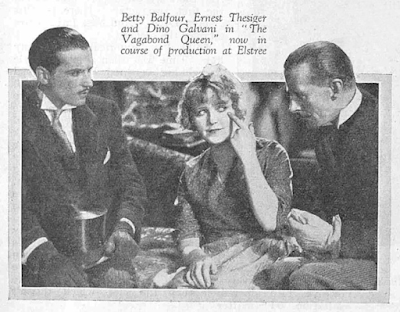
The story was from Douglas Furber whose various musical plays included The Lambeth Walk (Oi!!) with script from Rex Taylor and Val Valentine, which has the feel of some compromise. It does contain many fine moments especially from Our Betty but also from the excellent Ernest Thesiger, here as Lidoff who is the very the embodiment of world-weary royal secretary. If looks could kill any number of adversaries would have been disapproved of to death whilst he sees the multiple threats to the royal family, not just from the scheming Winkleburg (Harry Terry) but also from their own wistful incompetence – certainly in the case of the real Princess Zonia’s husband, plastered Prince Adolphe (Charles Dormer).


Ernest Thesiger photographs Betty Balfour during a break in filming. (Associated Newspapers/Rex/REX USA)

All seems so far away as the film opens in London with Betty playing Sally, a subversive house maid with a soft spot for one of her landlady’s tenants, the cash-strapped inventor Jimmie (Glen Byam Shaw) who is only a one-pound battery away from the invention of television. Unable to leave the house without his return being barred due to his long overdue rent, Sally steps out to acquire the missing item only for it to be destroyed by local yobbos. As she exacts a fruity revenge in Pickford fashion pelting them with fruit and veg from the market stalls, she’s spotted by Lidoff and offered £500 if she’s willing to stand in for Princess Zonia.


They say never look a gifting diplomat in the mouth but this is impossible for Sally to resist especially when she takes Jimmie with her on this trip in space and time. Bolonia is your typical Ruritanian paradise with chicken and pigs roaming the streets and revolutionaries around every corner. There are new costumes to wear and a lack of language skills to navigate – this plastic princess has a very sore throat – which only really becomes and issue with the shock revelation that Zonia has that husband who, despite his lack of awareness and visual recognition soon becomes an over amorous issue.


This is nothing though as the real reason for Sally’s appointment is revealed; she’s there to take the flak – literally – for the real Zonia and, if required, a bullet or two from Winkleburg’s assassins who line her route to the palace with menace in a tense/silly/very funny closing sequence.


Stephen Horne provided regally gleeful accompaniment for a film that was released in both silent and sound synchronised form – Britain on the cusp of the talkie transition at this moment. It’s hard to imagine the original music improving on his uncanny syncopation and inventions though.


From Britannia and Eve, June 1, 1929


I’m a king I tell you! – A king!


There was also time from a precious two-reeler from Charley Chase, Long Fliv the King (1926) as if the Ruritanian location had not been spoofed enough. No one quite makes fun of things like Charlie though and here he’s a commoner condemned to death who is married to Princess Helga of Thermosa (Martha Sleeper) who needs a hubby double quick to claim her throne. Charlie is reprieved just after their ceremony and is understandably keen to pursue both Crown and Princess thereby thwarting the schemes of the evil Hamir of Uvocado, the Prime Minister (Fred Malatesta). There’s also splendid support from Max Davidson as Charlie’s mate Warfield – painfully Jewish-coded to modern eyes but full of energy.


It's a grand laugh in the grand duchy and Oliver Hardy is on hand to add that extra dose of comic potency. Both he and Chase demonstrate the innate potency of the best silent comics; you’re smiling as soon as you see them, you know the comedy is coming; their eyes alive with mischief and not a second wasted which is important as the essence of all comedy is, of course… timing!


Saturday, 3 February 2024

Vic-Tok… The Story of Victorian Film, BFI talk with Bryony Dixon


We can only strive to realize, in some dim measure, the fascination which those pictured ribbons of celluloid will exercise upon the eyes and minds of future Londoners – let us say, at some remote epoch, when the throne of Great Britain will be occupied by a monarch of whom we can form no conception, under social conditions which may differ widely from those existing at the present day.


Canadian scientist, Joseph Miller Barr, 1897 concerning film of Victoria’s Diamond Jubilee*


Well Joseph, here we were 127 years later, for a spectacular show and tell from BFI archivist Bryony Dixon who has just published a book on Victorian cinema which starts in 1896 and ends in 1901, the year of Queen Victoria’s death. It’s a remarkable period and one which in the presence of such expertise, suddenly bristles with modernity and commercial opportunity. The new media of the time was not so unlike out own and Bryony made a convincing case for parallels between Tik-Tok – short films, sometime silent, often with music – with the 60-second high-impact and content rich output of ground-breaking Victorians.


Everything was fresh and competition was high with William KL Dickson, making great PR out of filming the 1900 Grand National in Aintree, riding a fast horse-drawn cab to Lime Street, catching the express to London Euston, developing the film on route and screening it at the Palace Theatre at 11.10pm in the evening. How fast do you want your sports news? This must have seemed so exciting and ground-breaking at the time, and it was: projected media in the age of steam speed.


Dickson, Scottish by reputation but Liverpudlian by birth had worked with Thomas Edison in America and, frustrated by the great copyright-hoarders focus on the nickelodeon, broke free of his contract to escape to the projecting future as it was opening up in Europe. He had an eye for news and wanted to make his own way even differentiating his film stock from that of his ever litigious former employer.


A detail from Launch of the Worthing Lifeboat (1898), it looks stunning on a proper screen


Clearly, the invention and appetite for innovation of the late Victorian age was so intense, we’ve spent the last 120 years just trying to catch up which is exactly why Bryony Dixon’s book, The Story of Victorian Film is so vital especially after her work leading the restoration of hundreds of films from their original materials over recent years. Bryony decided that transfers to video and other early digital media would not be good enough and showed a number of examples, in particular Dickson’s Launch of the Worthing Lifeboat (1898), a staged rescue for the camera of which showed the huge difference in depth of field, clarity and content between the decades old copies and the restoration from the negative: A vista which even in freezeframe simply invited you back to 1897, as silent waves crashes on pebbled shore and the locals watched as lifeboatmen rescued a volunteer even as he had to be dragged back into frame.


These restored films had formed the basis of The Great Victorian Picture Show at the BFI IMAX during LFF in 2019 and almost everything is now available to view on the BFI Player: our national heritage from these white-hot early years, a step into immersive Victorian cinema that is still so fresh and so familiar.


The book is very much the companion and guide to these films and is designed, as Bryony stressed, not only as an accessible and entertaining read in itself but also as a guide to resources now available and which require further academic study. There were questions even from the samples shown in tonight’s talk and, as with archaeologists who leave at least 10% of each dig for their successors, so the BFI’s whole project has raised more questions than answers.


Dixon split the films thematically in lose groups that show the breadth of Victorian film and she covered about half of those featured in the book with examples and explanations tonight:


Children Dancing to a Barrel Organ (1898)

Actualities and News including Dickson's Grand National Mar 24th, 1900. Bryony’s scouring of the archives and contemporary catalogues makes for fascinating reading with the majority of films being news-based at this time. Does the public’s base fascination drive visual technology? This was certainly the case with Wilkinson’s films of the Boer War which even though they mostly lacked the action he sought, showed those at home the conditions in which their friends and relatives were fighting and dying.


Street Life Bryony screened Children Dancing to a Barrel Organ (1898), a marvellous film shot near Kings Cross – an area I walked through on to the BFI, these locations feel so familiar in style as much as atmosphere. It’s not known if these young performers were professional but as Bryony pointed out, that’s part of the investigation that needs to follow the restoration.


There was time for Panoramas and Phantom Rides – again the fascination with place and the window on humanity only distanced by time and fashion – as well as Trick Films, humanity of all ages just as fascinated by seeming impossibility as actuality; the MCU began here with spring-heeled Jacks from across Europe. Looking beyond, we also saw the astonishing film of a solar eclipse from 28 May, 1900 by the magician, Nevil Maskelyne, while on an expedition by The British Astronomical Association to North Carolina. He’d first worked the trick in India in 1898 but the film was stolen on the way home… the battle between science and greed.


I'll see you on the dark side of the Moon...


In the book are also sections on: Artistic/Aesthetic, Natural History and Science, Variety acts and novelties, Comic sketches and facials, Erotic films – although the British were somewhat less active than the French in this area, and probably remained so. Travel and industry includes a detailed look at Feeding the Pigeons in St Mark's Square, Venice (1898) all that has changed is the dress, the pigeons still the same insistent grey.


Actualities and Topicals include The Launch of HMS Albion (1898), a breach launch into the Thames which created a backwash that led to the drowning of 34 people, filmed by both E. P. Prestwich and Robert W. Paul, the release of their films sparked one of the first debates on the public right to view such a loss of life. You don’t have to try very hard to find much worse on Twitter especially.


Drama and Adaptation


Bryony showed James Williamson’s five-minute long Fire! (1901) which, in the context of what we had seen before and what we generally understood of the narrative capabilities of the time, is a quite astonishing film, shifting from the scene of a fire, to a fire station and then a magnificent shot of horse-drawn fire engines and firemen on their way to the fire and then not just outside but inside the property rescuing a sleeping man. Now this is obviously well before Edwin S. Porter’s The Great Train Robbery (1903) and more narratively complex than Alice Guy-Blaché’s earlier efforts involving more than one scene but, all one should really do is marvel at technique at this stage as the styles we now take for granted were rapid-prototyped by the engineers, chemists and secretary-visionaries!


The firemen on their way...

Ultimately, what’s interesting is how quickly fashions and the technology changed. Local films, with Mitchell and Kenyon being the experts, were largely limited in their appeal to 1900-02 after which the novelty had worn off. In the case of drama, the films became longer with earlier shorts like Scrooge being joined together to form longer narratives. There were experiments with sound and colour and throughout the 1900s technology drove the new medium forward.


Bryony quoted Canadian scientist, Joseph Miller Barr writing in 1897* and who seemed to have guessed the future very accurately. He saw the development of sound, colour and 3D as well as the development of longer features; whoever guessed in 1993 that we’d end up with 60-second videos dominating the screen time of the younger generations must have found the same crystal ball… what goes up must come down and diversity and experimentation is the commercial norm.


To discover more I can’t recommend this book highly enough: through a glass brightly!


You can order The Story of Victorian Film direct from the BFI shop online or in person whilst you can view the 100s of Victorian restorations on the BFI Player: the search for meaning and connection is personal and it continues.


Monday, 18 September 2023

Standing out… The Crowd (1928) with Stephen Horne, BFI


"When John was twenty-one, he became one of the seven million that believe New York depends on them.”


In her introduction, the BFI’s Bryony Dixon pondered why this special film, undoubtedly a mainstay of the American cinematic canon, is not screened more often and, indeed, the last time I saw it was in Pordenone back in 2017 with the late Carl Davis conducting his own score and the orchestra at the Teatro Verdi. This aside, the film is not available on home media and hasn’t been restored in some time despite director King Vidor’s Big Parade being on Blu-ray and in crisp condition, a great film but not of the same standard.


The Crowd undoubtedly breaks a number of golden rules for Hollywood and indeed, as Bryony pointed out, a full seven different endings were filmed and tested reflecting MGM’s concerns about the more realistic style deployed and their audience proved them wrong by preferring Vidor’s take. Vidor’s wife, the glamourous and divinely elegant Eleanor Boardman, threw herself into the project with one of the most selfless performances of the twenties; hair tangled, dowdy-clothed and make-up free all along way from the glittering gowns of Proud Flesh. She’s far from proud here subjugating her star-status to play the long-suffering but steadfast lower-middle class wife and thereby enabling her surprise leading man to excel.


James Murray was far from Boardman’s level and had been pulled from the ranks of the extras after being spotted by Vidor. According to Bryony, Murray at first didn’t believe Vidor’s offer, he thought it was a joke and didn’t turn up for his audition and, when he finally saw it was a genuine offer, requested the director covered his bus fare… Perhaps there was something of The Crowd’s John Sims about Murray, it’s hardly fair to suggest he was playing himself and Murray, certainly nearer failure than success at this point, acts his heart out in the film a good-looking guy with natural charisma and yet who might not have that extra drive and/or skill to really stand out from the crowd.


In a packed NFT3 we saw how Vidor used these assets to maximum affect in a film that is as universal as it is timeless and with a style and subject matter far from the dreamy magic realism of studio films now as then. Hollywood hates standing apart from the crowd whether its remaking, filming yet more people in capes or turning cartoons into live action.


As Eleanor Boardman put it: “The Crowd was to be the first picture without glamour…” Vidor simply wanted to tell the tale of an ordinary man: one of the crowd, as he faces the challenges of daily life without supernatural heroics or an excess of good fortune.


The film was to be a prosaic The March of Life, a title John Gilbert suggested when discussing Vidor’s desire to follow up The Big Parade with a Big Parade of Peace. The project would undergo many changes in title but it was always going to be a very personal one for King Vidor as he had the chance to make the film he wanted in the wake of TBP’s massive success... Irving Thalberg happy to let him experiment so long as it helped him forget that 20% stake he’d had in the former film.


“I made pictures as a good employee and pictures that came out if my insides. This is one that came out of my guts. There was a lot of hypocrisy in early films and I wanted to get away from it.” King Vidor explained to Jordan R Young in 1978. Whilst casting Boardman to play against type, the director looked for an unknown so the film would present a “documentary flavour” with “…. a young, good-looking man who looks like he really might be a clerk…” No chance for John Gilbert then. Murray proved to be inspired casting with any technical limitations simply under-pinning his character’s self-deceptions as he moves forwards gradually after every devastating reversal.


As if to reinforce the everyman theme the film begins on 4th July in 1900 with the birth of “…a little man the world is going to hear from all right…” Father has high hopes and everything is indeed possible. Flick on to 1912 as John (an uncredited Johnny Downs) sits with the other kids asking each other what they’re going to do when they grow up. “My Dad says I’m goin’ to be somebody big!” he says but – at the same time - Father dies – and there’s a terrific shot of young John climbing the stairs to realise he has gone… the first major defeat in the march of life reinforced by expressionistic forced perspective.


James Murray


“You’ve gotta be good in that town if you want to beat the crowd.”


The years pass and John goes to find his fortune in New York City. Hi arrival is followed by superb camera work from Henry Sharp showing the press in the city: thousands of people flowing along sidewalks, mingling with the traffic at cross-roads in a double exposure showing the lifeblood of the concrete and commerce. The camera angles on tall buildings, shifting to a model shot as it rises ever higher pulling back to focus on a window through which it fades into a giant room of endless regularity: desks into infinity.


Somewhere near the middle sits our John: one of the many in at desk 137, he scratches his head, seemingly intent on his work but he’s trying to think of an answer to a newspaper quiz: “Name our new motor fuel and win one hundred dollars” … a dreamer passing time and hoping for a long shot… He clock-watches and preens himself for real life to begin after five o’clock.


He plans to study but Pal Bert (Bert Roach) has an offer he can’t refuse “I’ve got a pair of wrens dated up for Coney Island. Want to make it a four-some?” All the while there are people filling the streets and corridors… the Metropolis is teeming. Bert and John run from out of the shadowy crowd to greet their wrens: Mary and Joan (Estelle Clark). Joan is bouncy and Mary is a little shy – Boardman almost dowdy, gauche, chewing gun and head bowed – an Oscar performance, in my book, for 1928.


Boardman herself, was always such a sharp commentator and recognised the value of this work saying later that Mary Sims was simply “a job I had to do, I didn’t like to be so drab and unattractive, the hair hanging down, no makeup on…. I had confidence in Vidor; I knew he knew what he was doing…” and no doubt vice versa.


Eleanor Boardman


Bert and John both catch admiring glances at the girls’ legs as they climb the steps on a double-decker tram but whilst the former is pantomime leery, the latter has a deeper feeling: this girl is offering more than just a glimpse of stocking. The couples sit at the front of the bus as they drive down the avenue and the thousand calculations and connections of early courtship are made. “Look at that crowd! The poor boobs…  all in the same rut!” says John to a shocked Mary and then he sees a men dressed as a clown advertising for shoes… a “poor sap” whose father probably wanted him to be president. You just know that’s going to come home to bite.


Onto Coney Island where the light-hearted tone is maintained – this is how life can be as we play and romance – survival put to one side. The Crowd plays with both concepts equally well and, the mood is superbly balanced by Vidor, despite his apparently relaxed approach to the performers he controls their context and he casts for character: Murray was a natural whereas Boardman could truly act.


John proposes on their ride home and we switch to the wedding where Bert gives them “a year or two” … Funny scenes on the honeymoon train as the couple ready themselves for their first night and then some stunning shots from Niagara Falls where James pledges his love will never stop for the most beautiful girl in the world.


Back to life and “home sweet home” where good humour enables them to rise above the compromises of location and affordability… But the cracks are there: Mary’s family Mother (Lucy Beaumont) and brothers Jim (Daniel G Tomlinson) and Dick (Dell Henderson) are less than impressed with her husband’s ability to provide. John doesn’t even have any hooch left for Christmas and heads off to Bert’s for a bottle only to be caught up in a party as his weak will crumbles at the mixture of girls and gin…


The cracks begin to show...


We begin to lose confidence in John as his career drifts and he falls into a routine of careless marital bickering: he dreams while Mary cleans … and cooks and washes. Their arguing intensifies - she must carry the blame for his failure to progress with every culinary accident counting against her. But as he storms out, she calls down from the window: there’s something she hasn’t told him… Family life moves them onward but five years later they’re still in their assigned roles on the beach. As with Junior (Freddie Burke Frederick) and their daughter (Alice Mildred Puter) run in the sand, John plays a ukulele as Mary cooks… doing exactly what she’d normally be doing at home.


It was at this point that my daughter elbowed me and gave me a look… in fairness I had been thinking the same thought!


The couple’s luck changes twice in the space of a few minutes: John finally wins a caption competition and a life-changing $500. He returns home laden with presents yet the most unbearable tragedy is about to happen, one which completely changes the tone of the film – we’ve been lulled into a false sense of insecurity by Vidor and now we pay as John and Mary’s lives unwind.


“Except for The Crowd, I really am not proud of anything I did.” said Eleanor Boardman to film historian William Drew and you can see why as she pulls Mary through every emotional gear in the closing segments in a magnificent display of technique and conviction. Murray also excels as misery piles on misery and he loses direction almost to the point of self-oblivion. Out of pace with the crowd he’s on his uppers losing job after job and deluding himself that a new “break” is only around the corner… he’s as real a man as Hollywood gets.


Murray and Boardman aged up for one of ten alternative endings... 


Vidor’s brilliance is in not giving the audience an easy way out and we’re left wishing and hoping long after the end title card pops up, a film that leaves a mark and one you don’t simply walk away from.


All of which makes it frustrating that, in addition to being rarely screened, this major film is not available on home media although the 1981 restored version from Brownlow and Gill, featuring Carl Davis’ lovely orchestral score has been shown on TCM in the past. We have Wings, Sunrise and The Big Parade on Blu-ray; come on MGM or whoever you are these days.


Stephen Horne played a few of Carl’s lines in tribute to the late composer and filled the room with sympathetic lines that soon merged with the action on screen. I wonder how the quality of story, direction and performance impacts the improvisation, certainly with a film at this level if feels as if Stephen raises his game to the same level, duetting seamlessly with Vidor, Boardman and Murray.


One of the screenings of the year and a reminder of the power of the BFI archive and it’s role in our cinematic lives. Not just the usual crowd…


Reading list:


King Vidor’s The Crowd, The Making of a Silent Classic by Jordan R Young is a fascinating account of the film featuring interviews with Boardman and Vidor as well as an introduction from Kevin Brownlow. It’s available from Amazon in paper and on Kindle.


King Vidor, American by Raymond Durgnat and Scott Simmon is a high-content, well-researched biography from the early nineties and still to be found on Amazon too.


Wednesday, 29 September 2021

Anarchy in the UK… Nasty Women: A Comic Tribute, BFI with Meg Morley


There was a guy, I’m not sure if you remember him, who once referred to his presidential rival as a “nasty woman” long ago in The Time Before. In response film historians Maggie Hennefeld and Laura Horak ran a programme of comedy shorts at the 2017 Le Giornate del Cinema Muto in Pordenone featuring women behaving nastily for comic effect. As that festival is about to run live for the first time on two years and because female silent comedy is as funny as it is often unrecognised, the BFI decided on a re-run with a few old favourites thrown in.


In the ten years or so I’ve been stricken with this silent film bug, there has been much restoration and re-evaluation of women’s role in early film direction with Alice Guy-Blaché, Lois Webber, Nell Shipman, Germaine Dulac, Dorothy Davenport Reid and, of course, Mabel Normand amongst those now getting their due. But many of the key players in global comedy still require elevation in modern discourse, these women having faced the double bind of having to battle for recognition at the time and then being overwritten by a history that has favoured the men… we know their names and yet perhaps the greatest of all was directed in his first film by Mabel.


Today we gathered just to watch women being funny in the manner they were appreciated at the time: gender-neutral daftness all perfectly illuminated by Meg Morley’s improvisational excellence and introduced by long-time champion of the comically under-rated nasty women, Bryony Dixon.


The first two films got us warmed up…


The Finish of Bridget McKeen (1901) USA


Here Lies the Remains of Bridget McKeen Who Started a Fire with Kerosine


This brief comedy outlined the perils of using inflammatory material to start a fire with the titular hero meeting her end after causing an explosion.


Mary Jane’s Mishap; Or Don’t Fool with the Paraffin (1903) UK


A couple of years later and this rather more sophisticated British effort told the same tale. Directed by George Albert Smith this film has Bridget/Mary Jane played by his wife Laura Bayley, a former variety performer, who hams it up splendidly with many pleading looks right to camera, busting the fourth wall and still connecting with the disruptive soul onlooking natives.


She rests in pieces...


Léontine s’envole (1911) France


Our lessons in fire safety completed it was off to France for the enigmatic gallic anarchy of the legendary Léontine, also known as “Titine” in France and Betty” in the United States, about whom almost nothing is known. Maggie Hennefeld’s essay on the LA Review of Books1, shows what is known about this energetic screen presence but all this is entirely based on her surviving celluloid with her life off screen a closed book. She made some 22 episodes of her comic film series for Pathé-Frères from 1910 to 1912 after which she disappears apart from being spotted as an extra in a 1916 comedy.


Here she burns bright as a brat who keeps on begging her parents for one more balloon until, inevitably, she takes off and is carried across the sandy streets of what looks like the south of France pursued by all and sundry attempting to pull her to earth. This includes three acrobats who stand on each other’s shoulders to try and catch her. Everyone falls down and the camerawork is startling, following our brave star as she gamely hangs from balloons dangling from a crane metres above the ground.


Léontine after the balloons go up

Léontine enfant terrible (1911)


I’m not surprised Léontine is so awful in this film as her parents look like creatures from a gothic fairy tale, mother complete with prosthetic nose. Their daughter strikes back and smashes all of their plates and most of the house before spreading her destruction to the outside world. She ties two workmen together so they drop their boxes, sets fireworks off and smashes a man’s head into a pumpkin. There may be a deeper meaning to all this but surely there’s nothing more purely amusing than watching someone break completely with social convention and just let rip. A fanfare for the common woman.


Léontine garde la maison (1912)


Now, there’s one thing you really don’t want to do and that’s leave this woman in charge of the house and the baby… and the dog. Léontine feels put upon and responds in the only way she can, dishes are washed and smashed, kitchens are set alight and bathrooms flooded, then she goes to play with her pal and the dog and child disappear. Advertising for her lost items she gets dozens of children and dogs in return before being told off by mother. At the end she cries only until she’s left alone to fight again.


What is she rebelling against? What have you got?


Butter wouldn't melt: Chrissie White and Alma Taylor
 

Tilly’s Party (1912)


In the Tilly series, Alma Taylor and Chrissie White play merry havoc with social norms by cheeking their way through anarchic adventures which must have made the women in the audience feel just that bit more amused than the men. Here the girls disrupt a gathering at their parent’s house, lead the angry guests on a merry chase sat on the handlebars as their boyfriends cycle away. They manage to get to their “music lesson” just in time to get away with it all.


At the height of the suffrage debate, the women’s movement was so ingrained in society and so many women went to the pictures… perhaps cinema was more subtly supportive than the government may have thought?


Daisy Doodad’s Dial (1914)


Not only does American actress Florence Turner prove that if the face fits anything is possible, she also demonstrates the comedic special relationship between her home country and the old country. DDD concerns the efforts of Ms Turner and her hubby to win a face-pulling competition. They’re both very adept but Florence's facial flights of fancy end up getting her arrested before she finally wins out with her extraordinarily flexible fizzog2.


Flo’, this is great content for Tic-toc, bring back pro-face-pulling, there’s gold in gurning!


The Night Rider (1920) Texas Guinan


Not for nothing was Texas Guinan described as “the female William S Hart” who, as the Kennington Bioscope’s Michelle Facey 3   has said, was very much the real thing, a ranch gal from Waco, who could ride and shoot as good as any man on her father’s farm. Guinan toured as an itinerant rodeo performer before the stage (not the Deadwood one…) called. She featured in vaudeville were her pep and knack for self-promotion stood her in good stead: she once claimed to have accidentally shot herself in the side, but the show still went on, it being just a flesh wound an’ all. She was still a chorus girl in 1917 and as she rode a horse down the runway in the theatre, she was talent spotted by a movie man… probably.


Texas is as charming as she is tough and here she has to choose between two men, one of whom may be rustlin’ her cattle… as is usual, she doesn’t stand on politeness and if any man has wronged her… there ain’t no mercy! Not nasty, just assertive!


Meg Morley accompanied with thematic variety and satisfying melodic invention. No two “scores” were the same and she kept pace with the on-screen anarchy with the acuity of a seasoned jazz player, one used to working as part of an improvisational team.


A splendid afternoon on the Southbank and we drank a toast to the nasty but nice trailblazers who are being remembered anew.


Texas

1. Looking for Léontine: My Obsession with a Forgotten Screen Queen, Maggie Hennefeld, Los Angeles Review of Books September 24, 2019


2. Early 19th century: abbreviation of physiognomy.


3. In her introduction for the Kennington Bioscope’s screening of The Girl of the Rancho (1919), Wednesday 2nd May 2018!