Showing posts with label Ettore Manni. Show all posts

Saturday, 26 September 2020

Jeanne Genie… Mademoiselle (1966), BFI Blu-ray out now.


Watching Jeanne Moreau’s detachment as twisted fire starter, malicious flooder and silent poisoner you get the feeling that, had she not been a child at the time, this is a role Isabelle Huppert would have, probably, killed for. As it was Ms Moreau was dating director Tony Richardson at the time and this is the first of two collaborations they made after he left first wife Vanessa Redgrave. Original script writer, Jean Genet, could not see why Moreau's skills were needed and would have prefered a non-actor and yet it's hard to imagine this film without Jeanne's micro-managed emotions.


Famously a member of the “booed at Cannes” club, Mademoiselle had a very mixed response on initial release with The Observer’s Penelope Gilliatt calling it ‘dense and audacious’ and Alexander Walker of the Evening Standard finding it ‘memorable’, whilst The Sunday Telegraph’s Robert Robinson called it ‘frightful’ and Felix Barker of the Evening News, simply, ‘Quite terrible’. Over the years poet Patti Smith is far from alone in defending the film and this new release presents a stylishly flawed film that is ripe for re-appraisal.
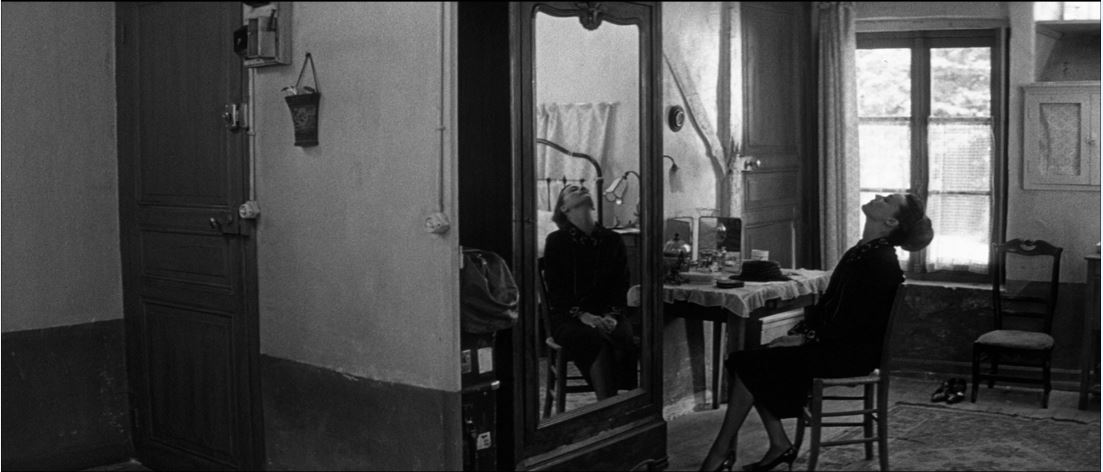

Jeanne Moreau alone in a room on a chair

Filmed in the stark black and white more usually associated with Woodfall Film’s British kitchen sinks, Richardson’s French foray, could almost be a silent film. Many who hear the dubbing of French performers into English may actually prefer that but at least Moreau’s voice is her own, not that she needs audible language to make her feelings shown. She is remarkable as the titular Mademoiselle with a performance of oblique intensity that conceals as much as it reveals.


In Jon Dear’s essay in the accompanying booklet, he describes Moreau as empowered by her solitude, committing destructive acts with impunity protected by her status and loneliness from consequence and discovery. We know from the very start, as her fishnet gloved hands casually open a sluice gate that floods a farm, that she has no guilt only fascination with the wreckage she creates. She stands excitedly watching the rescue attempt, attracted to the heroic masculinity of Italian woodsman Manou (Ettore Manni) who we begin to suspect is her motivation for causing the havoc.


Jeanne and Keith Skinner


The script was completed by Marguerite Duras based on Jean Genet’s original idea and the latter’s focus on isolated characters was drawn from his own experience as an outsider in a small rural community. No matter how much the Italian men step in to help put out fires and rescue farm stock from floods, they are constantly under suspicion from the locals, driven by xenophobic distaste as well as sexual jealousy. Manou is a big hit with the local ladies and, no doubt from Genet, there is the sexualisation of his manliness as well as physique with the camera following Mademoiselle’s interest.


Genet’s complex relation ship with the progression of his work to screen is examined in an essay from Jane Giles who provides much fascinating detail, as does Jon Dear who reveals that David Bowie’s Jean Genie was written about the author – new information certainly for me. Genet had long rolled off this particular project but his themes remain, especially those of control and identity; the disconnect between the schoolteacher’s actions and her wish to be respected. Her obsession with French war hero-turned-child killer Gilles de Rais and child warrior-turned-Saint, Joan of Arc, speak for themselves.


Jeanne and Ettore Manni in the wild

The film’s narrative is sometimes out of joint, adding to a general dislocation and a dreamlike quality a full-channel width away from Richardson’s A Taste of Honey (1961) or Look Back in Anger (1959). Mademoiselle dreams in the forest and then she meets Manou on a bridge and he shows her a snake he has wrapped around his midriff; it’s the most obvious phallic symbol and one the rightly belongs in a dream and yet, some time later the two resume their meeting and appreciation of the reptile.


This approach to narrative combines with Moreau’s masterful control to confound our expectations and to reinforce that feeling of reverie as the schoolmistress blows very hot and then very cold with Manou’s son, Bruno (Keith Skinner) chiding him for being dressed like a gypsy before going out of her way trying to help him. Whilst there is something building with his father, the boy is not yet tainted by the sex and sin of men and which she is drawn to and repulsed.


Hats off to David Watkin - stunning depth of field all achieved in camera and under water

At times the film feels like a folk horror of a slightly later vintage as David Watkin’s camerawork gives us a disorientating mix of largely static close ups and people dominated by the force of their country landscapes. The woodlands carry a visceral sense of freedom and ancient mystery whilst the village interiors are clinical and confining. Antoine Duhamel’s music amplifies these conflicting spaces perfectly and when events do happen, they are jumbled and disorientating.


Richardson's shots are oddly pointed with the village processing to church intercut with Mademoiselle's first evil deeds and fish being taken out of a river as they walk above. There's also a conversation between local women conducted almost entirely over a shot of their washing clothes; the enclosed atmosphere of the village focusing in on itself. The woods act as a catalyst for the school teacher, she reaches out to the boy when she sees him there and, of course, that is where the barriers are removed between her social self and her true nature.


Once Mademoiselle and the Woodsman do connect there is the most extraordinary sequence of physical interactions that, spoilers aside, provides a jaw-dropping crescendo amongst this deafened world of petty jealousy and indifference to truth versus preconceptions. It always comes down to the now…


In addition to the essay-packed 38-page booklet, there’s an interview with Keith Skinner with the BFI’s Vic Pratt as he looks back on the film as well as a new audio commentary from film scholar Adrian Martin recorded especially for this release.


There’s also a second feature, the British Doll’s Eye (1982) directed by Jan Worth who, writing about it in the booklet, describes it as an attempt to blur the lines between documentary and fiction in relation to sex workers and their male customers. The idea had been sparked by inviting men to write in with their responses to adverts for prostitutes and these led to Worth writing a script and directing the film.


Doll’s Eye features Jane (Bernice Stegers), a researcher working on a research project about men’s views on female sex work; Maggie (Sandy Ratcliff) a sex worker; and Jackie (Lynne Worth), a young woman who has moved south from the industrial north of England, as part of the early eighties migration as Thatcher’s “managed decline” saw prospects disappear. Jackie babysits for both and works part-time as a switchboard operator. Worth’s film pays tribute to the social realism of early Woodfall films but without attempting the same naturalism and the result is a mix of verbatim quotations from the source research and a restrained drama examining social situations and power relationships; ‘who looks at whom and for what purpose?’


Mademoiselle is out now and is available from the BFI shop and online.


Sunday, 9 February 2020

The libertines… City of Women (1981), BFI Fellini Centenary


"We do not go to Fellini to immerse ourselves in story and character or to encounter ideas. What we want from the maestro and what he gives us are fabulous adventures in feeling - a decidedly original mixture of nostalgia, poignancy, and joy that is unmistakably Fellini's own." John Gould Boyum, Wall Street Journal, 1981

"At the Cannes Festival the papers said that Fellini's last film was a total disaster, and that he himself had ceased to exist. It's terrible, but it's true, his film is worthless." Andrei Tarkovsky, 1981

I’m around the same age as Marcello Mastroianni when he made this film and just a few years younger than Federico Fellini who produced, directed and wrote this fantasy in which men of our age come face to face with feminism. I’m a generation or two below them and from a different cultural environment but I can’t say that I don’t know men like Snàporaz, Marcello’s character and therefore a cypher for Fellini. So, other than a snapshot of middle-aged male reactions to feminism, what can we make today of a film that so divided opinion at the time. We should also bear in mind what the director wrote about generational difference in the late sixties: “…faced with one of today’s youngsters, the young man of 1938 is like an accountant faced with a butterfly.”

I’m no butterfly counter but it’s safe to say that City is a startlingly inventive visual experience full of magically real episodes that are beautifully shot by Giuseppe Rotunno – Fellini in colour is always sweet-shop overload but capturing his mind’s eye took some doing and Rotunno worked with him on eight films. Mastroianni is also at his finest as the confounded Snàporaz who’s good nature allows him little awareness that he is part of a system of patriarchal oppression; it’s all a complete surprise to him, even when the points against become ever more personal.

Bernice Stegers gives Snàporaz the right impression, or so he thinks.
The film begins with Snàporaz waking up on a long train journey only to catch the eye of an attractive and enigmatic woman (Bernice Stegers) who excites his sexual interest so much he tries to make love to her in the toilets before mindlessly following her off the train at her station, which turns out to be a field in the middle of nowhere. Still following his base instinct, Snàporaz is left stranded as his train pulls away as does the woman after she calls out his crude advances.

Snàporaz begins a search for civilization only to find a hotel in the middle of a wood hosting a feminist convention with a particular focus on him; the woman from the train even pops up to target him personally. Snàporaz is initially fascinated and amused but this soon turns to concern. He is helped away from the febrile debating hall by a young woman, Donatella (Donatella Damiani) who seems friendly enough but soon has him on roller skates as dozens of other women come into this new room and skate at and around him.

He is helped escape again this time by a large woman (Iole Silvani) who finds him fallen at the bottom of the stairs and then offers to take him to the station on her motorbike. It’s a ruse though and she tries to have her wicked way with him in a greenhouse before being chided by her mother. It’s role-reversal for Snàporaz but things get even worse when he is rescued by girl gangs who drive too fast and eventually at him.

It's a trap and there are too many of them to quote George Lucas.
He seeks refuge at the large country house of Dr. Xavier Katzone (Ettore Manni) the ultimate woman hunter who has a hall of remembrance where he has recordings made of his 9,999 conquests… In the main hall Snàporaz finds his wife Elena (Anna Prucnal) who may become the 10,000th and he even has a cake to celebrate. Yet, whilst noting this impressive record, the priapic Doctor is now resolving to say goodbye to women… Then the police arrive, made up of the women from the hotel including the frisky motorcyclist and inform him that one of his precious pet attack dogs has died, a very male breed, a hunter for a hunter.

Dr. Katzone’s house is bigger than the hotel where the women convened and it contains a hall paying tribute to every conquest; pictures with recorded highlights which delight Snàporaz, who flicks them on and off with glee savouring their reduction to recorded signifiers of male dominance. There’s no love just lust and conquest. The film snowballs, and there’s no let-up in the escalation of the director’s cavernous visions. Fellini’s flash can be off-putting – Roma on the small screen is a tough watch; too much to squeeze through - and yet seeing it in cinema contains the exuberance rather than magnifying it. Either way, you have to tuck into Federico’s feast even when, cinematically speaking, you may just want to enjoy a contemplative sandwich.


But on it goes as Snàporaz’s unrepentant and, to be honest, almost uncomprehending, sexual attitudes are examined by a swirling array of larger than life women including his own wife, arrived to sing operatically and to throw herself at her reluctant husband:“I want to make love!”...“But it’s raining…” comes back his excuse as he looks for the younger women.

She’s less chance of lighting his fire than setting the drenched woodlands ablaze; he wants the ones he can’t have and he wants them all. As in a dream he chases two nearly-naked nubiles – including the ever-smiling Donatella until, unable to sleep in the huge bed provided for himself and his disappointed wife, he crawls underneath and through a hole to find a fairground in Katzone’s unfeasible basement.

As he descends on the slowest of helter-skelter slides, he sees his romantic life played out in front of him and his restless search for the perfect woman becomes a trial with the reward of a giant inflatable balloon variant of this impossible creature. Once more Marcello takes to the skies in a Fellini dream… or… is it?

Welcome to the House of  Fun...
Roger Ebert concluded his review in 1981 by saying the City of Women was ” …worth seeing because it's a bedazzling collection of images, because at times it's a graceful and fluid celebration of pure filmmaking skill, and because Fellini can certainly make a bad film but cannot quite make a boring one.”

City of Women is certainly not that and whilst it doesn’t have many answers it at least raises the questions. It deals with the feelings and, as with all feelings, they are not always rational or explainable. If nothing else we get to see Marcello dance like Fred Astaire… he’s the most charming of rogues and no one ever coped with the dual pressures of likable and roguish quite so well!

The BFI Fellini season continues for the rest of the month, full details on their website.


Silent film clearly was a strong formative experience for young Federico...

Monday, 28 January 2019

With friends like these… Le Amiche (1955), BFI


Another dip into Antonioni’s back catalogue and a most surprising, actually quite shocking film. Being more used to the director’s work in which very little can be said to be absolutely certain and in which interpretation is a vital part of the narrative, this film is both more defined in both story and morality. The “friends” in Le Amiche are attached to each other in the most fragile of ways and even love is measured against career opportunity or even pain. When one of the characters asks another why she still loves him she can only respond by saying maybe it’s because he hurts her so much…

This is also one of Antonioni’s most populated films with ten main characters all representing a variety of “friendships” – lovers, marriages of convenience, colleagues, work friends and, people who make you feel better for all the wrong reasons. Still… this world is one we all recognise.

The central character is Clelia (Eleonora Rossi Drago) has come from Rome to open a fashion boutique in her native Turin. As she gets ready in her hotel room, an attempted suicide is uncovered in the neighbouring room, a young woman, Rosetta (Madeleine Fischer) all dressed up with nowhere to go with her broken heart. One of Rosetta’s friends arrives, Momina (Yvonne Furneaux) who carries an air of bourgeoise authority even when she finally discovers what has happened to her friend. Soon she co-opts Clelia into investigating the incident and the latter, being far warmer, is more than willing to help.

Eleonora Rossi Drago and Madeleine Fischer
It’s fascinating to see Clelia at work when she finds the shop far from ready for its opening, whilst she’s met by indifference and sexual curiosity from the workmen – those who aren’t off sick that is – she stands up for herself and insists on speaking to the architect’s assistant, Carlo (Ettore Manni),  who she gets to call his boss in. When Cesare the architect (Franco Fabrizi) arrives, she holds him to agreed timelines and budget in spite of his attempts to gaslight and distract; familiar scenes for anyone who’s commissioned building work but Clelia has strength of character as well as project management discipline.

Clelia joins Momina and her clique on a day out meeting Nene (Valentina Cortese) an artist with more talent than her feckless husband Lorenzo (Gabriele Ferzetti who will later do more of the same in L’Avventura) who painted a portrait of the unfortunate Rosetta who, it transpires, fell in love with him and couldn’t face rejection.

Yvonne Furneaux, Eleonora Rossi Drago Anna Maria Pancani and Valentina Cortese
There’s a lively blonde Mariella (Anna Maria Pancani) who can have all the ones other can’t have (there’s always a Smiths reference…) and who cruelly jokes about Rosetta not even being good enough to finish even the simplest of suicides… Alpha Momina (a new band name right there) slaps her more acting more for affect than in anger and Rosetta chides her for being a hypocrite… you get the feeling that this demi-monde is too tough.

Clelia takes care of Rosetta though and employs her at her salon and she starts to gain in confidence. There are string class lines in this film and Carlo is surprised that Clelia has appointed someone who, literally, doesn’t need to work – he muses on the motivations of someone in that almost unimaginable position (nowadays, as then, they probably end up in finance or politics…).

Gabriele Ferzetti and Valentina Cortese
Meanwhile, Lorenzo becomes more attracted to the young woman, especially after he learns that Nene has been invited to be blatantly more successful than him in New York… is he genuine or is he just trying to reassert his manly mojo? Momina, for whom affairs are like seeing the hairdresser, advises her young charge to grab the bull by the horns and enjoy herself, ignoring the risks and heartbreak this will inevitably bring…

It’s a mad whirl of a film with Clelia at the heart ultimately having to decide if it’s the love of a good if lowly fellow like Carlo or a magnificent career like that of her boss (Maria Gambarelli) she wants. This is where the film is so clever as it confounds our cinematic expectations of “good” and “bad”. Characters behave in unexpected but entirely convincing ways and as the story winds up to its various climaxes, one by one, the leading narratives gently slap us in the face, not for effect perhaps, but more in anger.

Certainly one to see in the BFI’s Antonioni series if youcan - it runs through February - and another nail in the coffin of the “Only good after 1960” mindset I’d once assumed... wrong again Paul, so wrong!

Ettore Manni and Eleonora Rossi Drago