Showing posts with label Franco Fabrizi. Show all posts

Monday, 13 January 2020

Wasted youth… I Vitelloni (1953), BFI Fellini Centenary


Seven years before La Dolce Vita, another of Federico Fellini’s characters formed an innocent relationship with a youth that may or may not signify the possibility of escape from a dead-end existence. In his third film he drew upon his upbringing in seaside Rimini to paint a slightly autobiographical picture of five close friends who’s get up and go has got up and gone or, if you will, si alzò e se ne andò! I Vitelloni are not exactly bored teenagers, they’re well into their twenties and are either not working or still living under the assumption that life is about to start. It takes that friendship with a young lad working early shifts at the railway station to help one re-connect to his own youthful ambition.

As the train pulls the escaper away, the camera cuts to the bedrooms of his four friends as the lie asleep in each case pulling away as his momentum carries him clear of the ties that bind. It’s a neat moment and another one of Fellini’s great endings to accompany his great beginnings… although this is certainly one of his films that maintains narrative energy and interest throughout with rich characters and compelling episodes in which revelations are made and fortunes pivot.
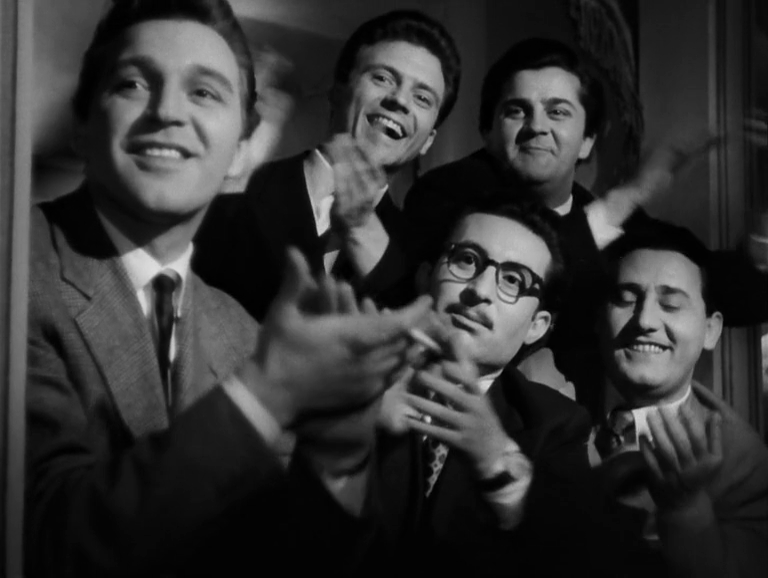
Franco Fabrizi, Franco Interlenghi, Leopoldo Trieste, Riccardo Fellini and Alberto Sordi
The subtitles translated I Vitelloni as The Bullocks and it could also be The Idle People, not so much the victims of post-war economic malaise as sheer boredom – anathema to Fellini who escaped the “Italian Blackpool” for Rome in the thirties in order to study law. The gang are stuck mostly living with parents and living the lives they have since they were 15. Fausto (Franco Fabrizi) is their leader, handsome, stylish and totally faithless, chasing girls with no self-control until the inevitable happens and someone gets pregnant.

That someone is Sandra (Leonora Ruffo) who in addition to having just won the local beauty contest, is the sister of Fausto’s best pal Moraldo (Franco Interlenghi) who is as considerate as Fausto is wild; the kind of guy the idiot needs and probably one of the few who would put up with prolonged exposure. Moraldo was described by the director as being closest to his own character although there is also a voice-over to provide additional context.

Fausto considering his options.
The others in the group are Alberto (Alberto Sordi) who has a fine singing voice, outgoing and not afraid to drag up for carnival. He lives with his mother and sister Olga (Claude Farell) who, unlike him, has a steady job and is also in a long-term relationship with a married man. As with later films, the women seem far more grown up than the men who struggle with even the basics of self-awareness and communication. Unlike her brother Olga is desperate knowing that her prospects are bleak and that she may have to seize the only chance she may have to get out.

Then we have Leopoldo (Leopoldo Trieste) a would be playwright who is awaiting his lucky break as he works away in his auntie’s house occasionally distracted by his pretty neighbour Gisella (Vira Silenti). He’s the most intellectual but not the smartest – as so often happens – and the butt of the group’s jokes. His big chance comes when an old theatre star comes to town Sergio Natali (Achille Majeroni) who leads the youngster on by allowing him to read him his play as they wine and dine. But Natali is far more interested in Leo than his words and as he tries to take their relationship in a different direction in the dockland shadows, the writer finally makes his escape.

Just watch the film Fausto...
The final member is the group is Riccardo (Fellini’s brother Riccardo) who is the least well realised character – a good guy who greases the social wheels of the group but who doesn’t have much of a dramatic arc. For that we need to go back to Fausto and the Rubini family…

Fausto’s father (Jean Brochard) who still doesn’t spare the rod for his man-child, makes sure that he marries Sandra and the couple seem happy enough. Sandra’s father (Enrico Viarisio) gets Fausto a job at his friend’s shop selling religious paraphernalia to nuns – hardly his dream but then he doesn’t appear to have one, except the life of a womaniser. He goes to the cinema with Sandra only to leave in order to pursue another woman (Arlette Sauvage) even as his wife is engrossed in the film and the whole experience with her husband. Fausto can’t commit even to the fantasy as the woman is just too distracting; he plays footsie, lights her cigarette and, after his inconclusive pursuit, returns to find Sandra outside, the film over.


Fausto flirts with the boss’s wife and ultimately loses his job as a result, falling foul of a more solid marriage. He enlists Moraldo’s help to steal an angel from the shop in revenge and tries to sell the statue to a nun and then a monk. Both have enough angels already and whilst Fausto sees only the monetary value of the piece, the “simple-minded peasant” (Silvio Bagolini) who pushes the angel on a barrow, is in awe.

The carnival scene is the film’s centrepiece and all the characters collide in one gloriously choreographed sequence. The camera moves through the mass as they dance, the tickertape falls and the music is incessant. After the ball the hangovers kick in and reality bites in the harshest of ways… Some will grow and others will fall back in the fantasy of routine.  

I Vitelloni is a fun film with a serious heart which I guess is Frederico all over. Nino Rota’s music is here too as it would be for decades; he weaves some gorgeous themes and as with 8 1/2, La Dolce Vita and the rest, holds the emotional lines together through the episodes. Not surprisingly the director called him the "most precious collaborator" he ever had and the two work so well with Fellini often cutting to Rota’s music, as the composer didn’t always see the visuals. That’s a fascinating level of trust.


Monday, 28 January 2019

With friends like these… Le Amiche (1955), BFI


Another dip into Antonioni’s back catalogue and a most surprising, actually quite shocking film. Being more used to the director’s work in which very little can be said to be absolutely certain and in which interpretation is a vital part of the narrative, this film is both more defined in both story and morality. The “friends” in Le Amiche are attached to each other in the most fragile of ways and even love is measured against career opportunity or even pain. When one of the characters asks another why she still loves him she can only respond by saying maybe it’s because he hurts her so much…

This is also one of Antonioni’s most populated films with ten main characters all representing a variety of “friendships” – lovers, marriages of convenience, colleagues, work friends and, people who make you feel better for all the wrong reasons. Still… this world is one we all recognise.

The central character is Clelia (Eleonora Rossi Drago) has come from Rome to open a fashion boutique in her native Turin. As she gets ready in her hotel room, an attempted suicide is uncovered in the neighbouring room, a young woman, Rosetta (Madeleine Fischer) all dressed up with nowhere to go with her broken heart. One of Rosetta’s friends arrives, Momina (Yvonne Furneaux) who carries an air of bourgeoise authority even when she finally discovers what has happened to her friend. Soon she co-opts Clelia into investigating the incident and the latter, being far warmer, is more than willing to help.

Eleonora Rossi Drago and Madeleine Fischer
It’s fascinating to see Clelia at work when she finds the shop far from ready for its opening, whilst she’s met by indifference and sexual curiosity from the workmen – those who aren’t off sick that is – she stands up for herself and insists on speaking to the architect’s assistant, Carlo (Ettore Manni),  who she gets to call his boss in. When Cesare the architect (Franco Fabrizi) arrives, she holds him to agreed timelines and budget in spite of his attempts to gaslight and distract; familiar scenes for anyone who’s commissioned building work but Clelia has strength of character as well as project management discipline.

Clelia joins Momina and her clique on a day out meeting Nene (Valentina Cortese) an artist with more talent than her feckless husband Lorenzo (Gabriele Ferzetti who will later do more of the same in L’Avventura) who painted a portrait of the unfortunate Rosetta who, it transpires, fell in love with him and couldn’t face rejection.

Yvonne Furneaux, Eleonora Rossi Drago Anna Maria Pancani and Valentina Cortese
There’s a lively blonde Mariella (Anna Maria Pancani) who can have all the ones other can’t have (there’s always a Smiths reference…) and who cruelly jokes about Rosetta not even being good enough to finish even the simplest of suicides… Alpha Momina (a new band name right there) slaps her more acting more for affect than in anger and Rosetta chides her for being a hypocrite… you get the feeling that this demi-monde is too tough.

Clelia takes care of Rosetta though and employs her at her salon and she starts to gain in confidence. There are string class lines in this film and Carlo is surprised that Clelia has appointed someone who, literally, doesn’t need to work – he muses on the motivations of someone in that almost unimaginable position (nowadays, as then, they probably end up in finance or politics…).

Gabriele Ferzetti and Valentina Cortese
Meanwhile, Lorenzo becomes more attracted to the young woman, especially after he learns that Nene has been invited to be blatantly more successful than him in New York… is he genuine or is he just trying to reassert his manly mojo? Momina, for whom affairs are like seeing the hairdresser, advises her young charge to grab the bull by the horns and enjoy herself, ignoring the risks and heartbreak this will inevitably bring…

It’s a mad whirl of a film with Clelia at the heart ultimately having to decide if it’s the love of a good if lowly fellow like Carlo or a magnificent career like that of her boss (Maria Gambarelli) she wants. This is where the film is so clever as it confounds our cinematic expectations of “good” and “bad”. Characters behave in unexpected but entirely convincing ways and as the story winds up to its various climaxes, one by one, the leading narratives gently slap us in the face, not for effect perhaps, but more in anger.

Certainly one to see in the BFI’s Antonioni series if youcan - it runs through February - and another nail in the coffin of the “Only good after 1960” mindset I’d once assumed... wrong again Paul, so wrong!

Ettore Manni and Eleonora Rossi Drago