Showing posts with label Le Giornate del Cinema Muto 2020. Show all posts

Monday, 21 December 2020

So here it is (against all odds)… 2020's Silent Highlights


“A journey in one’s armchair – a journey of the mind – is the nicest kind of journey, because it’s what we want it to be, because there are no obstacles, and all our dreams are granted.”


In such a year as this with no accompanied silent film screenings since the middle of March… how can Arthur find very much to thank? Well, let me tell you there is more to be thankful of in 2020 than in any normal year because, despite it all, people did carry on and they did put the show on Right Here! So here they are - in no particular order - my top twelve silent delights from a year spent mostly at home...


Buster and Natalie Talmadge 

1. Slapstick Festival – Our Hospitality (1923) with The European Silent Screen Virtuosi


If it was January it must have been Bristol and the reliably sensational Slapstick Festival which was again packed with rare and beautiful shorts as well as features I’d previously missed such as Lubitsch’s So This is Paris (1926) and James Cruze’s On to Reno (1928) starring Marie Prevost. The highlight was Buster’s Our Hospitality screened in the cathedral with an informed, passionate introduction from actor Paul McGann who this year joined with me in celebrating victory for Liverpool Football Club in the Premier League as well the World Club Championship… 2020 eh!?


Our Hospitality was the first of Buster’s features and a huge leap for comedy kind with a substantial budget enabling him to shift the legendary Canfield and McKay feud back to the 1830s resulting in a very funny and genuinely thrilling film with real drama added to the gags by one of the greatest of comedy innovators.


The European Silent Screen Virtuosi joyfully accompanied with Günter A. Buchwald, Romano Todesco and Frank Bockius filling the cavernous spaces with perfectly judged collaborative improvisation.


Pierre Magnier gets a hat, gets ahead.


2.       Cyrano de Bergerac (1925), with John Sweeney, Phoenix Cinema


Pure joy in February Finchley with a Cyrano that is one of the few surviving colourised silent features; a sumptuous classic that revels in its own excesses in full expectation that the audience know exactly what’s coming from this classic tale of secret love. It is a film that demands to be watched in a beautiful 108-year-old cinema and with accompaniment from someone as skilled as John Sweeney who provided so many stirring motifs that you could almost see a feathered hat bobbing over the keyboard.


I remarked at the time that it was “…well worth braving Storm Ciara for on a day National Rail told us not to travel! Faint hearts and all that…” Go on, tempt fate, why don’t you?


3.       Tatjana (1923), with John Sweeney, Kennington Bioscope


I don’t think anyone took the Cinema Museum for granted, even before all of this… but I wouldn’t have ever thought that this would be my last trip there for nine months and counting. This show was a very rare screening of a skilfully made tale of love and obsession during the turbulence of the Russian Revolution. Made in Germany with direction from the Danish Robert Dinesen, it does at least feature a Russian lead, Olga Tschechowa, as the woman distracting several comrades from purposeful politics.


John Sweeney is, of course, very much your man for the Russians and wove splendid dramatic and romantic lines through the web of revolutionary intrigue. He hadn’t seen the film – who had? – but he was, of course, spot on.


Jenny Hasselqvist y'all!


4.      Ingmar's Inheritance (1925), Selma Lagerlöf’s Jerusalem


Everything closed in the first Lockdown, those of us who could worked from home and, in my case, programmed an in-house season of Swedish films based on my reading of Selma Lagerlöf’s epic Jerusalem as translated by the well-intentioned but over fussy, Velma Swanston Howard. Four films were made of the two books of Victor Sjöström made the first two, The Sons of Ingmar (Ingmarssönerna) (1919) and then Karin Daughter of Ingmar (Karin Ingmarsdotter) (1920) which failed to repeat the success of the first film leaving the director to turn his attention elsewhere.


Gustaf Molander picked up the project and completed the story with his brace, Ingmar's Inheritance (Ingmarsarvet) (1925) and Till österland (1926). The two directors had many differences in approach with Sjöström’s narrative much closer to Lagerlöf’s text and more focused on the interior life of her conflicted characters whilst Molander broadened the palate, taking more liberties and setting up more action.


I especially enjoyed Ingmar's Inheritance which has a stellar cast including Lars Hanson, Mona Mårtenson, Conrad Veidt and Sweden’s actor/prima ballerina superstar Jenny Hasselqvist!


Indoor adventure with Raymond McKee


5.       KBTV – Kennington Bioscope Online, Kidnapped (1917) with John Sweeney (ITMA!)


When the going got tough, the tough went online… It was Dame Pamela of Walthamstow who once described the Kennington Bioscope as London’s Silent Speakeasy, an exclusive yet inclusive, almost mythical club of the committed and persistently passionate silent cinephiles who gather under shadowy circumstances once every three weeks or so… When the door of the Museum had to shut, these movie mobsters just stayed calm and carried on, shifting to digital and, with casual ease, bloomin’ well going global!


Hosted by Michelle Facey – literally the face of KBTV – throughout lockdown the Kennington Bioscope have been broadcasting shorter films on their YouTube channel but this episode was something else as there was a full feature film with live accompaniment from John Sweeney and an introduction from Fritzi Kramer, America’s premier silent blogger with Movies Silently and the woman who crowdfunded the restoration and DVD release of Alan Crosland’s adaptation of Robert Louis Stevenson’s Kidnapped. It’s a film for all the family and one which retains its sense of adventure and charm a century on.


Nita Naldi and John Barrymore: two great profiles...


6.       Dr. Jekyll and Mr. Hyde (1920), HippFest at Home with Neil Brand


One of the first and biggest disappointments of the year was the cancellation of Hippfest – ock, we were just a week away…  The Hipponauts stayed connected via social media though and after an earlier shared watch-along of Clara Bow’s It, this was the full Monty: a learned introduction from Pamela Hutchinson and the wonderful – properly diegetic – scoring of Neil Brand for one of the classics of the silent era, courtesy of Kino Lorber’s Blu-ray of the 2011 restoration.


This was also another of those “appointments to view” with so many of the silent film community watching and commenting as the film played; from London, Bristol, Scotland, Europe and the USA… we were all in the room sharing the film just as we do in festival. Sure, we had to bring our own drinks and nibbles, but this was a night when social distancing became merely a physical construct.


Valéry Inkijinoff acting up a storm


7.       Storm Over Asia (1928), Silent Film Days Bonn, Elizabeth-Jane Baldry and Stephen Horne


Some countries did better than others post lockdowns and in August the 36th Silent Film Days in Bonn was one of the first to run in Europe. The organisers also decided to stream some of the films along with the live accompaniment so that those of us who couldn’t make it, could experience something of the immediacy and ambience of the festival.


So, huddled over my laptop, in my Berlinale t-shirt and with my Louise Brooks Pordenone Silent Film Festival mug topped up, I watched this crystal-clear restoration of Vsevolod Pudovkin’s Storm Over Asia (1928) and listened to the visceral interplay between accompanists Elizabeth-Jane Baldry and Stephen Horne on headphones… and it was almost like being there; certainly one of the most visceral streams of the year.


Ruan Lingyu


8.      
Guofeng (National Customs) (1935) with Gabriel Thibaudeau, 39th Pordenone Silent Festival


Talking of Le Giornate del cinema muto… this year’s edition moved spectacularly online with an afternoon and evening’s worth of musician masterclasses, main feature and post screening discussion that gave us something of the festival’s immediacy and intensity. Every day for a week festival director Jay Weissberg bounded out from our screens drawing us into the programme of restored gems and quoting the above lines from Michel Robida about our shared armchair journeys.


The films were a treat from the restored Weimar sophistication of Abwege (sex and drugs and Brigitte Helm…) to the small-town, mid-west, juvenile Americana of Penrod and Sam (1923) via a rare trip to Greece for The Apaches of Athens (1930). It’s a close-run thing but my favourite was probably Guofeng (1935), accompanied by Gabriel Thibaudeau. Made during a fighting pause in the China’s lengthy civil wars the film promoted Chiang Kai-shek’s Kuomintang (KMT or Nationalist Party) call for a return to core values with its New Life Movement. The movement, sharing values with the opposing Communist Party, was reaction against Western imperialist influence and urged the people to observe social and political responsibilities, practice frugality and to know one’s sense of shame.


Now, if that sounds too functional a brief the resulting drama is nonetheless well made and acted especially by a radiant Ruan Lingyu, the star of Goddess (1934) among many other Chinese silents, before she committed suicide aged just 25 in early March 1935, some two months before the film’s release. She is extraordinary here as every time I’ve seen her, gently emoting and disarmingly direct, sometimes straight to camera if not to the audience, she never leaves her character.


The Masterclasses were also uniformly fascinating and provided extra dimensions to the screenings along with Jay’s masterfully chaired discussions. Sorry Jay, but next year’s festival is just going to have to be that much longer to allow for this all!! Immacolato!!


BFI's Bryony and KB's Michelle introduce

9.       The Cheaters (1929) with Cyrus Gabrysch, London Film Festival 2020


After Pordenone it was straight on to London for the next streaming festival and one that brought a collaboration from the Kennington Bioscope and the BFI. KBTV MC Michelle Facey introduced along with the BFI’s Bryony Dixon who filled us in on the remarkable McDonagh Sisters, Paulette who directed this and seven other features, Isabel, the star, acting under the name Marie Lorraine and Phyllis who worked as art director. They even had their own set, using their splendid family home Drummoyne House as well as some stunning locations around Sydney.


The Cheaters was the third of the McDonagh sister’s films and shows a remarkable consistency of tone and aesthetic. It’s a very proficient melodrama with Hollywood-level performances allied to a crispness of direction and that visual cohesion described by the National Film and Sound Archive as evidence of the McDonagh sisters' “understanding of mood and atmosphere.”


Cyrus Gabrysch’s accompaniment was a gorgeous gamelan, matching the drama but also the thread of family and love. Occasionally I glanced down at his work on the now famous Bioscope “Piano Cam” but mostly, as John and Neil had said in Pordenone’s masterclasses, the music was at the heart of the film and it felt exactly as if it was coming out of the screen!


10.   The House of Shadows (1924), Stephen Horne & Elizabeth-Jane Baldry, Le Giornate del Cinema Muto Silent Stream


There is much discussion about the “new normal” and whether cinema viewing will return in the same ways after the pandemic is ended but some things can stay, especially archive streaming. The Danish Film Institute has – literally – hundreds of silent films available to view on its site (of which more anon) whilst the San Francisco Silent Film Festival also provides highlights from previous screenings. Le Giornate has The Silent Stream which in addition to the masterclasses, features films from earlier editions including this gem from 2017, my first year in Pordenone.


The House of Shadows is an intense melodrama set in northern Norway and Anders Wilhelm Sandberg’s film is an intense, mystical family drama that is as disturbing as it is haunting with some outstanding locations matched by some exceptional performances.


Elizabeth-Jane and Stephen make for an intuitive paring and they fill the characters with so much musical warmth as well as dread, lifting their lines above the swooping panoramas and pacing the viewing narrative with a measured precision that confounds the occasional reminder that this is all played live. There’s a rapture of applause at the end and I think you can hear me whooping as well!


11.   Digital release of the year? The Intrigue (1916)/A Son of Erin (1916), Kino Lorber Blu-ray


Like many compulsive obsessives I have a stack of unwatched Blu-rays and DVDs, in order of release date or sub-sectioned by Director… and whilst this has been the year to eat into that reserve there’s also been good reason to add to the challenge by bringing in more! One I bought and watched was this great set from Kino Lorber featuring forgotten films from Julia Crawford Ivers.


Included are four films either written by or written and directed by Ivers all of which compliment her film, The Call of the Cumberlands (1916) included on the company’s boxset of Women Film Pioneers which, a six discs and 25 hours long, is the perfect lockdown companion.


This set majors on The Intrigue, a science fiction spy adventure from 1916, and whilst it’s very interesting, it was A Son of Erin (1916) written and directed by Ivers that drew my eye the most as it had a number of thematic parallels with Cumberlands; humble men making good, steadfast romance in a changing world and corruption in public office. Ivers sense of morality is consistent across these films and that draws you in further to the history of the films and the time.


Ben Model


12.   Streaming King: The Silent Comedy Watch Party, Ben Model and Steve Massa


Incredibly Ben Model hosted his thirty eighth silent comedy streaming on Sunday 20th December making him one of the most relentless bringers of digital joy for the year. The redoubtable Steve Massa provides deeply informed introductions and Ben live-accompanies shorts comedies starring every silent comedian you have and haven’t heard of. It’s an education and an inspiration. Also *funny*!


This week’s episode featured champion Charley Chase in There Ain’t No Santa Claus (1925) which proved that, actually Chaz, there is one, as this was the perfect comedy gift on a day, we desperately needed it! We also had Martha Sleeper – who I’ve previously descried as the silent era Parker Posey (OK, just me then…) and who is literally slapstick on skates in Sure-Mike (1925) - effortless amongst the mayhem in a two-reeler which also features some youngster name of Fay Wray. There was also lovely Lillian Peacock in A Shadowed Shadow (1916) which is not as dark as it seems… no shades of grey just grade “A” comedy.


Martha Sleeper


Steve and Ben take the digital biscuit and epitomise the resilience and invention of our silent cineaste subculture and its positive refusal to stand by in disconnected silence. As Ben says, people are contacting them and letting them know how the show is heloing them cope with social restrictions and much more beside; laughter maybe the best medicine but so is routine and dedication. 


Thank you boys and thank you everyone above for continuing to shine your light in 2020. We go again in 2021 and I look forward to seeing you online and in theatres as soon as possible.


Sunday, 11 October 2020

Rita, Stan and Babe too… Ballettens Datter (1913), Laurel or Hardy with John Sweeney and Neil Brand, Pordenone Day Eight


And so it ends with a medieval wedding with daft knights and kings dancing to a rag-time band and Stanley Laurel stepping on his princesses bridal train to reveal, “The End”. It ends with belly laughs from the family after eight days of a streamed Limited Edition of Le Giornate and the pledge to return in person next year. They made the best of what we hoped for and it was an experience that as festival director Jay Weissberg said, will have introduced new friends to the experience who will be there for the 40th Anniversary edition in 2021 even if at this stage, we don’t know where but we do know when.


The final day featured Danish dancing, Hardy romancing and Laurel prancing; it was pure Pordenone.


Rita Sacchetto


Until today I’d never heard of Rita Sacchetto, the German star of Ballettens Datter (1913) but now I know that she was at the forefront of new approaches to modern dance having been inspired by Isadora Duncan and learned ballet only to take her instruction towards freer expression, mixing pantomime with dance to create Tanzbilder (“dance pictures”), aimed at “completing” works of art through movement. She attracted the attention of Loie Fuller, known for her Serpentine Dance, which was captured on hand-coloured films at the turn of the century, and toured America with her.


Sacchetto dances in Holger-Madsen’s film and as accompanist John Sweeney said, it was not ballet and quite unlike anything he’d seen as a dance specialist. Professor Mary Simonson of Colgate University, filled in the dancer’s background in the after screening discussion and made me go back and watch those sequences again.


In a week full of insights into silent film musical accompaniment John explained the difficulties in playing with dance on screen as the performance is quite different in tone and pace to the drama that surrounds it. In this instance, Holger-Madsen’s focus on doorways and general framing, acted as a natural cue between changes in the narrative. It’s a very competently directed film as you would expect from the standards of Danish film at this time.


The Count obsesses before he controls...


Sacchetto plays prima dancer Odette Blant who is being romanced by Count de Croisset (Svend Aggerholm), who watches her performances in love-struck awe. But when she agrees to marry him he tells her that the condition must be that she gives up the stage. A year later Odette’s getting itchy feet and he chides her for dancing in front of the mirror - Holger-Madsen (also known at the time as Holger-Hyphen…), is very fond of mirrors and they give depth to this scene and others.


Odette goes to the Theatre where she used to dance and meets old friends including Delage, the manager and, when their leading dancer injures herself, he calls Odette to stand in – obviously they couldn’t afford an understudy… She agrees and lies about seeing her sick aunt whilst the Count, happy to enjoy watching other women dancing but not for others to enjoys his wife… goes to the theatre and the inevitable happens.


Love this sequence, it explains so much.


The Count then compounds his illogical position by accusing Odette of having an affair with Delage, a duel is arranged and things look like taking a dark turn, all because of his old school pride.


Ballettens Datter is another fine restoration from the Danish Film Institute and whilst the plot creaked to jaded modern eyes it’s a very entertaining window on contemporary mores and the eccentrically wonderful performance art of Rita Sacchetto.


With joyful synchronised serenades from maestro Neil Brand, Laurel or Hardy (US 1916-1925) raised the whole issue of fate and predetermination in slapstick comedy. Living in the era of hot-take history, many folk have difficulty understanding the nature of events, I mean, what took Stan and Ollie a decade to find each other? Didn’t they know?! It’s one of cinema’s great journeys and, whilst it’s always odd to watch one without the other, they were always a class act and it’s fascinating to view them on their way up when you’re constantly reminded of Buster Keaton’s comment, “Chaplin wasn’t the funniest. I wasn’t the funniest. Stan Laurel was the funniest.”


Runt and Plump

The Serenade (1916) was first up and was part of the period when the duo were “seeing” other comedy partners in this case Billy Ruge as Runt to Oliver Hardy’s Plump. Now clearly this is sizeism of the worst order but it is bloomin’ daft and very funny and it’s exactly why my Granddad Jim (yes, he was James Joyce, but the amateur boxer and carpenter variant) loved these men. I always think of Jim watching Mr Hardy’s work and here he oozes comedic charm as a tubby tuba player annoying his neighbours and fighting with Ruge’s Runt for the hand – and other parts – of the Bandleader’s daughter played by Florence McLoughlin.


Sermon on the mount...


Forward five years and Oliver was at Vitagraph for The Rent Collector (1921) and this was the first in a six-year period as part of writer-director Larry Sermon’s company. Sermon was Vitagraph’s biggest comedy star and here he gives himself the difficult task of becoming a rent collector in one of the roughest parts of town. Hardy is Hurricane Smith, a beardy hoodlum not given to polite negotiation having thrown the previous rent officer out of his window to his braying gang below. It’s the same moves from Ollie just different intent – he’s a lot more violent - and he cuts a darker figure than usual as the fearsome Hurricane bopping the opposition at will, winging them over his head and taking advantage of the charitable women of the mission. At Vitagraph Babe worked mostly as “chief comedy support”; he was always a team player and worked very well with Sermon who reputedly taught him golf!


Santa knows Stanley, he knows...

Over to Stanley and Detained (US 1924) from Selznick Pictures where he made a dozen films with Joe Rock after leaving Hal Roach. Rock tried to avoid paying him his due and so, fed up with trying to get blood out the stone, Stan went back to Roach.  In his notes Rob Stone therefore gives credit to the parsimonious Rock for driving Laurel back to the place where he’d end up with Hardy. In Detained, Stanley is rudely interrupted from his task of watering trees in the park by an escaped convict who swaps clothes leaving him to be arrested by the cops and interred in the con’s place. In his own way, Stan Laurel was Kafka…


“Shakespeare said it – No woman can make a fool out of a man. But she can give him a wonderful start.”


Clyde Cook and Noah Young hedge their bets


Moonlight and Noses (1925) sees our hero back at Roach, co-scripting and directing Australian comedian Clyde Cook as well as a young lass name of Fay Wray. Rob Stone says that Cook influenced Laurel and vice versa, and here he is in a duo with Noah Young as a couple of bungling burglars, showcasing a similar slow-paced delivery and relationship to the camera. James Finlayson’s in it too as Professor Sniff, “goofy half the time and cuckoo the rest…” and Laurel writes a great newspaper headline, just read your way down this one…


Cook plays the brains of the outfit but that’s not saying much and, as they break in to Prof. Sniff’s house, he agrees to let them off on the condition that they steal the body of Hemmingway Toots from the graveyard so he can prove his medical point (no wonder some have had enough of experts…) Needless to say, things don’t go to plan but you can sense Stan’s cheek and professionalism behind it all. Also, that Fay Wray, what a cracker, she’ll go onto to bigger things, mark my words!


Fay Wray, James Finlayson and Tyler Brooke 


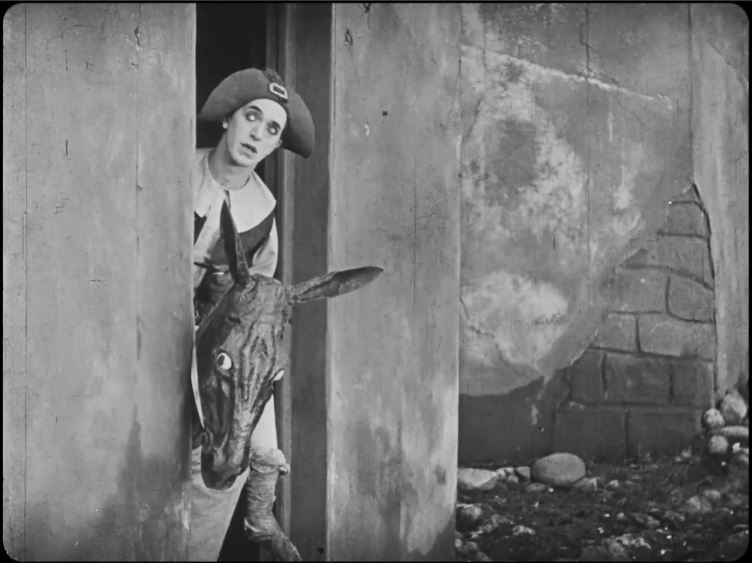
Only half of When Knights Were Cold (1922) survives but it ain’t half funny, especially Stan’s “horse” which is basically just a stuffed head on a stick, with two fake legs over an equine girdle. This, along with such fancies as taking a watering can to trees, and then to a fast-growing vine in this film, shows, to me at least, Laurel’s very Lancastrian humour, revelling in the surreal and the plain daft. That said Frank Fouce, who wrote and directed was born in Hawaii so what do I know? Stan is Lord Helpus who is out to rescue Princess Elizabeth New Jersey (Catherine Bennett) form the evil clutches of the Prince of Pluto (Stanhope Wheatcroft) and his numerous guards.


There’s one moment when Lord Helpus and a guard are so bored with their swordplay, they both lean against the wall tapping swords in a perfunctory way before Helpus kicks his adversary out of the window. Throughout Stan looks direct to camera, Mabel Normand style, but with his own particular twinkle; so much comedy to give. People may look for the Laurel persona in these films but he was clearly a flexible performer who if he was looking for his own defined style like Chaplin or Keaton, hadn’t yet found it. It’s chicken and egg or, perhaps, man and papier-mâché horse.


Which is where I came in. See you next year Giornate Family!


you can lead a fake horse to water...


Saturday, 10 October 2020

Swimming with films… A Romance of the Redwoods (1917) with Donald Sosin and Joanna Seaton, Pordenone Day Seven


Boys - I reckon when twenty men have been fooled by one small woman - - they'd better take their medicine!


There’s so much to relish in a restored Mary Pickford feature from her peak period; she’s the only person you watch when she’s on screen and runs through the numbers with all the ease of a virtuoso effortlessly emoting and impenetrably in character whether she’s scrubbing laundry, fighting for her life or just in the moments between sadness and resolve. She had what biographer Eileen Whitfield described as “a fountain of feelings” for the camera even if Cecil B DeMille wanted to influence them more than most.


Director DeMille clearly constructed A Romance of the Redwoods to allow its star to shine as often as possible although their relationship was not a straightforward one, one immovable the other unstoppable. Pickford later complained that she thought Cecil was a great producer but she didn’t think he had “any heart”, even though, she corrected, she “loved him”. Dwarfed by her director’s vision as much as the redwoods and the rest of its male cast – almost to a man six feet plus versus Mary’s five feet nothing – Mary gives a powerfully controlled performance and still shines through dominating everything and everybody.


The Queen


For his part DeMille was pleased with the results and accepted that, following the merger of Famous Players with Jesse L. Lasky’s Feature Play Company, it was difficult for his star to surrender her usual control over script and writer but she carried on like the “trouper” – his word – she was allowing him to be the director-producer he was. Today we can watch the result of both troupers’ output and, in spite of an outlandish scenario, the results are a delight especially given a crystal clear restoration that even on my old Dell Ultrabook look fantastic: you can almost sense the reality of the filming, the smell of redwoods, the dusty sets, Mary inwardly glowering at another instruction she was just going to ignore. In fairness, DeMille gives her plenty of close-ups and she was always ready!


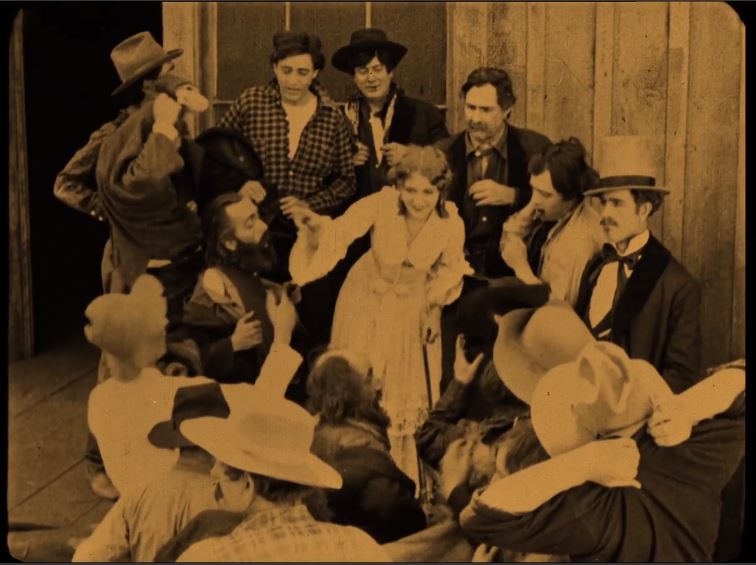
DeMille co-wrote with Jeanie Macpherson and the story was Pickford’s first western set among the Californian redwoods during the 49ers goldrush. Mary plays Jenny Lawrence, a young woman sent out to live with her uncle John after the death of her mother but who ends up with less than she bargained for. A stage robber called “Black” Brown (Elliott Dexter) who, as with Smith and Jones “never killed none” during his crimes, has traded places with her uncle after he died a heroic death trying to fend off an Apache attack. Black is mean but he isn’t a wanton killer, disarming his partner in crime, after he tries to cheat him out of their ill-gotten gains.


Elliott Dexter, Mary Pickford and Charles Ogle

Jenny duly arrives after an arduous journey to find her fake Uncle but has little choice but play along, penniless and friendless as Black proves by taking her to the saloon where not a single drunken miner or cowboy will listen to her story and she’s treated as a little joke by the brassy lasses singing and serving. Tully Marshall is at the bar as Sam Sparks, always a good sign, and there’s a sheriff for hire played by Walter Lang as well as a young man, Dick, played by Raymond Hatton who is the only one close to Mary’s height.


Jim Lyn (Charles Ogle) is the most sympathetic of the townsfolk and befriends the niece of the man they all think is John Lawrence. He’s key to the softening of tone as Jenny starts to tidy up Black’s house and attempts to get him to go straight after discovering one of his handkerchief’s with four mysterious holes in them, cue a nice moment as realisation creeps across her face as she lifts the folded kerchief to her face and sees they’re eyeholes.


Lost in the woods


Jenny takes in laundry and there’s a lovely scene with her scrubbing away against the backdrop of the giant redwoods. Jim comes to talk to her and she defends her deadbeat “Uncle” when he talks against him, little knowing that Black overhears her. The improbable seems to be happening as Jenny and Black fall in love and the latter seems willing to toil away prospecting. But searching for gold is hard work and maybe just one last “job” will set them up for a brighter future; what could possibly go wrong?


Donald Sosin accompanied with some gorgeous melodies and well-worked themes that strode hand-in-hand with performers and narrative. He also drafted in Joanna Seaton to provide vocals adding atmosphere to scenes in the saloon and neatly inputting context to the gold rush and western setting. Vocals as part of silent accompaniment can by high risk but for some reason they seem to work best with westerns, perhaps because they are so much apart of the cinematic musical landscape for so much of this genre?


Talking of musical landscapes, there was another excellent masterclass on Day Seven, this time featuring The Three Multi-instrumentalists, Frank Bockius, Günter Buchwald and Stephen Horne. Günter plays violin as well as piano, sometimes mind-bogglingly at the same time, Frank plays a whole range of percussion and Stephen flute, accordion, bells and whistles along with keyboards. The question is how do they make their choices for accompaniment?


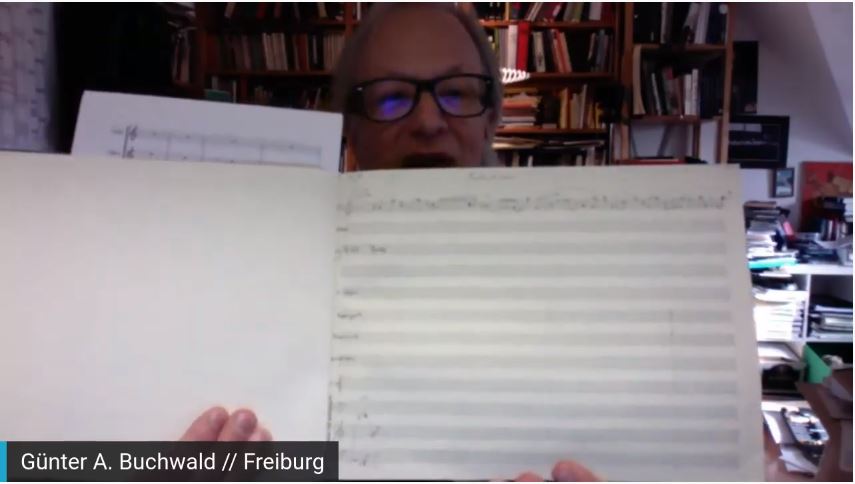
Günter, who started silent piano accompaniment in the late 70s, first used violin in 1984, when playing for The Princess and the Violin Player, which featured a character playing a Bruch Violin Concerto. The second instrument was not only used diegetically, but to create different atmospherics and he could also bow or pluck whilst hands playing the piano too.


Stephen started using the flute to add different sonority to his accompaniment to add colour and develop atmospherics. Whilst being an advocate for single instrument accompaniment there’s a danger as a solo pianist that you play as many notes as possible so it’s very restful on the ear to play a single line on another instrument.


Günter Buchwald, Stephen Horne and Frank Bockius


Frank observed that both violin and flute are voice-like instruments and you can modulate the tone in subtler ways than an actual voice which can be dangerous as it captures so much attention from the audience and the violin and flute are a bit more neutral. Frank has to plan his use of “bells and whistles” more carefully as they are less neutral and more reliant on narrative rhythm.


Talking of the dangers, Stephen that one player playing too many instruments that can take the audience out of the film; there needs to be restraint and logic to the choice. Günter having studied the semiotics of silent film music referred to one quote from a 20’s review that said they couldn’t be sure if there had been music or not… and so there’s a delicate balance to be made between scoring over the film and being heard to come from without it. All are well aware of this need but also, as Stephen said, “I don’t think there’s anything wrong with the occasional moment of showmanship… it’s good to remind the audience they they’re seeing a live performance.”


Günter shares his notes...

These musicians not only play multiple instruments they also play together and this is another art that requires deliberation and patience. Frank talked about the adaptation required; “For a percussionist from the classical area you miss a written score and from jazz you start a rhythm but the film changes and you need to be ready to stop as you’d overrun the action of the atmosphere: listening is the key as always.”


When playing with a trio Günter will leave the lower keys alone so his bassist can occupy that space and Stephen agreed saying that the “space” should always be there and that there’s no imperative to play all of the time. Listening is the most important thing and not to be afraid of dropping out to let the other musician(s) carry on if you feel your lines are crossing.


Frank highlighted that trust and familiarity with the others’ playing were key and also that someone has to lead to provide improvised musical direction. Stephen described Frank as “almost like another piano player, I’m aware that he’s interpreting the film which is quite unusual.” The two talked about their marvellous accompaniment to Lupu Pick’s Sylvester (1923) under the stars at last year’s Cinema Ritrovato in Bologna. Frank would lead and it worked with because of the film’s speed and frequent cutting.


Sylvester aka New Years Eve


Despite the stress of this successful experiment Frank summed up the process as: “we swim with the film and we have to make interesting waves for the audience…”


Following the pattern of the films is key for any player coming from jazz, whose instinct is to play with 4/4 or other regular rhythm when you need to adjust to the uneven pace of the film and not be metronomic. Stephen had also been unsure about playing with other melodic instruments but is finding a way to do it using a cue sheet approach so you’ve pre-planned out the film in order to prevent thematic clashes. He may also work with one notated theme that you can both return to during the film. This is certainly an approach that has worked well whenever I’ve seen him play with Elizabeth Jane Baldry and her harp.


So, be prepared, pay attention and listen but also be supremely talented would be my biggest take-aways. This session could have gone on all day as far as I’m concerned and thankyou to all the players for their masterclasses as well as accompaniment this week.


More Mary...


Friday, 9 October 2020

Verzweifelte hausfrau… Abwege (1928), with Mauro Colombis, Pordenone Day Six


I saw this film as part of last year’s BFI Weimar Season but couldn’t resist the chance to see the restored version again, with tints and crystal clarity, and also to “remaster” my own thoughts on a film that gets less attention than most of Pabst's output. Made between The Love of Jeanne Ney and Pandora’s Box it certainly has neither the dramatic sweep of the former nor the mythic intensity of the latter, but it’s nearly on a level in subtler ways. There's always less at stake but the enduring happiness of two - or more - people is always watching out for.


The director turns what could have been a light romantic tale into an intense psycho-drama that plumbs the depths of naughty, bawdy, gaudy, snorty Berlin club culture in ways that are less dramatically extreme but all the more believable. The film was entitled The Devious Path for the English market but the Giornate’s director Jay Weissberg is not alone in prefering the literal translation of A Stray which is far less judgemental and more reflective of the film’s point.  


Pabst certainly brought out the very best of Brigitte Helm as he did with a nervy Garbo and a fearless Brooks, with a mix of instruction, editing and the flying camerawork of Theodor Sparkuhl, who’s camera “…is as unchained as Brigitte Helm’s character...” especially as it moves in the midst of her wild dancing at the nightclub, inhibitions all lost. Helm is almost ever-present and we see every delicate transition as she flits from intense frustration to anger, from desire to fear, hate to love… her body thrown into acute angles just as her unique features shift through gears most of us don’t have. She’s the only thing really happening in the film which is a minimalist story of suburban disconnection stirring horrific extremes in her character Irene Beck.


Brigitte

Pabst digs into her portrayal and the tension is not just surface but disturbed. Helm was a relatively inexperienced actress at this point, just one year on from Maria but she had already worked with Pabst on Jeanne Ney and there was obviously a connection with the actress willing to commit so much. Occasionally she over-steps but quickly corrects and is always inhabited by the moment; a true “silent actress” supple and sensuous whether tortured or teasing.


But yes, Gustav Diessl is also in it as her neglectful husband Thomas and he’s full of dark-eyed tricks of his own. He too can transmit mixed signals and come over all doe-eyed destroyed seconds after being in control… he’s a very shadowy presence next to Brigitte’s shining light but… casting, lighting, directing will all do that for you.


Brigitte Helm and Gustav Diessl

Thomas is married to his work and won’t show Irene much attention let alone a good time and their union has hit the rocks at just the wrong point. Irene is much too much to not be noticed and artist Walter Frank (Jack Trevor) can’t help but to draw her and to be drawn to her… constantly sketching his affection in a studio dominated by her image. Irene and Walter plan an escape but Thomas spots the clues and arrives just in time to bring his wife back.


Irene is not to be constrained and breaks away to find her friends, led by Liane (Joyless Street’s Hertha von Walther) in a nightclub. This “den of iniquity” as Councillor Möller (Fritz Odemar) calls it, offers all kinds of temptation and as Irene sits knocking back the champagne her eye is caught by a lone woman, Anita Haldern (Ilse Bachmann). Eventually she follows her behind a curtain emerging somewhat refreshed by powders unknown as Pabst ticks off as many illicit activities as he can.


Off to the powder room...

Irene dances, flirts with a boxer Sam Taylor (Nico Turoff) – who couldn’t be more different than Thomas, and makes sure Walter also sees her independence. It’s a heck of a night and Sparkuhl’s camera draws us, hand-held, into the heart of the action, inebriating the viewer with images.


No less impressive is the scene once Irene gets home to find Thomas lying still in the darkness; the couple re-unite and all seems forgiven until Thomas spots the very odd hairy-chested man-doll Irene had been given at the club. It doesn’t look much to me but as a token of unabashed male sexual interest it’s clear enough to him. The row resumes and the new dawn fades…


Irene now begins a liaison with Boxer Sam who we see soaring in a display of the animalistic masculinity Thomas does not provide, and as he asks Walter to draw her picture, it looks like artist vs athlete unless Thomas the Accountant can intervene…


Ultimately the “devious” path is more about truth and fidelity than sex, drugs and nightclubbing and is very engaging, emotionally heightened cinema that relies on the depth of feeling rather than drama. It looks sensational partly because both Brigitte and Gustav do, and this new restoration, first shown at the 2018 Berlinale shows this off to maximum effect.


Local lad, Mauro Colombis, sent his recorded accompaniment from Australia, and it matched Pabst’s tonal subtlety in ways that were unexpected with rich melodic lines that were perfectly attuned to the torments and sweeping desired on screen. This online Limited Edition of Le Giornate has served to highlight the players more than usual and whilst a  virtual audience can never match the atmosphere of a live one, spirits across the globe must have been lifted by this new combination of music and movement.