Showing posts with label Hertha von Walther. Show all posts

Friday, 13 October 2023

Climb every mountain*… Le Giornate del Cinema Muto 42, Day Six


We finished off day six climbing every stairway, late after dinner and relegated to the Gods for the spirited but slightly odd Poker Faces (1926) featuring Edward Everett Horton and Laura La Plante in a winning combination of cheeky chappie and Universal’s top star for much of the Twenties who didn’t manage to achieve his career longevity, retiring as a movie star at just 30 in 1935 by which point Horton was pushing 50 and with years of success ahead.


Horton plays Jimmy Whitmore a man whose face gives nothing away expect, he’s Edward Everett Horton so, of course, there’s a lot of comic meaning flashing across his face, he’s no Buster Keaton in this regard. If anything, La Plante as his wife Betty is better at stoneface especially frustrated by his glacial career advancement – and consequent lack of new rug – and then stone-cold furious as his big break turns into a farce – a little forced compared with say Marie Prevost’s Up in Mabel’s Room, but still funny and with the charm of these two leads.


Jimmy gets offered a promotion so long as he can close a big new deal with out-of-town big shot George Dixon (George Siegmann) who he has to meet at the station. By this time Betty has stormed off to get a job of her own after Jimmy nixes the new carpet and thinking he sees her about to leave town, wearing a veil with similar luggage (of course) pursues her and starts to remonstrate. This attracts the attention of Big George who chivalrously steps in to defend the woman who, veil lifted, turns out to be of Chinese origin so, of course, she couldn’t be Jimmy’s wife… and our collective cringe went up a gear as an intertitle of Chinese appeared. That was 1926 that was.


Edward's way with women.


Jimmy and George don’t know who the other is though, despite having unknowingly got off on bad terms Jimmy’s boss Henry Curlew (Tom Ricketts) invites them to his house for dinner to finalise the deal. He also invites Jimmy’s wife which is an issue as the latter thinks he’s been deserted by his inconveniently ambitious spouse and has to hire a woman to act as his wife (Dorothy Revier). She’s married to Pug (Tom O'Brien) a prize fighter… not someone you’d want to upset in any way. Can you guess where this is going?


Naturally chaos erupts at Curlew’s house as the men find out who each other is and the old man’s new secretary is unveiled… it’s Betty who is probably more surprised about his new “wife” than Jimmy is about her new job. There follows extended confusion and confrontation as Jimmy tries to protect the honour of this young woman as George takes a shine to her. It’s well played by everyone, and the direction is well timed by Harry A. Pollard.


It’s a farce. sometimes you’re in the mood sometimes you’re not and tonight I was.


The daftness was enlivened considerably by a new score composed and conducted by Juri Dal Dan performed live by Zerorchestra, Pordenone’s finest and who played for this on the tradition GCM eve screening. The band were swingling and tight, turning musical direction on the flip of a dime and with short solos highlighting and reinforcing the comic energy. No wonder the Verdi was packed out to the rafters where we sat!


Hannes Schneider

Before our evening exertions we were on top of the world with Arnold Fanck and his intrepid mountaineering filmmakers for Der Berg Des Schicksals (Mountain of Destiny) (1924), the film that reputedly inspired dancer Leni Riefenstahl to get in touch with its pioneering director, Arnold Fanck, who then featured her in The Holy Mountain. I love Fanck’s films, the scenery obviously, the sense of actual adventure filming at these altitudes and the bravery of the leads taking on the actual crags and scrambles.


The “destiny” is for the son to follow the father in conquering the peak which he tried but failed to climb. Inspired by the fatal attempt of climber Carlo Garbari to summit the Guglia (“spire”) di Brenta in the Dolomites, Winter Olympian Hannes Schneider plays Bergsteiger who is haunted by the peak and his son is Alpine expert Luis Trenker who would star in other Fanck films and who looks like he was hewn from the granite of these mountains (was he Married to the Mountains?!).


Fanck would start by shooting footage of dangerous climbs and incredible landscapes and then evolve his stories later and sometimes there’s more climbing than character but there’s good support from non-climbers like Erna Morena as the climbers’ wife and mother as well as Hertha von Walther as Hella who Trenker has to go to rescue on a stormy night. She climbs well and looked familiar to me as she’s an uncredited actor in Pabst’s Joyless Street (1925).


Airy accompaniment was provided by Mauro Colombis and the ubiquitous Frank Bockius who is no doubt familiar with these Germanic hills! Stunning visuals on screen and hard-hitting, syncopations on stage!
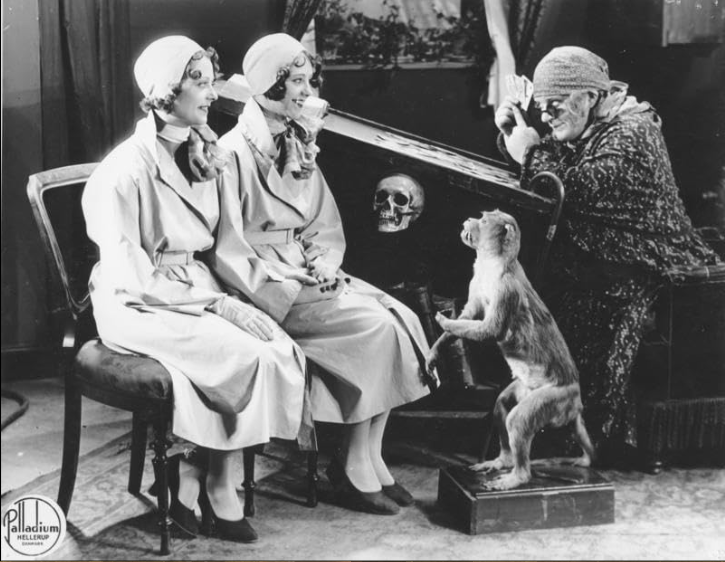
 

Harald Madsen charms Marguerite Viby and Nina Kalckar

The Slapstick programme brought us down to earth with the existential crises of  Pat and Patachon in Højt paa en kvist (High Up on a Twig) (1929) which featured the following intertitle: “One is tall, the other is short”, which I though was a very dry joke I’d made about their comedic proposition at the Kennington Bioscope in 2018… The two madcaps are engulfed a series of comedic situations during the course of this feature and attempt to romance two attractive young women, played by Marguerite Viby and Nina Kalckar, who are clearly such generous souls that they see the inner beauty in both men although they are under the misapprehension that they’re rich.


The film was apparently a return to form for the couple who had been working together for over 25 years at this point. Ulrich Ruedel is very good in the Giornate programme on the reasons for their success and on just why their comedy was different to the Brits and Hollywood. Clearly both men, Pat (Harald Madsen) and Patachon (Carl Schenstrøm) were good actors playing a different style to the gag-based Brits and it’s our challenge to understand why even if we just don’t laugh as much.


Meg Morley made her GCM42 debut and as usual accompanied with assured melodic invention and her jazz-practiced improvisations always have a distinctive quality even as she presents musical themes that are very much of the period, jazz age in spirit as much as form.


Mary Harald in the fields


Vendémiaire (1918), presented as one feature, was essentially a two parts plus prologue, from the master of the multi-part adventure, Louis Feuillade and showed a more considered and down-to-earth, director three years on from Les Vampires and the War. There were some lush landscapes of the canals and countryside near Lyon and a feature feel to the lengthy episodes as a plot unfolded about two escaped German POWs infiltrating a group of farm workers in the Great War.


René Cresté plays Pierre Bertin a soldier on leave to recover from his mental and physical wounds and he meets a family heading away from the front line to seek work and to find out what happened to their siblings. They all end up working on a vineyard in Lunel (Feullade’s hometown) run by Capitaine de Castelviel (Feuillade regular Édouard Mathé) and where the two Germans also infiltrate.  Wilfred (Louis Leubas) and Fritz (Manuel Caméré) cause much disruption as they try to further the fading German cause and frame a gypsy, Sarah (Mary Harald, who also featured in the director’s Tih Minh (1918) and who was of mixed race possibly born in Hong Kong or Vietnam) as they rob the Captain… there are fuller characters than in the director’s more adventure-based serials and, as the propaganda it undoubtedly was, Vendemiaire stirs your heart as you hope for the best for these refugees.


Accompaniment for the 143 minute run time was split between Gabriel Thibaudeau and John Sweeney who both provided the lyricism and spirit the subject matter demanded; John’s triumphant cadences at the films’ end were especially moving as the certainty of the victory at the time of release was clearly less and we now know that the new peace was only to last barely twenty-odd years.


There were also some extra special entrees before Poker Faces accompanied by maestro Stephen Horne and including some wonderful colour shots around Niagara Falls in, er, Wonderful Water (1922) and Max Roach comedy, A Truthful Liar (1924) featuring Will Rogers as Alfalfa Doolittle who becomes Ambassador to Cornucopia where he dispenses with formalities and gets matey with the King (Richard Pennell) who would much rather go to an American bar in the city than spend time with his suffocating court. Alfalfa duly uses his cowboy powers to rescue the King from runaway horses and would be assassins. It spoofs the whole Ruritanian idea and features the immortal couplet:


Roses are red,

Violets are blue,

I’m against royalty,

How about you?


There were also some poignant footage of the man Chaplin called The Master, Max Linder in 1924, still so full of charm and intelligence and yet struggling with mental health issues after the war that would lead to his death the following year. Enjoy yourself, it’s later than you think…


René Cresté and Gaston Michel Vendémiaire (1918) 


*See Le Giornate del Cinema Muto 42, Day Four


Friday, 9 October 2020

Verzweifelte hausfrau… Abwege (1928), with Mauro Colombis, Pordenone Day Six


I saw this film as part of last year’s BFI Weimar Season but couldn’t resist the chance to see the restored version again, with tints and crystal clarity, and also to “remaster” my own thoughts on a film that gets less attention than most of Pabst's output. Made between The Love of Jeanne Ney and Pandora’s Box it certainly has neither the dramatic sweep of the former nor the mythic intensity of the latter, but it’s nearly on a level in subtler ways. There's always less at stake but the enduring happiness of two - or more - people is always watching out for.


The director turns what could have been a light romantic tale into an intense psycho-drama that plumbs the depths of naughty, bawdy, gaudy, snorty Berlin club culture in ways that are less dramatically extreme but all the more believable. The film was entitled The Devious Path for the English market but the Giornate’s director Jay Weissberg is not alone in prefering the literal translation of A Stray which is far less judgemental and more reflective of the film’s point.  


Pabst certainly brought out the very best of Brigitte Helm as he did with a nervy Garbo and a fearless Brooks, with a mix of instruction, editing and the flying camerawork of Theodor Sparkuhl, who’s camera “…is as unchained as Brigitte Helm’s character...” especially as it moves in the midst of her wild dancing at the nightclub, inhibitions all lost. Helm is almost ever-present and we see every delicate transition as she flits from intense frustration to anger, from desire to fear, hate to love… her body thrown into acute angles just as her unique features shift through gears most of us don’t have. She’s the only thing really happening in the film which is a minimalist story of suburban disconnection stirring horrific extremes in her character Irene Beck.


Brigitte

Pabst digs into her portrayal and the tension is not just surface but disturbed. Helm was a relatively inexperienced actress at this point, just one year on from Maria but she had already worked with Pabst on Jeanne Ney and there was obviously a connection with the actress willing to commit so much. Occasionally she over-steps but quickly corrects and is always inhabited by the moment; a true “silent actress” supple and sensuous whether tortured or teasing.


But yes, Gustav Diessl is also in it as her neglectful husband Thomas and he’s full of dark-eyed tricks of his own. He too can transmit mixed signals and come over all doe-eyed destroyed seconds after being in control… he’s a very shadowy presence next to Brigitte’s shining light but… casting, lighting, directing will all do that for you.


Brigitte Helm and Gustav Diessl

Thomas is married to his work and won’t show Irene much attention let alone a good time and their union has hit the rocks at just the wrong point. Irene is much too much to not be noticed and artist Walter Frank (Jack Trevor) can’t help but to draw her and to be drawn to her… constantly sketching his affection in a studio dominated by her image. Irene and Walter plan an escape but Thomas spots the clues and arrives just in time to bring his wife back.


Irene is not to be constrained and breaks away to find her friends, led by Liane (Joyless Street’s Hertha von Walther) in a nightclub. This “den of iniquity” as Councillor Möller (Fritz Odemar) calls it, offers all kinds of temptation and as Irene sits knocking back the champagne her eye is caught by a lone woman, Anita Haldern (Ilse Bachmann). Eventually she follows her behind a curtain emerging somewhat refreshed by powders unknown as Pabst ticks off as many illicit activities as he can.


Off to the powder room...

Irene dances, flirts with a boxer Sam Taylor (Nico Turoff) – who couldn’t be more different than Thomas, and makes sure Walter also sees her independence. It’s a heck of a night and Sparkuhl’s camera draws us, hand-held, into the heart of the action, inebriating the viewer with images.


No less impressive is the scene once Irene gets home to find Thomas lying still in the darkness; the couple re-unite and all seems forgiven until Thomas spots the very odd hairy-chested man-doll Irene had been given at the club. It doesn’t look much to me but as a token of unabashed male sexual interest it’s clear enough to him. The row resumes and the new dawn fades…


Irene now begins a liaison with Boxer Sam who we see soaring in a display of the animalistic masculinity Thomas does not provide, and as he asks Walter to draw her picture, it looks like artist vs athlete unless Thomas the Accountant can intervene…


Ultimately the “devious” path is more about truth and fidelity than sex, drugs and nightclubbing and is very engaging, emotionally heightened cinema that relies on the depth of feeling rather than drama. It looks sensational partly because both Brigitte and Gustav do, and this new restoration, first shown at the 2018 Berlinale shows this off to maximum effect.


Local lad, Mauro Colombis, sent his recorded accompaniment from Australia, and it matched Pabst’s tonal subtlety in ways that were unexpected with rich melodic lines that were perfectly attuned to the torments and sweeping desired on screen. This online Limited Edition of Le Giornate has served to highlight the players more than usual and whilst a  virtual audience can never match the atmosphere of a live one, spirits across the globe must have been lifted by this new combination of music and movement.


Saturday, 6 July 2019

Desperate housewife… The Devious Path/Abwege (1928), with Stephen Horne, BFI Weimar Season


And so ended the BFI’s excellent Weimar Cinema season and all thanks to Margaret Deriaz for programming so many of the best and most representative films of the period. Some of my favourites have of course been Pabst’s and this film shows the director at his subtle best turning what could have been a light romantic tale into an intense psycho-drama that plumbs the depths of naughty, bawdy, gaudy, snorty Berlin club culture.

Pabst brings out the very best of Brigitte Helm as he did with a nervy Garbo and a fearless Brooks, with a mix of instruction, editing and the flying camerawork of Theodor Sparkuhl. She’s almost ever-present and we see every delicate transition as she flits from intense frustration to anger, from desire to fear, hate to love… her body thrown into acute angles just as her unique features shift through gears most of us don’t have. She’s the only thing really happening in the film which is a minimalist story of suburban disconnection stirring horrific extremes in her character Irene Beck.

Pabst digs into her portrayal and the tension is not just surface but disturbed. Helm was a relatively inexperienced actress at this point, just one year on from Maria but she had already worked with Pabst on Die Liebe der Jeanne Ney and there was obviously a connection with the actress willing to commit so much. Occasionally she over-steps but quickly corrects and is always inhabited by the moment; a true “silent actress” supple and sensuous whether tortured or teasing.


But yes, Gustav Diessl is also in it as her neglectful husband Thomas and he’s full of dark-eyed tricks of his own. He too can transmit mixed signals and come over all doe-eyed destroyed seconds after being in control… he’s a very shadowy presence next to Brigitte’s shining light but… casting, lighting, directing will all do that for you.

Thomas is, heh, married to his work and won’t show Irene much attention let alone a good time and their young marriage has hit the rocks at just the wrong point. Irene is much too much to not be noticed and artist Walter Frank (Jack Trevor) can’t help but be drawn to her… constantly sketching his affection in a studio dominated by her image. Irene and Walter plan an escape but Thomas spots the clues and arrives just in time to bring his wife back.

Irene is not to be constrained and breaks away to find her friends, led by Liane (Joyless Street’s Hertha von Walther) in a nightclub. This “den of iniquity” as Councillor Möller (Fritz Odemar) calls it, offers all kinds of temptation and as Irene sits knocking back the champagne her eye is caught by a lone woman, Anita Haldern (Ilse Bachmann). Eventually she follows her behind a curtain emerging somewhat refreshed by powders unknown as Pabst ticks off as many illicit activities as he can.


Irene dances, flirts with a boxer Sam Taylor (Nico Turoff) – who couldn’t be more different than Thomas, and makes sure Walter also sees her independence. It’s a heck of a night and Sparkuhl’s camera draws us, hand-held, into the heart of the action, inebriating the viewer with images.

No less impressive is the scene once Irene gets home to find Thomas lying still in the darkness; the couple re-unite and all seems forgiven until Thomas spots the very odd hairy-chested man-doll Irene had been given at the club. It doesn’t look much to me but as a token of unabashed male sexual interest it’s clear enough to him. The row resumes and the new dawn fades…

Irene now begins a liaison with Boxer Sam who we see soaring in a display of the animalistic masculinity Thomas does not provide, and as he asks Walter to draw her picture, it looks like artist vs athlete unless Thomas the Accountant can intervene…


Ultimately the “devious” path is more about truth and fidelity than sex, drugs and nightclubbing and is very engaging, emotionally heightened cinema that relies on the depth of feeling rather than drama. It looks sensational partly because both Brigitte and Gustav do, and this new restoration, shown at last year’s Berlinale shows this off to maximum effect.

Of course, the experience was also enhanced by another of Stephen Horne’s emotionally-intelligent accompaniments – as fluid as Fräulein Helm and dark and serious as Herr Diesel. A subtle mix of strong lines and syncopated sympathy one senses that Stephen may have played in more than a few Berlin bars…

Two months and a couple of dozen superb films, the BFI’s Weimar Season has been the best silent film strand in my time – I’m a very late adopted having started in 2010. The audience seem to have been there and we have enjoyed the show.

Ich danke dir Margaret und dem BFI!

Interiors...


Close-ups...


Obsession...


Disdain...


Nightclubbing...


And?