Showing posts with label Bookworms (1920). Show all posts

Sunday, 15 August 2021

Breaking the silence… The Wit and Wisdom of A.A. Milne, BFI, with Bryony Dixon and Neil Brand


C. Aubrey Smith’s famous explorer John Brice has an abnormally large “bump” on his head enabling him to discover the Equator and the North Pole with greater facility than the common man (or woman) and so it is with me and locating the Southbank after so many months away. This was not my first cinema of the pandemic but it *was* the first silent screening with live accompaniment since March 2020… and, what a way to break the silence with BFI Curator Bryony Dixon providing expert introduction and Neil Brand accompanying with all the contextual flourish and narrative instinct you would expect.


As with the best silent screenings, you leave the twenty first century schizoid experience behind you and pattern recognise your way back into the streets and suburbs of your greatgrandparents' or grandparents’ age, all too familiar Edwardian streets in SW20, West Wimbledon* or mock-classical town houses in Kensington or Westbourne Grove, even the St John’s Wood to Kilburn area where Alan Alexander Milne was brought up. The buildings are probably still there, but the people who live inside them have changed a lot but almost all of them would be familiar with the works of Milne that followed this early and short flurry of film activity.


He was involved with writing four stories filmed in 1920 for the company Minerva Films, founded in 1920 by the actor Leslie Howard with his friend and story editor Adrian Brunel. The company’s board of directors included C. Aubrey Smith, Nigel Playfair and A. A. Milne whilst one of the company's investors was H. G. Wells. This was the English intelligencia playing with the new media and, whilst the results in Milne’s case were commercially disappointing, the two films screened today were very well made, charmingly well written, played and skilfully directed by Brunel.


C Aubrey Smith a few decades earlier...


The first was The Bump (1920) featuring C. Aubrey Smith as the famous explorer mentioned above. Smith was 57 and the film makes great play of his cragginess with a sequence notating the origins of the scars on his face, a shark bite here and a lions’ claw there; he’s explored the world and has the autographs left by every predator he’s met.


Brice’s reputation is legend and in one well upholstered parlour, young Lilliam Montrevor (Faith Celli) is fascinated by his daring and manly pursuits. Her almost-beau, Freddy (Douglas Marshall) compares poorly as he can only dance and have a good time, he’s never explored or risked more than shoe leather. Lilliam, Freddy and her parents head off for a dance on Freddy’s scooter, the most unmanly transport they can imagine.


I’ve met a man at last!


Faith Celli from 1917

At the ball, among the effete fancy dress strides the imposing dress suit of Mr Brice and having go shot of Freddy after his seventh proposal (that month!), Lilliam proceeds to introduce herself and hilariously relives his tall tales of the north pole (wrapping herself up) and the equator (fanning herself) and even his discovery of the Piebald Gorilla who is seen relating his own version of events back in Africa.


Milne’s humour is very Oxbridge, even from this remove, and his title cards are witty in that knowing ironic way we’ve seen from the Fringe and beyond. Lilliam invites Brice round for tea at their house in, wait for it… Stuccoway Terrace and a romance seems on the cards.


But then a strange thing happens and the fearless explorer has to strike out on his own for this expedition and in unfamiliar territory, he asks for help from local natives all of whom seem to lead him further away… still, we do get to see even more wonderful London backdrops. Will Lilliam finally see Freddy and will Brice overcome the discombobulations of the city streets. It’s like a jungle out there…


Faint heart, never wonne faire laydee
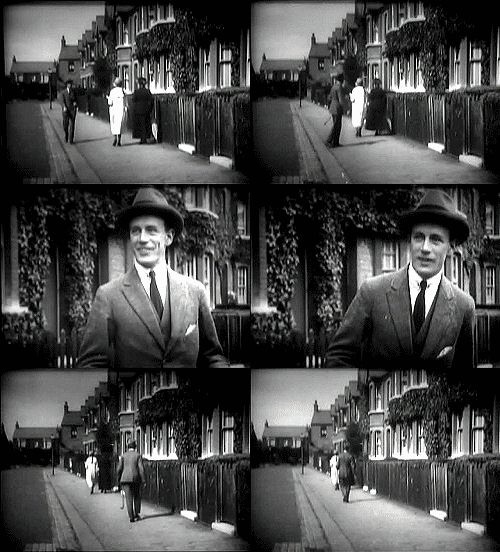

Off in pursuit... Gif from https://lesliehowardsteiner.blogspot.com


The second film featured young Leslie Howard in Bookworms (1920) another witty tale of love and adventure this time transporting a knight and fair maiden to Edwardian semi-detached suburbs. We find said maiden, Miranda (Pauline Johnson) reading The Wealth of Nations by Adam Smith in her guardian’s study. She lives with her Uncle Josiah (Jeff Barlow) and her Aunt Priscilla (Henrietta Watson) who employ a “tame dragon” (Mrs. R. Podevin) as Miranda’s guardian.


All is peaceful until one day Richard (Howard) a listless young man wakes up after his usual lie in to spy the neighbour of his dreams across the road. From that moment on he is a man on a mission, revitalised by romance and the need to meet this object of his affection but, every attempt to arrange an introduction is blocked by the Dragon or, in the case of his attempt to call for a Salvation Army collection, the family maid.


Pauline Johnsom a good few years later


He soon learns Miranda’s daily routine and follows her to the library every day only to find that dragon always between him and the goal. And then, then he has an idea. He will leave a note in the book she collects and simply wait for her response. Sounds fool proof doesn’t it, but the trouble with library books is that everybody reads them. A carefully orchestrated chaos ensues that leads to a surprising but satisfying ending. Just as you’d expect.


Neil Brand brought his experience and passion to the accompaniment as a man you could see thoroughly enjoying afternoon tea with Milne, Brunel and Howard. Can a sense of humour be expressed through music? It surely can and Mr Brand demonstrated this fact emphatically. It was so good to see and hear him and Bryony Dixon performing a show, tell and play again.


Before the two half-hour shorts, we were also shown the first film Lotte Reiniger made in England, illustrating Milne’s poem The King’s Breakfast (1937). As with all her work you soon forget you’re watching shadow puppets and get lost in the story and not least the certainty that butter is indeed better on toast than marmalade.


The author


This was an absolute treat and all the rarer for being on the BFI’s own 35mm prints. Here’s to many more such screenings as theatrical life cautiously resumes and we edge forward. The BFI still has social distancing in place, mask wearing for screenings and reduced capacity making the experience feel safe and risk managed in a way that is not always the case in some other sectors. AA Milne may have been a humorous man but he served in the Great War and was injured at the Battle of the Somme, he could spot a phoney like Brice and perhaps generals without method or even a cause.


Anyway, I thank the BFI for their hospitality, their diligence and their exceptional content delivery!


See you soon.


PS Bryony also mentioned that her colleague Jo Botting has a book in the works about Adrian Brunel, one to watch out for!


* Credit to Twitter user @OokpikUK who spotted the location as Pendarves Road in SW20, West Wimbledon. Richard's house is on the right and Miranda's on the left.

This is literally fifty metres from where I used to live in Lambton Road, Raynes Park/West Wimbledon... no wonder it felt familiar!!


Monday, 12 March 2018

The funniest woman in the World… Exit Smiling (1926), Meg Morley, Kennington Bioscope 2nd Silent Laughter Weekend


The Cinema Museum’s redoubtable tour guide, Morris Hardcastle, was offering his hand at £50 per shake given he had once shook Charlie Chaplin’s hand, for David Robinson and Kevin Brownlow he was suggesting a bargain £100 given the number of silent performers these two have met over the years. But before Exit Smiling, our final film of the packed, inspirational Saturday programme, Mr Robinson told us of meeting its inimitable star, Beatrice Lillie at a screening of the film at the BFI in the late 1960’s and raised the stakes once more. 

David said she was often described as the funniest woman in the World and on that night in her seventies she still dazzled in unpredictable ways slaying the audience and laughing throughout the screening: “she’s very good, she does things the way I do them!” she remarked at her younger self… a one-off performer with unique timing and sense of the ridiculous and yet who could also reduce you to tears (with or without an onion…).

In her excellent, in-depth introduction, Michelle Facey related the opinions of Chaplin and Keaton on this Anglo-Canadian marvel including the latter sleeping outside her hotel room door – a slapstick guard of honour for this toweringly-talented Torontian. Sadly (for us) Hollywood couldn’t easily cast this quirky and stunningly individual talent and, for this and no doubt several other reasons (maybe she just didn’t want to?) this was Bea’s only silent film and she made few after, much preferring the more interactive and improvisational freedoms of the stage.

Tonight, we watched not only Kevin Brownlow’s 16mm copy of Exit Smiling but, as it turned out, Miss Lillie’s own, so I’d make that another £50 for shaking the hand of projectionist Dave Locke.

Beatrice Lillie and Jack Pickford
We are truly blessed by these associations with the silent past and also by expert accompaniment from the Bioscope Players. Meg Morley, a jazz musician by night and, a silent film accompanist by er, other nights, played along with a thoroughly modern mix of jazz-age themes and improvised scoring that sound for all the world like it’s been months in the preparation. I always imagine the music as a duet and Bea is such a graceful performer with a dancer’s arm extensions and amazing timing, that the music followed suit; to this extent Meg riffed with Bea and took some bold decisions along the way (a flash of Carmen for the vamping!) enjoying the tones as much as the audience.

I’ve previously raved about the actress and the film here if you want a fuller synopsis. I'd watched the Warner Archives DVD but, as ever, it's still a treat to see this film on screen especially in what Ms P. Hutchinson once described as a silent speakeasy: this crowd are fascinating as well as fascinated and all respect the subject.

Raymond Griffith and Vera Reynolds not in a night club...
With Miss Lillie tonight and Mabel Normand last week, it’s easy to forget that men can also be funny too… The day opened with Raymond Griffith in The Night Club (1925) a film that didn’t actually feature a club but as Kevin Brownlow’s introduction made clear, had been logged down as a title before script or even story. Block-booking in advance meant that there had to be a film of this title and so it was squeezed into the first title card as a gentlemen’s club dedicated to avoiding marriage.
Griffith’s character get’s jilted at the alter as his fiancé’s ex returned at the last minute from a presumed death on a desert island and so keen was he to marry that he tries to ban all women from his life. His fortune turns when an uncle dies and leaves him a million, but the condition is that he must marry his second cousin (Vera Reynolds).

He heads off for foreign climes only to find not only bump into but fall in love with Vera’s character, but things get awkward when they both realised, and she miss-hears his intentions. There’s a nice cameo from Wallace Beery (a bad-tempered Mexican) and an even better one from Louise Fazenda who plays his “Carmen” for whom he would kill whether you pay him or not.

Griffith is so watchable, he takes everything in his stride – even this daft script – with a wide-eyed smile and a look straight to the audience. Costas Fotopolous joined in the fun on piano, twinkling the ivories in sympathy with Raymond's knowing gaze. 

Henrietta Watson, Pauline Johnson and the impossibly youthful Leslie Howard
Then we had Tony Fletcher’s traditional sweep through rare and early British film and a revelation to me with a silent and very young Leslie Howard in Bookworms (1920). Based on a scenario from AA Milne (yes, him) it told the story of a young chap, Richard (Howard) and his attempts to woo his neighbour Miranda Pottlebury (Pauline Johnson) away from her over-protective Aunt and Uncle. The Pottlebury’s all use the local library and Richard starts to leave notes in books they order in the hope of communicating with the girl of his fancy… The results are gently amusing, and it is a very charming film with glimpses of post-War English gardens and sitting rooms.

A Fugitive Futurist (1924) was your standard time-travelling con which did feature some interesting special affects showing London as it will be in the future… a derelict Strand and water-filled Trafalgar Square are, of course, only just around the corner now thanks to Brexit…

Lillian Hall-Davis, Sybil Rhoda, Humberston Wright and Phyllis Neilson-Terry in Boadicea (1927)
Starlings of the Screen (1925) featured a host of young gals looking for fame with the Stoll Picture Company, including Sybil Rhoda who was to feature in Hitchcock’s Downhill as well as Boadicea (1927) – her favourite performance – with Lillian Hall-Davis.  Various screen tests are featured including professionals such as Moore Marriott playing alongside the hopefuls who include Molly Weeks, Phyllis Garton, Nancy Baird and Shailagh Allen but Sybil wins and gets the part of Melody Rourke in Sahara Love (1926).

“Look at all that sand, dozens of it…”

Crossing the Great Sagrda (1924) is almost indescribable; a mock ethno-graphical film with title cards that could have been written by a Goon had they yet been invented. It featured sand courtesy of Blackpool Borough Council and free-form intertitles each one attributed to a different film company. Whatever it was about, I liked it and I laughed.

Almost as barmy was Beauty and the Beast (1922) featuring Guy Newall as The Beast and Ivy Duke as… you can guess. Meg Morley brought musical method to all the madness.


After lunch it was time to cut to the Chase, Charlie Chase… as Matthew Ross took us through some more highlights from the second coolest silent comic who was so much his own man any comparison belittles his suave majesty.

Charlie helps a pal pull his car out from a muddy patch and ends up losing his own car to Hal Roache’s ACME mud pool and then goes in a brilliantly desperate search of trousers in The Way of all Pants (1927). The session ended with plastic-surgery farce Mighty Like a Moose (1927) which is a work of World-cultural significance.

Mr Sweeney stayed cool at the keys and kept pace with the Chase.

Monty Banks bronze medalist in the Freestyle Moustache 
Then in a surprise entry for moustache of the day (he came third…), Monty Banks twitched his winning ways through A Perfect Gentleman (1927). You can’t fail to like Monty in this well-balanced comedy, as he chases around a ship trying to prove his innocence after having crashed his own wedding inadvertently drunk and then doubled his disgrace by being accused of robbing his former fiancé’s father’s bank. Not the day’s first wedding nor the last bank robbery. 

Costas was really on the beat for this lightweight charmer and he was clearly enjoying himself as his punchy lines accompanied Banks' every pratfall.

The KB weekenders are great for bringing attention to performers such as Banks and Griffiths, but we were about to be reminded of the sheer excellence of one of those who is deservedly still widely remembered. Four commentators were given the essentially impossible task of choosing a favourite moment from a Buster Keaton film.

Even married to the star, Natalie Talmadge wonders why sisters Constance and Norma always had easier gigs...
David Robinson chose the breath-taking closing scenes from Our Hospitality (1923) when our hero rescues Natalie Talmadge from the rapids, a waterfall and over-bearing relatives. Then Kevin Brownlow’s choice was the Tong war from The Cameraman including a mini-tribute to the camerawork in Intolerance I hadn’t previously spotted.

Poly Rose (known to many on The Twitter, as The Flying Editor) is a film editor (natch) who revealed some secrets about Keaton’s own editing for Sherlock Junior. It takes one to know one and it was fascinating to see how this mind-boggling segment was constructed through double exposure. Publicity stills, and contemporary reviews also suggest that there were other versions of Buster’s somnambulant transition from what we see, Keaton test screened his work and fine-tuned the brilliance.

Last up was David Macleod, broadcaster and president of the Blinking Buzzards, the UK Keaton Society, who has written extensively on the comedian’s sound films which extend far beyond his relatively-short silent period. He chose the pulsating climax to Steamboat Bill Jr (1928) as our hero literally risked life and limb in a town torn apart by hurricanes and another extraordinary river rescue.

Buster to the rescue as Marion Byron clings on in Steemboat Bill Jnr
John Sweeney accompanied and once again demonstrated extraordinary fluidity for those river-chase sequences but most of all he really Keatoned those keyboards!

A day of pure concentrated silent bliss – where else would we see these films and hear these musicians?! Thankyou Bioscope and the Cinema Museum.

The Way of all Pants!
