Showing posts with label Adrian Brunel. Show all posts

Sunday, 15 August 2021

Breaking the silence… The Wit and Wisdom of A.A. Milne, BFI, with Bryony Dixon and Neil Brand


C. Aubrey Smith’s famous explorer John Brice has an abnormally large “bump” on his head enabling him to discover the Equator and the North Pole with greater facility than the common man (or woman) and so it is with me and locating the Southbank after so many months away. This was not my first cinema of the pandemic but it *was* the first silent screening with live accompaniment since March 2020… and, what a way to break the silence with BFI Curator Bryony Dixon providing expert introduction and Neil Brand accompanying with all the contextual flourish and narrative instinct you would expect.


As with the best silent screenings, you leave the twenty first century schizoid experience behind you and pattern recognise your way back into the streets and suburbs of your greatgrandparents' or grandparents’ age, all too familiar Edwardian streets in SW20, West Wimbledon* or mock-classical town houses in Kensington or Westbourne Grove, even the St John’s Wood to Kilburn area where Alan Alexander Milne was brought up. The buildings are probably still there, but the people who live inside them have changed a lot but almost all of them would be familiar with the works of Milne that followed this early and short flurry of film activity.


He was involved with writing four stories filmed in 1920 for the company Minerva Films, founded in 1920 by the actor Leslie Howard with his friend and story editor Adrian Brunel. The company’s board of directors included C. Aubrey Smith, Nigel Playfair and A. A. Milne whilst one of the company's investors was H. G. Wells. This was the English intelligencia playing with the new media and, whilst the results in Milne’s case were commercially disappointing, the two films screened today were very well made, charmingly well written, played and skilfully directed by Brunel.


C Aubrey Smith a few decades earlier...


The first was The Bump (1920) featuring C. Aubrey Smith as the famous explorer mentioned above. Smith was 57 and the film makes great play of his cragginess with a sequence notating the origins of the scars on his face, a shark bite here and a lions’ claw there; he’s explored the world and has the autographs left by every predator he’s met.


Brice’s reputation is legend and in one well upholstered parlour, young Lilliam Montrevor (Faith Celli) is fascinated by his daring and manly pursuits. Her almost-beau, Freddy (Douglas Marshall) compares poorly as he can only dance and have a good time, he’s never explored or risked more than shoe leather. Lilliam, Freddy and her parents head off for a dance on Freddy’s scooter, the most unmanly transport they can imagine.


I’ve met a man at last!


Faith Celli from 1917

At the ball, among the effete fancy dress strides the imposing dress suit of Mr Brice and having go shot of Freddy after his seventh proposal (that month!), Lilliam proceeds to introduce herself and hilariously relives his tall tales of the north pole (wrapping herself up) and the equator (fanning herself) and even his discovery of the Piebald Gorilla who is seen relating his own version of events back in Africa.


Milne’s humour is very Oxbridge, even from this remove, and his title cards are witty in that knowing ironic way we’ve seen from the Fringe and beyond. Lilliam invites Brice round for tea at their house in, wait for it… Stuccoway Terrace and a romance seems on the cards.


But then a strange thing happens and the fearless explorer has to strike out on his own for this expedition and in unfamiliar territory, he asks for help from local natives all of whom seem to lead him further away… still, we do get to see even more wonderful London backdrops. Will Lilliam finally see Freddy and will Brice overcome the discombobulations of the city streets. It’s like a jungle out there…


Faint heart, never wonne faire laydee


Off in pursuit... Gif from https://lesliehowardsteiner.blogspot.com


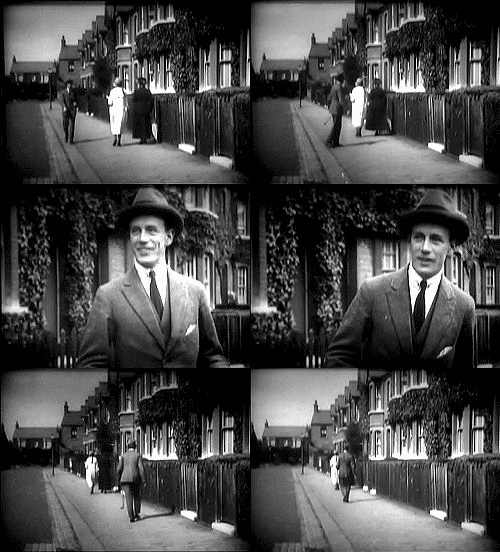
The second film featured young Leslie Howard in Bookworms (1920) another witty tale of love and adventure this time transporting a knight and fair maiden to Edwardian semi-detached suburbs. We find said maiden, Miranda (Pauline Johnson) reading The Wealth of Nations by Adam Smith in her guardian’s study. She lives with her Uncle Josiah (Jeff Barlow) and her Aunt Priscilla (Henrietta Watson) who employ a “tame dragon” (Mrs. R. Podevin) as Miranda’s guardian.


All is peaceful until one day Richard (Howard) a listless young man wakes up after his usual lie in to spy the neighbour of his dreams across the road. From that moment on he is a man on a mission, revitalised by romance and the need to meet this object of his affection but, every attempt to arrange an introduction is blocked by the Dragon or, in the case of his attempt to call for a Salvation Army collection, the family maid.


Pauline Johnsom a good few years later


He soon learns Miranda’s daily routine and follows her to the library every day only to find that dragon always between him and the goal. And then, then he has an idea. He will leave a note in the book she collects and simply wait for her response. Sounds fool proof doesn’t it, but the trouble with library books is that everybody reads them. A carefully orchestrated chaos ensues that leads to a surprising but satisfying ending. Just as you’d expect.


Neil Brand brought his experience and passion to the accompaniment as a man you could see thoroughly enjoying afternoon tea with Milne, Brunel and Howard. Can a sense of humour be expressed through music? It surely can and Mr Brand demonstrated this fact emphatically. It was so good to see and hear him and Bryony Dixon performing a show, tell and play again.


Before the two half-hour shorts, we were also shown the first film Lotte Reiniger made in England, illustrating Milne’s poem The King’s Breakfast (1937). As with all her work you soon forget you’re watching shadow puppets and get lost in the story and not least the certainty that butter is indeed better on toast than marmalade.


The author


This was an absolute treat and all the rarer for being on the BFI’s own 35mm prints. Here’s to many more such screenings as theatrical life cautiously resumes and we edge forward. The BFI still has social distancing in place, mask wearing for screenings and reduced capacity making the experience feel safe and risk managed in a way that is not always the case in some other sectors. AA Milne may have been a humorous man but he served in the Great War and was injured at the Battle of the Somme, he could spot a phoney like Brice and perhaps generals without method or even a cause.


Anyway, I thank the BFI for their hospitality, their diligence and their exceptional content delivery!


See you soon.


PS Bryony also mentioned that her colleague Jo Botting has a book in the works about Adrian Brunel, one to watch out for!


* Credit to Twitter user @OokpikUK who spotted the location as Pendarves Road in SW20, West Wimbledon. Richard's house is on the right and Miranda's on the left.

This is literally fifty metres from where I used to live in Lambton Road, Raynes Park/West Wimbledon... no wonder it felt familiar!!


Saturday, 6 October 2018

The home fires, burning… Blighty (1927), BFI with Costas Fotopoulos


A film about the Great War that doesn’t feature any battlefield action, Blighty was originally to be called Apres le Guerre which more accurately reflects the intended audience than the action. It’s pretty much all about the Home Front and is a like a silent-WWI version of a Family At War.

In his introduction, King’s College’s Dr Lawrence Napper, author of The Great War in British Cinema of the 1920s*, explained that the war had been a subject for the British film industry pretty much from the Armistice and far from films such as Blighty being considered “anti-war” they were plugging into the mind-set of audiences who having experienced loss were all aware of the horrors of war yet were proud of the contribution they had made to peace. Films re-enacting battles like Walter Summers’ Battles of the Coronel and Falklands Islands (1927), Mons (1926) and Ypres (1925) as well as AV Bramble’s Zeebrugge (1924) (recently screened in Portsmouth on 28th September**) were popular as indeed was this one which was being screened as part of the BFI’s World War One: Regenerations strand.

Directed by Adrian Brunel, Blighty focuses on the experience of the Villiers family who live in a well-upholstered Georgian pile in Park Lane and are so loaded they can even afford to have Jameson Thomas as a chauffeur. It’s interesting, that despite Mr Thomas’ best efforts this film is uplifted by the performances of the three main female actors.

Alright you 'orrible lot!
Nadia Sibirskaïa films are as rare as hen’s teeth and I’ve seen two in the last few days with this and the marvellous Au Bonheur des Dames. Best known for the extraordinary visual experiments of Menimentant she’s a fascinating player to add to the mix on this very British film. She has a febrile visage and features that quiver with emotion in an expressionistic and natural way instantly drawing the eye and the sympathy. Here she plays a refugee in France who meets, falls in love with, marries and has a child with the Villiers’ only son Robin (Godfrey Winn – a fascinating character in himself).

Robin starts the film off at university in old Heidelberg with lots of German friends all of whom enjoy a healthy duel as part of their studies. Robin is hearty enough to join in the fun but his first duel is called off as news breaks of the Russians mobilising after the assassination of Archduke Franz Ferdinand – those scars of honour will have to wait for the real thing.

The film recreates the assassination and features extensive footage from newsreels all of which would have felt as raw to the audience as images of 9/11 or 7/7. This mix of real and the imagined connected with audience sentiment whereas in 2017 people are complaining about the use of actual BBC reporters in the drama series The Bodyguard. It’s not so much that we’ve gone soft just that we don’t have the experience of suffering loss on this scale.

Lil and some bloke (Jameson T...)
Robin’s sister Ann is played by the remarkable Lillian Hall-Davis who brings her own emotional power to the screen with subtlety, utter control and the star power of a souped-up Keira Knightly. When Robin returns home to say that he has enlisted she hides her response in ways that leaves you in no doubt of the fear and quiet desperation just beneath the surface. She’s also concerned for chauffeur David Marshall although a number of experts doubted his suitability…

Sir Francis Villiers is played by Annesley Healey and his wife by Ellaline Terriss, the third of the terrific leading ladies (literally in her character’s case). She has perhaps the toughest role, carryong the pressure of playing the mother of a soldier, to be watched by thousands who had experienced the same anxieties and, ultimately, the same loss. It’s a role she carries with care and respect and she is so powerful.

These women are the emotional heart of a narrative that occasionally telegraphs its moves but, sadly, that was the reality of a situation in which men went off to war and lost their health or their lives.

The lack of gunfighting only serves to strengthen the unreality of the daily dread and the stabs of happiness that punctuate the fear only serve to heighten the tension and the sure knowledge that tragedy is only a telegram away… The audience had been there, felt that and wanted the comfort that this had not been in vain and that the future was positively underway.

Godfrey Winn and Jameson Thomas put it there!
Blighty does not disappoint in that respect and pays fair dues to the women who fought an agonising war of wait and see; keeping the home fires burning as brightly as they could.

Costas Fotopoulos marched along in spirited fashion on piano occasionally racing ahead of a narrative that struck most effectively in undemonstrative silence.

Further details of the other screenings in the BFI’s World War One: Regenerations programme are on the website.

*Dr Lawrence Napper’s The Great War in British Cinema of the 1920s is available from Amazon and all good bookstores.

**My post on the screening of Maurice Elevy’s epic Nelson (1918) and Zeebrugge (1924) at Number 6, Portsmouth is available here.


Monday, 15 May 2017

Ivor’s engine… The Man Without Desire (1923), Stephen Horne, Abbeydale Picturehouse, Yorkshire Silent Film Festival

Sheffield’s Abbeydale Picturehouse had been operating for three years when a group of bright young things conceived this oddly affecting drama perhaps in one of London’s more cutting edge West End licenced establishments… Absinthe may have been consumed as director Adrian Brunel and his producers, Miles Mander and Ivor Novello conceived a story across the decades of Venetian love gone cold. “My God, a man losing his passion: can you imagine it Manders?!” Ivor might have said… “Oh ya, and boys, let’s film on location – I’ve got a wizard idea to place a camera on a gondola in the Grand Canal…”

Organiser-in-chief, Johnny Best said that having opened the festival with Novello in excelsis with The Lodger, he wanted to programme this earlier film by way of comparison. It’s certainly not as polished as the Hitchcock film but it is always good to see British film from the early twenties: there’s just not enough of it about.

Luckily The Man Without Desire is on the BFI Player BUT without this place – the Abbeydale is pure cinema in its decayed glory, propped up entirely by stubborn passion – and this remarkable accompanist it won’t be the same. Live cinema equals film plus place, music and audience and Sheffield has done silent film proud.

Ivor plays... Steve Howe had one of these (probably more)
Mr Horne brought the bells and whistles if not the kitchen sink and performed the seeming impossible flute, accordion and piano solo-three-piece we’ve come to expect and yet never fail to be impressed by. He also brought some of his finest romantic themes along and lifted what is an occasionally lumpy film to the emotional heights the producers intended.

Ivor’s not the finished Novello but he still makes for a remarkable leading man especially one with a dark secret that’s two hundred years’ old. He’s also aided by the strikingly lovely Nina Vanna as the woman he loves across those centuries: she carries off Regency and Jazz-age equally well and is as eye-catching as her leading man.

The story is an unlikely one but if you take a purely metaphysical view, entirely plausible… (yeah).

Modern men
We begin in 1923 as a strange post-dated solicitor’s letter is opened and read out to a group of specially requested men: they all settle back for a long read…

The document takes us back to Venice just after 1800 and one Count Vittorio Dandolo (Novello) who is persistently serenading a beautiful woman who stands at her window paying power-puff penance for marrying a real count. She is Leonora (Nina Vanna) and her suffering is caused by Count Almoro (Sergio Mari) off galivanting with premier-league courtesan Foscolina (Dorothy Warren).

Finally she allows Vittorio to climb up to her balcony and reveals the reason she cannot smile for him: she has a son and cannot break from her horrible husband. But Vittorio cannot leave it and neither can Almoro who begin to circle around each other.

Nina Vanna and Ivor
Before what will be, will be, Vittorio meets a very unusual and gregarious, scientist named Mawdesley (Christopher Walker) who is experimenting with, Indian mysticism and suspended animation as you do. The two become firm friends well in time for the big blow up…

Stories have been circulating about Count Almoro and he has the writer’s hands broken in punishment… revenge is planned as Almoro’s maid Luigia (Jane Dryden) drops poison into his drink whilst attempting to deliver a love letter from Vittorio to Leonora… The treachery is uncovered and Almoro forces his wife to drink the wine in order to prove her innocence. This she does, as she is, but pays the price just in time to kiss farewell to her lover who then makes short work of the murderous Almoro.

Y'see, it's all quite simple really...
Pursued by the law and in total despair, Vittorio has no way out except, that is, being sent to sleep for two hundred years by Mawdesley to escape, both grief and retribution.

Back in 1923 the solicitors despatch a doctor, Roger (also Christopher Walker) to establish the likelihood of these event and do indeed succeed in waking Vittorio. They leave him to fully “wake up” which even I with no medical training, can see is risky… so it proves as the confused Count makes his way to the Almoro family home unaware of the time of day, let alone the year.

He encounters a woman every bit as lovely as Leonora, her descendent Genevia – also Nina V – and her cousin, every bit as obnoxious as his forebear, Gordi (Sergio too).

Meet the decendants
There are some nice touches as Vittorio discovers this strange new world of telephones and motorised transport and, as he sampled a rolled-up cigarette on a motor boat in the lagoon, Stephen threw in a few bars familiar to those who used to smoke Hamlet cigars, which got one of the biggest laughs of the day.

But the good humour cannot last. Mawdesley warned that there could be a price to pay for this escape to eternity… and well, you’ll just have to see it on the BFIPlayer!

The shock of the new.
It’s an enjoyable film for all its quirks and occasionally over-deliberate pacing. It’s location shoot doesn’t get overplayed but then they probably weren’t there for that long and who needs Venice when you have Ivor and Nina?

The Yorkshire Silent Film Festival continues until the end of May, full details on their site.


Sunday, 9 April 2017

The Silver Age… British Silent Film Festival Symposium 2017, Kings College, London


Random quote of the BSFF Symposium: "What for did ye no let your mither ken ye were in life?"

Back to college and two days of top-quality research, broken instruments, revelations and biscuit-fueled enlightenment and a reminder to always lock the door of your laboratory if there’s a cobra in it.

The Transition to Sound 1925-7 - Tony Fletcher

Tony introduced four films that featured early sound experiments that were a mixture of well-synched wonder and the downright shocking! The films were directed with metronomic precision in single studio set-ups in which very deliberate diction could be synchronized with minimal movement.

In The Gentleman (1925) – probably the earliest surviving British sound-on-film production – RB Salisbury is foppishly unsettling as George (RS Salisbury) a husband who, finding himself in “triangular circumstances”, uses weird passive-aggression to win back his wife, Lorna (Daye Dawne… great name) back from the suave Paul (Reginald Fox).  George starts throwing things out of their window and bemoaning his inability to get angry whilst Lorna had earlier said she might have loved him more “if only he’d knocked me about a bit.”

The odd man kept on piping “Thank you!” (pronounced Thank-Q!!) - a catchphrase that needed some work I felt…

Next up Betty Chester chatted amicably to camera in Pig-Tail Alley (1926) before being made up to look Chinese and singing the title song: the words “sinister”, “dope” and “oriental” were probably used in the same sentence… and Betty seemed so nice when she chatted before the song.

Then Basil Gill played a scary Santa Claus visiting two well-spoken children played by Nona and Sheila, the daughters of Vivian Van Damm, later the impresario behind the Windmill Theatre. Little Shiela went on to run the theatre after a successful career as a rally driver… 

There was more triangulatory discomfort in The Antidote (1927) in which an earnestly-bearded Jameson Thomas plays Professor Gilbert Oliver a man to wrapped up in his work with snakes to notice that his wife, Marion (Primrose Morgan) is bored enough to have started an affair with Dick - pronounced Dick! – (Walters Sanders). Dick’s discarded glove gives the game away and the prof plans poisonous revenge…

Look out!!
Class and the Train’s Effect: Reinvestigating the ‘Panicking Audience’ - Rebecca Harrison

We were reminded of the eternal snobbery of British society as the actuality of working class response to the new media of film was revealed as something more than contemporary descriptions of bumpkin-panic and ill-educated confusion.

The mechanics of cinema was well known across the country thanks to travelling fairs which featured sophisticated pop-up picture houses every bit as sophisticated as their more illustrious urban counterparts.

Once again, the establishment press is the main culprit for lazy portrayals of the poor and the “un-educated”. A reaction against the threat posed to the established order by modernity – new media will do that.


Trainspotting Too: Reporting from the BFI’s Victorian Project - Bryony Dixon & Steve Foxon

If you’ve never seen a 60mm (yes, six-ty!) Victorian moving picture then be prepared for your jaw to hit the floor. This was an update on the BFI’s ongoing mission to digitize and restore all of its films from the era of empire. The focus was on trains and Steve Foxton is a specialist with a rare passion for locomotives. He showed us four films and then re-showed them to explain what we were seeing: the make of trains, the direction of travel and the historical background.

This was film as forensic history – animated archeology that is every bit as exciting as digging up physical evidence…there should be a TV series in this!

Hang on!
Seismic Sturnutations: That Fatal Sneeze (1907) as Earthquake Film - Stephen Morgan

That Fatal Sneeze features a man sneezing so hard the whole world shakes or rather the camera, with a pendulum attached, makes it seem so. Stephen drew a connection with the San Francisco earthquake of 1906 and then explained the difference in director Lewin Fitzhamon’s approach from others: everything is shaken by the screen and not just the actor. The audience’s perception is impacted as men and dogs cling on for dear life. Ground-shaking stuff!

The Series Character on UK Screens before the First World War - Andrew Shail

Series as in ongoing stories based around the same characters as opposed to serials, ongoing single stories presented as linked episodes, were hugely popular. Andrew has identified 87 recurring characters who appeared in roughly 6% of all films placed on the UK market from 1907-12. There were spreadsheets and graphs which helped to explain how this phenomenon created a demand for the same characters and brand recognition for the actors who played them: the birth of the star system?

Caravans and Kinematographs: the origins of the public health film - Stephen Bottomore

In which we learned about the Women’s Imperial Health Association of Great Britain and their investment in cinema to educate the masses in entertaining ways. They were health missionaries who started making their own films by 1909-10 including How to Have a Baby and How to Dust a Room (my daughter needs to see the latter at least). They projected their films on the back of a caravan named The Florence Nightingale including one about flies…

The Fly Pest (1909) 35mm

It was excellent timing to schedule this one just before lunch, close-up photography of flies on all manner of surfaces including meat, sugar and a baby… All done to educate the public and yet I still ended up with the steak in King’s canteen…

‘A New Palace of Pleasure’: The Bohemia Cinema Pleasure Garden at Finchley, North London, 1912-18 Gerry Turvey

Modern day denizens of Finchley might be surprised to learn that not only were there elaborate picture houses lining their high street but Summer and Winter Gardens. The Picture Drome survives as the Phoenix but sadly the spectacular Bohemia with its 2,000 capacity gardens have long gone.

Llandudno, "Queen of the Welsh Resorts" as seen in Hindle Wakes
Maurice Elvey and Hindle Wakes: “It’s really about something – it’s about people” Lucie Dutton

Maurice Elvey told the BFI in 1949 that Hindle Wakes was “the greatest play ever written” and one of the films he most enjoyed making. Lucie set out to show us why he was so keen on Stanley Houghton’s play that he filmed it twice; was it the lure of Blackpool… of Llandudno?!

The director’s background in art theatre – he produced plays by Chekov, Strindberg, Ibsen - and political leanings – he was a trade unionist - would have seen him identify very closely with the message of working class independence. He also wanted naturalism in the film and both Estelle Brody and Peggy Carlisle spent time in a mill to learn how to properly look like they were doing the work.

This was more than just a “Lancashire film for Lancashire people” as the publicity had it, this was a liberating tale for all.

Adrian Brunel and the ‘missing’ film A Light Woman - Jo Botting

Adrian Brunel was one of the more… highly-charged characters of twenties film-making and A Light Woman - A Tale of Sunny Spain was a bridge-burner for him and Gainsborough Pictures who refused to allow him to edit the film after he attempted to sue his employers and generally tried to do just as he wished.

Screening - A Light Woman (1928)

Benita Hume shows impressive hurdling and swimming skills and as Dolores de Vargas, the “light” woman of the title and shows more shade than you could expect from abbreviated version of what is otherwise a lost film*. A DVD was shown of a 9.5mm reduced version produced for the home cinema market in the early thirties; the original was around 90 minutes whereas this was 25… enough to get the gist and to enjoy the mild tension of one man’s efforts to save his pal from marrying this flibbertigibbet.

Benita Hume in The Wrecker (1929)
Lots of good Benita on show her presence rather overshadowing the wimpy Donald Macardle as Ramiro her all-too-earnest would be lover and the rather-too-old-for-her Gerald Ames as the worldly Don Andrea who woos her in an attempt to save his friend from inevitable heartbreak. There’s rock-climbing and two of the main characters fall off a cliff-face: will they survive?!

It is hard to judge a film on this excerpt but it was engaging fare that made you wish for more outdoors adventures, character development and certainly more Benita.

*A fuller-length version was shown at a film club in 1976 and may still exist in the hands of a private collector... No one likes a hoarder: please share!

Making progress in re-assessing Progress Films - Ellen Cheshire

In which England’s Hollywood was revealed as being Shoreham-on-Sea and not, as you might expect, Ealing or Pinewood. Electric Pictures, Sunny South Films and Sealight had all been based in Brighton’s neighbouring town before Progress Films was set up in 1919 by Frank E. Spring.

Joan Morgan in 1917
It was Britain’s first studio complex in which people lived as well as worked and its main star was Joan Morgan daughter of house director Sidney Morgan. Ellen’s research revealed that Joan later became a writer and, unfortunately, a vocal supporter of the British Union of Fascists which hasn’t played well in Shoreham but at least Ellen has helped to find one of Joan’s other Progress films, Fires of Innocence (1922) which had been presumed lost…

Screening - A Lowland Cinderella (1921) 35mm

And so, onto the day’s main screening and Joan Morgan acting in simpler times…

Joan proves herself no light woman when it comes to acting and has leading-lady charm. She plays Hester Stirling the dispossessed daughter of a disappearing Dad (George Foley) who is abused by the morally-ugly sisters, uncle and aunt of the Torpichan clan with whom she is forced to live after her grandmother dies. It’s quite a neat little tale that involves a mildly complicated stash of rubies, sabotaged ball gowns and kindly nobility.

Dr. Silvanus Torpichan (Charles Levey) steals away the bag of rubies her father had secretly left for her and uses them to get rich in London. His shrew-like other half (Mary Carnegie) leads the bullying with her daughters Ethel (Mavis Clair) and Claudia (Eileen Grace) but the white sheep of the family is Tom (Cecil Susands) who even when Hester rebuts his romantic advances is kindly and jolly decent about it all.


A mild amount of tension is built up and, well, not for nothing is this film called Cinderella… As organizer and KC MC Dr Lawrence Napper pointed out on Day Two, these films are presented as much for their historical importance as their critical worth but I enjoyed this film and John Sweeney’s excellent accompaniment.

The Film Renter & Moving Picture News applauded a production that “demonstrates conclusively an author’s ‘atmosphere’ can be successfully transferred to the screen…” and also praised Joan Morgan’s “delightful acting”.    

Day Two

Sadly, work commitments meant that I missed the morning session including some fascinating-sounding talks on Sound, Music and Scotland as well as Scotland and Empire which included a screening of The Unsleeping Eye (MacDonald, 1928) on 35mm with live accompaniment from Stephen Horne – both film and music went down very well by all reports.

I arrived in time for the session on Sound and the British Exhibitor with four speakers who were also part of the ‘British Silent Cinema and the Transition to Sound 1927-1932’ research project coordinated at De Montfort University, Leicester and the University of Stirling, and funded by the Arts & Humanities Research Council.

“Almost, If Not Quite, As Good as the W.E.”: On Sound Apparatus 1929-1930 - Nyasha Sibanda

How the plucky Brits tried to compete with Western Electric in the provision of cinema sound systems. You know how this ends, but there were no lack of ideas from the manufacturers of Synchrophone and others.

The Projectionist faces the future
How to Lose Money in British Films: A Shareholder’s Guide - Geoff Brown

Geoff Brown gave a witty take on the tribulations of film companies as they failed to take advantage of the Cinematograph Films Act of 1927 and the introduction of quotas for home productions. The failings were ultimately very British

‘Avoiding a disaster attaching to a stampede’; the CEA and the reluctance of British cinemas to wire for sound - Laraine Porter

The Cinematograph Exhibitors’ Association advised British cinemas not to wire for sound in 1928 and by the time the inevitability of talkies was accepted the following year the race for amplification had become a desperate one. Failure to plan ahead, vision and strategy… themes repeated throughout British history…

The Empowering of British Cinema Operators, 1927-33 - John Izod

The new, new media disruption brought a major shift in the make-up of Cinema employees as musicians and other “operatives” became less important in the delivery of the product.


Anxieties of the Middle Generation in The Flag Lieutenant (1927) - Christina Hink

Generational tensions between those who fought in the Great War and those only old enough to remember it, came to a head in the late twenties. Maurice Elvey’s The Flag Lieutenant had no specific adversary and was more about the tensions between youthful ingenuity and aged experience (even though the “young” lead, Henry Edwards, was 44 at the time…)

Lulu’s ‘misadventures’ in London - Pamela Hutchinson

This truly was the most salacious section of our days and whilst we learned about “lustmord” and the impact of Jack the Ripper on Pandora’s Box we also heard of the young Brooks’ less than stellar turn at the Café de Paris (later to be the location for Piccadilly and some awful dancing from me in the late eighties). For the full scoop see Silent London here.

‘The Worst Kind of American Sensationalism’: Selling Stardom in the 1922 Daily Sketch Contest - Chris O’ Rourke

There were contrasting reactions to Norma Talmadge-branded initiatives – the first a search for a British star which led to accusations that it could undermine rather than encourage domestic talent. The Daily Sketch was particularly damning but changed its tune for the more overtly commercial Pretty Hair Competition of 1923 as sponsored by AMAMI Shampoo.

Chris had a slide showing some of the other competitions including that from Picture Show won by Sybil Rhoda who went on to feature in Hitchcock’s Downhill as well as Sinclair Hill’s Boadicea (1927) with Lillian Hall-Davis. If only more were known about Sybil and the latter film…

Sybil Rhoda wins the Picture Show prize!
Bryony Dixon, Laraine Porter delivered the plenary and facilitated the final discussion and we were done for another year with all eyes now turned to Leicester for the British Silent Film Festival screenings in October. Watch the BSFF site for more details!

In the meantime there are ongoing programmes from the Bioscope, Barbican and BFI – the mighty Three B’s of British silent film screening: The Silver Age of Silents!