Showing posts with label Monty Banks. Show all posts

Sunday, 19 April 2026

Rich mix… Kennington Bioscope 9th Annual Silent Weekend Day One


Carboard Lover (1928), with John Sweeney, introduction Ben Model


At the end of UK premier of restored Cardboard Lover, Dave Glass asked the audience if it was indeed, as restorer Ben Model asserted in his introduction, as good as if not better than The Patsy and Show People her other two smashes of 1928? Answer there came none… we were all too busy absorbing the film, and the fine-timing of Marion and Nils Asner in one of those silent films in which you can almost hear the dialogue, a speedball of a proto-screwball, amazing pace and so knowing. The simple answer was that we couldn’t judge on a single viewing especially against two films that many had seen on numerous occasions but, one our later it feels at least on a par.


The Cardboard Lover was the second to be filmed and the last to be released and so it absolutely shows Davis hitting a peak and also displaying a perfected screen persona incorporating influences from Mabel Normand to Stan Laurel but also so much of her own mischief. She’s a force of nature in character and performance with an energy that would be hard to catch in sound: like Douglas Fairbanks after a six-month bootcamp at a clown school run by Buster Keaton, Harry Houdini and Roscoe Arbuckle.


She’s aided by a spritely performance from Nils Arsner who shows that Swedish sense of humour to great effect, matching her gurn for gurn in a face off I did not expect. He plays elite tennis player Andre who is engaged to the sublime Simone as played by Jetta Goudal who gets impersonated to death by Marion in a scene prefiguring her taking the mickey out of Marsh, Negri and Gish in The Patsy.


Nils. Jetta and Marion. In drag. Again.


Marion Davies is Sally a preppy young woman on vacation with a group including Marion’s niece Pepi Lederer as Peppy by name, peppy by nature. In life she was Louise Brooks’ best friend and the actress wrote an chapter on the tragic Pepi in Lulu in Hollywood entitled Marion Davies’ Niece, a woman who struggled to be “… a person in her own right, not a way station or would-be friends of Marion and Mr Hearst…”. Best not to dwell on what she wrote about Marion though.


Here Miss Davies is at her peak and sparkling through the romance and the comedy as Sally sets her sights on Andre’s autograph and then acts as his one-woman defence against the allure of Simone who he cannot stand and yet cannot resist. He makes Marion promise to prevent his will from wavering even if it means giving him a sock on the jaw, a punchline that we know is going to arrive at some point for his struggle is real!


John Sweeney played along with Marion and Nils with a deftness of touch and laughter in his hands, what’s that modern saying about game recognising game? He was swinging!


I was one of the 600 plus silent film fans who backed Ben’s Kickstarter campaign to restore and produce a Blu-ray of The Cardboard Lover and I can’t wait to see it in May and share it with my family: watching it with an audience always brings out the reaction the comedy deserves.


Rediscoveries and restorations 1 – with John Sweeney, introduced by Dave Glass


To my over-caffeinated and sugar-pumped corporeality this was an injection of an accelerant that provided a high impact sucker punch after being left dazed by the emotional heft of Sprechende Hande aka Talking Hands (1925), a German documentary about the Oberlinhaus Nowawes care home and school for the deafblind neat Potsdam. Directed by women’s rights activist and co-operative pioneer Gertrud Da­vid neé Swiderski, it is a humbling film that shows the patient and richly rewarding work of the church run Oberlinhaus which won a gold medal at the Paris World's Fair in 1900 for its holistic approach to treatments that brought the deafblind into the world.


The film follows the painstaking introduction of language based on hand movements which taught the subjects language through which they were then able to communicate and understand the exterior world. There’s one moment in which a group communicate by hand as a sighted teacher rads the newspaper: watching people overcome disability together places so much of our daily struggles into context.


John Sweeney had seen the film and accompanied it here and almost the first thing everyone asked after the screening was what had happened to the institution after the Nazis came to power. Luckily they were protected by their National Socialist governor Dietloff von Arnim and after surviving the war – being used as a hospital to treat the wounded in 1945 – the Oberlinhaus continues its work today with over 2,000 employees and many more residents.


Also included was another previously mislaid film rescued by Chris Bird in 2022 and screened probably for the first time on well over a century, A Victim of Circumstances (1913), from the Thanhouser studio. This featured a reporter played by Harry Benham who was romancing a woman played by Mignon Anderson although her father disapproves. The young man is arrested for photographing a rich man – I know, typical eh? – and whilst be cleared of any charge, this is enough reason for the father (Justus D. Barnes) to forbid the marriage as clearly his potential son-in-law is the wrong sort.


Things are nicely turned around though once the old bigot himself is arrested after being found in possession of stolen goods foisted on him by a fleeing snatch thief. It’s not a fair cop but the film takes us through his ritual humiliation as he is photographed, finger printed and even filmed by the forces of the law before realising that not only is Justice blind it is also fallible.


Young John Gilbert 


The White Heather (1919) with John Sweeney


Directed by Maurice Tourneur, this fab restoration from the San Francisco Film Preserve was only rediscovered in 2023 and is a beautifully filmed drama of faithless cads, true brave-hearts and financial skull-duggery that you can find on the SFFP website. I’ve previously written about it here, but it was great to see it on the big screen and with live accompaniment. Holmes Herbert plays the increasingly unlikeable Lord Angus and Mabel Ballin as Marion, the woman he wrongs. She has steadfast friends though in the form of the youthful John Gilbert playing Dick Beach who sets off in search of the Captain (Gibson Gowland later of Greed…) and Alec McClintock (Ralph Graves) who also loves Marion and will fight through hell and deep waters to save her… A cracking adventure and with some exceptional underwater scenes.


Ivor and Isabel


The Triumph of the Rat (1926) with Costas Fotopoulos, introduction from Bryony Dixon


The more I see of British silent films the more I wonder how they got such a bad reputation in the first place. Granted this one is strangely uneven but it’s also deeper than you’d expect allowing Ivor Novello to demonstrate the most existential of triumphs against the most intractable adversity…


Graham Cutts’s direction was very fluid with lots of deft camera movement around the ballroom and, capturing it’s grimy decadence in most expressionist ways, the Coffin Club. It really is a film of two halves as the reformed Rat, Pierre Boucheron (Ivor), rather bored with being the kept man of Zélie de Chaumet (Isabel Jeans is A Queen!) who, as fans will recall, he seemingly spurned in the first of these three films… makes a bet that he can capture the heart of the stunning Madeleine de l'Orme (Nina Vanna) after glimpsing her at a ball.


This begins a charming rat and mouse between the former rodent and the young woman with Pierre using his wiles to catch her attention before, somewhat inevitably, falling for her. This is too much for the controlling Zélie who tells all to ruin their relationship. Pierre is too decent to make excuses and tumbles into a descent that sees him falling into poverty and being forced away from his friends at the Coffin – the always watchable Marie Ault (from Wigan) playing proprietor Mère Colline and Julie Suedo as Mou, one of the club’s dancers who has a soft spot for our hero.


Ivor relishes the chance to show he can play despair although he’s no Lillian Gish (but could she sing?). It’s heart-rending and his only triumph might well be to just survive… we’ll have to wait for the final film in the trilogy, The Return of the Rat (1929) to find out where this story ends up. The three have the same characters but tend to not follow the dramatic instructions left by their predecessor.


Week-End Wives (1929) with Cyrus Gabrysch, introduced by Lisa Stein Haven


The day started with another very fine British film which was a pretty-much perfectly exercised bedroom farce directed by Harry Lachman and starring Monty Banks. Following on from her presentation of her research into the Italian born-American star at the previous day’s silent Film Symposium (of which more later!), Lisa gave us another expert overview of this impeccable comic actor with the tiny moustache who was born Mario Bianchi in Cesena in North Eastern Italy just down the E45 from Bologna… before emigrating aged 17 to the USA. He started on stage then joined the Arbuckle company in 1918 making 35 short comedies by the early twenties.


Of course, for course many Britishers Monty is always down as the future Mr Gracie Fields – they wed in 1940 – but this was a marriage of Lancashire wit and talent with Umbrian nous and charm: they were a powerhouse couple and obviously great fun at parties. Banks’ British adventure began after he was declared bankrupt in 1927 after which he came to work for British International Pictures (BIP) in 1928. As Lisa points out this was after the passing of the 1927 Cinematographic Films Act which brought in the Quota Quickies. His films included Adam’s Apple (1928), Compulsory Husband (1930) and this one, the most complete and thankfully in the BFI archives on 35mm.


Monty has adventurer Max Ammon who cannot keep his driver in his golf-bag for long and forms a potential relationship with bored housewife Helene Monard - played by the spirited Annette Benson of Hitchcock’s Downhill fame and also Anthony Asquith’s brilliant Shooting Stars… One misunderstanding leads to another especially as Helene’s husband, uptight and grouchy Henri played with dashing flair by Jameson Thomas, is also bored and certainly fed up of egg and bacon breakfasts. It’s the little things…


The love quarter is, almost, completed by wannabe divorcee Madame le Grand, played by the fabulous Estelle Brody, so interesting to see her so far from the cotton mills of Hindle Wakes in this more vampish role. Brody was another American emigree who enjoyed success in the UK although this was not long to survive the coming of sound. Madame seeks legal advice from Henri and soon they are playing consultations of a more amorous kind. Then we discover that there is a fifth element and it’s the violent and unpredictable Monsieur le Grand (George K. Gee) out to win his wife back and to remove any obstacle.


Everyone gets wonderfully entangled and just when you think it’s getting too complicated it just gets more so and funnier. Comedy is precision work and Harry Lachman directs with near perfect timing.


I like Monty a lot and look forward to Lisa’s upcoming biography! She has also written about Sid Chaplin who made his Hollywood exit at the same time as the movies changed.


Der Student von Prague (1926) with John Sweeney, introduced by Michelle Facey


I missed the evening show which was the classic Weimar gothic adventure directed by Henrick Galeen and starring Conrad Veidt as the hellraising student who makes a deal with the Devil and has to confront the horror of his own dark soul. Based, as was the 1913 version, on a mix of Faust and a short story by Edgar Allan Poe, William Wilson, this is a fabulous tale of a man who haunts himself with marvellous location shots and overall cinematographic excellence from Gunter Krumpf – Veidt vs Veidt is something to behold.


There’s a recent Blu-ray release from Deaf Crocodile which features the recent restoration which  runs at 133 minutes with a score from Stephen Horne. If you haven’t got it already, why not? It also has Brigitte Helm in Alraune (1928) – absolutely essential!


It was a day of rich content at the Cinema Museum and the best thing is, we have more of the same tomorrow! *


*Written before the Day Two write up for reasons best known to the author…


Monday, 12 March 2018

The funniest woman in the World… Exit Smiling (1926), Meg Morley, Kennington Bioscope 2nd Silent Laughter Weekend


The Cinema Museum’s redoubtable tour guide, Morris Hardcastle, was offering his hand at £50 per shake given he had once shook Charlie Chaplin’s hand, for David Robinson and Kevin Brownlow he was suggesting a bargain £100 given the number of silent performers these two have met over the years. But before Exit Smiling, our final film of the packed, inspirational Saturday programme, Mr Robinson told us of meeting its inimitable star, Beatrice Lillie at a screening of the film at the BFI in the late 1960’s and raised the stakes once more. 

David said she was often described as the funniest woman in the World and on that night in her seventies she still dazzled in unpredictable ways slaying the audience and laughing throughout the screening: “she’s very good, she does things the way I do them!” she remarked at her younger self… a one-off performer with unique timing and sense of the ridiculous and yet who could also reduce you to tears (with or without an onion…).

In her excellent, in-depth introduction, Michelle Facey related the opinions of Chaplin and Keaton on this Anglo-Canadian marvel including the latter sleeping outside her hotel room door – a slapstick guard of honour for this toweringly-talented Torontian. Sadly (for us) Hollywood couldn’t easily cast this quirky and stunningly individual talent and, for this and no doubt several other reasons (maybe she just didn’t want to?) this was Bea’s only silent film and she made few after, much preferring the more interactive and improvisational freedoms of the stage.

Tonight, we watched not only Kevin Brownlow’s 16mm copy of Exit Smiling but, as it turned out, Miss Lillie’s own, so I’d make that another £50 for shaking the hand of projectionist Dave Locke.

Beatrice Lillie and Jack Pickford
We are truly blessed by these associations with the silent past and also by expert accompaniment from the Bioscope Players. Meg Morley, a jazz musician by night and, a silent film accompanist by er, other nights, played along with a thoroughly modern mix of jazz-age themes and improvised scoring that sound for all the world like it’s been months in the preparation. I always imagine the music as a duet and Bea is such a graceful performer with a dancer’s arm extensions and amazing timing, that the music followed suit; to this extent Meg riffed with Bea and took some bold decisions along the way (a flash of Carmen for the vamping!) enjoying the tones as much as the audience.

I’ve previously raved about the actress and the film here if you want a fuller synopsis. I'd watched the Warner Archives DVD but, as ever, it's still a treat to see this film on screen especially in what Ms P. Hutchinson once described as a silent speakeasy: this crowd are fascinating as well as fascinated and all respect the subject.

Raymond Griffith and Vera Reynolds not in a night club...
With Miss Lillie tonight and Mabel Normand last week, it’s easy to forget that men can also be funny too… The day opened with Raymond Griffith in The Night Club (1925) a film that didn’t actually feature a club but as Kevin Brownlow’s introduction made clear, had been logged down as a title before script or even story. Block-booking in advance meant that there had to be a film of this title and so it was squeezed into the first title card as a gentlemen’s club dedicated to avoiding marriage.
Griffith’s character get’s jilted at the alter as his fiancé’s ex returned at the last minute from a presumed death on a desert island and so keen was he to marry that he tries to ban all women from his life. His fortune turns when an uncle dies and leaves him a million, but the condition is that he must marry his second cousin (Vera Reynolds).

He heads off for foreign climes only to find not only bump into but fall in love with Vera’s character, but things get awkward when they both realised, and she miss-hears his intentions. There’s a nice cameo from Wallace Beery (a bad-tempered Mexican) and an even better one from Louise Fazenda who plays his “Carmen” for whom he would kill whether you pay him or not.

Griffith is so watchable, he takes everything in his stride – even this daft script – with a wide-eyed smile and a look straight to the audience. Costas Fotopolous joined in the fun on piano, twinkling the ivories in sympathy with Raymond's knowing gaze. 

Henrietta Watson, Pauline Johnson and the impossibly youthful Leslie Howard
Then we had Tony Fletcher’s traditional sweep through rare and early British film and a revelation to me with a silent and very young Leslie Howard in Bookworms (1920). Based on a scenario from AA Milne (yes, him) it told the story of a young chap, Richard (Howard) and his attempts to woo his neighbour Miranda Pottlebury (Pauline Johnson) away from her over-protective Aunt and Uncle. The Pottlebury’s all use the local library and Richard starts to leave notes in books they order in the hope of communicating with the girl of his fancy… The results are gently amusing, and it is a very charming film with glimpses of post-War English gardens and sitting rooms.

A Fugitive Futurist (1924) was your standard time-travelling con which did feature some interesting special affects showing London as it will be in the future… a derelict Strand and water-filled Trafalgar Square are, of course, only just around the corner now thanks to Brexit…

Lillian Hall-Davis, Sybil Rhoda, Humberston Wright and Phyllis Neilson-Terry in Boadicea (1927)
Starlings of the Screen (1925) featured a host of young gals looking for fame with the Stoll Picture Company, including Sybil Rhoda who was to feature in Hitchcock’s Downhill as well as Boadicea (1927) – her favourite performance – with Lillian Hall-Davis.  Various screen tests are featured including professionals such as Moore Marriott playing alongside the hopefuls who include Molly Weeks, Phyllis Garton, Nancy Baird and Shailagh Allen but Sybil wins and gets the part of Melody Rourke in Sahara Love (1926).

“Look at all that sand, dozens of it…”

Crossing the Great Sagrda (1924) is almost indescribable; a mock ethno-graphical film with title cards that could have been written by a Goon had they yet been invented. It featured sand courtesy of Blackpool Borough Council and free-form intertitles each one attributed to a different film company. Whatever it was about, I liked it and I laughed.

Almost as barmy was Beauty and the Beast (1922) featuring Guy Newall as The Beast and Ivy Duke as… you can guess. Meg Morley brought musical method to all the madness.


After lunch it was time to cut to the Chase, Charlie Chase… as Matthew Ross took us through some more highlights from the second coolest silent comic who was so much his own man any comparison belittles his suave majesty.

Charlie helps a pal pull his car out from a muddy patch and ends up losing his own car to Hal Roache’s ACME mud pool and then goes in a brilliantly desperate search of trousers in The Way of all Pants (1927). The session ended with plastic-surgery farce Mighty Like a Moose (1927) which is a work of World-cultural significance.

Mr Sweeney stayed cool at the keys and kept pace with the Chase.

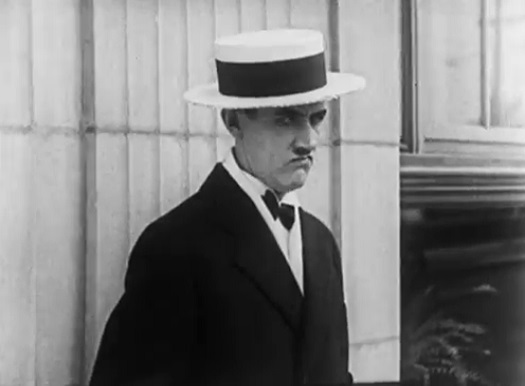
Monty Banks bronze medalist in the Freestyle Moustache 
Then in a surprise entry for moustache of the day (he came third…), Monty Banks twitched his winning ways through A Perfect Gentleman (1927). You can’t fail to like Monty in this well-balanced comedy, as he chases around a ship trying to prove his innocence after having crashed his own wedding inadvertently drunk and then doubled his disgrace by being accused of robbing his former fiancé’s father’s bank. Not the day’s first wedding nor the last bank robbery. 

Costas was really on the beat for this lightweight charmer and he was clearly enjoying himself as his punchy lines accompanied Banks' every pratfall.

The KB weekenders are great for bringing attention to performers such as Banks and Griffiths, but we were about to be reminded of the sheer excellence of one of those who is deservedly still widely remembered. Four commentators were given the essentially impossible task of choosing a favourite moment from a Buster Keaton film.

Even married to the star, Natalie Talmadge wonders why sisters Constance and Norma always had easier gigs...
David Robinson chose the breath-taking closing scenes from Our Hospitality (1923) when our hero rescues Natalie Talmadge from the rapids, a waterfall and over-bearing relatives. Then Kevin Brownlow’s choice was the Tong war from The Cameraman including a mini-tribute to the camerawork in Intolerance I hadn’t previously spotted.

Poly Rose (known to many on The Twitter, as The Flying Editor) is a film editor (natch) who revealed some secrets about Keaton’s own editing for Sherlock Junior. It takes one to know one and it was fascinating to see how this mind-boggling segment was constructed through double exposure. Publicity stills, and contemporary reviews also suggest that there were other versions of Buster’s somnambulant transition from what we see, Keaton test screened his work and fine-tuned the brilliance.

Last up was David Macleod, broadcaster and president of the Blinking Buzzards, the UK Keaton Society, who has written extensively on the comedian’s sound films which extend far beyond his relatively-short silent period. He chose the pulsating climax to Steamboat Bill Jr (1928) as our hero literally risked life and limb in a town torn apart by hurricanes and another extraordinary river rescue.

Buster to the rescue as Marion Byron clings on in Steemboat Bill Jnr
John Sweeney accompanied and once again demonstrated extraordinary fluidity for those river-chase sequences but most of all he really Keatoned those keyboards!

A day of pure concentrated silent bliss – where else would we see these films and hear these musicians?! Thankyou Bioscope and the Cinema Museum.

The Way of all Pants!


Sunday, 12 November 2017

Smile… Second Silent Laughter Saturday, Kennington Bioscope, The Cinema Museum, London


We were gathered to have a laugh in the beleaguered Cinema Museum* a former workhouse where the Chaplin family lived when fallen on hard times. What role this played on young Charlie’s sense of humour is hard to know but you have to imagine it contributed to the resilience of the street-hardened Lambeth boy. “Though your heart is aching… “

There was no Charlie today, although he’s always with us in the Museum (there’s a big statue for a start…) but there was a stellar line up of funny people to take us far away from the grey rain of south London.

Monty Banks Starter introduction by Matthew Ross with Meg Morley


Flying Luck (1927) with Monty Banks and Jean Arthur

Until today the main thing I knew of Monty Banks was that he married Our Gracie Fields, but he was a determined silent film comedian who couldn’t quite force his was into the top tier. This film was his last hurrah in Hollywood and tried to capitalise on the hoopla surrounding Charles Lindbergh’s trans-Atlantic flight.

It’s a fast-paced comedy with Monty’s character desperate to fly despite crashing his home-made plane, and things start as they mean to go on with a dangerous stunt as the aircraft moves off seemingly on its own with Monty in pursuit. Luckily Monty crashes into an army recruiting office and gets tricked into enlisting. On the way he meets Jean Arthur playing the niece of the Colonel (Jack W. Johnston) commanding his division as well as his future Sergeant (Kewpie Morgan) who kicks off their abusive relationship by throwing him off the bus.

Monty takes everything that’s thrown at him and his character is endearing – little bits of Charlie, Harry and Harold as well as a large dose of Latin-cheek (he was born and raised in Italy). It’s a victory for the little guy and a lovely film.

All that said, it wasn’t enough and sadly the distributors pulled his contract and he ended up in Blighty and the rest was Gracie and retirement in the forties in the luxury of Capri.

Meg Morley played along with the fun, flying high in Monty’s friendly sky.

Betty Balfour in Reveille (1924)
There followed a poignant two minutes silence following an extract from the British Reveille (1924) which featured Betty Balfour and a host of actors who if they didn’t fight in the Great War were certainly mightily affected by it. The film is on the BFI's most wanted list but elements survive including this sequence showing various characters observing the silence on Remembrance Day. Very moving and as silent as the Bioscope has ever been...

British Shorts introduced by Tony Fletcher with John Sweeney

Tony Fletcher introduced a deep dive into our domestic cinema history – I really appreciate these sessions as there’s always an uncanny familiarity with the faces and places: these artefacts are recognisably from our culture.

Now we all know that sound films didn’t begin with Mr Jolson and Tony screened two Vivaphone films which featured players miming along to recorded discs to startling effect.  I Do Like to Be Where the Girls Are (c.1912) featured the voice of Jack Charman and Cecil Hepworth’s stock players: stars Harry Buss, the principal comic along with Madge Campbell, Chrissie White, Alma Taylor, Violet Hopson, Claire Pridelle and others.

The Rollicking Rajah (c.1912) featured Harry Buss again along with the same Hepworth dancers this time accompanying a recording from Harry Fay. It’s a catchy tune and could well be a hit!

Harry Buss is where the girls are
The Curate and His Double (The Parson and His Double) (1907) featured a foretaste of the trick used in Christopher Priest’s The Prestige… not saying which one though! It’s glorious to see British comedy from this time, we were at the forefront with stage-toughened routines and performers who played direct to camera as if we were a live audience in Wilton’s or one of the thousands of music halls in Edwardian cities.

It was back to the seaside for Kelly Takes His Missus to Southend (A Useful Umbrella) (1913) was from the naughty postcard end of the pier and featured an outrageous couple – possibly Irish, possible both male – and their umbrella wielding trip to Southend and the Kursall. Only in Britain… and the sight of onlookers marvelling at the madness of the couple on the spinning floor made you feel a queasy nostalgia.

A Merry Night (1914) was packed with invention and camera trickery – a quite superb mini-symphony! Two drunks struggle home as the World tilts on its hand-held axis and as one lands home he finds his house playing drinks on his addled brain. I especially liked his paintings shooting at him and waving a tiny Bentine-esque white flag when he shot back!

Walter Forde was probably Britain’s top silent comic and in Walter Makes a Movie (1922) he shows just why. Surprisingly he’s a thief, stealing the purse of Patricia Highbrow (Pauline Peter)

Hapless Husbands introduced by Michelle Facey with Meg Morley


Michelle introduced a multi-national quartet of comedy contenders from Spain, America, France and Germany… all showing that, across the globe, the men, they know nothing.

Robinet is Jealous (1914) in which the multi-monikered Marcel Perez (aka Robinet, Tweedy, Tweedledum, Twede-Dan and many more...) won’t trust his wife even when she’s doing the nicest things for him. Perez was a pioneer of cinematic silly with a background in circus and music hall infusing his films with sight gags and quick-tricks. He went on to direct a marvellously bonkers feature The Extraordinary Adventures of Saturnino Farandola (1913) which I’d dearly love to see screened in cinema!

Innocent Husbands (1925) There was little “innocent” about Charlie Chase who had such a strong and unique persona: smartly-helpless in the face of outrageous fortune and always bouncing back after hubris-induced near-disaster. Here he tries to cover his tracks after ending up with a girl in his party when al he really wanted was to play draughts with his neighbour… long story short: it’s very funny!

Max Wants a Divorce (1917) because he will inherit a fortune as a bachelor… sadly he’s just married Martha Mansfield and needs to invent a reason to get divorced to claim his prize. The best laid plans fall apart as you can't cash in love for money as the poet said.

The Persian Carpet (1919) starred the little-known Gerhard Dammann as a man determined to get the best possible present for his other half to celebrate their anniversary. Like so many men he doesn’t really think it through… be careful what you wish for.

Be My Wife (1921) introduced by Jon Davies, with Lillian Henley

Alta Allen, Max Linder and Caroline Rankin
Even Charlie called Max The Master and Be My Wife (1921) showed exactly why. Linder had led the way in comedy but had been traumatised by the Great War, never to recover… one of millions who never lived free of it. This film was the second of those made post-War in Hollywood and is sophisticated and so-well balanced from the get-go.

Max duels for the attention of young Mary (Alta Allen) with rival Archie (Lincoln Stedman) who is the preferred candidate of her miserable Auntie (Caroline Rankin). It’s a French farce made transatlantic by Max’s cool and it features his iconic electrified hair.

Lillian Henley accompanied Max with assurance, matching his every mood in 1920’s tones and character. Linder directs with disciplined rhythms and must be a gift for duetting pianists.


Keaton Centenary introduced by David Wyatt and Susan Cygan with John Sweeney

Roscoe and Buster in The Butcher Boy
Buster Keaton’s first appearance on film was impeccable, a one-take wonder in Roscoe Arbuckle’s The Butcher Boy (1917) and we not only had a clip of the classic molasses mess from the same film, but a re-worked version of the sketch recorded for US TV in the early fifties. Buster may had been pushing sixty, but he made the sketch funnier with title cards for the actors to hold up playing on the joke being a joke. David Wyatt explained that Buster undertook a lot of small-screen work at this time and Susan Cygan read out an exchange between himself and Chaplin when they worked together on Limelight. Chaplin was surprised to find his old mucker fit and wealthy and when asked by Buster if he watched TV, said he wouldn’t have one in the house… “how do you keep so well?” he asked, “television…” was the reply.

We were shown a clip of an Arbuckle film, Iron Mule (1922) in which recently-unearthed footage shows Buster performing a trademark stunt as a native American. Roscoe was – undeservedly – persona non-grata by this stage and didn’t even get a credit but Buster always stood by him.

A crisp copy of Buster’s first solo effort, One Week (1921), was screened; amongst the most precise and near-perfect silent comedies. Actually, there’s no “near” about it.

John Sweeney accompanied what must be a very old friend with whirlwind pathos and slapstick timing.

She Could Be Chaplin! Anthony Slide on Alice Howell            


There was more to come with a session on Alice Howell from renowned researched Anthony Slide but, unfortunately, I had to depart, more than a little heartbroken after previously seeing her in Cinderella Cinders (1920) which was projected along with One Wet Night (1924). There was also a restored version of her 1917 feature Neptune’s Naughty Daughter completed by Glenn Mitchell from BFI and DFI materials.

You can’t see them all and I can read all about it in Mr Slide’s book, She Could Be Chaplin!: The Comedic Brilliance of Alice Howell which is available from Amazon in kindle or hardback.

I also missed Kevin Brownlow introducing Harold Lloyd’s The Kid Brother (1927) which I do have on DVD but… it’s never as good as watching on screen with live accompaniment and laughter shared amongst a warm room filled with an audience literally sharing the joke! Plus, Kevin’s introductions are not only insightful and witty they are informed by the fact that, often, he has met the people on screen.


Thankyou Cinema Museum and the Bioscope Team, another impeccable programme and one I know took commitment and much time to organise. I am loving your work!

*The Cinema Museum building is currently under threat of sale to property developers. To find out more and to sign the petition opposing any change of use, please visit the Museum’s Website.