Sunday, 15 August 2021

Breaking the silence… The Wit and Wisdom of A.A. Milne, BFI, with Bryony Dixon and Neil Brand


C. Aubrey Smith’s famous explorer John Brice has an abnormally large “bump” on his head enabling him to discover the Equator and the North Pole with greater facility than the common man (or woman) and so it is with me and locating the Southbank after so many months away. This was not my first cinema of the pandemic but it *was* the first silent screening with live accompaniment since March 2020… and, what a way to break the silence with BFI Curator Bryony Dixon providing expert introduction and Neil Brand accompanying with all the contextual flourish and narrative instinct you would expect.


As with the best silent screenings, you leave the twenty first century schizoid experience behind you and pattern recognise your way back into the streets and suburbs of your greatgrandparents' or grandparents’ age, all too familiar Edwardian streets in SW20, West Wimbledon* or mock-classical town houses in Kensington or Westbourne Grove, even the St John’s Wood to Kilburn area where Alan Alexander Milne was brought up. The buildings are probably still there, but the people who live inside them have changed a lot but almost all of them would be familiar with the works of Milne that followed this early and short flurry of film activity.


He was involved with writing four stories filmed in 1920 for the company Minerva Films, founded in 1920 by the actor Leslie Howard with his friend and story editor Adrian Brunel. The company’s board of directors included C. Aubrey Smith, Nigel Playfair and A. A. Milne whilst one of the company's investors was H. G. Wells. This was the English intelligencia playing with the new media and, whilst the results in Milne’s case were commercially disappointing, the two films screened today were very well made, charmingly well written, played and skilfully directed by Brunel.


C Aubrey Smith a few decades earlier...


The first was The Bump (1920) featuring C. Aubrey Smith as the famous explorer mentioned above. Smith was 57 and the film makes great play of his cragginess with a sequence notating the origins of the scars on his face, a shark bite here and a lions’ claw there; he’s explored the world and has the autographs left by every predator he’s met.


Brice’s reputation is legend and in one well upholstered parlour, young Lilliam Montrevor (Faith Celli) is fascinated by his daring and manly pursuits. Her almost-beau, Freddy (Douglas Marshall) compares poorly as he can only dance and have a good time, he’s never explored or risked more than shoe leather. Lilliam, Freddy and her parents head off for a dance on Freddy’s scooter, the most unmanly transport they can imagine.


I’ve met a man at last!


Faith Celli from 1917

At the ball, among the effete fancy dress strides the imposing dress suit of Mr Brice and having go shot of Freddy after his seventh proposal (that month!), Lilliam proceeds to introduce herself and hilariously relives his tall tales of the north pole (wrapping herself up) and the equator (fanning herself) and even his discovery of the Piebald Gorilla who is seen relating his own version of events back in Africa.


Milne’s humour is very Oxbridge, even from this remove, and his title cards are witty in that knowing ironic way we’ve seen from the Fringe and beyond. Lilliam invites Brice round for tea at their house in, wait for it… Stuccoway Terrace and a romance seems on the cards.


But then a strange thing happens and the fearless explorer has to strike out on his own for this expedition and in unfamiliar territory, he asks for help from local natives all of whom seem to lead him further away… still, we do get to see even more wonderful London backdrops. Will Lilliam finally see Freddy and will Brice overcome the discombobulations of the city streets. It’s like a jungle out there…


Faint heart, never wonne faire laydee
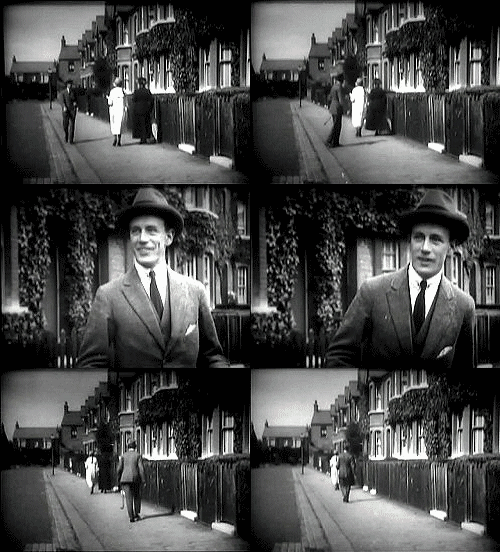

Off in pursuit... Gif from https://lesliehowardsteiner.blogspot.com


The second film featured young Leslie Howard in Bookworms (1920) another witty tale of love and adventure this time transporting a knight and fair maiden to Edwardian semi-detached suburbs. We find said maiden, Miranda (Pauline Johnson) reading The Wealth of Nations by Adam Smith in her guardian’s study. She lives with her Uncle Josiah (Jeff Barlow) and her Aunt Priscilla (Henrietta Watson) who employ a “tame dragon” (Mrs. R. Podevin) as Miranda’s guardian.


All is peaceful until one day Richard (Howard) a listless young man wakes up after his usual lie in to spy the neighbour of his dreams across the road. From that moment on he is a man on a mission, revitalised by romance and the need to meet this object of his affection but, every attempt to arrange an introduction is blocked by the Dragon or, in the case of his attempt to call for a Salvation Army collection, the family maid.


Pauline Johnsom a good few years later


He soon learns Miranda’s daily routine and follows her to the library every day only to find that dragon always between him and the goal. And then, then he has an idea. He will leave a note in the book she collects and simply wait for her response. Sounds fool proof doesn’t it, but the trouble with library books is that everybody reads them. A carefully orchestrated chaos ensues that leads to a surprising but satisfying ending. Just as you’d expect.


Neil Brand brought his experience and passion to the accompaniment as a man you could see thoroughly enjoying afternoon tea with Milne, Brunel and Howard. Can a sense of humour be expressed through music? It surely can and Mr Brand demonstrated this fact emphatically. It was so good to see and hear him and Bryony Dixon performing a show, tell and play again.


Before the two half-hour shorts, we were also shown the first film Lotte Reiniger made in England, illustrating Milne’s poem The King’s Breakfast (1937). As with all her work you soon forget you’re watching shadow puppets and get lost in the story and not least the certainty that butter is indeed better on toast than marmalade.


The author


This was an absolute treat and all the rarer for being on the BFI’s own 35mm prints. Here’s to many more such screenings as theatrical life cautiously resumes and we edge forward. The BFI still has social distancing in place, mask wearing for screenings and reduced capacity making the experience feel safe and risk managed in a way that is not always the case in some other sectors. AA Milne may have been a humorous man but he served in the Great War and was injured at the Battle of the Somme, he could spot a phoney like Brice and perhaps generals without method or even a cause.


Anyway, I thank the BFI for their hospitality, their diligence and their exceptional content delivery!


See you soon.


PS Bryony also mentioned that her colleague Jo Botting has a book in the works about Adrian Brunel, one to watch out for!


* Credit to Twitter user @OokpikUK who spotted the location as Pendarves Road in SW20, West Wimbledon. Richard's house is on the right and Miranda's on the left.

This is literally fifty metres from where I used to live in Lambton Road, Raynes Park/West Wimbledon... no wonder it felt familiar!!


Saturday, 31 July 2021

Heart of the country… L’Arlésienne (1922), Il Cinema Ritrovato, Günter Buchwald and L’Octuor de France


This quietly stunning film is operatic but not quite the simplistic melodrama I had expected it to be, with a skilfully woven narrative that foreshadows events throughout whilst pushing repeated beats concerning love, duty, innocence and the almost mystical connection between nature – ours and that of location. Filmed in the gorgeous city of Arles and the surrounding countryside of the Camargue, it’s almost entirely shot outdoors, featuring the images of locale and rural practice you’d expect from André Antoine, the director of L'hirondelle et la mésange (1920) and La Terre (1921). Sadly, it was to be his last film as studio interference curtailed his instincts too much and he focused on writing, but what a legacy he left.


This 4k restoration is a thing of beauty completed in 2020 by Fondation Jérôme Seydoux-Pathé and La Cinémathèque française from two unique diacetate prints preserved at the latter and this streaming version benefited mightily from musical accompaniment based on orchestral arrangements by Gabriel Diot from the score edited by Pathé in 1922. Günter Buchwald rearranged the score, which features compositions from Bizet (who incidentally wrote an opera based on this story), Gillet, Rachmaninov and others. He also added his own Impressions d’ Arles and conducted L’Octuor de France to create a perfectly synchronised emotional narrative that not only pull at present day heartstrings but also recreats the sound of the contemporary silent experience.


L'Arlésienne began as a short story, later a play (which Antoine directed), written by Alphonse Daudet and first published in his collection Letters from My Windmill (Lettres de mon moulin) in 1869 and Antoine shows us the man and the mill as if to say that he’ll be doing his best to pay respect to the source material. Having not read the story I can’t judge the director’s faithfulness but there are certainly many rich characters all of whom are explained and who contribute to the wholeness of the story… it’s very diligent storytelling.


Arles itself is a very important character here and having stayed there in the past, this film brings back memories of the town we visited chiefly on a Vincent van Gogh location spot. Whether by intention or design, Antoine features Alyscamps Cemetery, the Langlois Bridge, Saint-Trophyme Cathedral and other places painted by the Dutch master, but then he left few vistas un-catalogued in this uniquely atmospheric place of magical light. Just as it attracted the painters so the Camargue with its Roman heritage, wild horses and micro-climate, was ideal for film making and Antoine’s camera men, Pierre Trimbach and Léonce-Henri Burel, had an absolute blast from the evidence here.


Marthe Fabris and Gabriel de Gravone
 

From the opening shots of the city, its people and the family farm at the centre of the tale, the focus is on the sense of place as well as the transitory drama of the human lives. We meet Rose Mamaï (Lucienne Bréval) the matriarch of Castelet Farm, a large stone building set atop a rock with a view of the Arles skyline some miles away. Widowed young she runs the show with the help of her energetic elder son Frédéri (Gabriel de Gravone, later in Gance's La Roue) along with her father and a wise old shepherd, Balthazar (Louis Ravet of L'hirondelle...).


Her younger son has what we would now term special needs and is referred to as The Innocent (Jean Fleury). I’m always interested in how such characters are portrayed in early film and here he is seen as “good luck” by Balthazar who expends far more love and attention than the boy’s mother who has less time for a mind that will never “awaken”. Needless to say, the boy will prove important to the story and is very much a key component as one of the most sympathetic characters.


Maguy Deliac
 

Another is Vivette (Maguy Deliac, also on board for L'hirondelle…) Rose’s goddaughter and, it is assumed, Frédéri’s intended. Vivette lives with her grandmother, La Renaude (Berthe Jalabert) who rarely leaves their farm, her heart broken long ago by an unspecified liaison, these are passionate folk, for whom their sense of duty is as important as their sense of truth. Later on, Rose’s brother will mock the Camargue sensibilities, a jaded modern voice removed from the land, literally, as a river boat man fond of wine and appearances; the eternal push and pull of the new and the old is here too.


On a trip into Arles to see Vivette working in the vegetable market, Frédéri has an instant connection with a striking dark-haired woman. In Daudet’s story she is never named and here she is simply the Girl from Arles, L'Arlésienne, played by Marthe Fabris as a worldly-wise woman, possibly on the make. These City Girls are everywhere from Sunrise to the South of France… ready to distract men at the drop of a hat but, in fairness to this film, L'Arlésienne has nuance, she’s not just in it for the good time and good prospects, she just goes for what she wants even if it means throwing rose petals at him or faking a twisted ankle to get Frédéri to help her home.


Luis Ravet

Frédéri is besotted and soon starts seeking every opportunity to visit his new love, leaving Vivette bruised and on the backburner; he’s as keen as his new girl to make the match. He begins staying overnight, which surely would not happen in a British film of this vintage and is keen to marry his new love. Two problems emerge though on a visit to the bullfighting at the Roman arena, a “sport” that still takes place there to this day. Rose’s brother, Captain Marc (Jean Jacquinet) is disturbed to see that his nephew’s new girl is wearing a petticoat (I know!) whilst a handsome but tough-looking horse handler, Mitifio (Charles de Rochefort) looks daggers in L’Arlésienne’s direction.


Rose being insistent that no son of hers will marry anyone other than a maiden, she gets Marc to investigate the family background only for him to get drunk and lose the plot but far more severe are the revelations from the fearsome Mitifio… these devastate Frédéri and set out the far darker final third of the film as the film’s key questions get answered.


Charles de Rochefort
 

L’Arlésienne (1922) for all it’s light touches and scenic beauty earns its dramatic finale through force of storytelling logic, and fierce performance; love has to be honest and true and Antoine knew this just as much as Alphonse Daudet, writing perhaps broken-hearted from his windmill, fifty years before. Certainly, one of the best films in this year’s Ritrovato digital stream and one you still have a few days left to enjoy.


It’s on until 3rd August so you better be quick.


Bonus van Gogh location spots: The Langlois Bridge and the Alyscamps Roman cemetary 


Sunday, 25 July 2021

Bergman Begins… Ingmar Bergman Volume 1, BFI Limited Edition Blu-ray box set - out now!


I wouldn’t call this a great or harrowing drama. It really is only an everyday drama. Almost a comedy…


Well, this five-disc set is a feast of film covering the start of the legendary director’s career with eight films from 1944 to 1950, six directed by him and the other two featuring his script (and, as it transpires, some direction).


Much like the pupils in the opening film, Torment (1944), force-feeding themselves Latin in an attempt to cram it through their final exams, Bergman has seemed to be almost a chore for some of the admittedly lazier boys in class. He’s unavoidably part of the curriculum but his aversion to Hollywood happy endings and focus on long takes and mood presents a barrier to simply enjoying his work for the less familiar. I was that lazy student but, as I sat down to do my filmarbete i hemmet I soon abandoned my notebook and just fell for the rich characters and on screen.


Sometimes we can study too much and look for the early signs of patterns established much later but, honestly, watching these films from a time when Bergman had no idea how his career would pan out, is a positive joy. So, ahem, here’s “to joy” and to switching our analytical minds off as we relax and float down the stream of Swedish films second great coming. Not that I can stop myself looking for the influence of Victor Sjöström from the first… Bergman learned a lot from his friend, but he is clearly also picking up ideas from expressionism as well as neo-realism.


Alf Kjellin and Mai Zetterling in torment...

There’s also a good deal of humour in these films and I love, for example, the man who learned his craft in the theatre having his narrator introducing his first directed film, Crisis (1946) with the words above, followed by “let’s raise the curtain” just as one of the characters does exactly that in Ingeborg Johnson’s music room… he’s confident enough to play on words and with the form from the beginning.


The first film on the set is Torment (1944) for which Bergman wrote the screenplay and direction was provided by the experienced Alf Sjöberg – who directed the rather marvellous polar-bear hunting epic Den Starkaste (1929) - apart from the closing section which, as the latter was unavailable, ended up becoming the first film directed by Bergman and powerful moments they are too. That said Alf won the Cannes Film Festival Grand Prix for his work which is full of impressive atmospherics and technically advanced dynamics.


It’s always hard to know the split between script and directorial interpretation but the opening shot of Torment features the two leads, Alf Kjellin as Jan-Erik Widgren and the eternal Mai Zetterling as Bertha Olsson, in close-up huddled together against some existential menace, comforting each other as a world of threats mingles in the darkness around them. As filmmaker and writer Leigh Singer says in his excellent video essay, this sees Bergman start as he means to go on with this focus on uncertain love, extreme close-up and the invisible torments that plague us all. Bergman himself gives great credit to Alf Sjöberg in the Guardian Interview from 1982, also included here, film and style have many godfathers.


Stig Järrel torments Alf Kjellin

Torment is painful to watch at times given the moral situations of the leads, Widgren’s discomfort at school reflecting Bergman’s own experiences, as he struggles to cover the work and to meet the expectations of his exacting, cruel, Latin master known un-affectionately as "Caligula" (Stig Järrel) whilst meeting his parent’s expectations and falling in love with Bertha, the girl who works at the local tobacconists. Caligula is a superb creation from writer and performer, a monster in the classroom who covers his own frailty and fear with aggression and manipulation. This is a coded attack on Adolf Hitler, a man with complicated resonance for Bergman…, an inadequate who constantly excuses himself because he’s “ill” but who keeps on returning to cruelty.


He not only victimises Widgren, possibly as he senses weakness, but also preys on Bertha who is driven to drink by his unrelenting attentions. Once the “triangle” of love and abuse is complete something is going to have to give but, whilst there are life lessons to be learnt, there are also teachers who believe in nurturing and kindness…


Experiencing her lessons - Inga Landgré

Crisis (1946), Bergman’s first film as both writer and director, follows the theme of inter-generational friction in ways that easily pass the Bechdel Test. Bergman’s women are well wrought even as his male characters are also nuanced and riven with faults. Here there’s also a tussle between town and country as a woman from the city, Jenny (Marianne Löfgren) arrives in her home village to try and reconnect with the daughter she left there 18 years before. Jessie now owns a beautician’s and wants her daughter, Nelly (Inga Landgré) to come and join her.


The central character is Ingeborg, marvellously played by Dagny Lind, who must decide whether her claims as mother are to stand in the way of Nelly’s decision to find out what the life beyond is like. Matters are complicated by Jack (baby-faced Stig Olin who is in Torment and several others here) and occasionally employed actor who is with Jenny but quite fancies Nelly and has a way of gaslighting those around him.


Sisters? Marianne Löfgren and Dagny Lind

Jack offers to help Ingeborg to the station on one visit and uses the occasion to skilfully cast doubt on her motivations for wanting to “keep” Nelly; is she really selfish? The answer is no and nor is she stupid… she knows Nelly needs to find out about life for herself, the only way to learn is to go through it and that she does. What is so interesting about all these characters though is that everyone has good and bad to varying degrees, shades of grey, mistakes and misfortune.


All of this is already being expressed though framing and mis-en-scene as with later works and, as Singer again points out, if you want to tick off Bergman’s later preoccupations you will find them all here: physical journeys, signify major life changes, the restrictions of social institutions on independent feeling, sexual jealousy, doomed romance, a Godless universe… But these are eternal questions and ones that Bergman’s self-examination would never leave unaddressed.


Inga Landgré and Stig Olin
 

The director was also gathering a troop of regular actors as any theatre producer might and as he did throughout his later career. His next film, Music in Darkness (1948) directed from Dagmar Edqvist’s script, features marvellous Mai Zetterling again (anyone else see a resemblance to Emily Blunt?) whilst Stig Olin is in Port of Call (1948) and Prison (1949) both written and directed by Ingmar.


He’s also in Eva (1948), written by Bergman but directed by Gustaf Molander – another silent stalwart who had directed Alf Sjöberg as an actor in Ingmarsarvet (1925) a partially lost film that also features Swedish superstar, prima ballerina and actress, Jenny Hasselqvist.


Thirst (1949), released as Three Strange Loves in the United Kingdom, has a screenplay by Herbert Grevenius and features Birger Malmsten who is in no less than six of these films including the last… To Joy (1950). This is the only one of the films I’d seen before and one which sees Bergman really hitting his stride now as writer and director. This also has an excellent performance from his pal Victor Sjöström who really had no limits. Four years into his career and still with so much said and left to say, what a remarkable man he was. Here Bergman’s belief in the alignments of music and film come to the fore in the form of Beethoven’s 9th Symphony… it’s a powerful argument.


Victor Sjöström and Stig Olin in To Joy
 

This is, of course, an essential set and these restored gems come with a hefty side-order of extras: 

The Guardian Interview: Ingmar Bergman (1982, 62 mins, audio only): Ingmar Bergman pays tribute to Alf Sjöberg, the director of Torment, discussing his influence and impact on his own career

Ingmar Bergman: First Cries, Early Whispers (2021, 20 mins): a new video essay by writer, filmmaker and film journalist Leigh Singer

100-page perfect-bound book featuring new essays by Jan Holmberg (CEO of the Ingmar Bergman Foundation), Philip Kemp, Geoff Andrew, Jessica Kiang, Alexandra Heller-Nicholas, Kat Ellinger and Laura Hubner


It is out now and can be ordered direct from the BFI Shop either online or in - socially distanced - person. You won’t regret it! Hurry too as it’s a limited edition!


Prison (1949)

Port of Call (1948)

Music in the Dark (1948)

Thirst (1949)

Wednesday, 21 July 2021

Hot media… Figaro (1928), Il Cinema Ritrovato 35 Digital Streaming


As the UK sweats and my new home office warms up over 30 degrees centigrade, the weather is almost Italian and therefore the perfect ambiance for watching restored and rediscovered film in the annual cinematic celebration that is Il Cinema Ritrovato. This year Bologna has a live event but as travelling remains an issue from the UK, some of us have to watch from a far via the festival’s streaming channel, a choice selection from the main programme. Very engaging it is too for withing minutes of clicking play on this film, the 918 miles between my laptop and Bologna disappear and I’m sat in the Cinema Jolly, a cool bottle of iced tea in my hand, rehydrating as I’m lost in this sparkling restoration… Travel is all in the mind, man, and in time as well as space.


Figaro exemplifies the ambition of late silent period French film and of course its director, Gaston Ravel who had twenty years of filmmaking under his belt by this stage as he decided to combine the Beaumarchais trilogy, Le Barbier de Séville, Le Mariage de Figaro and La Mère coupable into one two-hour film. These plays pre-dated the French Revolution and were controversial in their day – the second was banned by Louis XVI after a private reading, although Queen Marie-Antoinette was a fan – for addressing changing attitudes to the ruling classes as well as sexual politics. Naturally enough they were still appealing to later Third Republic viewers not least for their fame as operas from Mozart, Rossini and Milhaud.


Ravel deftly handles these three related narratives and brings out the extraordinary energy of his cast, especially dancer and performer par excellence, Edmond van Duren as Figaro and Marie Bell as his wife Suzanne. Van Duren is full of Fairbanks force and is in near constant flow, free running his way as the catalytic cohesion binding the story and defining the mood throughout. As the finest barber in town, he keeps tabs on every head he’s had the pleasure to know including the great and good such as Count Almaviva (Tony D’Algy, dimpled and handsome) who he helps to romance Rosine (Arlette Marchal, a divine profile...).


Arlette Marchal

Rosine is of noble birth but the ward of Doctor Bartholo (Léon Bélières) and entrapped – sorry – engaged to be married to the old duffer who attempts to keep her under lock and key. Figaro has a plan, he always does, and gets the Count to pretend to be a commoner, Lindor, sent to help Rosine with her piano playing. It almost works as well until Bartholo spots too much close attention from teacher to pupil and after chasing his competitor out, takes advice from the sinister Basile (José Davert with long dank hair and daft hat) to slander the Count’s reputation. There’s a superimposition of snakes as don Basile’s words literally poison Rosine’s mind and she accepts her only refuge with the Doctor.


Cue another plan from Figaro…


Edmond van Duren and Tony D’Algy


The years move on and married life does not suit the Count who, whilst he loves his wife, also loves other women too, if for different reasons. There are lavish and frankly shocking, parties involving all kinds of naked cavorting – checks notes, “blimey, this is French!” – as amorous Almaviva collects conquests much as millennials used to catch Pokemon. Meanwhile Figaro has found love too and met his perfect match in Suzanne (Marie Bell, another fantastic presence from the stage) who he asks permission to marry. The Count agrees on one condition… and the couple must find a way to re-direct his energies.


Plan A involves young Chérubin (Jean Weber), Rosine’s godson, dressing up as the bride to be… which would have been an interesting surprise for the Count had he not interrupted the ruse. But the team of Figaro and Suzanne is irrepressible and there’s so much delight in seeing their eyes light up as yet another plan is hatched! The rhythm of the film is so perfectly judged by Ravel and the pace never drops as invention is uninterrupted by every counter move from the Count.


No social distancing at the Count's party...


The final part of the story moves things on another year or so after Almaviva has sent Chérubin off to serve in the army for being a little too tall and handsome for the life at court… Rosine has had a baby by this point and things seem to have calmed down for the couple. Then we see the noble and promoted Colonel Chérubin in battle – some excellent mobile camera work amongst the charging horses – before, mortally wounded, he passes on a secret to comrade in arms Major Bogaerts (Genica Missirio).


Bogaerts takes the message to Rosine who, in gratitude, has him employed as the Count’s secretary. By this stage Rosine’s child is a toddler enjoying a Punch and Judy show from Figaro and Suzanne – there is no limit to their talents. The two see Bogaerts for what he is and know they must defend the Count and Rosine from whatever mischief he is up to… this calls for not one but two cunning plans… and, as Figaro says: “Suzanne you are so shrewd. Worthy of your husband!”


The film is rich in character as well as cinematography, sets and costume design – from JK Benda who also worked with Jacques Feyder and others. There are sumptuous moments, on location too especially at the Château de Rochefort-en-Yvelines where we see Suzanne spellbinding Bogaerts, supposed sweethearts among the sweet peas.


Marie Bell and Tony D'Algy

It’s hard to understand how Ravel was practically forgotten for decades as Pierre Philippe points out in the catalogue essay, but his success here came just as sound pictures were about to change along with tastes. The director and film are exactly why Il Cinema Ritrovato is essential viewing though, restoring not only the physical results of his work but also his reputation as new memories are created by an audience eager for the delightful shocks and surprises of the old.  


Figaro was restored in 2K in 2020 by Gaumont in collaboration with CNC - Center national du cinéma et de Immagage animée, at Éclair laboratory. It comes with a delightful new score from Alvaro Bello Bodenhöfer, guitarist and composer, who weaves some lovely lines around this comedy of love and light.


The streaming festival continues and there is a lot more to come, all viewable up to 3rd August. Details here!!


She can hear music...
