Showing posts with label Christopher Bird. Show all posts

Sunday, 5 October 2025

Love and Death… Le Giornate del Cinema Muto Edition 44, Day Two

Harry Solter on the job. Photo from Biograph Project showing restored image on right vs old paper copy...


Oh, Willie, my child dead, dead, dead! and he never knew me, never called me mother!*


Morning Mr Griffith... Something about a woman hiding a jewel thief in case her husband thinks he’s her secret lover, then a bloke gets stranded on an island for years enough to grow a big beard and returns to suspect his wife of “moving on” and then pirate gold is hidden in a kitchen, next to the hob, almost impossible to find when the next generation need it? Yes, these were just three of the scenarios facing the American Bioscope players under DW Griffith’s direction in 1908 and, luckily, they were all able to act their way out of it! To appreciate these films is an act of imagination and sympathy, it’s enabling yourself to ignore 117 years of over sophistication and also the “presentist” view that where we are now is somehow where we’ve always been (and will always stay – even if we vote in authoritarians…) but… no, in 1908 things were quite different and these films remind us of what changes and what stayed broadly The Same.

John Sweeney appreciates this more than most and used to hearing him at the BFI and Bioscope, I have to say he blew the lid off of the slick top-of-the-range Fazioli (if Ferrari made pianos..) and made us believe in these stories.


Blanche Forsythe and the rotter, Fred Morgan


East Lynne (1913) with Philip Carli


East Lynne was all the rage in the 1910s as it had been since the publication of Ellen Wood’s novel of the same name in 1861 and the subsequent attempts to capture the book’s fire in a bottle narrative on stage. Now on film, in the first of a number of adaptations, director Bert Haldane probably assumed familiarity with the story, and that might certainly explain some of the pacing issues.


The DCP screened to day is the result of a restoration of a 35mm nitrate from the collection of Christopher Bird who said at the recent screening in London’s Kennington Bioscope that whilst East Lynne is not a lost film as such but when quality is, as Kevin Brownlow says, the main thing archive cinema has to sell itself to modern audiences, this film has certainly been missing in terms of the vibrancy, contrast and tasty tints we glimpsed today.


Chris obtained an almost complete nitrate copy from a private collector which, compared with the black and white copy held by the BFI maybe missing the first reel but comes with an extra three minutes and those high-quality tints. Together with film archivist Bob Geoghegan and the BFI the restoration work has continued leading to today at the Teatre Verdi – a rare surviving copy of a British feature film from the pre-war era. Graphic designer and blogging wunderkind Fritzi Kramer (aka Movies Silently) has been involved in reconstructing some of the film’s title cards and, as she said to Chris, melodramas like this have to be watched in the spirit in which they were made and meant to be received – “loving the hokum, not taking it too seriously”.


All too true and the film looks good, courtesy of DOP Oscar Bovill, even though the same few locations – “just through the bushes… yes, the same ones as before…” – do a lot of the heavily lifting for “The Outside”, and some of the background actors, notably the partially-animated blonde male servants and a Doctor far younger than his wig,  should have stayed off shot. BUT, and it is a very British But!, there are serviceable performances from Blanche Forsythe as Lady Isobel, handsome Fred Paul as the steadfast Archibald Carlyle and whoever it was playing Barbara Hare, the sister of the man falsely accused of a murder committed by Isobel’s would be paramour, Captain Levison, as played with pantomime menace by Fred Morgan.


As a trained historian (well, they tried!) I delighted in the nods to period politics when Carlyle goes up against the scheming Levison to become the local MP, there are placards calling for the abolishment of the Window Tax and the Corn Tax (Corn Laws), as well as in support of Chartism which indicate that Bad Fred is a radical Whig whilst the goodie is a Tory. The Chartists stood apart from both main parties and were calling for such things like a vote for all men over 21, secret ballots and an end to property qualification for MPs, and, of their six main demands, all but one – annual elections – were achieved by 1919. The fact that Mrs Wood’s next book was A Life’s Secret (serialised in 1862) which attacked what she saw as unscrupulous Trade Unionists tells us all we need to know of her politics. She’d fit right in these days mind…


*East Lynne was adapted into a play - East Lynne. A Domestic Drama in a Prologue and Four Acts by T. A. Palmer in 1874 and it was on stage where the story became a phenomena, almost guaranteeing success and the half-joking line “East Lynne’s playing next week”. It was also the source of much ridicule with Palmer’s line during Little Willie’s death scene, given birth to the term “dead and never called me mother…”


Italia Almirante Manzini in Notte di Tempesta (GIF from the excellent Silents Please!)


Notte di Tempesta (IT 1917) with Meg Morley


Not only do we get to be introduced to La Diva della settimana: Italia Almirante Manzini but we also got to hear jazz specialist Meg Morley on the Fazioli and, it might just be me, but amongst her perfectly in 1917-character improvisations there’s the occasional fluid line of which McKoy Tyner would be proud! Her playing whisked us through this stylish drama which, as with the above, was a melodrama made firmly in the theatrical tradition of the country from which they came.


I’m not sure if Manzini breaks in to the Bertini-Borelli-Menichelli champions league of elite Divas but she is a very effective performer. And, just when I really wished that I had my copy of Angela Dalle Vacche's Diva: Defiance and Passion in Early Italian Cinema, I find myself revisiting the power of the other three in order to judge Italia, but she is her own woman at the end of the day with the author mentioning Manzini's "operatic, stylised, and statuesque" way of acting, which are much in evidence during Night of the Storm, with Italia as The Storm!


Manzini is stylish, sporty – she plays tennis although always in a way that keeps her in camera shot, leaving herself vulnerable to passing shots from the back line… she plays a lot more too in a film that often falls foul of its narrative convolutions but it’s fun, and anyone falling for a bad Count in this type of undertaking had better be prepared for the consequences.


The Bioscope reviewer of 25th October 1917, as quoted in the magnificent Giornate catalogue was keen: “It is admirably mounted and its exteriors are full of the glowing sunlight and rich shadow which mark the Italian filmmaker as a supreme pictorial artist. The acting constitutes a good example of the emotional school…” and it does! As much as the light and the shade, this is the mark of a true Diva film!

I look forward to seeing more of her as the week progresses.


Japanese Paper Films with Yoko Reikano Kimura and Hikaru Tamaki


This was a treat I didn’t know I needed but through dozens of ultra-quirky flipbooks, so much pleasure was derived especially with the superb accompaniment of Yoko Reikano Kimura on koto, and Hikaru Tamaki on cello. It was a madly compelling session with so much humour and plain silliness all held together by the accompaniment and the ability of the two players to catch and match the mood! Excellent!


Fleischers!!


The Clown’s Little Brother (US 1920) leads me to suspect that Max and Dave Fleischer might be highly addictive with their hybrid cartoons showing Max in the studio as his creations create havoc on paper and on the ground. The use of filmic photo-reference gives The Clown a fluidity not always seen in animation at the time and when he is joined by his more dynamic little brother… things go blotto! Later in the day there was more madness with Jumping Beans from 1923. Fleischer's greatest success was still to come with his extraordinary Superman cartoons, his eye for detail as well as motion was unmatched.


This was followed by another in the Ukrainian Children’s Films strand, Lazar Frenkel’s Robinson on His Own (UkrSSR, 1929) which showed the what unites little boys is always greater than what divides them. Daan van den Hurk accompanied both films with elan, humour and humanity.


There were two hours of Charlie Chaplin from the Chaplin Archives and many rare actualities with Stephen Horne accompanying the fact and the fiction.


Bernhard Goetzke and Lil Dagover


Der müde Tod (1921), with Ilya Poletaev


Made in 1921 when there were over half a million war-widows in Germany, Fritz Lang’s stunning Destiny or Der müde Tod (literally The Weary Death) suggests that love is stronger than death but no less avoidable. To a nation still mourning the Great War’s devastation, its gothic kindness would have touched so many: fairy-tale frankness masking a more eternal and hopeful message that we go on beyond...


Death is played rather convincingly by Bernhard Goetzke who carries his dark duties with a heavy heart and weary resolution: it’s not easy being the man in black but he wears it well and is nothing if not fair. Lil Dagover is the Maiden who tries to reason with The Glum Reaper after the untimely demise of her love (Walter Janssen) her selfless pursuit of his life touching even his grief-drenched soul.


It is interesting that the man is in distress and not the damsel; she is relentless and willing to risk all and give all to save her love. It is a sad sign of the Weimar’s new hopes that we get to see Lil Dagover playing something of the swashbuckling hero, not that she wasn’t capable just that actresses would be less “allowed” later on and by no means just in Germany.


Ilya Poletaev accompanied on three keyboards: piano, harpsicord and organ bringing dynamism and vivid shades of dark and light as the action demanded for the three segments in which The Maiden fights for her love and the Verdi was, not for the first or last time, transfixed!


The message? Love is stronger than death.


A certain Mr Fairbanks was so impressed he would take ideas for his new film about Bagdad...


PS: DONNA… In the early evening there was a memorial drink for film historian Donna Hill who passed away not long after this event in 2024. Donna was someone I knew mostly through social media and from our discussions of not just silent film but also cats and the music of Bauhaus. I still owe her a gelato but she was a warm and imaginative person who was always so willing to discuss her passions. Her death affected many in this community and I don’t think I’m alone in thinking that this was going to be the first Giornate in which her absence was going to be truly felt. Rest in peace.


Friday, 11 July 2025

Pen-Ultima Thule – The Edge of the World (1937 cut), Birkbeck College


“Edge of the World was entirely saved for me by the editor (Derek Twist) … I mean, Flaherty with no story – at least I had the semblance of a story – took about six months to cut Man of Aran, and then it wasn’t any good…”

Michael Powell, Powell, Pressburger and Others (1978) BFI


The last few decades have seen a bonanza of different mixes, demos and alternate cuts of the output of the most familiar musicians from The Beatles and The Stones to even JS Bach, Erik Satie and Taylor Swift (not together…). Each new variation fascinates and paints a picture of the artists on route to their eventual well-known statements, the elements of Strawberry Fields Forever are interesting because they sound so different to the magical mix created by George Martin and his “Boys” and they show how decisions were reached in search of the perfected final version.


So it is with film, with a boom in “Limited Editions” featuring different cuts of even the most esoteric of films. Getting to see a different version of a classic film some of us have seen dozens of times is pretty rare though and to see Michael Powell’s first major “personal” cinematic statement in a form not seen since its original release in 1937 is not only rare it’s almost certainly unique and it happened again on screen right here on 8th July 2025 in Birkbeck Institute for the Moving Image Cinema a lifetime after it was last seen in this form.


How there came to be a copy of this Mark I release of the film is a story of its own and owes everything to conversations between passionate cineastes one of whom, Bob Geoghegan, Director of the Archive Film Agency and a man of many parts, knew he had a copy of the film safely stored on 35mm nitrate but not the exact age. SO it was that investigation revealed it to be a print from the year of release and one that was different from that we know in significant ways. He duly created a digital transfer from these materials for projection at this event.


Inspired by the evacuation of the Island of St Kilda a few years before, The Edge of the World has been recently restored by the BFI and I’d last seen this at Bologna in 2023 but this was something else entirely as Christopher Bird explained in his introduction to a room full of the very people you’d usually find in Il Cinema Ritrovato, some who’d come a long way for this rarity. Chris had scrupulously prepared a shot-by-shot comparison video for four key moments from the films, showing us three before revealing the fourth a very important moment from the ending shot which I won’t spoil.


Technically, Michael Powell is a much better filmmaker than Robert J Flaherty...


The video ran the two versions side by side and it was easy to see the gaps in the restored version against the fuller shots on this 1937 version. For whatever reason – and this is where the historians come in and dig deeper than the primary evidence – Powell re-edited the film in the 1940s no doubt when he had more success and clout behind him so that the version we have been watching all of lives is what he wanted us to watch some eight (?) years after it was first released. As he said in the quote at the top, Derek Twist brought this production home with Powell struggling with a limited budget and, after St Kilda’s owner refused, a last-minute change of location to the island of Foula across the North Sea to Shetland.


In general, the newly-revealed film showed more of the reaction shots to discussions between the main characters filling out the narrative and engaging us with more of the wonderful locals who we would see again when Master of Ceremonies, Professor Ian Christie, screened Return to the Edge of the World a BBC-funded documentary returning Powell, John Laurie and Grant Sutherland back to the remains of the society they filmed amongst. It’s a wonderful film and Laurie is full of mischief with a mystical twinkle greeting every islander who’s name he feigns to have remembered. A special time for both.


I’ve written about this film a number of times before on here but every viewing only makes it more impressive – not least because of the three or so “new” minutes but also the achievement of Powell’s team in making of the film was an epic adventure in itself. "200,000 feet on Foula" was Powell's original title for his book on the making of the film and references the immense amount of footage shot… thanks be to Mr Twist again!


Powell and drama-documentarist Robert Flaherty did not get on and their methods were so different with the Englishman choosing to use actual actors for his depiction of disappearing cultures. In the end the skill of the story making as well as the players and crew win the day for Foula. EOTW is about as political as Powell gets as he highlights the failure of government to support the islanders as they drown their dogs and cut their losses in the saddest of circumstances. I wonder what happened to the folk of St Kilda, Rachel Johnson, the last of the native St Kildans, died in April 2016 at the age of 93, having been evacuated at the age of eight… what stories did she and other tell of their traumatic changes? Powell caught the dramatic truth better than his rival over on the Irish Aran.


Christie and co also presented us with some fabulous extras including Smith (1939) a public information film promoting a charity helping ex-servicemen, The Embankment Fellowship Centre, which was once lost not just to film archives but also film history. This was introduced by the remarkable Mark Fuller who’d actually found the only remaining copy by tracking down the charity - now called The Ex-Service Fellowship Centres - who revealed that they not only have materials about the project but also a copy of the film! They are now called Veterans Aid and the film is available to view on their website.


We also saw the poignant, An Airman's Letter to His Mother (1941) which is so revealing of the times in which Powell made films and the nature of lived experience during wartime.


My thanks to the following:

  • Christopher Bird
  • Ian Christie
  • Mark Fuller
  • Bob Geoghegan

And also the audience of some of the most cinematically curious people in the country and, indeed, in the town!

The next event at the BIMI is Voices from the Chorus presented by Ian and Robert Denning. Full details are available on the Birkbeck website.


Thursday, 24 April 2025

Stage-coaching… The California Mail (1929), Kennington Bioscope with Cyrus Gabrysch


There were some outstanding shots – glorious panoramas of the rugged West, cameras placed beneath horses pounding hooves, above them from the vantage point of a stagecoach driver and even amongst them as a man fought to control their ferocity during a breath-taking race and chase. If this was the work of Abel Gance we would be in raptures but it was Albert S. Rogell and respect is due.


We were watching the world premier of a rediscovered lost film and Christopher Bird was projecting from the back row and risking his own copy – probably the only one left anywhere – albeit on his own projector through which it had already passed during testing. The film, projector and projectionist all passed the audition tonight and we saw something special as well as something unique.


The California Mail (1929) was projected from a 16mm archive print that had been made by transferring original filmic materials onto Gun Film which had been sold off cheaply by the RAF and yet was typically only twenty feet long meaning that the previous owner would have had to splice together something like 900-1000 times to make the complete 1800+ foot film – his labours have not been lost thanks to Mr Bird and the film is in the safest of hands.


The view from Chris's projector of The California Mail (pic Chris Bird)

Written by Marion Jackson and Leslie Mason the film tells the tale of attempts to find a safe route through to California for much-needed gold supplies during the dog days of the Civil War. The gang trying to stop the shipments is led by the very butch, “Butch” McGraw (C.E. Anderson) whose gang regularly ambush the Yankee shipments forcing the Union to run a contest to find the quickest stagecoach.


There’s a new member of Butch’s gang who has yet to prove himself name of Bob Scott (Ken Maynard) who after being despatched to capture the daughter of one of the town’s leaders, Molly Butler (Dorothy Dwan). He lifts her off her horse but then proceeds to take her back to safety. Butch sends “Rowdy” Ryan (Paul Hurst) to kill the duplicitous Bob but he’s more messy than rowdy and Bob spots him hiding in a barrel before convincing him it’s all part of his plan to get the stagecoach franchise so the gang can get tipped off.


First there has to be a three-way race-off to decide the best company to run the franchise and Bob takes the seat in the California Mail coach and after a genuinely thrilling and incredibly dangerous race – in which some horses might possibly have been injured – he prevails. This is where we see Maynard in between the horses pulling them back into position and definitely doing his own stunts. According to Chris he had been a trick rider with Buffalo Bill’s Wild West Show, Ringling Brothers’ circus, then later a champion rodeo rider with his horse Tarzan (the Wonder Horse!) – here acting under his own name and being the handsomest equine star this side of Trigger of Tonto.


Ken and Tarzan with a baby in Heir to Trouble (1935)


It's a very entertaining ride and I won’t spoil the final sequence which just has to be seen to be believed. Chris quoted Kevin Brownlow in saying that westerns are often not given the credit they deserve for the technique and skill involved in making them and this was one of those late silent films which not only showed the level of Hollywood filmmaking but, as David Thompson said, you could almost hear the voices ready for the coming of sound.


Once talkies had arrived Maynard added another string to his impressive bow by becoming the first Singing Cowboy. Cyrus Gabrysch – accompanying sight unseen – certainly made the Bioscope’s piano sing and galloped along in sync with man, woman and horse both on and off the screen as Mr Bird’s trusty projector provided a comforting whir behind us… only at The Bioscope amigos!


Sue Carol and Richard Walling

Walking Back (1928) was the first film of the evening and was another 16mm archive print from Chris Bird’s collection. It was directed by Rupert Julian for Cecil B. DeMille but there’s a strong likelihood that the latter was as involved in this as Lon Chaney was in Phantom of the Opera’s direction (as rumour has it and I like this rumour). There’s certainly some of Cecil’s trademark salacious male gaze (am I being unfair...? c.f. Sign of the Cross and many more…) but either way it’s a fast-paced fun ride with plenty of jazz energy!


Sue Carol, as flapper Patsy Schuyler certainly has It! and was understandably regarded as a potential Clara competitor for a while. She is exceptionally pretty but Clara had depth and range that drew a deeper engagement certainly based on this script which, in fairness, doesn’t give Sue much to do other than look good and support her man, one “Smoke” Thatcher – not a good nickname if he were to follow the family name and attach straw to cottage roofs… He’s played with considerable gumption by Richard Walling who is a rebel without much cause and also little clue.


That said, there are elements of a fifties/sixties generational drama with “reckless” kids doing battle with their misunderstanding parents. And I ask myself, just when did I start siding with the grown-ups?!


Sue Carol 


After an opening of drunken foolishness which sees one overloaded car crash off the road following a flat tyre caused by a smashed and very illicit whiskey bottle, the gaggle of flapper legs and male drunkenness leads the party to a café shortly followed by the police and a quick disposal of the hootch. Later on, there’s a party to which Smoke can take his “fire” Patsy but only if his father (Robert Edeson) will loan him his car. This doesn’t work and so Smoke borrows his neighbour’s car only to find that his rival Pet Masters (Arthur Rankin) has taken Patsy instead.


The two butt heads over Patsy and then, irresponsibly, smash their cars together in a demolition derby that is going to cost Smoke a lot in terms of money and paternal approbation. Still, it’s an energetic sequence and it’s better than watching Jeremy Clarkson do it. Finally with Patsy clinging on to his side Smoke upends his rival’s car and is declared the winner but at what a cost.


They take the ruined vehicle to a garage where the mechanic informs him that the borrowed car, now wrecked, has become a stolen car and his is the place the police will often look first. Smoke needs some money fast and as luck would have it there arrive three smartly dressed individuals who need someone to drive their Mercedes for a particular errand. Their true intent only gradually reveals itself to the rather dense Smoke as they park up outside his father’s bank intent on robbing it… OK, it’s not high art but it is great fun full of youthful jazz-age energy and great stunt driving. It’s a witty film with the tone set with one if the opening intertitles, 1928 – and how! – the shock of the old-new never fails to impress.


The boys try to win Patsy over...

Mordaunt Hall was even slightly moved, writing in The New York Times that the film was "… no worse than the general average of those dealing with wine, automobiles and the biological gropings of persons under the age of 24. As a matter of fact, it is a little better. Miss Carol, as Patsy, is pretty, and Mr. Walling, as Smoke, looks as though if he had the right opportunity to be intelligent, he might fool everyone."


Ashley Valentine proved that you could play the piano with jazz hands and thoroughly enjoyed accompanying this peppy entertainer. I especially like the hint of The Godfather theme when the gangsters arrive to make our heroes an offer they can’t refuse.


Another richly entertaining evening in Lambeth and I’m surprised that this kind of thing isn’t available on prescription by now. An absolute tonic!


Walking Back as viewed from the back (pic Chris Bird)


Thursday, 2 March 2023

More please… Oliver Twist (1922), with John Sweeney, Kennington Bioscope


8 Great reels that make you ask for more. Will Hays says Jackie Coogan Films are the sort the World needs…

Print Advert - Wyoming County Times, 20th December 1923


Introducing the screening of four films from his personal collection Christopher Bird delighted us with an evening of films connected with Charles Dickins and, to a lesser extent Lon Chaney.


First was Mrs Lirriper’s Lodgers (1912), an almost complete film previously considered lost and rescued by Chris from a pile of rubbish at the end of a antique collector’s garden. Painstakingly restored with over 400 manual fixes, the film, based on a story from Dickens, was a delight, telling a moral tale in limited time with the constant thought in our heads that this very nearly didn’t exist but for a collector’s endless curiosity.


Next up were three short 35mm films exchanged for a reassuringly expensive pint of lager – we all have our price and clearly the seller was happy to offload these potentially explosive nitrate curios. Included was a precious glimpse of a young Lon Chaney, looking dashing in one of the few elements of his early films still extant, this from Tangled Hearts (1916). Back to the Dicken’s theme and another previously lost film, Oliver Twisted (1918) starring Fred Evans, aka Pimple, as an actor playing Bill Sykes who seems to stagger over the fourth wall as he feels his way through an approximation of the story from our main feature clutching a wooden club and a three-legged toy dog. To watch Fred at work is to marvel at the consistency of British humour, always daft, always knowing.


Last of the shorts was Hello Hollywood (1927) a fascinating look behind the camera at eth sprawling estates and backlots of the major studios. Lon Chaney was mentioned in one intertitle and we also saw the set of Paris used in The Hunchback of Notre Dame.


You've got to pick a pocket or two...

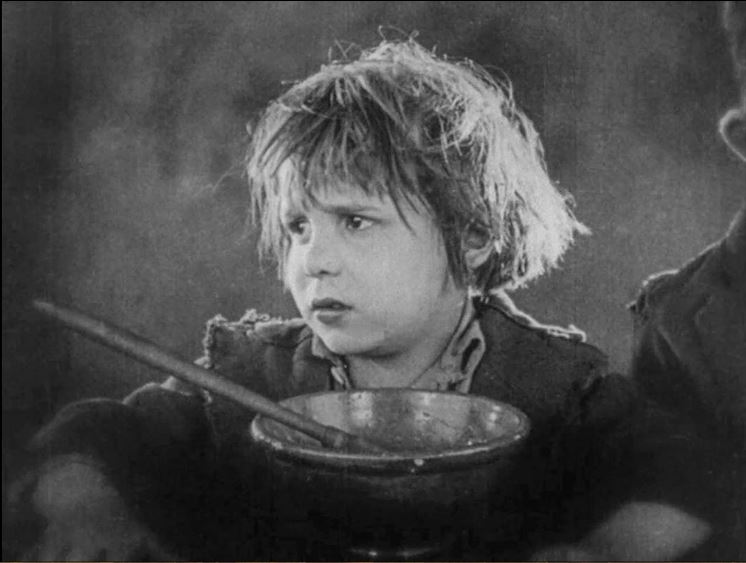
Containing roughly equal parts Dickens and Chaney was the main feature, Oliver Twist (1922) which was shown from a 16mm print again from Chris’ collection. This is another lost and found which on rediscovery in Yugoslavia in 1973, had to have intertitles inserted with help from star Jackie Coogan and producer Sol Lesser for Blackhawk Films restoration. The film is close to complete, missing perhaps a reel out to the original eight, but making total narrative sense and more.


Directed by Frank Lloyd, the film makes light of the complexity of Dickens’ original work – some 370 pages and 170,000 words, rather more than you need for a film. That said, like so many early films, it was based on a story that most people knew very well as the Pimple short further proves, including Nancy’s horrific demise – so fearful that Pimple has to change actress twice.


This feature was made just before Lon Chaney really hit the big time but, as with every one of his films that I’ve seen, he is submerged in character and all you see is Fagin, not a man heavily made up and radically adjusting his body shape to present the image of an older man, twisted by poverty and the evil that men do in picking a pocket or two. It’s fascinating how so many of the characters are recognisable in look and feel even at this early stage but Fagin is not as semitic as the Ron Moody portrayal.


The well meaning and well-to-do see the good in the boy... mostly.

This is not a starring role for Lon though, that privilege goes to eight-year old Jackie Coogan who had already made four features since his debut in The Kid and was looking good on it. It’s rare to find a child actor this accomplished but this is even more striking given the vintage. His expression is flexible and controlled and he knows how to hold himself even when there’s no dialogue or action directly involving him. He too is completely submerged in his role and is a very impressive Twist… not without an instinctive humour that places him apart from the more obviously terrorised Mark Lester! This is a tough role for a junior.


Elsewhere there is sterling work in bringing life to Dickens’ – genuinely iconic – cast of characters from the cheeky tea-leaf The Artful Dodger (Edouard Trebaol), the corpulent Mr. Bumble (James A. Marcus) to the battered but brave Nancy (Gladys Brockwell) and her loathsome man Sikes (George Siegmann); ultimately brought down by his own fears… Dickens was writing well before Freud but very few of his characters can escape from conditioning and context.


On the other side of the tracks there are a series of well-to-do saviours including the Maylie family with Rose (Esther Ralston) and a Mr Brownlow – no, not that one – all seeing the good in Oliver even when fate and his companions sometimes work against his fortune and character.

Jackie Coogan and Esther Ralston on the right


Talking of Mr Brownlow, our version, Kevin, interviewed Jackie Coogan extensively for his Hollywood series and also used the rushes of the full meeting for Lon Chaney: A Thousand Faces (2000), on which Christopher Bird worked as Editor. Two degrees of Kevin Brownlow and beyond. Coogan was very impressed with Chaney’s contribution in spire of his father’s warnings that the elder actor would try and steal scenes… well, good luck to anyone trying to distract from young Jackie and I reckon Lon did a great job.


John Sweeney put in a marathon shift and accompanied the whole programme with the seemingly endless variation of light and tone he has at his finger tips. In spite of the circumstances, Oliver remains good whilst so many around him are made bad through situation and malice, John sort out the enduring truths of Dicken’s social morality and gave them full voice as we watched the shadows on screen. Classic and classy all round.


Another Bioscope super show and with tea and Tunnocks tea cakes, who could ask for anything more?


Thursday, 27 October 2022

Life, live from Lambeth... Faces of Children (1925), with Meg Morley, Kennington Bioscope


Back home to the Cinema Museum for one of the great films of the French silent, and one accompanied with consistently inventive Verve, the odd delicious Blue Note and Stax of syncopated stamina from Meg Morley; two hours of emotive, compelling improvisation with hints of period classical as well as Meg’s diverse jazz chops. She won’t agree but she made the evening and was so in tune with Jacques Feyder’s tale of childhood grief.


The film was critically-acclaimed yet a commercial failure and for a long time this it only circulated as a two-reel 9.5mm condensed version – available on YouTube and worth watching! – and as Christopher Bird said in his excellent introduction, this encouraged the young Kevin Brownlow to seek out more complete versions. The film was finally restored over a twenty-year period starting with the Cinémathèque royale de Belgique in 1986 and ending with Lobster Films in 2004 but it is still rarely screened which is exactly why we need the Kennington Bioscope more than ever!


Never work with animals or children unless, that is, the children are exceptional actors… was my observation of first watching this film on DVD. My cold shrivelled soul had prepared me for the worst with this tale of youthful anguish but, once again, I was so wrong as it is a naturalistic marvel and one that at almost a century’s years’ distance, it was made in 1923, rings true with unflinching honesty and the director’s iron grip on the dimensions of love and pain. Children are childish, but also easily desolated and whilst Feyder’s players are casually cruel, they learn their lessons hard.


Jean Fores and Victor Vina


A good deal of this is attributable to the film’s remarkable lead Jean Forest, who was just 12 at the time and plays with the controlled intensity of someone twice his age; that’s direction but also a natural talent. The director had featured him in his previous film, Crainquebille (1922) and probably wrote Faces… with him in mind – you can only make this kind of story work with such a freak of acting nature. He is not alone though, with the actor playing his stepsister, Arlette Peyran also remarkable.


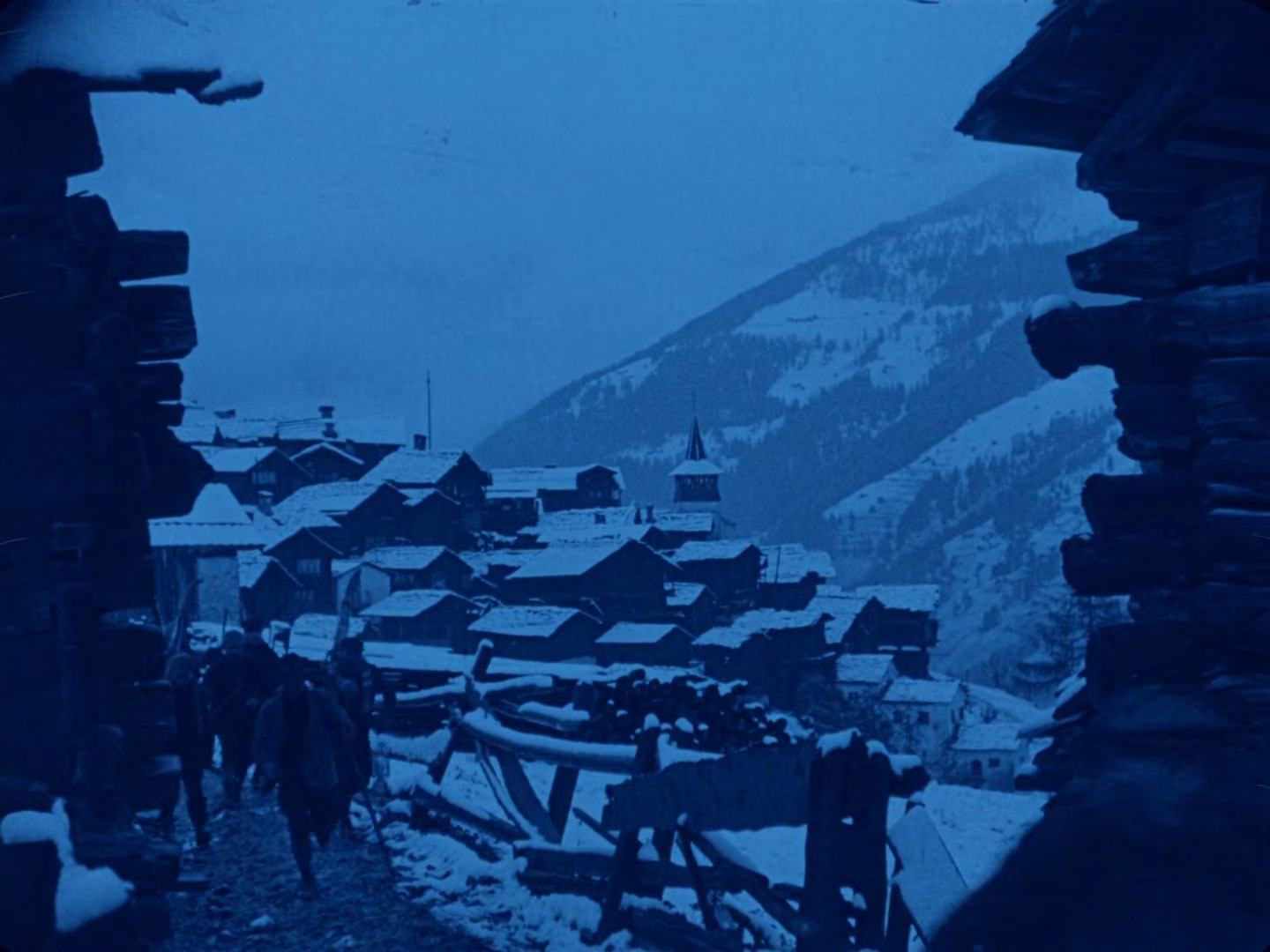
Feyder hits us hard right from the opening, showing the funeral of the boy’s mother; ten-year old Jean is numb but expected to stand with his father Pierre Amsler (Victor Vina), the local mayor, through the ceremony as his five-year old sister Pierrette (Pierrette Houyez) is distracted by play. In ten potent minutes, the director introduces the main players and the situation against a stunning backdrop of Saint-luc, a village nestled high in the Swiss Alps. It is a beautifully location for a sad occasion and the worst of all situations: a mother dead leaving her young children all too early.


Amongst the serious adult mourning, Jean looks on in shocked silence as the funeral process unfolds and his mother’s coffin is lowered down the stairs in their chalet. Pierette is too young to understand and is told that Mama has gone away for a while, but Jean is old enough to understand that he’ll never see his mother again. The procession extends out of the house and through the snow-covered streets to the cemetery at the edge of the town. Jean follows alongside his weeping father whilst we keep cutting to see Pierrette playing with a neighbour… The boy braves the entire ceremony before finally collapsing in sadness… you’d need a heart of stone not to be moved but Feyder isn’t just creating a melancholy drama; these are well-drawn characters showing natural grief.


Rachel Devirys and Victor Vina


The months pass with father and son paying due respect to the departed but Pierre begins to worry about his children’s’ care with no mother. He starts to court a milk maid Jeanne Dutois (Rachel Devirys) but hasn’t the heart to tell Jean of his intentions. There doesn’t appear to be anything calculated in this new relationship as events will bear out… and what we see of Pierre, is what his children see, a man subdued by responsibility and grief.


Jean mourns his loss intensely, saying his prayers in front of a portrait of his mother each night. The portrait comes to life and his mother (Suzy Vernon) smiles down at him. This is one of only a couple of moments of magic realism in a film otherwise anchored so much in reality but again this is not just the faces of children but their imagination


The new couple agree to marry but Pierre cannot tell Jean and sends him away with his godfather, Canon Taillier (Henri Duval) who is to break the news as best he can… As Jeanne and Pierre marry the priest tells Jean who resolves to support his father and make the best of things. Things get off to the worst possible start as Jean returns home to find himself locked out; he cannot convince his new stepsister, Arlette (Arlette Peyran) that this is his home too and, having got off on the wrong foot, their relationship swiftly deteriorates.

Jean returns to the village

Jean is relegated to a small back room as his sister shares his old room with Arlette – he resents everything that moves the family on from how they were. Jeanne is unrelentingly kind and fair minded never giving Jean a real reason to dislike her but he doesn’t need one as he works through his anger at the nearest targets: the symptoms of his mother’s absence and not the cause. It’s a film in which a lot happens even as not much happens, the audience has to connect the emotional dots; intuit emotional states and route for simply everyone!


The battle between the children hots up as Arlette tries to involve herself in the others’ games. She invades their little island where they are trying to roast chestnuts only to be repelled and pushed into the water by Jean: whatever she dishes out he sends back with increasing spite. Jean is tormented a boy trying to process adult grief and lashing out at anyone who even inadvertently increases his sadness.


Through it all his parents remain patient and Arlette – as we grown-ups can see – makes every allowance. Of course, this only makes things worse as Jean finally begins to push things too far and lives are put at risk. The closing segments of the film see Feyder rapidly pick up the pace and torture the audience with the prospect of unbearably unhappy endings: you’ll just have to sit through these moments yourself because I can say no more without spoiling things…


The Battle of Boiled Chesnuts


As controlled film making, Faces of Children ranks with the best of French (and indeed Belgian) silent cinema. The leads are all superb and whilst the three children are the obvious standouts it’s also worth highlighting the performances form those adults forced to work with them… and Rachel Devirys is especially nuanced as Jeanne.


The cinematography from Léonce-Henri Burel and Paul Parguel is also superb, especially in the later nighttime scenes whilst they capture the majesty of the background locations as well as the intimacy of the children’s interior lives. Both had worked with Gance and it shows in the snows, day and night during the desperate torch-lit search as the whole village spreads out on the snow looking for a missing child.


And, throughout the full drama Meg Morley produced nuance and emotionally sophisticated narrative accompaniment of her own. I haven’t been going to the KB enough over recent months but I was glad to be back ,,, there is indeed, no place like "home"..


David Wyatt: There was a tribute to Bioscope stalwart and multi-talent Dave Wyatt who recently passed away. Dave was one of the core group at the Bioscope and had a fascinating career in film before becoming a collector and contributor to this priceless south London enterprise. Rest in silence Mr Wyatt and thank you for all the joy you brought!