Showing posts with label Frank Lloyd. Show all posts

Thursday, 2 March 2023

More please… Oliver Twist (1922), with John Sweeney, Kennington Bioscope


8 Great reels that make you ask for more. Will Hays says Jackie Coogan Films are the sort the World needs…

Print Advert - Wyoming County Times, 20th December 1923


Introducing the screening of four films from his personal collection Christopher Bird delighted us with an evening of films connected with Charles Dickins and, to a lesser extent Lon Chaney.


First was Mrs Lirriper’s Lodgers (1912), an almost complete film previously considered lost and rescued by Chris from a pile of rubbish at the end of a antique collector’s garden. Painstakingly restored with over 400 manual fixes, the film, based on a story from Dickens, was a delight, telling a moral tale in limited time with the constant thought in our heads that this very nearly didn’t exist but for a collector’s endless curiosity.


Next up were three short 35mm films exchanged for a reassuringly expensive pint of lager – we all have our price and clearly the seller was happy to offload these potentially explosive nitrate curios. Included was a precious glimpse of a young Lon Chaney, looking dashing in one of the few elements of his early films still extant, this from Tangled Hearts (1916). Back to the Dicken’s theme and another previously lost film, Oliver Twisted (1918) starring Fred Evans, aka Pimple, as an actor playing Bill Sykes who seems to stagger over the fourth wall as he feels his way through an approximation of the story from our main feature clutching a wooden club and a three-legged toy dog. To watch Fred at work is to marvel at the consistency of British humour, always daft, always knowing.


Last of the shorts was Hello Hollywood (1927) a fascinating look behind the camera at eth sprawling estates and backlots of the major studios. Lon Chaney was mentioned in one intertitle and we also saw the set of Paris used in The Hunchback of Notre Dame.


You've got to pick a pocket or two...

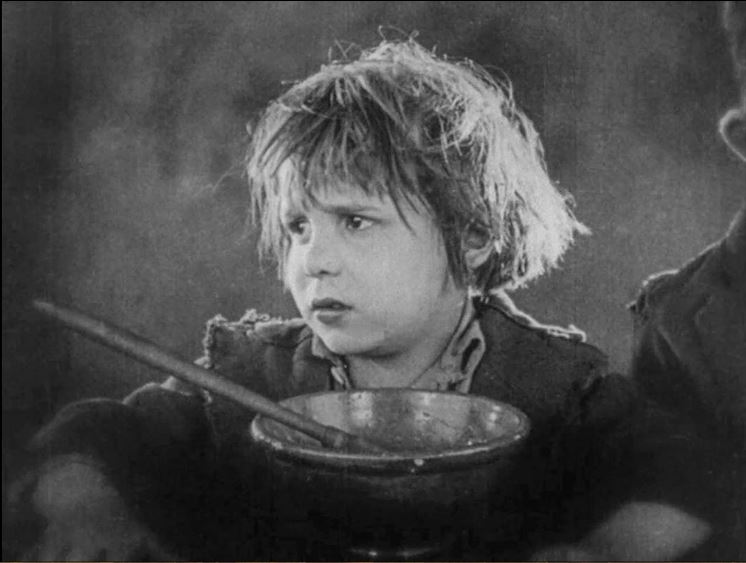
Containing roughly equal parts Dickens and Chaney was the main feature, Oliver Twist (1922) which was shown from a 16mm print again from Chris’ collection. This is another lost and found which on rediscovery in Yugoslavia in 1973, had to have intertitles inserted with help from star Jackie Coogan and producer Sol Lesser for Blackhawk Films restoration. The film is close to complete, missing perhaps a reel out to the original eight, but making total narrative sense and more.


Directed by Frank Lloyd, the film makes light of the complexity of Dickens’ original work – some 370 pages and 170,000 words, rather more than you need for a film. That said, like so many early films, it was based on a story that most people knew very well as the Pimple short further proves, including Nancy’s horrific demise – so fearful that Pimple has to change actress twice.


This feature was made just before Lon Chaney really hit the big time but, as with every one of his films that I’ve seen, he is submerged in character and all you see is Fagin, not a man heavily made up and radically adjusting his body shape to present the image of an older man, twisted by poverty and the evil that men do in picking a pocket or two. It’s fascinating how so many of the characters are recognisable in look and feel even at this early stage but Fagin is not as semitic as the Ron Moody portrayal.


The well meaning and well-to-do see the good in the boy... mostly.

This is not a starring role for Lon though, that privilege goes to eight-year old Jackie Coogan who had already made four features since his debut in The Kid and was looking good on it. It’s rare to find a child actor this accomplished but this is even more striking given the vintage. His expression is flexible and controlled and he knows how to hold himself even when there’s no dialogue or action directly involving him. He too is completely submerged in his role and is a very impressive Twist… not without an instinctive humour that places him apart from the more obviously terrorised Mark Lester! This is a tough role for a junior.


Elsewhere there is sterling work in bringing life to Dickens’ – genuinely iconic – cast of characters from the cheeky tea-leaf The Artful Dodger (Edouard Trebaol), the corpulent Mr. Bumble (James A. Marcus) to the battered but brave Nancy (Gladys Brockwell) and her loathsome man Sikes (George Siegmann); ultimately brought down by his own fears… Dickens was writing well before Freud but very few of his characters can escape from conditioning and context.


On the other side of the tracks there are a series of well-to-do saviours including the Maylie family with Rose (Esther Ralston) and a Mr Brownlow – no, not that one – all seeing the good in Oliver even when fate and his companions sometimes work against his fortune and character.

Jackie Coogan and Esther Ralston on the right


Talking of Mr Brownlow, our version, Kevin, interviewed Jackie Coogan extensively for his Hollywood series and also used the rushes of the full meeting for Lon Chaney: A Thousand Faces (2000), on which Christopher Bird worked as Editor. Two degrees of Kevin Brownlow and beyond. Coogan was very impressed with Chaney’s contribution in spire of his father’s warnings that the elder actor would try and steal scenes… well, good luck to anyone trying to distract from young Jackie and I reckon Lon did a great job.


John Sweeney put in a marathon shift and accompanied the whole programme with the seemingly endless variation of light and tone he has at his finger tips. In spite of the circumstances, Oliver remains good whilst so many around him are made bad through situation and malice, John sort out the enduring truths of Dicken’s social morality and gave them full voice as we watched the shadows on screen. Classic and classy all round.


Another Bioscope super show and with tea and Tunnocks tea cakes, who could ask for anything more?


Sunday, 21 June 2020

The films of Julia Crawford Ivers… The Intrigue (1916)/A Son of Erin (1916), Kino Lorber Blu-ray


History is addictive and that’s not something my tutor would have expected me to say when I under-delivered on my essay tackling Stalin and the Nationalities… but one thing, literally, leads you to another and to make sense of things, to get the bigger picture, you always have to keep on digging. In the case of Julia Crawford Ivers, a woman who I knew nothing about pre-lockdown, I am now starting to understand just a little of her motivation as both a writer and director.

This handsome Blu-ray set from Kino Lorber, includes four films either written by or written and directed by Ivers and compliments her film, The Call of the Cumberlands (1916) included on the company’s exhaustive but not exhausted boxset of Women Film Pioneers. If she has been known at all, it has mainly been as the principal screenwriter for William Desmond Taylor – with whom she made some twenty films – and, naturally, as one of the suspects in his murder (for which my sources tell me, the main suspect is MMM, but keep that under your hats…).


This set majors on The Intrigue, a science fiction spy adventure from 1916, and whilst it’s very interesting it was A Son of Erin (November 1916) written and directed by Ivers that drew my eye the most as it had a number of thematic parallels with Cumberlands (January 1916); humble men making good, steadfast romance in a changing world and corruption in public office.

Where an honest man is needed most… in politics!

Both films star Dustin Farnum as likeable men from traditional backgrounds – the mid-west in Cumberlands and ol’ Ireland in Erin (aka Éire in old English money) – who are drawn away from their trueloves, Sally and Katie, both played by Londoner Winifred Kingston who later became Mrs Farnum (remaining so until his death in 1929). More connections and they’re also both in The Intrigue in un-credited roles. In both roles the women sacrifice a lot in order to support their man’s ambition and whilst they trust that this will be rewarded, there is no guarantee. Any echoes in Ivers’ support of Taylor are purely speculative but she was an all-rounder, who had fulfilled so many roles in cinema and who produced as well as directed and certainly let the likes of Taylor and Frank Lloyd take the full credit for some collaborations.

Winifred Kingston and Dustin Farnum
Farnum is a happy go lucky fella Dennis O'Hara, a “simple soul” who dreams of being a New York Cop, so many of whom were indeed Irish. Katie sells her best pig to the local landlord to fund his trip out to America leaving herself vulnerable to the Englishman’s unprincipled advances as well as the chance her man just will not make it. Dennis duly arrives in the city and fails to secure anything other than work as a navvy; another famously Irish occupation.

The City is corrupt though and we see the unofficial alliance between the councillor O'Keefe (Wallace Pyke) and city contractor, Hardy (Lee Willard), both of whom are paying of a police force that also collects protection money from local retailers, including one who appears to be a madam. Against all this is a civic reformer, John D. Haynes (Hugo B. Koch), a man clearly in need of allies.

Selling her best pig
Dennis’ popularity earns him the chance to join the force – they need the “dago vote” in the next election - and he progresses to sergeant – “the Big Brother of the tenement block”, a few decades before that phrase would change in meaning. Ivers spends good time on establishing her characters and there’s a nice scene with Sgt O’Hara sharing an apple with a street seller. Trusted by all sides, his crooked Captain finally tests him, by asking him to collect the protection money. He refuses and ends up in court as part of a newspaper investigation into corruption. Here he shows his honesty and loyalty and gets a job as a building inspector where he helps uncover a corrupt concrete racket. Finally, he is enlisted by Haynes to help in his campaigning and helps to persuade the East Side to vote for reform.

The honest man enters politics
Back in Ireland, the evil landlord tries to hide Dennis’ letter inviting Kitty to finally join him and assaults her instead only to be rebuffed by her greater intensity. This is exactly what happens to Kingston’s character in the Cumberlands, both physically best male aggressors; so much for damsels in distress, Ivers’ women are forces to be reckoned with! Having given everything she had to help Dennis succeed, Kitty heads off in the sure and certain knowledge that their partnership will be stronger than ever.

OK, it’s not a great film and Ivers’ is not a great director but she is a very competent film maker and creates entertaining stories with characters that ae recognisable and rewarding to watch; inspiring cinematic ideals for the largely working class, “simple souls” who watched in their millions.

As in Cumberlands, Ivers' uses natural light to create sentimental shots
The Intrigue has more dash and daring do yet is also interesting from a political perspective. The story concerns and American inventor Guy Longstreet (Cecil Van Auker), who comes up with a deadly X-Ray gun that could win either side the Great War currently being fought across the Atlantic. The US was not involved at this point and the film reflects this both in the American military’s lack of interest in the weapon and in the ultimate fate of the deadly ray-gun.

In the middle of all this is a competent caper directed by Scotland’s Frank Lloyd described in Anthony Slide's engrossing commentary as perhaps the consummate Hollywood director with over 125 feature films across a forty year career that included the singular feet of three Oscar nominations in one year (1929). Here he is certainly still learning his craft but there are some good cross-cuts linking characters and their thoughts, repeated use of “iris outs” when changing scene and some in-camera trickery enabling one character to consider his options in close up whilst his friend and collaborators appear in long shot/as small versions below, in his mind’s eye.

The weapon maker weighs up his options...
The cinematographer having to perform these feats was none other than Ivers’ son, James van Trees who enjoyed a long career himself, there on merit and not just family connections, not eventually anyway! Interesting how “small” a place Hollywood is at this stage and how interconnected so many are.

Having been rejected by his own war pigs, Longstreet takes his device to Europe and looks to sell to one side – un-named but in Germanic uniform – whilst the other sends it’s best spy to follow progress as the American returns home to finish construction of the mass destruction elements of his weapon. Rather than send A Man, who would be obvious, they decide to send Countess Sonia Varnli as played by stage star Lenore Ulrich who we have already seen working as a nurse in a field hospital. The Countess decides to send her assistant as played by Florence Vidor, as herself and to smuggle herself on board as a peasant girl. Florence’s husband was of course King, and he has an uncredited appearance as a chauffeur. I hadn’t realised that after divorcing King Vidor in 1924, Florence would go onto marry famed violinist Jascha Heifetz, one of the greats and a huge influence on my violinist Uncle.

Florence Vidor and Lenore Ulrich
But I digress, Anthony Slide is slightly disappointed in Lenore’s performance and I have to confess I’d hoped Florence would have been given more to do as her "understudy", but the latter is mostly impressive if patchy. A discovery of David Balasco – along with so many from Mary Pickford to Barbara Stanwyck – Ulrich had been in films sporadically since 1911 but seems a little ill at ease here, over emoting initially and, as Slide observes, seemingly happier to play the role of peasant girl than sophisticated Mata Hari. She does OK but there is the occasional hand to forehead moment and her huge expressive eyes are quite distracting in close up!

Lenore Ulrich's big eyes, spy...
The big baddy in all this is the Baron Rogniat as played by Liverpool’s own Howard Davies (by the way, coming in 2023, Silent Scousers: a study of the La’s who starred and the Maggie’s who made it (Faber)) who knows exactly how to wield and evil moustache. He aims to steal the weapon’s secrets and kill off the inventor… only the Countess/cleaning woman can save the situation! Yes, again we have yet another woman of agency from Ivers and one who will indeed dictate the outcome she thinks best.

On the right, Howard Davies from Liverpool
That I won’t spoil as these are all films that should be seen by anyone who wants to see that bigger picture of early Hollywood; the three dimensional jigsaw puzzle that has a smaller and smaller section devoted to DWG the further we move into the second century of cinema.

The Intrigue also comes with the surviving fourth reel of The Majesty of the Law (1915), written and directed by Ivers’ along with all of Ben Blair (1916) directed by William Desmond Taylor from Ivers’ script. There’s also an essay in the booklet from Ivers’ expert, film historian April Miller. It’s available direct from Kino Lorber in the US but you will need to order from Amazon.com to get delivery to Europe.

No sheep were harmed in the making of the film... probably.


Saturday, 4 February 2017

Clara's baby… Children of Divorce (1927) on Blu-ray


“Gary’s such a big boy, so strong, so manly and so bashful, I always wanna rumple his hair an’ listen to all his troubles.” Clara Bow

Clara Bow in Blu-ray high-definition and the clearest possible view of her soon-to-be-stellar co-star, Gary Cooper; what could possibly go wrong?!

Even in her annus mirabilis when every single film topped the charts from Mantrap, Kid Boots to It! – it was recognised that Miss Bow needed better scripts to fully reach her potential. Sadly, much as it tries, Children of Divorce was not to be it... Joseph von Sternberg was brought in to re-shoot and re-direct the ending and whilst elements of the work received high praise – Clara’s soon-to-be-ex, Victor Fleming saying that the final sequence was amongst the greatest in cinema – overall the audience is left unsatisfied by characters with obscure motivations. The film tries to make a serious point about the importance of family life and the damage done by un-committed parenting but… it feel half-hearted and more concerned with the big dramas of duty.

Clara
All this said, what it does have is the magical realism of Clara Bow – an “expression-engine” who could break the heart of the most cynical viewer with a quicksilver intensity possessed by few other performers. Next to her, the ridiculously handsome Coop struggles to get beyond mildly forlorn or slightly distracted… he’s eye-catching alright but not really enough to draw your focus from Clara.

Stories abound of Bow getting her beau-to-be the part in this film and/or fighting for him to keep it after a stinker of a start. There is still no denying his own potent star appeal but Clara’s was in full burn and Coop was still learning the ropes alongside this sexual superpower. As he said in an off-set interview: “…you couldn’t steal scenes from Clara Bow. Nobody could… She just naturally walks away with every scene she’s in.”

Mr Cooper
He was also up against the equally lovely and capable Esther Ralston.

Esther is so polished and focused and knows exactly how to present face to camera whereas Cooper is often at unflattering angles. The big galoot has charm to burn possessing what Colleen Moore called “that peculiar personality, that intangible quality that communicates on camera…” Yet here, in terms of craft, he’s miles behind Ralston who glides with effortless sadness through the film. Her Jean is the only character really sure of herself around whom Bow’s impulsive Kitty and Cooper’s confused Ted struggle to make the right choices.

Ralston knows how to pose for intense close-ups and works the camera so well throughout. There was a lot for Coop to learn.

Esther Ralston
The film had five writers and it shows with a wayward central message about damaging divorce and also the need for socially convenient marriage getting in the way of emotional fulfilment: we – or rather the upper set – marry for money and do not always follow their hearts. Sadness and despair can be the only result.

The film starts in a de-facto orphanage for the sons and daughters of divorced ex-pats living in Paris and it is here that a young Kitty (Joyce Coad) is dropped off by her mother, (Hedda Hopper in her acting days), who tells her she’ll see her in the Summer – that’s a long time out of the way. She is befriended by the young Jean (Yvonne Pelletier) who provides the unqualified affection her parents cannot. Soon they meet a fiery young boy, Ted Larrabee, who forms a strong attachment to Jean…

Soul sisters
Fast-forward some years to a party at a country house where Kitty (now Clara) entertains the smart set including the titled but broke Prince Ludovico de Saxe (Einar Hanson) who loves her but cannot afford to marry her. Sailing impressively over a hedge on horseback is Ted (now Coop) who lands impressively to gulp down a glass of champagne from Kitty. This scene took some 23 takes according to Bow biographer David Stenn and almost got Cooper fired.

Enter the grown-up Jean (Esther), now very wealthy and a target for any cash-strapped socialite but wealth is the furthest thing on Ted’s mind as is transfixed. Kitty bounds over, as she will many times, to push herself between the two and poor Prince ‘Vito dies a little more inside.

Vito dying a little more...
Jean still loves Ted but wants him to make something of himself before they can consummate their childhood pledge to wed. Kitty loves Jean but also wants to marry into success and if she can’t afford have the man she loves, that’s the Prince, she’ll take the next best thing once Ted has become a success as a bridge-building architect.

Kitty arranges a party starting at Ted’s office and ending up the following morning with the biggest hangover imaginable for, even though Ted struggles to remember, the two got married at the culmination of the previous night’s revels.

WHAT a hang-over!
It’s the worst of timings as Jean has written to Ted saying that maybe they should marry but chance has gone and she sentences herself to noble exile in Paris in order to give Kitty a chance at happiness…

Some years later Kitty and Ted along with their well-cast daughter – the spit of a juvenile Bow -  arrive in Paris and this convoluted quadrangle of love is about to come crashing down around their sad heads.

There are some bold images in the closing segment – perhaps from von Sternberg – but… no spoilers! Overall the main director Frank Lloyd works competently with the narrative in spite of a repeated need to flash back to the younger versions of Jean and Kitty as if to remind us that the child is mother to the woman.


But the restoration is super quality and you can’t fail to be moved by the three leads especially and of course, Clara Bow. When those sad eyes open wide and Klieg lights giving her ample tears a powerful glow, you’d have to be made of stone not to feel more than a little welling up of your own.

There a cracking score from the Mont Alto Motion Picture Orchestra which incorporates contemporary songs within a carefully crafted whole: for instance, JS Zamecnik’s Heart of Dreams is a recurring theme beginning as the youngsters become friends and returning for every key moment.

To top it all the set also includes the Discovering the It Girl documentary narrated by Courtney Love which, if you haven’t seen it features contributions from David Stenn, Diana Serra Cary (Baby Peggy) and Clara’s son, Rex Bell Jnr.

Children of Divorce in excellent production from Flicker Alley and is available direct. It deserves to do well and let's hope for more Blu-ray Bow in the near future!

Buy it! Buy it NOW!
