Wednesday, 30 June 2021

Being natural... Solax - The House Built by Alice Guy Blaché, KB TV, Women & Silent Screen Online


“There is nothing connected with the staging of a motion picture that a woman cannot do as easily as a man, and there is no reason she cannot master every technicality of the art... “Alice Guy-Blaché in The Moving Picture World, July 11, 1914.


This was some undertaking, a collaboration between the Kennington Bioscope and the Women & Silent Screen Online Conference, that featured nine of serial ground-breaker Guy Blaché’s films as writer, director and producer for Solax Films. As noted by the Bioscope’s Michelle Facey, the French woman was the only woman owner of a film studio at the time and she remains the only woman to have occupied this position over a century later which is remarkable and depressing in equal measure.


Guy Blaché made her own way, from inventing narrative film making to helping establish the studio system that would eventually help displace her in mainstream history. According to The New York Dramatic Mirror, by 1912 she was drawing an annual income of between $50-60,000 – some salary in modern terms and allowing for inflation a measure of her success. Whilst few with an interest in silent film would not be aware of her work, she is now emerging more fully from the shadows, as she becomes the subject of more academic research, restoration and a widespread critical rebirth. Her inclusion on Kino and the BFI’s early women filmmakers’ anthologies, Pamela B. Green’s revelatory biography, Be Natural (2018) and a new ARTE French documentary, Alice Guy, Pioneer of the 7th Art, Forgotten by History from directors Nathalie Masduraud and Valérie Urrea, all contribute to this growth in awareness of her contribution and influence.


And still the only one...

The stream was an online equivalent of “A Solax Night”, curated by Kim Tomadjoglou from the Library of Congress who had a number of films on show along with the BFI, Eye Filmmuseum, George Eastman Museum and Lobster Films. It was hosted by Michelle Facey, KBTV’s regular compere and featured introductions by Tomadjoglou; Allison Farrell and Tami Williams, University of Wisconsin–Milwaukee (who helped co-ordinate), and the LOC restoration team, Heather Linville (Lab Supervisor), Frank Wylie (Head Lab Timer), Lynanne Schweighofer (Preservation Specialist), and George Willeman (Nitrate Vault Leader) who talked about the dream job of restoring Alice’s films.


Their efforts were much appreciated as we were able to sense for ourselves the ability and appeal of Guy Blaché’s American films, after she and husband Herbert, used Gaumont’s empty studios in Fort Lee, New Jersey, to start her own production company, Solax which produced films at an astonishing rate between 1911 and 1914 before the War and Edison’s trust, forced filmmakers to Hollywood. These films show us the cinematic skills of the director, enabling us to move beyond the “recovery narrative” and to see how well Guy Blaché made films and money in this most competitive world. We can see how she evolved as a filmmaker with more dynamic camerawork, more cuts and even split screens and how she made the most of the emotional capacity of her stock troop of players. Eat your heart out DWG!

All of this, of course, was enhanced by some of the finest musical accompaniment on the planet.
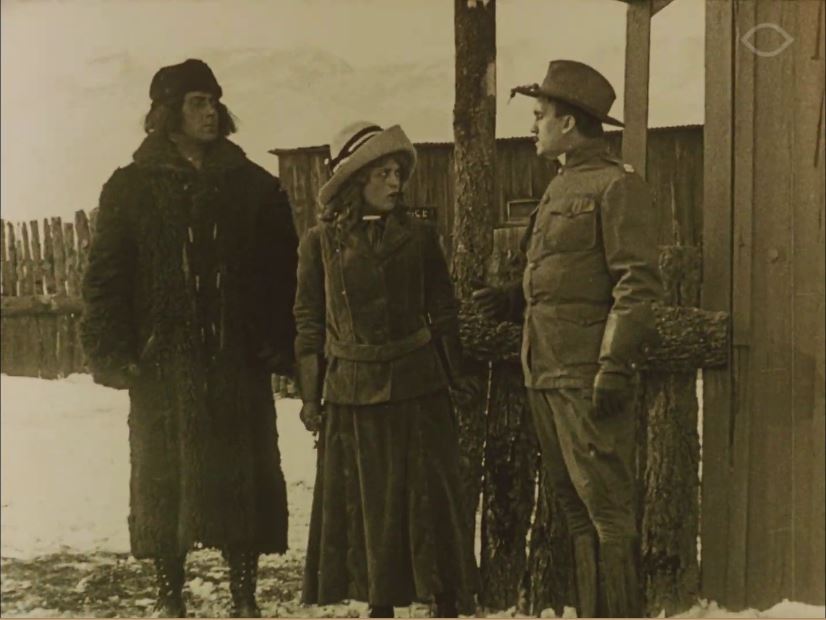

Race relations on Love's Trail

Frozen on Love’s Trail (1912) with Costas Fotopoulos

First up was a curious tale of “the devotion of a redskin” shot around Fort Lee, New Jersey – old “Hollywood” – which showed that loyalty and sacrifice were not only limited to white settlers out West. The story is set on a reservation in the “Klondike” where, Mary, a young woman, is kind to a mixed race native American courier who falls in love with her much to the distaste of her would be paramour Captain Black and others at the post. Needless to say, amongst some superb snowy locations, the courier proves he’s worth any number of Captains.

Guy Blaché’s concerns on race were also to inform A Fool and His Money (1912) which was probably the first narrative feature with an all-black cast, the white actors having refused to work with the black co-stars. She was from Paris, what did she know of old prejudice?


Vinnie Burns showing her total lack fear of fire...

Two Little Rangers (1912) with Andrew Earle Simpson

This thriller has previously been shown at the KB live and shows Guy Blaché’s editing ability with multiple cuts enhancing the narrative urgency of what is a tough tale in which the two young women take on bandit Bill Gray. Vinnie Burns plays the older of the sisters and was the genuine article, trained as a stunt woman by Guy Blaché, and, according to Solax PR, known as “the girl who isn’t afraid of fire, water, air or beast!”

Vinnie draws her gun, races on horses, pulls the postmaster up a rock face and fashions a bow and arrow to set fire to Gray’s hideout and her little sister, a splendid Gladys Egan, gives as good as she gets out-drawing Gray and also taking man and the elements in her stride. These are the forerunners of not just serial action heroines but also women of agency that grow to populate cinema. Also proof that things did not start off with woman “the weaker vessel” having to be rescued every five minutes on screen. Post-modern, postmaster’s daughters!


Split screen telephone call in The Strike. Lois Weber was watching.

The Strike (1912) with Lillian Henley

Guy Blaché’s stance on industrial relations next and an even-handed one it tries to be at a time when trade unionism was disturbing the balance of power in the advance capitalist economies… The director’s solution seems to be that boss and workers should understand each position more and that, as is the case, when disaster strikes all should work together. It’s fascinating to watch and to imagine the response of a 1912 audience to this over-heated melodrama which, whilst it focuses on the positivity of working together on the more important things, fails to address to underlying questions of fair pay and workers’ rights as you’d expect from a woman with a company to run. See Charlie for a more left leaning take perhaps, but there’s work to be done on the politics of silent film makers?


Poor man, rich man...

A Man’s a Man (1912) with Andrew Earle Simpson

More social concerns are evident in this tale of gross inequality in which a poor Jewish man has his daughter killed by a hit and run rich man. It’s harrowing but also powerful in its own way as the chance for vengeance is passed over for delicately handled forgiveness with a closing scene to moisten the eye of the most cynical silent cineaste.


Something's coming...

Starting Something (1911) with John Sweeney

From The Consequences of Feminism onwards, Guy Blaché was concerned with gender roles and often had her characters cross-dress to prove her underlying point of natural equality at a time when women did not even have the vote (except in New Zealand). Here Jones objects to the way his wife Bettie (Blanche Cornwall) dresses and takes revenge by wearing a dress… his wife’s Aunty is a suffragette and given to masculine attire and confusion reigns when Jones mistakes her for his wife, albeit with the aid of alcohol. To cure him of his addiction to the demon drink, Auntie suggests a course of “mental suggestion” to persuade Jones that his tipple is toxic and that he must keep dancing or die… I’ve really no idea what was in the water in the Solax script room but this is great fun and deserves a full viewing. Doug Fairbank’s Coke Ennyday would love this film!


The mind play also reflects contemporary fascination with hypnotism and psychology… another area of silent film that might reward study. But that’s just my suggestion…


Darwin Karr down in the sewers

The Sewer (1912) with John Sweeney

This two-reeler is credited to director Edward Warren with set design and script by former Gaumont colleague Henri Menessier who turns the sewers of the title into a sinister underground world of shadows and twisted structures, the art of darkness. John Stanhope (Darwin Karr) and his wife are philanthropists who are being taken for a ride by Herbert Moore (William Leverton) who runs the phony “Charity Organization Society”.


Moore and his pals – led by a beefy version of Fagin – aim to use little Oliver (Magda Foy – the Solax Kid cross-dressing!), to rob the good natured Stanhopes. But Oliver refuses to steal - yes, he is not at all twisted! – and is taken in by the charitable couple giving Stanhope a concealed miniature saw as a thank you present… he obviously had one spare for just such an occasion.

The gang’s second attempt succeeds and they tie Stanhope up and lower him to his doom in the sewer… how can he escape and save his family?! The sewers are a highlight all tinted green to reflect the odorous darkness… and this is a fun film performed with conviction and skill.


Watch that man

Cousins of Sherlocko (1913) with Colin Sell

Save me dick old top, or it’s a striped suit and iron bars for innocent me!

This awkwardly titled comedy follows the attempts of two detective “cousins” of Sherlock Holmes to track down a notorious robber called Jim Spike played by Canadian comedian Fraunie Fraunholz, a name to conjure with. Fraunie also plays Jim Neill who, unsurprisingly, is the spitting image of Spike a resemblance that costs him his engagement to Jane Ellery (Sally Crute) once her father sees “his” wanted picture in the newspaper. There follows a cat and mouse with the police and the convict involving some trademark Guy Blaché cross-dressing as Jim and his pal try to avoid the striped suit and iron bars. It’s a good laugh and well played by all.


"No Mr. Bond, I expect you to die!"

The Detective’s Dog (1912) with Meg Morley

Does anyone know how many Rovers have rescued over the course of cinematic history? It’s a high number for sure but here we have one of the very first as the newly adopted pet of Kitty, Detective Harper’s daughter, races out to find his new master. Harper has been trapped by the evil Richard Toole, who rather than shoot him in the head, straps him to a table with a buzz saw inching towards him… probably one of the first such scenes of unnecessarily complicated execution. Can the cop be found by the hound and can the detective capture dastardly Dick Toole? You’ll still edge towards the edge of your seat…

By this point the actors are starting to look familiar – Blanche Cornwall of Two Little Rangers, plays Mrs Harper for instance, Lee Beggs is Toole just as he was Sherlocko’s cousin and Darwin Karr is James Harper, Secret Service Detective with Magda Foy – famous for Falling Leaves - as Kitty. It’s fascinating to see them at working at pace with this being just one of up to three movies they were making that week. Here we see the discipline and control from the showrunner and her team; the cast deliver comedy and tragedy on her cue.


No Greater Love...

Greater Love Hath No Man (1911) with John Sweeney

Directed by Alexander Butler and Guy Blaché, this is another stirring western melodrama that once again features Fearless Vinnie Burns as Florence, "The Rose of the Camp". She is beloved by Jake (Romaine Fielding) but takes a shine to, handsome Harry Litchfield, the new superintendent of the Gatlach Mine in New Mexico. It’s love at first sight but not for the Mexican miners who feel Harry is cutting them short on the weighting of their gold. One of them pulls a gun but Flo’ is too fast for him, Vinnie’s persona is consistent; she always stands her ground.

The Mexicans hatch a new plan and Jake, overhearing has to decide if he can overcome his love-sick jealousy to save his rival even at the cost of his own love. It’s the kind of moral high stakes that still resonate in these disbelieving days and there’s a stirring finale culminating in a tableau echoing classic art, heroes, heroines, glory and the United States flag. Even then, the immigrants knew what this meant more than most…

The famous sign at the Solax Studios reminding the actors to “Be Natural” never led Guy Blaché to ignore the need for dramatic power in her films. As a result, they showed seemingly ordinary people living extraordinary lives and formed a powerful connection with the mass audiences of the time as they stared in wonder at people so much like themselves on screen.

Alice, please take a bow!

Alice being interviewed later in life, from Be Natural

Seven of these films are available on the Kino Blu-ray/DVD Alice Guy Blaché Volume 2 – The Solax Years which you can order direct in the USA or via Amazon and others in the UK/EU.

Volume 1 covers her Gaumont years and both are part of Kino's Pioneers, First Women FilmMakers series. The box set has the two films from the above – Two Little Rangers and No Greater Love – that aren’t on Volume 2… all essential of course!


Thursday, 17 June 2021

A passion play... Piccadilly (1929), BFI Blu-ray out 21st June


“Just imagine the whole place being upset by one little Chinese girl in the scullery?”


Piccadilly may need one of those advisory warnings Talking Pictures use when dealing with materials that reflect “the prevailing attitudes of the time” but the film did enable Anna May Wong to be the one thing she wasn’t really allowed to be in her native America – a romantic lead. Gilda Gray may well have top billing here but there’s no doubt who your sympathies are meant to be with, in the love-tangle at the heart of this story.


Director E A Dupont, had already made two films on the theme of infidelity and waxing entertainment careers with Varieté (1925), based in the circus and music halls of Berlin, in his native Germany and Moulin Rouge (1928), another BIP title set in a saucy Parisian demi-monde still many decades away from the existence of Kylie’s Absinthe Fairy. This film, whilst preoccupied with London’s West End, also spends a good deal of time in East End where it turns out that whilst you can’t take Limehouse out of May Wong’s Shosho, it’s also hard to take her out of the area’s  pervasive misery.


Anna May Wong


Art director Alfred Junge, who worked with everyone from Paul Leni to Michael Powell, faithfully captured the atmosphere of both and, slightly disappointingly for me and other 80’s clubbers, recreated the interior of the Café de Paris, between Eros and Leicester Square, which I had always assumed was the location for the filming, in Elstree Studios. It was worth it though, as this allowed the remarkable camera mobility we see in the film as the dancers whirl around and audience reacts to the visceral movements and swirling passions of the cabaret…


This disc comes with an odd five-minute Prologue to Piccadilly, in which Jameson Thomas’s character form the film, Valentine, talks briefly to a former customer (John Longden) with dark regret in his heart in front of his humble rural ale house. This was intended for US audiences at a time when most films had sound… oddly, we’re not surprised to find that Valentine’s “sound world” lacks the style and excitement of his silent glories…


“Can you picture things? Then close your eyes and I’ll tell you a strange story about Piccadilly…”


Café de Paris on set, complete with famous twin staircases


And so, we begin… and there are many strange aspects to this particular story. In her excellent booklet essay, the BFI’s Bryony Dixon explains that it is hard to say which was the more shocking for contemporary audiences: the drugs or interracial relationships. For his part Jameson Thomas, speaking about the cutting of the kiss between his character and Shosho, in a 1931 interview in US fan magazine Movie Classic, felt that ‘in England we have less prejudice against scenes of interracial romance than in America. In France still less, and in Germany none at all. But we are still careful to handle such scenes tactfully.’


It’s hard for casual viewers to contextualise the daring of the love story in these enlightened times perhaps and also because Anna May Wong, in a Brooksian way, seems to stare out at the viewer as if the past 92 years hadn’t happened. When I first saw the film, it was also the first time I’d watched her but now with several viewings and a number of other films under my belt, her talent is as clear in terms of its quality as much as its compromise by American film makers.


Jameson Thomas


Piccadilly was an original screenplay by Arnold Bennett, a British novelist of social concerns and who once observed that “good taste is better than bad taste, but bad taste is better than no taste.” The resultant film was a highpoint for native silent film albeit one that was made with international funding, cast and crew. The director bringing Germanic sensibilities to his London locations as, in fairness, did Mr Hitchcock, and whilst arty-farty Close-up may have felt it owed little to the location, I’d disagree as there’s a lot of “London” in the film.


Werner Brandes' camera may have been almost entirely on-set but he captures the West End thrills as well as the murky otherness of Limehouse; London’s original China Town, with crowded streets squeezed in between Whitechapel and East End docks on the North-side of the river Thames.


Cyril Ritchard and Gilda Gray


His camera swoops through the opening sequences as we see the Piccadilly Club’s star attractions, Victor and Mabel descending the Café de Paris steps to wow the audience with their quick stepping. Victor is played by Cyril Ritchard (the artist in Blackmail) and Mabel by Gilda Gray (a Polish actress, big in the US and who popularised a dance called The Shimmy). Victor wants to take their partnership into a more romantically choreographed direction but suave club owner, Valentine (Jameson Thomas), is the object of Mabel’s genuinely adoring eye.


Things come to a head after a disgruntled diner, Charles Laughton, temporarily stealing the show as a corpulent complainer with a dirty plate. Valentine tracks down the source of the imperfection as he finds his scullery distracted by a dancing Chinese girl Shosho - played Anna May Wong. He orders her removal but not before clocking the moves… there’s something there. Later he auditions her in his room and, whilst we aren’t shown the sequence, Shosho leaves him with her lucky charm. An unseen transaction has taken place.


Victor forces Valentine’s hand by harassing Mabel one time too many and then offering to quit only for the club owner to fire him first. Game over and literally slapped down, Victor leaves and Mabs pins her colours to the main man yet she isn’t able to hold the star billing alone and soon Valentine is looking for someone to pull in the punters.


The Shosho show in Soho

It’s Shosho’s big chance and she plays her cards well, insisting on choosing her own costume from a seller in Limehouse rather than the fake theatricals from Soho. Victor finds himself being outmanoeuvred by a woman finally realising her potential and power. As Shosho woos Valentine her loyal friend Jim (King Hou Chang) takes it on the chin as she insists on his accompanying her at the club. Shosho’s dance is, of course, a sensation and the sequence is superb as the camera roams around the ballroom catching the response from the crowd as the glitter ball slowly turns… Mabel senses that her game is up and pleads with Victor but he is commercially and emotionally banking on Shosho.


There’s a fascinating and very deliberate sequence where Valentine takes Shosho out to an East End pub in which a young girl dances with a black man. The man is ejected for daring to dance with a white girl but, to her credit she – an uncredited Ellen Pollock - argues her case long and loud. It’s a startling moment outside of the show business milieux and the most pointed reference to the race issue in the whole film; the voice of Bennett and Dupont?


Shosho duly notes the situation and both she and Victor know they must be discrete, so much is unspoken and we come very close to seeing them kiss only for concerns about the American market forcing a timely cut.  As these two grow closer though, Mabel and Jim can’t let go… it’s a passion play as much as anything else.


Gilda Grey may have been the big name but the film’s success is founded on Wong’s crisp naturalism and you can only imagine the impact if she was the only Asian actress you were used to seeing? Shosho is a rounded character as well,  not some manipulative and inscrutable “other” but a player, every bit as much as Victor, Val and Mabel. That’s show business  and looks, talent and drive are the ultimate equalisers... as is love.


Gilda Gray

Jameson Thomas is grand as the dashing alpha male Valentine, ruling all but his heart with a rod of commercial iron. I also see  more in Gilda Gray’s performance with each viewing and she gives Mabel a vulnerability that is inversely proportioned to Shosho’s burgeoning self-awareness.


King Hou Chang deserves special mention too for frequent scene stealing; he was a non-professional and yet his portrayal of the conflicted Jim is pitch perfect as his love and loyalty are stretched to the limit by Shosho’s ambition. Hannah Jones also throws in sure-footed light relief as Bessie, Shosho's friend and the distractible supervisor of the part-time plongeurs. 


I watched the new BFI Blu-ray which comes with a swinging rendition of his original 2003 score – only his third - from Neil Brand which is played by talented jazz ensemble including the composer himself on piano, Henry Lowther on trumpet, Stan Sulzmann playing saxes and flute, Rowland Sutherland, flute, Alec Dankworth on bass, Paul Clarvis, percussion and Jeremy Price, literally, blowing his own trombone. Sulzmann and Sutherland’s flutes get some of the best lines, often cutting expressively through the jazzed interplay to signal a nuanced change on tone and atmosphere.


King Hou Chang


Neil picks themes from contemporary and later period jazz to suitably illuminate this proto-noir, following the rhythms of the dance as well as character and story develop. Those flutes are essential for delicately adding Shosho’s musical presence but the aural ethnicity is restrained even in a score that, occasionally, can feel insistent. Every silent film and accompaniment have a different balance in terms of narrative pacing and musical energy and here compositional invention wins out given the absolute respect for the source material.


Mr Brand explains himself in more detail in one of the set’s excellent video essays along with an appraisal of the film from Bryony Dixon and a documentary on the career of Anna May Wong from film historian Jasper Sharp who is currently writing a book on the actress too. There’s also Cosmopolitan London (1924), part of the Wonderful London series, which takes a luck at multiculturism as it was with accompaniment from John Sweeney. 


As usual, this is essential viewing and reading from the BFI and you can order it now from their online shop.


Monday, 31 May 2021

Addio Giovezza! (1918 and 1927), Augusto Genina, Cineteca Bologna Box Set


You men are all Judases. Even when you kiss you betray…


These were the second and third adaptations of Sandro Camasio and Nino Oxilia’s wildly successful 1911 play, the first, in 1913, made by the playwrights themselves. Oxilia went on to write and direct including two of my favourite Diva films Rapsodia satanica (1917) and Sangue blu (1914) both with Lyda Borelli.


They’re part of a new set from Cineteca Bologna that collates four of the director’s work, majoring with a quite wonderful restored silent version of Il Prezzo Della Bellezza (1930), aka Prix de Beauté which, as you all know, stars Louise Brooks in full radiance. That film alone makes this set worth buying at all costs and as soon as possible, but the other films give a fascinating insight into Genina’s work of which so little survives. In their booklet introduction, Mariann Lewinsky and Andrea Meneghelli explain the difficulty in analysing the director’s work based on so few films.


Genina did not always make great films, but in each film he made, he knew how to encapsulate a world…


Ruggero Capodaglio and Lido Manetti in 1918


This is certainly true for his stunning, colourised Cyrano de Bergerac (1922) as well as these films both of which are based in Turin University… Genina also brought out the best in his performers from the sympathetic slapstick of our hero Mario’s sidekick, Leone, to fulsome roles for his lead actresses who are emotionally dominant throughout.


In 1918, Mario’s love interest is his landlady’s daughter Dorina who is played by Maria Jacobini who is a most compelling watch, quickly striking you with her warmth and range of expression. As Lewinsky says, it is she rather than Lido Manetti - later Arhold Kent acting in the US – who is the centre of the film even though his character Mario is the nominal focus.


Jacobini had been in a relationship with Nino Oxilia until his death in late 1917 when he had been planning his own remake of the play… it’s hard not to view her performance and the film itself as a tribute. She was the surprise of this package and I’d like to see more of this contemporary of Francesca Bertini – same age and experience but so different in style.


Maria Jacobini and Lido Manetti (later Arhold Kent)


The story is fairly easily summarised but is clearly so malleable as the various remakes show. Small town boy Mario leaves his loving parents behind to study law in Turin. En route he meets the comically short-sighted Leone (Ruggero Capodaglio) who is also to study law, and the two quickly bond; friends for life by the time the train arrives.


They face fresher humiliation together as they are tricked into paying for a huge round of drinks by some senior students… so much changes and yet so little, eh first years? They go in search of a room on the fourth floor of a cheap house being rented by a woman and her seamstress daughter, Dorina. Mario likes the look of both room and girl as does his myopic pal, but, as usual, Leone loses out. Gradually Mario raises the courage to tell Dorina that he likes her and soon his studies take on a broader remit.


The years pass and as finals approach an enigmatic and beautiful woman comes for a fitting at the dressmakers below their apartment. It is Elena played by, erm, Elena Makowska one of the Diva class actors who could hardly have been better cast as the elegantly illusive clothes horse who clearly gets what she wants. Yes folks, a “Jolene” scenario is about to take place as the mystery beauty sets her intense gaze on young Mario and the two click via a lovely set piece in the opera as he searches the stalls and galleries for the lady with camelias originally given to him by Dorina.


Elena Makowska looking like a Diva!

This treacherous play by Mario rather undermines our sympathies and Genina wisely distracts us with a farcical set-up for his planned assignation with Elena in his room. The place is filled with flowers and he gets Leone to pretend that it’s for him so that poor Dorina suspects nothing… but she wasn’t born yesterday. Everything is set until the students start to strike in protest at a reduction in exams… they need their lawyer, Mario to lead the protest…


Convincingly these are people still learning in and out of university and whilst the lessons are sometimes hard, they can also be unexpected.


Augusto Bandini three years before he met Louise Brooks

Move forward almost a decade, and we have a version with a different focus on character.


This version, whilst technically an upgrade, doesn’t always have the edge over 1918 especially as the latter is a fuller version and there are some parts missing especially at the end – the run time was originally 87 minutes and what survives is only just over an hour. Both have their visual strengths and noteworthy performers.


Now, I’m not claiming to be an expert on the films of Cliff Richard but after some time watching the 1927 version, I realised that the young lead was Walter Slezak, who plays Susan Hampshire’s grumpy director dad in Wonderful Life (1964). That aside, he had a distinguished career and it’s always interesting to see younger versions of actors you know only in later life.


Here Slezak’s Mario is more of the fulcrum and the real drama is between the two women, in this case Carmen Boni’s Dorina and Elena Sangro’s Elena who, whilst lacking her predecessor’s ethereality puts in a more convincing performance, acting Elena’s way to Mario’s heart and showing a good deal more tenderness in the process towards her helpless rival.


Walter Slezak


Another familiar face pops up and promptly falls over and it’s Prix de Beauté’s Augusto Bandini getting more laughs than Leone No. 1 with his greater physicality and comic energy. Leone’s myopia may well be real but there’s one uncomfortable instance on the train ride to Turin when he sits down next to an actress in black face and then quickly shuffles away once he gets close enough to detect her skin colour; a reminder of the way the wind was blowing in Italy at the time where Il Duce was already premier.


The new friends arrive at University and face the same ragging from the more experienced students, before ending up in the student bar, The Ark, where we witness a comic rundown of some of the student types; the Hippo, the Giraffe Piggy and a shapely pair of legs named Leda – shades of the director’s fascination with Brooks’ pins in Prix.


Carmen Boni


They find their rooms and Dorina, with Carmen Boni’s gamine delicacy a contrast to Maria Jacobini’s more physical performance.  There’s more of a focus on their friendship group and one delightful sequence in which a portable record player is set up and the youngsters dance along in ways reminiscent of Brian Ferry’s backing singers… their moves are robotic and comically stylised – the youth dancing to sounds with an appeal laughably obscure to one of Genina’s generation. Timeless inter-generational confusion, which brings us back to Slezak and Cliff…


As they romp, the vamp is downstairs getting her clothes fitted, marvelling at the youthful energies and planning her introduction to Mario. His betrayal of Dorina is again bitterly pragmatic, a young man who can’t say know to a more experienced offer; is this his real education and is the answer to focus on himself and his studies more? As Dorina’s quote at the top says, perhaps all men can be faithless when it comes to love and ambition.


Elena Sangro


Both films make the choice to buy this set an easy one – even without Brooksie – although the cover photo and multiple images of her legs emerging from the car at the lakeside, show that Cineteca Bologna know their main selling point.


You can buy the disc direct from them or from Amazons who place it in the “Books” section because of the lovely booklet which is very informative on the actors and the films.


Sunday, 23 May 2021

Nation or nurture? Maeve (1981), BFI Blu-ray out now


I felt very strongly that documentary was fiction because the shots were chosen and because of the politics of the person with the camera. Thus, I decided that if Maeve were fictionalised, we would have more scope to tell the truth.


Writer/director Pat Murphy was well ahead of the curve on this issue, as quoted in Dr Emmie McFadden’s excellent booklet essay, Sites of Power – Memory, Storytelling and Identity; what we get is not necessarily what we see and this new BFI release has a wider discussion about the portrayal of Ireland by film makers from without the country in the documentary Irish Cinema – Ourselves Alone? (1996). Murphy is very much from within having grown up in Dublin and Belfast before coming over to study in England and whilst her other films Nora (2000) and Anne Devlin (1984) were based on actual lives, Maeve is based, in part at least, on her own experiences. The film was also the first made entirely on location in Belfast… a mere 84 years after the Lumiere Brothers filmed O’Connell Street down in Dublin.


Maeve is a film that reads like a book; a dialogue-rich mix of naturalism, magic-realism and deliberately challenging set-piece debates about Irish nationalism and the feminist cause. Arguing with her – increasingly ex – boyfriend Liam about the true cause, Maeve tells him that this very masculine history erases her sex, past, present and, very probably, future whilst his response is that feminism is a side show weakening the main priorities of the movement for one state.


Mary Jackson's Maeve arrives home

So it goes and, whilst this debate is still alive, the activists of forty years ago are now themselves outflanked/diluted by agitators with new concerns for social recognition even as buses are still being burned in Northern Ireland. At one point Liam talks enviously of his father’s ability to grow up “inside all that and accepting it…” republican history; an unmovable trajectory for independence that provides its own myths and momentum and its own rewards. He bemoans the fact that at his age his father was already blowing up border posts and that he might be just one of those revolutionaries who don’t want to get shot.


The narrative moves back and forth as Maeve (Mary Jackson) looks back on everything she left behind on her return home from London where she intends to study photography. Such a lifestyle is frivolous to Liam (John Keegan) who is becoming only more entrenched in his views, all the more so as what he considers Maeve’s self-obsession moves her further away from him. But is the whole cause as likely to one day be as obscure as the stone circle Maeve flies over on her way back home? There’s an Englishman next to her who’s going to write an article on megalithic monuments for The Journal of Lost Knowledge…


Brid Brennan's Roisin brings home unwanted attention


We begin with Maeve’s father, Martin Sweeney played by the excellent Mark Mulholland, who you fancy, must have known Ted Hastings as a young man, spinning yarns in a pub by the River Lagan. He writes to Maeve after being told to take to his back room by British soldiers clearing the streets for a bomb nearby.


A lot of actual stories are relayed through the characters – giving real substance to Murphy’s documentary purpose. Maeve sits with her sister Roisin (Brid Brennan excelling in only her second film) who tells her of being stopped by a group of republicans with a boy armed with a gun. Then there is the story of a British soldier who climbed into bed with them – rifle in hand – expecting a warmer welcome than he got. The girls are made to jump up and down by a patrol and generally the view of the army is mixed to say the least.


But there’s little unity even within the Catholic “side” with most people, like Maeve’s parents just wanting to get on with their lives – to compromise. This isn’t enough for Maeve. As Dr McFadden points out, a woman’s duty here is seen as supporting the men in the fight for nationalism and yet her own mother is derided by her Uncle who caused her father to spend a year in jail by hiding explosives in his house without telling him. Martin gets the respect for doing the time and yet his brother has little respect for the wife that held the family together.    


Mary Jackson and John Keegan

A centre. A landmark. Laying a foundation, giving new ground. Grounding ourselves… Clarity. About what happens, about what’s supposed to happen… A lie. The truth. A lie that tells the truth… A projection. A memory… A way of thinking. A way of not thinking.


Younger Maeve recites this free verse as the camera pans over a misty clear Belfast, seen from the hills… all peace and possibility just before she rows with Liam, pining for the freedoms brought by blowing up border posts.


It’s Murphy’s willingness to experiment like this that keeps the film fresh and delivers the unexpected delights and shocks that make it so rewatchable. It’s a very earnest film but that’s a compliment given the subject and our unwillingness to let go of categorisations that lead to binary thought. She’s not didactic and leaves us to take things at face value and make our own minds up – a rare objectivity. A very Irish objectivity.


Mark Mulholland with Nuala McCann as Young Maeve


There are strange and lovely episodes with young Maeve exploring a dry-stone wall as her father, looking straight to camera, retells a story about a calf following him home, as they break from delivering his baked goods to the rural areas where they lived for a while before being forced back to the city and eventually the Falls Road. Then there’s a visit to the Giants Causeway on the Antrim coast, where mother and daughters walk barefoot before encountering an odd man blasting the sea with catholic verse, nature shouted down by nurture.


Writer director Lizzie Borden also writes an essay for the booklet in this set and notes that Maeve has been pushed into the ‘Irish Troubles’ bin, “… important but a partial and patriarchal view of its content” yet re-watching it she was “…stunned by how relevant its feminism is, ahead of its time and exactly of this time”. She also notes the bravery of filming in an actual warzone.


Now is the right time to reappraise this invaluable film and this is another superb set from the BFI.


The booklet includes an interview with Murphy, co-director John Davies and cameraman Robert Smith from March 2021. Davies remains “really pleased with the way the political commentary dipped in and out of the fabric of the film…” and I have to say they got this right as you care for Liam, Martin, Roisin and Maeve. The remains no easy answers.


Also included is a video essay on the film from Chris O’Neill, filmmaker and Head of Cinema at Triskel Arts Centre as well as the Donald Taylor Black and Kevin Rockett's documentary mentioned at the top. Ourselves Alone? separates the reality of domestic productions from the shamrock-tinted spectacles of The Quiet Man and other films which, even though they have merit, don’t really tell the whole story.


If you want that, you can and should order Maeve direct from the BFI online!


PS My Dublin uncle, actor and comedian Mike Nolan, was once in a film with Rock Hudson called Captain Lightfoot (1955) playing “Willie the Goat”. It’s a load of Hollywood blarney directed by Douglas Sirk, but at least Mike was the real thing and it was filmed in Ireland! It’s a riot, check it out on blur-ray too or on Amazon Prime.


Saturday, 22 May 2021

Back in the NFT 1… L’Eclisse (1962), BFI, Southbank, London


I wish I didn’t love you, or that I loved you much more…


A couple of years back in the old normal, the BFI ran a spectacular Antonioni season and this was the only major work I missed seeing on the big screen… how very good of them then to programme it as part of their re-opening season of Big Screen Classics. How could I not be there for this, mask on, hand gel at the ready and even beard trimmed should anyone recognise me from the days before. I feel so much of a connection with Charlton Heston right now and if you swap guns for vinyl records, I'm your omega man and we’re cooking Solent Green with gas although we'll never escape this planet of so many damn apes.


Special measures in place I was guided through unfamiliar routes the NFT 1, every other seat of three taken out and pre-booked precision now essential. A short promo plugs the cinematic survivors and urges us to return and when things are as well organised as at the BFI, there is no reason to hold back; this old-new normal, feels comfortable already and the reward is worth the small sacrifices. It always has been.


Alain Delon and Monica Vitti 
 

L'Eclisse (The Eclipse) is regarded as the last part of a trilogy preceded by L'Avventura (1960) and La Notte (1961) - all are essays on modernism, architecture, politics and communication: the spaces between people with the greatest gulf being between men and women. All feature Monica Vitti, an actress with supernatural levels of expression, who can deliver the most impenetrable depths even as she smiles a look of uncertain love.


You don’t have to watch these films through chic horned-rim glasses stroking bearded chin, dressed in pressed white lined shirts and the finest Armani – although it does help. They operate as puzzles for the ages and were so ground-breaking that we now cannot help but view them through the prism of their influence. Directors from Goddard to Scorsese have lauded Antonioni as perhaps the father of modern European cinema: the man who, as he claimed, took the bicycles out of neo-realism and mixed the sensibilities of documentary filmmaking with innovative narratives focused on the cultural tipping point of the early sixties when concrete and deadly technology had turned post war Europe into a society whose progression was built on philosophical quicksand: instinct left behind by innovation.


L'Eclisse is divided into segments beginning and ending with endings that may well be beginnings; two very “cinematic” sequences that play with expectation and context as Monica Vitti’s Vittoria, searches for a valid relationship with modern masculinity set adrift by a culture in flux. Vitti was Antonioni’s partner at the time and you can only wonder what their weekends were like… Their relationship went back to Antonioni’s Il Grido (1957) for which the Vitti voiced the character Dorian Gray, Michelangelo surprised her in the dubbing booth one day by telling her she had a beautiful neck and should be in the movies… the silver-haired, silver-tongued charmer!


“Other male directors have adopted the point of view of a female character, but none has made a woman his surrogate in the way that Antonioni has Monica Vitti.”


So writes Gilberto Perez in his Criterion essay, L’Eclisse: Antonioni and Vitti (see below) and he presents a good argument for the director and actresses’ intimacy informing their work in this film. Antonioni may have been unfairly described by Bergman as an “amateur” but his films are less about conventional stories Ingmar, and more about the uncertainties of the characters to whom things may happen. He’s the Miles Davis to Bergman’s Dave Brubeck… both “modern” but with one more interested in the spaces between the notes than the precision of his playing. In Monica Vitti he found a performer who could inhabit those spaces and define them with even more uncertainty. Bergman miss-read that too...


The opening sees Vittoria finishing with her long-term partner Riccardo (Spanish actor Francisco Rabal) after an agonised all-night attempt to talk it over… The characters are shown at exhausted angles as they move awkwardly around the room, like caged animals tortured by incomprehension at their own captivity. Riccardo’s apartment is packed full of modern art, books and aesthetic artifice but is there a genuine connection with his possessions?


Breaking up is hard to do.


Vittoria looks through a frame and pulls out a trinket the viewer may have seen as part of a picture: but it’s not real just an illusion. The house is on a new estate on the edge of Rome – all manicured lawns and quiet, ordered streets – the future of bourgeois living yet overlooked by a menacing water tower that has the slightest echoes of the mushroom clouds so threatening the World order at the time: the age of accumulated anxiety.


Vittoria escapes the attentions of her new ex and goes to find her mother in Rome’s stock exchange - the Borsa. Milan was and is the main exchange in Italy but the Roman version was favoured by smaller investors. Antonioni shot over the weekend with a good many stockbrokers guesting as extras for authenticity… their work all sweaty, panicked shouting for an edge in an exchange where values may shift at the slightest rumour, miss-calculation or pronouncement from a trusted source.


At the Borsa with Mum, watching the money go.

Vittoria’s mother (Lilla Brignone) is a well-off widow addicted to the thrill of playing the stocks and is far too excited about her latest gains to listen to her daughter’s story. She uses an energetic young broker Piero (Alain Delon) to place her “bets” and he doesn’t seem to let her or any of his customers down so totally focused is he on winning in this frenetic, animalistic environment built, as it so happens, on the site of a pagan Roman temple with ancient columns still visible in this monument to modern greed.


Vittoria returns home and is greeted by her friend Anita (Rosanna Rory) the wife of a pilot who is away collecting a new plane. They drink and then join their new neighbour, Marta (Mirella Ricciardi) recently returned from living in Kenya. This section has perhaps the most specific meaning of any in the film as the colonial life is examined and Vittoria ends up in black face dressed and dancing as an African maid: uncomfortable viewing to modern eyes but pointedly so given Marta’s reference to Africans as “monkeys”, something Vittoria gently takes her to task on.


Mirella Riccadi, Monica Vitti and Rosanna Rory


Their party is disturbed after Marta’s dog escapes and they race out into the darkness to find it along with several others running free. Vittoria finds the poodle but then is distracted by the sounds of the wind blowing through the ropes of flag poles – like a child she retains a fascination with the unexpected: an almost musical noise gently pushing through the night stillness.


Vittoria flies with Anita and her husband over to Verona for another interlude. As she wanders the airfield taking in the unfamiliarity, she passes two African men sitting outside a café: nothing happens in the film by accident.


The scene shifts abruptly back to Rome as the stock market takes centre stage and we learn more of Piero. There’s a black day on the markets across Italy and Vittoria’s mother is not alone in losing millions of Lira. Piero is at the centre of things trying to limit the damage and secure his company’s clients for the recovery. There are dark mutterings about the market being rigged, political influencers and insider trading… this is Piero’s world and Antonioni doesn’t like it.


Millions of Lira lost, the man takes a tranquilizer and draws flowers...


Fascinated by one man’s reaction to his huge losses, Vittoria is drawn into events and from there to Piero. They begin a relationship but it’s a faltering one: they cannot seem to match their pace… He takes Vittoria to his family home and she is almost shocked by the display of art on show: either it’s too much conspicuous consumption or she cannot reconcile this cultural background with Piero’s fiscal amorality.


Piero is lightning quick at calculating opportunities on the markets but he can’t “play” Vittoria and can't absorb her fluctuations in the way he can company data. For her part, Vittoria doesn’t understand his fascination with making money… she’s more interested in working out the world around her and – at the very least – finding something different, something real?


Vittoria is unsettled by Piero's family wealth

The relationship the two develop is stop-start in the most heartbreakingly familiar of ways… they’re struggling to connect even though the chemistry is right – Delon and Vitti!? – but too often Vittoria slips from Piero’s embrace as he tries for confirmation of her feeling through physical contact. Vittoria is a woman fresh from one unfulfilling relationship and here we see someone unwilling to make the same mistake on the rebound.


Gradually Vittoria is being persuaded and we assume we know how this all ends but, as with Piero, are constantly put on our guard by Vittoria’s uncertainty. No lo so… is a phrase she utters so often at one point Piero tells her not to say she doesn’t know in answer to his questioning but she can’t tell him what is lacking or what she wants.


The male gaze... Alain Delon


Spoilers in the next paragraph!


By the end their words mean literally nothing and they engage in a farewell that has all of the right words – see you tonight, every night – with all intention adrift.  Having agreed to meet once more at their regular meeting place, we wait for some six minutes for them to turn up as Antonioni focuses on the finer details, the water butt – now burst open and flooding the pavement – the building works, the regular passers-by – the nurse with baby – as the city makes its way oblivious to the significance of the empty space on the corner of the street and of the unbridgeable gaps in human understanding: the spaces between us all.


Antonioni regular, Gianni Di Venanzo, provides superb cinematography and allied to the director’s choice of locations presents an other-worldly view of a progressive Italy that still looks modern half a century later. These new suburban vistas are almost empty and with nary a car in sight whilst near silence provides an almost ever-present soundtrack to Vittoria’s un-spoken reconnaissance as she slowly walks the streets.


Vitti’s self-control is supreme (sorry Mr Bergman) and she manages to convey so much with expressive economy – her face a picture of studied neutrality and her eyes giving away only the possibilities of her thoughts. By contrast Delon’s Piero is impulsive and cock-sure: the unreality of monetary gain being its own reward: an end unto itself and the irrational refuge of many a modern careerist.


I’m not sure if L’Ecclise ranks higher than L’Avventura or La Notte but my response evolves with each viewing, especially on that big screen. This is not just the director’s knack for avoiding too much narrative certainty but also the immense detail in his work and its enduring integrity. This week I watched the film and my certainties shifted in new ways… that’s the wonder of cinema!


L'Eclisse is showing again on 5th and 15th June - details of that and all the new BFI programmes can be found on their website. See you there!


Gilberto Perez' essay can be found on the Criterion website here.