Sunday, 4 October 2020

Back home… Penrod and Sam (1923) with Stephen Horne, Le Giornate del Cinema Muto 39


Every October we travel in time and space to Pordenone in north-western Italy for a week of silent film, socialising and the odd few hours of sleep. In these Covid-curtailed times we’re still transported digitally and emotionally if not physically by the streaming of an event many call home, as Le Giornate Cinema Muto goes online-only. It’s the best we could hope for as we hope for the best… for cinema and for culture.


Festival director Jay Weissberg captured the moment as he introduced a collection of travelogues, taking us from monochrome New York to silent London, via tinted Ostend and eternal Egypt, a magical carpet ride of spaces and people that are recognisably the same as those we know. He quoted from a Michel Robida article: “A journey in one’s armchair – a journey of the mind – is the nicest kind of journey, because it’s what we want it to be, because there are no obstacles, and all our dreams are granted.”*


There’s certainly something dreamlike about the Svenska Biografteatern footage of New York from 1911 – used in August Blom’s Danish film, Atlantis (1913) amongst others – which captures the attitude of the locals proudly being photographed in front of impossibly tall buildings, crossing the Brooklyn Bridge, Times Square, the Flatiron Building on 5th Avenue and Broadway… It’s a glimpse of the future world as viewed by our great grandparents – railways over head and below, constant motion as motor cars vie with horse-drawn carriages and electric trams, with one family standing out as they’re chauffeured behind the ghost camera, that of Antoinette Lochowicz, identifiable via its number plate.


Accompaniment for our tour was provided by Mexico’s José María Serralde Ruiz, whose well-travelled improvisations perfectly matched our feelings of awe and longing, trapped, as surely now as the moment when the light first struck the nitrate elements of the time.


Tonight’s main feature was the recently restored Penrod and Sam (1923), the second of the film adaptations of Booth Tarkington’s novels about young Penrod Schofield as he grows up in a small town that is an idealised mid-western America before the Great War. Tarkington wrote three books on Penrod, and later The Magnificent Ambersons, and there are public domain audiobooks of his trilogy if you’d like to hear more. The story as seen through the film, is something of an updated Tom Sawyer, with plenty of underlying adult themes if you look hard enough.


Sam (Joe Butterworth) and Penrod (Ben Alexander)

The opening title cards dedicate the film to “The spirit of Boyhood which always has been and always will be the same… “ and what follows is a superb capturing of childhood concerns from director William Beaudine who brings out some extraordinary performances from his cast of kids and, indeed, their pets – take a bow Cameo aka the noble Duke, Penrod’s dog. Beaudine was adept at working with youth and went on to direct Mary Pickford’s child-like fable Sparrows (1926) as well as a talkie remake of this film in 1931 and many more including Billy the Kid Versus Dracula (1966) which may or may not be as childish as it sounds.


Right here in 1923, he captured the life of a pre-teen as accurately as the Swedes shot those New York streets with be-freckled Ben Alexander (11 and a ½) coached and edited to a very impressive performance as the pugnacious Penfold. Penfold, together with his best mate Sam Williams (Joe Butterworth), lead a gang of boys dedicated to re-enacting battles based on very-specific childish logic and they also have a boys-only members club called the In-Or-In Lodge, which has a strict no-girls allowed policy – not even for Majorie Jones, Penfold’s “most beautiful girl in the world” – and a rigorous ’nishiashun ceremony.


Penfold is immediately shown to be, almost literally, at war with big Roddy Bitts (Buddy Messinger) the son of the richest man in town, and the story starts with light-hearted run ins between Roddy’s rebels and Penfold’s “Federal” forces. The rules of engagement are largely non-contact and wooden swordfights can only be won by first contact with the opponent’s clothing.


Boy's club

Interestingly Roddy’s most valiant soldiers are his “colors”, two black brothers Verman (Joe McCray) and the younger Herman (Gene Jackson) who are both treated as equals in the gangs even though they look noticeably poorer. Again, both lads give excellent performances and their position in the film feels so much more natural than other black performers in many other productions of the time.


Herman gets captured by Penrod and Sam and hidden in Penrod’s elder sister’s wardrobe until further notice. War is Hell.


We soon get to meet that sister, Margaret, (Mary Philbin, who’s next film was a staring one, in Erich von Stroheim’s Merry-Go-Round) as well as the parents, Dad (the super Rockcliffe Fellowes) and Mom (Gladys Brockwell, possibly Brooklyn’s eye-roll champion of 1915…) and the family dynamic unfolds. Dad’s about business, his evening cigar and the newspaper whilst Mom looks after the housework not covered by their black housemaid and Margaret is in love with Robert Williams (Gareth Hughes), Sam’s elder brother.


Ideal American Family

Herman’s escape from his wardrobe cell, hidden under one of Margaret’s dresses is typical of the tone of the film’s mostly slapstick first half but things do take a darker turn as the boys themselves take things too far in victimising their underserving enemies, bookish Georgie Bassett (Newton Hall), whilst their deserving ones, Robby, backed up by Dad (William V. Mong), up the ante by levelling false accusations and getting Penrod a “good lashing” from his father’s belt.


There’s a growing dislike between Penrod and Robby that gets more intense and, as they’re destined to become grown-up rivals like their fathers, there’s no particular happy ending other than the wealthiest having the fewest real friends. Even Mr Burns has Smithers…


Mary Philbin and Gladys Brockwell

Stephen Horne’s accompaniment played deeply on the narrative and emotional vectors as he presented slapstick lines at helter-skelter pace, aiming, as he said in the after screening discussion, “… to create the feeling that it was fun but… slightly out of control and that at some point (the fun) would come to an abrupt halt!” It was the kind of sure-fingered and thematically premeditated improvisation we’ve come to expect from Mr Horne and he rounded off the viewing experience with rich dashes of humour and a melodic flourish.


Also in the discussion, Katherine Fusco, associate professor of English at the University of Nevada, Reno, observed that the boys are imitating the adults and also instructing them as it is only through remembering how it felt to be a boy that Penrod’s father is able to help his son whereas Robbie’s Dad is millions of dollars away from being able to empathise. This has echoes today but it's fascinating to see how US writers and film makers have always been suspicious of capital wealth – not so much as socialists - far from it - but in the way that money brings conflicted priorities that, if not addressed after salutary lessons are learned, will bring nothing but bad fortune to you and those you are supposed to love.


Celebrating the spirit of '76!

So, Penrod and Sam was far from child’s play (sorry) and is a typical Pordenone gem, one that was very well polished by this Library of Congress restoration!


More to come for the next week and full details are on the festival website. The films are available to view for 24 hours so you can still catch the show if you’re quick.


* Images de Paris. Girouettes. Les rêves tournent au gré des vents, La Presse, 22nd October 1934


Duke waits to hear his master's voice...

Pordenone 

Saturday, 3 October 2020

After hours… Dementia (1955), BFI Dual Format


I enjoyed DEMENTIA. It stirred my blood, purged my libido… The work was a work of art. Whether YOU like it or not will depend entirely upon the permeability of your emotional shell, your idioplasm and your previous conditions of servitude.”


Filmed in Venice, Los Angeles, mostly on a single night in 1953, Dementia makes up in atmosphere what it lacks in budget and is that rarest of things, a silent film made after 1929. It’s audacious and combines disjointed narrative with music and performance to project defined mental states onto screen. David Lynch would love it, Jim Jarmusch too as another fan of night-time dislocation in Mystery Train or Martin Scorsese for After Hours. Maybe even Orson Welles, whose Touch of Evil famous single-take opening was also shot on Venice’s Windward Avenue, which is where Dementia’s lead character, The Gamin, is seen running from and towards trouble.


Preston Sturges definitely was a fan and gave his friend, writer-director John Parker, carte blanch to use the quote above. Praise indeed and we must celebrate the cleansing of Preston’s libido even now even though I’m not quite sure what he meant! The film does have a feminist edge though and the usual treatment of femininity in Hollywood is subverted as violence against women is not glorified or used to titillate, it’s there as an every-present unease with The Gamin, played by Adrienne Barrett (Parker’s secretary and a decent actress in her only leading role), also capable of violence and, whilst distressed, certainly not a helpless damsel. But, as Ian Schultz says in his essay in the set’s booklet, there are “… multiple incidents (that) let the viewer know that The Gamin is living in a world where women are pursued and abused.”


The opening shot into the hotel


Dementia
is a silent film with only sound effects and screams emanating from its players all set to the uncanny vocalese of Marni Nixon over avant-garde composer George Antheil’s music. Antheil had composed the score for Ballet Mécanique (1924) by experimental filmmakers Fernand Léger and Dudley Murphy (with cinematography by one Man Ray) – another silent link. Antheil was also the musician who worked with Hedy Lamarr in developing theories of spread-signal radio guidance… We also have some cool jazz from the actual Shorty Rogers and his actual band, the Giants, which roots the pivotal night club sequence in the deceptive comforts of sophisticated modern improvisations as the action takes its turn to be more surreal.


Originally a ten-minute film, Parker expanded his film to an hour with help from two of his leading actors, Bruno Ve Sota who, according to Shultz was most probably the film’s director and Ben Roseman, who plays The Gamin’s abusive father and the rather strange police officer who tracks her throughout – it is a film that wears Freudian psychology on its sleeve.


The titles roll as the camera focuses on the stars over LA and then pulls down to reveal a skid row street before moving across to pull through a hotel window where sleeps a young woman known only as the Gamine. She’s restless, pulling at the bed clothes disturbed by feverish conscience perhaps and by the thought of being overwhelmed by a wave at the beach as she runs for safety.


Male menace throughout night-time Venice


She wakes and heads out into the night encountering characters from her past or present and which, taken at face value, build into a defined story of who she is and what she’s done but the air of unreality leaves enough uncertainty to keep you uncertain as almost everything that does happen is like a waking dream. She keeps on seeing newspaper headlines about a “mysterious stabbing” and doesn’t react as we expect… she’s not repulsed by violence; she may well enjoy it?


She meets Richard Barron as the Evil One – the Charley Chase of Earth 2, turned to crime rather than comedy – who appears to pimp her out to a passing Rich Man (Bruno Ve Sota), who takes her to various night clubs. The Rich Man is greasily seedy, eyeing up the dancers like so much property and as they travel in his limousine, the Gamine thinks back to her parents or rather her parents’ graves. She’s shown a graveyard by a tall ghoulish figure wearing a black mask, rather like a sinister Ghost of Christmas Past, and sees visions of her mother (Lucille Howland) and father (Ben Roseman) as the latter shoots the former and, in revenge, we see her stab him in the back. Did she or did she just want to? The fact that the Detective wears the same face may suggest either or neither.


Mum and Dad in the graveyard

So it goes as she heads to the Rich Man’s apartment where events do not quite pan out as we expect on any level and from there further into the darkness encountering strange flower sellers, drunks and Short jazzmen. Is it reality? You have to be kidding… but she definitely had too much to dream last night.


Dementia was too much for the censors and it was banned with Parker only managing to get it screened once in 1955. Jack H Harris bought the movie and it was re-worked in 1957 as Daughter of Horror – also on this BFI disc - with added narration from Johnny Carson sidekick Ed McMahon who claimed to be the ghoul in a re-shot cemetery scene, although this seems unlikely given shots of Barrett with said figure from ‘53. That sequence is best known as that featured as the movie-within-a-movie in Harris’ The Blob (1958) as the film teenagers are watching when The Blob arrives to kill them.


The vibe turns strange for Shorty and the Giants


So, you’ll want to check over your shoulder when you’re watching Dementia but you’ll probably be too engrossed in what is a remarkably stylish and engaging film. Ed Wood’s cinematographer, William C Thompson was used for the film yet his capture of Venice after hours is far beyond anything Wood brought out from him. Somehow, the stars aligned to create a work of lasting interest, cinematically oddball but sincerely strange!


Dementia is available for pre-order from the BFIonline shop right now and will be available on 19th October, well before Halloween.


Saturday, 26 September 2020

Jeanne Genie… Mademoiselle (1966), BFI Blu-ray out now.


Watching Jeanne Moreau’s detachment as twisted fire starter, malicious flooder and silent poisoner you get the feeling that, had she not been a child at the time, this is a role Isabelle Huppert would have, probably, killed for. As it was Ms Moreau was dating director Tony Richardson at the time and this is the first of two collaborations they made after he left first wife Vanessa Redgrave. Original script writer, Jean Genet, could not see why Moreau's skills were needed and would have prefered a non-actor and yet it's hard to imagine this film without Jeanne's micro-managed emotions.


Famously a member of the “booed at Cannes” club, Mademoiselle had a very mixed response on initial release with The Observer’s Penelope Gilliatt calling it ‘dense and audacious’ and Alexander Walker of the Evening Standard finding it ‘memorable’, whilst The Sunday Telegraph’s Robert Robinson called it ‘frightful’ and Felix Barker of the Evening News, simply, ‘Quite terrible’. Over the years poet Patti Smith is far from alone in defending the film and this new release presents a stylishly flawed film that is ripe for re-appraisal.


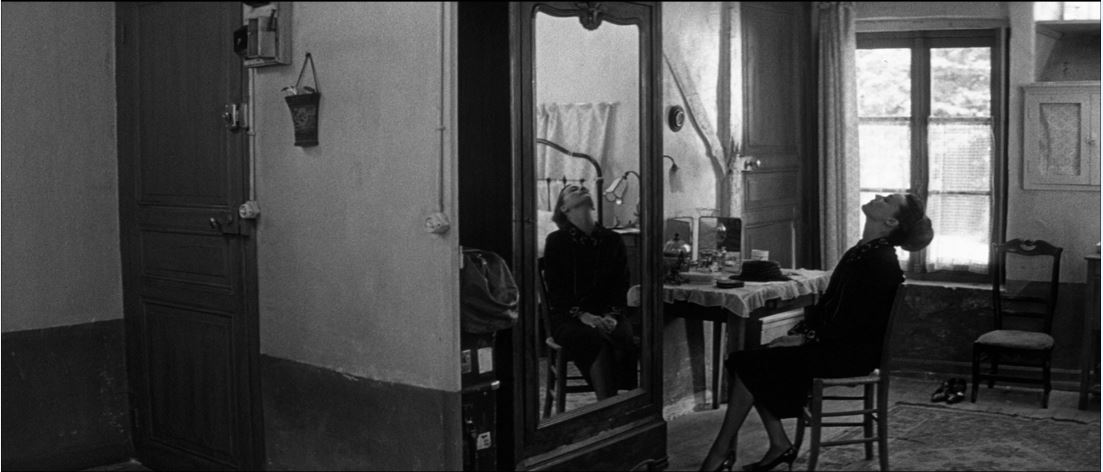
Jeanne Moreau alone in a room on a chair

Filmed in the stark black and white more usually associated with Woodfall Film’s British kitchen sinks, Richardson’s French foray, could almost be a silent film. Many who hear the dubbing of French performers into English may actually prefer that but at least Moreau’s voice is her own, not that she needs audible language to make her feelings shown. She is remarkable as the titular Mademoiselle with a performance of oblique intensity that conceals as much as it reveals.


In Jon Dear’s essay in the accompanying booklet, he describes Moreau as empowered by her solitude, committing destructive acts with impunity protected by her status and loneliness from consequence and discovery. We know from the very start, as her fishnet gloved hands casually open a sluice gate that floods a farm, that she has no guilt only fascination with the wreckage she creates. She stands excitedly watching the rescue attempt, attracted to the heroic masculinity of Italian woodsman Manou (Ettore Manni) who we begin to suspect is her motivation for causing the havoc.


Jeanne and Keith Skinner


The script was completed by Marguerite Duras based on Jean Genet’s original idea and the latter’s focus on isolated characters was drawn from his own experience as an outsider in a small rural community. No matter how much the Italian men step in to help put out fires and rescue farm stock from floods, they are constantly under suspicion from the locals, driven by xenophobic distaste as well as sexual jealousy. Manou is a big hit with the local ladies and, no doubt from Genet, there is the sexualisation of his manliness as well as physique with the camera following Mademoiselle’s interest.


Genet’s complex relation ship with the progression of his work to screen is examined in an essay from Jane Giles who provides much fascinating detail, as does Jon Dear who reveals that David Bowie’s Jean Genie was written about the author – new information certainly for me. Genet had long rolled off this particular project but his themes remain, especially those of control and identity; the disconnect between the schoolteacher’s actions and her wish to be respected. Her obsession with French war hero-turned-child killer Gilles de Rais and child warrior-turned-Saint, Joan of Arc, speak for themselves.


Jeanne and Ettore Manni in the wild

The film’s narrative is sometimes out of joint, adding to a general dislocation and a dreamlike quality a full-channel width away from Richardson’s A Taste of Honey (1961) or Look Back in Anger (1959). Mademoiselle dreams in the forest and then she meets Manou on a bridge and he shows her a snake he has wrapped around his midriff; it’s the most obvious phallic symbol and one the rightly belongs in a dream and yet, some time later the two resume their meeting and appreciation of the reptile.


This approach to narrative combines with Moreau’s masterful control to confound our expectations and to reinforce that feeling of reverie as the schoolmistress blows very hot and then very cold with Manou’s son, Bruno (Keith Skinner) chiding him for being dressed like a gypsy before going out of her way trying to help him. Whilst there is something building with his father, the boy is not yet tainted by the sex and sin of men and which she is drawn to and repulsed.


Hats off to David Watkin - stunning depth of field all achieved in camera and under water

At times the film feels like a folk horror of a slightly later vintage as David Watkin’s camerawork gives us a disorientating mix of largely static close ups and people dominated by the force of their country landscapes. The woodlands carry a visceral sense of freedom and ancient mystery whilst the village interiors are clinical and confining. Antoine Duhamel’s music amplifies these conflicting spaces perfectly and when events do happen, they are jumbled and disorientating.


Richardson's shots are oddly pointed with the village processing to church intercut with Mademoiselle's first evil deeds and fish being taken out of a river as they walk above. There's also a conversation between local women conducted almost entirely over a shot of their washing clothes; the enclosed atmosphere of the village focusing in on itself. The woods act as a catalyst for the school teacher, she reaches out to the boy when she sees him there and, of course, that is where the barriers are removed between her social self and her true nature.


Once Mademoiselle and the Woodsman do connect there is the most extraordinary sequence of physical interactions that, spoilers aside, provides a jaw-dropping crescendo amongst this deafened world of petty jealousy and indifference to truth versus preconceptions. It always comes down to the now…


In addition to the essay-packed 38-page booklet, there’s an interview with Keith Skinner with the BFI’s Vic Pratt as he looks back on the film as well as a new audio commentary from film scholar Adrian Martin recorded especially for this release.


There’s also a second feature, the British Doll’s Eye (1982) directed by Jan Worth who, writing about it in the booklet, describes it as an attempt to blur the lines between documentary and fiction in relation to sex workers and their male customers. The idea had been sparked by inviting men to write in with their responses to adverts for prostitutes and these led to Worth writing a script and directing the film.


Doll’s Eye features Jane (Bernice Stegers), a researcher working on a research project about men’s views on female sex work; Maggie (Sandy Ratcliff) a sex worker; and Jackie (Lynne Worth), a young woman who has moved south from the industrial north of England, as part of the early eighties migration as Thatcher’s “managed decline” saw prospects disappear. Jackie babysits for both and works part-time as a switchboard operator. Worth’s film pays tribute to the social realism of early Woodfall films but without attempting the same naturalism and the result is a mix of verbatim quotations from the source research and a restrained drama examining social situations and power relationships; ‘who looks at whom and for what purpose?’


Mademoiselle is out now and is available from the BFI shop and online.


Sunday, 20 September 2020

The Griffith Cut… The Mother and the Law (1919), more Miriam Cooper


“I bit my lip and drew blood. The camera stayed on my face and you can see the blood run down my chin, I didn’t even feel the pain so intent was I on what I was doing…”*


As unreliable and opinionated a witness as she was in her biography, Miriam Cooper truly was the Dark Lady of the Silents and the scene she is referring to was one I almost dismissed as too over the top. Miriam plays The Friendless One, is a woman wronged spying on her gangster lover as he tries to force Mae Murray’s innocent into sex; it’s horrible on both those levels and Miriam is carrying a gun that she is terrified of using and yet so compelled with anger she really wants to.


By coincidence she is in the same position as Vincent Cassel in La Haine (currently on re-release !) who really wants to kill a fascist skinhead and yet struggles to hold himself back from the fateful moment. As Cassel goes through all manner of moral torments his face is contorted in much the same way as Cooper’s as she bites her lip and the blood flows. Is she trying to shock herself away from this course of action or is her hate so intense she no longer cares who she hurts, even herself? Either way, you can sense Griffith’s prompting as Cooper reacted with Gish-like method and Billy Bitzer’s camera kept on rolling… just as it did for her co-star Mae Marsh.


Marsh said in 1917, “I have seen Intolerance twenty times, I suppose, and it never occurs to me that ‘The Girl’ in the modern epic is myself. It is all Mr. Griffith…In his pictures everything - scenery and players- is just so many instruments in his orchestra.” Stuck as he was between radically different moral and political views, Griffith felt that 'motion pictures must be true to life saying that "the truer they are the greater they are.'" His view of “truth” was, of course, as subjective as yours and mine but we can all agree on a bloodied lip.


Robert Harron and Mae Marsh

The Mother and the Law has one of the most complex gestations in silent film having originally been filmed just after Birth of a Nation as a small budget drama concerning a couple down and out in the big city. Before BoaN was even released though, Griffith was plotting his next move and the result would be the epic Intolerance of which the film would form just one of the four strands. Intolerance unachieved at the box office and in 1919 the director re-cut this film along with the Babylonian sequence with the effervescent Constance Talmadge.


Both are on the Masters of Cinema Intolerance Blu-ray and Mother is especially worth viewing as a separate film as Griffith included more footage and rounded out parts of his story and some of the characters, not least Cooper’s Friendless One (honestly DW, why not just call her Francine or something?).


Arthur Lennig, has written about the film in Film History , 2005, Vol. 17, No. 4, Unfashionable, Overlooked or Under Estimated (2005, Indiana University Press)* and establishes that: “Once Griffith decided to make Intolerance, The Mother and the Law would be changed from a simple story into an audacious indictment of how large social, economic, and moral pressures affect the lives of the principal characters.”


Miss Jenkins at a society ball, realising people have too much fun...

Griffith’s target for intolerance seems an odd one for modern viewers in that he decided that some charitable organisations, “up-lifters”, were in it for their own glory. In the film their commitment to the expense of too much charity leads to lay-offs, as the factory owner needs to pay for his barren sister’s indulgences. This triggers a violent strike and the main characters’ fall into poverty and further intolerance, yet it does seem more than a little convoluted: which industrialist is seriously going to cut salaries in order to fund his sibling’s pet charity? This, of course, did not go unnoticed at the time and in the 1919 cut, the director is at pains to explain that he doesn’t mean all charities only those run by bored, sexually frustrated women and not the Salvation Army, the church and the majority of "charitable" charities. DW was however inspired by contemporary government reports and, according to Lenning, “…had in mind John D. Rockefeller, who by this time was managing much of his father's fortune… a pious and sheltered young man opposed to whatever he considered licentious, including drinking and dancing…”


For Griffith, mankind’s moral weakness could only be changed by appealing to people’s good conscience and not by legislation and force. It is an argument for the ages from the country that was to prohibit the sale of alcohol in 1920 and which, even today, is reluctant to force its citizens to wear face masks or not own automatic rifles.


These “intolerables” who don’t tolerate poverty and unchristian behaviour from the undeserving poor are not DGW’s only target in the film and, as Lennig argues, he was concerned with the inequalities created by “indifferent capitalism”, criminality and the death penalty. So, to give him his due, The Mother and the Law is if nothing else a damning inditement of the latter. Lenning quotes assistant cameraman Karl Brown on the impact a visit to San Quentin – “an actual prison inhabited by living dead men” – had on his director who then made sure that the film’s execution sequence was as accurate as possible. The three men standing ready with razors ready to cut the ribbons that drop the panel between the doomed man’s feet is particularly unsettling; as with a firing squad, they would never know which cut was the quickest.


Griffith's meticulous gallows


Griffith is also critical of “indifferent capitalism” and not just in its preference to indulge “self-proclaimed do-gooders” rather than pay a living wage. Uncaring industrial cost-cutting leads all three of our main characters to the slums and criminality and whilst DW would have recoiled at socialist solutions he was strangely on the same page with regards to the plight of Marx’s “industrial reserve army”, the under-employed.


“Bitter mistakes” unbalance society with Cooper’s Friendless One and “her first love”, The Boy (Robert Harron, who doesn’t get enough press!) and The Dear One (Mae Marsh) all displaced from Jenkins Mill and semi-rural idyll, and forced to fend for themselves in the city where they “flounder helplessly in the nets of fate”.


Miriam’s good looks get her the attention of a Musketeer of the Slums (Walter Long who played a black-faced villain in BoaN) and work as a hostess in his bar. It is unclear if she becomes a prostitute but she becomes the Musketeer’s girl – possibly wife – tough choices with no one else to turn to.


Robert Harron, Walter Long and Miriam Cooper

Bobby Harron gets work as a small-time crook whilst Mae ekes out a living with her father in the slums. Marsh’s character is the most nuanced, the moral heart of the film who retains the child-like innocence her director was so fond of. She and Harron start a relationship but she refuses his advances, believing in spit of everything around her, in Christian values. The Boy marries her and they form a new family when their child is born and he informs the Musketeer that he no longer wants to work in the business of crime.


But it is not so easy to disentangle himself from the underground and he’s set up for a crime he didn’t commit and ends up doing time. Meanwhile the “do-gooders” end up taking their baby away from The Dear One, refusing to believe that the wife of a criminal is capable of bringing up a child. Then the Musketeer notices The Dear One and the scene is set for the breakneck injustices of the final half and hour when murder, circumstantial evidence and conscience all come into play.


Lenning has The Mother and the Law as the last time Griffith would examine the world around him in a naturalistic manner and with a critical, crusading spirit. It’s a film that, in a simpler way than Intolerance, gives some balance to our view of his problematic views on race and social order, both of which were challenged at the time and which we must continue to contextualise.


Griffith/Bitzer deliberately allow this close up of Mae Marsh to drift out of focus: she's lost...

Harron, Marsh and Cooper are all good and the latter gives probably her most distinguished performance. Miriam is strikingly modern, dark eyes so worldly and fierce whereas Marsh is Victorian, child-like and under-nourished, running through the Griffith range with almost equal skill to Lillian and Mary. But Cooper is an outlier of a more sophisticated age even if she lacked the other’s raw skill. Harron is also a fine player and inhabits this sunken world with naturalistic ease, he too carrying the shallow frame of a poorer age.


Walter Long also shows what a fine performer he was without BoaN’s “make up”, he kept on reminding me of the original Musketeer, Snapper Kelly from Griffith’s Pig Alley (1912), Elmer Booth who died in a car crash in 1915. Harron, who also died a tragic death in 1920, was in that film too, which was co-written by Anita Loos who also worked on The Mother and the Law… Griffith at his best with a largely settled team?


Harron behind bars...

The Masters of Cinema Blu-ray is available at a ridiculously reasonable price from Amazon. You probably already have it but you may not have watched The Mother and the Law… in which case please give it a go for DW’s sake and for Miriam Cooper’s lip!


*Miriam Cooper, The Dark Lady of the Silents

**Arthur Lennig, The Mother and the Law Author(s): Source: Film History, 2005, Vol. 17, No. 4, Unfashionable, Overlooked or Under Estimated (2005), Indiana University Press


 Bonus screen shots!

Uplifters and indifferent capitalists...

Strike breaking that wouldn't be out of place in a Soviet film...

Miss Marsh emotes


Thoroughly modern Miriam

The Docks of New York

Sunday, 13 September 2020

Hate our way… La Haine (1995), BFI re-release, in cinemas now.


“How you fall doesn't matter. It's how you land!”


There’s a tendency to doubt any human experience beyond our own with denial a most compelling response to grief, day after day it’s not just Laurence Fox who thinks all lives are equally threatened or equally free but it’s simply not true either empirically or emotionally.


I remember the riots that formed the basis of Mathieu Kassovitz’s story and watching this visceral film a quarter of a century later is a sobering experience as the Western World undergoes another alarming rise in civil disobedience in response to police brutality. These things are never simple as indeed Kassovitz makes totally clear, but it is the sheer mind-numbing predictability of events repeating themselves that hits you the hardest.


As one of the main characters says, "la haine attire la haine!", “hate breeds hate!” and yet we carry on, societies in free fall, telling ourselves that, from moment to moment, “... so far so good... so far so good…” yet the hard impact is ever approaching.


Kassovitz was inspired by the death of Malik Oussekine, a student who died after being badly beaten by the riot police after a mass demonstration in 1986 as well as that of a young Zairian, Makome M’Bowole, who was killed when a gun went off at point blank range while in police custody and handcuffed to a radiator in 1993. Both are referred to in the opening montage, now just two victims in the endless human chain of fear and disregard; you don’t have to have a bleeding heart to despair at the sheer inefficiency of hate, there is simply no utility.


Hubert Koundé, Saïd Taghmaoui and Vincent Cassel


Kassovitz is described by Jodie Foster in her interview on the Criterion Edition as a man from the streets who was also very well educated and in his search for authenticity he filmed in the Parisian “projects” of Chanteloup-les-Vignes where the actors and production team, moved for the filming three months prior to the start of the shoot.


The three leads are featured in virtually every scene and all leave their mark, Hubert Koundé as Hubert has not only uncanny grace and power but also, as Foster says, a childlike quality that gives his character a vulnerability despite of his intelligence and apparent purpose. Hubert runs a small gym and boxes, peddling dope to cover his costs – something so commonplace many of us will have seen it at school (most Tory MPs aside).


Saïd Taghmaoui’s Saïd appears to be the youngest and is the joker in the pack, of North African descent and therefore a more significant part of French imperialistic history than the others. He’s easy going, less aggressive and the most neurotypical.


Hubert Koundé


Vincent Cassel is, of course extraordinary, as the hyper Vinz – of Jewish heritage - attention deficit, ultra-energised and with testosterone levels cancelling out reason. He mimics Robert de Niro’s Travis Bickel in the bathroom, “…you looking at me?! Tu me regardes?!” fierce but still boyish. He wants to kill a cop if their friend dies in police custody but we’re not sure even he’s sure he’ll do it even though the momentum of the film is such the sense of strictly limited mortality is ever present.


The film begins with footage of actual riots before revealing that the lads’ friend, Abdel Ichacha, has been hospitalized after taking part. The locals attack the police station in retaliation and this leads to a riot during which a police officer loses his revolver… Vinz, finding the weapon, finally has some power in a life curtailed by economic and social circumstance, but how will he use it.


The story follows the three for the day after the riot as their normal monotony is broken by thoughts of revenge and the constant presence of a police force intent on not losing control of the situation. There are community liaison officers amongst the police but more forceful elements are now at play and some of the policing is shockingly aggressive; one painful scene has two Parisian policemen humiliate and torture two of the boys as another watches in disgust.


Saïd Taghmaoui

This is one of those moments when I doubted the narrative – I am a policeman’s son after all – but then I read about the death of Makome M’Bowole… La Haine forces these issues and the responsible thing is to educate yourself and not ignore patterns of brutality or even dismiss them as the problem of certain countries. In my father’s time parts of Liverpool were so rough that the bobbies patrolled in groups of three, they weren’t armed with anything other than truncheons and, by and large, they came from the same working-class culture as those they policed. Now, societies are far more diverse and structurally broken… France, Britain and the US are all, to varying degrees, in decline economically, politically and morally.


Pierre Aïm’s cinematography pulls the viewer into this grim world, with exceptional mobility, extended takes and the choice of black and white stripping away the artifice of cinema and pushing you face to face with the main characters as they travel from the projects into Paris for the first time, in search of money and chance. There are superb cameos on their journey, with François Levantal as Astérix, a coke fiend who supposedly owes Saïd money and who plays Russian roulette with Vinz’s gun – this is real madness boys, only he’s palmed the bullets… Then there’s the drunk (Vincent Lindon) who offers to drive the car they steal when they realise that none of them can drive and the old man who emerges from the toilet they’re in to casually relate how his friend died of exposure after failing to re-board the train taking them to the gulag; life can be lost in such mundane ways.


Marooned in Paris after midnight, the boys encounter a group of skinheads and only Vinz’s gun saves them from a beating, they capture one of the skins (Mathieu Kassovitz) and Hubert tries to goad Vinz into showing that he can kill someone he hates. It feels like a pivotal moment but then the three have still to return to the projects…


La Haine still punches above its weight and is recommended for old Harrovians and state school oiks alike. It has its message but it is also great cinema and needs to be seen on the big screen.


It’s now on general release and at the re-opened BFI over the rest of September, details on the BFI website here.


Sunday, 6 September 2020

The 3D comic… After the Fox (1966), BFI Blu-ray coming soon!


“Because I’m a small crook I have to go to prison, it’s only the big crooks that stay free…”


There is an enduring fascination with the notion of Peter Sellers being an empty vessel who was only inhabited by the roles he played and the suspicion that this even extended to his private life. No doubt he was highly adept at mimicry and took this to the screen with such convincing “method” that you could barely see the “real me” at all. As Vic Pratt says in his excellent video essay accompanying this new release, this was a myth Sellers was happy to promote, telling The Daily Mail in 1960 that “I haven't a personality. I sometimes wonder whether I really exist at all.”


In After the Fox, Sellers plays, Aldo Vanucci, aka The Fox, an Italian criminal who is a master of disguise OR… is he Peter Sellers, playing Peter Sellers as an Italian master of disguise? It’s hard to tell but there’s a likability and knowing good humour about each sub-role, from Aldo playing a priest angry at his sister’s becoming an actor, or as the doctor who, get this, impersonates himself to escape prison (maybe). Pride of place has to go to Aldo’s impersonation of Federico Fabrizi, a film director using the pretence of making a film to smuggle stolen gold into Italy.


There’s so many layers in Neil Simon’s onion of a plot and so many knowing pot shots at Italian cinema from the deliberate “FF” to lines like “What’s neorealism?”, “No money…” which is pretty funny when you consider this film’s director, Vittorio De Sica famously directed Bicycle Thieves. Michel Antonioni is also high up on the list of targets with this FF making a film up on the spot and deciding that his two leads sitting and doing nothing would make a statement on our inability to communicate in modern society… “Lights, camera and no action!” indeed.


Victor Mature and Britt Ekland make a statement 

There’s also a scene when Victor Mature’s fading Hollywood leading man, Tony Powell, arrives to a mob reception in Rome, which reminiscent of Antonioni’s movie star in L’Avventura and probably makes the same point: the public aren’t interested in the who just the what. Mature came out of retirement to make his first film in four years and he’s excellent value for money; perhaps he fancied a laugh and an all-expenses trip to Europe, but his screen presence and willingness to send himself up is in full-blooded contrast to Sellers’ artifice. Same ends, different means.


Of course, Sellers is also playing Sellers as the brother of his sister who is his wife… with Britt Ekland staring in her first film as Gina Vanucci  who becomes Gina Romantica when The Fox decides on his plan to film his crime and hide his crime as a film. Aldo is getting tired of the criminal life and wants to look after his mother and sister, “I want to steal enough to go straight!”, another zinger from Simon that still holds true to this day.


The gold was stolen in Egypt by master criminal Okra (Akim Tamiroff) who uses his sister (Maria Grazia Buccella) to strip down to a bikini in order to distract the armoured car drivers, who veer off straight into the back of lorry. My daughter rolled her eyes but Okra’s sister is further reduced by merely being his spokeswoman and she mouths his words in the restaurant in which Aldo is briefed.


Years before Sara Cooper, Maria Grazia Buccella was an evil man's mouthpiece


She later says to Aldo that Okra “…doesn’t allow me to talk to anyone, I haven’t used a telephone in six years…” which is more of a punchline than a proto-feminist comment. Never-the-less, she has beautiful eyes and plays her part in adding emotional depth as well as humour especially in a world in which, as Aldo says only the big crooks, like her brother and no doubt many film producers, stay free. Simon’s script is most certainly not without intent.


Aldo and his gang of three stooges, Polio (Paolo Stoppa), Siepi (Tino Buazzelli) and Carlo (Mac Ronay) steal filming equipment from Vittorio De Sica (as himself) and he then transforms into Federico Fabrizi in order to persuade Tony Powell to accept the leading “role”, in spite of the objections of his agent Harry Granoff (the ever excellent Martin Balsam) who was looking for an actual script and contract.


Crew and cast, now completed by the newly christened Miss Romantica, head off to the seaside village of Sevalio, actually  Sant' Angelo on Ischia in the Bay of Naples, for the film’s impressive set pieces as hundreds of villagers act as extras in action Fabrizi makes up on the hoof. Here there is little sign of any of the reported tensions between Sellers and De Sica, as the latter marshals his extras well to energise the dénouement.


De Sica makes like DeMille


The film had a mixed reception on release and Simon for one was critical of how his script turned out but it is well made and still very funny, good performances all round and impressive comedy chops from Ekland as well as Mature. But it’s Sellers’ film and for a man who wasn’t really there, he always manages to convince us enough to care and to believe in Aldo’s misguided by sincere code of honour.


The film is bookended by a groovy Bacharach and David theme song which, melodically powerful as it is, also as Vic Pratt says, sums up the unsettling aspects of Sellers’ persona, The Hollies in close harmony asking Sellers in character “who is me”, to which he answers, I am a thief, I am the Fox… and so much more, obscurely.


Pratt quotes The Daily Herald review of The Battle of the Sexes (also on BFI Blu-ray!) describing Sellers as “… the first 3D comic, his rivals are all cardboard cut-outs, if you round the back of them, you’d find nothing.”  In this film we can Sellers disappear into character just as he would do all the way through to Chance the Gardner; as the most soulful of mimics, he could walk on water.


In addition to Vic’s essay, Peter Sellers: Master of Disguise  (2020, 14 mins), there’s also a nifty interview with Britt Ekland, After the Fox: A Socially Distanced Interview (2020, 15 mins) which contains much good-humoured insight and positivity as she looks forward to returning to the London stage.


There’s an East German newsreel, DDR Magazin Nummer 11 (1962, 12 mins) with director Vittorio De Sica paying a visit to Berlin and The Man With the Velvet Voice: Maurice Denham (1961 + 1975, 72 mins) featuring the mellow tones Mr Denham in two rarities from the BFI National Archive: the CFF classic The Last Rhino and BTF film Go As You Please… in Britain


And there is a lovely Victorian silent snippet, Robbery (1897, 1 min), possibly the earliest heist comedy? And, you better order your copy quick as, for the Illustrated booklet with new writing by Vic Pratt, Dr. Deborah Allison and Howard Hughes, notes on the extras and full credits, is only available with the first pressing.


After the Fox is released on 21st September and you can pre-order now on the BFI website; you will not regret it!