Saturday, 12 September 2015

The bear hunters… Den Starkaste (1929), with Stephen Horne, British Silent Film Festival

Day Two at the BSFF and another surprise – so many silent films so little time... This late-period silent Swedish film is so accomplished it presents almost as a modern film and you wouldn’t be surprised if someone spoke such is the eloquence with which the directors use visual language.

Den Starkaste (The Strongest) was co-directed by Alf Sjoberg and cinematographer Axel Lindblom the latter having formulated the story whilst out filming documentary footage in the Barents Sea in the early twenties. Linblom clearly loved the outdoor life and quit cinema after this film to become a farmer. Here his mastery of capturing snowscapes is superbly counter-balanced with the cramped interiors of wooden sailing ships just as his close-ups of human emotional interplay are juxtaposed by long shots of man in the uncertain enormity of nature.


The film follows a group of Arctic hunters as they take their boats into the heart of brightness during the summer months of seal and polar bear hunting: harsh work if you can get it and even harder for a bunch of southern intellectual film makers. It makes Man of Arran look like a day trip to Southport (mind you, Lord Street on a Saturday night?!)

Sjoberg and Lindblom mix what looks like documentary footage with their action, there are a number of animals harmed in the film and one hopes that this wasn’t just for the benefit of the entertainment.

Bengt Djurberg and Gun Holmquist
The cinematography is stunning – the coast and ice may look amazing but there is still a real art to capturing this in difficult conditions. At one point an actor or stunt man (what’s the difference apart from insurance premium?) leaps over slippery ice flows that even Lillian Gish might think twice about; on more than one occasion he slips and almost missed his mark, with no one anywhere near - this was dangerous business.

Maria Röhr, Hjalmar Peters,  Anders Henrikson, Bengt Djurberg & Gun Holmqvist
But there’s no story without "the human" and the heart of this tale is the rivalry between two sailors Ole (Anders Henrikson) and Gustaf (Bengt Djurberg) who is the “strongest” of the title; firm of feature and strong of jaw, with a remarkable set of teeth (as a Brit, one notices these things and feels envy). When pestered by a farm hand chopping wood, Gustaf simply picks him up and throws him away – he has the smile of a winner, the confidence to rise to every challenge but even he may need help as the story progresses.


On his way to port, he encounters willowy Ingeborg (Gun Holmquist, another Swedish superior being…) the daughter of whiskery Larsen (Hjalmer Peters) the captain of The Viking (natch!) an ocean-going hunting vessel. Ingeborg would like her father to spend more time at home but he wants to be able to hand his ship (and daughter) over to a man he can trust.

Ole about to take aim
In the frame is Ole who is gifted Larsen’s rifle and who would also like his daughter… yet Ingeborg isn’t interested and certainly not in the way she demonstrates in returning Gustaf’s appreciative gaze on the road.

The Viking’s crew prepare for their summer campaign and set off for their last night on the town, a fight breaks out (as it seems it must) and in the kerfuffle a rival crew member steals the rifle...this will be important later on.

Bengt Djurberg and Gösta Gustafson
After they set sail, Gustaf begins to make himself useful on the Larsen homestead when he finds out that Ingeborg lives there: his smile, her eyes… it was always going to happen. But, once Larsen and Ole return his over-confidence blows up in his face and he’s cast adrift after swiftly besting Ole. He vows to return for Ingeborg’s hand (and the rest of her).

Gustaf joins the crew of The Maud, captained by the even more whiskery Olsen (Civert Braekmo) and which includes a hunter called Jens (Gösta Gustafson of Sir Arne's Treasure and later Summer with Monika) who carries a familiar rifle…

Gustaf out muscles Ole
It is inevitable that the two ships will meet out on their hunt into the brutal Barents and this is where the film really takes off as the men pursue their prey and human nature reverts to its basic elements. Gustaf sets off with Jens on a boat to shoot seal, they lose touch with The Maud and things look bleak, even bleaker as Jens, jealous of the better man, leaves him for dead on an ice flow.


All looks lost until The Viking sends Ole on a boat to rescue him… the latter rather disappointed when he discovers who he’s saved. Now things really kick on and the action and emotion starts to peak with rivalry, spiced by mistrust, envy and the question of that rifle...

Den Starkaste ranks with many a good Scandanavian silent outdoor epic. The story is an old one but told very well with a good narrative focus and superb use of those contrapuntal rhythms of man and nature.

There are no weak links in the cast with Henrikson and Djurberg excelling in the rivalry and as the subject of their competition (the girl not the rifle, although she is called Gun), Holmquist injects the right mix of doe-eyed and disaffected – if Ole’s the future she’s not looking forward to it and she reserves her affection for her father until the right man comes walking along the road…

Gun Holmquist and Bengt Djurberg courtesy of SFI
The title card translations don’t always reveal it but there’s also clear evidence of the famous Swedish sense of humour and whilst there are serious moments aplenty, the story is is well-balanced all round.

Once again Stephen Horne was on hand or rather hands, to add excellent improvisations to the visuals. Whether performing a pre-composed score or making it up on the spot, he puts so much lyricism into his playing – music for the big country and huge emotions!

Axel Lindblom on site
Other silent film musicians are available though and next I shall describe Mr John Sweeney’s epic accompaniment to the almost three hours of Michel Strogoff!

More detail on Den Starkaste is available on the Swedish Film Institute database which is where I've appropriated some of the above images - the SFI  watermark is a give-away.

Friday, 11 September 2015

Top guns... The Guns of Loos (1928), Stephen Horne, British Silent Film Festival

Henry Victor
This was one of those silent films that leaves you reeling – imagery, invention and performance intensity all enhanced by a score that refused to let its own power do anything other than add flavour to these already potent ingredients. Ever seen Stephen Horne accompany an uninteresting silent film? Nope, me neither - he always respects the primary source and works to bring out the best of what’s already there: like a skilled actor interpreting a Tudor text.


The Guns of Loos was a surprise to those, like me, who had never previously heard of it and, following a day of early British talkies, a step back to silence simply blew those others away. After hours of sometimes ponderous delivery, films that merely played with the novelty of sound and static actors tied by invisible strings to their microphones, we were reminded of just how powerful moving images could be in 1928.

This wasn’t the first Sinclair Hill directed film we’d seen today, that was Dark Red Roses (1929) in which a fretful sculptor, David (Stewart Rome) weighs up the option of cutting his cello-playing love rival’s hands off. The action was studio-bound and a few performances aside, Frances Doble was good as the object of the artists’ attention, it just felt slight and a little bit clunky.

Grimlaw fights for his self-worth
Not so The Guns of Loos which took a character-led view of the Battle of Loos – known with good reason as Dundee’s Flodden and the largest land battle in British military history. Some 60,000 lives were lost including many from the Dundee divisions of Scottish regiments. Stephen’s score was commissioned by The Great War Dundee Project and Dundee Contemporary Arts to help commemorate the centenary for a city which sent over 30,000 men to fight.

The story was informed by Sinclair Hill’s own wartime experience and so impressed Lloyd George that he claimed: “if I had had this film in 1916 it would have been worth a division to me.”

The Guns of Loos is about true love, redemption, comradeship, industrial relations and the movement of horse-drawn gun batteries at speed, over muddy ground. No animals were – probably – injured during the filming of this story but a number of cameramen may have required a rest-cure.

There is a love triangle between munitions factory owner John Grimlaw (Henry Victor), a young army officer Clive (Donald Macardle) and Diana Cheswick (Madeleine Carroll here in her first film and who serenely reminded me once again why my granddad Bill was such a fan…). The battle was partly lost due to a shortage of British munitions and Hill smartly ties this in with this smaller scale drama.

Time for a speech...
The film is packed full of “European” camera flourishes – this could almost be a German film… There’s a lovely sequences as the camera pans over the faces of a wedding party a pub... then swaying in grainy close-up as the groom gives a speech. As the locals gather to say farewell to those about to fight, the image movies to and fro as they sing Auld Lang Syne – with Clive and John almost pulling at Diane like a wish bone. The ground beneath is indeed shifting beyond anybody’s control and then as the line moves up screen there appears almost a mirror image below of men and horses trudging over the mud of the western front.

There are inspired shots of gun batteries being moved – a tracking shot from alongside and then some shots from underneath which convey the rough-edged energy – the images are blurred and impressionistic, a little bit Gance and something altogether more modern. The impact is visceral and unsettling – the uncertain velocities of battle.

A tip of the hat to Hill’s cinematographers: D.P. Cooper, Desmond Dickinson and Sidney Eaton.

Donald Macardle and Madeleine Carroll
The performances are universally interesting and none more so than from Henry Victor, who, held in close up for so many shots, is a revelation, spitting out his lines as he urges his factory workers on, crying in fear as he breaks down during his first action and then gradually re-building his self-worth urged on by his rival and comrade… There weren’t many heroes this complex in contemporary cinema.

Donald Macardle’s eyes are also close to tears as he looks on at Diana in the bitter-sweet adoration of the loser in love… he is decent and strong but Diana sees something great in Grimlaw, something she can help save with her huge, enigmatic frown, gentle smile and… simple excess of lovely.

Diana’s mother, Lady Cheswick, is also superbly played by Adeline Hayden Coffin who looks like she may have a crush of her own on young Clive but exudes emotional intelligence. There’s also grand support from Bobby Howes as factory worker then private, Danny and an impossibly young,  Hermione Baddeley (a hyper-Hermione: who knew such a thing existed?) as his girlfriend Mavis.

These people just feel real and Hill deserves great credit for his casting and coaching. The British war films of the period tended to be as "documentary" as possible and whilst Hill’s reconstructions are no different and are exemplary in that respect, his characters ring true.

Daniel Laidlaw on screen
Which brings us right back to Mr Horne’s score... which was, as always, laced with his trademark integrity, due diligence and lyricism carrying intrinsic warmth that elevates any hope or adds poignancy to any tragedy. Stephen was ably supported by two other players on cornet and percussion*. He also had the aid of bagpiper Daniel Laidlaw who not only fought in the battle itself but also appeared in the film. A sample of his playing was inserted in the live music… eerie and effective; if that doesn’t make you feel just a little bit Celtic then you’re English beyond all help!

We could have watched the whole show all over again even as the long day closed… Catch the film and live score if you can and here’s hoping that this one gets a DVD release.

While we’re at it, isn’t it time for The First Born and The Manxman to also be released? Two of the best British silent films with two excellent Stephen Horne soundtracks… how does that not work as a commercial proposition Mr and Ms Copyright Holder?!

You ain’t heard the last of this, mark my words, The Man!

*I didn’t catch their names but if someone could let me know I’ll update.

British infantry of the 47th (2nd London) Division advance through the gas cloud on 25 September 1915

Monday, 7 September 2015

Everlasting love... Ma l'amor mio non muore! (1913)


Ma l'amor mio non muore! was specifically written for Lyda Borelli, one of Italy’s leading stage actresses and featured her performing two of her most famous roles on stage: Salome and Zaza in front of an undoubtedly star-struck audience of extras. It’s one of the moments; historical film as history in itself; the actress and her effect.

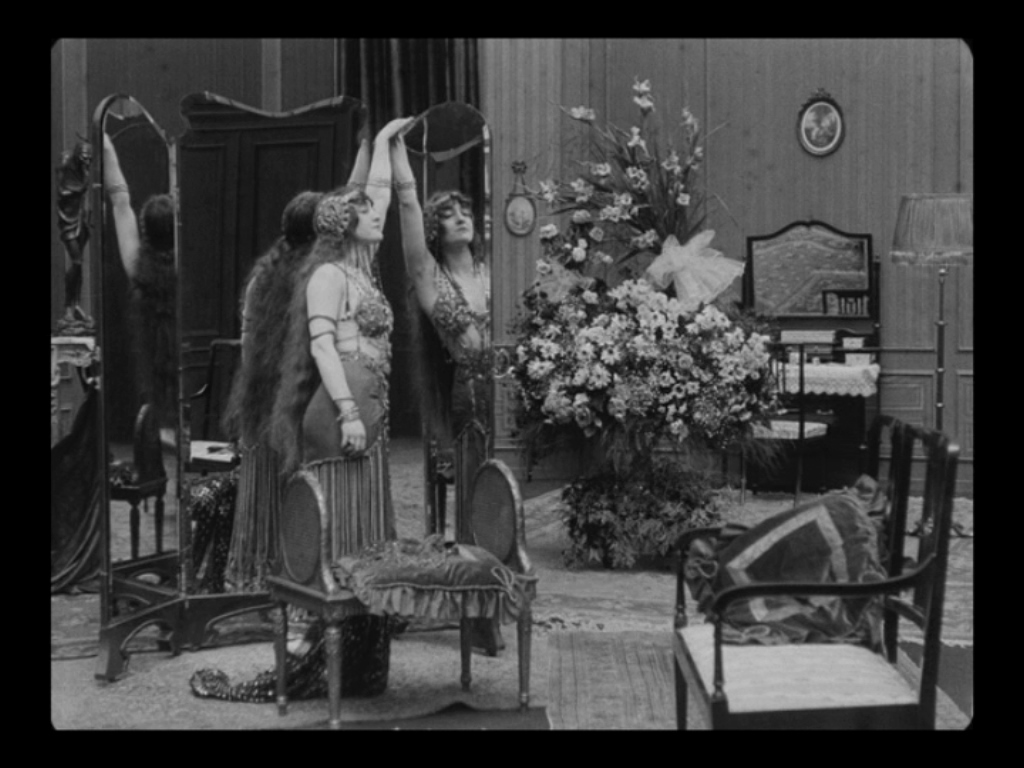
Lyda Borelli on stage
As Ivo Bloom notes in the booklet for the Cineteca di Bologna DVD release, it’s also a document of La Borelli finding her way with the new medium: her first time on screen, developing her film acting style and so instinctively well, even from the modern viewpoint. Next to Asta Nielsen, Borelli’s acting is amongst the most naturalistic you’ll find in 1913. Yes there are a few moments of over-wrought arms-aloft, hand-jiving but look closely and you’ll notice an incredible range of expression: fleeting moments of anger, and even disgust that wouldn’t be found on the face of many.

Borelli didn’t care about her “look” so much as her expression, it seems, even though the look took care of itself... and her storytelling is in many ways well in advance of the film’s narrative.

Borelli often shows emotion through poise alone...
Mario Caserini directs well with lots of similarities to contemporaries in Italy as well as elsewhere in Europe – Bauer, Christensen, Blom, Perret et al. There is, as Bloom notes, less editing than in American cinema but long takes on huge sets which provide their own “cuts” in the story.

The vast "playing area" of the Colonel's house
 In Colonel Holbein’s house, the parlour leads off to his study on the right and the dining room on the left which is initially covered by curtains. The characters move around in long takes and are choreographed to move the narrative around the space: Ida’s character Elsa being romanced by Sthar the spy at her piano whilst the traitor looks over to the study to see the two colonels examining the war plans he must steal. The colonels leave and whilst Elsa says farewell, Sthar sneaks across to the study and takes his prize.


No doubt Lois Weber or DW Griffith would have done this differently but it works all the same whilst also looking altogether more splendid and grandiose than they might have made it. It’s probably a bit lazy to say that the Italians favoured style over substance but there are some rich textures in the mis-en-scene and so many huge floral displays.

Salome?
La Borelli also has more costume changes than Lady Gaga or even Lady Miss Kier (anyone remember DeeLite: a costume change for almost every song if memory serves!?) and this film is a must for dedicated followers of Mariano Fortuny and the rest. And, of course she wears it all well, with a practiced physicality developed over a decade on stage and yet with granular emotional control that belies her cinematic experience: she sucks the viewer into these improbably large spaces and you completely overlook some of the hams surrounding her (Improbable spaces? Impossible beards!).


The film starts with information being handed to the spy Moise Sthar (Gianpaolo Rosmino); he reads the instruction then furrows his brow working out how to achieve his goal to steal the secret war plans of the Wallenstein army.

The Rotter!
Next we cut to the army’s chiefs of staff, including Col. Julius Holbein (Vittorio Rossi Pianelli) who returns home to his daughter Elsa (Lyda Borelli) and their massive drawing room. They are entertaining Colonel Theubner (Emilio Petacci) tonight and he is greeted before the surprise arrival of Sthar who’s fiendish plan is to go to the colonel’s house and steal the plans!

The camera pans and follows Lyda...
The cur makes up to Elsa who politely demonstrates her skills on piano for him as he prepares his audacious robbery. Mission accomplished and the Holbein family are in ruins: the Colonel does the honourable thing leaving the blameless Elsa to be exiled. Harsh, as the young people now might say…

Elsa may be down but she is not out and, having made her way to the Riviera, soon secures a gig at the opera where her song and dance begins to ensure sell-out audiences. She’s the toast of the town and pestered by male admirers in a manner that must have been all too familiar to La Borelli.

Mario Caserini moves his characters with geometric precision
Surrounded by men in dinner suits, Elsa has never been more alone until she catches the eye of another sad-looking individual. We know, but she doesn’t, that this is Prince Maximilien of Wallenstein (Mario Bonnard) who has been sent to the coast to recuperate from illness, his father the Grand Duke of Wallenstein (Dante Cappelli) having been the same man who signed the order to exile Elsa…

The Prince and the showgirl... get a little too close for the censors
Fate has thrown the two together and soon they fall in love after Maximilien hears Elsa’s playing in a village church: just so we’re all clear - she might be an actress but she’s a soulful one.

Queue some moments of happiness and a quite convincing canoodle on a yacht which would never have got passed the powers that be in the US: passion.

But... even this new reality cannot escape the couple’s collective past and they are spotted by Sthar (what a spy he is!) who, having already done so much damage, is still intent on “revenge” and sets about revealing their relationship.


You know this will not play well in Wallenstein but will obligation and shame tear this love apart?

I watched the 2013 restoration which looks quite unreal for a 102 year old film (that’s as old as my Aunty Lil – who still looks grand!) with hardly a blemish. This makes the close-ups immensely rewarding as the Italians appeared to use far less make up than the Americans: Borelli lives!


There’s a choice of two soundtracks, a collection of contemporary works and an excellent new score from Francesca Badalini who plays on piano accompanied by Aurora Bisanti on violin and Guilia Monti on cello.

The disc is available direct from the Cineteca di Bologna or from Amazon (who bizarrely have it listed in books) – an important part of Italian film history and crystal clear view of one of the greatest performers of the era. Oh, I forgot to mention that she was a diva? Of course she was, but she was an actress more than anything else and her work is still fascinating.

Friday, 4 September 2015

Immigrant song… The Italian (1915), Kennington Bioscope with John Sweeney


There’s a point at which The Italian really grabs its audience by the throat – cutting across the comfort of a century of cultural remove to push you right back into your seat. The main character has gone from being a caricature to being a man almost pushed into the camera in the desperate struggle to save his young child.

Fighting for his family
Pietro “Beppo” Donnetti (George Beban) is featured in as extreme a close up as you’ll find in a film shot in 1914, eyes popped in rage as he is robbed of the money he needs to buy live preserving milk for his ailing baby. Things get worse… he gets into a fight with his robbers, gets arrested, tries to get help from the local gang boss Bill Corrigan (Leo Willis), who kicks him unceremoniously off his moving car almost into the path of another… and, finally, he ends up in jail powerless to help himself or his family.

As the Los Angeles Times said at the time, a “less clever character artist” than stage veteran Beban might ignore the deeper possibilities of this melodrama and indeed he does help to make what the paper terms as “a story that pulsates with human interest” and he can even bring a tear to the modern eye…

The Gondolier in love with life and his customers
In fairness George had thrown in plenty of comic miss-direction in the film’s opening sequence in Italy. He plays a hapless gondolier who is so distracted by his canoodling passengers and thoughts of his own sweetheart that he crashes into a bridge and tumbles into the canal.

Beppo (no relation to Harpo, Chico, Gummo, Zeppo... Groucho) loves Annette Ancello (Clara Williams) but her father Trudo Ancello (J Frank Burke) isn’t convinced by the boy’s economic prospects – not just his wayward oarsmanship – and will marry her off to a well-off merchant unless he can prove his worth within a year.

Love and freedom in the old country
Beppo sets off to New York to make his fortune certain that the land of opportunity will provide… but we’ve been here before or at least many times since. This immigrant tale is so familiar not just because of the dozens of Italian stories that followed – especially including, The Godfather Part 2 – but because of the eternal truths of immigration.

He ekes out a living shining shoes and then Corrigan buys his vote on the condition he persuades other Italians to vote for him and he becomes obliged to him. With the Irishman’s help he is able to pay for Annette’s passage to America and the two are re-united after one last piece of comedy at the docks as Beppo waits for her at the first class landing.

Clara Williams and Baby "Tony": his star soon faded...
The two marry immediately and twelve months’ later they have a son, Antonio – Tony… of course.

But it’s a hot town, summer in the city and they cannot afford to buy pasteurised milk for baby Tony and he begins to decline… Then comes the fateful moment when their luck runs out.


Beppo returns home after his brief sentence and finds Annette still beside herself with grief… In his anger Beppo looks to the man he now holds responsible and then the fates conspire to offer him the most dreadful revenge imaginable…

There’s an idea that this film may have been intended as a deterrent but in the USA of all places, surely the nation was only as strong as the people who came from all round the World to build it?


Nominally written by Thomas H. Ince (a credit-taker of Thomas Edison proportions and a similarly-significant figure in the development of film) and actually by C. Gardner Sullivan The Italian is superbly directed by Reginald Barker who really shows how much invention there was in 1914: a lovely Bauer-esque camera “zoom” into Beban at the start followed by a number of close ups and some excellent composition as Annette lies in bed with the new born. Credit to cinematographer Joseph H August!


 The film is still moving and is no simple morality tale: the story is unresolved with no simple solution. Whatever Beppo’s naivety, his tragedy is not deserved – it’s not fair - and as his love for Annette endures we can only hope they fight on to build their lives anew.

John Sweeney accompanied with his usual aplomb and, was it just me or was there the odd bar or two of the Godfather theme morphed amongst his deft improvisation?


On tonight’s undercard were a strange French comedy involving a bear – Patouillard et l'ours policier (1911) English title more prosaically Bill and the Bear – which was uncomfortable watching for animal lovers whilst also not being remotely funny… mind you, if the creature could just have loosened his muzzle a few inches; it might well have been!

Spirits were lifted by Felix Gets Broadcast (1922) in which the feline with cattitude gets radioed to Egypt and blows smoke rings to make himself a unicycle: what indeed, were they smoking?

Gustavo and Felix
 There was also a lovely Italian short Stella Marina (1912) which was in magnificent condition following restoration. It featured the grand Gustavo Serena (star of Assunta Spina (1915), Quo Vadis? (1913) and many more…) in pursuit of a, lovely but evasive, fisher-maid played by Enna Saredo (his wife?). The backgrounds were so clear you could almost smell the Neapolitan sea air…

Isle of Death: the test shoot and the painting
Before that we had a glimpse of a new silent… Isle of Death inspired by both Arnold Böcklin’s original painting and Rachmaninov who was in turn also inspired by it… The score is from local favourite Costas Fotopoulos and the project is directed by Alberto Bona who also acts and was on hand to explain the project.

It is a Kickstarter Project and looks really worth your time and investment so take a look at the website isleofdeath.


Accompaniment was also provided by the supernaturally-skilled Cyrus Gabrysch and Lillian Henley who next month, will sing accompaniment to Evangeline (1929) - recently reviewed on this site and a film I can't wait to see on the Bioscope screen!
Another grand evening at the Kennington Bioscope: celebrating past silent and helping promote the next generation! There's plenty more to come...