It can be no co-incidence that the occurrence of co-incidence
in the films of John M. Stahl is surprisingly regular: I mean, what are the
odds? Yesterday's film, Suspicious Wives,
relied on multiple instances of happenstance and today’s The Song of Life (1922) did too and in a much
more satisfying and purposeful way.
Anyone familiar with the novels of Paul Auster will
appreciate the role of chance in driving narrative and changing lives and Stahl’s
deployment of sheer luck in this film was a question of stylistic impact and
not, as Deadpool might say, “lazy writing” …
Co-incidence number one, a woman leaves her husband and
child on the same day as he dies in a bizarre and frighteningly realistic railway
accident. The film cuts forward thirty years to show that the move from
dustbowl city just did not work out for the woman, Mary Tilden (Georgia
Woodthorpe in a meaty role for a 62-year old), who is now struggling to make
ends meet and not string enough to work even cleaning dishes.
 |
| Gaston Glass, Georgia Woodthorpe and Grace Darmond |
Co-incidence number two; Mary decides to kill herself by
drinking poison, but her cat knocks the drink from her hand and it drips
through to the apartment below where a struggling writer, David (Gaston Glass)
sees it drip onto his paper. He rushes up stairs and seeing that she has tried
to kill herself invites her downstairs for breakfast and support. His wife Aline
(Grace Darmond) returns and seeing the alacrity with which the older woman
cleans up decides it’s a good idea if she moves in with them whilst she goes
back to work.
Co-incidence number three: David’s book is about a baby abandoned
by his mother on the day his father died… yes, Mary is his mother. This may
seem all too convenient, but it sets up a rich melodrama that allows for much exposition
on the nature of maternal love, abandoned children – why is David a writer? –
and, ultimately retribution.
It’s the best Stahl so far and features some memorable
moments in the happy-ish but poor lower East-side streets: two adorable children
playing tricks on their dad, a cheeky monkey and a roof-top street party in the
heat wave. There are some super exteriors of New York too.
Gabriel Thibaudeau accompanied on the piano with sympathy and
taking each shock turn in his stride.
 |
| Hildur Carlberg |
The film is an unusual love triangle – OK, quadrangle – but the
programmers were smart lining it up after Dreyer’s The Parson's Widow (1920) which also features the (non-romantic) love
between a mother—figure and two younger lovers.
This film, Swedish title Prästänkan,
is much more defined and so remarkably controlled from the high-quality cinematography
to the casting of so many memorable fizzogs: no Hollywood glamour here just
real people with all their quirks!
It’s as madcap as Lubitsch and Pola but gradually evolves
into a touching story of love, loss and community. Einar Rød – who looks like
he’s on his way to playing an in-store acoustic set at Rough Trade East – is Söfren
an unlikely aspiring pastor who is motivated by the “living” and not the
calling as he applies for the vacant position. His sweetheart is Mari (Greta
Almroth) and the two are banking on his winning the position.
Einar gets the gig but on one condition, the local law has
it that the previous pastor’s widow can marry the successful candidate… This is
when Hildur Carlberg makes her entrance as Margarete Pedersdotter and it is the
most fascinating of castings, as with Stahl, another rich role for an older
actor. Hildur is superb, scowling one minute and sardonic the next, making short
work of Söfren’s blatant ambition and seemingly casting him under a spell. The
two are wed and Mari comes to work at the parsonage as Söfren’s sister… Margarete
sees this coming and blocks the two at every turn with her two faithful old
retainers. It’s a good film for the older actors in general!
 |
| There were three people in the marriage... |
It’s slapstick and subtle especially when Söfren dresses up
as a demon to scare his wife to death… she wipes the floor with him as he
raises his arms to show his slippers under the white sheet.
One of the very best films of the week and all the more so
for John Sweeney’s continued revelries on the Teatro Verdi’s Fazioli piano.
Onto the afternoon and another film from a Balzac novel, the
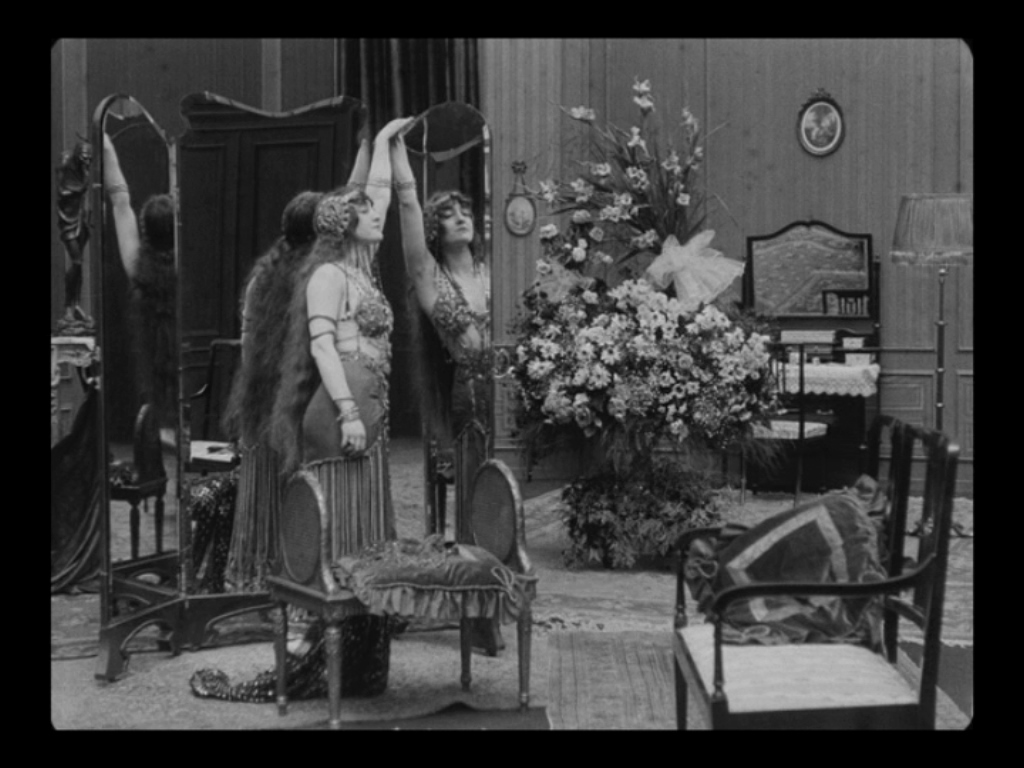
German Liebe (Histoire des treize) (1927),
directed by Paul Czinner and starring his partner Elisabeth Bergner as the
beguiling Antoinette de Langeais, a role previously played by Lyda Borelli and
Norma Talmadge (The Eternal Flame (1922))
but here recreated more in line with the original story arc. Antoinette is
unhappily married but will not allow any of her flirtations to develop, much to
the frustration of the Marquis de Montriveau (Hans Rehmann) and, some of the
watching audience…
 |
| Elisabeth Bergner and Hans Rehmann |
Bergner is highly impressive in a series of sumptuous gowns
and is a very nuanced performer on a par with the afore-mentioned on this
evidence. The Marquis hatches a plan to teach her a lesson and you can
understand why…
Günter Buchwald accompanied with grace and piano-patience.
The evening saw another orchestral treat with a screening of
Mario Bonnard’s The Sposi Promises
(1922) with the New Chamber Orchestra Ferruccio Busoni with Naonis Orchestra,
conducted by Massimo Belli, performing Valter Sivilotti score.
I knew nothing about this film, which is always the delight
of this silent shindig and it was… spettacolare!
At first it looked like it was going to be a quirky rural comedy but by the end
we had witnessed revolution, bread riots, invasion, massed battles, plague and some
wild headgear.
Bonnard handles the epic and the intimate with equal skill
and his quick cuts, tracking shots and framing is so consistent and compelling
for a story that packs so much in. Sleep-deprived and a little bit groggy on
Day Five, I was entertained enough to mouth “shhhh” in Italian to some chattering
young Italians beside me (like they cared). When in Pordenone…
 |
| One Wedding and a Thousand Funerals |
The restoration is sparkling and Valter Sivilotti’s score
spirited and sympathetic: the best accompaniments always follow the film’s lead
and have the confidence to run alongside with their own expression of the
narrative. This was a huge deal for the Italians and Valter took his chance with
the élan of Francesco Totti!
Bonnard adapted the classic novel by Alessandro Manzoni
(1827) which is set in northern Italy in 1628, during the oppressive years of
direct Spanish rule and the Milan plague of 1630, wikiparently the most widely
read book in Italian history?
It’s an assault of characters and events but you soon get
with the rhythm of a story based around the two lovers Lucia (Emilia Vidali)
and Renzo (Domenico Serra – possibly a distant relative of Mike Myers?) who are
forced apart by cruel nobility and feckless priests. It’s a lot of plot but in
summary: One Wedding and a Thousand Funerals.
The cinematography of Giuseppe-Paolo Vitrotti is worthy of
mention especially the aerial tracking on the baddy Don Rodrigo’s opulent
dining table – I’ve seen this shot before but later (Dwan, Lubitsch?) and it sets the scene beautifully as the
Spaniards revel in their ill-gotten opulence!
At the end you want to watch it all again which is handy as
upstairs at the Teatro they’re selling the DVD edition published by the
Fondazione Cineteca Italiana! There are mugs and t-shirts, but this will be my most
Italian souvenir of Le Giornate 37!




+colour.png)