
Imagine a world without digital media, a world in which a
few people may have had VHS, Betamax or Video2000 video recorders and in which,
if you wanted to see a specific film after it’s general release had concluded,
you had to wait and hope that it would turn up on TV. What if very few
of the films you liked or had heard about from books, or the niche-cultural NME,
Time Out or Sight and Sound, were suitable for television either
because of their subject matter or perceived worthiness? This was the world of
the mid-1970s and it is so far removed from today’s streaming, downloading and
digital home media, that many under the age of say 40 might struggle to
understand.
SCALA!! Or to give its full title of, SCALA!!! Or, the
incredibly strange rise and fall of the world’s wildest cinema and how it
influenced a mixed-up generation of weirdos and misfits… sets out to
explain how we lived in those dampened times, gathering in venues with sticky
carpets, rumbling inner city traffic and an audience some of whom were there
for the cheap accommodation all-nighters would provide – and I knew a few who
would sleep there on trips to the capital.
 |
| Kings Cross 1981: Alan Gregory, manager,Jayne Pilling, programmer and Stephen Woolley (Photo David Babsky) |
Stephen Woolley founded The Scala in 1978 in order to programme
films outside the mainstream; the forgotten or the forbidden and material even
the BFI wouldn’t touch. There was a growing interest in obscure, quirky and
classic cinema pre-dating the Scala, and grindhouse, sleazy and arthouse porn in
the seventies and Woolley, Jayne Pilling, Helen de Witt and Jane Giles may not
have been the only ones observing this but, kids… they put the show on right
here!
These were the films the NME (which I devoured every week as
my teenage training for the counterculture I expected to find down south)
covered and celebrated, the works of John Walters, Russ Meyer, Derek Jarman,
young David Lynch and other emerging outsiders. The venue also screened
classics such as King Kong, and the likes of Laurel and Hardy or days
devoted to The Saint or The Avengers, stylish sixties. It was
part of that cultural re-evaluation inspired by punk and new wave and there
were outposts across the country linked together by the NME and others; Eric’s club
in Liverpool would screen Enter the Dragon before gigs, and more –
membership there was also 50p a year, I think?
The Scala opened in 1978 in Tottenham Street in a 350-seat
cinema that had been built in the basement of an office building, Scala House
which replaced a rather splendid theatre… such is progress. The newly formed
Channel Four Television moved into the building forcing the Scala Cinema to relocate
to the circle of the former King's Cross Cinema in July 1981.
 |
| Lemmy in The Decline of Western Civilisation, as usual... |
This is where I first started to go to the Scala but, I
must confess, not quite in the way that some of those interviewed for this
documentary did. I remember one especially good double bill with Penelope Spheeris’
jaw-dropping The Decline of Western Civilization Part II: The Metal Years
(1988) supporting the mighty Talking Heads in Stop Making Sense (1984),
still the greatest concert film ever made and the perfect balance to the dinosaur
world depicted in “The Metal Years” but this is the art of programming and the
team at the Scala were masters of it.
The Scala felt like the biggest cinematic jukebox in London
and whilst they revelled, as do some of the talking heads in the film, in its
cult, “outsider” status, most of the films shown there were not being shown
anywhere else or, in many cases, not before the Scala had shown that prints were
available. Being a student at the start of the 80s, we
watched so many films that were not doubt inspired by the Scala and then brought to the sticky-carpeted, quirky, independent Penultimate Picture Palace off Cowley Road in Oxford. That’s where
we saw Walerian Borowczyk’s Immoral Tales (1973) on a double bill with La
Bête (1975), exactly as seen at the Scala, along with so many others including classics like Blondes Have More Fun all on 35mm... imagine that?!
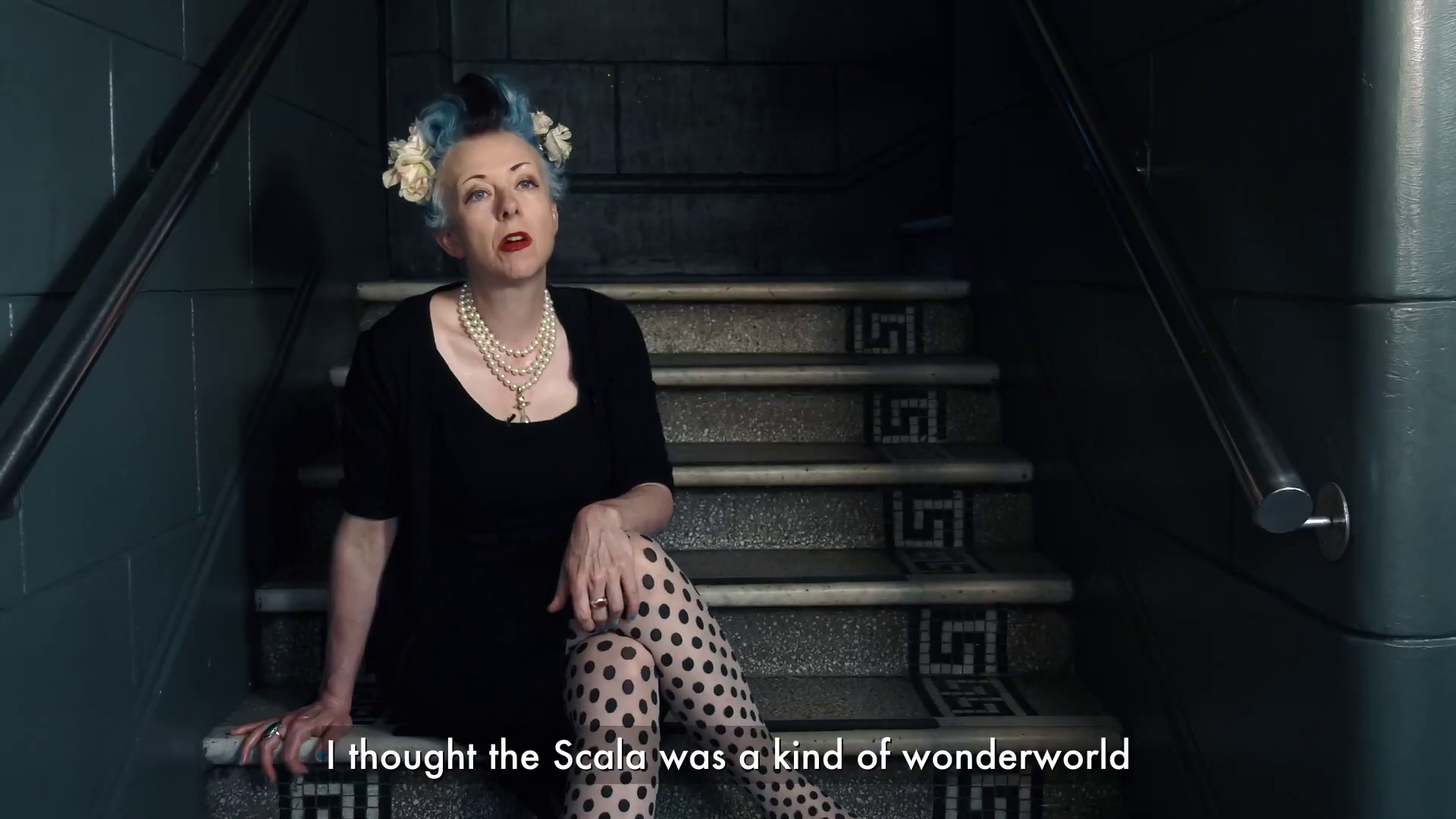
Co-directed by Jane Giles a Programme Director for many
years, and Ali Catterall, who credits the venue with turning him into a film
critic, the film features contributions from the people who worked at the Scala
as well as those who were there simply to watch the films, or to get a
late-night drink and, possibly more in the darkness of the auditoriums’ upper rows…
Actor/writer Ralph Brown (you know, Danny the Dealer in Withnail) worked
in the bar and has some high quality tales to tell as does DJ Mark Moore, Gay’s
the Word bookshop manager Jim MacSweeney, Adam Buxton, Caroline Catz and
others. There’s a glint in everyone’s eyes about the moments and the extremes
that sometimes occurred.
 |
| Ralph Brown rages against the machines |
Stewart Lee’s story about Thunderclap! (1975) stands
out when a man who had wandered in not knowing what to expect and, after
gradually realising the way the film was going – multiple sexual encounters,
hardcore and probably illegal – turned to the audience and asked them what they
were watching and why. As Stewart says, you don’t get this in the multiplex…
Barry Adamson, who I first saw playing bass for Magazine at
Eric’s in 1978, provides a suitably dynamic score, influenced by sixties beats,
surf guitars, and the cinematic references he’s so adept at. He too was a Scala
regular and in addiction to his many scores, the musical vibrancy of these
films is reflected in his solo albums like Moss Side Story (1989) and Oedipus
Schmoedipus (1996) – containing the swaggering brilliance of The Big
Bamboozle! – which are designed as soundtracks for imaginary films.
Scala!!! Celebrates its influence on these creators and the
cineastes, but more than anything else it marks the spirit of enquiry that made
us all seek out the films and the spirit of this place that, ultimately, was
all things to all people. Café, monkey house, venue, meeting place, hotel…
inspiration.
You can experience/re-experience the Scala for yourself
this month as the BFI is not only showing the documentary itself from 5th
January but also a number of the films that it championed including Faster
Pussycat! Kill! Kill!, Pink Narcissus, Pink Flamingos, La Bête and,
amazingly Thundercrack! – not for the easily offended as the programme
notes (I wonder if Ricky Gervais will come along?).
Long live The Scala spirit!!!
Details of the BFI’s season of films screened by the Scala are to be found here.
Scala!!! screenings on the Southbank and elsewhere can befound here.
It’s not the same as the old A3 printed schedules, which
were a work of art in themselves from Mike Leedham and Patricia McGrath of 2D
design but things have moved on in some respects. I may have some in the loft,
excuse me while I get the ladder…
The Scala Programme for January 1986, a real mix with three silent GW Pabst films on 8th - Secrets of a Soul hasn't been screened in decades by the way! - zombies, Woody Allen, Hitchcock, classic gay marathon, Madonna, Letter to Brezhnev and Stop Making Sense.
 |
| Scala Programme, January 1986, Taken from Scala Cinema 1978-1993 by Jane Giles |


+hill+trip.jpg)




