Showing posts with label Iván Petrovich. Show all posts

Sunday, 29 January 2023

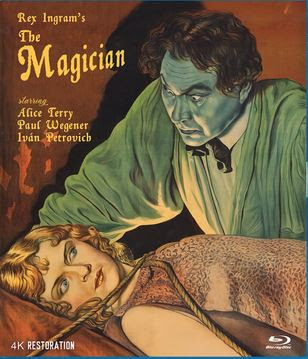
She'll lose her heart in Monte Carlo? The Magician (1926), with Laurent Pigeolet, Redwood Creek Blu-ray


"…weird, fantastic, adequately suspensive, and shivery…”

Lawrence Reid, Motion Picture News


Of the thousands of silent films lost this is one of those that was found, having been considered "perhaps the most elusive of lost films”, by critic Carlos Clarens before being rediscovered restored and shown on TCM and released on Warner Classics DVD a decade ago. This project is based on a 16mm black and white source from a private collection and whilst it doesn’t have the DVD’s tints, it’s pretty much the same cut as far as I can tell. This is the first time that the film has been released on Blu-ray and is the result of a Kickstarter from Redwood Creek Films who conducted a 4k transfer and restoration of the materials.


The film is new to me although I have some familiarity with the work of Rex Ingram and The Magician is notable not just for its mystery and imagination but also its location having been filmed in France with shots featuring Monte Carlo and Paris. Carlos Clarens explains this as a means of avoiding studio interference, and given how he sums up the response on release as mostly on grounds of tastelessness, it’s easy to see why Ingram wanted time alone with his monstrous creation.


In addition to an international cast there’s also a British connection with young Michael Powell, often resident in the South of France, acting as an assistant director as well as an extra in one brief appearance. This cast include Ingram’s wife, Alice Terry, as well as sundry Frenchmen and the wide-eyed stylings of Herr Paul Wegener who, as one of the characters observes, looks like he’s stepped out of a melodrama. Paul gets the job done though and his magically-unreal mad Professor Haddo is a joy whether he’s hypnotising Alice, inexplicably influencing the tables at the casino or plotting ancient magic. Powell was not impressed though saying his "one expression to indicate magical powers was to open his huge eyes even wider, until he looked about as frightened as a bullfrog." Maybe you had to be there.


Michael Powell and Gladys Hamer


The script is based on a 1908 novel by W. Somerset Maugham, as unlikely as it seems, and is characterised by an uncanny intensity mixed with some humorous episodes that serve to both relive and build up the eventual tension. This is Todd Browning strange and proto-Universal odd, with the seemingly unstoppable Haddo plotting murder and the most gruesome recycling of human flesh… there really ought to be some kind of cinema code to restrict the horrific imaginations of these debauched show people.


All begins artistically enough with sculptor Margaret Dauncey (Alice Terry) moulding a huge clay statue of Pan which is of such a scale that I really doubt she’ll be able to get it out of the room. Also present is Margaret's painter friend Susie Boyd (Gladys Hamer) who provides the first moments of light relief as she changes the title of an abstract painting from sunrise to sunset over the Seine.


I was right about the scale of the work though for the clay suddenly cracks and the giant head falls onto Margaret threatening more than just her promising career. Her spine damaged only the state-of-the-art intervention of handsome surgeon Dr. Arthur Burdon (Iván Petrovich) saves her with an onlooking doctor praising his skill as almost magical.


The saving of a human life is a comparatively simple matter. On the other hand, the scientific creation of life does indeed call for the powers of a magician.


Paul Wegener keeps it real.


Also watching – really, really, wide-eyed – is Professor Haddo, who plans on actual magic, and more, with this most attractive of patients. The operating theatre is the strangest of places to pick up potential subjects for hypnotism and heart donation but it’s the early worm who catches the worm even though Margaret and Dr, Arthur soon begin a romance. Haddo meanwhile discovers the rare recipe for creating life in his local library – OK, a library – and makes his plans to, literally, steal Margaret’s heart.


After engineering a chance meeting in the park, Haddo then turns up at a visiting circus as the young couple along with Susie and her quirky pal (played by Michael Powell) watch a snake charmer. Haddo, has some words with the charmer, before picking up the snake and holding it to bite his hand, within seconds he makes the bite disappear, but the snake then bites and apparently almost kills the charmer’s assistant. He’s either a genuine magician or a master of prestidigitation.


If you wish to see strange things, I have the power to show them to you…


Haddo then makes a visit to the young woman’s apartment and proceeds to hypnotise her, using the completed head of her sculpture to present her with a vision of a pre-code Hell in which people seem to be doing exactly the kinds of things that got them sent there in the first place. He urges one especially lithely demonic, dancing faun (Hubert I. Stowitts, an American dancer at the Folies Bergere), to make his moves on Margaret who succumbs in ways that would dismay William Hays…


Hellzapoppin!


Margaret and her good Doctor plan to marry but on the morning of their ceremony, Arthur discovers that she has not only been whisked away by Haddo but has married him. Convinced that her will is being controlled, he begins to search Europe for them finally tracing them a year later to Monte Carlo where Haddo is using Margaret to somehow fix the odds at the gaming table presumably to fund his greater plan.


Arthur and his friend Dr. Porhoët (Firmin Gémier, a leading light of French Theatre who created the role of Père Ubu in the original production of Alfred Jarry's Ubu roi in 1896) set out to foil the Professor and the closing segment is full of classic horror tropes right down to a lightning illuminated tower and an “Igor” played by Henry Wilson. It’s high camp and schlock horror but this is one of the places were that all began. It’s a key work “Supervised by Rex Ingram” even if he didn’t direct all of it according to Henry Lachman, who directed the Sabbat section, and Powell’s memoirs.


The result is great fun and whilst Wegener is over the top as usual, it’s all part of the fun – he does indeed heighten the melodrama. Terry is a very effective damsel in distress and the Ingram’s supervision brings out the best in all his players. Laurent Pigeolet’s score adds a lot of flavour, inventive piano that works well with the creeping unreality of the evil professor’s emotional invasion of the couple’s real world.


Iván Petrovich and Alice Terry
 

The restoration has the flaws of the material and lacks the clarity you’d expect from a 35mm source with digital cleaning – we are so spoilt these days – but it looks like what it is, a direct copy from 16mm. The 2010 Warner Archive DVD is still to be found on eBay and other places and whilst it’s claimed as 88 minutes it’s 80 and as I say at the tope the same cut… probably!


Some copies of this Blu-ray are for sale on eBay, it’s not cheap but it is different.


Monday, 11 November 2019

The root of all evil? Alraune (1928) with Stephen Horne and Martin Pyne, Barbican


So good to be back at the Barbican for a rare silent screening and with expertly inspired accompaniment from the two-man band of Horne and Pyne: four hands, ten instruments?

Directed with sure-footed competence more than style by Henrik Galeen, Alraune doesn’t rank with the best of Weimar cinema but it is still a very interesting film and one I’ve always wanted to see projected with live accompaniment. There are long passages when little happens but human interactions and the music sustained the film in these quieter moments. Variously known as Unholy Love, Mandrake, or A Daughter of Destiny, Alraune is missing a few key segments and again the accompaniment stepped in to offer thematic uplifts as well as emotional context throughout.

The music was eloquently varied, featuring more than just the duo’s prime instruments of drum and piano. Martin’s vibraphone, played with bow as well as soft mallets, lead the line in plaintive and eerie interplay with Stephen’s piano and as the two switched instruments they worked superbly well in support of the events on screen. There was magic in the air on and off.

On screen the magic stemmed from the Germanic Middle Age legend of the Mandrake root (the Alraune of the title), which – and listen carefully here - if left to absorb a hanged man’s “essence” in the ground under his execution, was capable of giving life either by enabling pregnancies or helping witches produce children without the aid of a living sperm donor. Such progeny were said to have no souls and sound far more trouble than they’re worth but, you know, there’s always someone ready to give it a go: to mess with Nature.

First of all, find a hanging man.
Step forward our mad scientist for the day, former Golem of this parish, Paul Wegener who plays Professor Jakob ten Brinken who has become interested in the nature versus nurture debate and this has somehow led him onto the legend of the root. By using the mandrake, he hopes to engineer a human being in order to establish “whether the parents’ genetic make-up, has a purely random effect on the offspring.” Can he create something pure and free from hereditary conditioning? I think you know where this is heading.

The professor grows the Mandrake as required and gets his nephew Franz Braun (Iván Petrovich) to help him find a lady of the “lowest order” - Die Dirne (The Whore) played by Mia Pankau - to act as the incubation chamber for the new being. Just as the woman arrives at the Professor’s apartments, turning in shock to see him emerge in white coat, the film jumps forward almost two decades… some sense lost through censoring perhaps?

Oh, mother... Mia Pankau
Alraune ten Brinken (Brigitte Helm) is the fully grown experiment, now at boarding school and is first seen toying with fly as it attempts to escape from a glass of water, she reaches out, not to rescue but to push it back; not the behaviour of a well-educated young woman. There is more to come as she leads her classmates into acts of rebellion, she dances, wears cologne and plants a stage beetle on the mother superior’s robes.

Clearly Alraune has out-grown school and to facilitate her escape has lured a young man, Wölfchen (Wolfgang Zilzer) into loving her: he is to steal money from his family and they are to run away. Once on their train to freedom she orders champagne and starts flirting with a likely lad who spies her from the corridor. Wölfchen tries to fight him off but there’s to be no respite as a troop of circus performers join the train. Alraune is immediately impressed by the magician’s sleight of hand especially when in one sexually obvious moment he lets a mouse run up her skirt; she leans back and looks him straight in the eye when even Bad Maria might think twice.

Paul Wegener and Brigitte Helm

At the circus things move on and Alraune is seen sharing a cigarette with the lion tamer (Louis Ralph) standing so close that she can light his fire with her own as it were. Chided for her wanton troublesome-ness Alraune walks into the lions’ cage challenging the beasts to come and have a go if they think they’re cat enough. The animals don’t move until the Tamer rushes in with his whip.

So, a heartbreaker with nerves of steel and a twisted sado-masochistic streak… is this what the Professor wanted to find out? How would a woman born from the human stew of a prostitute, a murderer and the mysterious root vegetable work out?

He’ll soon be able to find out as he finally catches up on his “daughter” after years of searching. He whisks her off to polite society where she plays tennis with Der Vicomte (handsome John Loder out of The First Born) who soon proposes… But, he’s not the only man to have fallen for Alraune and the Professor blackmails her into staying under his “care”.

He's behind you... 
From this point one it’s a battle between the scientist and his creation and we all know how those usually turn out or do we? The film has more than a few tricks and turns up its sleeve … there’s an irony in the impact of the Professor’s own true “nature” on the “nurture” of his subject perhaps?

 
Alraune is worth watching purely for Brigitte Helm’s performance alone. I love her physicality and dancer’s contortions: she seems almost too frail to be an evil thing and yet there’s considerable strength behind her movement as the Professor will find out. She has the range too and whilst it’s fun to watch her evil contortions we also see hints of a growing humanity… or do we? Paul Wegener is pretty good too, mad science-ing with consummate abandon and obsessing intensely about his creation, Frankenstein with a mid-life crisis and unrealistic expectations.

But, as with all the very best silent film screenings, it was the mix of film, music – excellent audience! – and, of course this wonderful venue! There’s more to come at the Barbican in the New Year and here’s to more screenings like this!!


Tuesday, 30 June 2015

Roots manoeuvre… Alraune (1928)


After some years of silent exploration you’ve probably seen a fair chunk of the “cannon” and the key cult films and it gets a little harder to gain the same “hit” as when you first watched a Caligari or a Warning Shadows. That’s not to say that I’m getting jaded, just more travelled… but, whatever I watch, there’s always something remarkable.

Here we have a slightly plodding tale of mystery but one that has another extraordinary performance from Brigitte Helm whose expressive control and sheer “slinkiness” create what C. Hooper Trask in his New York Times review described as “a most engaging evening's display of erotics." They say the lights are always bright on Broadway… they say there’s always magic in the air...

The root grows below the gallows...
Now then, the nature of this particular magic is quite specific and pretty unusual dating as it does to a story from the German Middle Ages about a root – the Mandrake (the Alraune of the title) – which if left to absorb a hanged man’s “essence” in the ground under his execution, was capable of giving life either by enabling pregnancies or helping witches produce children without the aid of a living sperm donor. Such progeny were said to have no soul and sound far more trouble than they’re worth but, you know, there’s always someone ready to give it a go: to mess with Nature.

As mythology goes Alraune, starts with a disadvantage being not quite as splendidly sinister as Der Golem or as creepy as Nosferatu – it’s a root! The version available also seems to have been the victim of cuts at the crucial section dealing with conception and birth so the viewer has to draw their own conclusions about the part played by the vital vegetable… The film is based on Hanns Heinz Ewers’ novel of 1910 from which more specifics can be gleaned.

Paul Wegener
Our mad scientist for today is former Golem of this parish, Paul Wegener who plays Professor Jakob ten Brinken who has become interested in the nature versus nurture debate and this has somehow led him onto the legend of the root. By using the mandrake he hopes to engineer a human being in order to establish “whether the parents’ genetic make-up, has a purely random effect on the offspring.” Can he create something pure and free from hereditary conditioning…? I think you know where this is heading…

The professor grows the Mandrake as required and gets his nephew Franz Braun (Iván Petrovich) to help him find a lady of the lowest order - Ein Mädchen von der Gasse (Valeska Gert) - to act as the incubation chamber for the new being. Just as the woman arrives at the Professor’s apartments, turning in shock to see him emerge in white coat, the film jumps forward almost two decades…

Not your typical girl...
Alraune ten Brinken (Brigitte Helm) is at boarding school and is first scene toying with fly as it attempts to escape from a glass of water, she reaches out, not to rescue but to push it back; not the behaviour of a well-educated young woman. There is more to come as she leads her classmates into acts of rebellion, she dances, wears cologne and plants a stage beetle on the mother superiors robes.


Clearly Alraune has out-grown school and to facilitate her escape has lured a young man, Wölfchen (Wolfgang Zilzer) into loving her: he is to steal money from his family and they are to run away. Once on their train to freedom she orders champagne and starts flirting with a likely lad who spies her from the corridor.

Wölfchen tries to fight him off but there’s to be no respite as a troop of circus performers join the train. Alraune is immediately impressed by the magician’s sleight of hand especially when in one sexually obvious moment he lets a mouse run up her skirt; she leans back and looks him straight in the eye when even Bad Maria might think twice…

Have you got a light, boy?
At the circus things move on and Alraune is seen sharing a cigarette with the lion tamer (Louis Ralph) standing so close that she can light his fire with her own as it were. Chided for her wanton troublesome-ness Alraune walks into the lions’ cage challenging the beasts to come and have a go if they think they’re cat enough. The animals don’t move until the Tamer rushes in with his whip.

Alraune in the roar
So a heart-breaker with nerves of steel and a twisted sado-masochistic streak… is this what the Professor wanted to find out? How would a woman born from the human stew of a prostitute, a murderer and the mysterious root vegetable work out?

The root of all evil (sorry, just had to)
He’ll soon be able to find out as he finally catches up on his “daughter” after years of searching. He whisks her off to polite society where she plays tennis with Der Vicomte (handsome John Loder who I last saw in The First Born) who soon proposes… But, he’s not the only man to have fallen for Alraune and the Professor blackmails her into staying under his “care”.

From this point one it’s a battle between the scientist and his creation and we all know how those usually turn out or do we? The film has more than a few tricks and turns up its sleeve …

She's behind you...
Directed with competence and the odd dash of style by Henrik Galeen, Alraune doesn’t rank with the best of Weimar cinema in my opinion although I’m sure I’d enjoy it more in cinema with live accompaniment. It is, however, worth seeking out purely for Brigitte Helm’s performance alone. I love her physicality and dancer’s contortions: she seems almost too frail to be an evil thing and yet there’s considerable strength behind her movement as the Professor will find out.

Brigitte abides...
Paul Wegener is pretty good too, 15 years after his student days in Prague – one of the finest actors in German silent film and one who has been unjustly accused of collaboration in later years whereas he apparently donated money to the resistance and helped to hide the vulnerable.

I watched a copy of the 2000 reconstruction on your actual video which you can view in poorer quality on YouTube. It deserves better and I’m sure the Editionfilmmuseum folk will one day get around to it... although we are still waiting for the release of The Student of Prague guys!

The Full Maria