Showing posts with label Evelyn Greeley. Show all posts

Monday, 26 December 2022

These are a few of my favourite things… 10 from 2022


And so this is Christmas and what have we done...? Turns out quite a lot more than in the Year of Our Covid, 2021 but still not as much as we’d like to have done… in this game you take what you can get though and savour each experience as much as you can. Silent film doesn’t throw itself at you like an overeager superhero flick desperate to win back it’s $200 million budget, oh my no, you have to make an effort and all of that is rewarded with the shocks and joys of unremembered humanity and artistic enterprise. All of which is a Boxing Day hungover way of saying; hey Ma, will you look at these apples (and no, I don’t really know what that means)!


Woman of the Year: Dora Brandes (1916)/Poor Jenny (1912) with Stephen Horne, BFI Asta Nielsen Season


She acts, that’s the thing… she does not just pose before the camera… She impersonates a character, she makes it live and have meaning, a hundred meanings… New York Times, 1921


Who could have foreseen that Asta Nielsen would be 2022’s MVP – someway ahead of Liz Truss in terms of relevance, attainment and talent – but Pamela Hutchinson and the BFI set out one of the finest seasons of silent treasures for many a year with screenings of rare Nielsen grooves propelling us into the year with a spring in our step and a growing appreciation of this most important actor. Sure, I’d seen Asta’s before but mostly in her greatest hits, Hamlet (thrice), Joyless Street (twice), Afgrunden (so many times…) but it was a real connoisseur’s delight to be able to dig deeper into a body of work that is very rarely screened in this breadth and depth.


Asta Nielsen


As an example of Die Asta’s almost unparalleled range I’ve picked these two with accompaniment from Stephen Horne who has a way with Silent Sirens (and a CD to prove it, available here if you are shameless and unhip enough to have not bought a copy!). Poor Jenny (1912) was from the early days of the Asta series, written and directed with partner Urban Gad who the actress insisted at the time came with her to Germany to carry on the work begun with Afgrunden. It’s a typical rags-to-riches-back-to-rags again narrative but, as she joked, this was more than enough to feed her dramatic energy.


Dora Brandes, directed by Magnus Stifter, following her break with Gad, plays with the already well-worn Star is Born tropes. Asta playing a successful actress who finds herself having to choose between an older politician and a much younger journalist. Drama ensues… hearts break. As you watch you can begin to fully understand Asta’s ability to express and connect. So often at the start of her films, she’s seen smiling straight to the audience before the action begins, melting hearts and renewing her intimacy with the watchers and unflinching honest look, the only time she’s out of character, or at least the character she’s about to play. As a person she’s a mystery and her pre-show smiles just hint at the complexity to come whilst showing how easily she can draw us in… it only takes a few seconds looking at those huge dark eyes. Queen.


Asta and her infinite variety...

Downfall (1923) with John Sweeney, introduced by Pamela Hutchinson, BFI Asta Nielsen Season


Sorry, but I’m not just having one Asta moment and this was a breath-taking film that showcased the full power of Asta’s performance level whilst also confronting the fact that she was getting older – she commissioned the film aged 41. Watching her character with minimal make-up. looking in horror at her unfamiliar face in the unforgiving mirror before being deadened by her lover’s unyielding humiliations and finally vanishing from the love of her life’s vision… is oddly rewarding. Certainly, she presents one of the most searing portrayals of aged tragedy in silent film and proof, if any were needed, of her ability to transcend melodrama and to give something extra special entirely from within character.


Back in Bologna… Foolish Wives (1922), Timothy Brock, Il Cinema Ritrovato 36th Edition


At last, I was back in Italy and it was too hot, there was too much to do and far too much to see: I loved it!! So many highlights, watching the restored Nosferatu with Mr Brock and full orchestra in the Piazza Maggiore,  watching, The Conformist and Singing in the Rain in the same space and then the almost supernatural hit of three hours’ worth of The Beatles in Peter Jackson’s third episode of Get Back, including the full Rooftop Concert: the gear does not get any fab-er than that, a revelation and a stunning twist of the Extended Scouse Universe.


The big silent showcase was this splendid restoration of the first million-dollar movie, as acclaimed the publicity… Spectacularly, Erich von Stroheim delivered on the ROI and Universal had another hit on its hands from the most complex man in most parts of Hollywood whose productions had the skill of DeMille, the scale of Griffith and a dark heart the latter could never explain to himself. This is a slick crime caper movie from before the days when slick crime capers set in this period were all the rage. But Erich is making sure we see the seedier side as well, he and his two “cousins” are charming con artists, but he has a debauched sexuality which makes his character all too difficult to root for and yet we are conditioned to try… even now.


Timothy Brock’s extraordinary new score was performed with vigour by L’Orcestra del Teatro Comunale di Bologna which he conducted. His score included Russia themes reflecting the grandiosity on screen and also delicious lines of his own mapping every strange and unusual nuance from von Stroheim’s screen. It felt complete with the film and completed that magical connection between the place, the audience and the film that makes live silent screenings so compelling and which makes this place, almost uniquely, a truly silent city.


Les Misèrables (1912) with John Sweeney, Gabriel Thibaudeau and Silvia Mandolini


This was epic in length and was an unexpected joy equalling in its own way, the lengthier silent serial of 1926. Based in four parts totalling 168 minutes in length it was split into two screenings with different accompanists. The first parts, focusing on Jean Valjean and then Fantine, featured John Sweeney’s accompaniment and we were back the next day for Gabriel Thibaudeau’s piano and Silvia Mandolini’s violin as the story shifted onto Fantine’s daughter Cosette.


Recommended for students of French history and film alike; extraordinary clarity of purpose from Albert Capellani who was able to capture so much from the book with a narrative fluidity not often associated with this early period.


Evelyn Greeley


Phil-for-Short (1919), with John Sweeney, BFI


This film was introduced by me at the BFI and for a few hours at least, I was an honorary Nasty Woman.


Inspired by a remark made by the grandson of a one-time Yukon bordello owner, there has been an ongoing project to research and revive interest in unsung women filmmakers who broke new ground in the early years of cinema. This film is a deceptively nuanced take on gender roles in the wake of the Great War and increased recognition of women’s roles.


I wouldn’t say that Phil is a nasty woman, but she is a liberated one and just imagine how good it felt to watch her in 1919 newly enfranchised and with a range of choices starting to open up. As played by the energetic Evelyn Greeley, Phil stands out as practical, inventive and a leader; all very male characteristics for the older generation. She has to deal with reality as her aged father is still buried in the myths and legends of his books and, lovely and liberating though he is, she works the farm and is happy to step up to make things happen for herself and the men in her life.


There is now a magnificent new box set from Kino which includes this film and 98 others. It’s out now and is THE Archive Release of the Year – US and Canada can order direct.


Mary Johnsson - Gunnar Hede's Saga (1923) 

Gunnar Hede's Saga (1923) with Guenter A. Buchwald and Neil Brand, Bonn Silent Film Festival


Have Internet will travel and virtual Bonn was as excellent as usual. As many may know I’m always up for a Saga directed by Mauritz Stiller and based on a book by Selma Lagerlöf and, even though this one is still missing about half an hour, it is a thoroughly entertaining romp through snow, love and madness which features the humanity you’d expect from Selma along with the mastery of locations and character you can rely on from Mauritz. It’s a story about reindeers and redemption (the latter, always a Selma theme) and, how fitting that a film featuring two violin players and the healing power of music, should be accompanied by the Silent Film Supergroup of Guenter A. Buchwald on violin and Neil Brand on piano… I really wish I’d been there to witness this gig in the flesh but the streaming screening will have to do for now and how!


Norma Talmadge in The Lady (1925)

The Lady (1925), Daan Van Der Hurk, Le Giornate del Cinema Muto, Streaming


Oh, outrageous fortune! All set, ALL SET, for my first Giornate since pre-C, and I catch the latest variant a few days before I’m due to head for Venice Airport. So it goes, so it goes and at least we had the streaming version to give us some of the finest films from the full festival. 


Norma Talmadge has always been relatively undervalued in recent times, not afforded the screen time or respect of stella contemporaries Gloria, Mary or Lilian and so I was pleased to see her featured so extensively in this year’s programme and, if I had to pick just the one film to watch t would have been Frank Borzage’s The Lady, a film rated so highly by Talmadge scholars such as Greta de Groat. Norma and Frank did not disappoint and she provides perhaps the most affecting, emotionally powerful performances of her career although not one she wanted to repeat too quickly.


After the mid-teens, Talmadge called the commercial shots and as Jay Weissberg pointed out in his introduction, The Lady was too louche for middle American audiences and did not perform that well. As Talmadge herself said, quoted by Ben Brewster and Lea Jacobs in their notes on the Giornate site, she wasn’t going to follow up the film’s style “… I am not going to do any more like it for a time, anyway. Not that I don’t like to do characterizations – I love it. But what can we do? We must play to the box office… So, for a while I am going to do modern things. I think they want to see me in gowns, in style.”


A great actor but also a smart businesswoman who played the game until, to paraphrase, she no longer needed to.


Faces of Children (1925), with Meg Morley, Kennington Bioscope


2022 we were back home to the Cinema Museum and here was one of the great films of the French silent period, and one accompanied with consistently emotive, compelling improvisation with hints of period classical as well as Meg’s diverse jazz chops, so in tune with Jacques Feyder’s tale of childhood grief. The film was critically-acclaimed yet a commercial failure and for a long time this it only circulated as a two-reel 9.5mm condensed version – available on YouTube and worth watching! – and as Christopher Bird said in his excellent introduction, this encouraged the young Kevin Brownlow to seek out more complete versions. The film was finally restored over a twenty-year period starting with the Cinémathèque royale de Belgique in 1986 and ending with Lobster Films in 2004 but it is still rarely screened which is exactly why we need the Kennington Bioscope more than ever!


Face off: Ivan vs Brigitte


Manolescu (1929), with John Sweeney, Le Giornate del Cinema Muto Streaming


This was like watching Fantasy Silent Film, a game in which the combination of two of the best strikers in cinema muto score hattrick after hattrick combining in ways that seemed impossible especially to this viewer who had no idea they had ever played together. Manolescu… Ivan “The Cat” Mosjoukine versus Brigitte “The Panther” Helm in a battle for our eyeballs, our attention… our love. Honestly, you could have taken the script for Carry on Cabby and given it to these two and we’d all be collapsed in a pool of utter distraction. You want engagement well here he and she are…


Mr Sweeney was fully aware of all of the above and slotted into musical midfield as the great playmaker he is (that’s enough footie references. Ed.)


Up in Mabel’s Room (1926), Günter A. Buchwald & Zerorchestra, Le Giornate del Cinema Muto Streaming


Directed by E. Mason Hopper, this perfectly executed farce was based on the play by Wilson Collison and Otto Harbach from 1919, and like every successful comedy of this type it relies on perfectly executed performances and timing, whether from the performers and director or in the editing suite. There’s also some exceptionally pithy title cards courtesy of F. McGrew Willis’ script and Walter Graham’s text… and if a picture paints a thousand words, the expressions on Marie Prevost’s face are a British Library’s worth of inuendo!


Extra spice was added by accompaniment recorded right at the start of this year’s festival at the screening in Teatro Zancanaro, Sacile, it had that live energy some of the streaming films don’t always get, although, to be fair this was an ensemble, with the local group Zerorchestra improvising alongside Günter A. Buchwald’s piano and violin. This film was the perfect finale for the streaming version though, setting us up for a physical return in 1923, sorry, 2023!


We’re back up and rolling and 2023 I aim to attend as many screenings and festivals as possible, I’m looking at you Hippfest, Slapstick, Europe and even further afield… as for Pordenone, we are long overdue!


Happy Christmas and a let’s have a brilliant 2023!


Look to the future now, it's only just begun.

Click on the cover to order this set!

Tuesday, 26 July 2022

Classical comedy... Phil-for-Short (1919), with John Sweeney, BFI


Oh, my husband’s all right – but he’s not vital.


These notes are based on my introduction to the screening of this film on 17th July, I’d like to thank the BFI for the opportunity, John Sweeney for his amazing accompaniment and the audience for not booing me off stage. A splendid time was had by all.


Women's films were changing


This film was released on 2nd June 1919, just two days before Congress passed the 19th Amendment in the US which finally granted some women the right to vote and could be seen as part of a broader trend of films that focused on female stars taking charge of their own destiny.


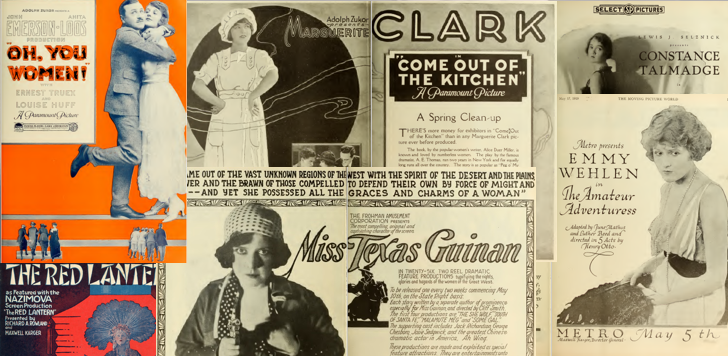
Cinema had always had tomboys with Mary Pickford and others not just cheeking the men but outwitting them but there was a definite moment being created after the Great War opened up a new drive for relative equality. Films such as Come out of the Kitchen, The Amateur Adventuress and the entire oeuvre of Texas Guinan showed more confident leads actively taking on men at their own game and leading their own agendas.


Famously, there were more women working in Hollywood in 1916 than 2016*, over half of silent films were written by women and there were more directors, not just Lois Weber, Mabel Normand and Nell Shipman. It wasn’t to last after male corporatisation led to the establishment of the Hollywood we all know; Universal, once home to 30 female directors, didn’t have another woman director after Weber left in 1919, until 1982…


Summer releases in 1919


Clara Beranger


It needs no cursory glance at the current releases and those of even six months ago to prove that there are more writers among the feminine sex than the male persuasion. The heart throb, the human interest note, child life, domestic scenes and even the eternal triangle is more ably handled by women than men because of the thorough understanding our sex has of these matters…

Moving Picture World, 24th August 1918


Clara Beranger co-scripted Phil-for-Short with Forrest Halsey and was a fierce proponent of women’s role in the industry for the reasons outlined above.  Not only were more women watching films at this point, but the industry relied on their input.


Clara was able to peruse her own agenda and she also scripted Miss Lulu Bett (1921), screened last month at the BFI and another film tackling the role of women post war and suffrage. Both Lulu and Phil ultimately decide their own course of action and they are true to themselves.


Clara Beranger in 1918


Evelyn Greeley


The studio PR suggested that Evelyn was the most proposed-to woman in America? Well, she may or may not have been but she was married three, possibly four times in the end. Her past is obscured by the usual studio hype but she was certainly not an all-American girl having been born in Austria before emigrating with her family aged ten.


She began on stage before small roles in short films from 1914 onwards – she was 25 – before being signed up from 1917-19 by the World Film Corporation with whom she featured mainly alongside Carlyle Blackwell up to Phil-for-Short, billed as her first solo starring role. Her final film was in 1922 with Blackwell, Bulldog Drummond, after which she retired with the first of those husbands presumably to start a family.


She’s very good in this film though, energetic and very naturalistic, greeting every misfortune with a pause and then a smile as she figures out a countermeasure. The education she has been provided by her academic father seems to have not only informed but enlightened her approach; she’s a woman of action, decisive and morally courageous.


Whilst reviews seem to have been mixed, but no one seemed to complain about her ability.


Evelyn Greeley hiding from proposals...

I don’t want to be a man?


One of the reasons for negativity is almost certainly the fact that Phil by name means Phil by nature. Evelyn dresses as a boy for a good portion of the film and initially out of necessity as she has to pick up the responsibility for keeping the family farm running. Later she disguises herself as a boy in a bid to escape the local moral majority and to solve certain romantic difficulties.


This was definitely a challenge for some, with Variety, according to Nasty Women curators Maggie Hennefeld and Laura Horak, condemning it as a “a sissy play, too nice for our boys; we want them to be manly,” after a local screening attended by a Boy Scout troop in Wilmette, Illinois. What would our Robert Baden-Powell have said? I do hope he saw the film.


Possibly the filmmakers saw Ossi in drag in Lubitsch’s cheeky, I Don’t Want to be a Man (1918) but there’s no way an American film could be as daring… and whilst this is hardly the only example of cross-dressing in early Hollywood, Phil is a challenge because of her sex and not sexuality.


I work like a boy, why shouldn't I dress like one?


Stronger woman, weaker men


Phil stands out as practical, inventive and a leader; all very male characteristics for the older generation. She has to deal with reality as her aged father is still buried in the myths and legends of his books and, lovely and liberating though he is, she works the farm and is happy to step up.


Then the man who takes her fancy, John Alden (Hugh Thompson, wonderful as a stuffed shirt), has decided he hates all women after discovering his fiancée was a gold digger.  He doesn’t know himself any longer but Phil, educated in the emotional meaning of classical philosophy, knows what to do. For what it’s worth, I don’t see John as emasculated just confused and bruised by his experience. More than anything he needs a friend like Phil who can manage his mood…


Then there's the more general complaint from John's sister, who's husband is "alright" just not "vital" with the meaning focused on his lack of vitality, not so much unmanly as submerged in manners and the day-to-day. Men need liberating too.


Charles Walcott and Hugh Thompson


High society and lower morality


Within the film as well as without there are some very old-fashioned responses to the ancient ideas of Greek freedoms of movement, thought and free will (gosh). The moral majority base their high ground on the old days but they’re completely at a loss in explaining away the really old ways… especially the aptly named McWrath family (emphasis on Wrath, nice one Clara!), Donald the village banker, corner stone of the church and his disapproving mother.


Outside of the village, Phil has to deal with John’s wealthy bourgeois family who, whilst they like her culture also have issues with an amoral violinist making merry with John’s sister and being the very epitome of a gaslighting womaniser.


Wherever she goes, Phil tries to find a way forward. A classical education needn’t be as bad as Britain’s Prime Minister has made it seem… and she is liberated in thought as well as action by the clear-sighted pursuit of moral balance.


The McWraths respond


Is it all Greek?


Phil’s so-called after a poem by the much-misunderstood Sappho who as Hennefeld and Horak point out was often referenced in silent films as part of a general attraction to Greek literature with the hints of her precise hidden depths that the Old Fogey’s object to here.


As with “Greek Deployments” by the likes of DeMille, there’s an excuse for under-the-counter meaning and shorter frocks justified in the name of higher art and here, whilst we do have dancing in diaphanous skirts, we also have Phil berating saucy male onlookers and Donald’s appreciative leer cut short by his mother’s disapproval. The hypocrisy of inappropriate male gazing is made clear and the dancing, whilst hardly balletic, is more about freedom than allure.


This film plays with so many angles and Greeley is wonderfully peppy, hardly pausing for breath justifying her love of Greek movement and expression or deciding on cross-dressing as her own “twin” to escape from unwanted suitors including her late father’s doctor - a man old enough to be her censor.


The search for beauty is perhaps the search for truth?


Moving Picture Classic, June 1919


Entertaining intertitles


I love the film’s witty intertitles and the design of the title cards is as deft as the film’s overall tone, overlaying text on images and the live action in a very effective way that doesn’t take you out of the action but smooths the flow. There’s wit and there’s wisdom and the BFI audience laughed with and not at… the sense of the moment still ruining true after 103 years.


Here’s why Phil is so called.


That joke isn’t funny anymore?


Critical opinion in the trade press was split and, as ever, the challenge for the modern viewer is to understand why.


It is too bad that Evelyn Greeley… did not lead off with a stronger picture… Miss Greeley has a pleasing personality and is a sufficiently accomplished actress, given the right sort of role, but only occasionally does she have the opportunity to appear at her best in this unconvincing story.

The Film Daily, 11th July 1919


This picture offers Miss Greeley splendid opportunities for her starring debut, and her natural ability will see her up the ladder of fame. Considerable ingenuity was exercised in compiling this scenario to fit the piquant charm and saucy roguishness of the new fledged star…This picture will please young people.

The Billboard, 7th June 1919


This is a thoroughly daft but enjoyable film but it succeeds precisely because of Greeley’s open-hearted playing. Phil is a real pick-you-up leaping every moral hurdle in a single bound and connecting comedically and emotionally.


John Sweeney enriched the film with his seemingly effortless array of classical lines mixed with the authentic moods of period and narrative that make his work so highly valued. As usual his improvisation fitted seamlessly with the orchestra on screen, from Phil’s dance and romance to the light and shade of the lightened drama. I’d previously only seen Phil on the small screen, streamed from last year’s silent festival in Pordenone, but this, this was the way to properly see and understand this charming production.


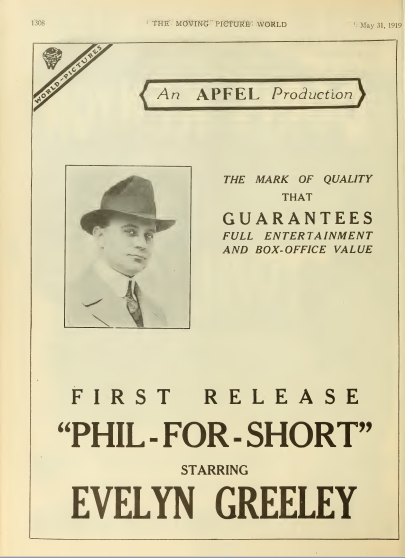
Directed by Oscar Apfel, the Mark of Quality...


A Nasty Woman?


Inspired by a remark made by the grandson of a one-time Yukon bordello owner, there has been an ongoing project to research and revive interest in unsung women filmmakers who broke new ground in the early years of cinema.


One of the outputs is a magnificent new box set from Kino which includes this film and 98 others. It’s out in August and it’s on my Christmas list if anyone’s thinking of a gift?


I wouldn’t say that Phil is a nasty woman though but she is a liberated one. Imagine how good it felt to watch her in 1919 newly enfranchised and with new choices starting to open up.


PS You can find out more about Nasty Women on the Women Film Pioneers Project website.


There's also a piece about Phil and other NW films from project co-director Maggie Hennefeld, also of the University of Minnesota, on the Flow Journal site.


*Silent Women: Pioneers of Cinema (Supernova Books, 2016), Melody Bridges, Shelley Stamp et al.

Friday, 8 October 2021

An education... The Public Prosecutor and the Teacher (1948)/Phil for Short (1919), Le Giornate 40th Edition Streaming, Day Five and Six

Evelyn Greeley has some questions...


If people chose to see wrong and evil in aesthetic beauty then there’s something wrong with them!


Catching up on the last two days of online Giornate, there’s a common thread of judge not let you too be judged or at least read the book not just the cover. Whether it’s Korea in 1945 or the USA in 1919, people are all too willing to think the worst of others based on appearances and it’s only those who look deeper who make themselves and others happier.


Day Five: The Public Prosecutor and the Teacher (1948)

After liberation from Japanese colonial control in August1945, filmmakers in Korea still made silent films with a shortage of equipment meaning that half the films of this period were effectively silent or, in the case of The Public Prosecutor and the Teacher (1948), interpreted by a byeonsa – a more improvisational version of the Japanese benshi, here Sin Chul described by Jay Weissberg, artistic director of Giornate del Cinema Muto, as the last of the great practitioners working up to the 1980s.


Lee Yeong-ae also wants to know the answers


The story feels a little similar to other Korean films I’ve seen from this time but is none-the-less still affecting and well constructed. It’s not a classic but it is not only representative of the cinema of the newly liberated country but also shows the performance ability of the actors. The MVP here is Lee Yeong-ae who plays the titular teacher, Choi Yang-chun, and rightly gets the most screentime. As the school is kind hearted and morally brave, offering help to one of her poor students, Min Jang-son who lives in poverty with his ailing grandmother.


As well as feeding the young man and encouraging his studies, she takes an interest in his home life, helping to keep his greedy landlord at bay as well as feeding his gran. No doubt without her assistance he would be lost and when she suddenly has to leave the school he is distraught until she gives him a savings book and the money to carry on his studies. She leaves without knowing that his grandmother has just died but she has given him a lifeline…


The teacher and the murderer


A decade later she lives with her husband in another part of Seoul and bumps into Su-dong, an acquaintance of Min who is a baker. He tells her that, last he knew, Min had continued his studies and had qualified as a lawyer but that he hadn’t seen him for years. Then Choi meets a young girl who is crying as she has lost her father and once again she looks after the child.


Then a murderer escapes prison and finds his way to Choi’s house when  her husband is away, again she calms herself and tries to help him on the promise he gives himself up after seeing his daughter – the same girl she found in the streets.


After the man is arrested the locals gossip and somehow manage to blame Choi and he returning husband feels shamed and threatens her with a knife only to trip and kill himself. She’s charged with murder and, finally, reunites with Min (Kim Dong-min) this time in his role as a prosecutor….


Kim Dong-min


Such melodramas were very popular in Korea and developed very stylistically to suit local tastes – as everywhere. The story arc is satisfying and Lee Yeong-ae is excellent as the kind of teacher we all need and there’s a constant focus on schoolyards full of the next generation. Education and second chances would be vital over the coming years.


Day Six: Phil for Short (1919) with José Marìa Serralde Ruiz

Oh, my husband’s all right – but he’s not vital.


Talking of education… there’s teachers, schools and disagreeable neighbours in this thoroughly daft but enjoyable film which, despite being censored for being too nice according to Nasty Women curators Maggie Hennefeld and Laura Horak, also managed to offend Variety who’s reviewer condemned it as a “a sissy play, too nice for our boys; we want them to be manly,” after a local screening attended by a Boy Scout troop in Wilmette, Illinois. What would our Robert Baden-Powell have said? I do hope he saw the film.


Evelyn Greeley and Hugh Thompson


Directed by Oscar Apfel it features a scenario from Clara Beranger – another American woman silent film writer - and Forrest Halsey and is a delightful comedy about old fashioned responses to the ancient ideas of Greek freedoms of movement, thought and free will (gosh). The moral majority base their highground on the old days but they’re completely at a loss in explaining away the really old ways…


But as Maggie and Laura say, it’s not boys but girls who dress up as boys who disrupt the sexual norms in this film, this chiefly being Damophilia Illington – call me Phil for short* – played by the wonderfully energetic Evelyn Greeley.

* Wouldn’t you rather be called Phil than Damn?


Phil’s so-called after a poem by the much misunderstood Sappho (yes, she was…) who as Hennefeld and Horak point out was oft sourced for silent films as part of a general attraction  to Greek literature with the precise hidden depths that the Old Fogey’s object to here. As with “Greek Deployments” by the likes of DeMille, there’s an excuse for under-the-counter meaning and shorter frocks justified in the name of higher art.


This film plays with so many angles and Greeley is wonderfully peppy, hardly pausing for breath justifying her love of Greek movement and expression or deciding on cross-dressing as her own “twin” to escape from her overbearing – would be husband – her late father’s doctor and a man old enough to be her censor.


She meets a classics teacher “woman-hater” John Alden (Hugh Thompson) who is just female phobic, as a boy and then cross-dresses again as his twin Phil… to assist him in connecting with his female students and in the hope of connecting more intimately with him…


It’s not as frankly sexual as say Ossi Oswalda in Lubitsch’s I Don’t Want to be a Man (1918) but it is a surprisingly forward American film and very entertaining too. I’d loved to have been in the audience for a screening in the bible belt circa 1920 0r even 2020…


As with Ossi, Greeley is in control throughout, or at least driving her own agenda in a world full of closed and confused male minds. That’s not “naughty”, it’s liberating!!


They don't stand a chance!!