Showing posts with label Clara Beranger. Show all posts

Tuesday, 26 July 2022

Classical comedy... Phil-for-Short (1919), with John Sweeney, BFI


Oh, my husband’s all right – but he’s not vital.


These notes are based on my introduction to the screening of this film on 17th July, I’d like to thank the BFI for the opportunity, John Sweeney for his amazing accompaniment and the audience for not booing me off stage. A splendid time was had by all.


Women's films were changing


This film was released on 2nd June 1919, just two days before Congress passed the 19th Amendment in the US which finally granted some women the right to vote and could be seen as part of a broader trend of films that focused on female stars taking charge of their own destiny.


Cinema had always had tomboys with Mary Pickford and others not just cheeking the men but outwitting them but there was a definite moment being created after the Great War opened up a new drive for relative equality. Films such as Come out of the Kitchen, The Amateur Adventuress and the entire oeuvre of Texas Guinan showed more confident leads actively taking on men at their own game and leading their own agendas.


Famously, there were more women working in Hollywood in 1916 than 2016*, over half of silent films were written by women and there were more directors, not just Lois Weber, Mabel Normand and Nell Shipman. It wasn’t to last after male corporatisation led to the establishment of the Hollywood we all know; Universal, once home to 30 female directors, didn’t have another woman director after Weber left in 1919, until 1982…
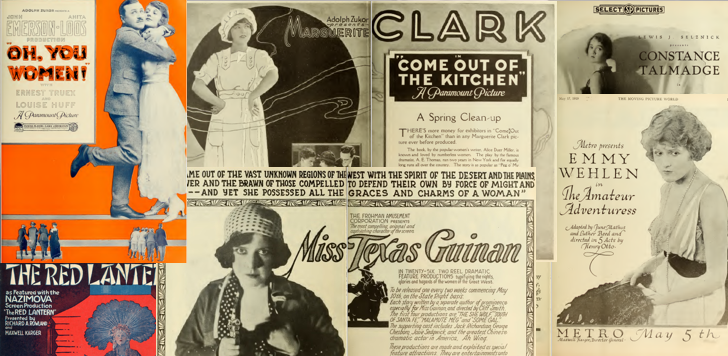
      

Summer releases in 1919


Clara Beranger


It needs no cursory glance at the current releases and those of even six months ago to prove that there are more writers among the feminine sex than the male persuasion. The heart throb, the human interest note, child life, domestic scenes and even the eternal triangle is more ably handled by women than men because of the thorough understanding our sex has of these matters…

Moving Picture World, 24th August 1918


Clara Beranger co-scripted Phil-for-Short with Forrest Halsey and was a fierce proponent of women’s role in the industry for the reasons outlined above.  Not only were more women watching films at this point, but the industry relied on their input.


Clara was able to peruse her own agenda and she also scripted Miss Lulu Bett (1921), screened last month at the BFI and another film tackling the role of women post war and suffrage. Both Lulu and Phil ultimately decide their own course of action and they are true to themselves.


Clara Beranger in 1918


Evelyn Greeley


The studio PR suggested that Evelyn was the most proposed-to woman in America? Well, she may or may not have been but she was married three, possibly four times in the end. Her past is obscured by the usual studio hype but she was certainly not an all-American girl having been born in Austria before emigrating with her family aged ten.


She began on stage before small roles in short films from 1914 onwards – she was 25 – before being signed up from 1917-19 by the World Film Corporation with whom she featured mainly alongside Carlyle Blackwell up to Phil-for-Short, billed as her first solo starring role. Her final film was in 1922 with Blackwell, Bulldog Drummond, after which she retired with the first of those husbands presumably to start a family.


She’s very good in this film though, energetic and very naturalistic, greeting every misfortune with a pause and then a smile as she figures out a countermeasure. The education she has been provided by her academic father seems to have not only informed but enlightened her approach; she’s a woman of action, decisive and morally courageous.


Whilst reviews seem to have been mixed, but no one seemed to complain about her ability.


Evelyn Greeley hiding from proposals...

I don’t want to be a man?


One of the reasons for negativity is almost certainly the fact that Phil by name means Phil by nature. Evelyn dresses as a boy for a good portion of the film and initially out of necessity as she has to pick up the responsibility for keeping the family farm running. Later she disguises herself as a boy in a bid to escape the local moral majority and to solve certain romantic difficulties.


This was definitely a challenge for some, with Variety, according to Nasty Women curators Maggie Hennefeld and Laura Horak, condemning it as a “a sissy play, too nice for our boys; we want them to be manly,” after a local screening attended by a Boy Scout troop in Wilmette, Illinois. What would our Robert Baden-Powell have said? I do hope he saw the film.


Possibly the filmmakers saw Ossi in drag in Lubitsch’s cheeky, I Don’t Want to be a Man (1918) but there’s no way an American film could be as daring… and whilst this is hardly the only example of cross-dressing in early Hollywood, Phil is a challenge because of her sex and not sexuality.


I work like a boy, why shouldn't I dress like one?


Stronger woman, weaker men


Phil stands out as practical, inventive and a leader; all very male characteristics for the older generation. She has to deal with reality as her aged father is still buried in the myths and legends of his books and, lovely and liberating though he is, she works the farm and is happy to step up.


Then the man who takes her fancy, John Alden (Hugh Thompson, wonderful as a stuffed shirt), has decided he hates all women after discovering his fiancée was a gold digger.  He doesn’t know himself any longer but Phil, educated in the emotional meaning of classical philosophy, knows what to do. For what it’s worth, I don’t see John as emasculated just confused and bruised by his experience. More than anything he needs a friend like Phil who can manage his mood…


Then there's the more general complaint from John's sister, who's husband is "alright" just not "vital" with the meaning focused on his lack of vitality, not so much unmanly as submerged in manners and the day-to-day. Men need liberating too.


Charles Walcott and Hugh Thompson


High society and lower morality


Within the film as well as without there are some very old-fashioned responses to the ancient ideas of Greek freedoms of movement, thought and free will (gosh). The moral majority base their high ground on the old days but they’re completely at a loss in explaining away the really old ways… especially the aptly named McWrath family (emphasis on Wrath, nice one Clara!), Donald the village banker, corner stone of the church and his disapproving mother.


Outside of the village, Phil has to deal with John’s wealthy bourgeois family who, whilst they like her culture also have issues with an amoral violinist making merry with John’s sister and being the very epitome of a gaslighting womaniser.


Wherever she goes, Phil tries to find a way forward. A classical education needn’t be as bad as Britain’s Prime Minister has made it seem… and she is liberated in thought as well as action by the clear-sighted pursuit of moral balance.


The McWraths respond


Is it all Greek?


Phil’s so-called after a poem by the much-misunderstood Sappho who as Hennefeld and Horak point out was often referenced in silent films as part of a general attraction to Greek literature with the hints of her precise hidden depths that the Old Fogey’s object to here.


As with “Greek Deployments” by the likes of DeMille, there’s an excuse for under-the-counter meaning and shorter frocks justified in the name of higher art and here, whilst we do have dancing in diaphanous skirts, we also have Phil berating saucy male onlookers and Donald’s appreciative leer cut short by his mother’s disapproval. The hypocrisy of inappropriate male gazing is made clear and the dancing, whilst hardly balletic, is more about freedom than allure.


This film plays with so many angles and Greeley is wonderfully peppy, hardly pausing for breath justifying her love of Greek movement and expression or deciding on cross-dressing as her own “twin” to escape from unwanted suitors including her late father’s doctor - a man old enough to be her censor.


The search for beauty is perhaps the search for truth?


Moving Picture Classic, June 1919


Entertaining intertitles


I love the film’s witty intertitles and the design of the title cards is as deft as the film’s overall tone, overlaying text on images and the live action in a very effective way that doesn’t take you out of the action but smooths the flow. There’s wit and there’s wisdom and the BFI audience laughed with and not at… the sense of the moment still ruining true after 103 years.


Here’s why Phil is so called.


That joke isn’t funny anymore?


Critical opinion in the trade press was split and, as ever, the challenge for the modern viewer is to understand why.


It is too bad that Evelyn Greeley… did not lead off with a stronger picture… Miss Greeley has a pleasing personality and is a sufficiently accomplished actress, given the right sort of role, but only occasionally does she have the opportunity to appear at her best in this unconvincing story.

The Film Daily, 11th July 1919


This picture offers Miss Greeley splendid opportunities for her starring debut, and her natural ability will see her up the ladder of fame. Considerable ingenuity was exercised in compiling this scenario to fit the piquant charm and saucy roguishness of the new fledged star…This picture will please young people.

The Billboard, 7th June 1919


This is a thoroughly daft but enjoyable film but it succeeds precisely because of Greeley’s open-hearted playing. Phil is a real pick-you-up leaping every moral hurdle in a single bound and connecting comedically and emotionally.


John Sweeney enriched the film with his seemingly effortless array of classical lines mixed with the authentic moods of period and narrative that make his work so highly valued. As usual his improvisation fitted seamlessly with the orchestra on screen, from Phil’s dance and romance to the light and shade of the lightened drama. I’d previously only seen Phil on the small screen, streamed from last year’s silent festival in Pordenone, but this, this was the way to properly see and understand this charming production.
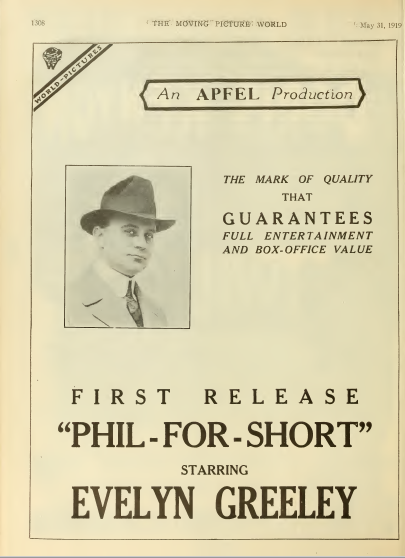
 

Directed by Oscar Apfel, the Mark of Quality...


A Nasty Woman?


Inspired by a remark made by the grandson of a one-time Yukon bordello owner, there has been an ongoing project to research and revive interest in unsung women filmmakers who broke new ground in the early years of cinema.


One of the outputs is a magnificent new box set from Kino which includes this film and 98 others. It’s out in August and it’s on my Christmas list if anyone’s thinking of a gift?


I wouldn’t say that Phil is a nasty woman though but she is a liberated one. Imagine how good it felt to watch her in 1919 newly enfranchised and with new choices starting to open up.


PS You can find out more about Nasty Women on the Women Film Pioneers Project website.


There's also a piece about Phil and other NW films from project co-director Maggie Hennefeld, also of the University of Minnesota, on the Flow Journal site.


*Silent Women: Pioneers of Cinema (Supernova Books, 2016), Melody Bridges, Shelley Stamp et al.

Sunday, 19 June 2022

A house is not a home... Miss Lulu Bett (1921), BFI


The family beast of burden, whose timid soul has failed to break the bonds of family servitude…


This film is an almost perfect exemplar of a Hollywood studio film of this period featuring a superb performance from Lois Wilson in the lead and smoothly satisfying direction from everyone’s third-favourite de Mille… William ranking behind his brother Cecil and then his daughter Agnes a hugely successful dancer who was not “pretty enough” for films but became a huge star on stage and then choreographed a dozen stage musicals revolutionising the genre over a long career.


Clearly, she was given the kind of encouragement from father William that is solely lacking in the Master of the Deacon house, Dentist and Justice of the Peace, Dwight (Theodore Roberts), who seems to treat his family as slaves, especially his sister-in-law Lulu. In its own quite gently comic way Miss Lulu Bett is as powerful as many more serious dramas with a story of a family drudge, run down not just by the domineering but also everyone else; a modern-day Cinderella five years before Colleen Moore’s Ella Cinders, but of a genre and a general situation many endured.


Ethel Wales, Lois Wilson and Milton Sills

Based on Zona Gale’s Pulitzer-prize winning play and bestselling novel with a screenplay by Clara Beranger, the film reflected Gale’s activism and concern with suffrage and women’s right to choose their own destiny. It was still commonplace for family hierarchies to leave the unmarried supporting their parents, I have this in my own story with a great grandmother looked after by her eldest daughter, Mabel. When my Nain married in the mid-1920s, Mabs, the elder sister, objected on the grounds that she should be wed first but her elder brother stepped in on our Jenny’s behalf. So, thank you Uncle Alec, without whom I wouldn’t be here.


As a member of the National Women’s Party, Gale lobbied for the 1921 Wisconsin Equal Rights Law and she was also an Executive Member of the Lucy Stone League which concerned itself with opportunities for women beyond the right to vote. A century on it’s hard to understand some social attitudes although perhaps a lot less difficult after the last five years…


Theodore Roberts is shocked, shocked I tell you!

Back to the film…. everyone has written Lulu off – destined for spinsterhood and chained to the household chores. Lois Wilson is a revelation, emoting in an understated way and carrying a lot of subtle meaning. This is the only film I’ve seen her in and watching it for the second time – the first at an excellent Kennington Bioscope weekender in the before times – you appreciate more of the seamless directorial skill and Wilson’s ability to hold not only the narrative but our belief together. She gives her character strength and the willingness to repay her light-hearted and inconsiderate oppressors the benefit of the doubt. Driven by duty and her own sense of honour she’s also just waiting for an opportunity to re-join the World outside the kitchen.


Dwight sets the tone but Lulu’s half-sister Ina (Mabel Van Buren) does nothing to help her, not so much a wicked stepsister as a lazy one. Their mother, Grandma Bett (Ethel Wales) is no better, dodging her duties as easily as she deflects Dwight’s supposed dominance, usually by stomping off out of range. The Brett’s two daughters also have their own techniques for avoiding the bully’s blasts, youngest Monona (Mae Giraci) is far too quick for the old man, feigning deafness and fading from view when it suits whilst Di (Helen Ferguson) is the apple of his eye, being, unlike her spinsterish aunt Lulu, eminently marriable. The only problem is that Dad has eyes on more socially advanced suitors than Di’s boyfriend Bobby Larkin (Taylor Graves).


Lulu listens intently to tall tales

Lulu has to suffer a thousand unkind cuts from Dwight, she’s both relied upon to cook and clean whilst at the same time blamed for being too useless to get married. It’s no joke but never say never… Lulu’s chance comes in the unlikely form of Dwight’s likeable blow-hard of a brother Ninian (Clarence Burton) who returns from a supposedly action-packed World tour and regales the family and their friends with stories of daring do. Lulu is by this stage transfixed after Ninian shows her just the slightest kindness yet even this is inspired by the family friend, teacher Neil Cornish (Milton Sills) who is the one to ask where she is and looks on in despair when Lulu swallows the big fat fibs.


Ninian takes Lulu, Dwight and Ina for a meal and makes a joke of asking her to marry him by slipping a cigar band around her figure as she jokingly promises to honour and obey. Only trouble is, Dwight’s a JP and, therefore, they had accidentally had a proper ceremony and are now man and wife. Ninian’s up for giving it a go and Lulu takes the chance too, feeling there’ll be no other.


She moves in with her “husband” but a few days later he reveals that he’s already married to a woman who left him years ago and whilst he’s not sure is still alive, there’s a big chance she will be. That’s big of Ninian and it’s also big of Lulu that she puts principle first and reluctantly returns “home”.


Milton Sills ain't fooled

Now things really kick off as she discovers the house in a mess and the family bickering over chores… you’d think they’d be pleased to see her but no, she’s putting Dwight’s reputation at risk and has to accept the blame and the ignominy of being rejected by her husband after just one week. Yet Lulu discovers new depths: “The only thing I’ve got left is my pride and you’ve got to let me keep that…” and she works upwards from there.


There are superb performances not least from Theodore Roberts who would have been a shoo-in for Best Cigar-Chomping, Blood-Vessel-Busting Oscar had they been invented at this point, whilst Milton Sills is a steadfast lead with future salvation written all over him. But it’s Lois Wilson who wins out and she’s great value for a story that makes it’s point without getting too improbable of tiresome… we’re all for Lulu and, as the poet said, you’ve got to hope for the best and that’s the best you can hope for and Lulu Betts does not disappoint with an uplifting ending that blows the roof off!!


The film is available on Blu-ray from Grapevine and is online too if you peruse YouTube. Great to see it getting this screening in London though.


Friday, 8 October 2021

An education... The Public Prosecutor and the Teacher (1948)/Phil for Short (1919), Le Giornate 40th Edition Streaming, Day Five and Six

Evelyn Greeley has some questions...


If people chose to see wrong and evil in aesthetic beauty then there’s something wrong with them!


Catching up on the last two days of online Giornate, there’s a common thread of judge not let you too be judged or at least read the book not just the cover. Whether it’s Korea in 1945 or the USA in 1919, people are all too willing to think the worst of others based on appearances and it’s only those who look deeper who make themselves and others happier.


Day Five: The Public Prosecutor and the Teacher (1948)

After liberation from Japanese colonial control in August1945, filmmakers in Korea still made silent films with a shortage of equipment meaning that half the films of this period were effectively silent or, in the case of The Public Prosecutor and the Teacher (1948), interpreted by a byeonsa – a more improvisational version of the Japanese benshi, here Sin Chul described by Jay Weissberg, artistic director of Giornate del Cinema Muto, as the last of the great practitioners working up to the 1980s.


Lee Yeong-ae also wants to know the answers


The story feels a little similar to other Korean films I’ve seen from this time but is none-the-less still affecting and well constructed. It’s not a classic but it is not only representative of the cinema of the newly liberated country but also shows the performance ability of the actors. The MVP here is Lee Yeong-ae who plays the titular teacher, Choi Yang-chun, and rightly gets the most screentime. As the school is kind hearted and morally brave, offering help to one of her poor students, Min Jang-son who lives in poverty with his ailing grandmother.


As well as feeding the young man and encouraging his studies, she takes an interest in his home life, helping to keep his greedy landlord at bay as well as feeding his gran. No doubt without her assistance he would be lost and when she suddenly has to leave the school he is distraught until she gives him a savings book and the money to carry on his studies. She leaves without knowing that his grandmother has just died but she has given him a lifeline…


The teacher and the murderer


A decade later she lives with her husband in another part of Seoul and bumps into Su-dong, an acquaintance of Min who is a baker. He tells her that, last he knew, Min had continued his studies and had qualified as a lawyer but that he hadn’t seen him for years. Then Choi meets a young girl who is crying as she has lost her father and once again she looks after the child.


Then a murderer escapes prison and finds his way to Choi’s house when  her husband is away, again she calms herself and tries to help him on the promise he gives himself up after seeing his daughter – the same girl she found in the streets.


After the man is arrested the locals gossip and somehow manage to blame Choi and he returning husband feels shamed and threatens her with a knife only to trip and kill himself. She’s charged with murder and, finally, reunites with Min (Kim Dong-min) this time in his role as a prosecutor….


Kim Dong-min


Such melodramas were very popular in Korea and developed very stylistically to suit local tastes – as everywhere. The story arc is satisfying and Lee Yeong-ae is excellent as the kind of teacher we all need and there’s a constant focus on schoolyards full of the next generation. Education and second chances would be vital over the coming years.


Day Six: Phil for Short (1919) with José Marìa Serralde Ruiz

Oh, my husband’s all right – but he’s not vital.


Talking of education… there’s teachers, schools and disagreeable neighbours in this thoroughly daft but enjoyable film which, despite being censored for being too nice according to Nasty Women curators Maggie Hennefeld and Laura Horak, also managed to offend Variety who’s reviewer condemned it as a “a sissy play, too nice for our boys; we want them to be manly,” after a local screening attended by a Boy Scout troop in Wilmette, Illinois. What would our Robert Baden-Powell have said? I do hope he saw the film.


Evelyn Greeley and Hugh Thompson


Directed by Oscar Apfel it features a scenario from Clara Beranger – another American woman silent film writer - and Forrest Halsey and is a delightful comedy about old fashioned responses to the ancient ideas of Greek freedoms of movement, thought and free will (gosh). The moral majority base their highground on the old days but they’re completely at a loss in explaining away the really old ways…


But as Maggie and Laura say, it’s not boys but girls who dress up as boys who disrupt the sexual norms in this film, this chiefly being Damophilia Illington – call me Phil for short* – played by the wonderfully energetic Evelyn Greeley.

* Wouldn’t you rather be called Phil than Damn?


Phil’s so-called after a poem by the much misunderstood Sappho (yes, she was…) who as Hennefeld and Horak point out was oft sourced for silent films as part of a general attraction  to Greek literature with the precise hidden depths that the Old Fogey’s object to here. As with “Greek Deployments” by the likes of DeMille, there’s an excuse for under-the-counter meaning and shorter frocks justified in the name of higher art.


This film plays with so many angles and Greeley is wonderfully peppy, hardly pausing for breath justifying her love of Greek movement and expression or deciding on cross-dressing as her own “twin” to escape from her overbearing – would be husband – her late father’s doctor and a man old enough to be her censor.


She meets a classics teacher “woman-hater” John Alden (Hugh Thompson) who is just female phobic, as a boy and then cross-dresses again as his twin Phil… to assist him in connecting with his female students and in the hope of connecting more intimately with him…


It’s not as frankly sexual as say Ossi Oswalda in Lubitsch’s I Don’t Want to be a Man (1918) but it is a surprisingly forward American film and very entertaining too. I’d loved to have been in the audience for a screening in the bible belt circa 1920 0r even 2020…


As with Ossi, Greeley is in control throughout, or at least driving her own agenda in a world full of closed and confused male minds. That’s not “naughty”, it’s liberating!!


They don't stand a chance!!
